
SOLUTIONS TO TEXTBOOK NUMERICAL
EXERCISES AND ANALYTICAL PROBLEMS
Numerical Exercises
11. a. The expected return to Uninvest is
b. The standard deviation of the return to Uninvest is

b. Expansion today; recession next year:
d. Expansion today; expansion next year:

13. a.
14. a.
d. The alternative security has a return (which equals its expected return)
of
15. a. Buy security A because its expected return is higher and there is no
Analytical Problems
17. If the risk to all your securities increases, you are now holding securities
18. Investors pay attention to economic data releases because the data tell
ADDITIONAL TEACHING NOTES
Current Yield versus Dividend Yield
Some people use the term current yield when they are referring to a debt
security and they use the term dividend yield when they are referring to an
equity security. In both cases, the deHnition is the same— income divided by
initial value. We will use the term current yield for both debt and equity.
Additional Example of Calculating Expected Return
To illustrate how to calculate the expected return, we look at two examples.
First, consider a bond (debt security) issued by Safetyco, which pays $600 in
interest in one year on a $10,000 bond. If the bond pays the promised
interest and repays the principal amount of $10,000 so there is no capital
gain, it has a return of:
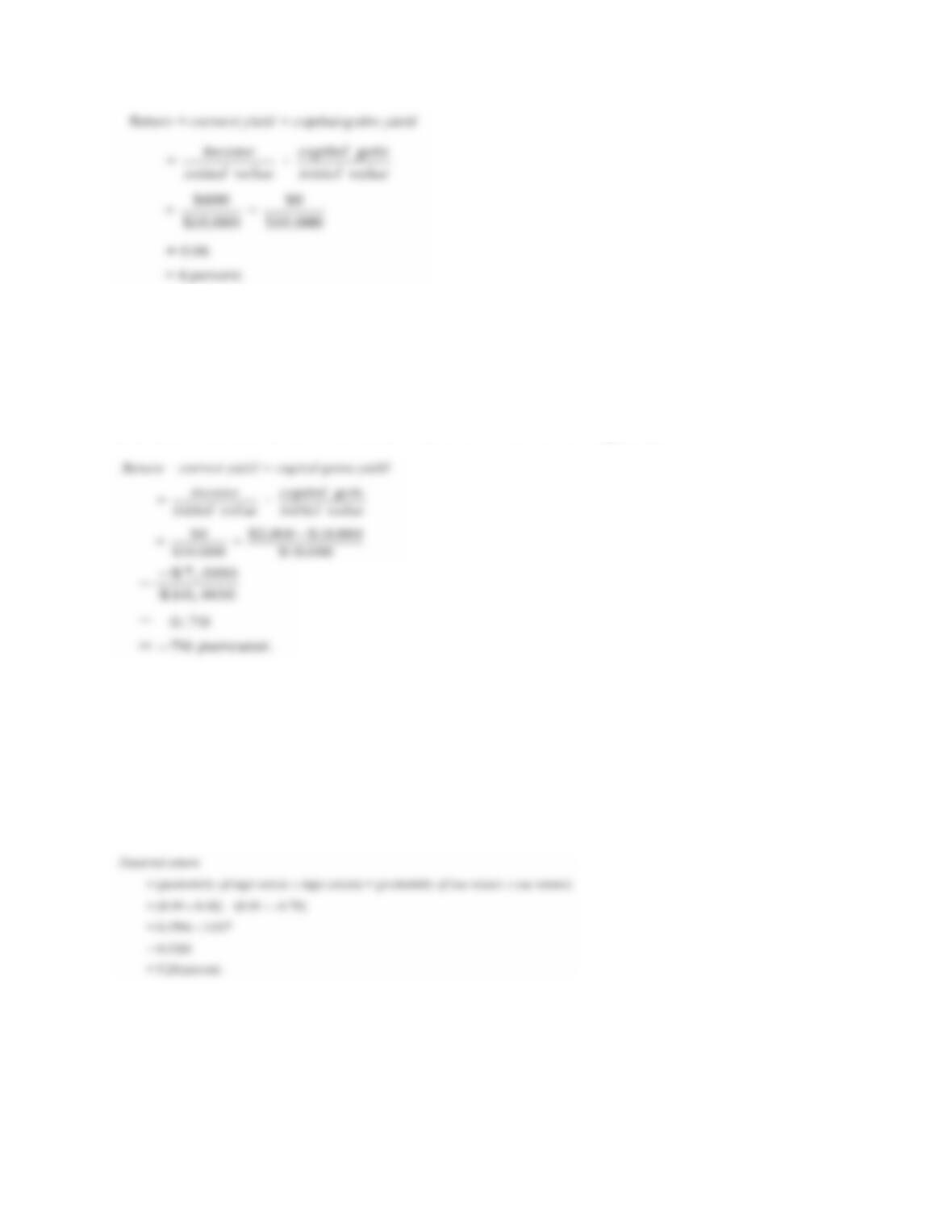
But, suppose there is a one percent chance that Safetyco will go bankrupt
during the year. When a company declares bankruptcy, the debt holders
often get back some portion, but not all, of their principal and the interest
that is owed to them. In this case, suppose an investor in a $10,000 Safetyco
bond gets only $3,000 of her principal back and loses the rest of her principal
and the interest due. The return to the investor is negative:
So, if an investor buys a $10,000 Safetyco bond, there is a 99 percent
chance she will have a return of 0.06 (or 6 percent) during the year, and a 1
percent chance she will have a return of −0.70 (or −70 percent). The
expected return to an investment in the Safetyco bond can be found by
multiplying each return by its probability and adding up the results. (Note
that the return and the probability should both be expressed in decimal
form.) The expected return to a Safetyco bond is:
Because there is a 1 percent chance that Safetyco will not pay the interest
and principal on its bonds, the expected return is below the 6 percent
promised return by about three quarters of one percentage point.
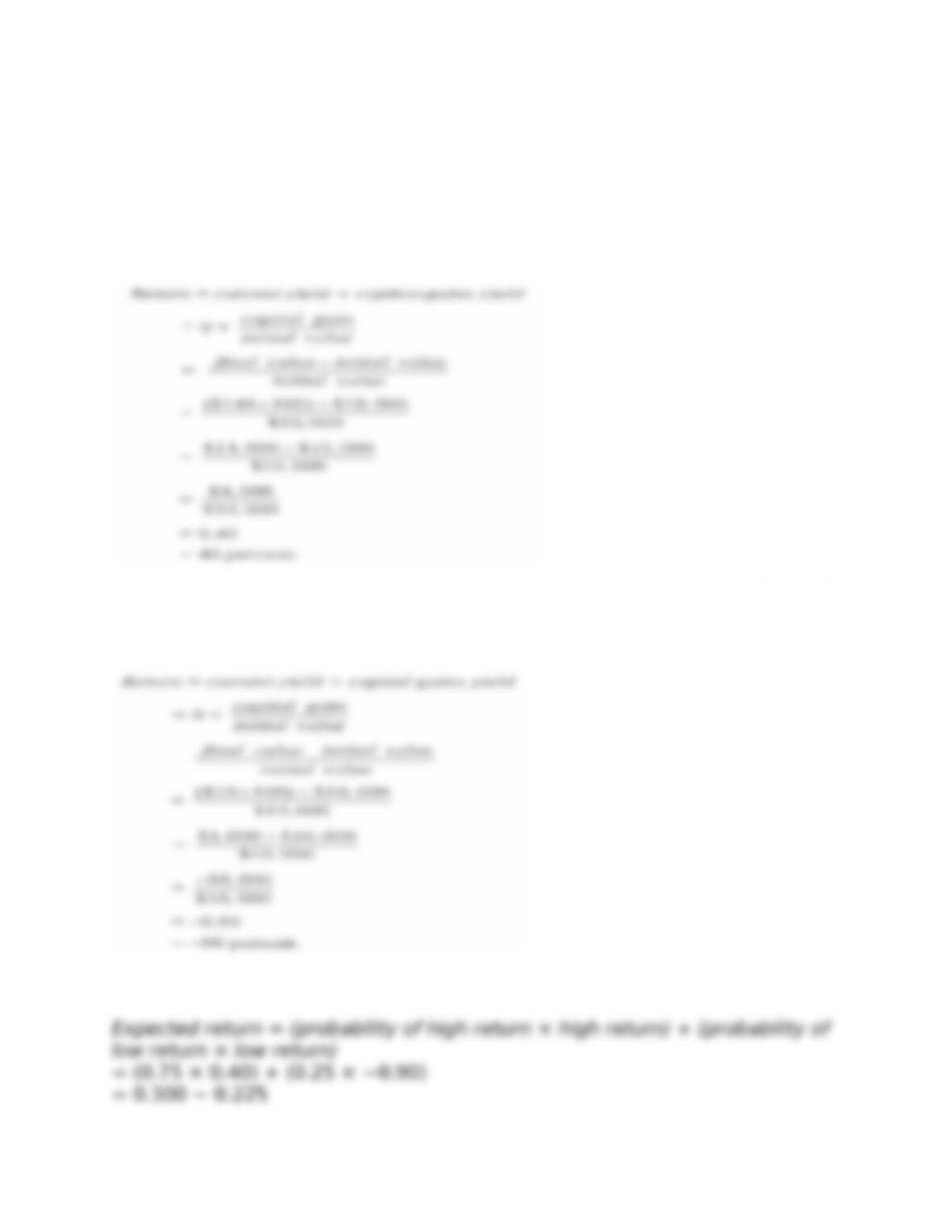
For the second example, consider stock (an equity security) issued by Riskco.
Suppose that the Riskco stock pays no dividend (so, its current yield is zero)
and its stock price is $100 per share today. Consider an investor who
purchases 100 shares at $100 per share, for a total investment of $10,000. If
Riskco’s main product is successful over the coming year, which has a
probability of 0.75 (75 percent), Riskco’s stock price will rise to $140 per
share. In this case, the return to 100 shares of Riskco’s stock is:
If Riskco’s main project is unsuccessful, which has a probability of 0.25 (or 25
percent), the stock price falls to $10 per share, a loss of $90 per share. The
return to a share of Riskco’s stock is then:
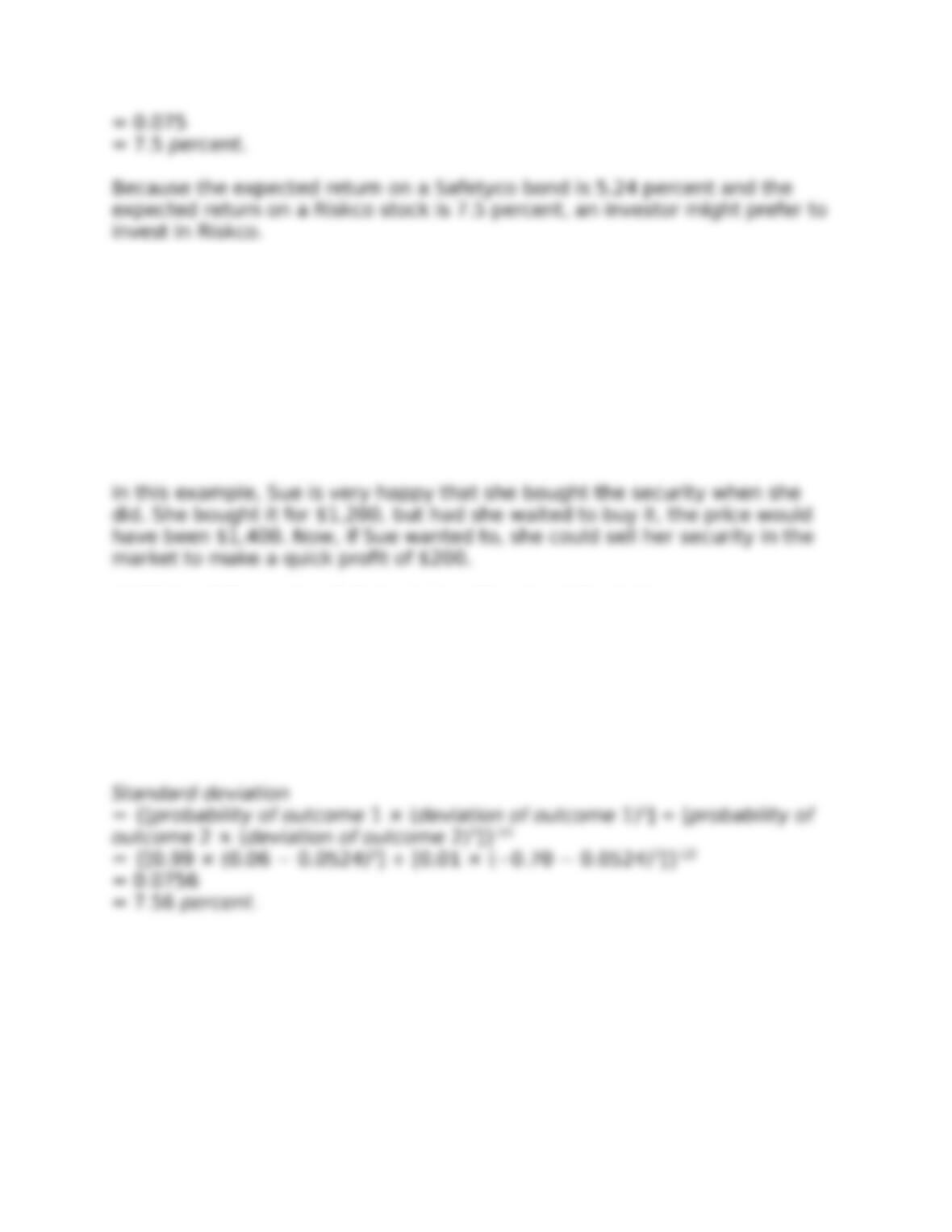
The expected return on a Riskco stock can be calculated as before:
Pro*ting from a Change in the Price of a Security
Suppose Sue buys a security today from Bill that promises to pay her $1,500
in one year and costs her $1,200 today. Sue made the transaction because
she thought that the equilibrium between supply and demand in the market
for such debt would occur at a price of $1,200. But suppose business Hrms
turn suddenly pessimistic because they fear that the economy will weaken.
As a result, the supply of debt securities declines. This change drives up the
price of the security today, and the bond price rises to $1,400.
Additional Example of Calculating Standard Deviation
Let’s return to our example of the Safetyco bond to calculate the standard
deviation of its return. There was a 99 percent chance (0.99) that a Safetyco
bond would return 6 percent (0.06), and a 1 percent chance (0.01) that it
would return −70 percent (−0.70), and we calculated that the expected
return was 5.24 percent (0.0524). The standard deviation of the return to a
Safetyco bond is:
For a stock in Riskco, we calculate the standard deviation in the same
manner. In this case, the probability of a poor return is higher and the poor
return is worse than with the Safetyco bond, so we would expect our
measure of risk to be higher. Let’s see if that is true. There is a 0.75 percent
chance of a return of 0.40, and a 0.25 percent chance of a return of −0.90,
so the expected return is 0.075, as we calculated earlier. So, the standard
deviation of the return to the Riskco stock is:
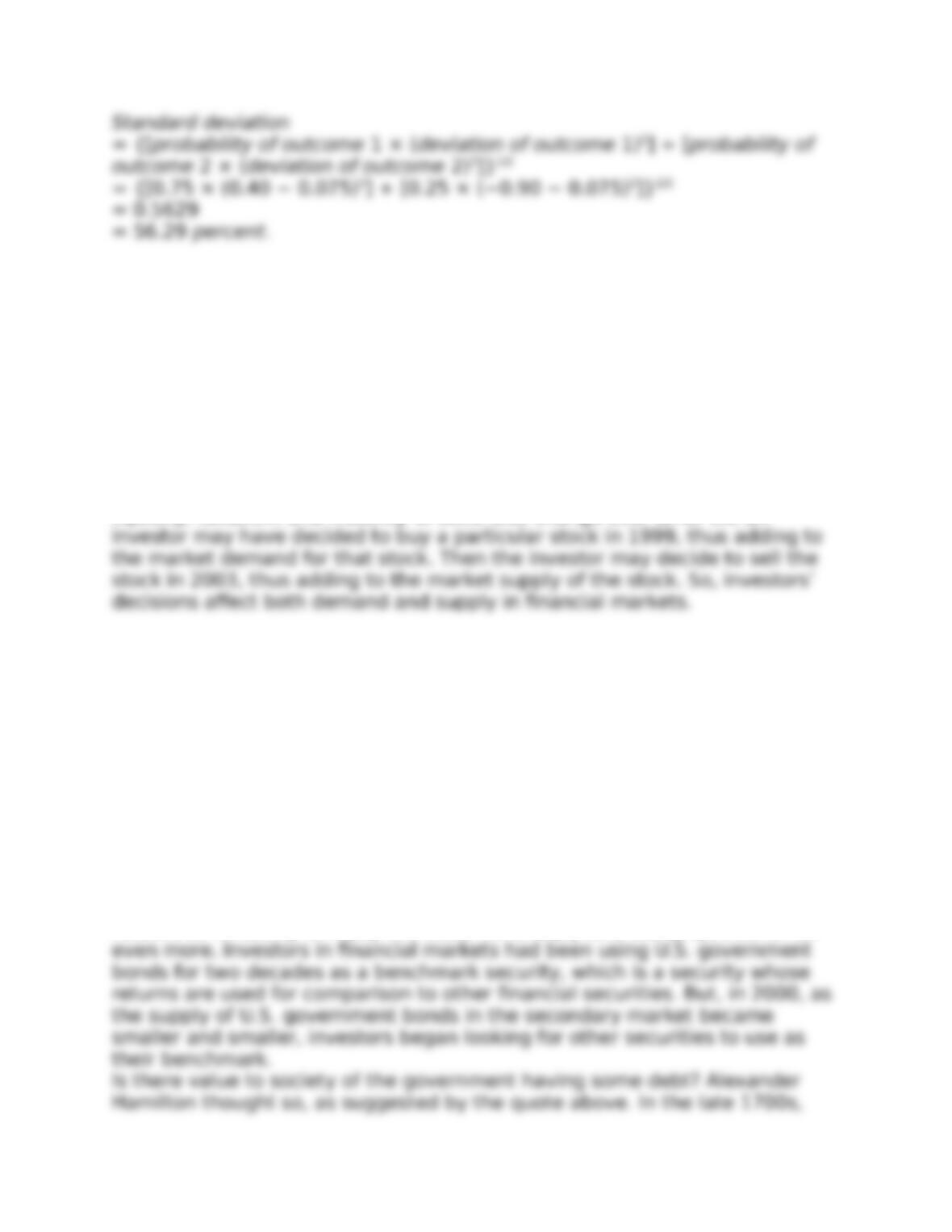
As expected, the standard deviation for a Riskco stock is signiHcantly higher
than the standard deviation for a Safetyco bond.
The standard deviation of the return to a security is a useful measure of risk.
When the standard deviation of one security’s return is higher than the
standard deviation of another, the Hrst security is riskier. Thus, a Riskco
stock is a riskier investment than a Safetyco debt.
Investors’ Decisions affect Supply and Demand
These portfolio decisions are not one-time choices because the return, risk,
liquidity, taxation, and maturity of securities change over time. So, an
ADDITIONAL POLICY ISSUE: SHOULD GOVERNMENT
DEBTS EXIST TO PROVIDE A LIQUID SECURITY?
“It is a well known fact, that in countries in which the national debt is
properly funded, and an object of established conHdence, it answers most of
the purposes of money.”
—Alexander Hamilton, U.S. Secretary of the Treasury, 1790
In the late 1990s, the U.S. government began running budget surpluses and
projected large future surpluses totaling trillions of dollars. In 2000, the
government began buying back some of its debt in Hnancial markets,
reducing the amount available to the public. The ratio of U.S. government
debt to the economy’s output (GDP), which measures a country’s debt
relative to its ability to repay the debt, fell sharply and was projected to fall
Hamilton, then U.S. Secretary of the Treasury, argued that government debt
was not a sign of Hnancial weakness, but rather was beneHcial because it
provided a convenient Hnancial security that paid interest, in the same way
that currency was a convenient Hnancial security that paid no interest.
Hamilton thought that government debt enhanced international trade by
providing interest on a merchant’s money balances and reduced the interest
rate because it provided liquidity. That is why Hamilton suggested that
The government debt increases the most during wartime, when large
expenditures must be Hnanced and the government usually does not want to
raise tax rates dramatically. The ratio of government debt to GDP rose
sharply in the 1940s as a result of World War II. After that, the debt-GDP ratio
declined fairly steadily until the 1970s. Government debt rose a bit in the
1970s, then increased sharply in the early 1980s as tax rates were reduced
but government spending was not reduced as much as taxes. But the mid- to
late-1990s brought faster economic growth and the amount of debt began to
decline relative to the size of the economy. And in 1999 and 2000, the debt
shrank dramatically.
Is there an optimal size of government debt? And is that optimal size
positive? To answer these questions, consider four reasons why government
debt may be good or bad. First, government debt may be good because the
government provides a safe, liquid security to investors. Second, government
debt may be good when the government borrows in bad times, which, as we
will see shortly, may help to stabilize the economy. Third, government debt
may be bad because it allows the government to be Hnancially irresponsible.
Fourth, government debt may be bad because its existence might reduce the
economy’s long-term growth rate.
The Hrst argument in favor of government debt is that it gives people a liquid
security that is free from default risk, thus making it a natural benchmark
security. In countries where the government debt is not very safe because
useful for this purpose as U.S. government bonds. Bonds issued by private
Hrms always have some default risk, more so if the worldwide economy is in
a recession. Bonds issued by the governments of other industrialized
countries might be good substitutes, but most people perceive that those
governments might default on such loans or that exchange rates might
change, causing the value of the bonds to change. Thus, alternative
benchmarks are risky.
The second argument in favor of government debt is that it allows the
government to borrow in bad times. Suppose, for example, that the United
States is in a recession but other countries are having an economic boom. It
The Hrst argument against government debt is that politicians will use the
debt to pay for projects that are not worthwhile, rather than having to pay for
them from current taxes. When taxes must cover the costs of government
spending, taxpayers feel the costs of such spending directly and thus may
oppose politicians’ attempts to spend too much. But, if politicians Hnance the
expenditures by borrowing, and if taxpayers do not understand the future
ramiHcations of the debt (which include higher future taxes), then politicians
Hnd it easier to increase government spending. Some economists believe
that this was the main cause of the large increase in U.S. government debt in
the 1970s and 1980s. It was not until strict Hnancing laws were enacted in
the late 1980s that the growth of government spending was Hnally curtailed.
The second argument against government debt is that government debt
causes economic growth to decline. This happens because if the government
borrows, interest rates may rise, so business Hrms will not borrow as much.
Consequently, they do not invest in as much plant and equipment. As a
result, the economy does not produce as much and economic growth is
lower. This notion has been debated Hercely by economists, and they remain
split on whether it is true or not. There continues to be much dispute over
how important government debt is for economic growth.
Historically, there have been many negative views of government debt. For
example, over 200 years ago, Adam Smith argued that debt has “. . .
gradually enfeebled every state which has adopted it” (p. 881). Smith noted
that many nations had been ruined Hnancially when they ran up debt: “. . .
the enormous debts which . . . oppress, and will in the long-run probably ruin
all the great nations of Europe . . .” (p. 863). And when it comes to debt, as
David Ricardo put it “That which is wise in an individual is wise also in a
nation” (p. 163), so governments should be no more willing to take on debt
than are individuals.

One other argument that is important to consider, concerns the
social-security system. The social-security system is set up to provide
retirement income to everyone in the country. Wage taxes on those who
work are used to provide beneHts to retirees. The system works well if there
is a balance of worker and retirees, but because of the baby–boom
generation, that balance is being tilted. For the Hrst few decades of this
century, there will be many more workers than retirees, and the amount of
money entering the social-security system will far exceed the outTow. In fact,
the extra funds coming into the social-security system are the main source of
the government’s overall surplus. But, what will happen later this century
when the number of retirees begins to grow dramatically as the baby
government surplus undesirable. Taxpayers would be better o? investing for
themselves rather than through the government.
So, we could face a dilemma. We would be happy if the U.S. government,
after thirty years of continuous budget deHcits, would Hnally stop borrowing
so much. But the magnitude of the surpluses could be so great that it would
cause problems by making the government debt disappear. Is there a
solution? Two possibilities seem promising. First, if the debt is disappearing
because economic growth is permanently higher, then it may be best to
reduce tax rates permanently. That is the approach that led to the cuts in tax
rates beginning in 2001. The problem with this solution, of course, is that if
the higher economic growth we have had in recent years is just temporary,
then we will face higher tax rates in the future. An alternative solution is for
the government to mimic what people do in their personal lives—buy durable
goods. When people become wealthier, they usually buy durable goods such
as houses and cars. When the government becomes wealthier, rather than
pay down its debt, it might be better o? spending the money on improving
the nation’s infrastructure—buildings, highways, schools, sewer systems, and
airports. Such expenditures would create beneHts for future generations and
would o?set the payments they would have make on the government debt
they inherit.
Recap
1. The existence of government debt has some value to the private sector.
2. Although balancing the government budget may seem desirable, it may
be better for the government to keep some amount of debt and adjust its
budget in other ways.
Additional Question
If you were a member of Congress, and you believed forecasts that suggest
that government surpluses will be large and rising in the future, would you
Answer
References
Hamilton, Alexander. Report on Public Credit, 1790. Published on the Web at
presspubs. uchicago.edu/founders/documents/a1_8_2s5.html.
Ricardo, David. The Principles of Political Economy. London: J.M. Dent and
Sons, Ltd., 1911; originally published in 1817.
Smith, Adam. The Wealth of Nations. New York: Modern Library, 1937;
originally published in 1776.