
ADDITIONAL ISSUES FOR CLASSROOM DISCUSSION
1. You may wish to revisit the academic debate of the late 1970s when the
rational expectations revolution was in full swing and the importance of
microeconomic foundations became clear. The two-period model
presented here was one of the rst types of dynamic models that
economists began to use following that debate. The model developed in
this chapter presents a basic framework, which can be used with
additional assumptions to explore more complicated issues.
2. If your students have all completed a course in intermediate
microeconomics or a principles course in which indi%erence curves were
used, you can introduce indi%erence curves here. In the text, we make a
very simple assumption about preferences in the example in which
people choose to consume an amount in the rst period equal to one-half
of the present value of income. This assumption was made for simplicity,
but is somewhat undesirable. So, if your students know about
indi%erence curves, you can do a lot more with the two-period model.
3. You may wish to expand on the discussion of the Ricardian equivalence
proposition. Economists have been debating the issue for some time,
with disagreement about its importance continuing to today. The nice
feature of the two-period model is that students can see how people
whose spending is a function of the present value of their income will not
be affected by a change in the timing of their income, with the present
value unchanged. But you may want to expand on all the ways in which
Ricardian equivalence may not hold, including considerations of
households that are credit constrained or who face uncertainty about
their incomes or about future taxes. Even if you spend a lot of time
discussing the exceptions, establishing Ricardian equivalence as a
benchmark is useful.
SOLUTIONS TO TEXTBOOK NUMERICAL
EXERCISES AND ANALYTICAL PROBLEMS
Numerical Exercises
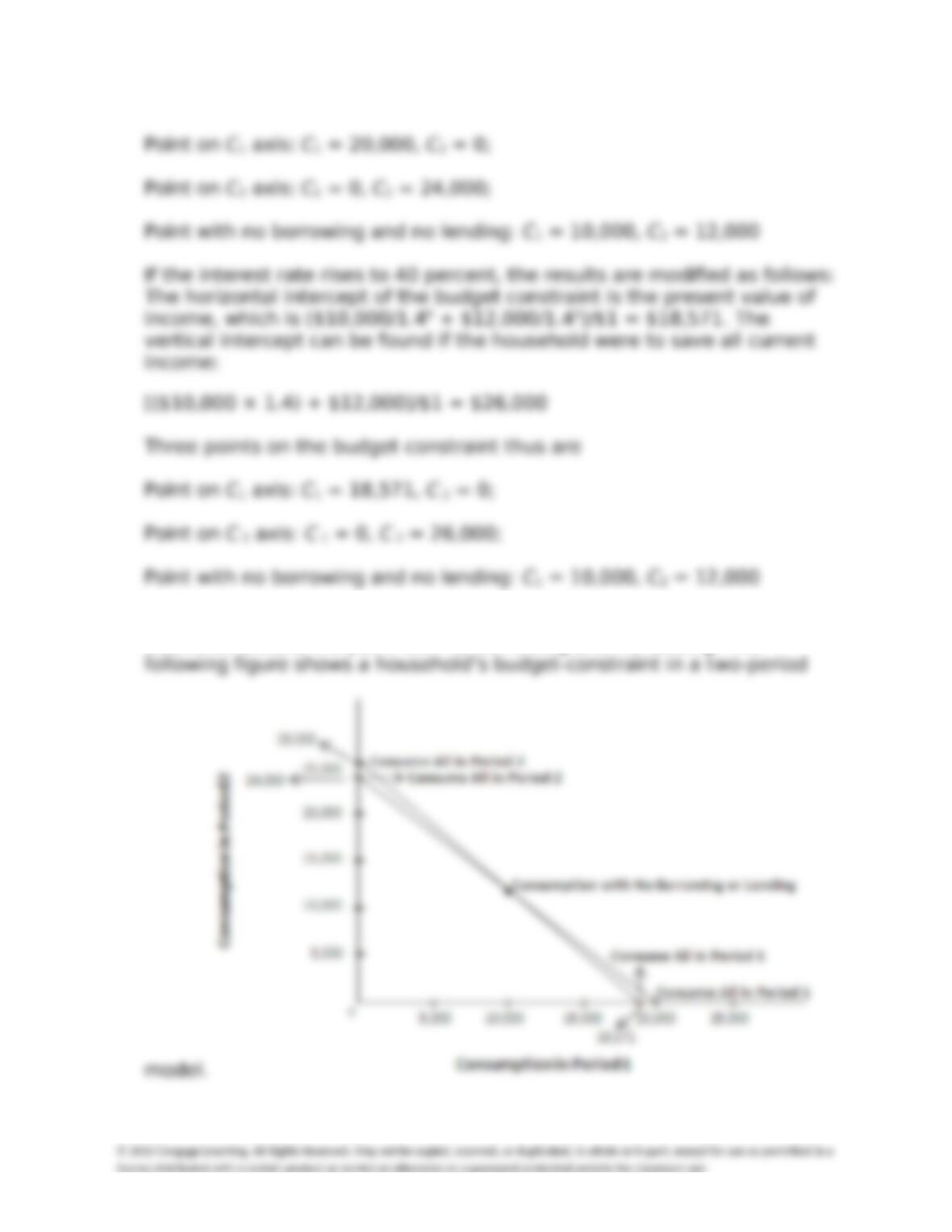
11. The horizontal intercept of the budget constraint is the present value
Chapter 13: Modern Macroeconomic Models 137
Thus, a higher interest rate causes the budget constraint to rotate
clockwise around the point with no borrowing and no lending. The
Chapter 13: Modern Macroeconomic Models 138
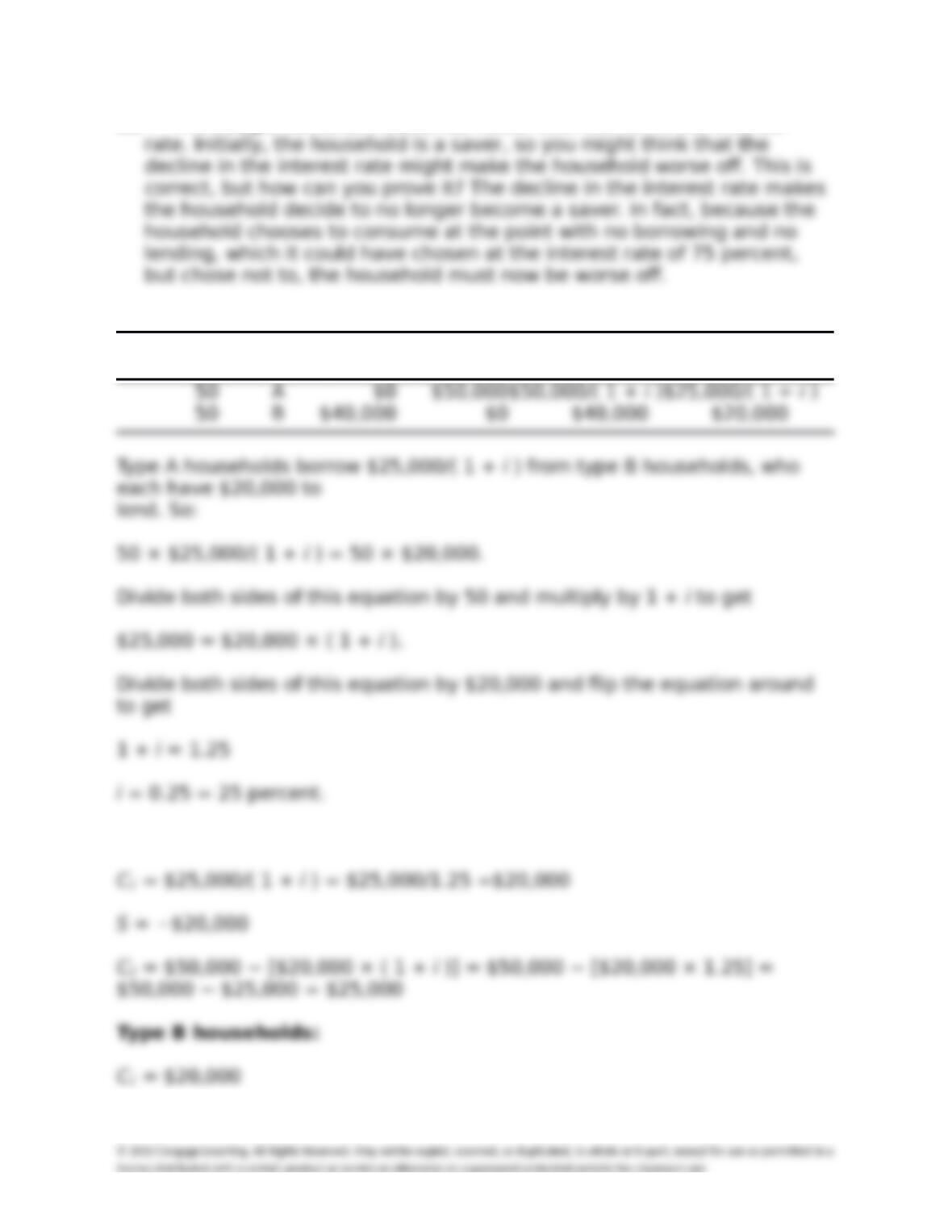
12. The budget constraint becomes >atter with the fall in the interest
13.
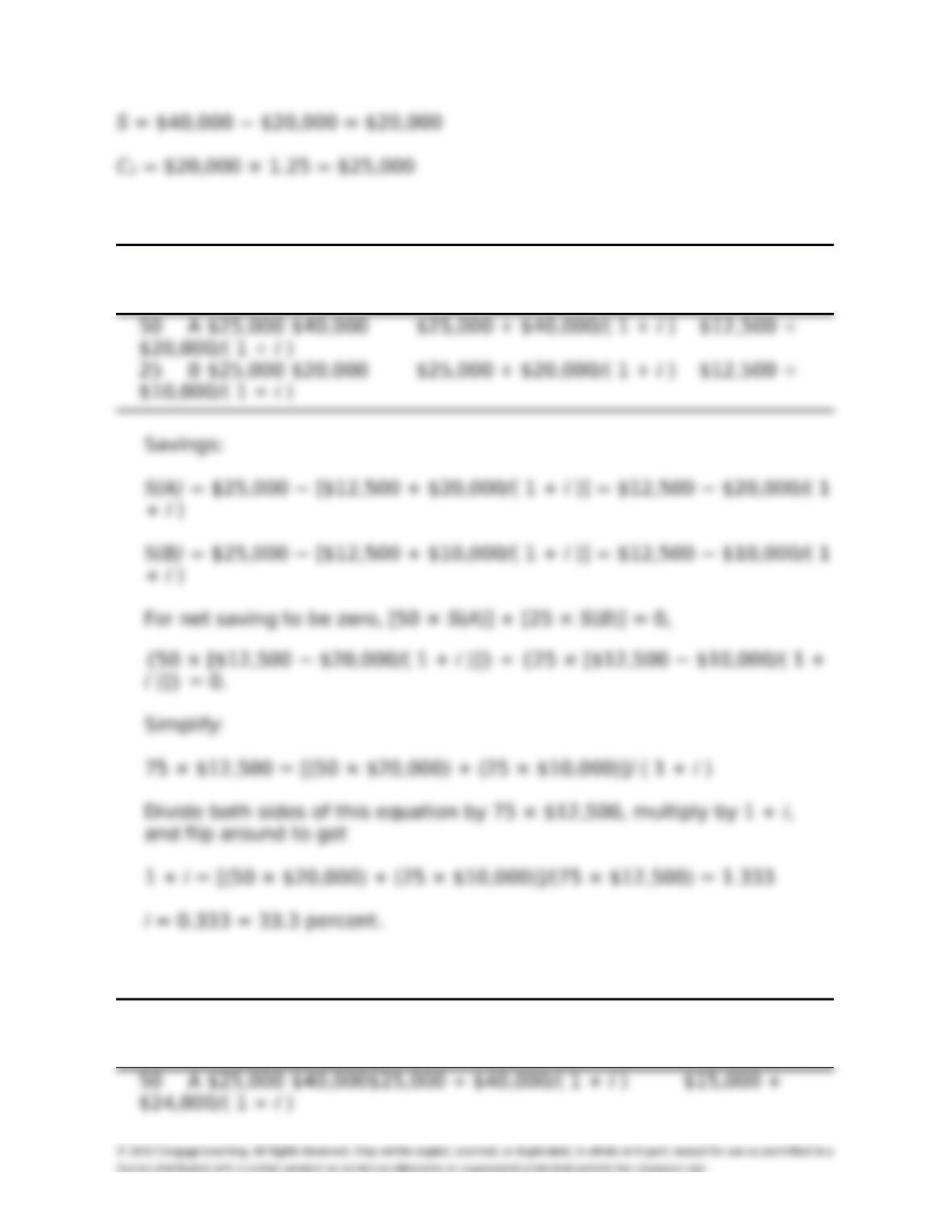
Households Period 1 Period 2Present Value C1
Income Income (Income)
Type A households:
Chapter 13: Modern Macroeconomic Models 139
14.
a.
Households Period 1 Period 2Present Value (Income)
C1
Income Income
b.
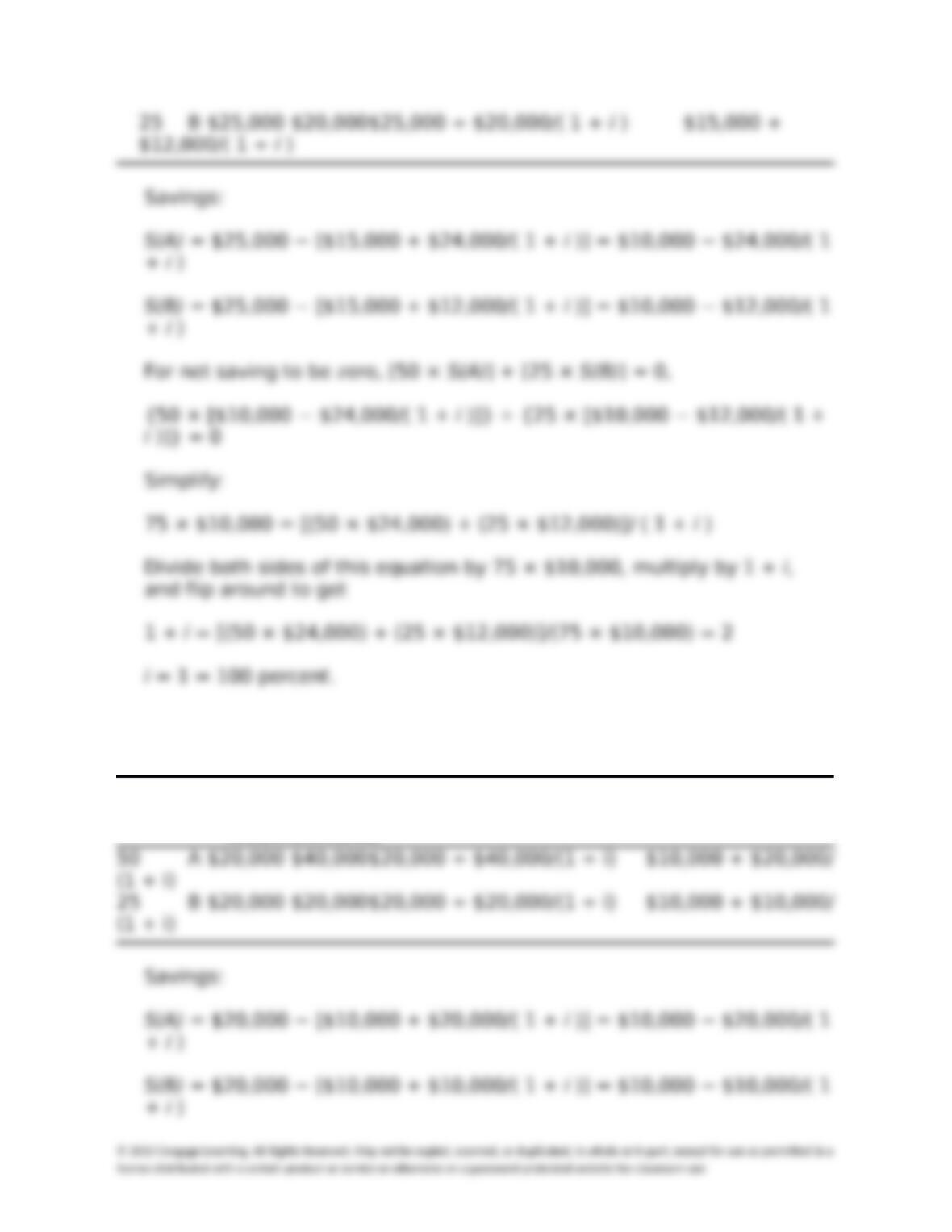
Households Period 1 Period 2Present Value (Income)
C1
IncomeIncome
Chapter 13: Modern Macroeconomic Models 140
This result shows that an increase in the desire for consumption
(impatience) yields a higher interest rate.
c.
Households Period 1 Period 2Present Value (Income)
C1
IncomeIncome
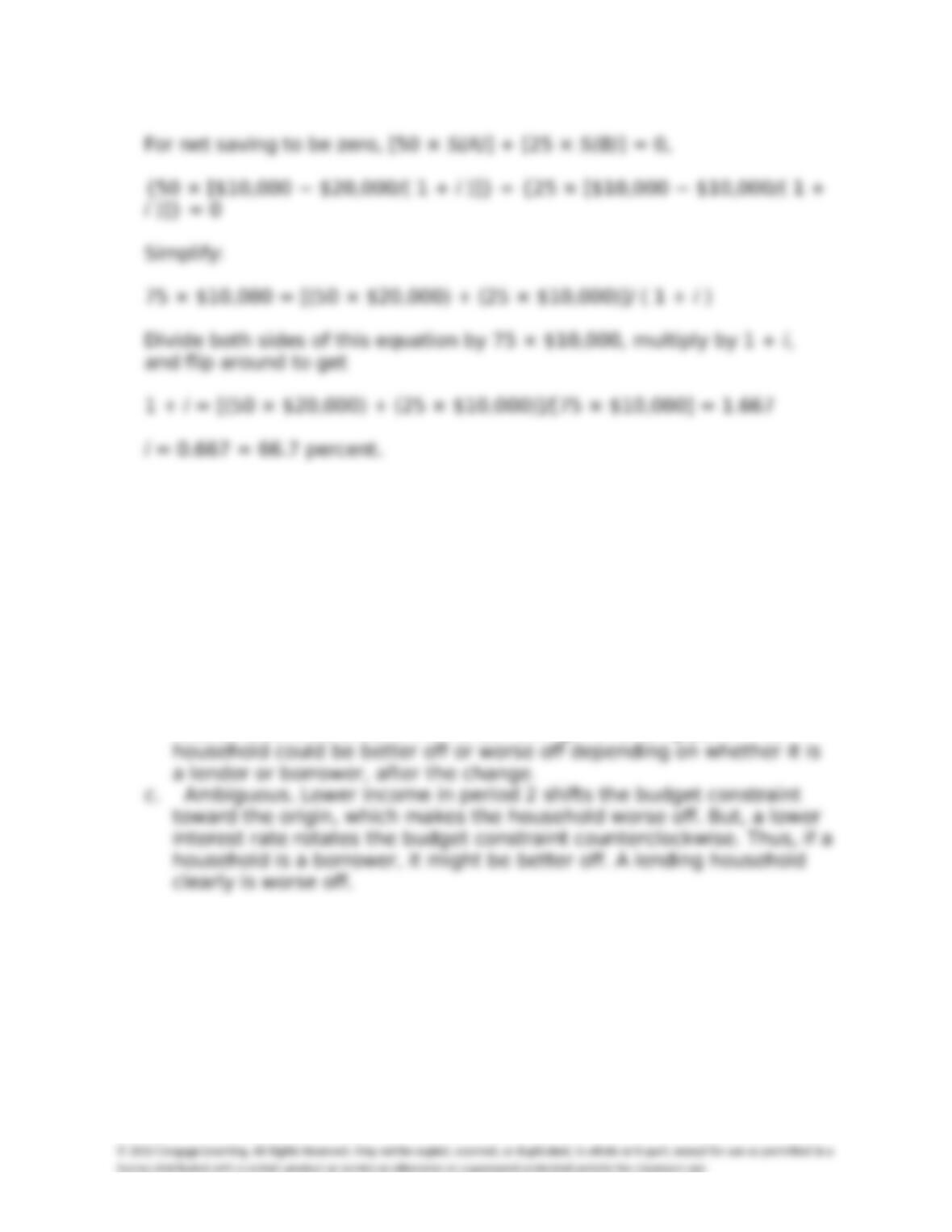
Chapter 13: Modern Macroeconomic Models 141
This result shows that lower income in period 1 by everyone increases
the desire for borrowing, which raises the interest rate.
Analytical Problems
15.
a. Worse o%. Lower income in period 1 means a lower present value of
income, so the budget constraint shifts toward the origin with the
same slope. The household is worse o% because it no longer can buy
the same amount of goods as before.
b. Ambiguous. When the interest rate is higher, the budget constraint
rotates clockwise around the no-borrowing, no-lending point. The
16.
a. Greater volatility in earnings from a small business means that the
household will increase its precautionary savings.
b. Increased wealth reduces precautionary savings.
c. Less need for spending leads to reduced precautionary savings.
17. With constant in>ation at 5 percent and no change in what monetary
policymakers do, your rational expectation of in>ation is 5 percent. If
they announce a 3 percent increase in the growth rate of the money

Chapter 13: Modern Macroeconomic Models 142
supply, your rational expectation is to increase your expected in>ation
rate by 3 percent, from 5 to 8 percent.
18. Higher income in period 1 shifts the budget constraint out, which makes
the household better o%. But, a lower interest rate rotates the budget
constraint counterclockwise. Thus, if a household is a borrower it would
be better o%. A lending household may be worse o%; the answer is
ambiguous and depends on how much the budget constraint shifts and