ADDITIONAL ISSUES FOR CLASSROOM DISCUSSION
1. Ask your students how often they go to the ATM to get cash. Did the ATM
model in the chapter change their views about how often to go? For
many people, given how low the interest rate is on bank accounts, the
model convinces them to go to the ATM less often and take out more
cash each time.
2. This is a good time to discuss the di”erence between endogenous and
exogenous variables in greater detail. Some students, especially those
with strong math backgrounds, seem to catch on to the concept readily,
while others have trouble understanding how a variable can be
exogenous in one model and endogenous in another. You may want to
explain it using a simple example, such as supply and demand. When we
talk about the determinants of the demand curve, we treat the price
level as exogenous and ask how demand is a”ected by changes in other
variables, which shift the curve with the price held constant. But, once
we have established how each variable shifts the curve, we add a
discussion of the supply curve, and see how the two curves together
determine the price, which is now an endogenous variable. Changes in
other variables that a”ect demand and supply shift a curve, leading to a
change in the price.
ANSWERS TO TEXTBOOK NUMERICAL
EXERCISES AND ANALYTICAL PROBLEMS
Numerical Exercises
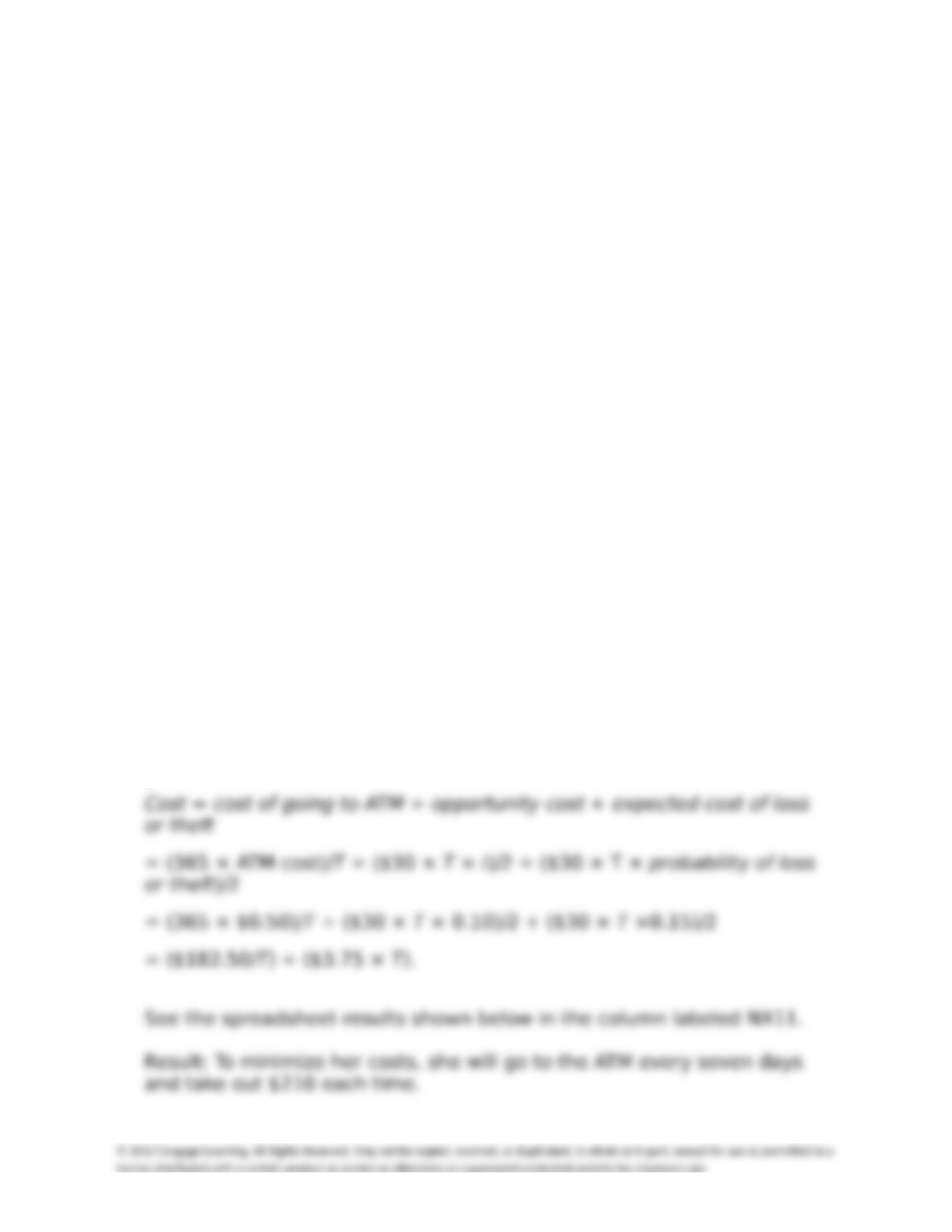
1. Following the determinants of equation (1) with the new parameters
gives:
Chapter 11: Modeling Money 117
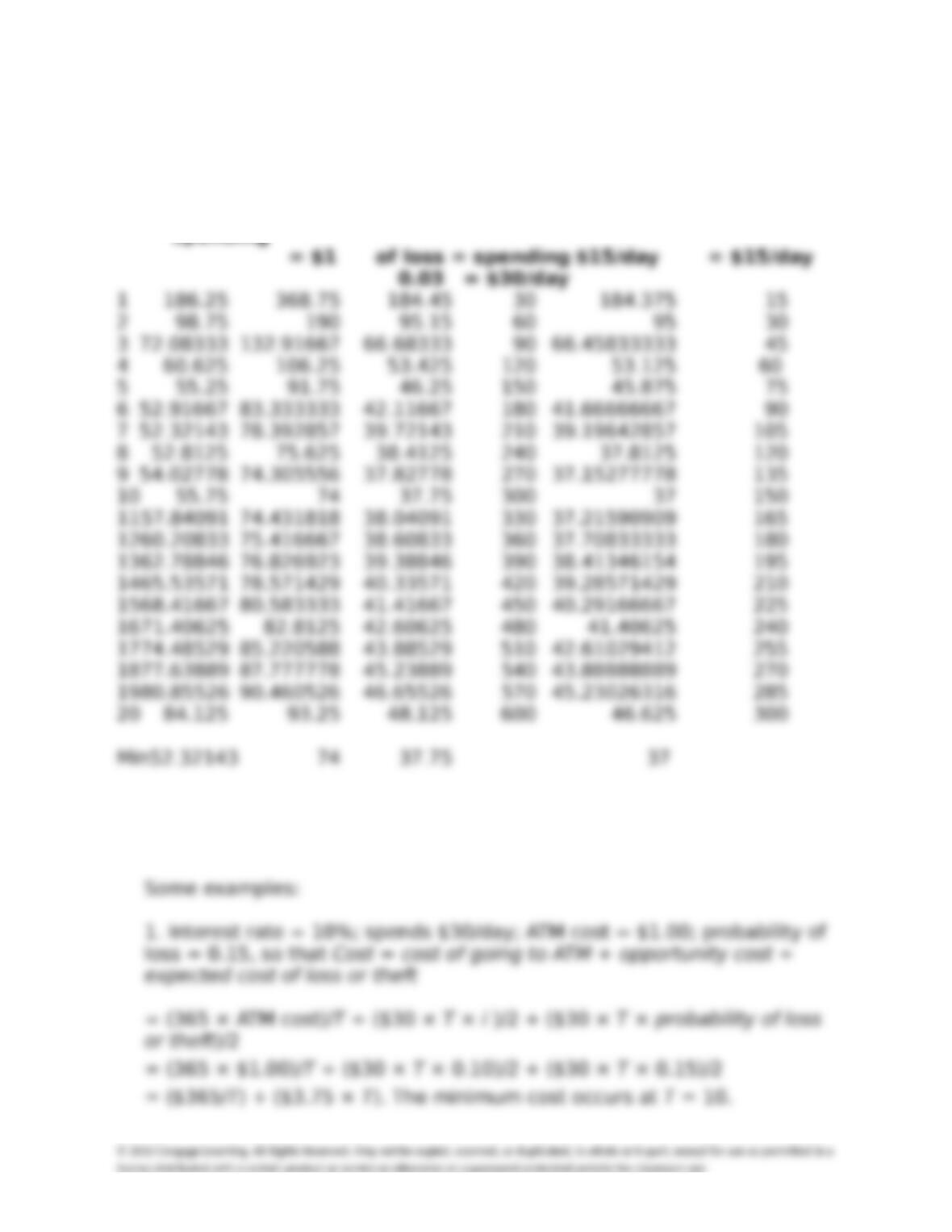
Spreadsheet Results for Exercises 11 and 12:
T NX11 NX12 NX12 Amount NX12 Amount
withdrawn withdrawn
ATM cost Probability when Spending = when
spending
2. See the spreadsheet in the answer to numerical exercise 11. Result: She
will go to the ATM every ten days under many di”erent combinations of
the parameters.
Chapter 11: Modeling Money 118
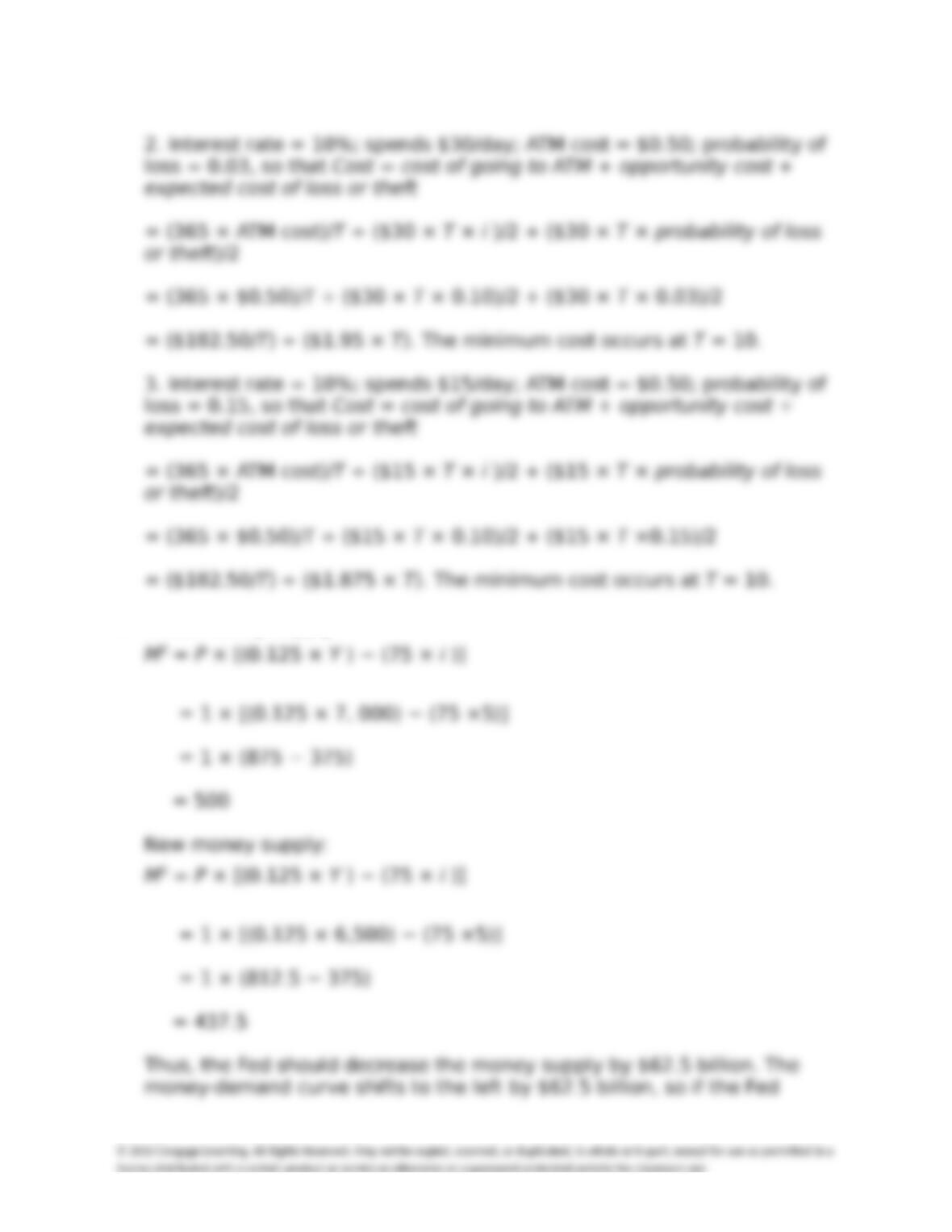
3. Initial money supply:
Chapter 11: Modeling Money 119
Analytical Problems
5. The money-supply curve shifts to the right such that the nominal interest
rate is unchanged, so it shifts by the same distance, to the right, as the
money-demand curve did.
6. This is the mirror image of Figure 11.7. The interest rate rises gradually,
reaches a peak, and then declines back to its original level.
ADDITIONAL TEACHING NOTES
MORE DETAILS ON MODELS OF MONEY
Transactions-cost models of money
In a transactions-cost model of money, people face a tradeo” between
holding cash and keeping deposits in the bank where they earn interest. The
cost of holding cash arises because of the lost opportunity to earn interest.
But there is a transactions cost of going to the bank to get cash, so a person
does not want to go to the bank too often—thus, such a model is known as
a transactions-cost model. In this model, money demand depends on the
interest rate, because the higher the interest rate, the less cash people
want to hold because the opportunity cost is higher. This model was the Krst
formal explanation of the negative relationship between money demand
and the interest rate.
These models are usually partial-equilibrium models, as they do not model
both the supply and demand for money. So, in these models, it is hard to
ask questions such as: What is the optimal amount of money for the
economy to have? But the transactions-cost model can be embedded in a
broader model to produce a general-equilibrium model.
Chapter 11: Modeling Money 120
Models with money in the utility function
Economists studying complicated issues, who do not want to model money
explicitly, often use models that force money to play a simpliKed role. The
idea is that money can be a part of the larger model and may a”ect other
macroeconomic variables, but in a simple way that makes solving the model
very easy. That way, researchers can spend their modeling e”ort on other
variables, such as interest rates or output growth, without focusing as much
on the role of money.
Shortcut models, including those with money in the utility function, are still
general-equilibrium models. In economists’ ways of looking at the world, the
best models are general-equilibrium models that explain everything from
principles, such as random-matching models, cash-in-advance models,
shopping-time models, and overlapping-generations models. Next best are
general-equilibrium models that take shortcuts, such as models with money
in the utility function or transactions costs. Worst are partial-equilibrium
models that only explain a few macroeconomic variables, but do not
analyze some major ones. But, in economics, the issue to be explained or
analyzed determines the choice of model. For some issues, a complete
general-equilibrium model is best. But, sometimes those models simply are
not developed well enough to answer the issue at hand, so even a
partial-equilibrium model may then suNce.
Random-matching models of money
One idea about money that leads naturally to a particular type of model is
that money is useful because people cannot fully anticipate when spending
opportunities will arise. So, people carry money with them as a precaution,
in case they need it unexpectedly or discover a good opportunity to buy
something.
Chapter 11: Modeling Money 121
Such a model is called a random-matching model because people who hold
money are viewed as consumers who randomly bump into producers and
trade their money for goods. The model illustrates a number of ideas about
the way money operates in the real world: (1) money is valuable because it
helps people trade, (2) an increase in the amount of money causes
production to increase in the short run, (3) an increase in the amount of
money causes the price level to be higher in the long run, and (4) money
exists even though it pays no interest and there are bonds that pay interest.
Cash-in-advance models
In the cash-in-advance model, people acquire cash before they can
purchase goods and services. This model is similar to the random-matching
model in the sense that people need money in both models to buy goods
and services. But, in a cash-in-advance model, there is no uncertainty about
when a shopping opportunity will arise. Instead, people plan ahead to get
cash when they need it. So in these models, people choose how much to
buy versus how much to save, facing a tradeo” between the amount of
cash they hold, on which they do not earn any interest, and the amount
they keep invested, earning interest. If the interest rate increases, the
tradeo” changes, and people are likely to modify the amount they buy and
the amount they save.
Shopping-time models of money
Money’s role as a medium of exchange can be represented explicitly in a
model in which the more money people hold, the less time it takes them to
shop. Thus, if you do not have much money, you cannot buy expensive
things, or else you must spend time going to the bank to get cash, or you
must pay for something by writing a check, which takes longer than paying
cash. These models thus give cash an advantage over other forms of
payment.
One advantage of a shopping-time model of money is that it rePects the
obvious notion that you could save time and e”ort by keeping money in
your wallet. For example, your main daily cash expense might be going to
lunch with your friends, and you never know if you will end up at a cheap
Chapter 11: Modeling Money 122
spot that costs just $5 or a more expensive place that will cost much more.
So, you keep plenty of cash on hand to give yourself more opportunities.
Cash-in-advance models are like shopping-time models with an inKnite
amount of time available to buy something if you do not have enough cash
on hand.
Overlapping-generations models of money
The overlapping-generations model of money is one in which money serves
solely as a store of value, not a medium of exchange. This model assumes
that people need some asset as a savings vehicle, but because of the
structure of generations born at di”erent times, they may not be able to do
so in any form other than money. In the simplest version of this model,
people are born at di”erent times and have two periods in life: when one
generation is old, a new generation is born. Money is needed because a
young person might like to borrow from an old person, but the old person
will not be around next period to receive the repayment of the loan. The
presence of money is an arrangement that allows trade between
generations.
The biggest challenge in these models is to explain how di”erent assets
exist at the same time. That is, how can money, which pays no interest, be
used when bonds, which pay interest, also exist? Some element of the
model must allow this coexistence. In some models, transactions costs
occur when bonds are used, so only relatively wealthy people use bonds;
the poor use money. Another possibility is that legal restrictions imposed by
the government cause bonds to be of some minimum size, so only wealthy
people purchase them.
More insight into the ATM model
We can gain some insight into why the model works the way it does by
looking at some extreme situations in the model. For example, suppose the
costs of going to the ATM fell to zero. What would Tracy do? With no costs of
going to the ATM, just opportunity costs from holding cash, Tracy would
Chapter 11: Modeling Money 123
make a trip to the ATM whenever she wanted to buy something.
Alternatively, imagine that the interest rate on money in the bank fell to
zero and there was no chance her cash would be lost or stolen. Then the
only cost would be the cost of trips to the ATM, which Tracy would minimize
by receiving her paycheck in cash and never going to the ATM. In reality,
people face costs of going to the ATM, banks pay interest, and there is some
chance your cash will be lost or stolen. Consequently, people will use the
ATM periodically to get cash, but not too frequently.