Chapter 11: Modeling Money 116
CHAPTER 11
Modeling Money
TEACHING OBJECTIVES
Goals of Chapter 11
A. Incorporate the functions of money into a series of models to show how
those functions affect the demand for money.
B. Show how the demand for money depends on people’s spending, the
level of prices of goods and services, and the nominal interest rate.
C. Analyze the supply of money to investigate how changes in the supply of
money affect the nominal interest rate in the short run.
D. Incorporate time into a model of money to show how the effects of
changes in the money supply lead to different changes in the nominal
interest rate in the short run and the long run.
E. Look at the data on money, income, prices, and nominal interest rates to
test the models developed in the chapter.
TEACHING NOTES
A. Introduction
1. In this chapter, three models are developed, each more complex than
the previous
2. These models are building blocks of more complete macroeconomic
models
B. The ATM Model of the Demand for Cash
1. Model a person’s demand for cash, based on spending habits,
transactions costs, the interest rate, and the possibility of loss or
theft; use Figure 11.1
2. Compare cost of getting cash (transactions cost) with opportunity cost
of holding cash (interest that could be earned on bank deposits and
risk of loss or theft), given spending habits
Chapter 11: Modeling Money 117
c) If the risk of loss or theft declines, the person will go to the ATM
less often and hold more cash, on average
d) If the person increases spending, both the frequency of trips to the
ATM and the average cash balance will rise
5. Building an economic model requires us to distinguish between
exogenous variables (determined outside the model) and
endogenous variables (determined within the model)
a) In the ATM model of cash demand, the exogenous variables are the
nominal interest rate, the amount spent daily, the cost of a visit to
the ATM, and the probability of loss or theft
b) The endogenous variables are the frequency of visits to the ATM,
the amount withdrawn on each visit, and the average cash balance
6. We can also distinguish between different types of models, depending
on whether key variables are endogenous or exogenous
a) A general-equilibrium model is one in which all the key
macroeconomic variables are endogenous
b) A partial-equilibrium model is one in which some key
macroeconomic variables, such as the nominal interest rate, are
exogenous
c) In building economic models, economists usually start with
C. The Liquidity-Preference Model
1. The liquidity-preference model incorporates both the supply and
demand for money, making the nominal interest rate endogenous
2. The demand for money focuses on spending and the nominal interest
rate as determinants, just as in the ATM model (but ignoring some
other aspects)
3. The ATM model showed that a higher nominal interest rate reduces
money demand, so we plot a money-demand curve that slopes
downward (Figure 11.4), with the nominal interest rate on the
vertical axis; the location of the money-demand curve depends on
other factors that affect money demand, including the other factors in
the ATM model, such as incomes
4. The Federal Reserve determines the supply of money; their decision is
not affected by the nominal interest rate, so the money-supply curve
is a vertical line (Figure 11.4)
Chapter 11: Modeling Money 118
7. An increase in the money supply would reduce the equilibrium
nominal interest rate, and vice-versa, in the model: the liquidity
e.ect (Figure 11.5)
8. If money demand is affected over the course of the business cycle,
then nominal interest rates change as economic recessions and
expansions occur (Figure 11.6)
a) Higher money demand in expansions leads to higher nominal interest
rates
b) Lower money demand in recessions leads to lower nominal interest
rates
9. When prices increase, people need more money for transactions, so
their money demand increases, which in turn causes the equilibrium
nominal interest rate to decline
10. Because the demand for money is proportional to prices, we
often examine the real money-demand function, which suggests
that the real quantity of money demanded depends on people’s real
income and the nominal interest rate
D. The Dynamic Model of Money
1. Introduction
a) Models that do not allow variables to change over time, such as
the ATM model and the liquidity preference model, are called
static models
b) Models that allow variables to change over time are dynamic
models
c) Because money serves as a store of value, and because the
inflation rate and the nominal interest rate both relate to time (the
change in prices over time and the payment of interest for loans
over time), a dynamic model of money is useful
3. The Effects of an Increase in the Growth Rate of the Money Supply
a) In a dynamic model of money, an increase in the growth rate of the
money supply leads to higher inflation in the long run (Figure
11.8)
b) In the short run, there may initially be a liquidity effect that causes
the nominal interest rate to decline, but eventually the higher
Chapter 11: Modeling Money 119
inflation rate causes the nominal interest rate to rise above its
original level
c) Possibly, if people anticipate the higher inflation rate, the nominal
interest rate may rise immediately, overcoming the liquidity effect
d) In dynamic models, people’s expectations matter, such as people’s
expectations of inflation; use the box on Microeconomic
Foundations of Money and the Friedman Rule
E. Policy Perspective: Using Models of Money Demand in Practice
1. Do our theories of money demand help us understand the data?
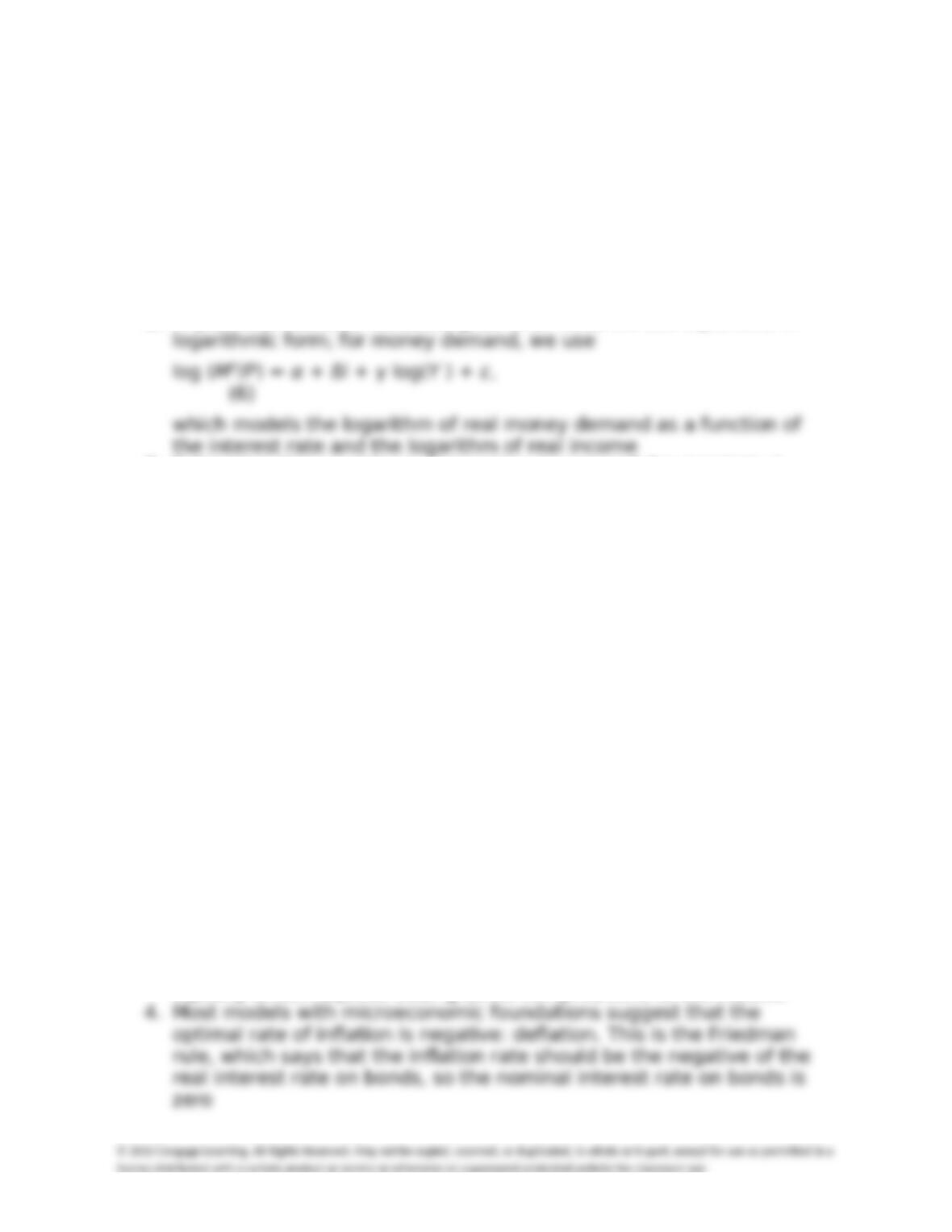
2. In practice, because variables grow over time, we use equations in
3. Estimating this equation is done using econometrics (statistical
techniques used in economics), especially regression analysis
4. Early research found that the money demand equation did not work
well with the data, suggesting the need to rethink the theory
5. But in recent years, with more data in hand, estimates of equation (6)
Ft the data well, assuming that changes in technology have not
changed the demand for money too much; use Policy Insider: Can the
Federal Reserve Accurately Forecast the Demand for Money?
F. Policy Insider: Can the Federal Reserve Accurately Forecast the Demand
for Money?
1. The Federal Reserve’s empirical procedure for estimating money
demand is based on two equations: one for the long run and another
for the short run
2. The model performed well for several years after being developed,
but then ran into diGculties
3. Partly as a result, the Fed stopped setting targets for money growth
G. Microeconomic Foundations of Money and the Friedman Rule
1. Models that show how individuals use money are known as models
with microeconomic foundations
2. Models with microeconomic foundations of money include
transactions-cost models, search models, cash-in-advance models,
shopping-time models, and overlapping-generations models
3. Simple versions of these models have no liquidity effect; obtaining a
liquidity effect requires adding some complications to the models

Chapter 11: Modeling Money 120