© 2014 Cengage Learning. All Rights Reserved. May not be scanned, copied or duplicated, or posted to a publicly accessible website, in whole
or in part.
APPENDIX
Marketing Plan Worksheets
2. Use this information to better understand a firm’s strengths and weaknesses, and to
recognize the opportunities and threats that exist in the marketing environment.
3. Develop goals and objectives that capitalize on strengths.
4. Develop a marketing strategy that creates competitive advantages.
5. Outline a plan for implementing the marketing strategy.
These worksheets are available in electronic format on our text‘s website at
www.cengagebrain.com. By downloading these worksheets, you will be able to change the outline
or add additional information that is relevant to your situation. Remember that there is no one best
way to organize a marketing plan. We designed our outline to serve as a starting point and to be
flexible enough to accommodate the unique characteristics of your situation.
As you complete the worksheets, it might be useful to refer back to the text of the chapters. In
completing the situation analysis section, be sure to be as comprehensive as possible. The viability
of your SWOT analysis depends on how well you have identified all of the relevant environmental
issues. Likewise, as you complete the SWOT analysis, you should be honest about the firm’s
characteristics. Do not depend on strengths that the firm really does not possess. Honesty is also
important for your listing of weaknesses.
I. Executive Summary
The executive summary is a synopsis of the overall marketing plan. It should provide an
overview of the entire plan including goals/objectives, strategy elements, implementation
issues, and expected outcomes. The executive summary should be the last part of the
marketing plan that you write.
II. Situation Analysis
A. The Internal Environment (refer to Exhibit 3.3)
Review of marketing goals and objectives
Identify the firm’s current marketing goals and objectives.
Explain how these goals and objectives are being achieved.

Explain how these goals and objectives are consistent or inconsistent with
the firm’s mission, recent trends in the external environment, and recent
trends in the customer environment.
Review of current marketing strategy and performance
Describe the firm‘s current marketing strategy with respect to products,
pricing, distribution, and promotion. Which elements of the strategy are
working well? Which elements are not?
Describe the firm‘s current performance (sales volume, market share,
profitability, awareness, brand preference) compared to other firms in the
industry. Is the performance of the industry as a whole improving or
declining? Why?
If the firm‘s performance is declining, what is the most likely cause (e.g.,
environmental changes, flawed strategy, poor implementation)?
Review of current and anticipated organizational resources
Describe the current state of the firm’s organizational resources (e.g.,
financial, capital, human, experience, relationships with key suppliers or
customers). How are the levels of these resources likely to change in the
future?
If resource levels are expected to change, how can the firm leverage
additional resources to meet customer needs better than competitors?
If additional resources are not available, how can the firm compensate for
future resource constraints (lack of resources)?
Review of current and anticipated cultural and structural issues
In terms of marketing strategy development and implementation, describe
the positive and negative aspects of the current and anticipated culture of the
firm. Examples could include:
The firm’s overall customer orientation (or lack thereof)
The firm’s emphasis on short-term versus long-term planning
Willingness of the firm‘s culture to embrace change
Internal politics and power struggles
The overall position and importance of the marketing function
Changes in key executive positions
General employee satisfaction and morale
Explain whether the firm’s structure is supportive of the current marketing
strategy.

B. The Customer Environment (refer to Exhibit 3.4)
Who are the firm‘s current and potential customers?
Describe the important identifying characteristics of the firm’s current and
potential customers with respect to demographics, geographic location,
psychographic profiles, values/lifestyles, and product usage characteristics
(heavy vs. light users).
Identify the important players in the purchase process for the firm’s products.
These might include purchasers (actual act of purchase), users (actual
product user), purchase influencers (influence the decision, make
recommendations), and the bearer of financial responsibility (who pays the
bill?).
What do customers do with the firm’s products?
How are the firm’s products connected to customer needs? What are the
basic benefits provided by the firm’s products?
How are the firm’s products purchased (quantities and combinations)? Is the
product purchased as a part of a solution or alongside complementary
products?
How are the firm’s products consumed or used? Are there special
consumption situations that influence purchase behavior?
Are there issues related to disposition of the firm’s products, such as waste
(garbage) or recycling, which must be addressed by the firm?
Where do customers purchase the firm’s products?
Identify the merchants (intermediaries) where the firm’s products are
purchased (e.g., store-based retailers, ecommerce, catalog retailers, vending,
wholesale outlets, direct from the firm).
Identify any trends in purchase patterns across these outlets (e.g., how has
ecommerce changed the way the firm’s products are purchased?).
When do customers purchase the firm‘s products?
How does purchase behavior vary based on different promotional events
(communication and price changes) or customer services (hours of operation,
delivery)?

How does purchase behavior vary based on uncontrollable influences such
as seasonal demand patterns, time-based demand patterns, physical/social
surroundings, or competitive activities?
Why (and how) do customers select the firm’s products?
Describe the advantages of the firm’s products relative to competing
products. How well do the firm’s products fulfill customers’ needs relative to
competing products?
Describe how issues such as brand loyalty, value, commoditization, and
relational exchange processes affect customers’ purchase behaviors.
Describe how credit or financing is used in purchasing the firm’s products.
Also, do customers seek long-term relationships with the firm, or do they
buy in a transactional fashion (based primarily on price)?
Why do potential customers not purchase the firm’s products?
Identify the needs, preferences, and requirements of non-customers that are
not being met by the firm‘s products.
What are the features, benefits, and advantages of competing products that
cause non-customers to choose them over the firm’s products?
Explain how the firm’s pricing, distribution, and/or promotion are out of
sync with non-customers. Outside of the product, what causes non-customers
to look elsewhere?
Describe the potential for converting non-customers into customers.
C. The External Environment (refer to Exhibit 3.5)
Competition
Identify the firm’s major competitors (brand, product, generic, and total
budget).
Identify the characteristics of the firm‘s major competitors with respect to
size, growth, profitability, target markets, products, and marketing
capabilities (production, distribution, promotion, pricing).
What other major strengths and weaknesses do these competitors possess?
List any potential future competitors not identified above.

Economic Growth and Stability
Identify the general economic conditions of the country, region, state, or
local area where the firm’s target customers are located. How are these
economic conditions related to customers’ ability to purchase the firm’s
products?
Describe the economics of the industry within which the firm operates.
These issues might include the cost of raw materials, patents,
merger/acquisition trends, sales trends, supply/demand issues, marketing
challenges, and industry growth/decline.
Political Trends
Identify any political activities affecting the firm or the industry with respect
to changes in elected officials (domestic or foreign), potential regulations
favored by elected officials, industry (lobbying) groups or political action
committees, and consumer advocacy groups.
What are the current and potential hot button political or policy issues at the
national, regional, or local level that may affect the firm’s marketing
activities?
Legal and Regulatory Issues
Identify any changes in international, federal, state, or local laws and
regulations affecting the firm’s or industry’s marketing activities with
respect to recent court decisions, recent rulings of federal, state, or local
government entities, recent decisions by regulatory and self-regulatory
agencies, and changes in global trade agreements or trade law.
Technological Advancements
How have recent technological advances affected the firm’s customers with
respect to needs/wants/preferences, access to information, the timing and
location of purchase decisions, the ability to compare competing product
offerings, or the ability to conduct transactions more effectively and
efficiently?
Have customers embraced or rejected these technological advances? How is
this issue related to customers’ concerns over privacy and security?
How have recent technological advances affected the firm or the industry
with respect to manufacturing, process efficiency, distribution, supply chain
effectiveness, promotion, cost-reduction, or customer relationship
management?

What future technologies offer important opportunities for the firm? Identify
any future technologies that may threaten the firm‘s viability or its marketing
efforts.
Sociocultural Trends
With respect to the firm’s target customers, identify changes in society’s
demographics, values, and lifestyles that affect the firm or the industry.
Explain how these changes are affecting (or may affect) the firm’s products
(features, benefits, branding), pricing (value), distribution and supply chain
(convenience, efficiency), promotion (message content, delivery, feedback),
and people (human resource issues).
Identify the ethical and social responsibility issues that the firm or industry
faces. How do these issues affect the firm’s customers? How are these issues
expected to change in the future?
III. SWOT Analysis (refer to Exhibit 4.4)
A. Strengths
Strength 1: _________________________________________________________
Strength 2: _________________________________________________________
(Repeat as needed to develop a complete list of strengths)
How do these strengths enable the firm to meet customers‘ needs?
How do these strengths differentiate the firm from its competitors?
B. Weaknesses
Weakness 1: ________________________________________________________
Weakness 2: ________________________________________________________
(Repeat as needed to develop a complete list of weaknesses)
How do these weaknesses prevent the firm from meeting customers‘ needs?
How do these weaknesses negatively differentiate the firm from its
competitors?
C. Opportunities (external situations independent of the firm—not strategic
options)
Opportunity 1: _______________________________________________________
Opportunity 2: _______________________________________________________
(Repeat as needed to develop a complete list of opportunities)

How are these opportunities related to serving customers’ needs?
What is the time horizon of each opportunity?
D. Threats (external situations independent of the firm)
Threat 1: ___________________________________________________________
Threat 2: ___________________________________________________________
(Repeat as needed to develop a complete list of threats)
How are these threats related to serving customers’ needs?
What is the time horizon of each threat?
E. The SWOT Matrix (refer to Exhibit 4.5 and Exhibit 4.6)
Strengths:
•
•
•
•
Opportunities:
•
•
•
•
Weaknesses:
•
•
•
•
Threats:
•
•
•
•
F. Developing Competitive Advantages (refer to Exhibit 4.7)
Describe ways that the firm can match its strengths to its opportunities to create
capabilities in serving customers‘ needs.
Are these capabilities and competitive advantages grounded in the basic principles
of operational excellence, product leadership, and/or customer intimacy? If so,
how are these capabilities and advantages made apparent to customers?
Can the firm convert its weaknesses into strengths or its threats into opportunities? If
not, how can the firm minimize or avoid its weaknesses and threats?
Does the firm possess any major liabilities (unconverted weaknesses that match
unconverted threats) or limitations (unconverted weaknesses or threats that match
opportunities)? If so, are these liabilities and limitations apparent to customers?

Can the firm do anything about its liabilities or limitations, especially those that
impact the firm’s ability to serve customers’ needs?
G. Developing a Strategic Focus
What is the overall strategic focus of the marketing plan? Does the strategic focus
follow any particular direction, such as aggressiveness, diversification,
turnaround, defensiveness, or niche marketing?
Describe the firm’s strategic focus in terms of a strategy canvas. How does the
firm’s strategic thrust provide sufficient focus and divergence from other firms in
the industry?
IV. Marketing Goals and Objectives
A. Marketing Goal A: __________________________________________________
(should be broad, motivational, and somewhat vague)
Objective A1: ______________________________________________________
(must contain a specific and measurable outcome, a time frame for completion, and
identify the person/unit responsible for achieving the objective)
Objective A2: ______________________________________________________
(must contain a specific and measurable outcome, a time frame for completion, and
identify the person/unit responsible for achieving the objective)
B. Marketing Goal B: __________________________________________________
(should be broad, motivational, and somewhat vague)
Objective B1: ______________________________________________________
(must contain a specific and measurable outcome, a time frame for completion, and
identify the person/unit responsible for achieving the objective)
Objective B2: ______________________________________________________
(must contain a specific and measurable outcome, a time frame for completion, and
identify the person/unit responsible for achieving the objective)
(Can be repeated as needed to develop a complete list of goals and objectives.
However, having one goal and two or three objectives is advisable to greatly reduce
the complexity of the marketing strategy.)
V. Marketing Strategy
A. Primary (and Secondary) Target Market
Primary target market

Identifying characteristics (demographics, geography, values,
psychographics):
Basic needs, wants, preferences, or requirements:
Buying habits and preferences:
Consumption/disposition characteristics:
Secondary target market (optional)
Identifying characteristics (demographics, geography, values,
psychographics):
Basic needs, wants, preferences, or requirements:
Buying habits and preferences:
Consumption/disposition characteristics:
B. Product Strategy
Brand name, packaging, and logo design:
Major features and benefits:
Differentiation/positioning strategy:
Supplemental products (including customer service strategy):
Connection to value (core, supplemental, experiential/symbolic attributes):
C. Pricing Strategy
Overall pricing strategy and pricing objectives:
Price comparison to competition:
Connection to differentiation/positioning strategy:
Connection to value (monetary costs):
Profit margin and breakeven:
Specific pricing tactics (discounts, incentives, financing, etc.):
D. Distribution/Supply Chain Strategy
Overall supply chain strategy (including distribution intensity):
Channels and intermediaries to be used:
Connection to differentiation/positioning strategy:
Connection to value (nonmonetary costs):
Strategies to ensure channel support (slotting fees, guarantees, etc.):
Tactics designed to increase time, place, and possession utility:
E. Integrated Marketing Communication (Promotion) Strategy
Overall IMC strategy, IMC objectives, and budget:
Consumer promotion elements
Advertising strategy:
Public relations/publicity strategy:
Personal selling strategy:
Consumer sales promotion (pull) strategy:
Trade (channel) promotion elements
Advertising strategy:
Public relations/publicity strategy:
Personal selling strategy:
Trade sales promotion (push) strategy:
VI. Marketing Implementation
A. Structural Issues
Describe the overall approach to implementing the marketing strategy.
Describe any changes to the firm’s structure needed to implement the marketing
strategy (e.g., add/delete positions, change lines of authority, change reporting
relationships).
Describe any necessary internal marketing activities in the following areas:
employee training, employee buy-in and motivation to implement the marketing
strategy, overcoming resistance to change, internal communication and promotion of
the marketing strategy, and coordination with other functional areas.
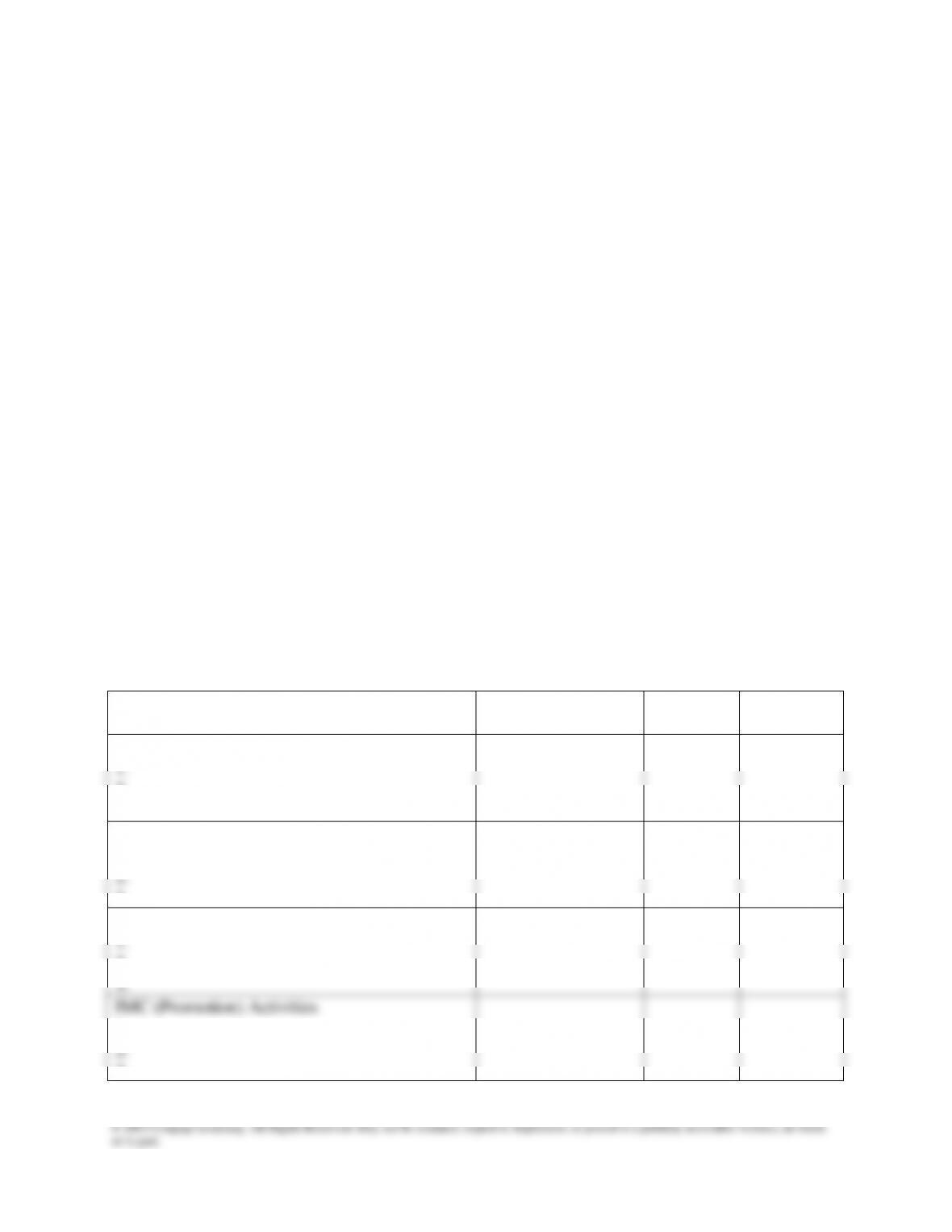
B. Tactical Marketing Activities (be very specific—this lays out the details of the
marketing strategy and how it will be executed)
Specific Tactical Activities
Person/Department
Responsible
Required
Budget
Completion
Date
Product Activities
1.
2.
3.
Pricing Activities
1.
2.
3.
Distribution/Supply Chain Activities
1.
2.
3.
IMC (Promotion) Activities
1.
2.
3.

VII. Evaluation and Control (refer to Exhibit 9.5)
A. Formal Controls
Describe the types of input controls that must be in place before the marketing plan
can be implemented. Examples include financial resources, capital expenditures,
additional research and development, and additional human resources.
Describe the types of process controls that will be needed during the execution of
the marketing plan. Examples include management training, management
commitment to the plan and to employees, revised employee
evaluation/compensation systems, enhanced employee authority, and internal
communication activities.
Describe the types of output controls that will be used to measure marketing
performance and compare it to stated marketing objectives during and after the
execution of the marketing plan.
Overall performance standards (these will vary based on the goals and
objectives of the marketing plan). Examples include dollar sales, sales
volume, market share, share of customer, profitability, customer satisfaction,
customer retention, or other customer-related metrics.
Product performance standards (these are optional and will vary based on
the product strategy). Examples include product specifications, core product
quality, supplemental product quality, experiential quality, new product
innovation, branding, and positioning.
Price performance standards (these are optional and will vary based on the
pricing strategy). Examples include revenue targets, supply/demand balance,
price elasticity, yield management, or metrics based on specific price
adjustments.
Distribution performance standards (these are optional and will vary
based on the distribution strategy). Examples include distribution
effectiveness/efficiency, supply chain integration, value (time, place, and
possession utility), relationship maintenance (collaboration, conflict),
outsourcing, or direct distribution performance.
IMC (promotion) performance standards (these are optional and will vary
based on the IMC strategy). Examples include communication objectives;
brand awareness, recognition, or recall; campaign reach, frequency, and
impressions; purchase intentions; and public relations, sales, and sales
promotion effectiveness.
B. Informal Controls
Describe issues related to employee self-control that can influence the
implementation of the marketing strategy. Examples include employee satisfaction,
employee commitment (to the firm and the marketing plan), and employee
confidence in their skills. If any of these controls are lacking, how can they be
enhanced to support the implementation of the marketing plan?
Describe issues related to employee social control that can influence the
implementation of the marketing strategy. Examples include shared organizational
values, workgroup relationships, and social or behavioral norms. If any of these
controls are lacking, how can they be enhanced to support the implementation of the
marketing plan?
Describe issues related to cultural control that can influence the implementation of
the marketing strategy. Examples include organizational culture and organizational
rituals. If any of these controls are lacking, how can they be enhanced to support the
implementation of the marketing plan?
C. Marketing Audits (refer to Exhibit 9.6)
Explain how marketing activities will be monitored. What are the specific profit-
and time-based measures that will be used to monitor marketing activities?
Describe the marketing audit to be performed, including the person(s) responsible
for conducting the audit.
If it is determined that the marketing strategy does not meet expectations, what
corrective actions might be taken to improve performance (overall or within any
element of the marketing program)?
If the marketing plan, as currently designed, shows little likelihood of meeting the
marketing objectives, which elements of the plan should be reconsidered and
revised?
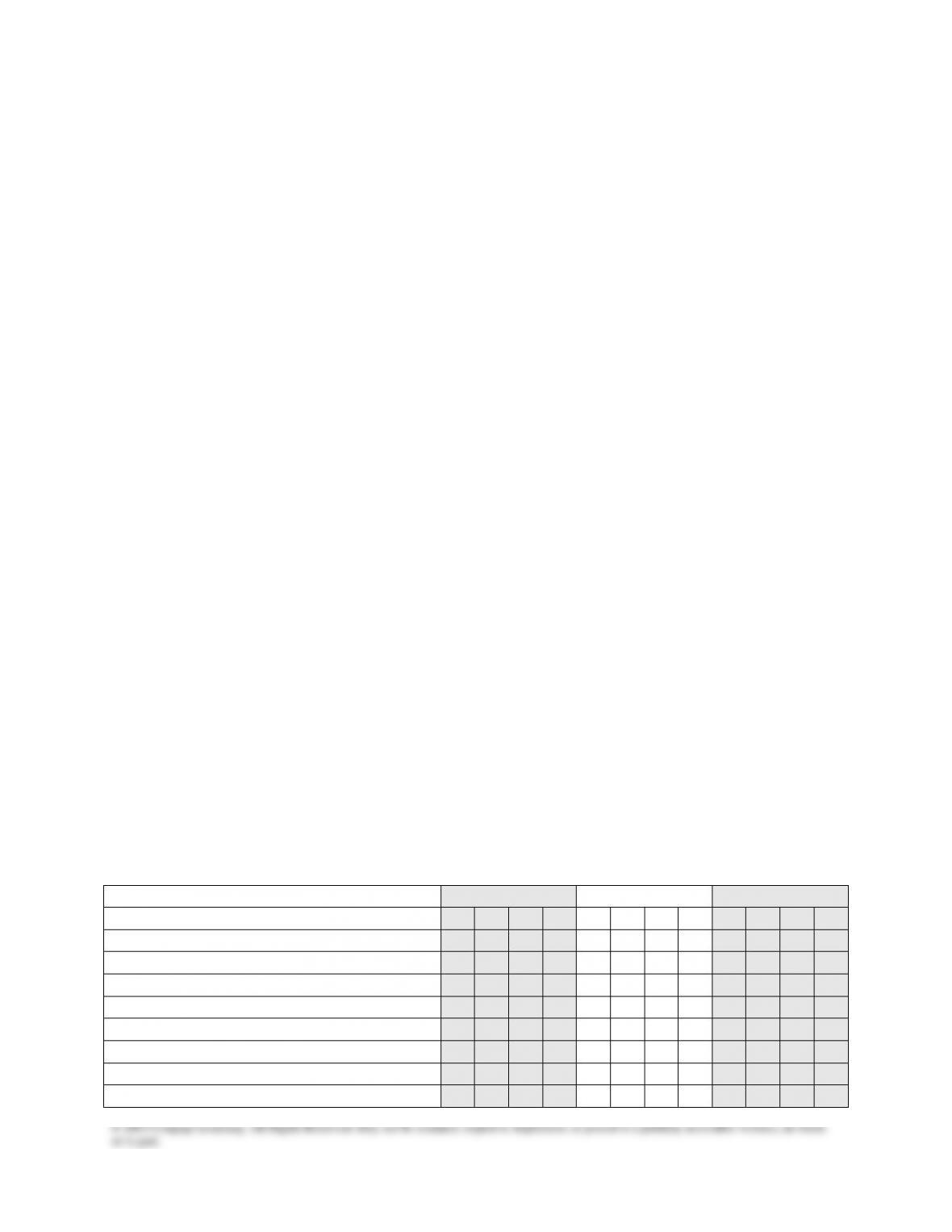
D. Implementation Schedule and Timeline (refer to Exhibit 9.7)
Month
________
________
________
Activities Week
1
2
3
4
1
2
3
4
1
2
3
4
Product Activities
Pricing Activities
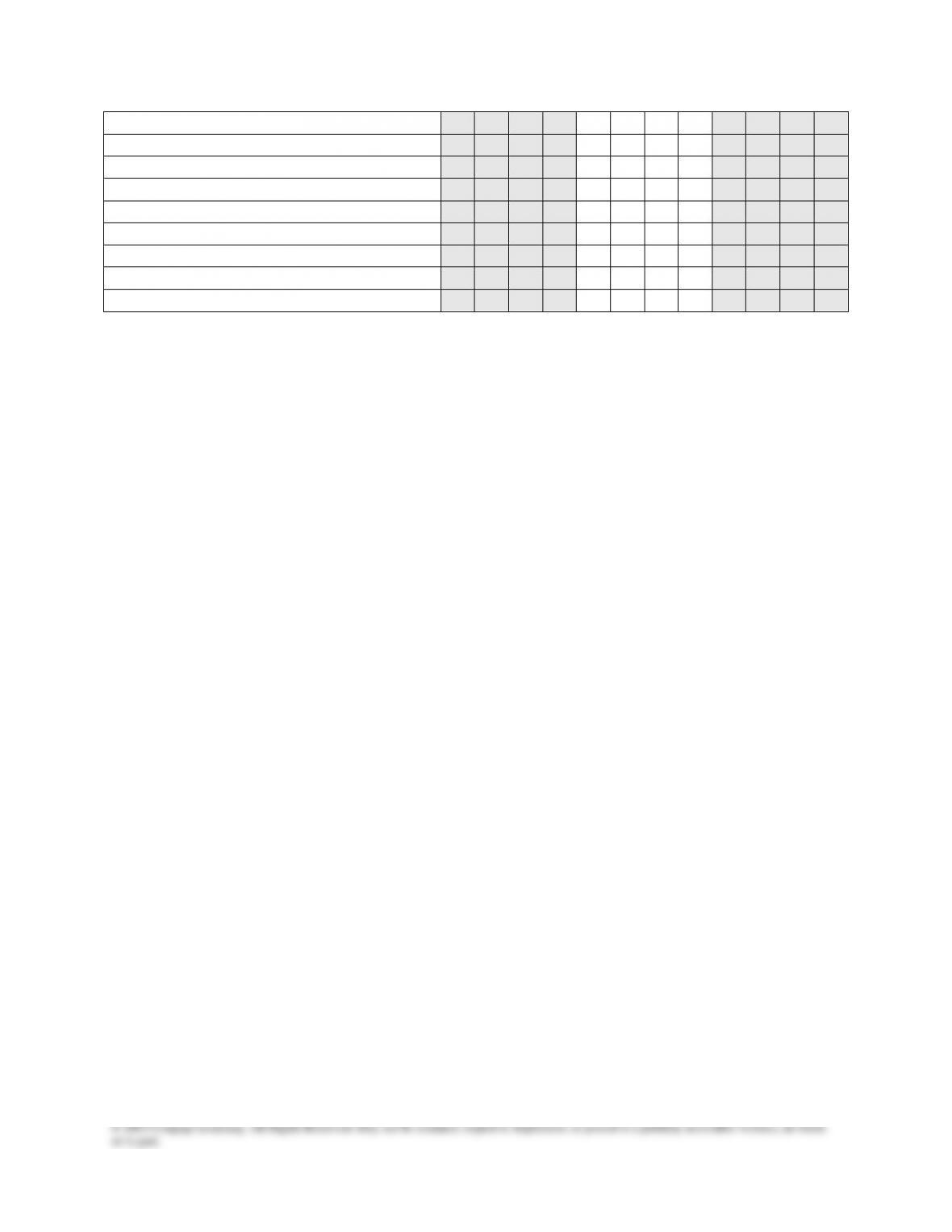
Distribution Activities
IMC Activities