
Harrod’s Sporting Goods
Case 1
Ratio Analysis
Purpose: The case allows the student to examine ratio analysis within the context of a customer-banking
arrangement. The firm has a disagreement with the bank over how much it should be paying in relation to
prime (no prior knowledge of banking is required for the case). An item of particular interest is the impact
of an extraordinary loss on the firm’s income statement. It has a major effect on the analysis of the
company. Industry comparisons also are utilized.
Relation to Text: The case should follow Chapter 3.
Complexity: The case is moderately complex. It should require 1 to 1½ hours.
Solutions
1.
Ratios
2013
2014
2015
1.
Net income
4.52
5.42%
3.99%
Sales
2a.
Net income
6.09%
7.23%
5.71%
Total assets
b.
Net income sales x sales / total assets
4.52 x 1.35
5.42% x 1.33
3.99% x 1.43
3a.
Net income
16.04%
18.55%
15.02%
Stockholder’s equity
b.
Net income / total assets
6.09%
7.23%
5.71%
(1 – debt / total assets)
(1 – .620)
(1 – .610)
(1 – .620)
2.
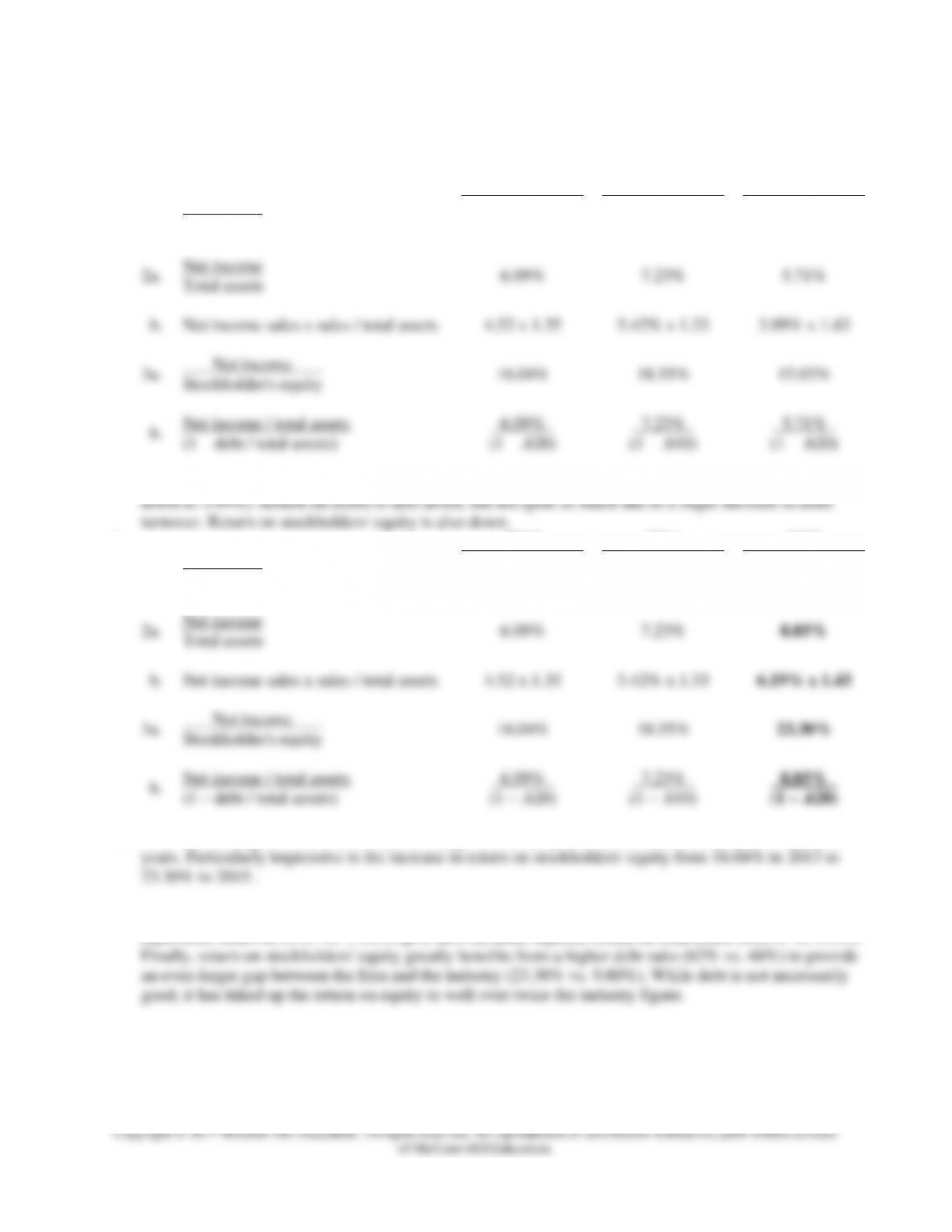
Harrod’s has suffered a sharp decline in its profit margin, particularly between 2014 and 2015 (5.42%
down to 3.99%). Return on assets is also down, but not quite as much due to a slight increase in asset
turnover. Return on stockholders’ equity is also down.
3.
2013
2014
2015
1.
Net income
4.522
5.42%
6.19%
Sales
2a.
Net income
6.09%
7.23%
8.85%
Total assets
b.
Net income sales x sales / total assets
4.52 x 1.35
5.42% x 1.33
6.19% x 1.43
3a.
Net income
16.04%
18.55%
23.30%
Stockholder’s equity
b.
Net income / total assets
6.09%
7.23%
8.85%
(1 – debt / total assets)
(1 – .620)
(1 – .610)
(1 – .620)
4.
After eliminating the effect of the nonrecurring extraordinary loss, the trend is clearly up over all three
years. Particularly impressive is the increase in return on stockholders’ equity from 16.04% in 2013 to
23.30% in 2015 .
5.
Harrod has a clear superiority in the profit margin (6.19% vs. 4.51%). This is further enhanced by a more
rapid asset turnover (1.43 vs. 1.13) to give an even more superior return on total assets (8.85% vs. 5.1%).
Finally, return on stockholders’ equity greatly benefits from a higher debt ratio (62% vs. 48%) to provide
an even larger gap between the firm and the industry (23.30% vs. 9.80%). While debt is not necessarily
good, it has hiked up the return on equity to well over twice the industry figure.

6.
Ratios
2015
Industry
1.
Sales
6.31
5.75
Receivables
2.
Sales
4.75
3.01
Inventory
3.
Sales
2.77
3.20
Fixed assets
Harrod’s is clearly superior to the industry in receivables turnover (6.31 vs. 5.75) and inventory turnover
(4.75 vs. 3.01) and this more than compensates for a lower sales to fixed assets ratio (2.77 vs. 3.20).
7.
Becky would appear to have strong grounds for a complaint. It appears that the banker was using
unadjusted income statement numbers to arrive at the conclusion that Harrod’s was on a downward trend
in terms of the profitability ratios. Also, using unadjusted data the profit margin was below the industry
average.
However, the inferior performance was due to an extraordinary, nonrecurring loss. In terms of normal
operating performance, the company is clearly on an upward trend and well above the industry averages
on all counts. One percent over prime appears to be much more reasonable than 2½ percent over prime.