A IFA
IFA
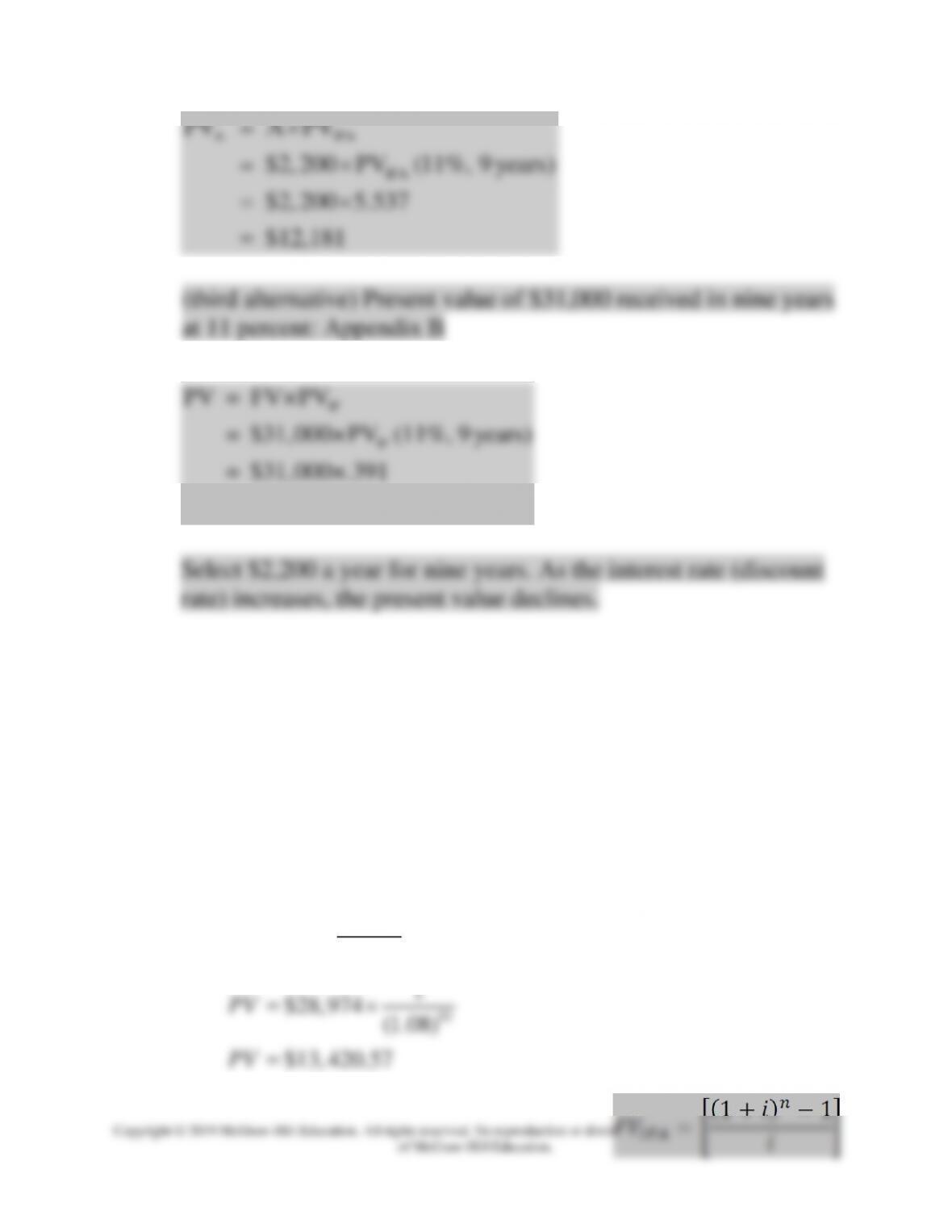
PV A PV
$2, 200 PV (11%, 9 years)
$2, 200 5.537
$12,181
=
=
=
=
(third alternative) Present value of $31,000 received in nine years
at 11 percent: Appendix B
IF
IF
PV = FV×PV
= $31,000×PV (11%, 9 years)
= $31,000×.391
= $12,121
Select $2,200 a year for nine years. As the interest rate (discount
rate) increases, the present value declines.
30. You need $28,974 at the end of 10 years, and your only investment outlet is an 8 percent
long-term certificate of deposit (compounded annually). With the certificate of deposit, you
make an initial investment at the beginning of the first year.
a. What single payment could be made at the beginning of the first year to achieve this
objective?
b. What amount could you pay at the end of each year annually for 10 years to achieve
this same objective?
9-30. Solution:
.a
10
1
(1 )
1
$28,974 (1.08)
n
PV FV
i
PV
=
+
=
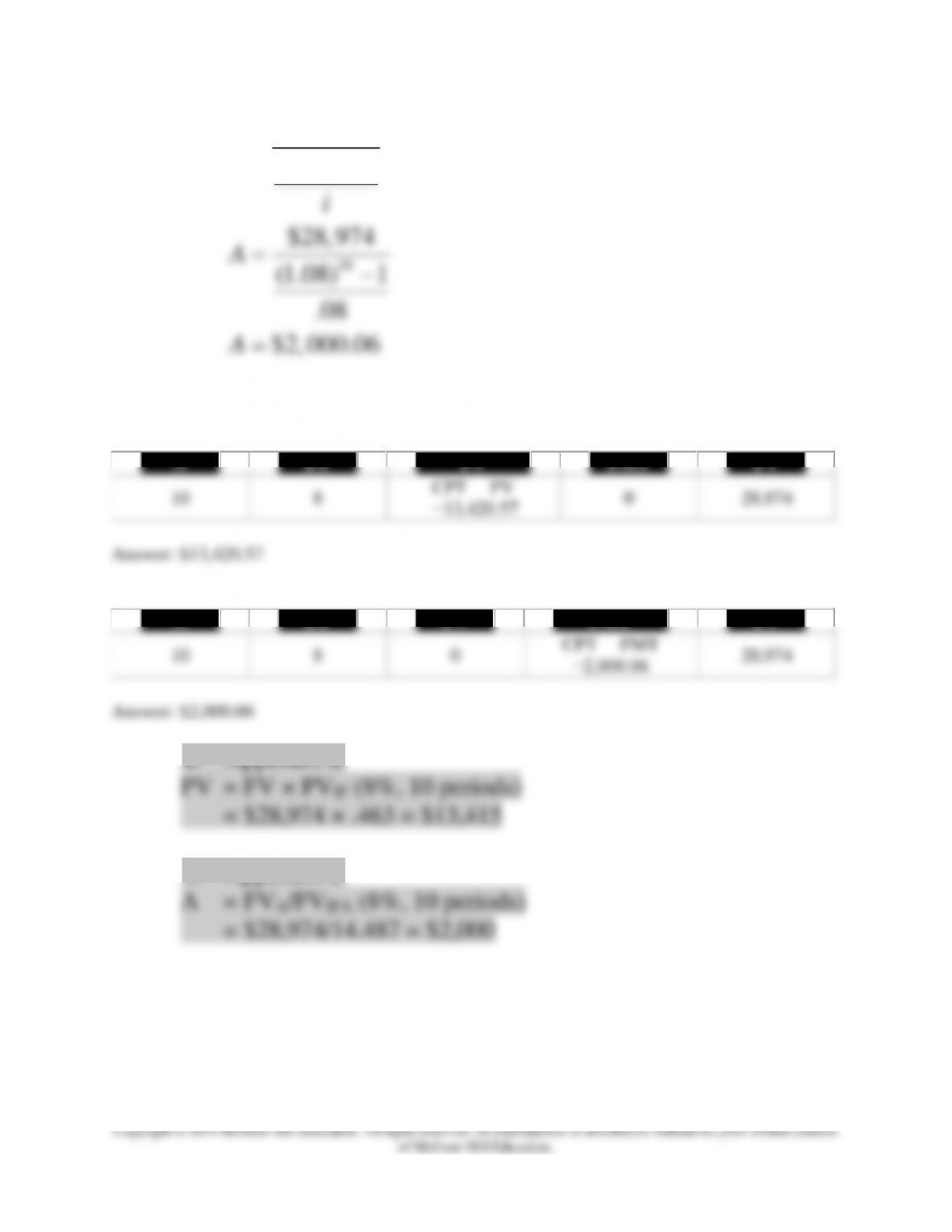
10
(1 ) 1
$28,974
(1.08) 1
A
n
FV
A
i
i
A
=+−
=−
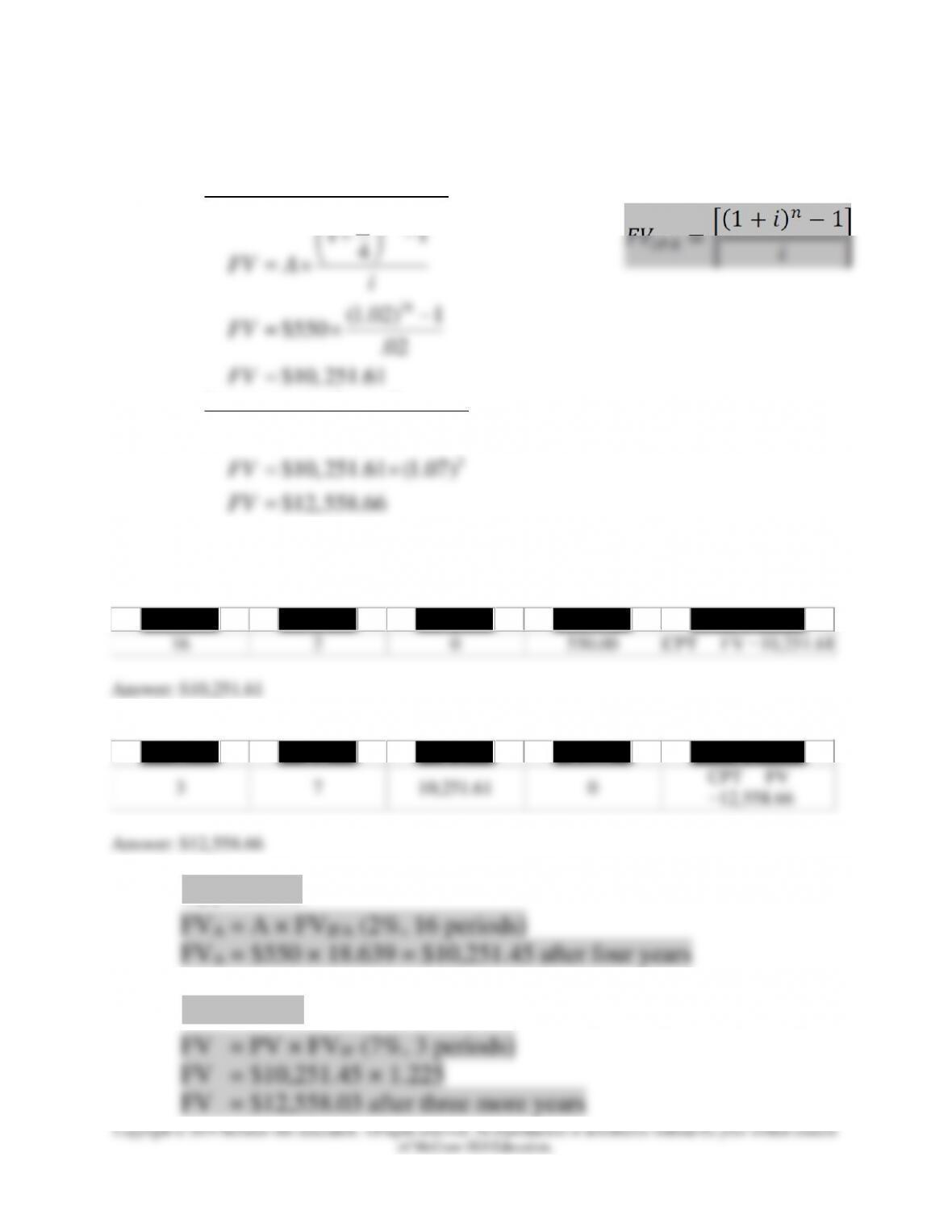
9-31. Solution:
Quarterly deposits for four years
4
16
11
4
(1.02) 1
$550 .02
$10, 251.61
n
i
FV A
i
FV
FV
+−
=
−
=
=
Investment growth over three years
3
(1 )
$10, 251.61 (1.07)
n
FV PV i
FV
= +
=
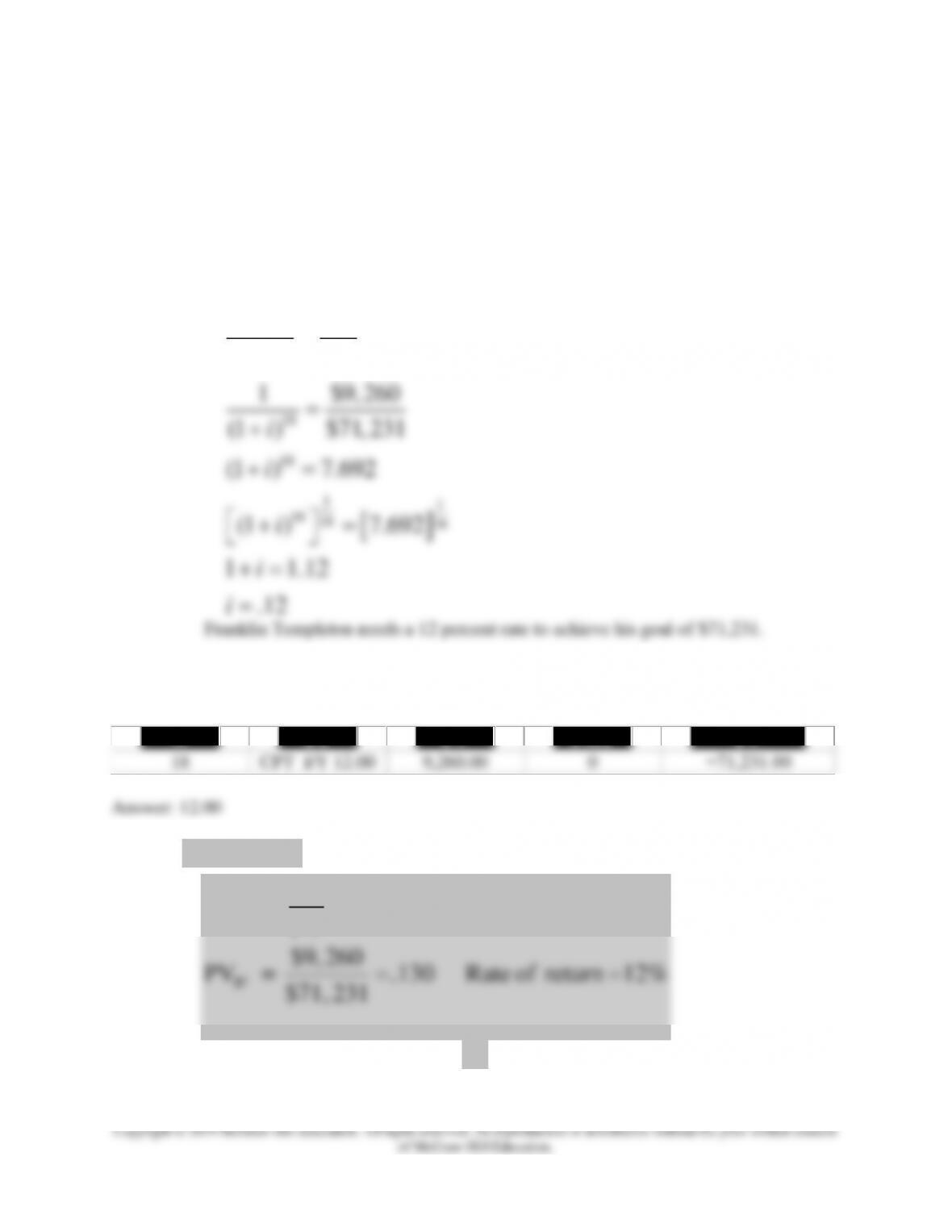
32. Yield (LO9-4) Franklin Templeton has just invested $9,260 for his son (age one). This
money will be used for his son’s education 18 years from now. He calculates that he will
need $71,231 by the time the boy goes to school. What rate of return will Mr. Templeton
need in order to achieve this goal?
9-32. Solution:
18
1
(1 )
1 $9,260
(1 ) $71,231
n
PV
i FV
i
=
+
=
+
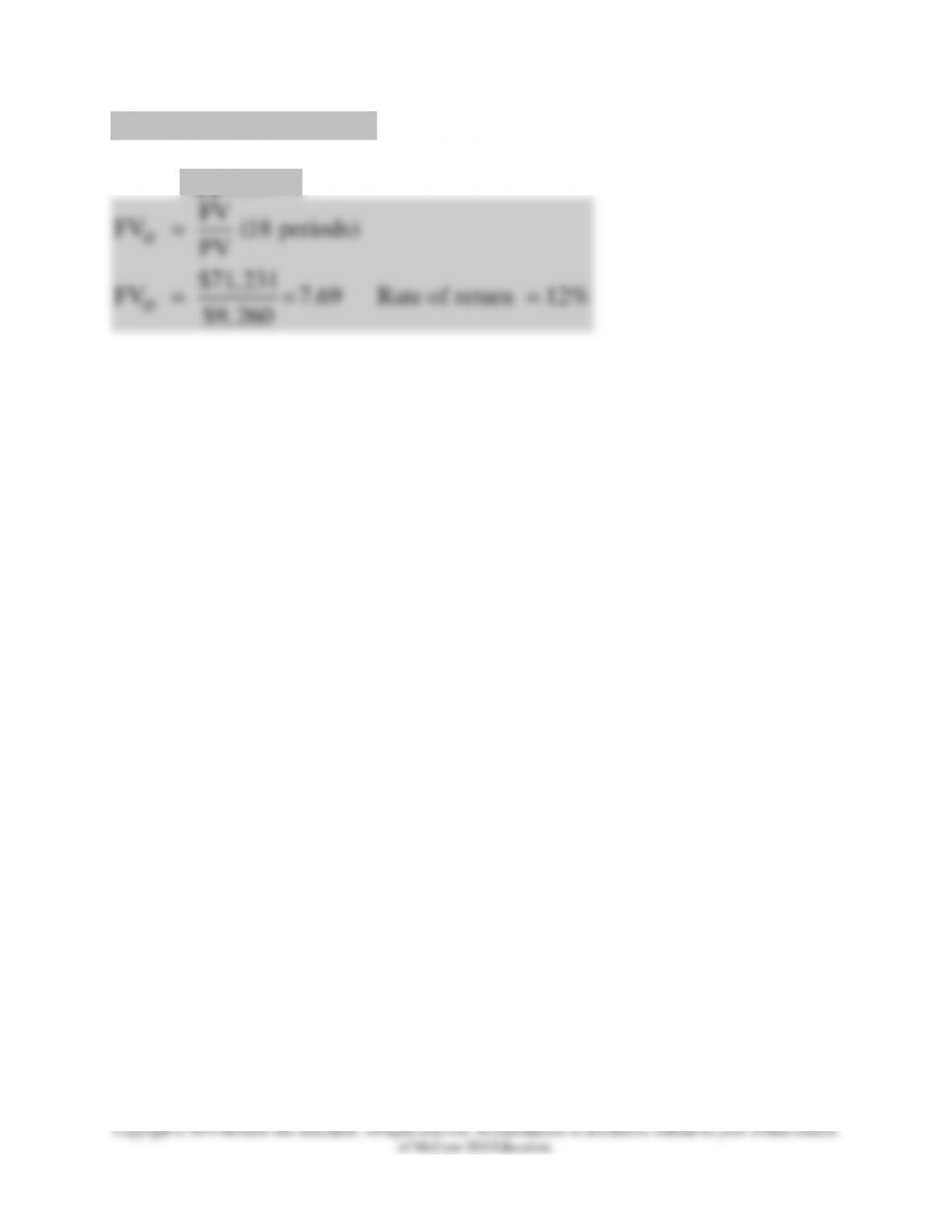
Alternative solution
Appendix A
IF
IF
FV
FV (18 periods)
PV
$71, 231
FV 7.69 Rate of return 12%
$9, 260
=
= = =
33. Yield with interpolation (LO9-4) Mr. Dow bought 100 shares of stock at $14 per share.
Three years later, he sold the stock for $20 per share. What is his annual rate of return?
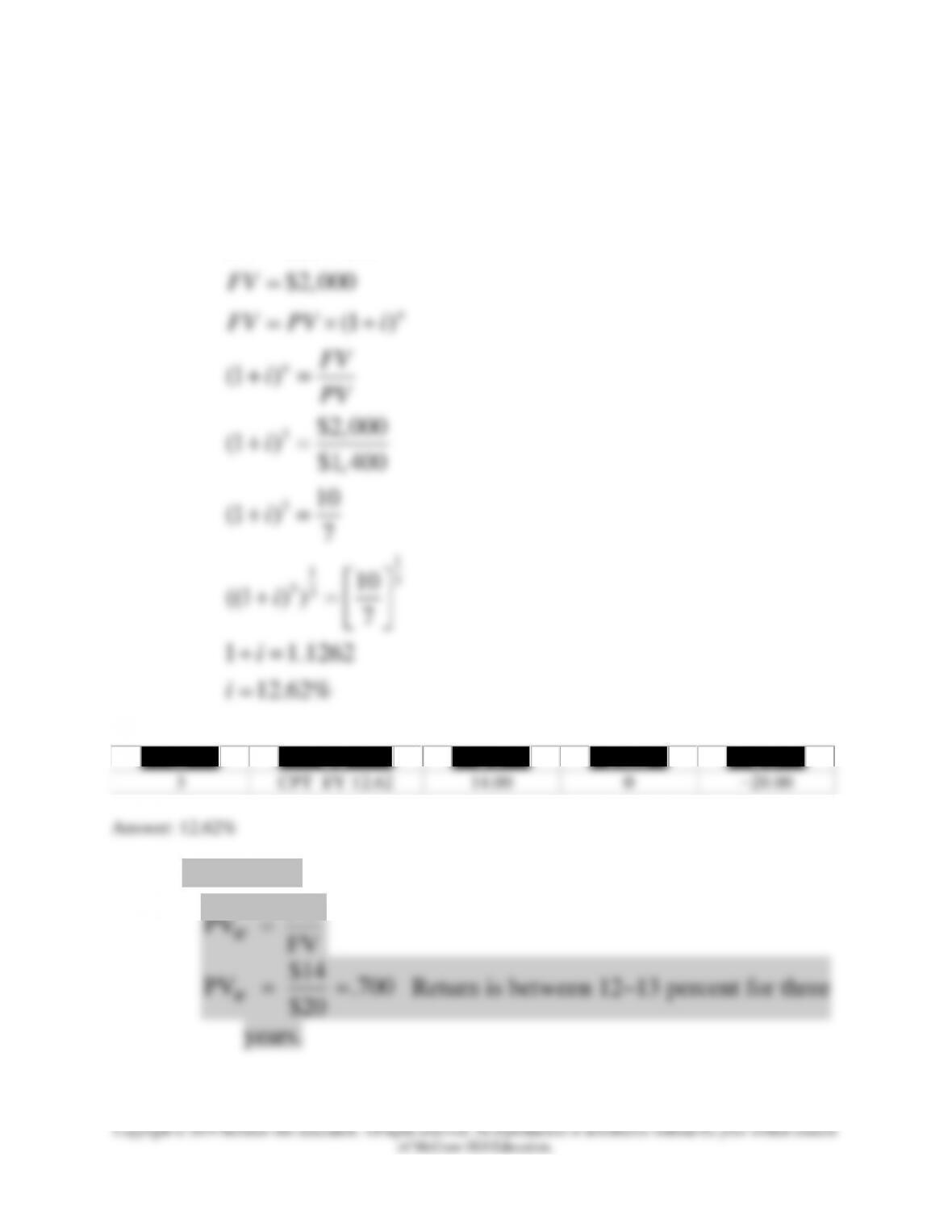
9-33. Solution:
3
3
1
13
$14 100
$1,400
$20 100
$2,000
(1 )
(1 )
$2,000
(1 ) $1,400
10
(1 ) 7
n
n
PV
PV
FV
FV
FV PV i
FV
i
PV
i
i
=
=
=
=
= +
+=
+=
+=
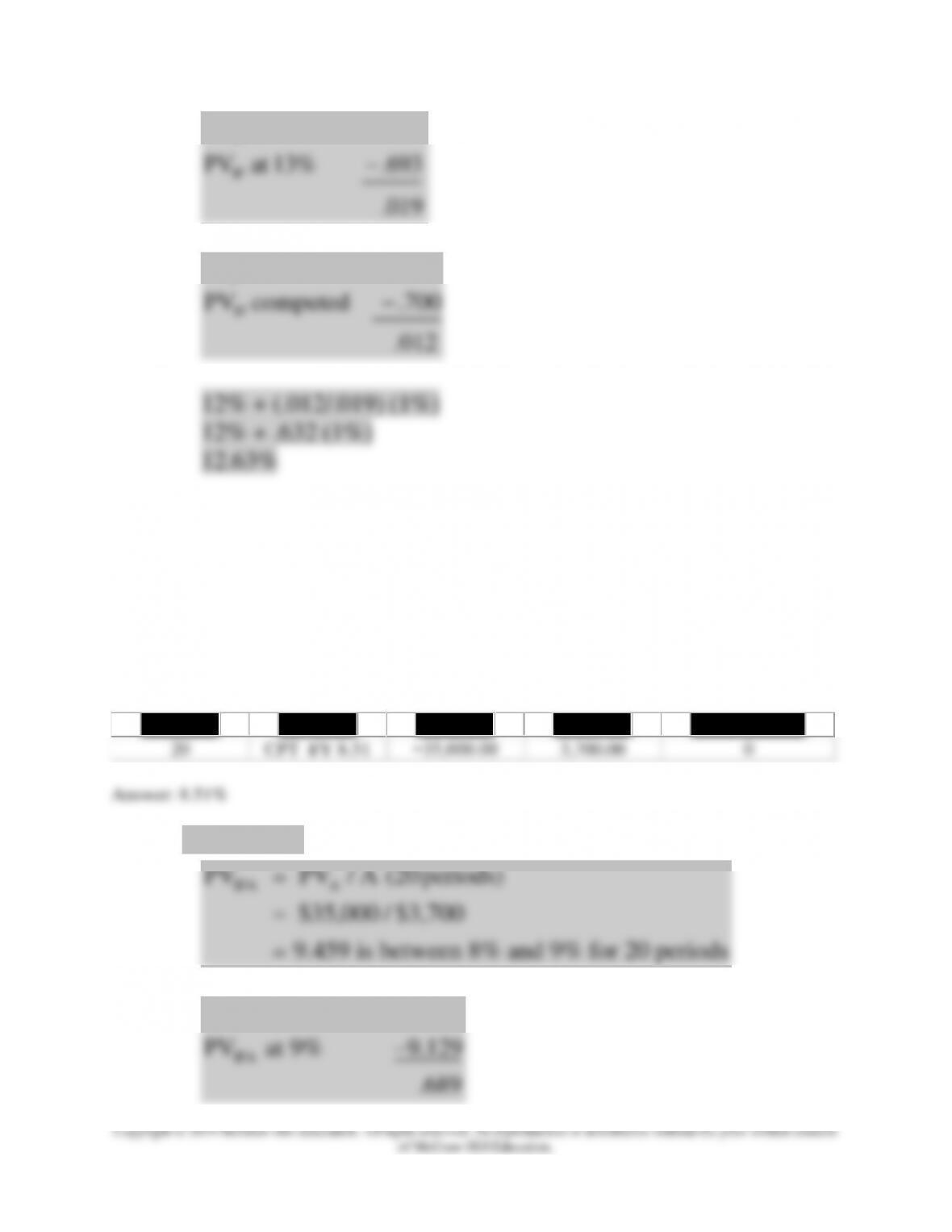
IF
IF
PV at 12% .712
PV at 13% .693
.019
−
IF
IF
PF at 12% .712
PV computed .700
.012
−
12% + (.012/.019) (1%)
12% + .632 (1%)
12.63%
34. Yield with interpolation (LO9-4) C. D. Rom has just given an insurance company
$35,000. In return, he will receive an annuity of $3,700 for 20 years.
At what rate of return must the insurance company invest this $35,000 in order to make
the annual payments? Interpolate.
9-34. Solution:
Calculator Solution:
N
I/Y
PV
PMT
FV
20
CPT I/Y 8.51
−35,000.00
3,700.00
0
Answer: 8.51%
Appendix D
IFA A
PV PV / A (20 periods)
$35,000 / $3,700
9.459 is between 8% and 9% for 20 periods
=
=
=
IFA
IFA
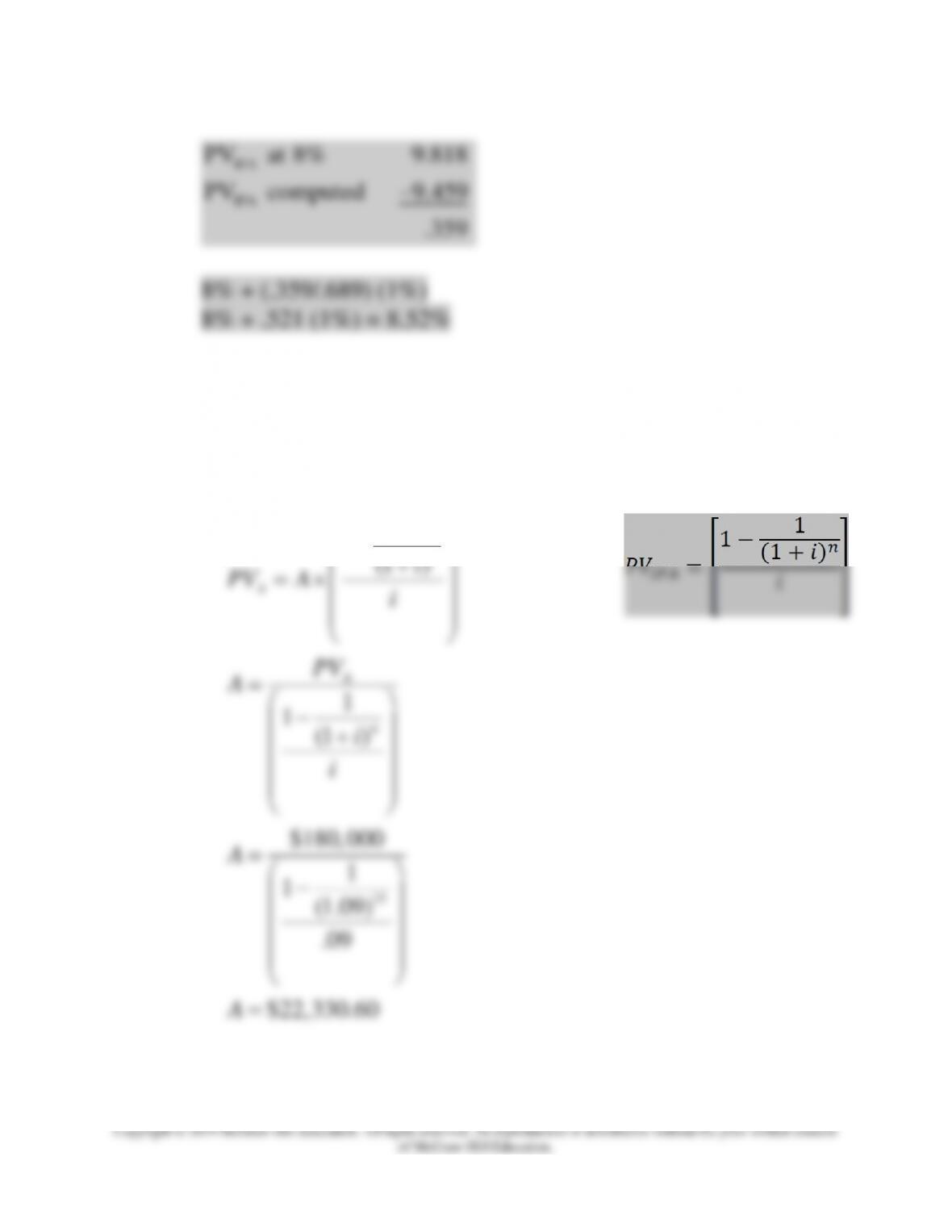
PV at 8% 9.818
PV at 9% 9.129
.689
−
35. Betty Bronson has just retired after 25 years with the electric company. Her total pension
funds have an accumulated value of $180,000, and her life expectancy is 15 more years.
Her pension fund manager assumes he can earn a 9 percent return on her assets. What will
be her yearly annuity for the next 15 years?
9-35. Solution:
1
1(1 )
1
1(1 )
n
A
A
n
i
PV A
i
PV
A
i
−
+
=
=
−
+
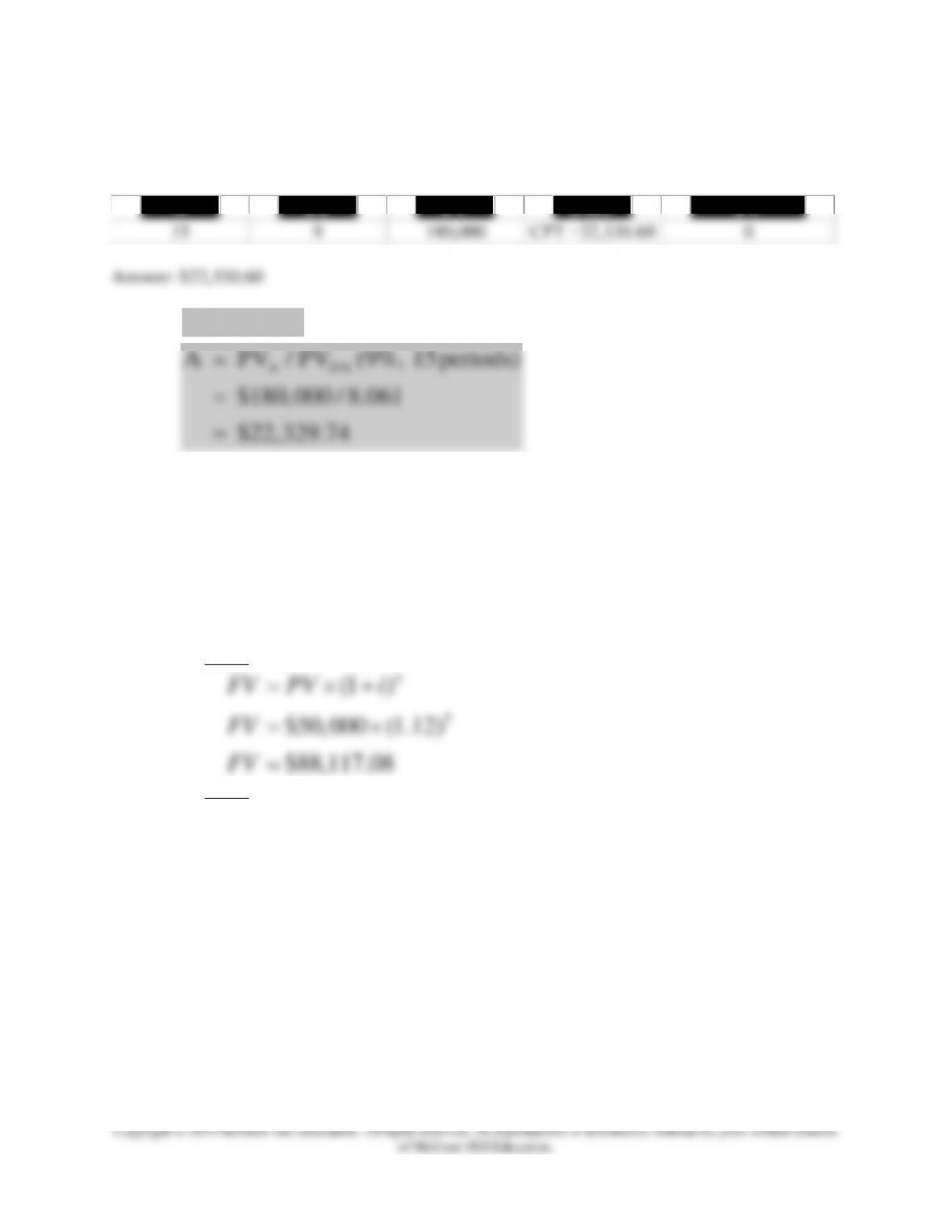
Calculator Solution:
N
I/Y
PV
PMT
FV
15
9
180,000
CPT −22,330.60
0
Answer: $22,330.60
Appendix D
A IFA
A PV / PV (9%, 15periods)
$180,000 / 8.061
$22,329.74
=
=
=
36. Morgan Jennings, a geography professor, invests $50,000 in a parcel of land that is
expected to increase in value by 12 percent per year for the next five years. He will take the
proceeds and provide himself with a 10-year annuity. Assuming a 12 percent interest rate,
how much will this annuity be?
9-36. Solution:
Part 1
5
(1 )
$88,117.08
n
FV PV i
FV
= +
=
Part 2
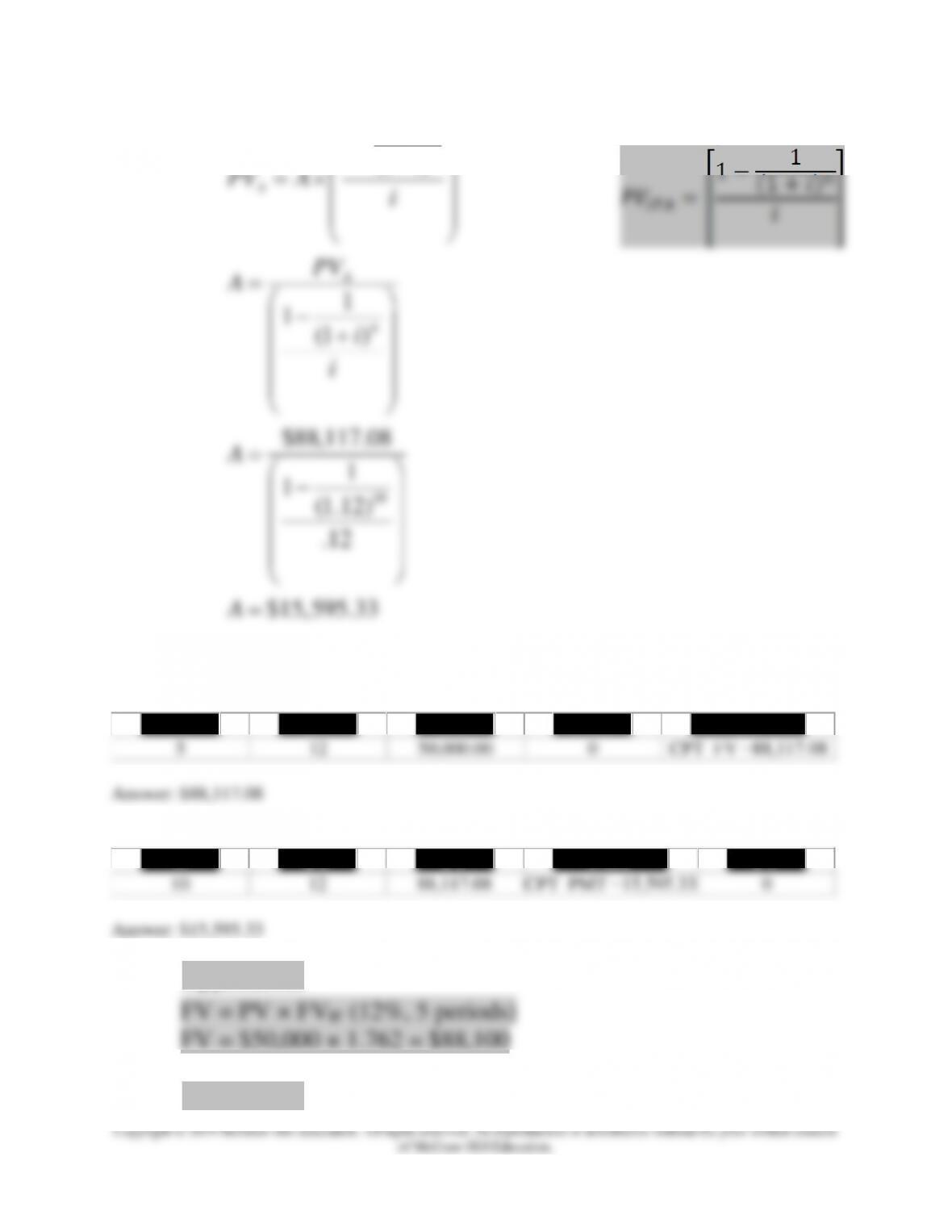
10
1
1(1 )
1
1(1 )
$88,117.08
1
1(1.12)
.12
n
A
A
n
i
PV A
i
PV
A
i
i
A
−
+
=
=
−
+
=
−
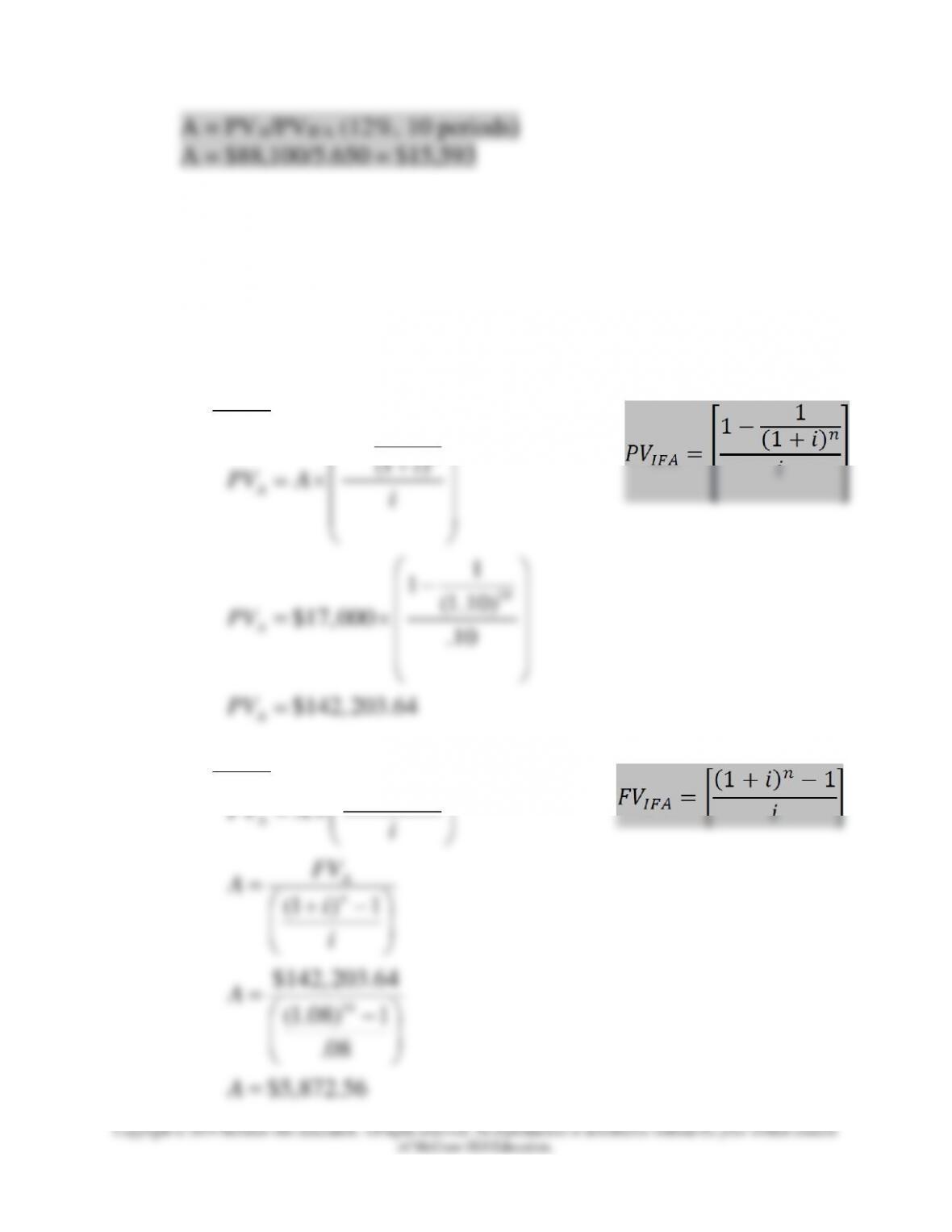
37. Solving for an annuity (LO9-4) You wish to retire in 14 years, at which time you want to
have accumulated enough money to receive an annual annuity of $17,000 for 19 years after
retirement. During the period before retirement you can earn 8 percent annually, while after
retirement you can earn 10 percent on your money.
What annual contributions to the retirement fund will allow you to receive the $17,000
annuity?
9-37. Solution:
Part 1
19
1
1(1 )
1
1(1.10)
n
A
i
PV A
i
−
+
=
−
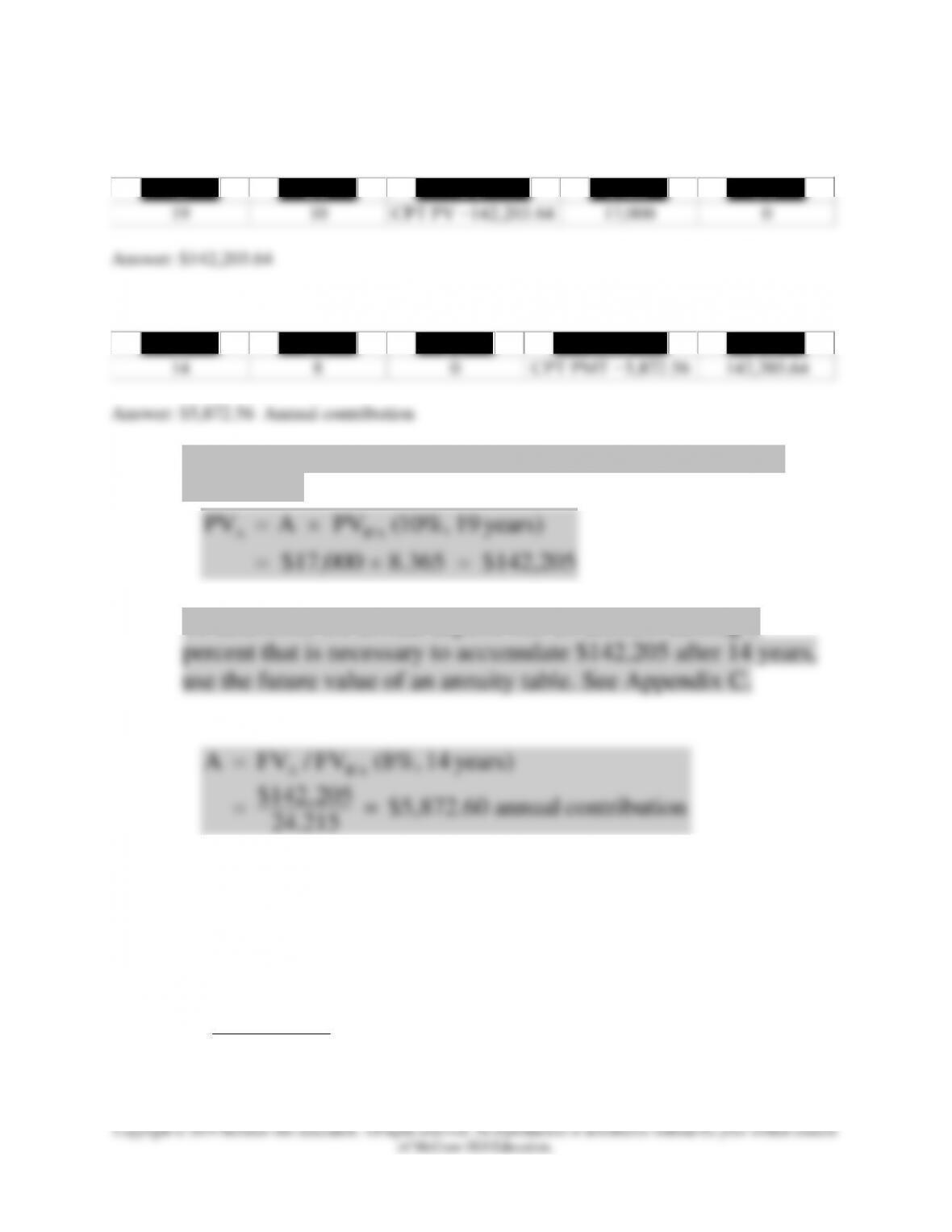
Calculator Solution:
Determine the present value of a 14-year annuity during retirement:
N
I/Y
PV
PMT
FV
19
10
CPT PV −142,203.64
17,000
0
Answer: $142,203.64
To determine the annual deposit into an account earning 8% that is necessary to accumulate
$142,203.64 after 14 years, solve for the annuity:
N
I/Y
PV
PMT
FV
14
8
0
CPT PMT −5,872.56
142,203.64
Determine the present value of an annuity during retirement:
Appendix D
A IFA
PV A PV (10%, 19 years)
$17,000 8.365 $142,205
=
= =
To determine the annual deposit into an account earning 8
A IFA
A FV / FV (8%, 14 years)
$142,205 = $5,872.60 annual contribution
24.215
=
=
38. Del Monty will receive the following payments at the end of the next three years: $2,000,
$3,500, and $4,500. Then, from the end of the 4th through the end of the 10th year, he will
receive an annuity of $5,000 per year. At a discount rate of 9 percent, what is the present
value of all three future benefits?
9-38. Solution:
Payment #1
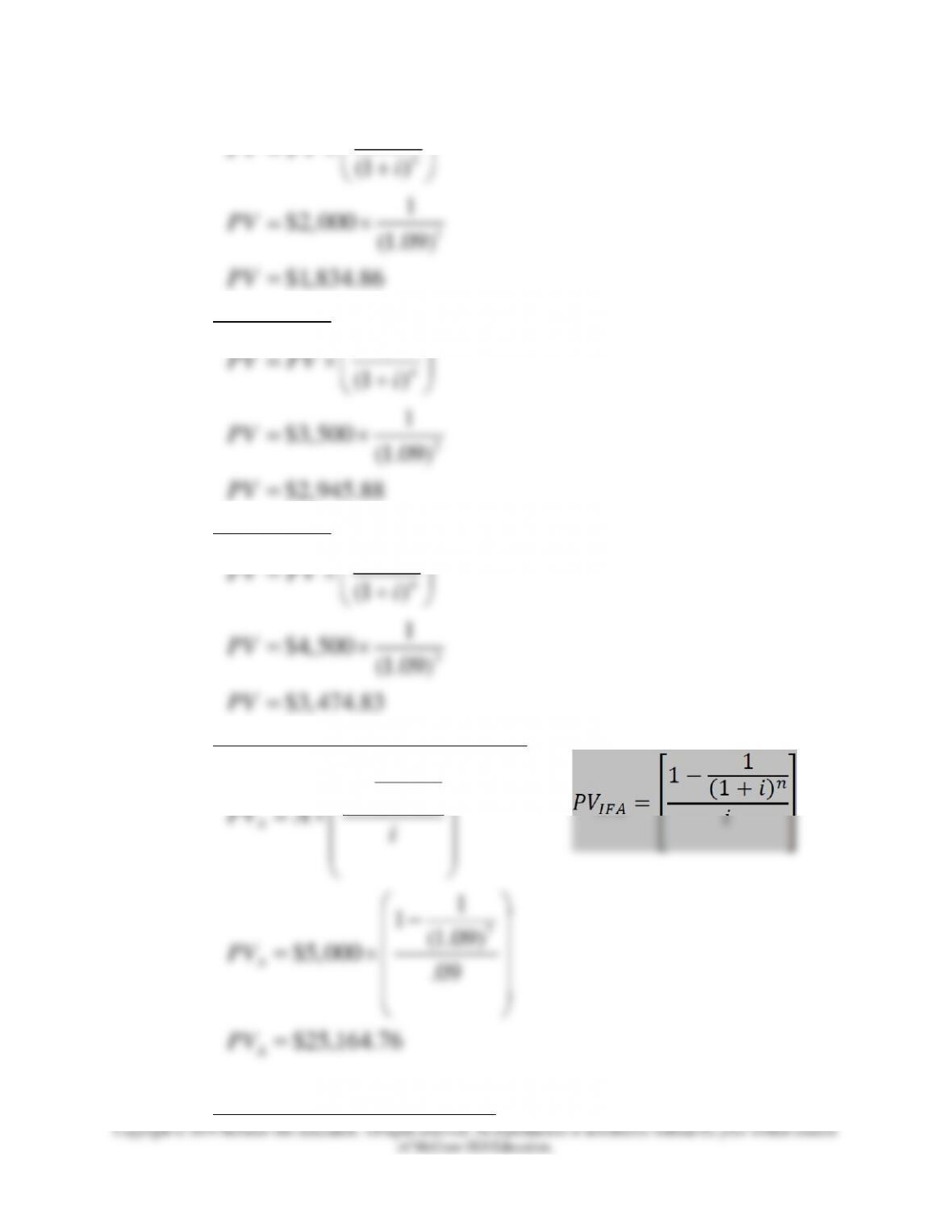
1
(1 )
1
n
PV FV
i
=
+
3
1
(1 )
1
$19,431.81
n
PV FV
i
PV
=
+
=
Total Present Value
$ 1,834.86 Payment #1
+ 2,945.88 Payment #2
Calculator Solution:
First find the present value of the first three payments.
N
I/Y
PV
PMT
FV
1
9
CPT PV −1,834.86
0
2,000
Answer: $1,834.86
N
I/Y
PV
PMT
FV
2
9
CPT PV −2,945.88
0
3,500
Answer: $2,945.88
N
I/Y
PV
PMT
FV
3
9
CPT PV −3,474.83
0
4,500
Answer: $3,474.83
Total = 1,834.86 + 2,945.88 + 3,474.83 = $8,255.57 as of now
Then find the present value of the deferred annuity.
N
I/Y
PV
PMT
FV
7
9
CPT PV −25,164.76
5,000
0
Answer: $25,164.76 as of the end of year 3.
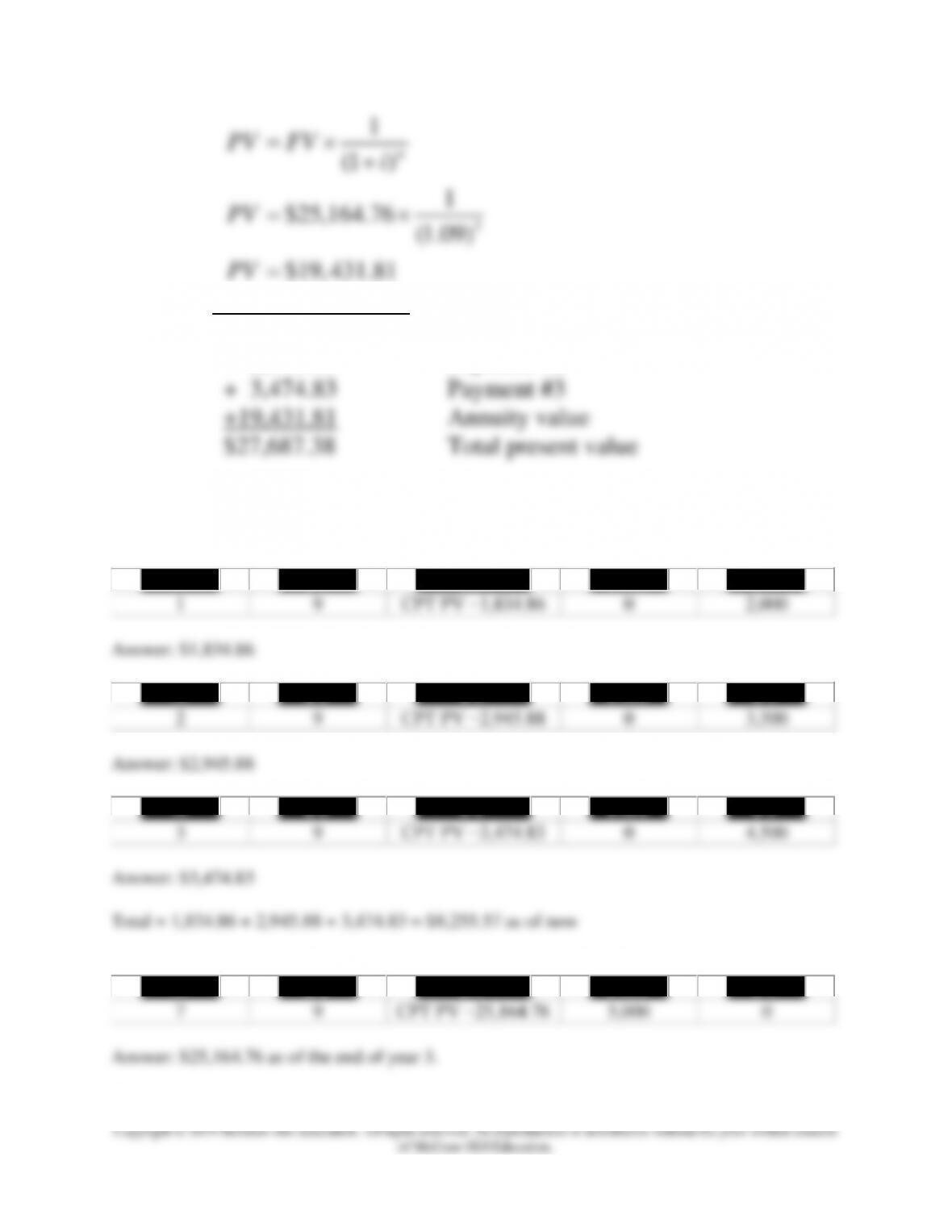
Then, find its PV as of now:
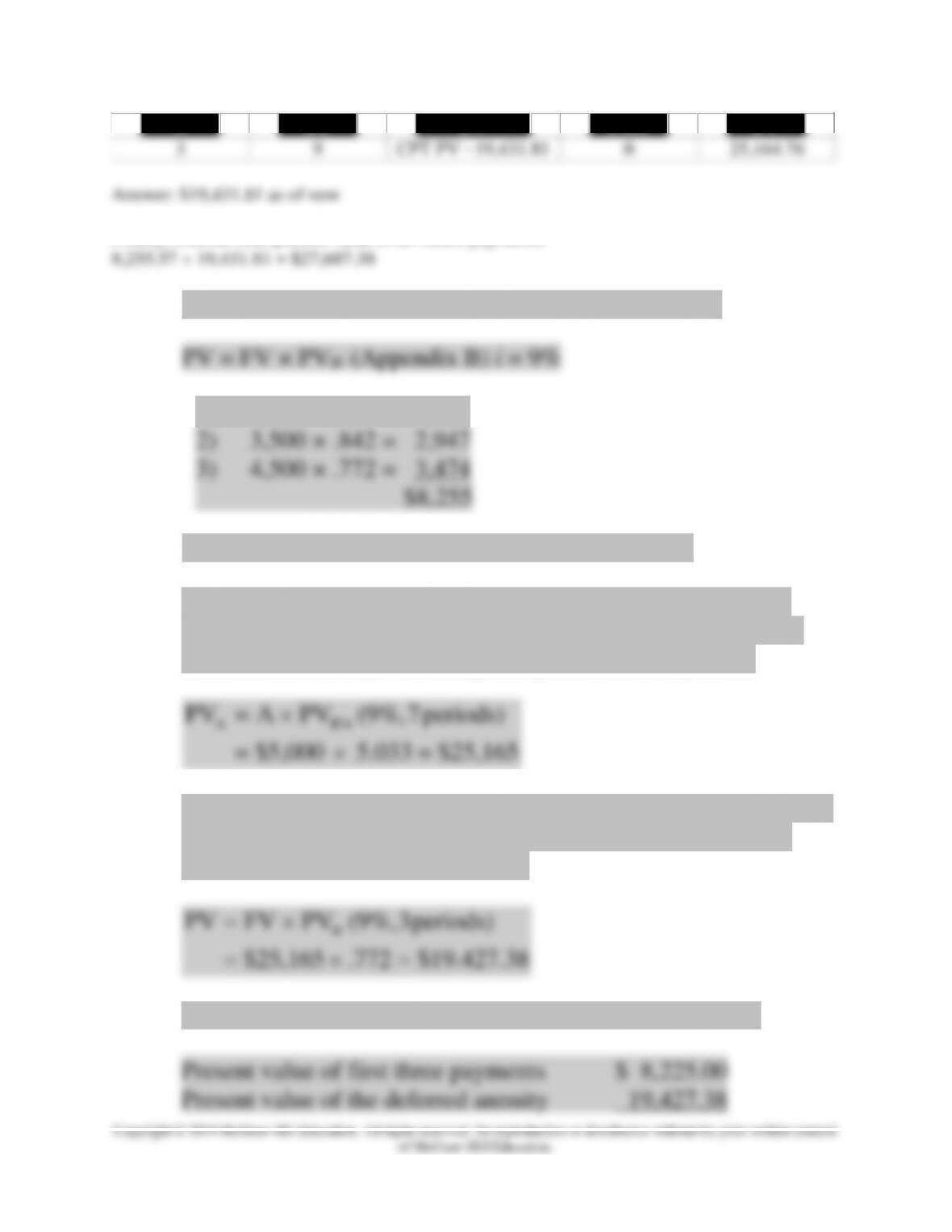
N
I/Y
PV
PMT
FV
3
9
CPT PV −19,431.81
0
25,164.76
Answer: $19,431.81 as of now
Finally, find the total present value of all future payments.
8,255.57 + 19,431.81 = $27,687.38
First find the present value of the first three payments.
PV = FV × PVIF (Appendix B) i = 9%
1) $2,000 × .917 = $1,834
2) 3,500 × .842 = 2,947
$8,255
Then find the present value of the deferred annuity.
year through the 10th year) at a discount rate of 9 percent. The
value of the annuity at the beginning of the fourth year is:
A IFA
PV A PV (9%,7periods)
$5,000 5.033 $25,165
=
= =
deferred annuity. Use Appendix B.
IF
PV FV PV (9%,3periods)
$25,165 .772 $19.427.38
=
= =
Present value of first three payments $ 8,225.00
Present value of the deferred annuity 19,427.38
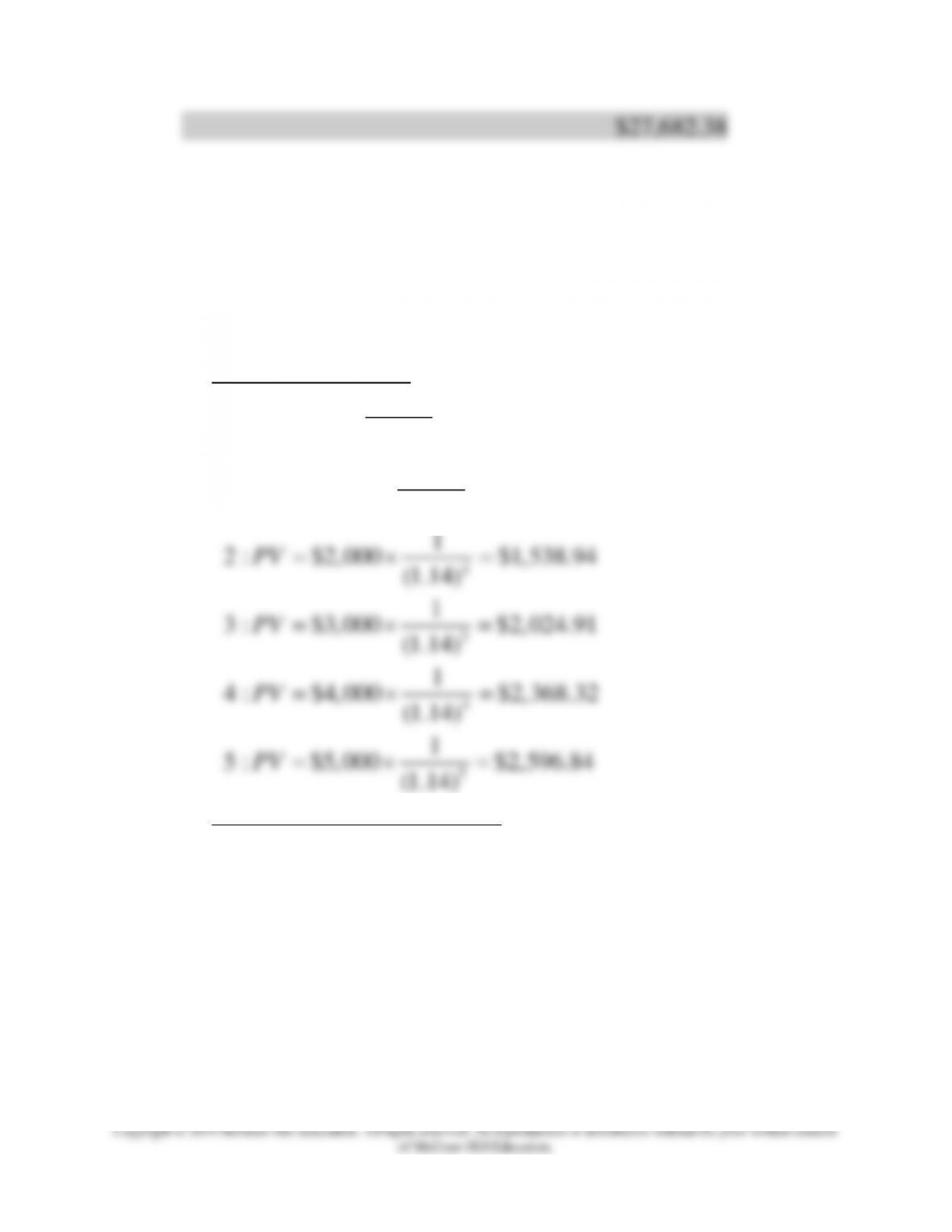
$27,682.38
39. Bridget Jones has a contract in which she will receive the following payments for the next
five years: $1,000, $2,000, $3,000, $4,000, and $5,000. She will then receive an annuity
of $8,500 a year from the end of the 6th through the end of the 15th year. The appropriate
discount rate is 14 percent. If she is offered $30,000 to cancel the contract, should she do it?
9-39. Solution:
First Five Payments
1 :
1
1
(1 )
1
$1,000 $877.19
(1.14)
n
PV FV
i
PV
=
+
= =
1
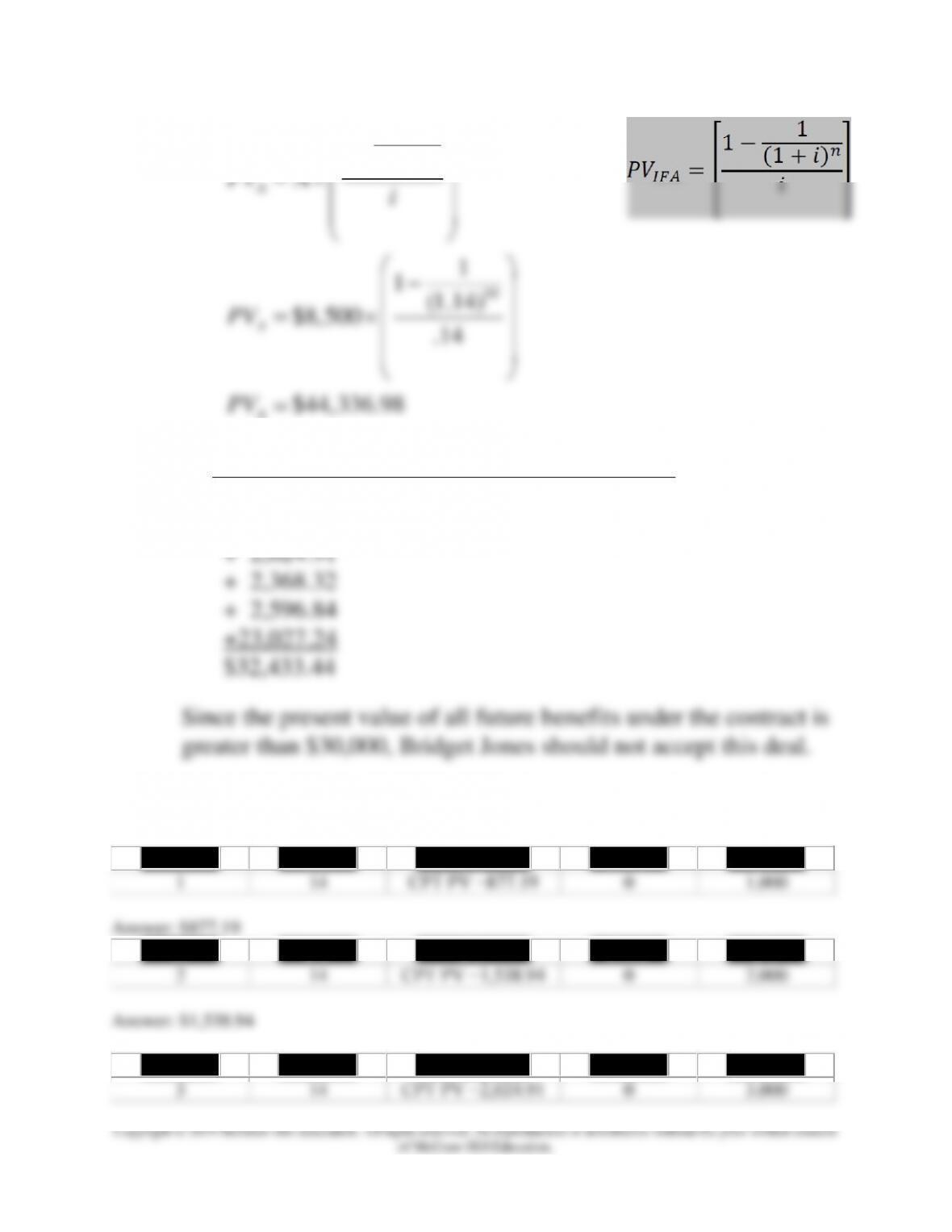
10
1
1(1 )
1
1(1.14)
n
A
i
PV A
i
−
+
=
−
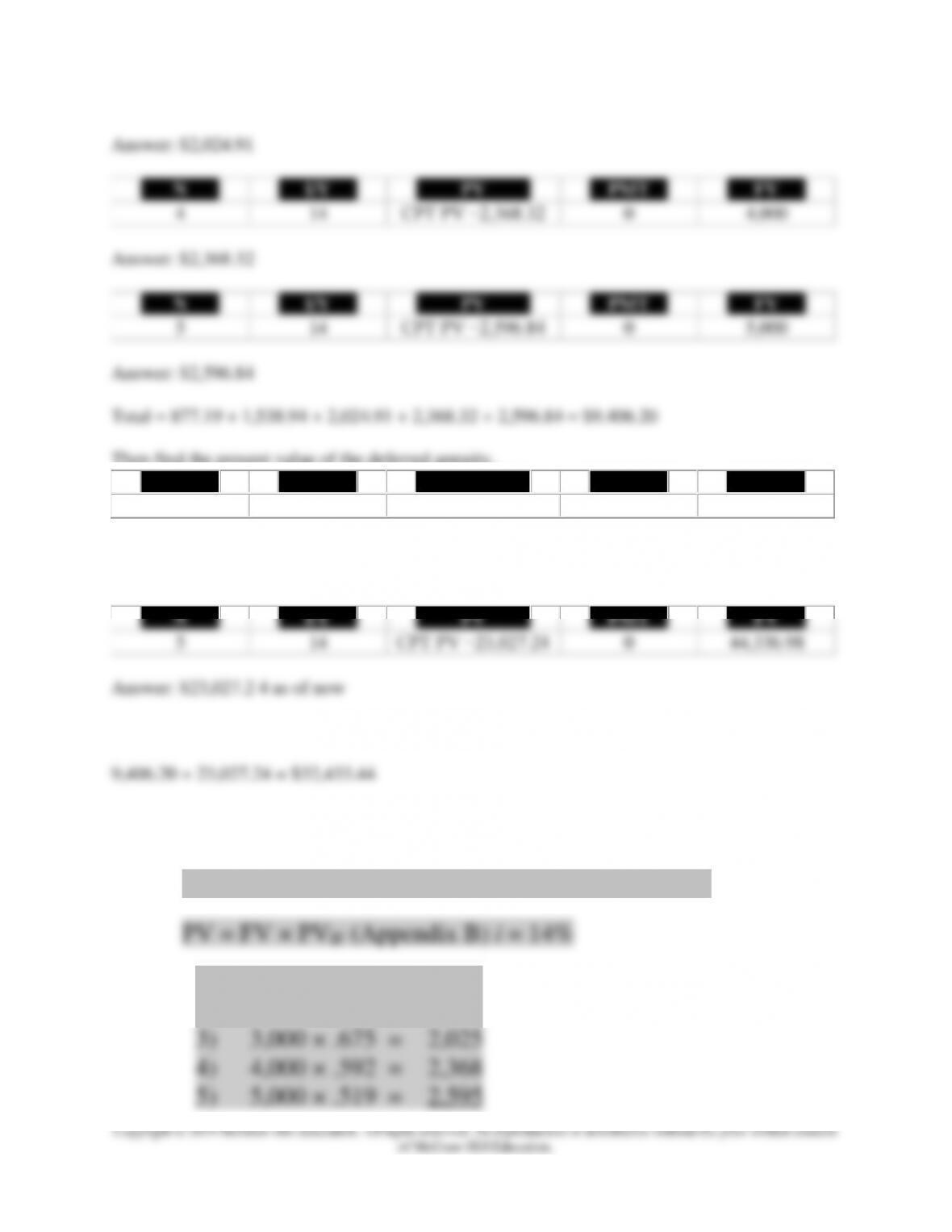
N
I/Y
PV
PMT
FV
4
14
CPT PV −2,368.32
0
4,000
N
I/Y
PV
PMT
FV
5
14
CPT PV −2,596.84
0
5,000
Total = 877.19 + 1,538.94 + 2,024.91 + 2,368.32 + 2,596.84 = $9,406.20
Then find the present value of the deferred annuity.
N
I/Y
PV
PMT
FV
10
14
CPT PV −44,336.98
8,500
0
Answer: $44,336.98 as of the end of year 5
Then find it PV as of now:
N
I/Y
PV
PMT
FV
5
14
CPT PV −23,027.24
0
44,336.98
Answer: $23,027.2 4 as of now
Finally, find the total present value of all future payments.
9,406.20 + 23,027.24 = $32,433.44
Since the present value of all future benefits under the contract is greater than $30,000, Bridget
Jones should not accept this amount to cancel the contract.
First find the present value of the first five payments.
PV = FV × PVIF (Appendix B) i = 14%
1) $1,000 × .877 = $ 877
2) 2,000 × .769 = 1,538
5) 5,000 × .519 = 2,595
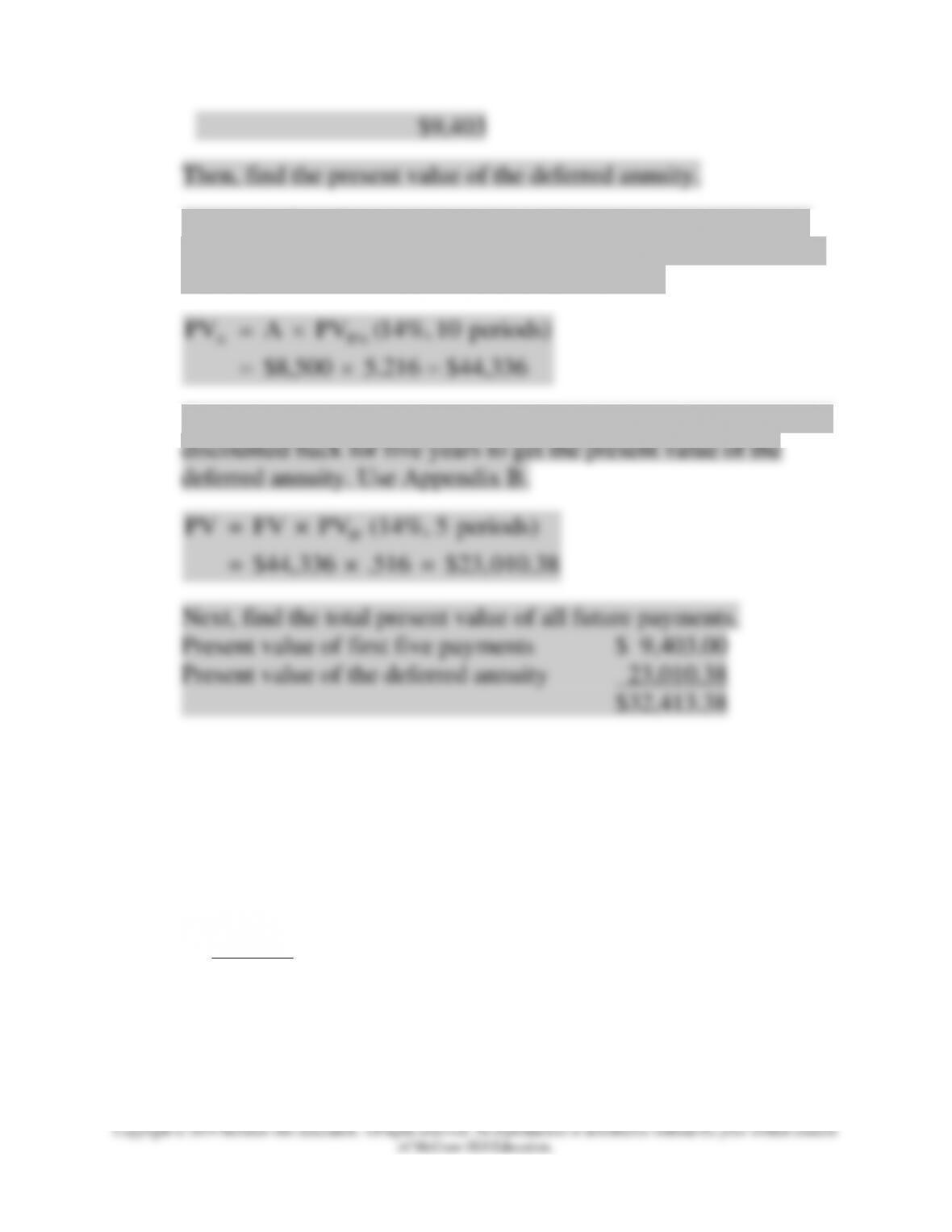
$9,403
Then, find the present value of the deferred annuity.
Appendix D will give a factor for a 10-period annuity (6th year
through the 15th year) at a discount rate of 14 percent. The value
of the annuity at the beginning of the 6th year is:
A IFA
PV A PV (14%, 10 periods)
$8,500 5.216 $44,336
=
= =
This value at the beginning of year 6 (end of year 5) must now be
discounted back for five years to get the present value of the
deferred annuity. Use Appendix B.
IF
PV = FV × PV (14%, 5 periods)
= $44,336 × .516 = $23,010.38
Present value of the deferred annuity 23,010.38
$32,413.38
9-40. Solution:
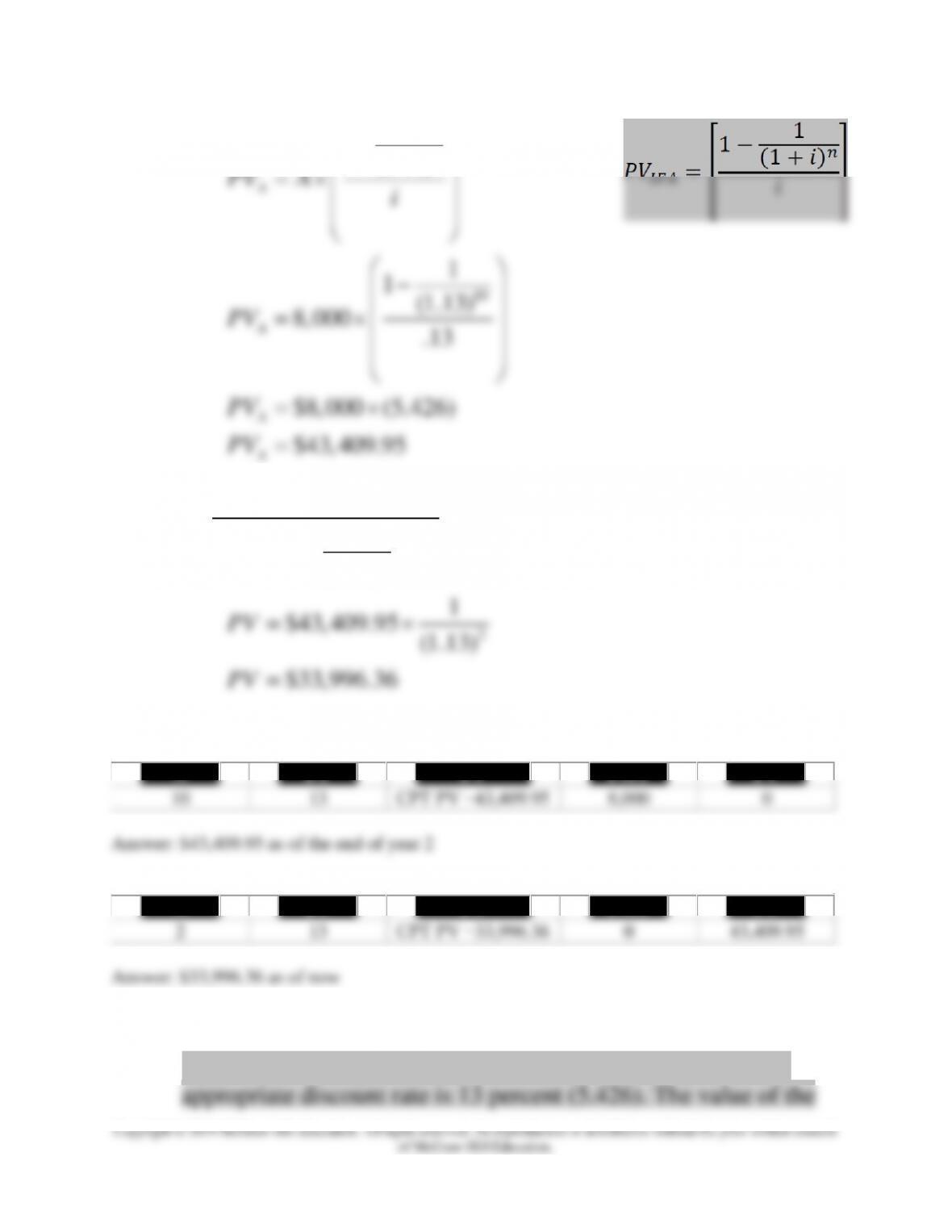
1
1(1 )
1
n
A
i
PV A
i
−
+
=