Chapter 9
Time Value of Money
Discussion Questions
9-1.
How is the future value (Appendix A) related to the present value of a single
sum (Appendix B)?
The future value represents the expected worth of a single amount, whereas the
present value represents the current worth.
FV = PV (1 + i)n future value
( )
luePresent va
1
1
FVPV
+
=n
i
9-2.
How is the present value of a single sum (Appendix B) related to the present
value of an annuity (Appendix D)?
The present value of a single amount is the discounted value for one future
payment, whereas the present value of an annuity represents the discounted
value of a series of consecutive future payments of equal amount.
9-3.
Why does money have a time value?
Money has a time value because funds received today can be invested to reach a
greater value in the future. A person would rather receive $1 today than $1 in
10 years, because a dollar received today, invested at 6 percent, is worth $1.791
after 10 years.
9-4.
Does inflation have anything to do with making a dollar today worth more than
a dollar tomorrow?
Inflation makes a dollar today worth more than a dollar in the future. Because
inflation tends to erode the purchasing power of money, funds received today
will be worth more than the same amount received in the future.
9-5.
Adjust the annual formula for a future value of a single amount at 12 percent
for 10 years to a semiannual compounding formula. What are the interest
factors (FVIF) before and after? Why are they different?
( )
IF
FV PV FV Appendix A
12%, 10 3.106 Annual
6%, 20 3.207 Semiannual
in
in
=
==
==
The more frequent compounding under the semiannual compounding
assumption increases the future value so that semiannual compounding is worth
.101 more per dollar.
9-6.
If, as an investor, you had a choice of daily, monthly, or quarterly
compounding, which would you choose? Why?
The greater the number of compounding periods, the larger the future value.
The investor should choose daily compounding over monthly or quarterly.
9-7.
What is a deferred annuity?
A deferred annuity is an annuity in which the equal payments will begin at
some future point in time.
9-8.
List five different financial applications of the time value of money.
Different financial applications of the time value of money:
Equipment purchase or new product decision
Present value of a contract providing future payments
Future value of an investment
Regular payment necessary to provide a future sum
Regular payment necessary to amortize a loan
Determination of return on an investment
Determination of the value of a bond
Chapter 9
Problems
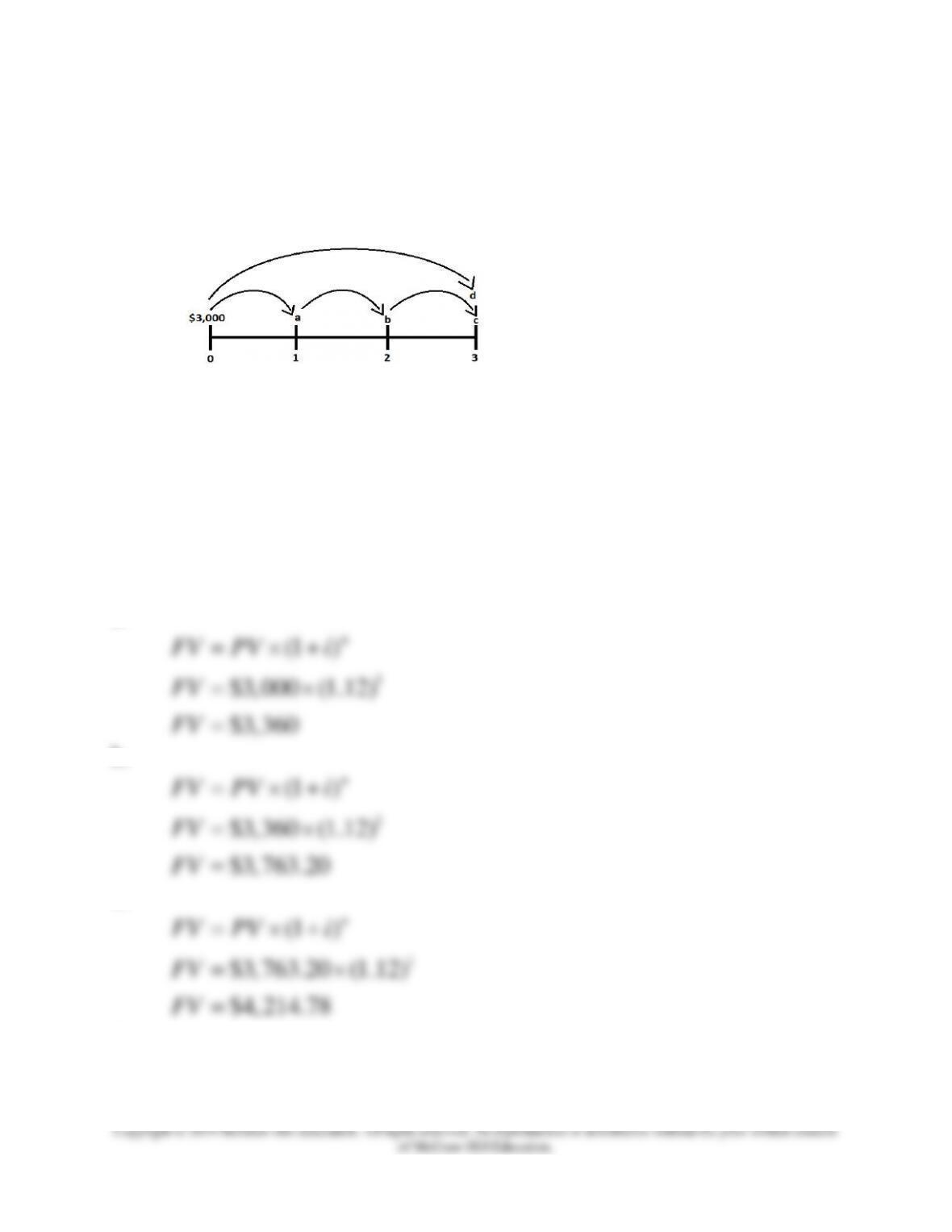
1.You invest $3,000 for three years at 12 percent.
a. What is the value of your investment after one year? Multiply $3,000 × 1.12.
b. What is the value of your investment after two years? Multiply your answer to part a
by 1.12.
c. What is the value of your investment after three years? Multiply your answer to part b
by 1.12. This gives your final answer.
d. Combine these three steps by using the formula
( )
1n
FV PV i= +
to find the future
value of $3,000 in 3 years at 12 percent interest.
9-1. Solution:
a.
1
(1 )
$3,360
n
FV PV i
FV
= +
=
b.
1
(1 )
$3,763.20
n
FV PV i
FV
= +
=
c.
1
(1 )
$4,214.78
n
FV PV i
FV
= +
=
d.
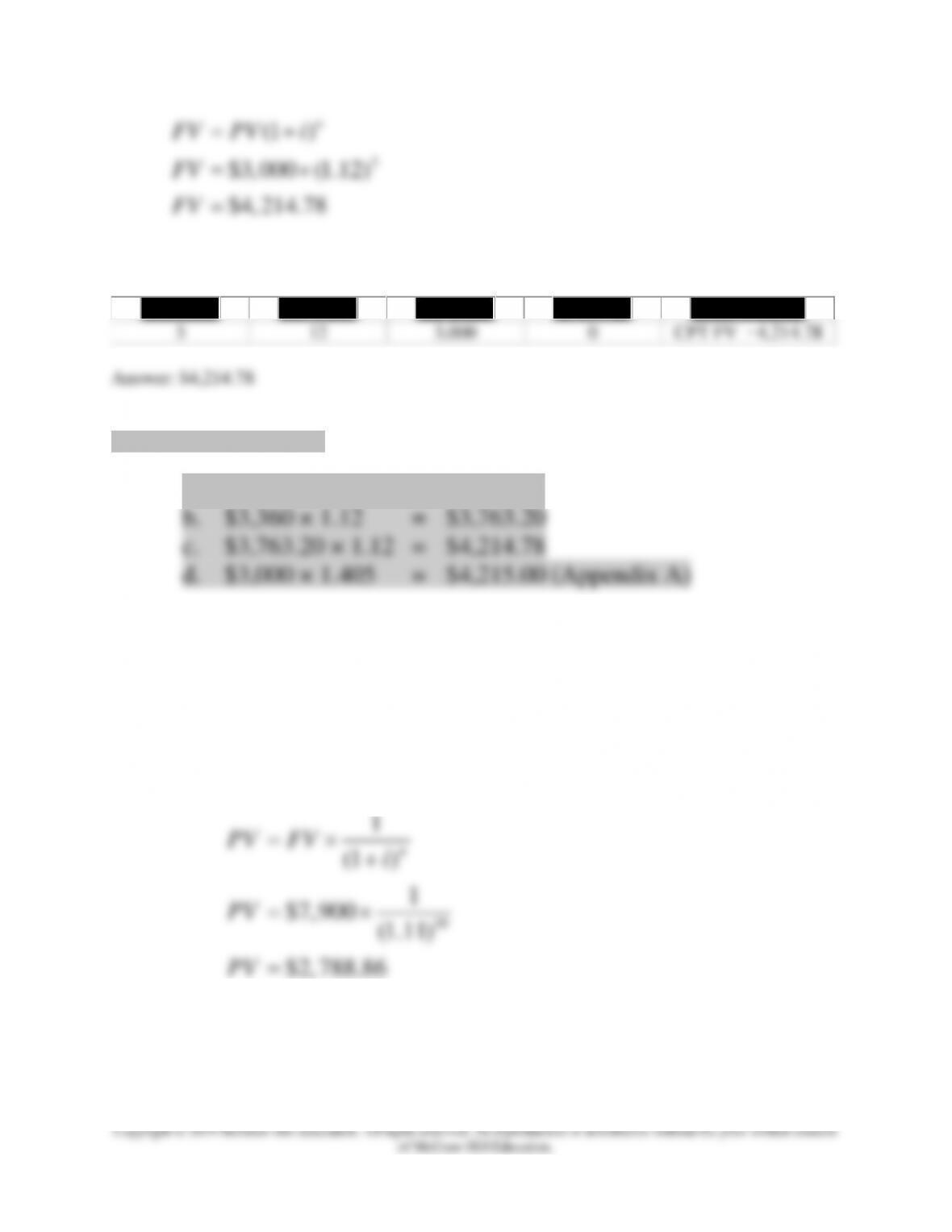
3
(1 )
$3,000 (1.12)
$4, 214.78
n
FV PV i
FV
FV
=+
=
=
Calculator Solution:
(d)
N
I/Y
PV
PMT
FV
3
12
3,000
0
CPT FV −4,214.78
Answer: $4,214.78
Solution using TVM Tables:
a. $3,000 × 1.12 = $3,360.00
2. Present value (LO9-3) What is the present value of
a. $7,900 in 10 years at 11 percent?
b. $16,600 in 5 years at 9 percent?
c. $26,000 in 14 years at 6 percent?
9-2. Solution:
a.
10
1
(1 )
1
$2,788.86
n
PV FV
i
PV
=
+
=
b.
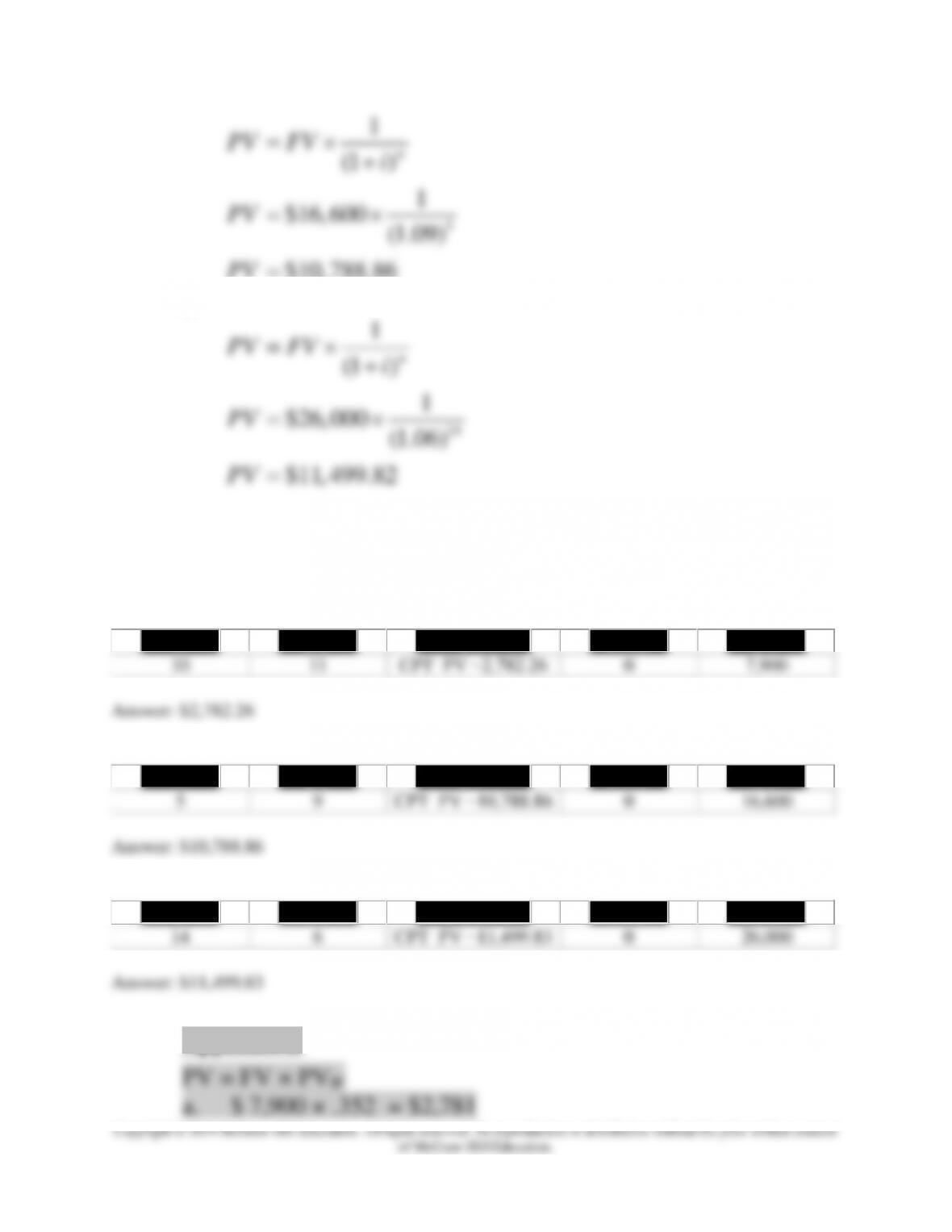
1
(1 )
1
n
PV FV
i
=
+
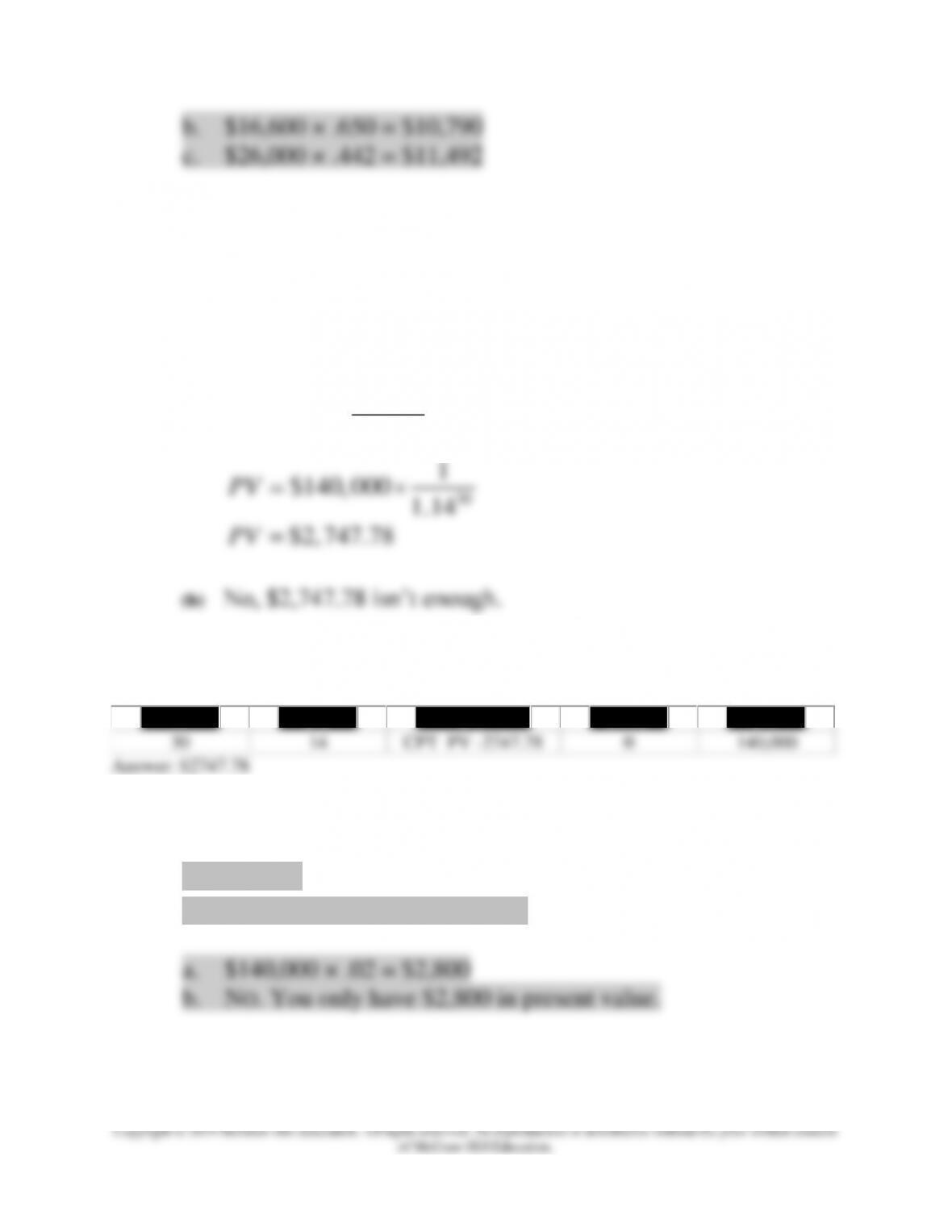
3. Present Value (LO9-3)
a. What is the present value of $140,000 to be received after 30 years with a
14 percent discount rate?
b. Would the present value of the funds in part a be enough to buy a $2,900 concert
ticket?
9-3. Solution:
(a)
1
(1 )n
PV FV
i
=
+
1
$140,000 1.14
PV =
Calculator Solution:
(a)
N
I/Y
PV
PMT
FV
30
14
CPT PV -2747.78
0
140,000
Answer: $2747.78
(b)
No. You only have $2747.78.
Appendix B
PV = FV × PVIF (14%, 30 periods)
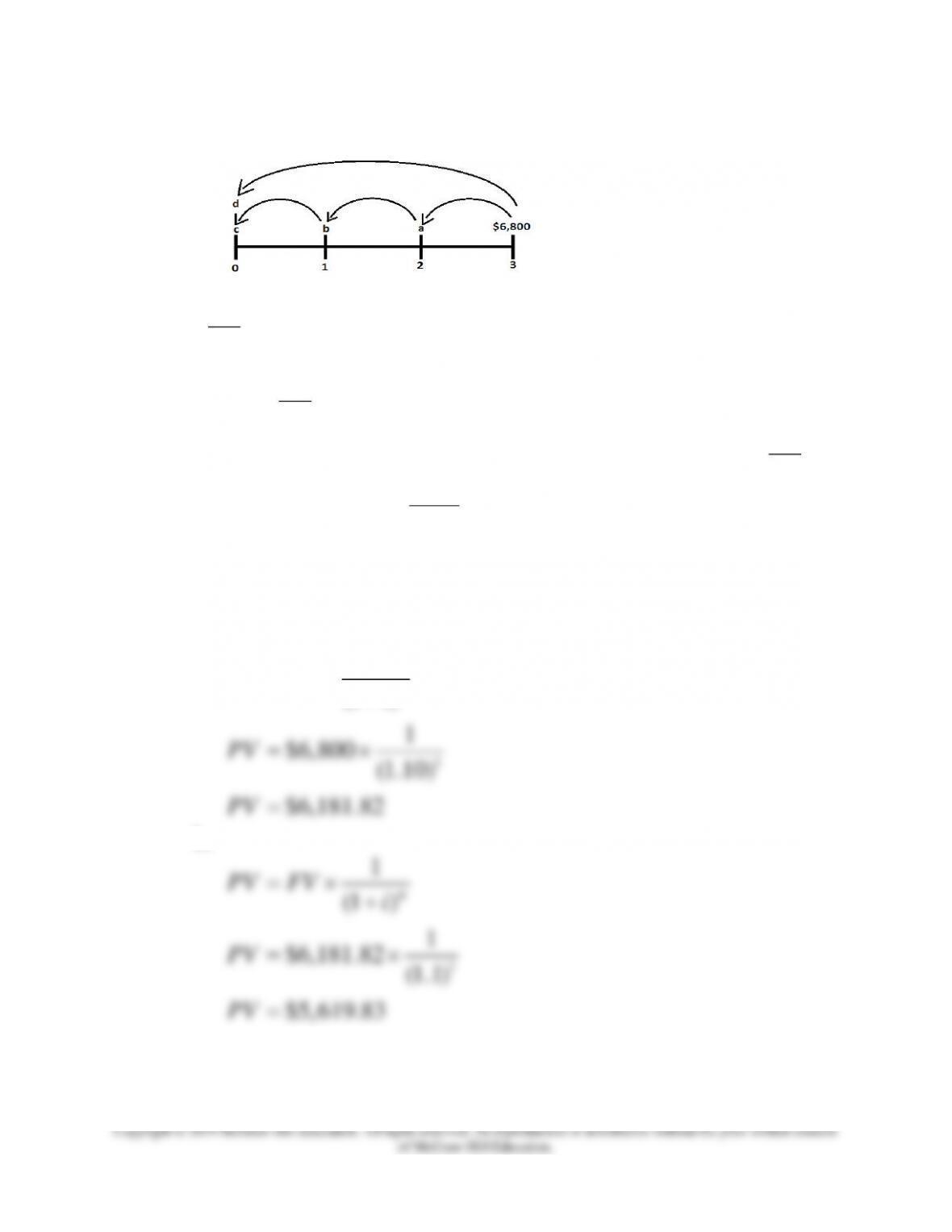
4. Present Value (LO9-4) you will receive $6,800 three years from now. The discount rate is
10 percent.
a. What is the value of your investment two years from now? Multiply $6,800 by
1
1.10
or divide by 1.10 (one year’s discount rate at 10 percent).
b. What is the value of your investment one year from now? Multiply your answer to
part a by
1
1.10
.
c. What is the value of your investment today? Multiply the part b answer by
1
1.10
.
d. Use the formula
1
(1 )n
PV FV
i
=
+
to find the present value of $6,800 received three
years from now at 10 percent interest.
9-4. Solution:
a.
1
(1 )
1
n
PV FV
i
=
+
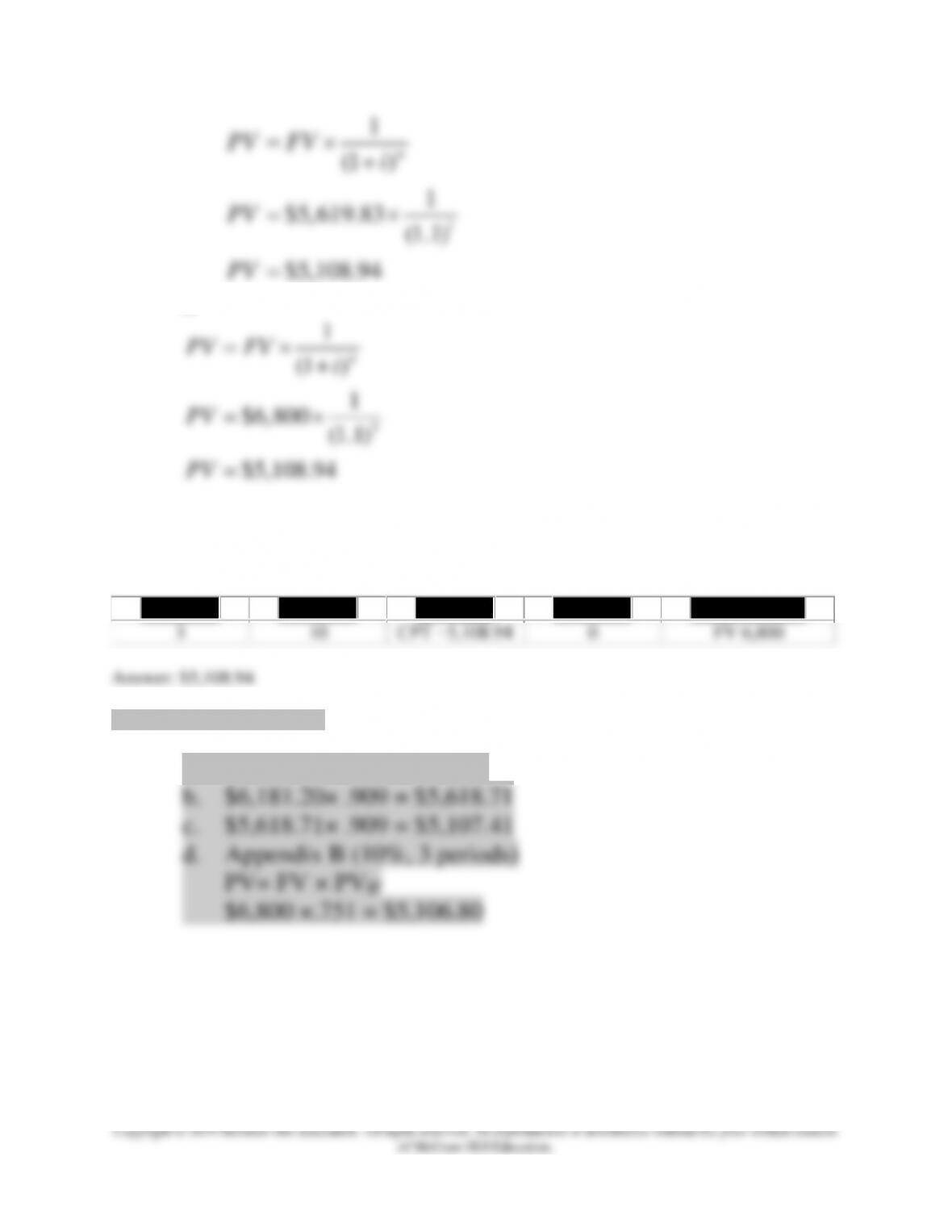
1
1
(1 )
1
$5,108.94
n
PV FV
i
PV
=
+
=
d.
3
1
(1 )
1
$6,800 (1.1)
$5,108.94
n
PV FV
i
PV
PV
=
+
=
=
Calculator Solution:
(d)
N
I/Y
PV
PMT
FV
3
10
CPT −5,108.94
0
FV 6,800
Answer: $5,108.94
Solution using TVM Tables:
a. $6,800 × .909 = $6,181.20
b. $6,181.20× .909 = $5,618.71
c. $5,618.71× .909 = $5,107.41
d. Appendix B (10%, 3 periods)
PV= FV × PVIF
$6,800 ×.751 = $5,106.80
5. If you invest $9,000 today, how much will you have
a. In 2 years at 9 percent?
b. In 7 years at 12 percent?
c. In 25 years at 14 percent?
d. In 25 years at 14 percent (compounded semiannually)?
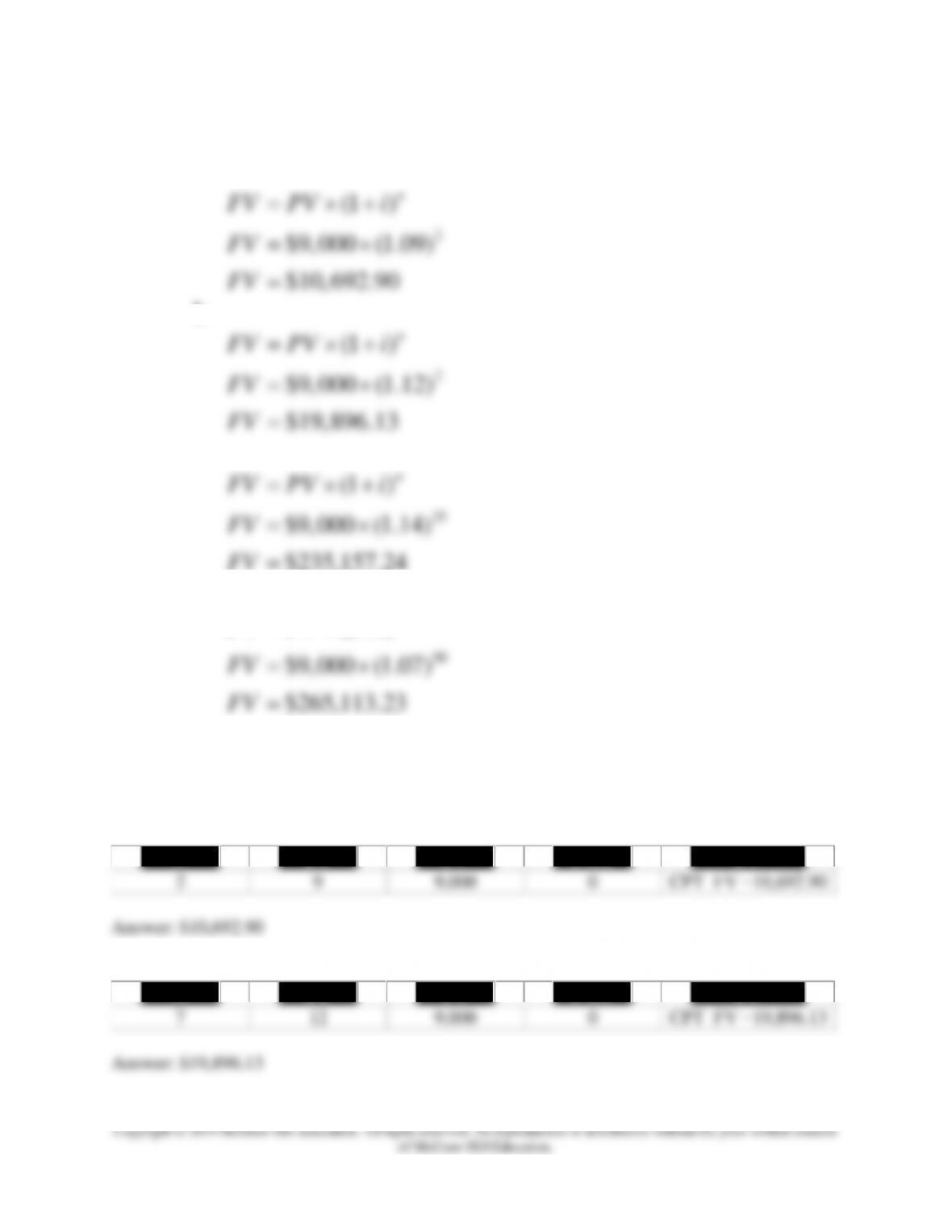
50
(1 )
n
FV PV i
= +
9-5. Solution:
a.
2
(1 )
$10,692.90
n
FV PV i
FV
= +
=
b.
2
(1 )
$19,896.13
n
FV PV i
FV
= +
=
c.
25
(1 )
n
FV PV i
= +
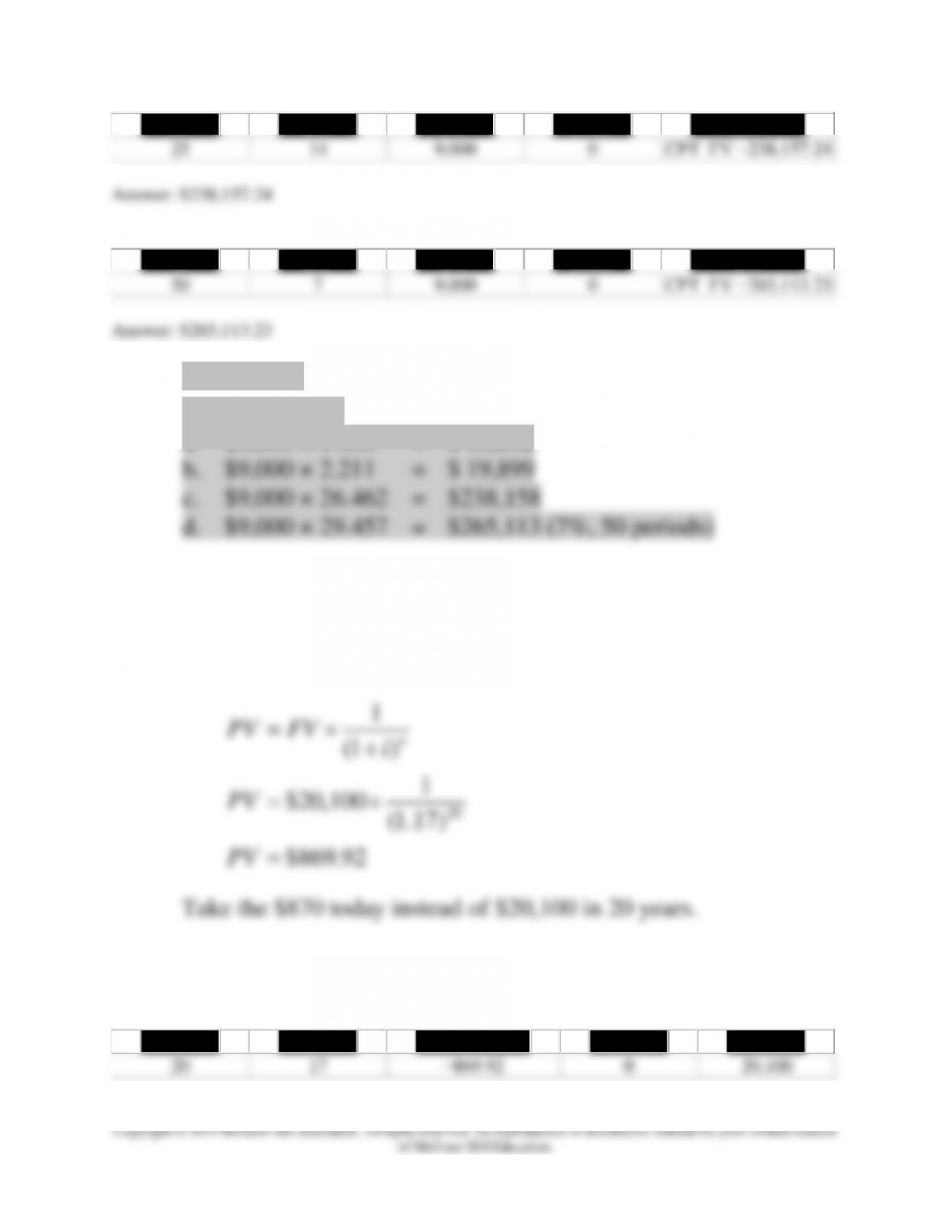
N
I/Y
PV
PMT
FV
25
14
9,000
0
CPT FV −238,157.24
Answer: $238,157.24
(d)
N
I/Y
PV
PMT
FV
50
7
9,000
0
CPT FV −265,113.23
Answer: $265,113.23
Appendix A
FV = PV × FVIF
a. $9,000 × 1.188 = $ 10,692
6. Present value (LO9-3) Your aunt offers you a choice of $20,100 in 20 years or $870
today. If money is discounted at 17 percent, which should you choose?
9-6. Solution:
1
(1 )
1
n
PV FV
i
=
+
Calculator Solution:
N
I/Y
PV
PMT
FV
20
17
−869.92
0
20,100
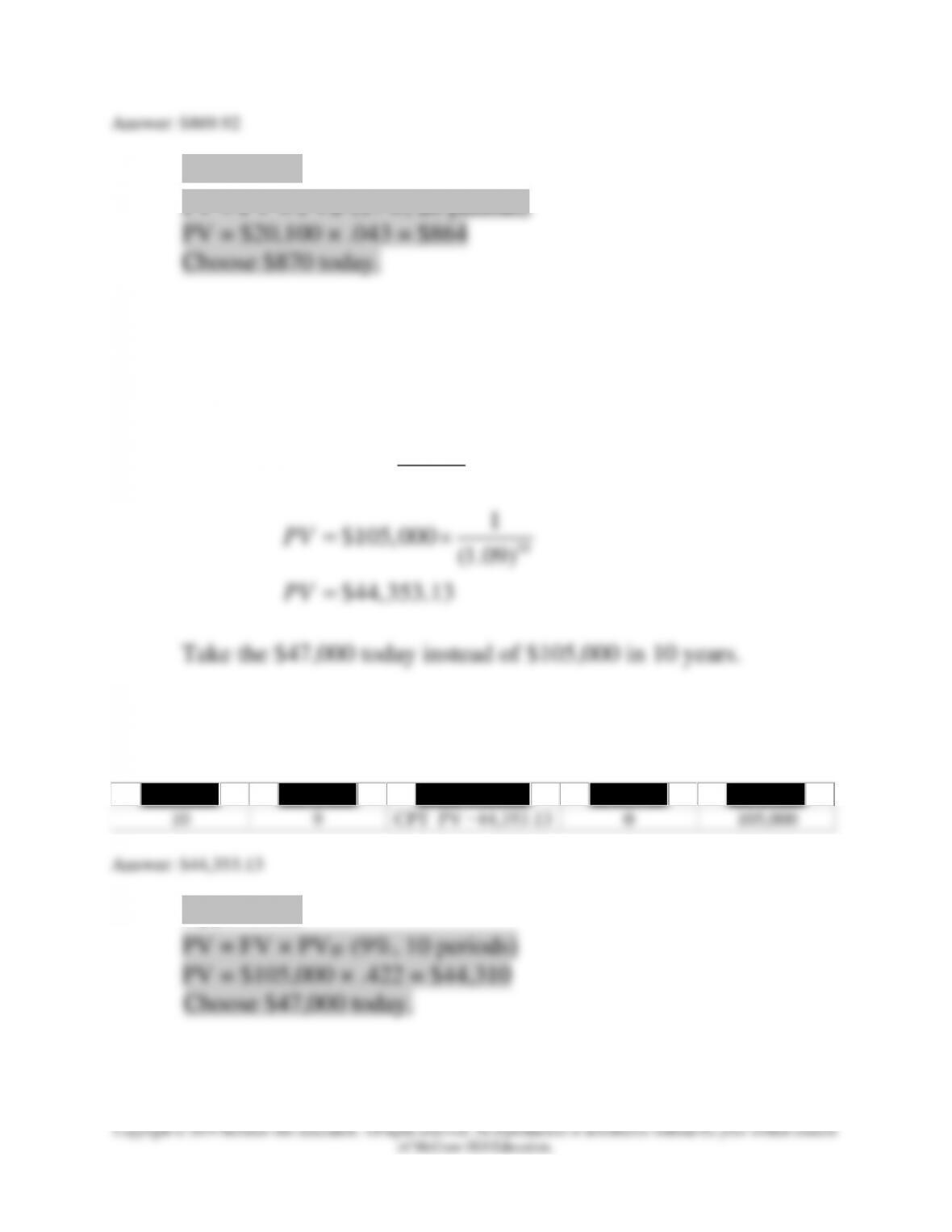
PV = FV × PVIF (9%, 10 periods)
Answer: $869.92
Appendix B
PV = FV × PVIF (17%, 20 periods)
PV = $20,100 × .043 = $864
Choose $870 today.
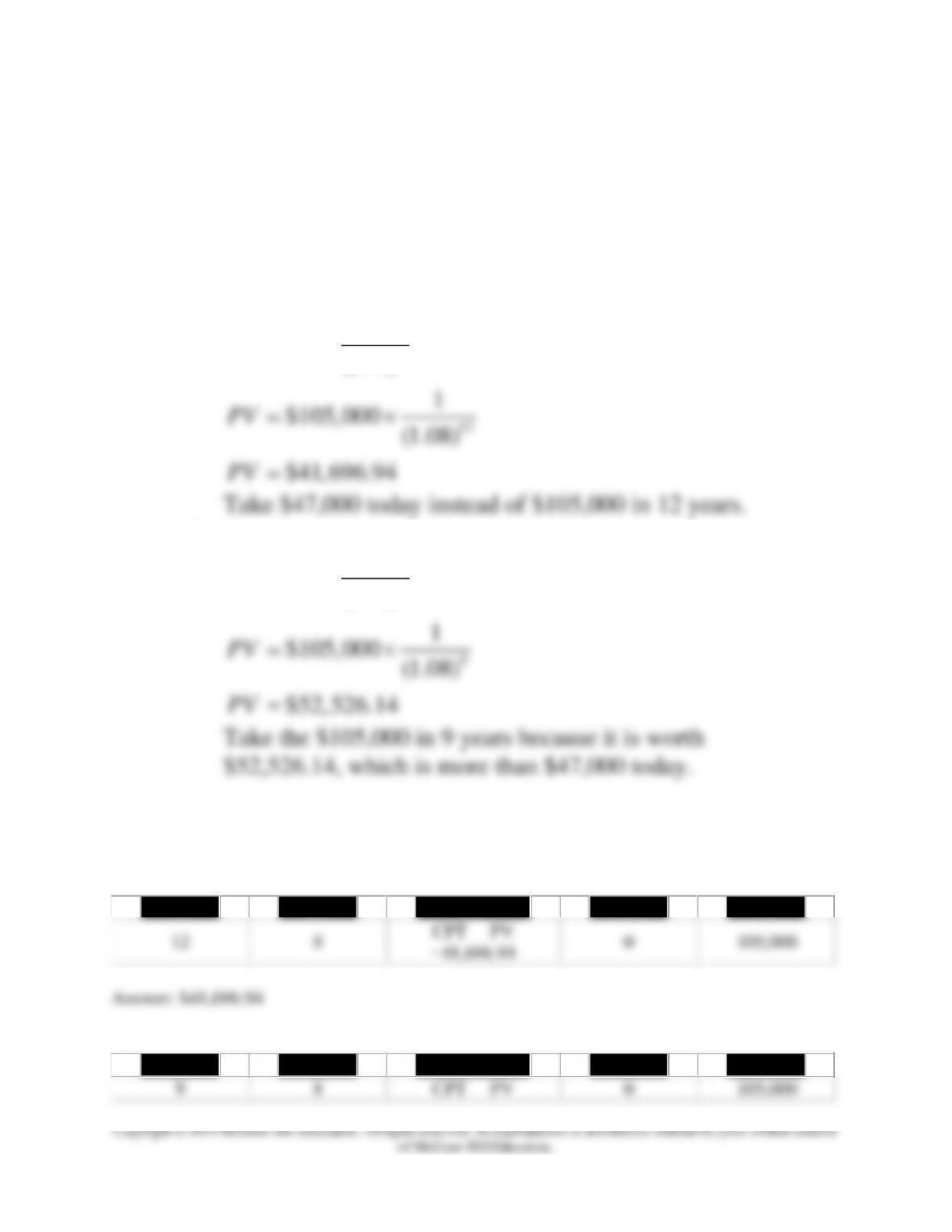
7. Present Value (LO9-3) Your uncle offers you a choice of $105,000 in 10 years or $47,000
today. If money is discounted at 9 percent, which should you choose?
9-7. Solution:
1
(1 )
1
n
PV FV
i
=
+
8. Present Value (LO9-3) Your father offers you a choice of $105,000 in 12 years or $47,000
today.
a. If money is discounted at 8 percent, which should you choose?
b. If money is still discounted at 8 percent, but your choice is between $105,000 in 9
years or $47,000 today, which should you choose?
9-8. Solution:
a.
1
(1 )
1
n
PV FV
i
=
+
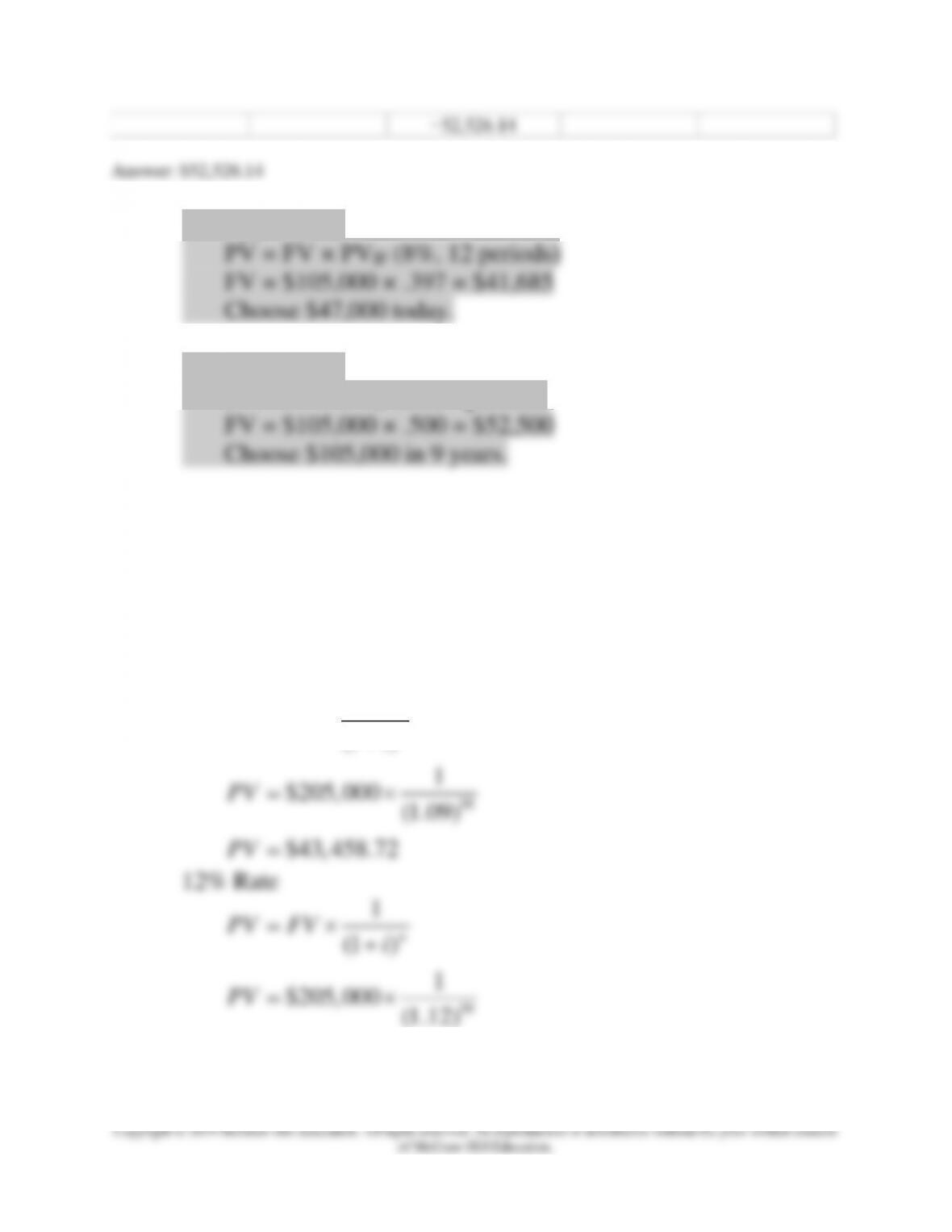
−52,526.14
Answer: $52,526.14
a. Appendix B
b. Appendix B
PV = FV × PVIF (8%, 9 periods)
9. Present Value (LO9-3) You are going to receive $205,000 in 18 years. What is the
difference in present value between using a discount rate of 12 percent versus 9 percent?
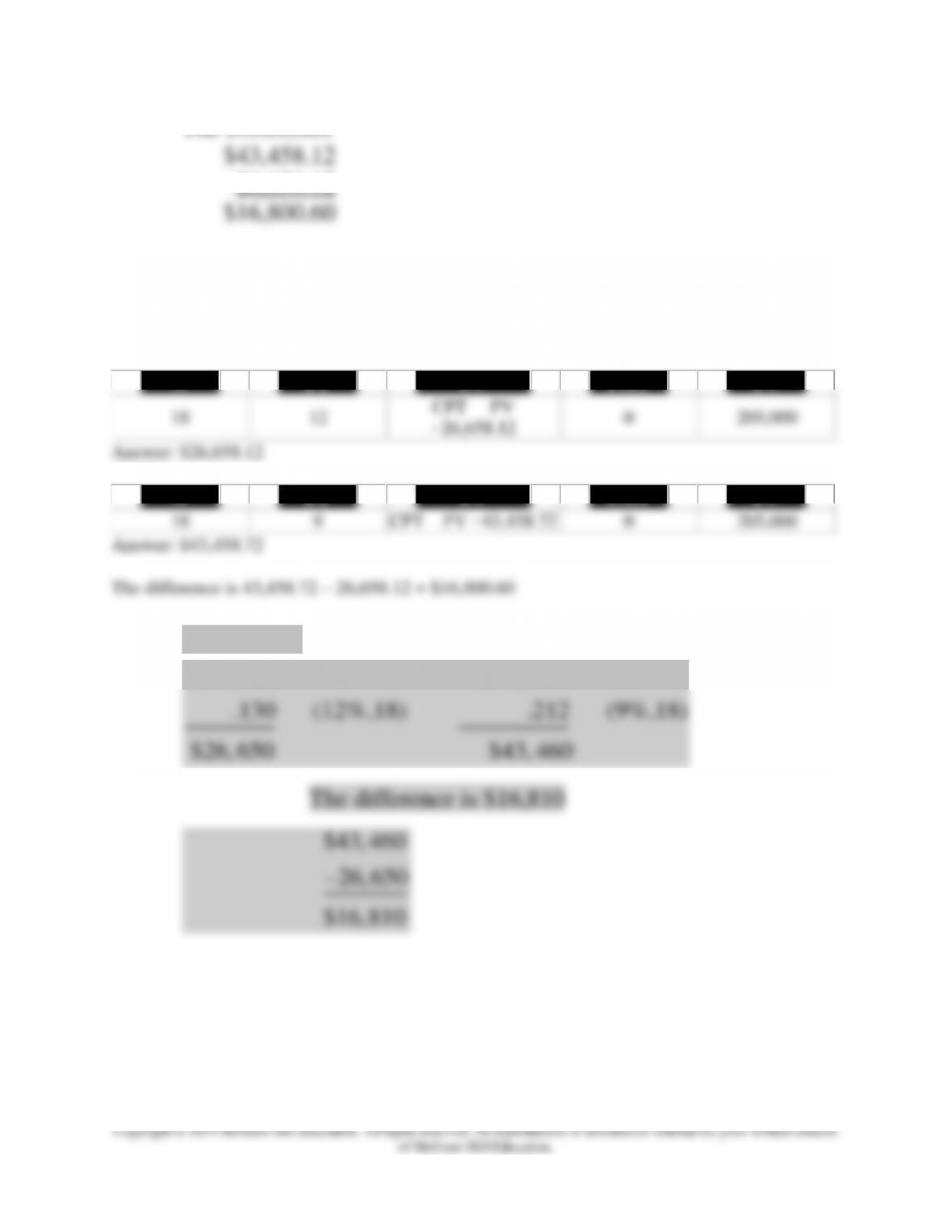
9-9. Solution:
9% Rate
1
(1 )
1
n
PV FV
i
=
+
The Difference
–26,658.12
Calculator Solution:
At 12%
N
I/Y
PV
PMT
FV
18
12
CPT PV
−26,658.12
0
205,000
Answer: $26,658.12
At 9%
N
I/Y
PV
PMT
FV
18
9
CPT PV −43,458.72
0
205,000
Answer: $43,458.72
The difference is 43,458.72 – 26,658.12 = $16,800.60
Appendix B
$205,000 $205, 000
.130 (12%,18) .212 (9%,18)
$26, 650 $43, 460
The difference is $16,810
$43, 460
26,650
$16,810
−
10. How much would you have to invest today to receive
a. $15,000 in 8 years at 10 percent?
b. $20,000 in 12 years at 13 percent?
c. $6,000 each year for 10 years at 9 percent?
d. $50,000 each year for 50 years at 7 percent?
9-10. Solution:
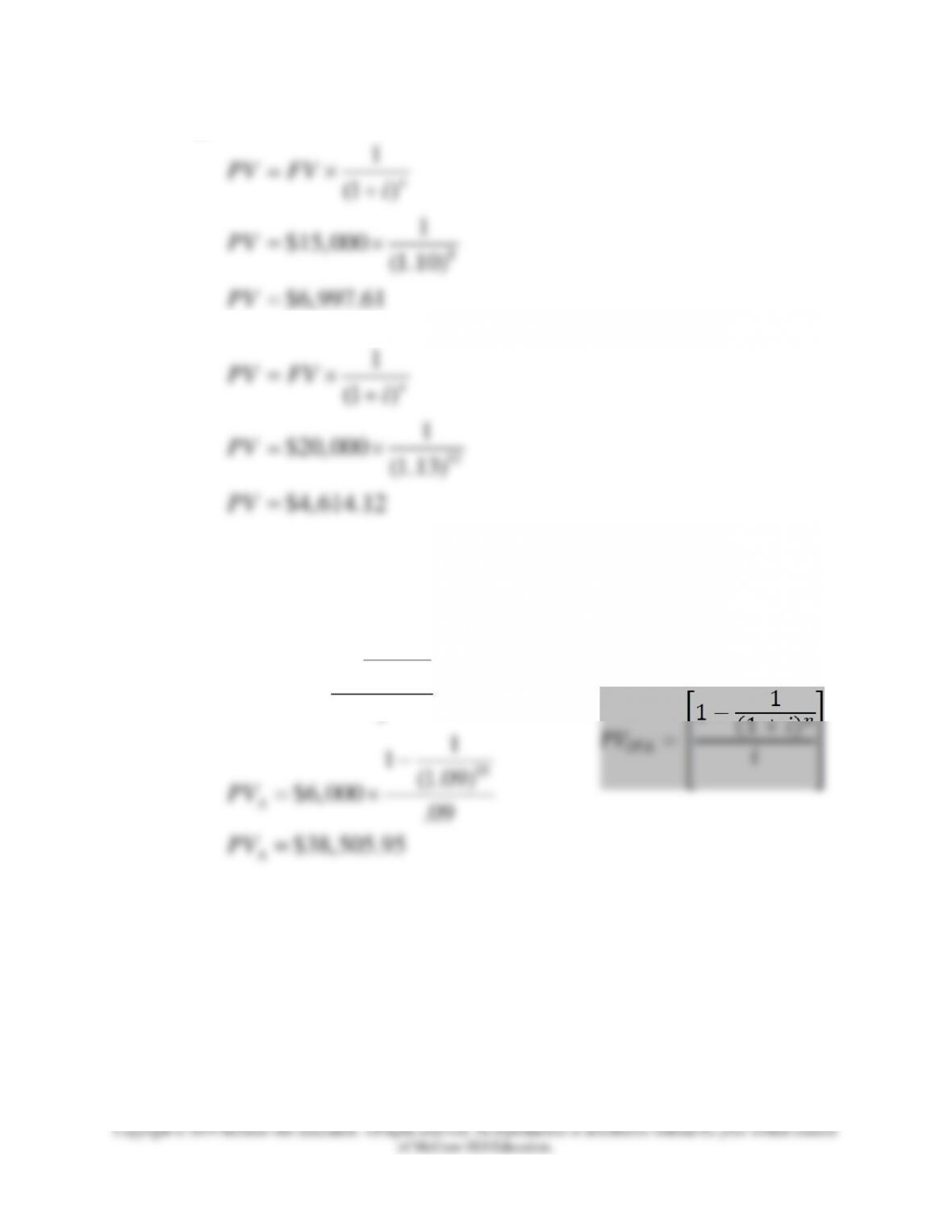
a.
8
1
(1 )
1
$6,997.61
n
PV FV
i
PV
=
+
=
b.
12
1
(1 )
1
$4,614.12
n
PV FV
i
PV
=
+
=
c.
10
1
1(1 )
1
1(1.09)
n
A
i
PV A
i
−+
=
−
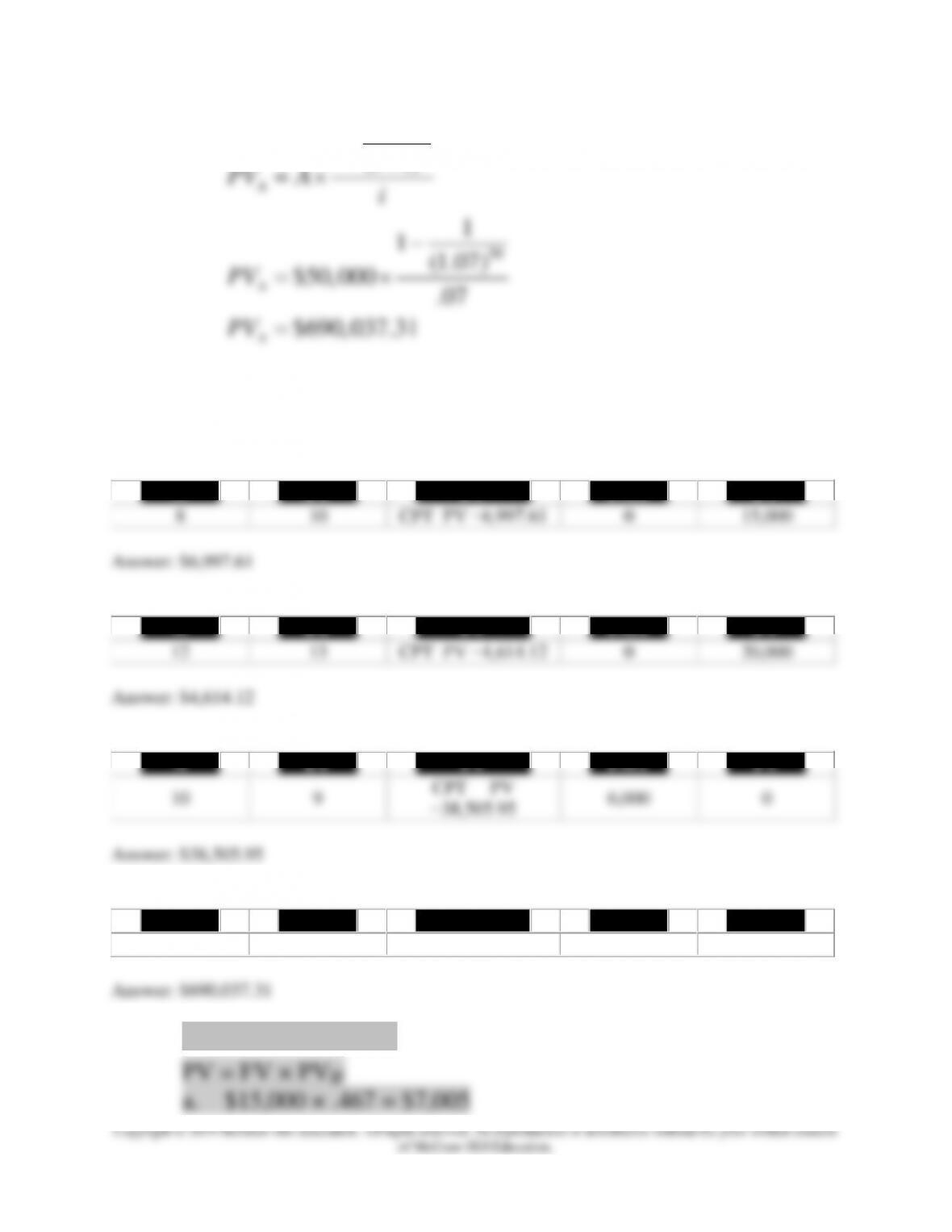
50
1
1(1 )
1
1(1.07)
n
A
i
PV A
i
−+
=
−
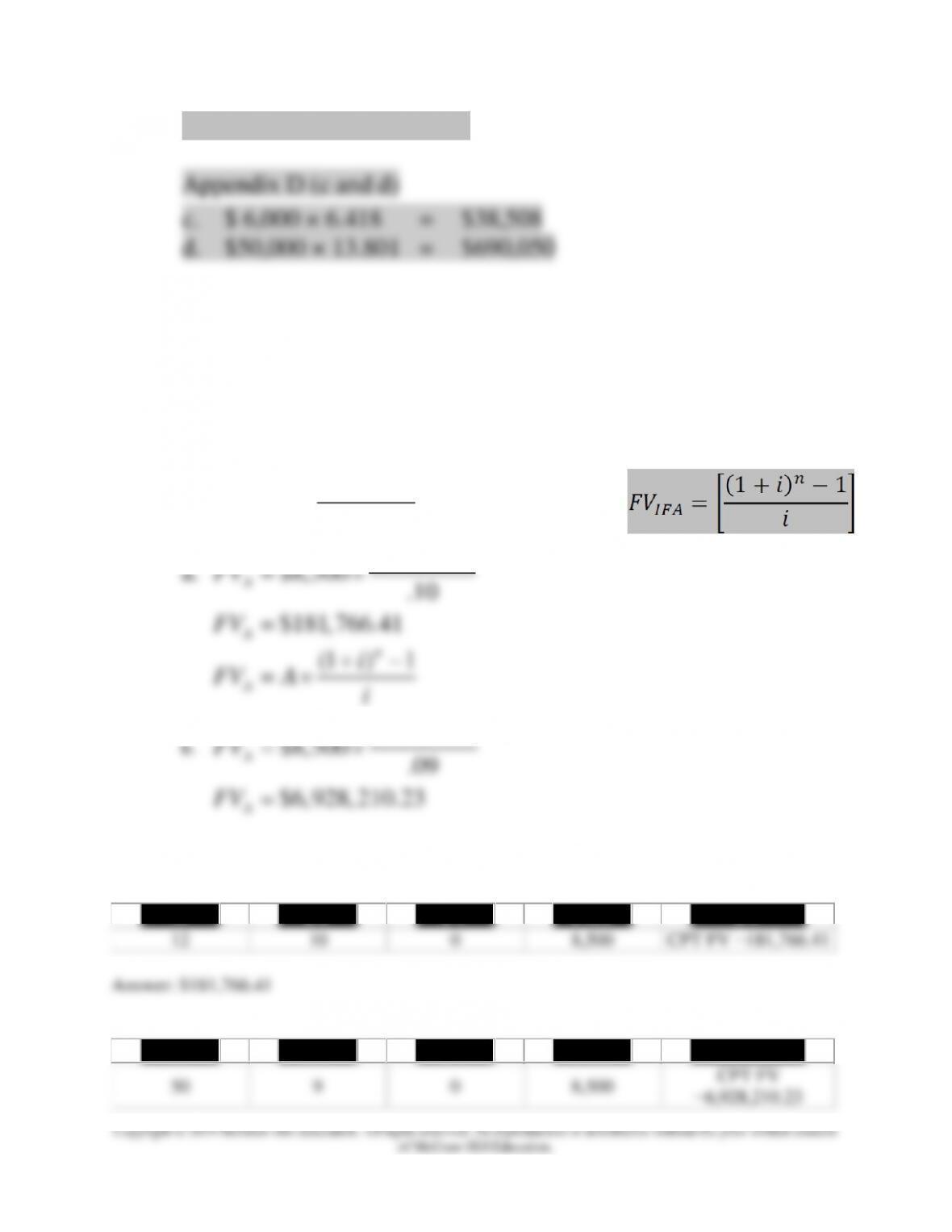
b. $20,000 × .231 = $4,620
11. Future value (LO9-2) If you invest $8,500 per period for the following number of periods,
how much would you have?
a. 12 years at 10 percent.
b. 50 years at 9 percent.
9-11. Solution:
12
(1 ) 1
(1.10) 1
$181,766.41
n
A
A
A
i
FV A
i
FV
+−
=
−
=
b.
50
(1 ) 1
(1.09) 1
$8,500 .09
$6,928,210.23
n
A
A
A
i
FV A
i
FV
FV
+−
=
−
=
=
Calculator Solution:
(a)
N
I/Y
PV
PMT
FV
12
10
0
8,500
CPT FV −181,766.41
Answer: $181,766.41
(b)
N
I/Y
PV
PMT
FV
50
9
0
8,500
−6,928,210.23
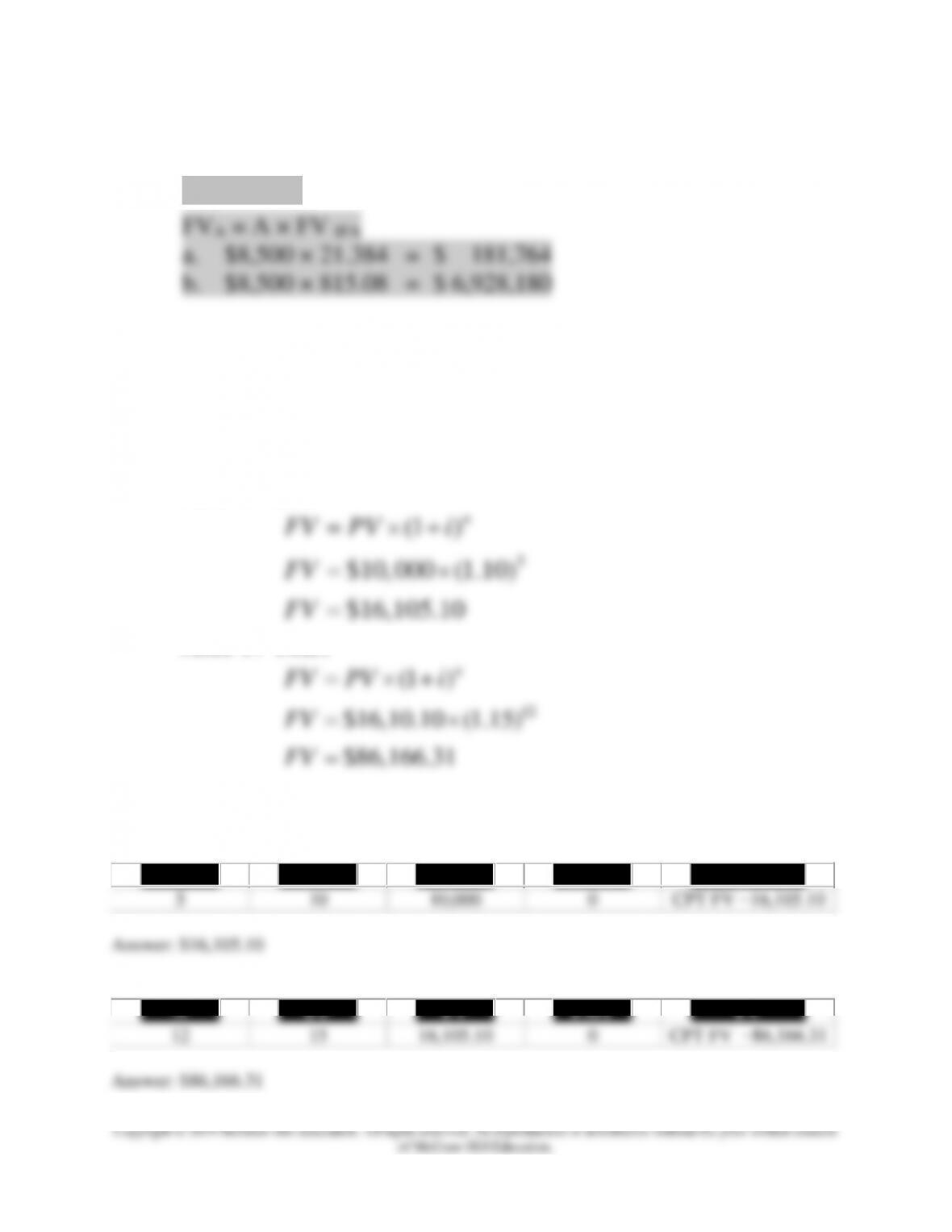
Answer: $6,928,210.23
Appendix C
12. You invest a single amount of $10,000 for 5 years at 10 percent. At the end of 5 years you
take the proceeds and invest them for 12 years at 15 percent. How much will you have
after 17 years?
9-12. Solution:
After 5 Years
5
(1 )
$10,000 (1.10)
$16,105.10
n
FV PV i
FV
FV
= +
=
=
After 17 Years
12
(1 )
$16,10.10 (1.15)
$86,166.31
n
FV PV i
FV
FV
= +
=
=
Calculator Solution:
First step:
N
I/Y
PV
PMT
FV
5
10
10,000
0
CPT FV −16,105.10
Answer: $16,105.10
Second step:
N
I/Y
PV
PMT
FV
12
15
16,105.10
0
CPT FV −86,166.31
Answer: $86,166.31
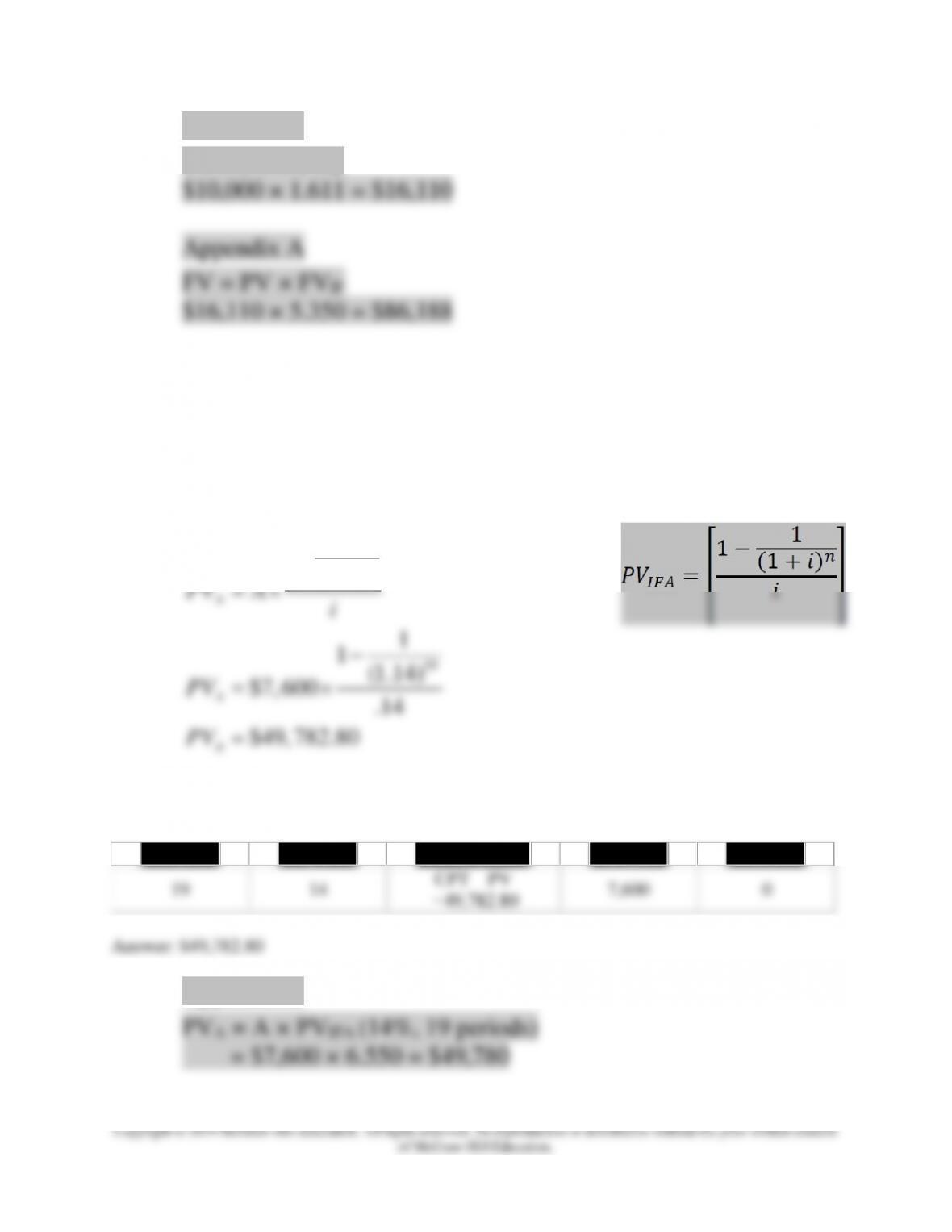
Appendix A
FV = PV × FVIF
13. Present value (LO9-3) Mrs. Crawford will receive $7,600 a year for the next 19 years
from her trust. If a 14 percent interest rate is applied, what is the current value of the future
payments?
9-13. Solution:
19
1
1(1 )
1
1(1.14)
$7,600 .14
$49,782.80
n
A
A
A
i
PV A
i
PV
PV
−+
=
−
=
=
Calculator Solution:
N
I/Y
PV
PMT
FV
19
14
CPT PV
−49,782.80
7,600
0
Appendix D
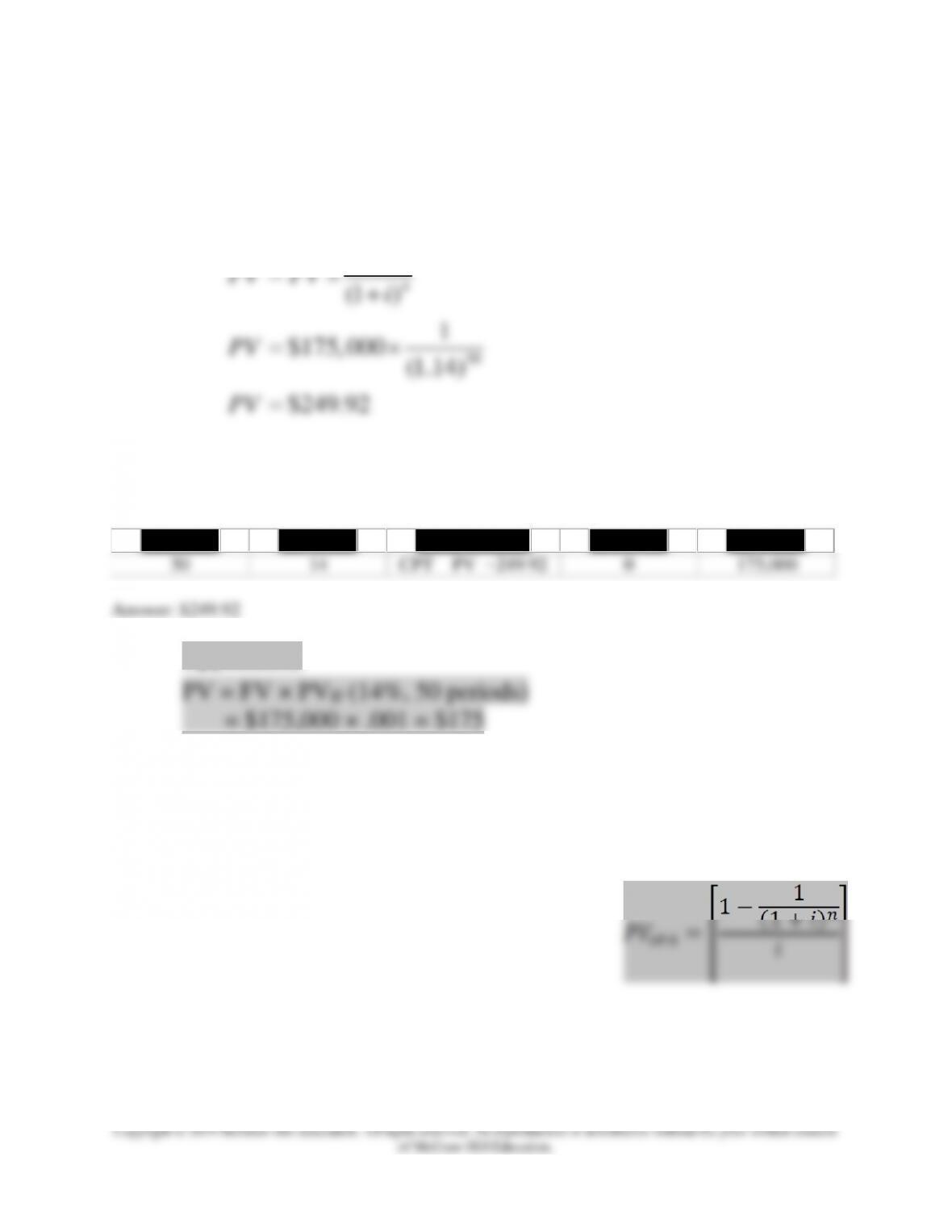
14. Phil Goode will receive $175,000 in 50 years. His friends are very jealous of him. If the
funds are discounted back at a rate of 14 percent, what is the present value of his future
“pot of gold”?
9-14. Solution:
50
1
(1 )
1
$175,000 (1.14)
n
PV FV
i
PV
=
+
=