
Problem 6-9 Problem 6-10 Problem 6-14
Copyright © 2011 McGraw-Hill/Irwin and ANSR Source India Pvt Ltd. (www.ansrsourceindia.com)
MAIN MENU – CHAPTER 6
Spreadsheet Templates
Foundations of Financial Management
Working Capital Management
Spreadsheet Templates by Block, Hirt and Danielsen

Problem 6-9
Objective: Short-term versus longer-term borrowing
Student Name:
Course Name:
Student ID:
Course Number:
Stern Educational TV, Inc., has decided to buy a new computer system with an expected life of three years at a cost
of $200,000.The company can borrow $200,000 for three years at 12 percent annual interest or for one year at
10 percent annual interest.
a. How much would the firm save in interest over the three-year life of the computer system if the one-year loan is
utilized, and the loan is rolled over (reborrowed) each year at the same 10 percent rate? Compare this to the
12 percent three-year loan.
b. What if interest rates on the 10 percent loan go up to 15 percent in the second year and 18 percent in the third year?
What would be the total interest cost compared to the 12 percent, three-year loan?
Foundations of Financial Management
Block, Hirt and Danielsen
Problem 6-9
Instructions
Complete the tables below with data and formulas.
Stern Educational TV, Inc.
If Rates Are Constant:
Amount
Borrowed Rate Years Interest
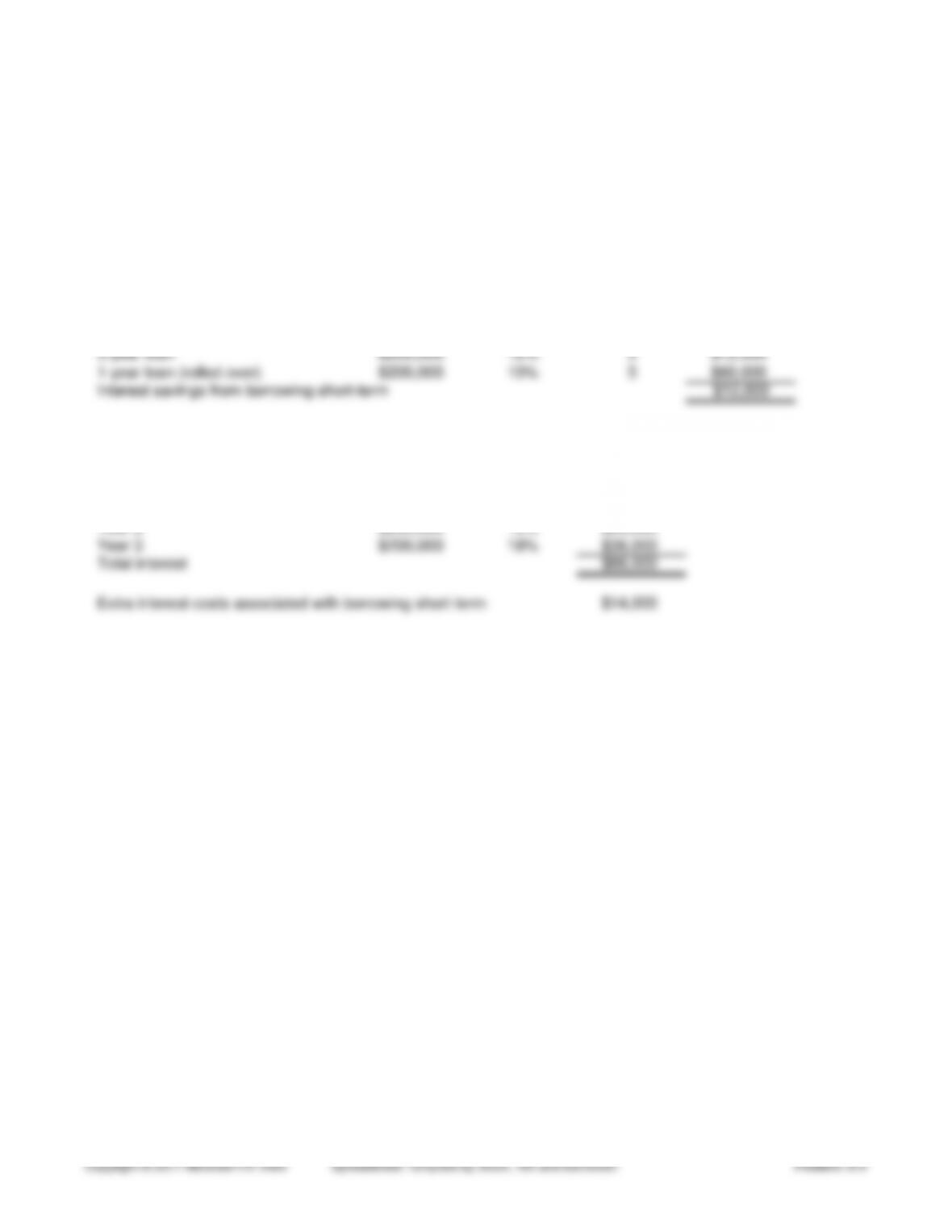
3-year loan $200,000 12% 3$72,000
1-year loan (rolled over) $200,000 10% 3$60,000
Interest savings from borrowing short-term $12,000
If Short-term Rates Change:
Amount
Borrowed Rate Interest
Year 1 $200,000 10% $20,000
Year 2 $200,000 15% $30,000
Year 3 $200,000 18% $36,000
Total interest $86,000
Extra interest costs associated with borrowing short-term $14,000
Solution

Problem 6-10
Objective: Optimal policy mix
Student Name:
Course Name:
Student ID:
Course Number:
Assume that Hogan Surgical Instruments Co. has $2,000,000 in assets. If it goes with a low-liquidity plan for the
assets, it can earn a return of 18 percent, but with a high-liquidity plan, the return will be 14 percent.
If the firm goes with a short-term financing plan, the financing costs on the $2,000,000 will be 10 percent, and
with a long-term financing plan, the financing costs on the $2,000,000 will be 12 percent.
(Review Table 6–11 on page 178 for parts a, b, and c of this problem.)
a. Compute the anticipated return after financing costs with the most aggressive asset-financing mix.
b. Compute the anticipated return after financing costs with the most conservative asset-financing mix.
c. Compute the anticipated return after financing costs with the two moderate approaches to the asset-financing mix.
d. Would you necessarily accept the plan with the highest return after financing costs? Briefly explain.
Foundations of Financial Management
Block, Hirt and Danielsen
Problem 6-10
Instructions
Complete the tables below with data and formulas to calculate the anticipated return under each scenario.
a. Compute the anticipated return after financing costs on the most aggressive asset-financing mix.
Most aggressive Amounts Rate Return
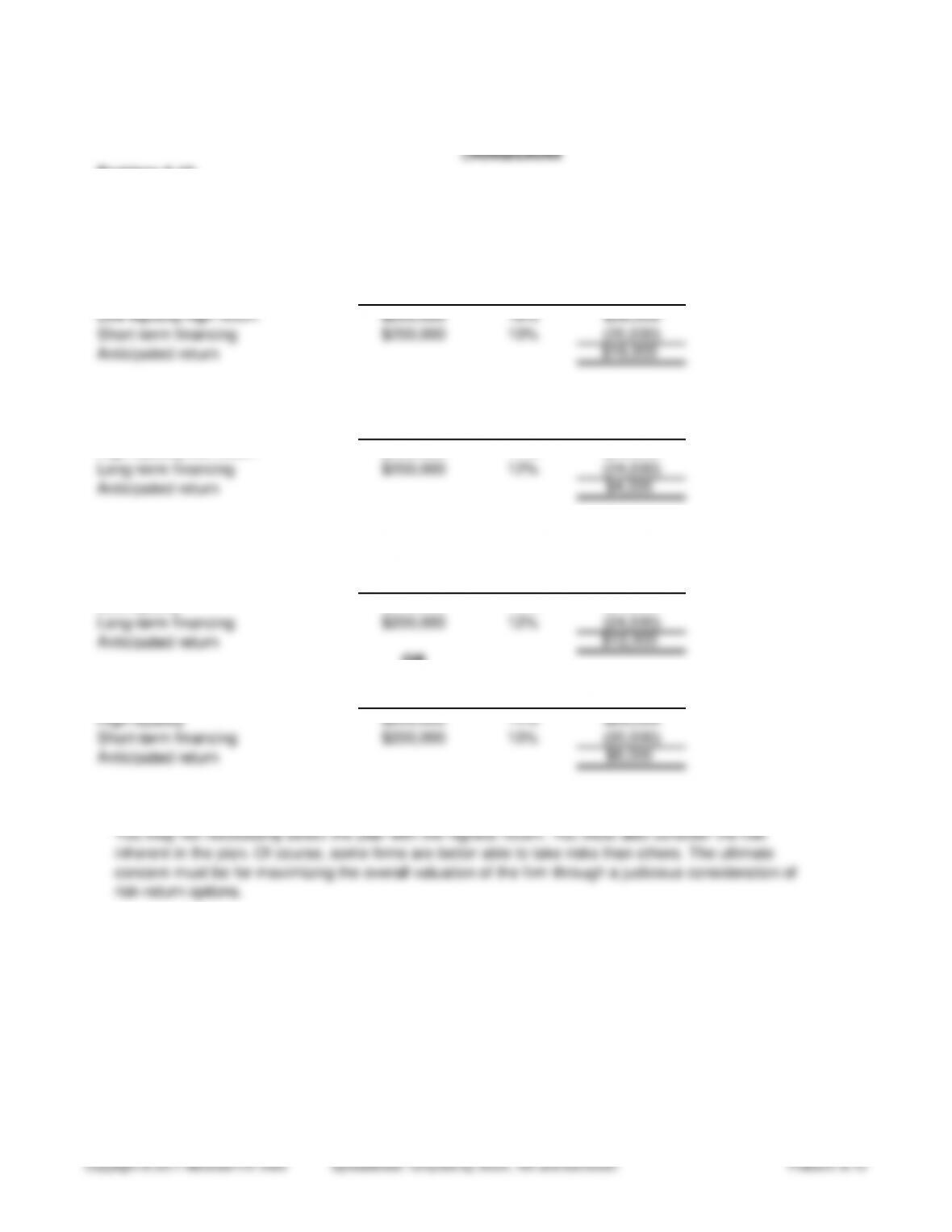
Low liquidity/high return $200,000 18% $36,000
Short-term financing $200,000 10% (20,000)
Anticipated return $16,000
b. Compute the anticipated return after financing costs on the most conservative asset-financing mix.
Most conservative Amounts Rate Return
High liquidity/low return $200,000 14% $28,000
Long-term financing $200,000 12% (24,000)
Anticipated return $4,000
c. Compute the anticipated return after financing costs on the two moderate approaches to the
asset-financing mix.
Moderate approach Amounts Rate Return
Low liquidity $200,000 18% $36,000
Anticipated return $12,000
Anticipated return $8,000
Solution

Problem 6-14
Objective: Conservative versus aggressive financing
Student Name:
Course Name:
Student ID:
Course Number:
Collins Systems, Inc., is trying to develop an asset-financing plan. The firm has $300,000 in temporary current assets
and $200,000 in permanent current assets. Collins also has $400,000 in fixed assets.
a. Construct two alternative financing plans for the firm. One of the plans should be conservative, with 80 percent of
assets financed by long-term sources and the rest financed by short-term sources. The other plan should be
aggressive, with only 30 percent of assets financed by long-term sources and the remaining assets financed by
short-term sources. The current interest rate is 15 percent on long-term funds and 10 percent on short-term financing.
Compute the annual interest payments under each plan.
b.Given that Collins’s earnings before interest and taxes are $180,000, calculate earnings after taxes for each of your
alternatives. Assume a tax rate of 40 percent.
Foundations of Financial Management
Block, Hirt and Danielsen
Problem 6-14
Instructions
Complete the templates below to solve the requirements of this problem.
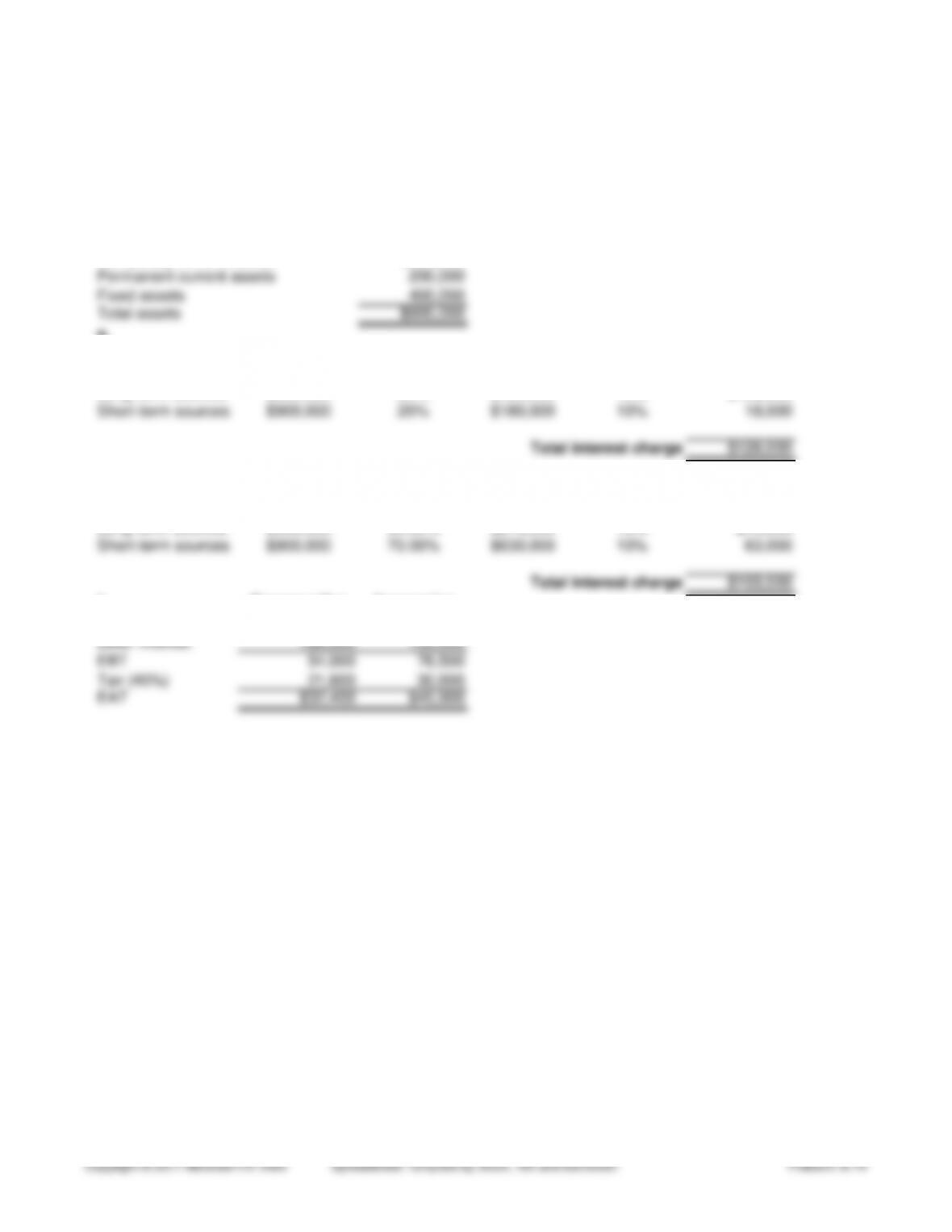
Temporary current assets $300,000
Permanent current assets 200,000
Fixed assets 400,000
Total assets $900,000
a.
Conservative Amount % of Dollar Interest Interest
Total Amount Rate Expense
Long-term sources $900,000 80% $720,000 15% $108,000
Short-term sources $900,000 20% $180,000 10% 18,000
Total interest charge $126,000
Aggressive Amount % of Dollar Interest Interest
Total Amount Rate Expense
Long-term sources $900,000 30.00% $270,000 15% $40,500
Short-term sources $900,000 70.00% $630,000 10% 63,000
Total interest charge $103,500
b. Conservative Aggressive
EBIT $180,000 $180,000
Less: Interest 126,000 103,500
EBT 54,000 76,500
Tax (40%) 21,600 30,600
EAT $32,400 $45,900
Solution