Chapter 20 – External Growth through Mergers
Chapter 20
External Growth through Mergers
Discussion Questions
20-1.
Name three industries in which mergers have been prominent.
Computers, telecommunications, public utilities, pharmaceuticals, and energy.
20-2.
What is the difference between a merger and a consolidation?
In a merger, two or more companies are combined, but only the identity of the
acquiring firm is maintained. In a consolidation, an entirely new entity is
formed from the combined companies.
20-3.
Why might the portfolio effect of a merger provide a higher valuation for the
participating firms?
If two firms benefit from opposite phases of the business cycle, their variability
in performance may be reduced. Risk-averse investors may then discount the
future performance of the merged firms at a lower rate and thus assign a higher
valuation than was assigned to the separate firms.
20-4.
What is the difference between horizontal integration and vertical integration?
How does antitrust policy affect the nature of mergers?
Horizontal integration is the acquisition of competitors, and vertical integration
is the acquisition of companies that produce goods and services used by the
company.
Antitrust policy generally precludes the elimination of competition. For this
reason, mergers are often with companies in allied but not directly related
fields.
Chapter 20 – External Growth through Mergers
Chapter 20
Problems
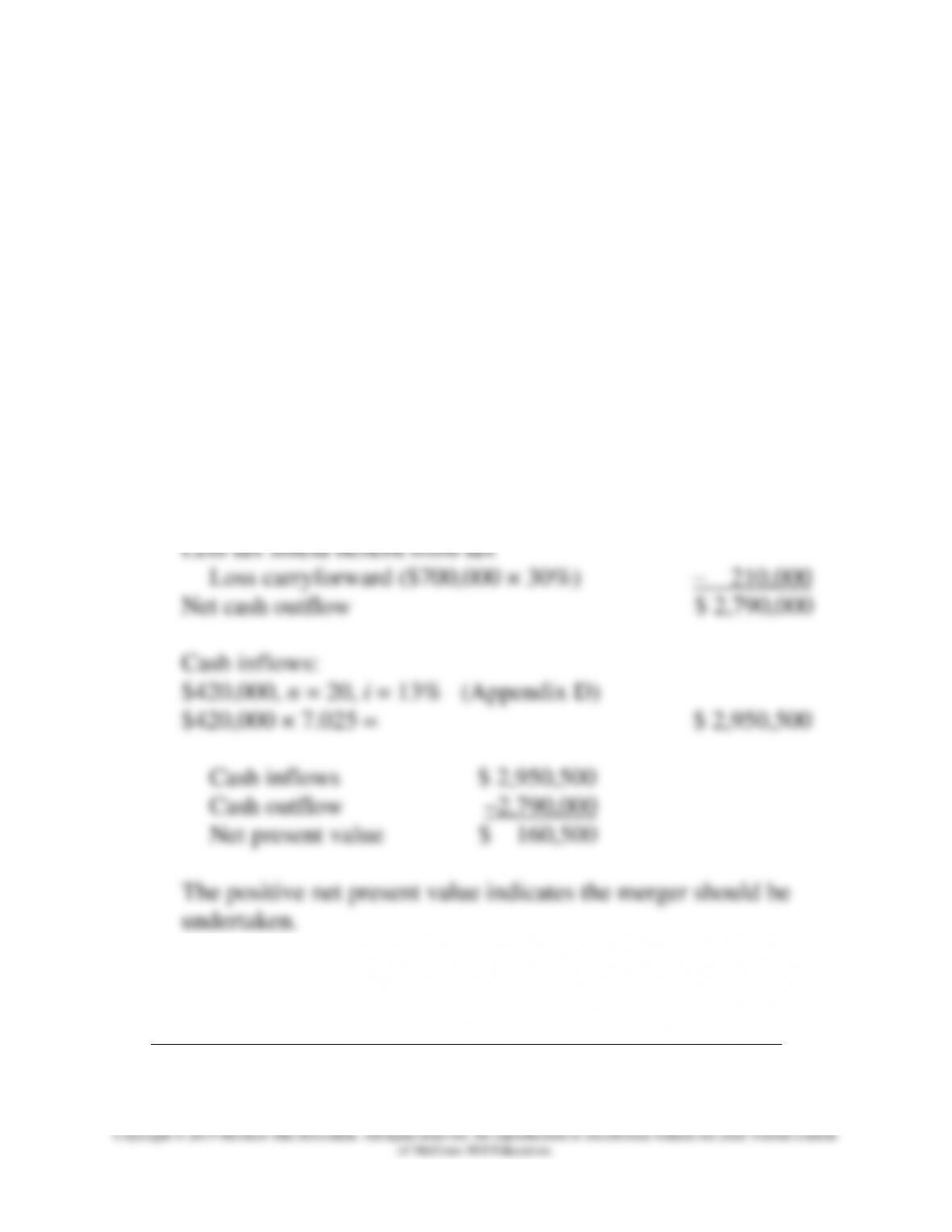
1. Tax loss carryforward (LO20-1) The Clark Corporation desires to expand. It is
considering a cash purchase of Kent Enterprises for $3 million. Kent has a $700,000 tax
loss carryforward that could be used immediately by the Clark Corporation, which is
paying taxes at the rate of 30 percent. Kent will provide $420,000 per year in cash flow
(aftertax income plus depreciation) for the next 20 years. If the Clark Corporation has a
cost of capital of 13 percent, should the merger be undertaken?
20–1. Solution:
The Clark Corporation
Cash outflow:
Purchase price $ 3,000,000
2. Tax loss carryforward (LO20-1) Assume that Western Exploration Corp. is considering
the acquisition of Ogden Drilling Company. The latter has a $470,000 tax loss
carryforward. Projected earnings for the Western Exploration Corp. are as follows:
Total
20X1 20X2 20X3 Values
Before-tax income ……………..
$185,000
$250,000
$370,000
$805,000
Chapter 20 – External Growth through Mergers
Taxes (35%) ……………………..
64,750
87,500
129,500
281,750
Income available
to stockholders ……………….
$120,250
$162,500
$240,500
$523,250
a. How much will the total taxes of Western Exploration Corp. be reduced as a result of
the tax loss carryforward?
b. How much will the total income available to stockholders be for the three years if the
acquisition occurs? Use the same format as that in the text.
20-2 Solution:
Western Exploration Corp.
a. Reduction in taxes due to tax loss carryforward =
b. Western Exploration Corp.(with merger and associated tax
benefits)
20X1
20X2
20X3
Total
Before tax income
$185,000
$250,000
$370,000
$805,000
Tax loss
carryforward
185,000
250,000
35,000
470,000
Net taxable income
0
0
335,000
335,000
Taxes (40%)
0
0
117,250
117,250
Aftertax income
available to
stockholders
$185,000
$250,000
$252,750*
$687,750**
* Before-tax income – Taxes ($370,000 – $117,250 = $252,750)
** Before-tax income – Taxes ($805,000 – $117,250 = $687,750)
Chapter 20 – External Growth through Mergers
Cash inflows
PV factors for the analysis (11%) (Appendix D)
Years
(1–5)
(6–15)
(16–25)
3.696
1–15
7.191
1–25
8.422
1–5
–3.696
1–15
–7.191
6 to 15
3.495
15 to 20
1.231
Year (1–5)
Cash inflow $150,000
20-4. (Continued)
Years (16–20)
Cash inflow $210,000
Chapter 20 – External Growth through Mergers
5. Impact of merger on earnings per share (LO20-3) Assume the following financial data
for Rembrandt Paint Co. and Picasso Art Supplies:
Rembrandt
Paint Co.
Picasso Art
Supplies
Total earnings ……………………………………………………
$1,200,000
$3,600,000
Number of shares of stock outstanding …………………
600,000
2,400,000
Earnings per share …………………………..…………………
$2.00
$1.50
Price-earnings ratio (P/E) ……………………………………
24×
32×
Market price per share ………………………………………..
$48
$48
a. If all the shares of Rembrandt Paint Co. are exchanged for those of Picasso Art
Supplies on a share-for-share basis, what will postmerger earnings per share be for
Picasso Art Supplies? Use an approach similar to that in Table 20-3.
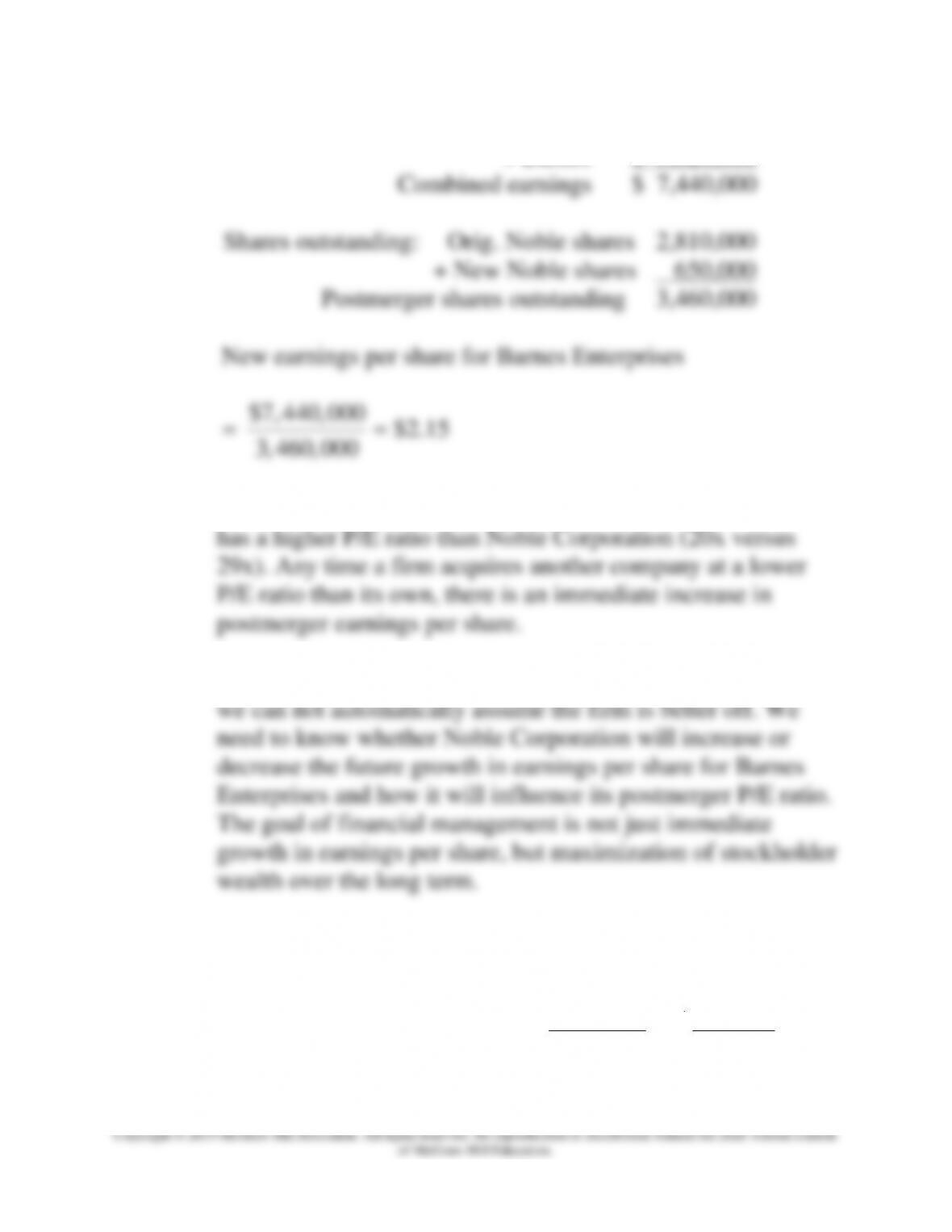
b. Explain why the earnings per share of Picasso Art Supplies changed.
c. Can we necessarily assume that Picasso Art Supplies is better off after the merger?
20–5. Solution:
Rembrandt Paint Co. and Picasso Art Supplies
(approach similar to Table 20-3)
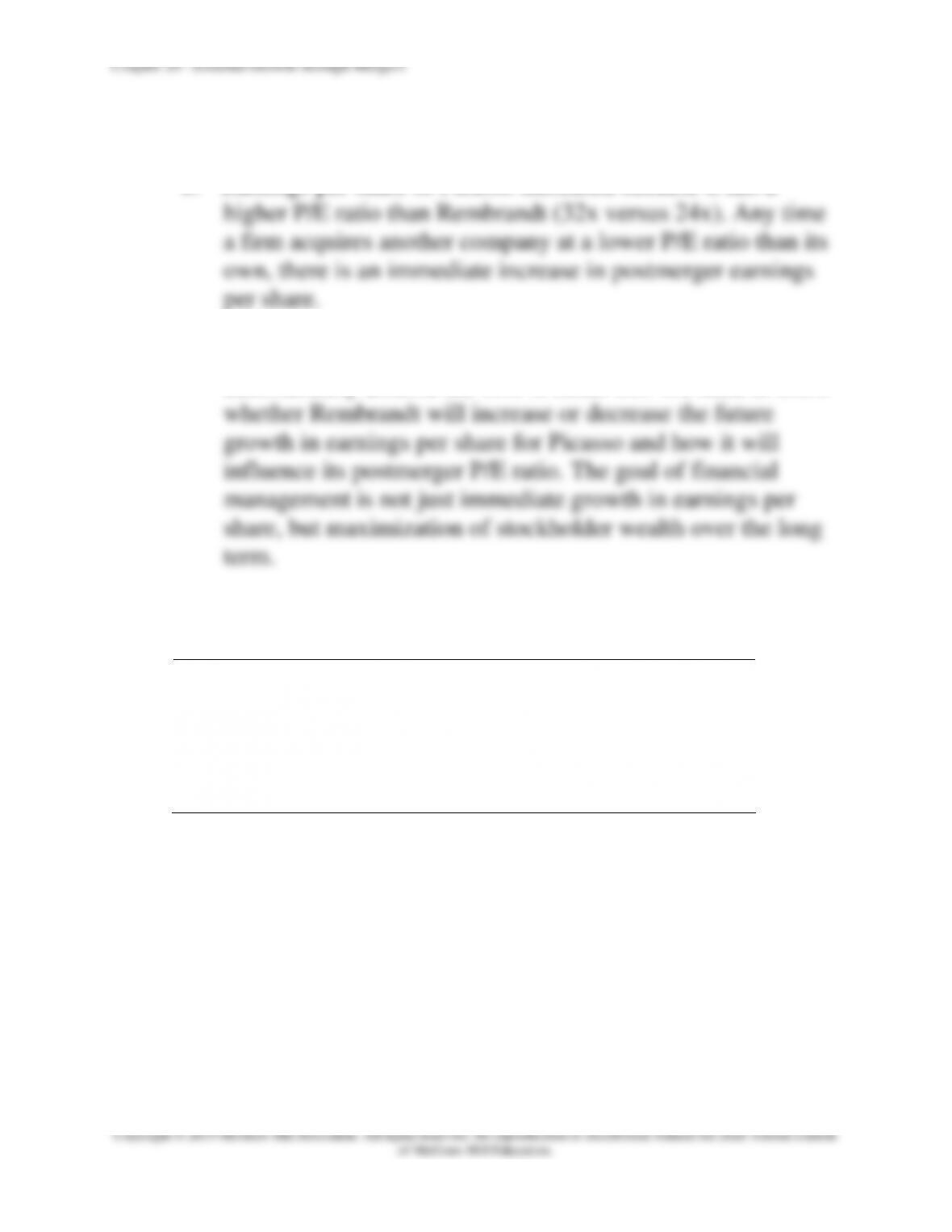
a. Total earnings Rembrandt $1,200,000
+ Picasso $3,600,000
New earnings per share for Picasso Enterprises
Chapter 20 – External Growth through Mergers
a. Total earnings: Noble $ 1,820,000
+ Barnes $ 5,620,000
3,460,000
b. Earnings per share of Barnes Enterprises increased because it
c. Although earnings per share for Barnes Enterprises went up,
7. Mergers and dilution (LO20-3) The Jeter Corporation is considering acquiring the A-Rod
Corporation.
The data for the two companies are as follows:
A-Rod Corp.
Jeter Corp.
Total earnings …………………………………………
$1,000,000
$4,000,000
Number of shares of stock outstanding ………
400,000
2,000,000
Earnings per share …………………………………..
$2.50
$2.00
Price-earnings ratio (P/E) …………………………
12
15
Chapter 20 – External Growth through Mergers
Market price per share ……………………………..
$30
$30
a. The Jeter Corp. is going to give A-Rod Corp. a 60 percent premium over A-Rod’s
current market value. What price will it pay?
b. At the price computed in part a, what is the total market value of A-Rod Corp.?
(Use the number of A-Rod Corp. shares times price.)
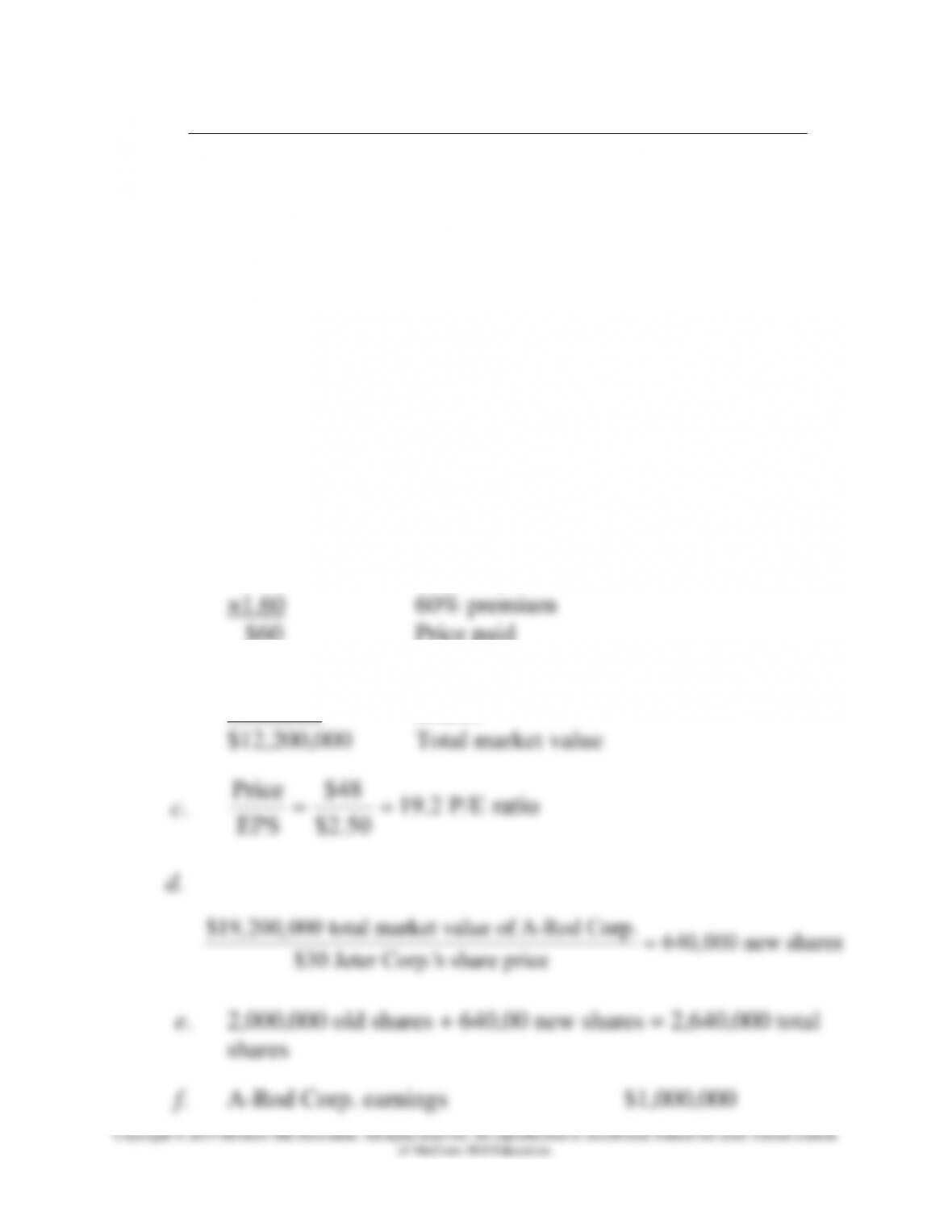
c. At the price computed in part a, what is the P/E ratio Jeter Corp. is assigning
A-Rod Corp?
d. How many shares must Jeter Corp. issue to buy the A-Rod Corp. at the total value
computed in part b? (Keep in mind that Jeter Corp.’s price per share is $30.)
e. Given the answer to part d, how many shares will Jeter Corp. have after the merger?
f. Add together the total earnings of both corporations and divide by the total shares
computed in part e. What are the new postmerger earnings per share?
g. Why has Jeter Corp.’s earnings per share gone down?
h. How can Jeter Corp. hope to overcome this dilution?
20-7 Solution:
Jeter Corp. A-Rod Corp.
a.
$30
Current price
×1.60
60% premium
$60
Price paid
b.
$40
Price paid
×400,000
Shares
$12,200,000
Total market value
c.
d.
e.
2,000,000 old shares + 640,00 new shares = 2,640,000 total
shares
f.
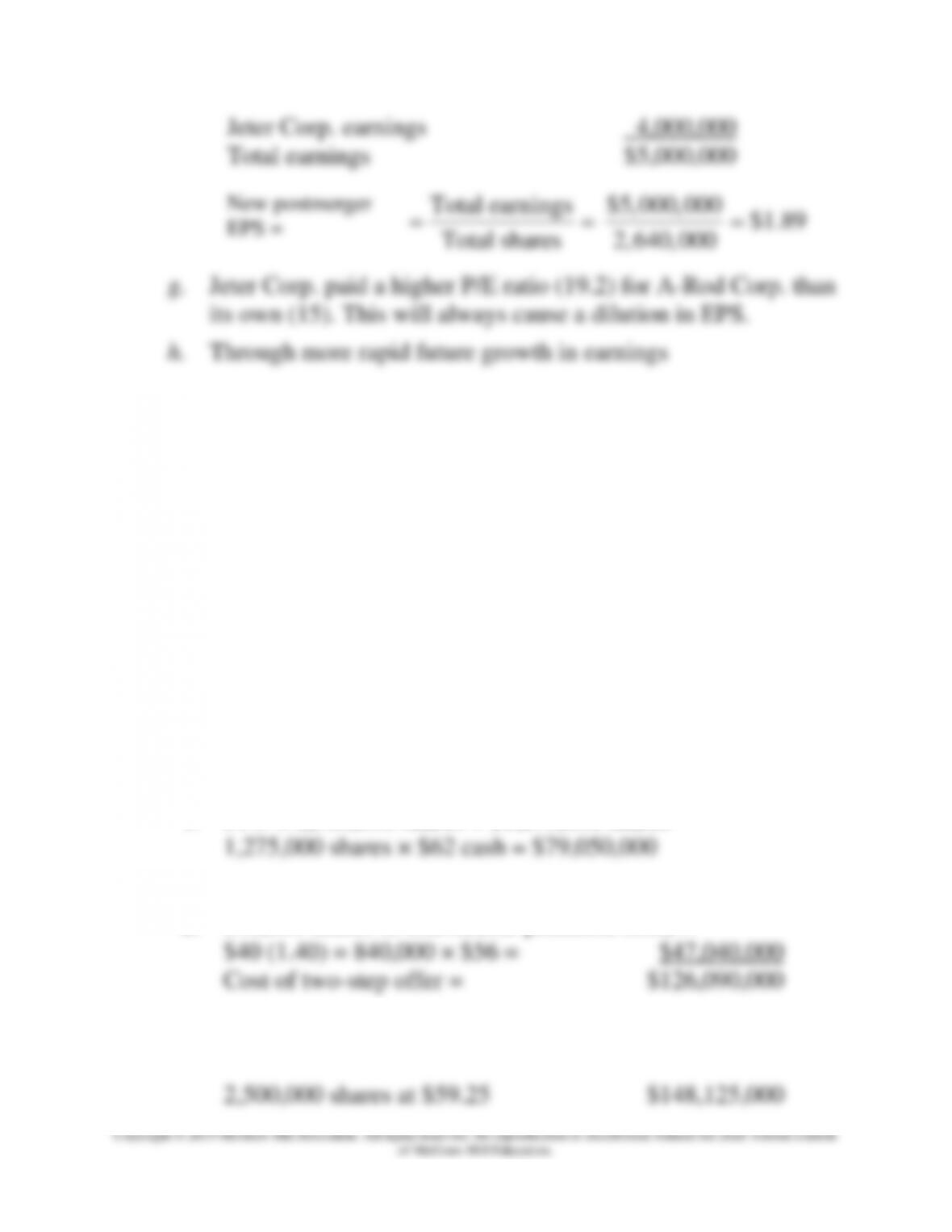
A-Rod Corp. earnings
$1,000,000
Chapter 20 – External Growth through Mergers
Jeter Corp. earnings
4,000,000
Total earnings
$5,000,000
New postmerger
EPS =
Total earnings $5,000,000 $1.89
Total shares 2,640,000
= = =
g. Jeter Corp. paid a higher P/E ratio (19.2) for A-Rod Corp. than
its own (15). This will always cause a dilution in EPS.
h. Through more rapid future growth in earnings
8. Two-step buyout (LO20-2) The Hollings Corporation is considering a two-step buyout of
the Norton Corporation. The latter firm has 2.5 million shares outstanding and its stock
price is currently $40 per share. In the two-step buyout, Hollings will offer to buy 51
percent of Norton’s shares outstanding for $62 per share in cash and the balance in a
second offer of 840,000 convertible preferred stock shares. Each share of preferred stock
would be valued at 40 percent over the current value of Norton’s common stock. Mr.
Green, a newcomer to the management team at Hollings, suggests that only one offer for
all of Norton’s shares be made at $59.25 per share. Compare the total costs of the two
alternatives. Which is better in terms of minimizing costs?
20–8. Solution:
Hollings Corporation
Two-Step Offer
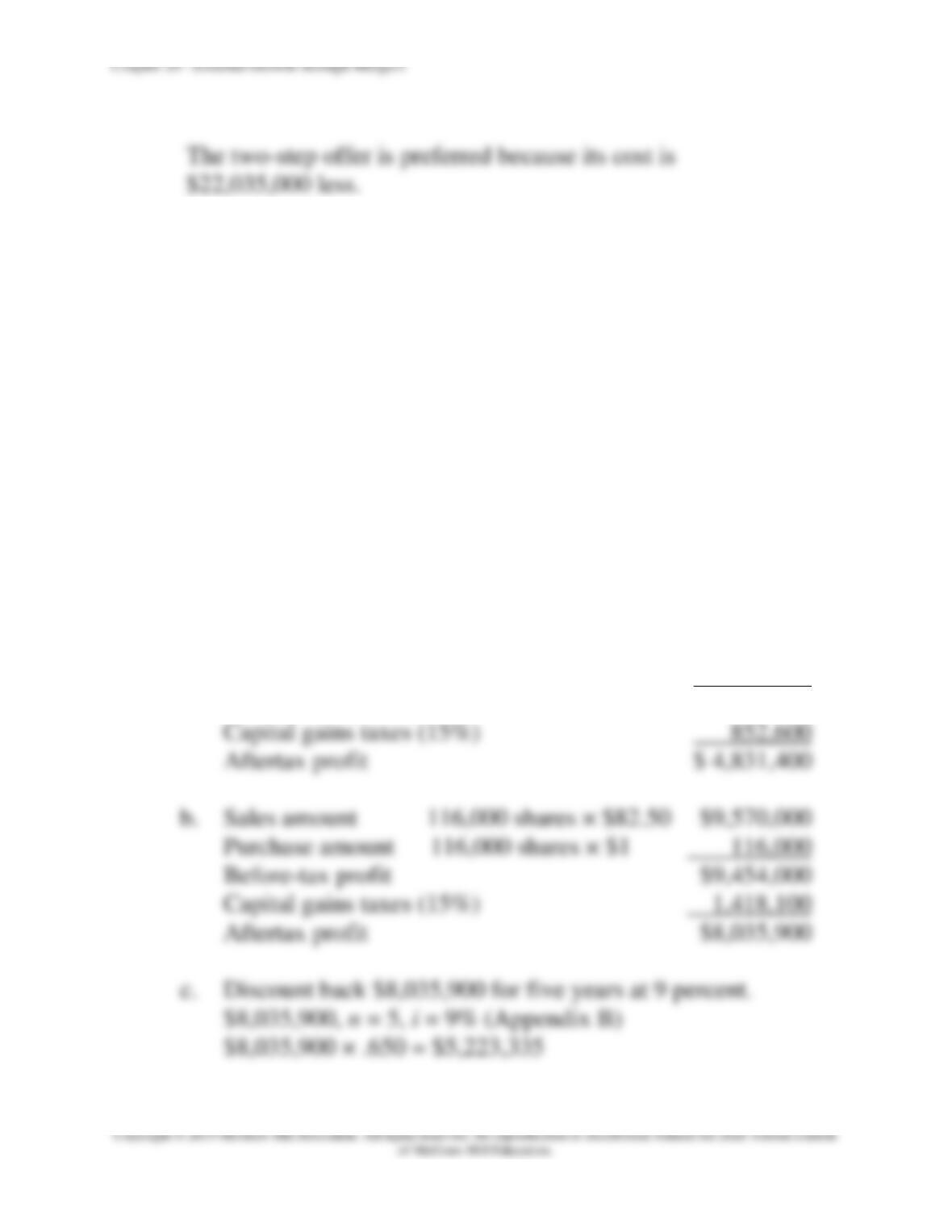
1. 51% × 2,500,000 shares = $1,275,000 shares
2. 840,000 shares of convertible preferred stock ×
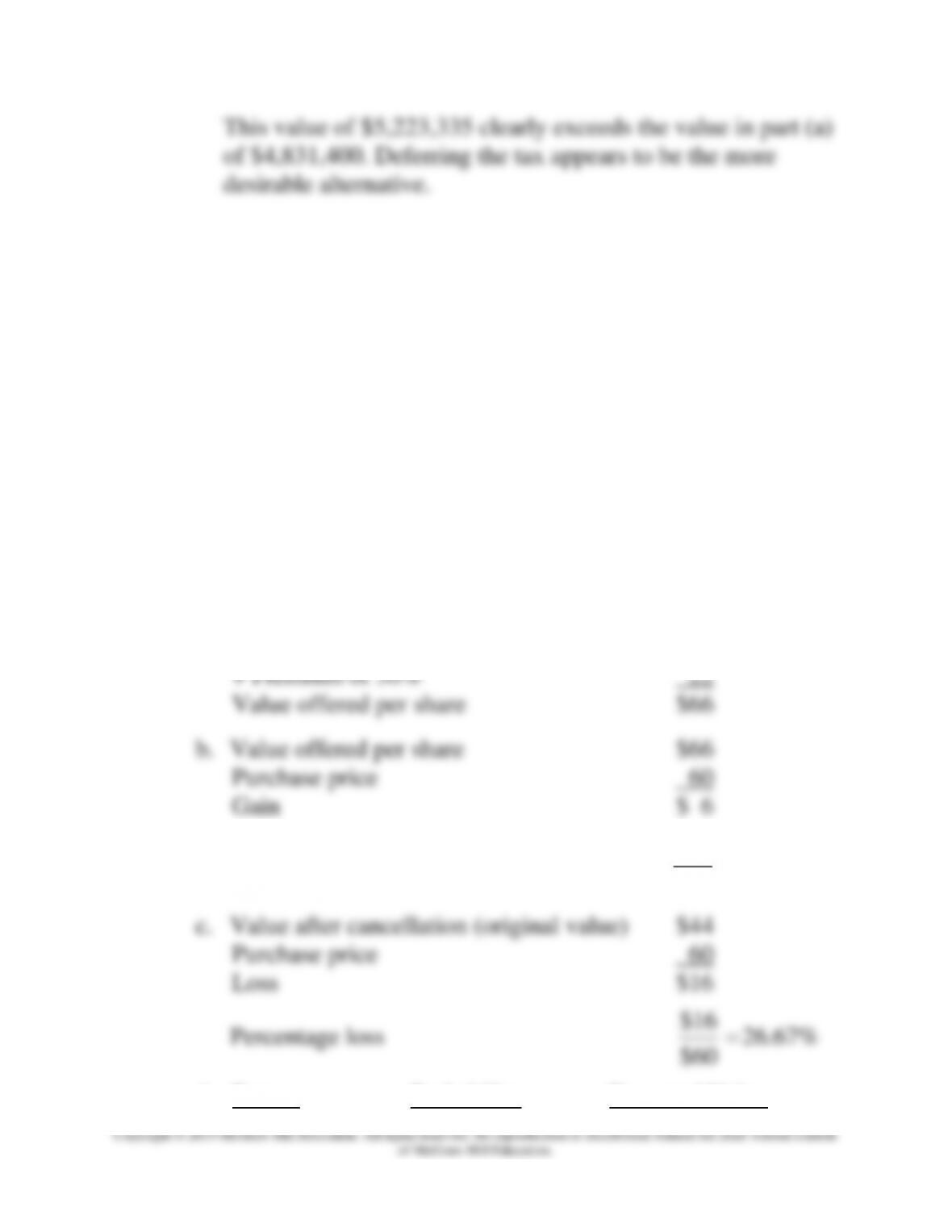
Single Offer
Chapter 20 – External Growth through Mergers
10. Premium offers and stock price movement (LO20-1) Chicago Savings Corp. is planning
to make an offer for Ernie’s Bank & Trust. The stock of Ernie’s Bank & Trust is currently
selling for $44 a share.
a. If the tender offer is planned at a premium of 50 percent over market price, what will be
the value offered per share for Ernie’s Bank & Trust?
b. Suppose before the offer is actually announced, the stock price of Ernie’s Bank & Trust
goes to $60 because of strong merger rumors. If you buy the stock at that price and the
merger goes through (at the price computed in part a), what will be your percentage gain?
c. Because there is always the possibility that the merger could be called off after it is
announced, you also want to consider your percentage loss if that happens. Assume you
buy the stock at $60 and it falls back to its original value after the merger cancellation.
What will be your percentage loss?
d. If there is an 80 percent probability that the merger will go through when you buy the
stock at $60 and only a 20 percent chance that it will be called off, does this appear to
be a good investment? Compute the expected value of the return on the investment.
20–10. Solution: Chicago Savings Corp.
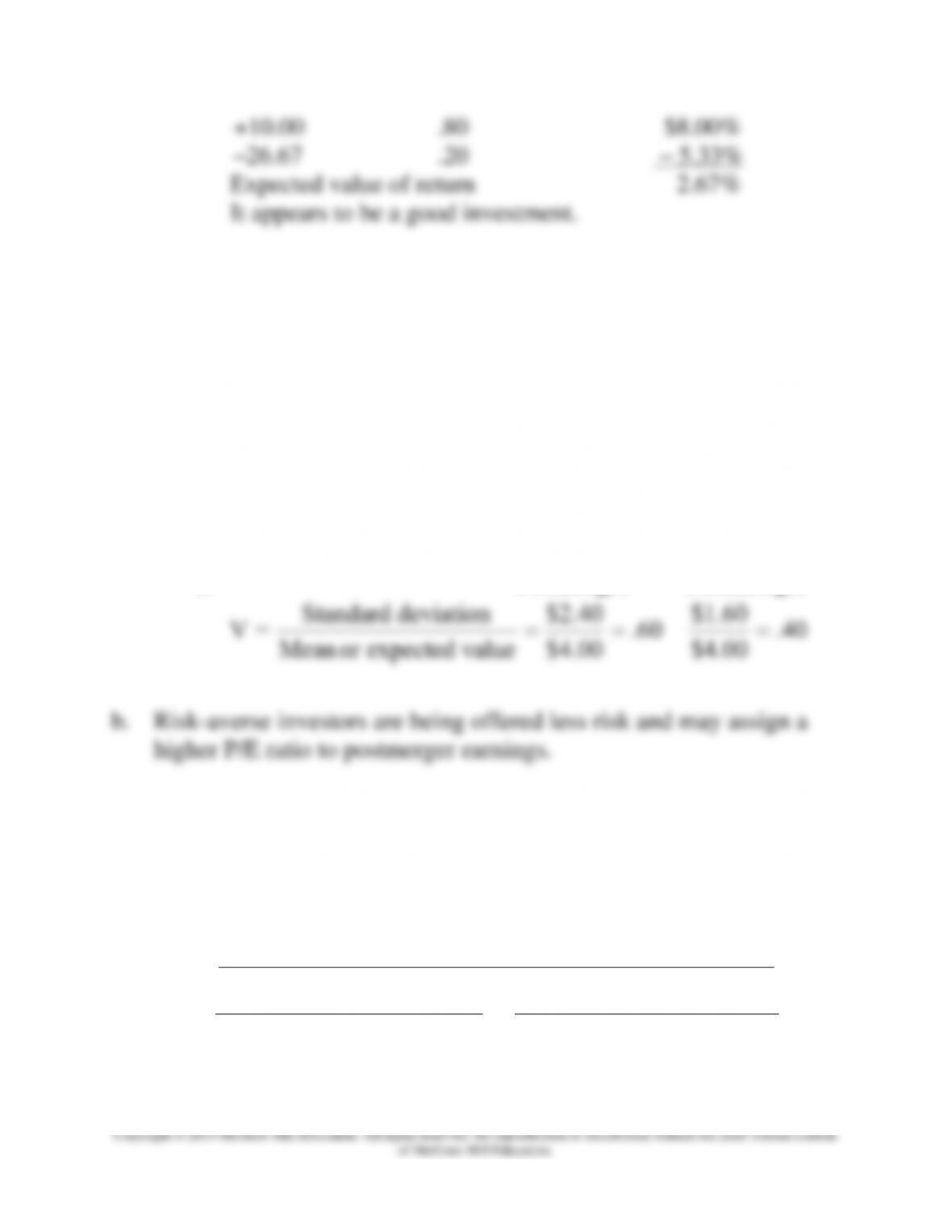
a. Market price of Ernie’s Bank & Trust $44
Percentage gain
$6 10.00%
$60 =
Chapter 20 – External Growth through Mergers
11. Portfolio effect of a merger (LO20-4) Assume the Knight Corporation is considering the
acquisition of Day Inc. The expected earnings per share for the Knight Corporation will be
$4.00 with or without the merger. However, the standard deviation of the earnings will go
from $2.40 to $1.60 with the merger because the two firms are negatively correlated.
a. Compute the coefficient of variation for the Knight Corporation before and after the
merger (consult Chapter 13 to review statistical concepts if necessary).
b. Discuss the possible impact on Knight’s postmerger P/E ratio, assuming investors are
risk-averse.
20–11. Solution:
Knight Corporation
a. Premerger Postmerger
12. Portfolio consideration and risk aversion (LO20-4) General Meters is considering two
mergers. The first is with Firm A in its own volatile industry, the auto speedometer
industry, while the second is a merger with Firm B in an industry that moves in the
opposite direction (and will tend to level out performance due to negative correlation).
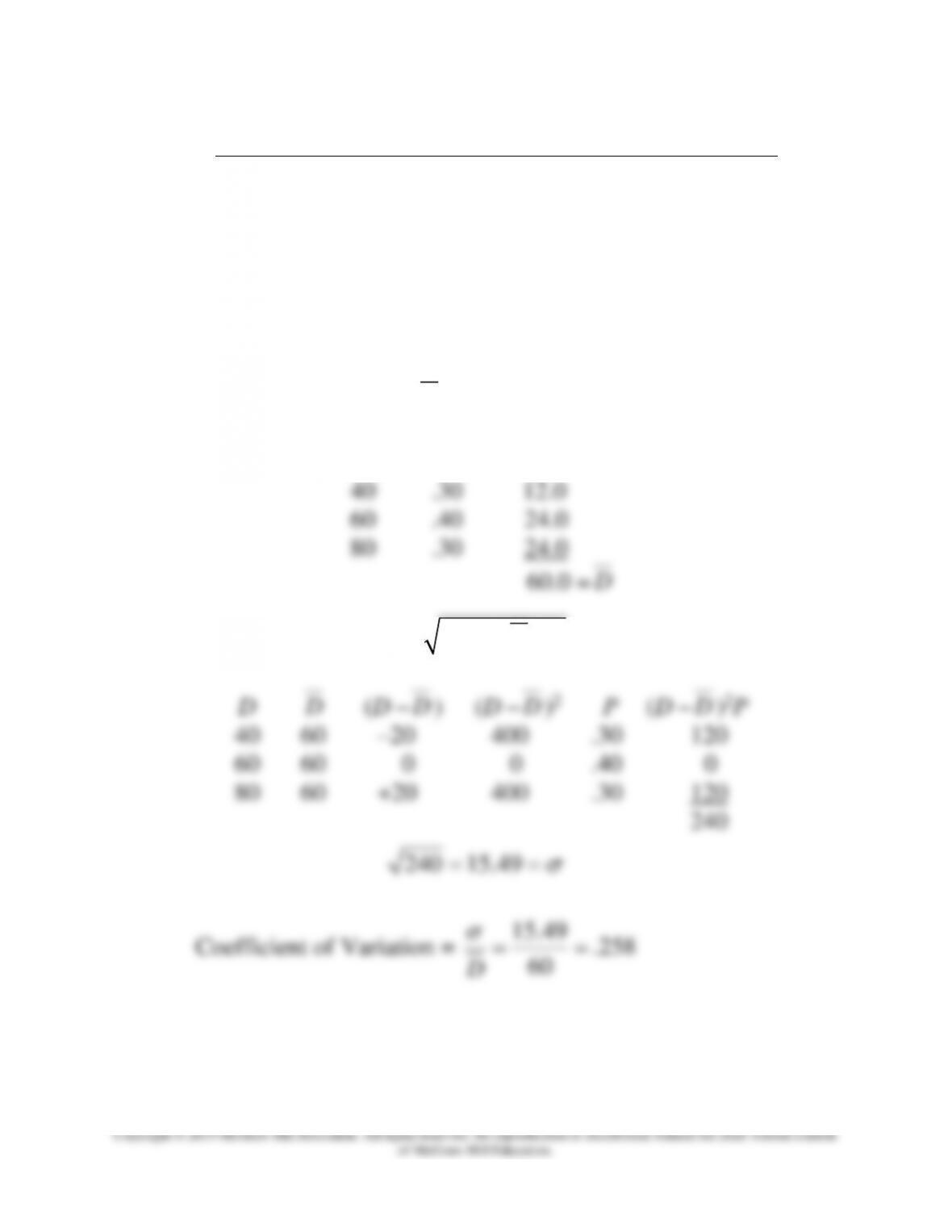
a Compute the mean, standard deviation, and coefficient of variation for both investments
(refer to Chapter 13 if necessary).
General Meters Merger General Meters Merger
with Firm A with Firm B
Possible Possible
Earnings Earnings
($ in millions) Probability ($ millions) Probability
$40…………………… .30 $40…………….. . .25
Chapter 20 – External Growth through Mergers
60 ………………….. .40 60 …………….. . .50
80 ………………….. . .30 80 …………….. . .25
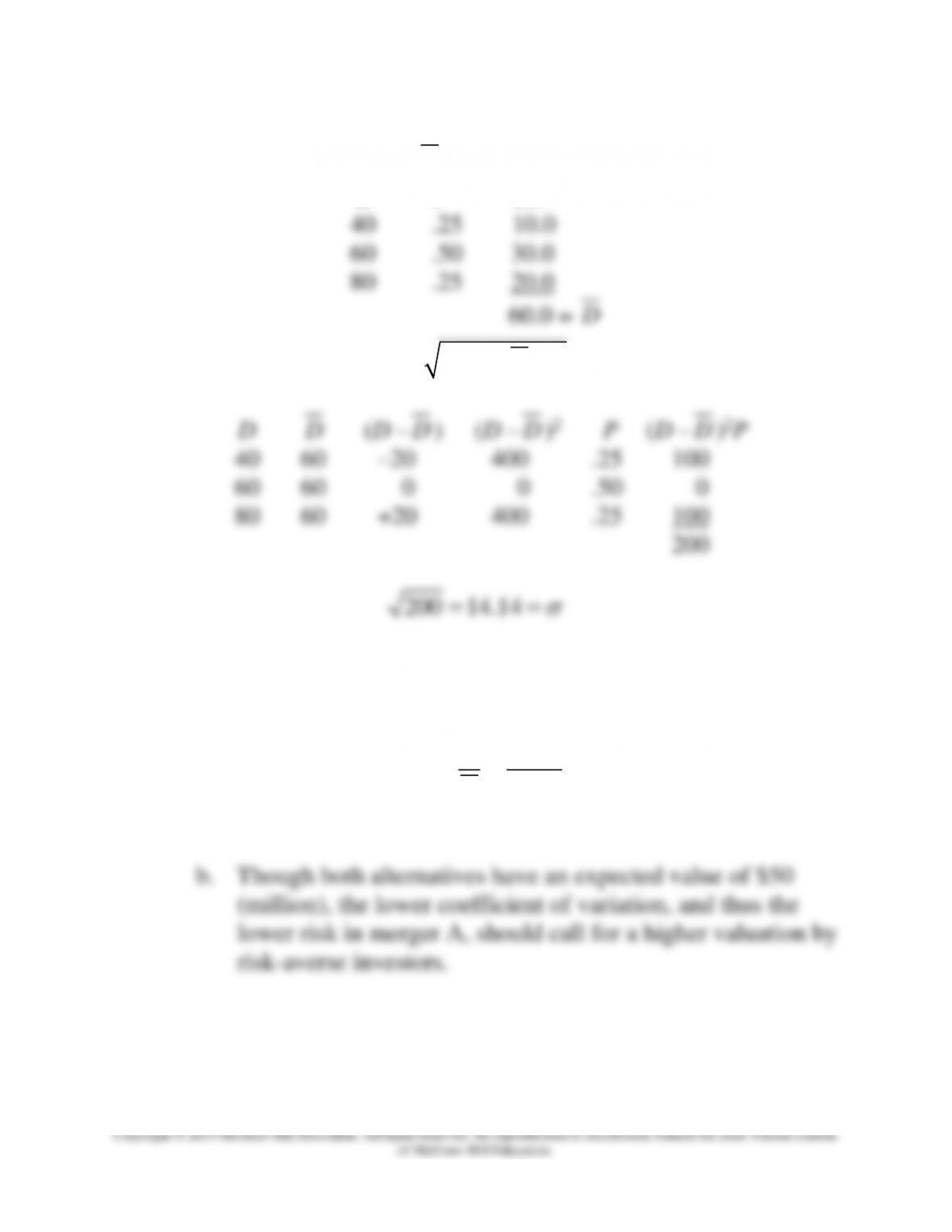
b. Assuming investors are risk-averse, which alternative can be expected to bring the
higher valuation?
20–12. Solution:
General Meters
a. Merger with A (answer in millions of dollars)
D DP=
D P DP
2
()D D P
= −
60
D
Merger with B (answer in millions of dollars)
Chapter 20 – External Growth through Mergers
D DP=
D P DP
2
()D D P
= −
20-12. (Continued)
Coefficient of variation =
14.14 .236
60
D
==