Chapter 19: Convertibles, Warrants, and Derivatives
16. Price appreciation with a warrant (LO19-4) Assume you can buy a warrant for $6 that
gives you the option to buy one share of common stock at $14 per share. The stock is
currently selling at $18 per share.
a. What is the intrinsic value of the warrant?
b. What is the speculative premium on the warrant?
c. If the stock rises to $29 per share and the warrant sells at its theoretical value without a
premium, what will be the percentage increase in the stock price and the warrant price
if you buy the stock and the warrant at the prices stated here? Explain this relationship.
19–16. Solution:
a. ($18 stock price – $14 exercise price) × 1 share per
warrant = $4 intrinsic value
Chapter 19: Convertibles, Warrants, and Derivatives
17. Profit potential with a warrant (LO19-4) The Redford Investment Company bought 100
Cinema Corp. warrants one year ago and would like to exercise them today. The warrants
were purchased at $24 each, and they expire when trading ends today (assume there is no
speculative premium left). Cinema Corp. common stock is selling today for $50 per share.
The exercise price is $30 and each warrant entitles the holder to purchase two shares of
stock, each at the exercise price.
a. If the warrants are exercised today, what would the Redford Investment Company’s
dollar profit or loss be?
b. What is the Redford Investment Company’s percentage rate of return?
19–17. Solution:
The Redford Investment Company
a. Intrinsic value of a warrant = (Market value of common
stock – Exercise price of warrant) × No. of shares each
warrant entitles holder to purchase.
18. Comparing returns on warrants and common stock (LO19-4) The Gifford Investment
Company bought 90 Cable Corporation warrants one year ago and would like to exercise
them today. The warrants were purchased at $25 each, and they expire when trading ends
today. (Assume there is no speculative premium left.) Cable Corporation common stock
was selling for $49 per share when Gifford Investment Company bought the warrants. The
exercise price is $41, and each warrant entitles the holder to purchase two shares of stock,
each at the exercise price.
a. What was the intrinsic value of a warrant at that time?
Chapter 19: Convertibles, Warrants, and Derivatives
b. What was the speculative premium per warrant when the warrants were purchased?
The purchase price, as indicated earlier, was $25.
c. What would Gifford’s total dollar profit or loss have been had they invested the $2,250
directly in Cable Corporation’s common stock one year ago at $49 per share? Cable
Corporation common stock is selling today for $59 per share.
d. What would the percentage rate of return be on this common stock investment?
Compare this to the rate of return on the warrant computed when the common stock was
selling for $59 per share.
19–18. Solution:
Gifford Investment Company (Continued)
a. ($49 stock price – $41 exercise price) × 2 shares = $16
intrinsic value
Chapter 19: Convertibles, Warrants, and Derivatives
19. Return calculations with warrants (LO19-4) Mr. John Hailey has $1,000 to invest in the
market. He is considering the purchase of 50 shares of Comet Airlines at $20 per share. His
broker suggests that he may wish to consider purchasing warrants instead. The warrants are
selling for $10, and each warrant allows him to purchase one share of Comet Airlines
common stock at $18 per share.
a. How many warrants can Mr. Hailey purchase for the same $1,000?
b. If the price of the stock goes to $40, what would be his total dollar and percentage
return on the stock?
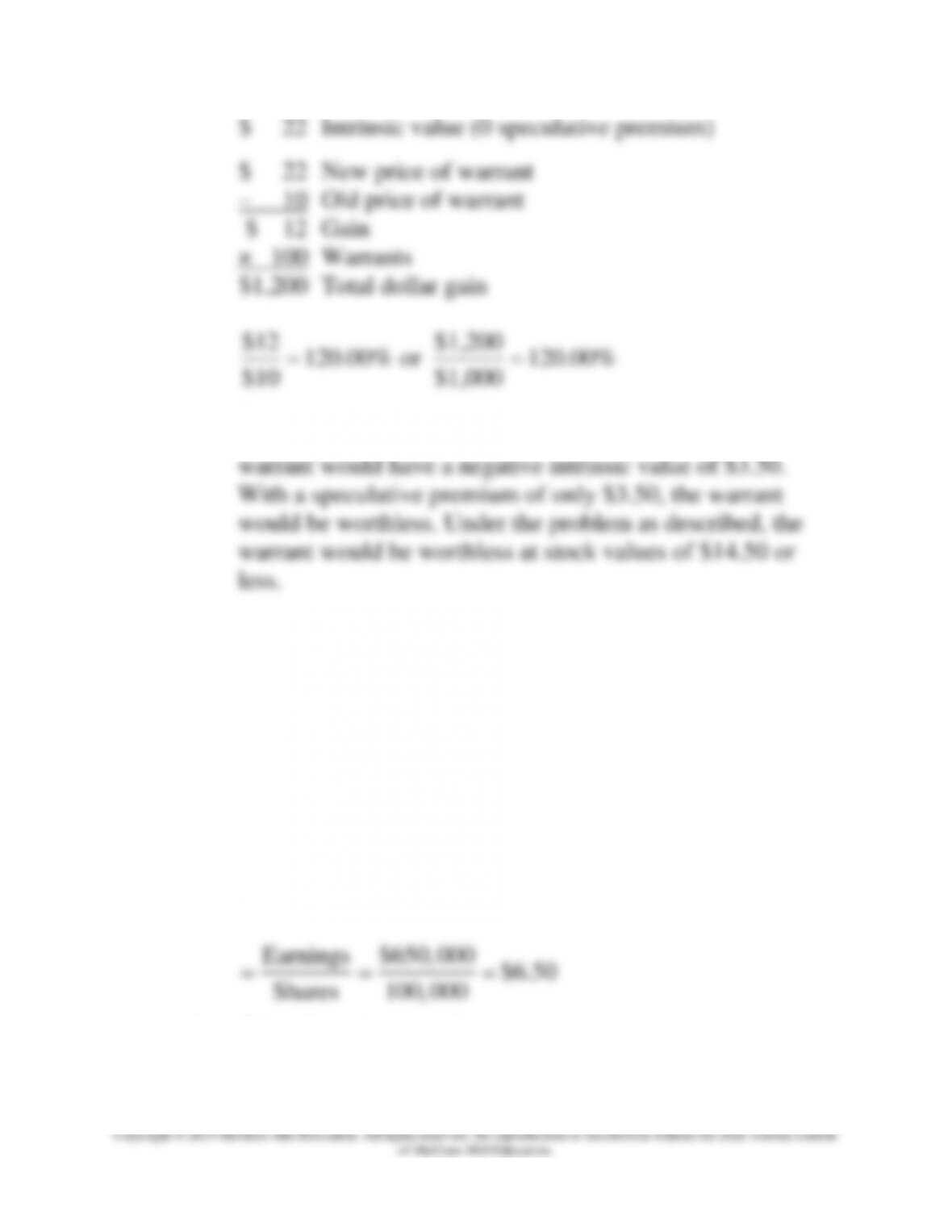
c. At the time the stock goes to $40, the speculative premium on the warrant goes to 0
(though the market value of the warrant goes up). What would be Mr. Hailey’s total
dollar and percentage returns on the warrant?
d. Assuming that the speculative premium remains $3.50 over the intrinsic value, how far
would the price of the stock have to fall from $40 before the warrant has no value?
19–19. Solution:
Comet Airlines
a.
$1,000 100 warrants
$10
=
$20 $1,000
19-19. (Continued)
c. $ 40 Stock price
– 18 Exercise price
Chapter 19: Convertibles, Warrants, and Derivatives
$10 $1,000
d. With an $18 exercise price, at a stock price of $14.50, the
20. Earnings per share with warrants (LO19-5) Online Network Inc. has a net income of
$650,000 in the current fiscal year. There are 100,000 shares of common stock outstanding,
along with convertible bonds, which have a total face value of $1.6 million. The $1.6
million is represented by 1,600 different $1,000 bonds. Each $1,000 bond pays 6 percent
interest. The conversion ratio is 10. The firm is in a 30 percent tax bracket.
a. Compute basic earnings per share.
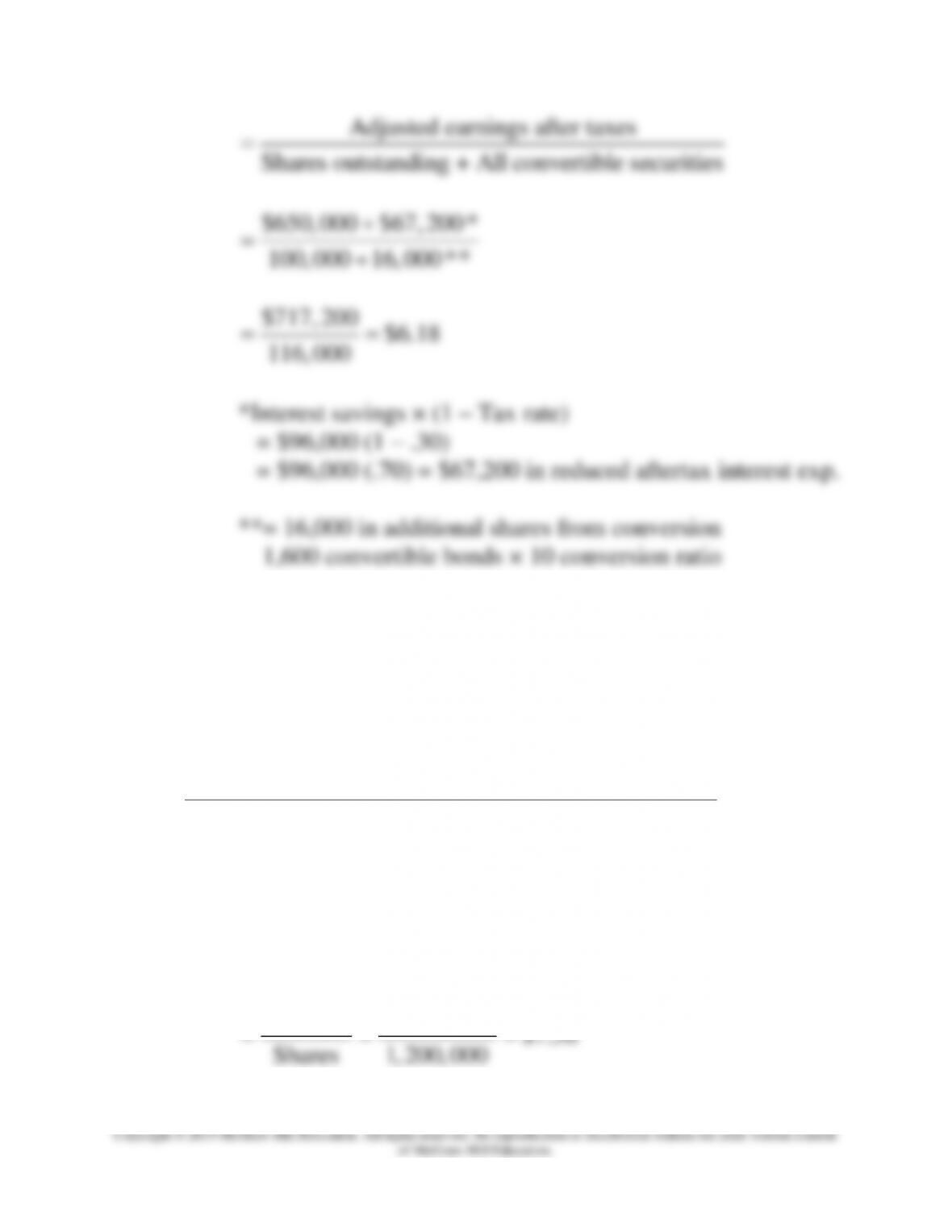
b. Compute diluted earnings per share.
19–20. Solution:
Online Network Inc.
a. Basic earnings per share
Earnings $650,000 $6.50
Shares 100,000
b. Diluted earnings per share
Chapter 19: Convertibles, Warrants, and Derivatives
Adjusted earnings after taxes
21. Earnings per share with convertibles (LO19-5) Myers Drugs Inc. has 1.20 million shares
of stock outstanding. Earnings after taxes are $9 million. Myers also has warrants
outstanding that allow the holder to buy 100,000 shares of stock at $15 per share. The stock
is currently selling for $50 per share.
a. Compute basic earnings per share.
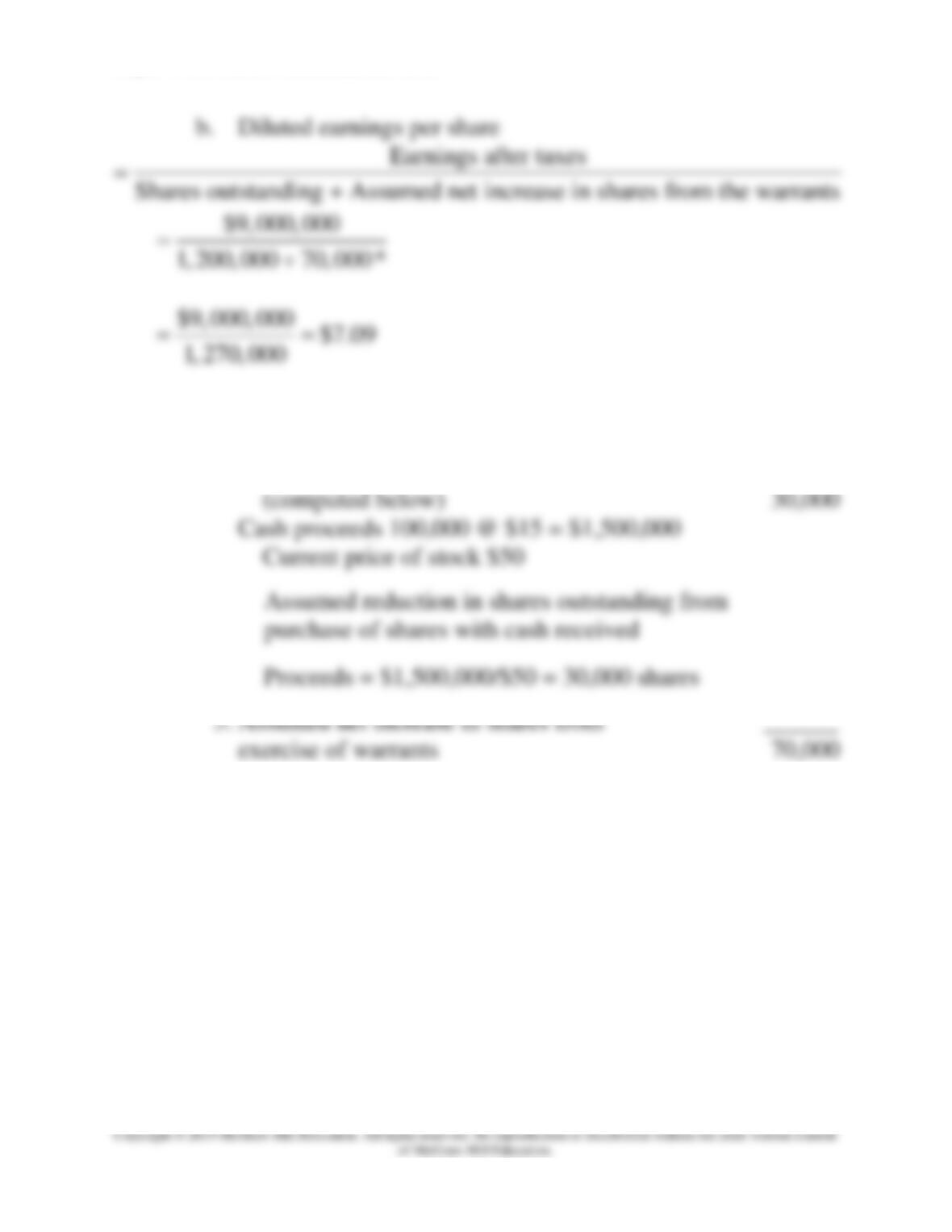
b. Compute diluted earnings per share considering the possible impact of the warrants.
Use the following formula:
Earnings after taxes
Shares outstanding + Assumed net increase in shares from the warrants
19–21. Solution:
Myers Drugs Inc.
a. Basic earnings per share
Earnings $9,000,000 $7.50
Shares 1, 200,000
Chapter 19: Convertibles, Warrants, and Derivatives
1, 270,000
* 1. New shares created 100,000
2. Reduction in shares from cash proceeds
22. Conversion value and changing pure bond value (LO19-3) Tulsa Drilling Company has
$1.3 million in 12 percent convertible bonds outstanding. Each bond has a $1,000 par value.
The conversion ratio is 40, the stock price is $36, and the bonds mature in 10 years. The bonds
are currently selling at a conversion premium of $60 over the conversion value.
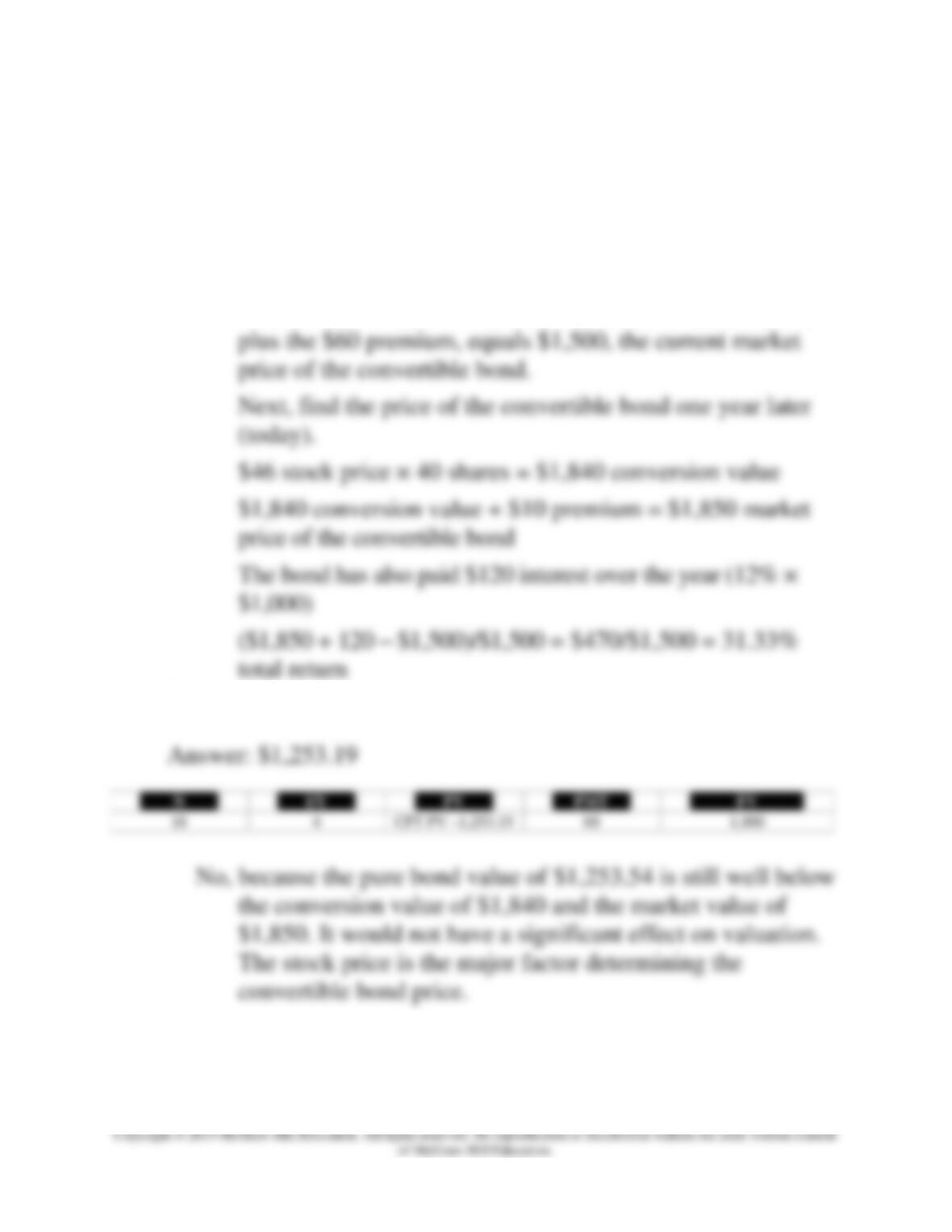
a. Today, one year later, the price of Tulsa Drilling Company common stock has risen to
$46. What would your rate of return be if you had purchased the convertible bond one
year ago and sold it today? Assume that on the date of sale, the conversion premium
has shrunk from $60 to $10. (Hint: Don’t forget to include the interest payment for the
first year)
Chapter 19: Convertibles, Warrants, and Derivatives
b. Assume the yield on similar nonconvertible bonds has fallen to 8 percent at the time of
sale. What would the pure bond value be at that point? (Use semiannual analysis.)
Would the pure bond value have a significant effect on valuation then?
19–22. Solution:
Tulsa Drilling Company
a. First find the price of the convertible bond. The conversion
value is $1,440 ($36 × 40). The conversion value, $1,440,
b. Pure bond value after one year (nine years remaining).
23. Falling stock prices and pure bond value (LO19-3) Manpower Electric Company has
6 percent convertible bonds outstanding. Each bond has a $1,000 par value. The conversion
ratio is 20, the stock price $36, and the bonds mature in 16 years.
Chapter 19: Convertibles, Warrants, and Derivatives
a. What is the conversion value of the bond?
b. Assume after one year that the common stock price falls to $30.50. What is the
conversion value of the bond?
c. Also assume that after one year interest rates go up to 10 percent on similar bonds.
There are 15 years left to maturity. What is the pure value of the bond? Use semiannual
analysis.
d. Will the conversion value of the bond (part b) or the pure value of the bond (part c)
have a stronger influence on its price in the market?
e. If the bond trades in the market at its pure bond value, what would be the conversion
premium (stated as a percentage of the conversion value)?
19–23. Solution:
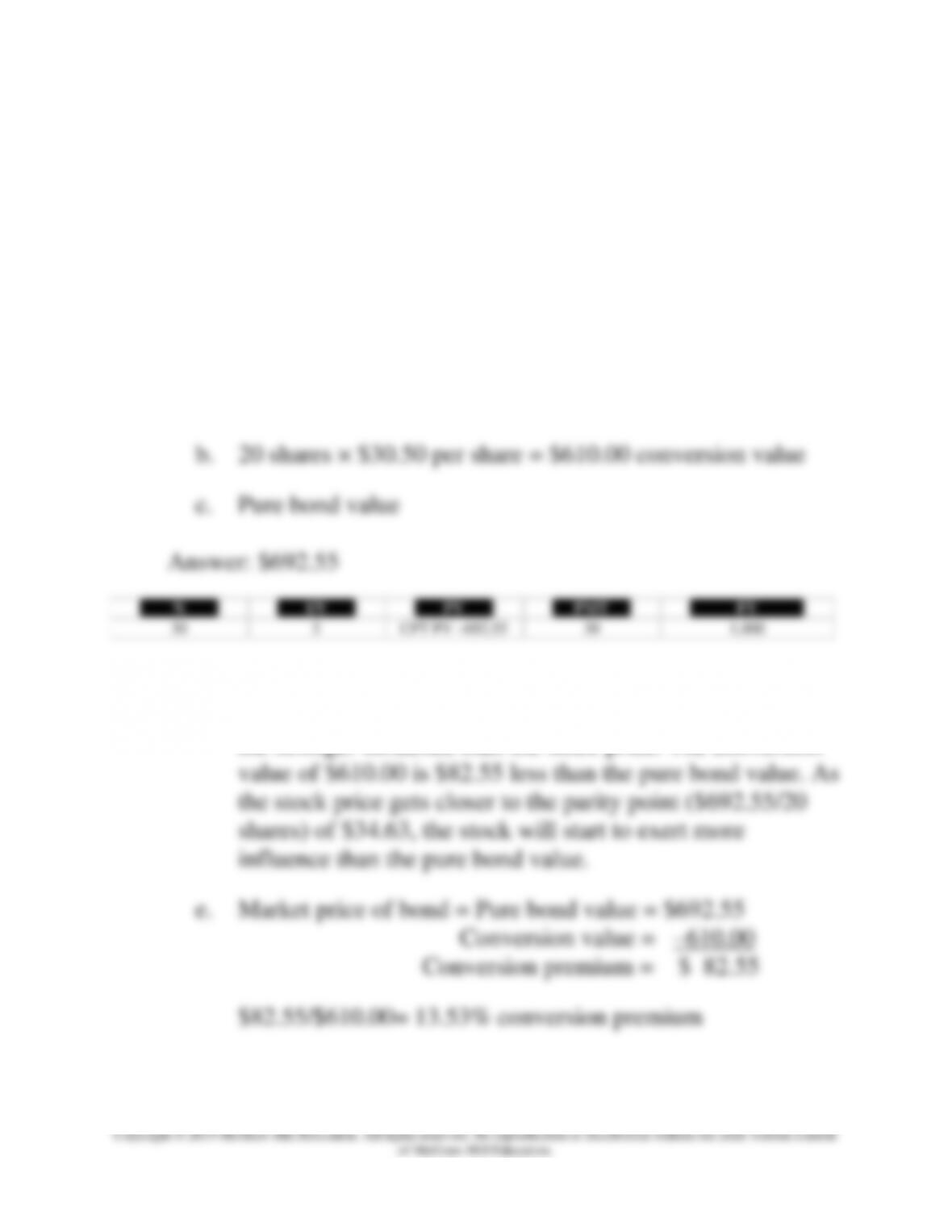
a. 20 shares × $36 per share = $720 conversion value
d. For the time being, the pure bond value ($692.55) will have
the stronger influence than the stock price. The conversion
Chapter 19: Convertibles, Warrants, and Derivatives
COMPREHENSIVE PROBLEM
Comprehensive Problem 1.
Fondren Exploration Ltd. (rates of return on convertible bond investments) (LO19-1)
Fondren Exploration Ltd. has 1,000 convertible bonds ($1,000 par value) outstanding, each of
which may be converted to 50 shares of stock. The $1 million worth of bonds has 25 years to
maturity. The current price of the stock is $26 per share. The firm’s net income in the most
recent fiscal year was $270,000. The bonds pay 12 percent interest. The corporation has 150,000
shares of common stock outstanding. Current market rates on long-term nonconvertible bonds of
equal quality are 14 percent. A 35 percent tax rate is assumed.
a. Compute diluted earnings per share.
b. Assume the bonds currently sell at a 5 percent conversion premium over conversion value
(based on a stock price of $26). However, as the price of the stock increases from $26 to $37
due to new events, there will be an increase in the bond price, and a zero conversion
premium. Under these circumstances, determine the rate of return on a convertible bond
investment that is part of this price change, based on the appreciation in value.
c. Now assume the stock price is $16 per share because a competitor introduced a new
product. Would the conversion value be greater than the pure bond value, based on the
interest rates stated here? (See Table 16-3 in Chapter 16 to get the bond value without
having to go through the actual computation.)
d. Referring to part c, if the convertible traded at a 15 percent premium over the
conversion value, would the convertible be priced above the pure bond value?
e. If long-term interest rates in the market go down to 10 percent while the stock price is
at $23, with a 6 percent conversion premium, what would the difference be between the
market price of the convertible bond and the pure bond value? Assume 25 years to
CP 19-1. Solution:
Fondren Exploration Limited
a. Diluted earnings per share
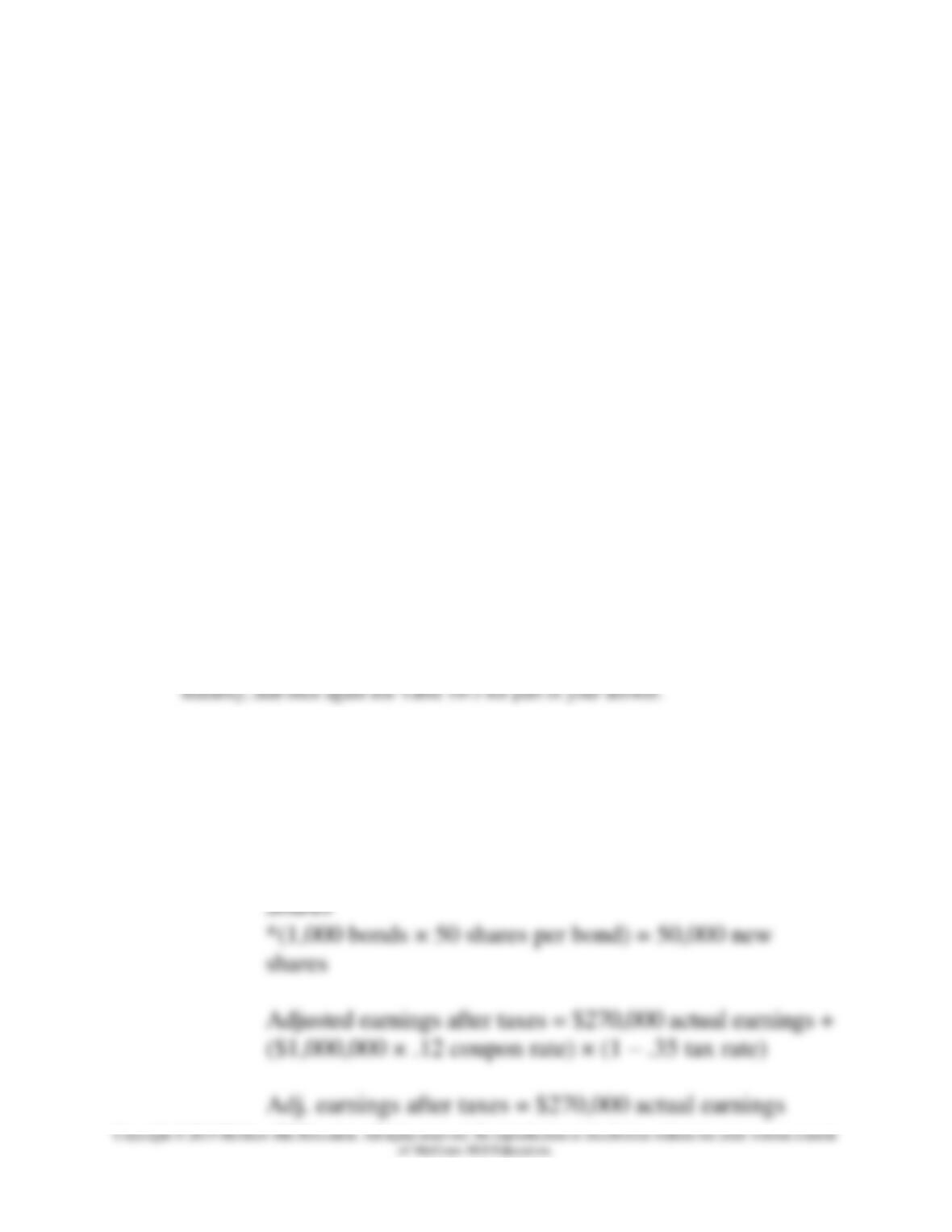
Adjusted Shares = 150,000 + 50,000* = 200,000 Adj.
Chapter 19: Convertibles, Warrants, and Derivatives
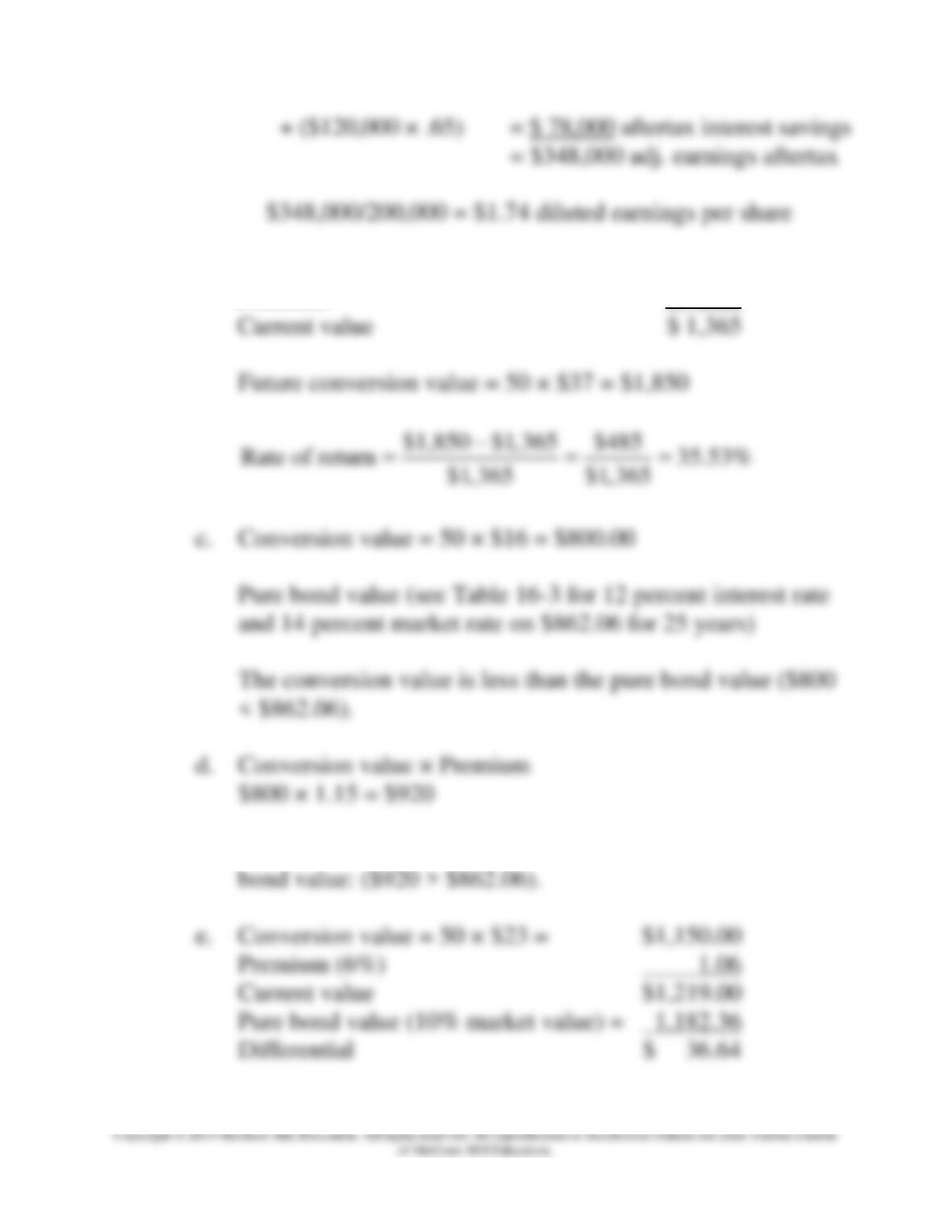
b. Current conversion value = 50 × $26 = $ 1,300
Premium × 1.05
The convertible would be trading for greater than the pure
Chapter 19: Convertibles, Warrants, and Derivatives
Comprehensive Problem 2.
United Technology Corp. (a call decision with convertible bonds) (LO19–1) United Technology
Corporation (UTC) has $40 million of convertible bonds outstanding (40,000 bonds at $1,000 par
value) with a coupon rate of 11 percent. Interest rates are currently 8 percent for bonds of equal risk.
The bonds have 15 years left to maturity. The bonds may be called at a 9 percent premium over par.
They are convertible into 30 shares of common stock. The tax rate for the company is 25 percent.
The firm’s common stock is currently selling for $41, and it pays a dividend of $3.50 per
share. The expected income for the company is $38 million with 6 million shares outstanding.
Thoroughly analyze the bonds and determine whether the firm should call the bond at the
9 percent call premium. In your analysis, consider the following:
a. The impact of the call on basic and diluted earnings per share (assume the call forces
conversion).
b. The consequences of your decision on financing flexibility.
c. The net change in cash outflows to the company as a result of the call and conversion.
CP 19-2. Solution:
United Technology Corporation (UTC)
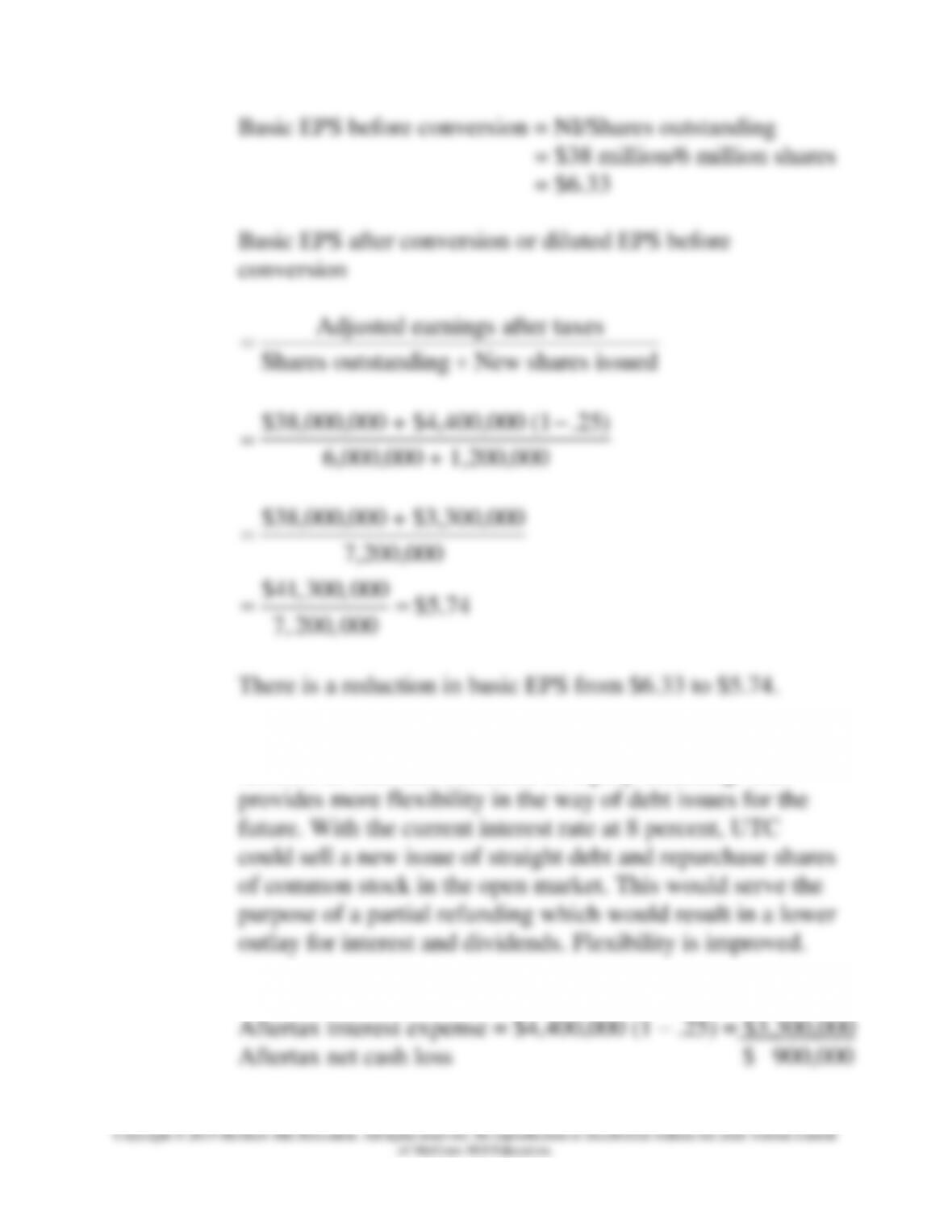
Interest expense 11% × $40 million = $4,400,000 million
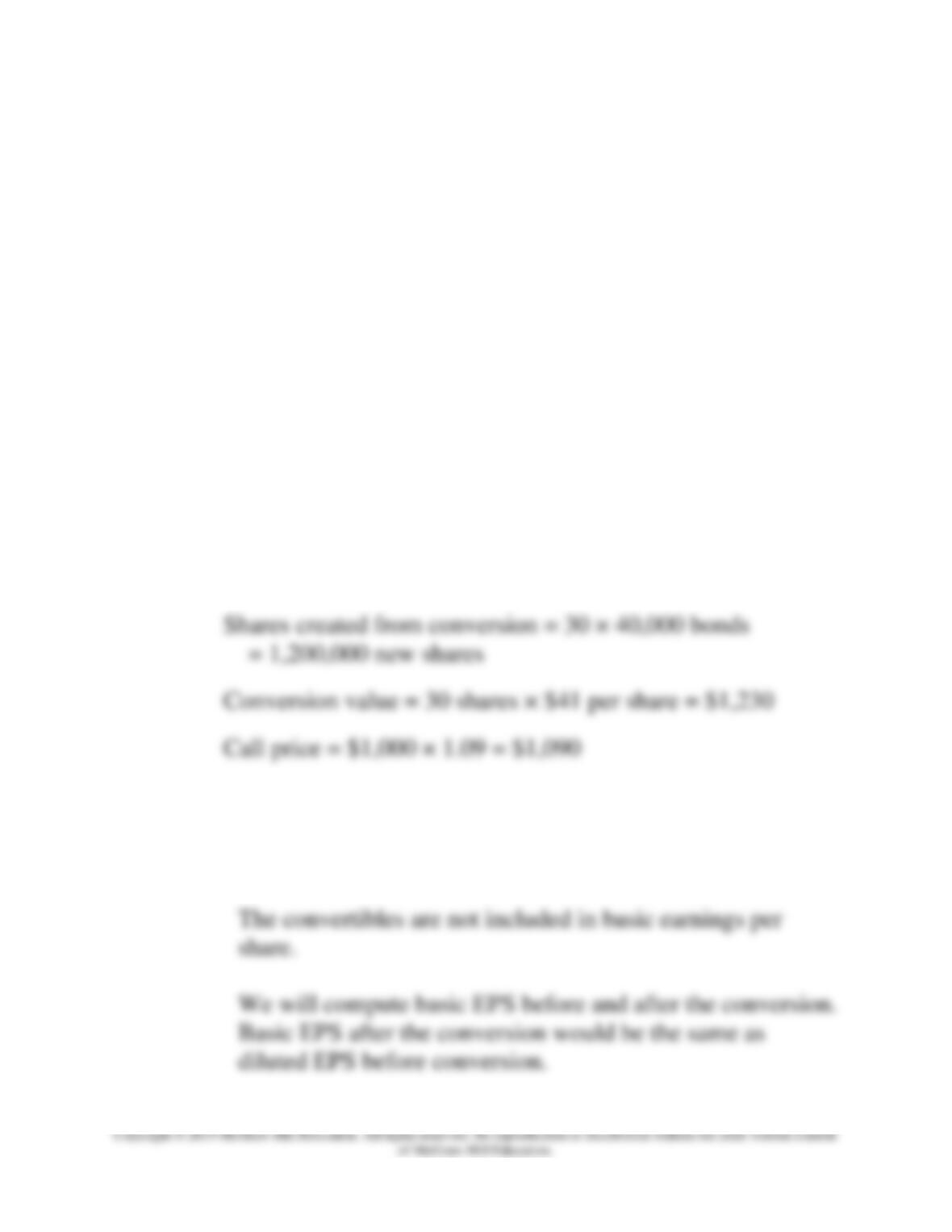
a. If the bond is called, it will be converted because the
conversion value is greater than the call price ($1,230 >
$1,090).
Chapter 19: Convertibles, Warrants, and Derivatives
b. With the elimination of the convertible bond, UTC has
reduced its debt and increased its equity financing. This
c. Aftertax dividend expense = 1,200,000 × $3.50 = $4,200,000