
Problem 19-13 Problem 19-20 Problem 19-22
Copyright © 2011 McGraw-Hill/Irwin and ANSR Source India Pvt. Ltd. (www.ansrsourceindia.com)
Convertibles, Warrants, and Derivatives
Spreadsheet Templates
Foundations of Financial Management
MAIN MENU – CHAPTER 19
Spreadsheet Templates by Block, Hirt and Danielsen

Problem 19-13
Objective: Conversion value versus pure bond value
Student Name:
Course Name:
Student ID:
Course Number:
Standard Olive Company of California has a convertible bond outstanding with a coupon rate of 9 percent and a
maturity date of 15 years. It is rated Aa, and competitive, nonconvertible bonds of the same risk class carry a 10
percent return. The conversion ratio is 25. Currently the common stock is selling for $30 per share on the New York
Stock Exchange.
a. What is the conversion price?
b. What is the conversion value?
c. Compute the pure bond value. (Use semiannual analysis.)
d. Draw a graph that includes the pure bond value and the conversion value but not the convertible bond price. For the
stock price on the horizontal axis, use 10, 20, 30, 40, 50, and 60.
e. Which will influence the bond price more—the pure bond value or the conversion value?
Foundations of Financial Management
Block, Hirt and Danielsen
Problem 19-13
Instructions
Enter formulas to complete the requirements of this problem.
Information
Par value $1,000
Conversion ratio 25
Stock price $30.00
Years till maturity 15
Nonconvertible bond return 10%
Convertible bond coupon rate 9%
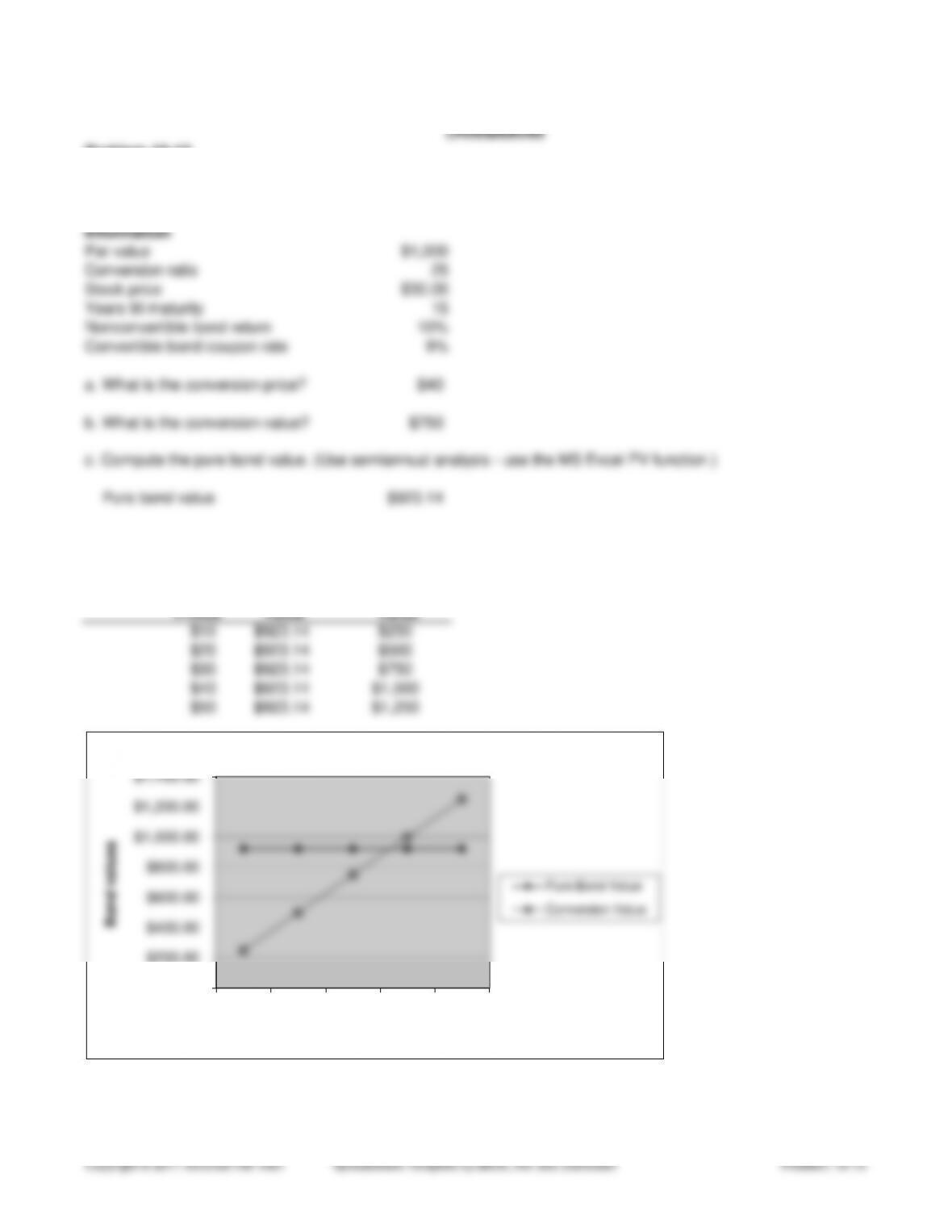
a. What is the conversion price? $40
b. What is the conversion value? $750
c. Compute the pure bond value. (Use semiannual analysis – use the MS Excel PV function.)
Pure bond value $923.14
d. Draw a graph that includes the pure bond value and the conversion value but not the convertible bond price.
For the stock price on the horizontal axis, use 10, 20, 30, 40, and 50.
Stock Pure Bond Conversion
Prices Value Value
$10 $923.14 $250
$20 $923.14 $500
$30 $923.14 $750
$40 $923.14 $1,000
$50 $923.14 $1,250
Solution
$1,400.00
Bond values

e. Which will influence the bond price more—the pure bond value or the conversion value?
At a stock price of $30 per share, the price of the bond will be influenced more by the pure bond value (floor price)
of $923.14. If interest rates move up the pure bond value will fall and if they move down, the pure bond value will rise.
As the stock rises from $30 per share to the crossover point of $36.93 ($923.14/25) the market price of the bond will
react directly to stock price changes and the market price of the bond will rise with the stock price. The biggest
premium over the pure bond value will occur at $36.91 where the pure bond value equals the conversion value.

Problem 19-20
Objective: Earnings per share with convertibles
Student Name:
Course Name:
Student ID:
Course Number:
Online Network, Inc., has had net income of $600,000 in the current fiscal year. There are 100,000 shares of common
stock outstanding along with convertible bonds, which have a total face value of $1.4 million. The $1.4 million is
represented by 1,400 different $1,000 bonds. Each $1,000 bond pays 5 percent interest. The conversion ratio is 20.
The firm is in a 30 percent tax bracket.
a. Calculate basic earnings per share.
b. Calculate diluted earnings per share.
Foundations of Financial Management
Block, Hirt and Danielsen
Problem 19-20
Instructions
Enter formulas to complete the requirements of this problem.
Information
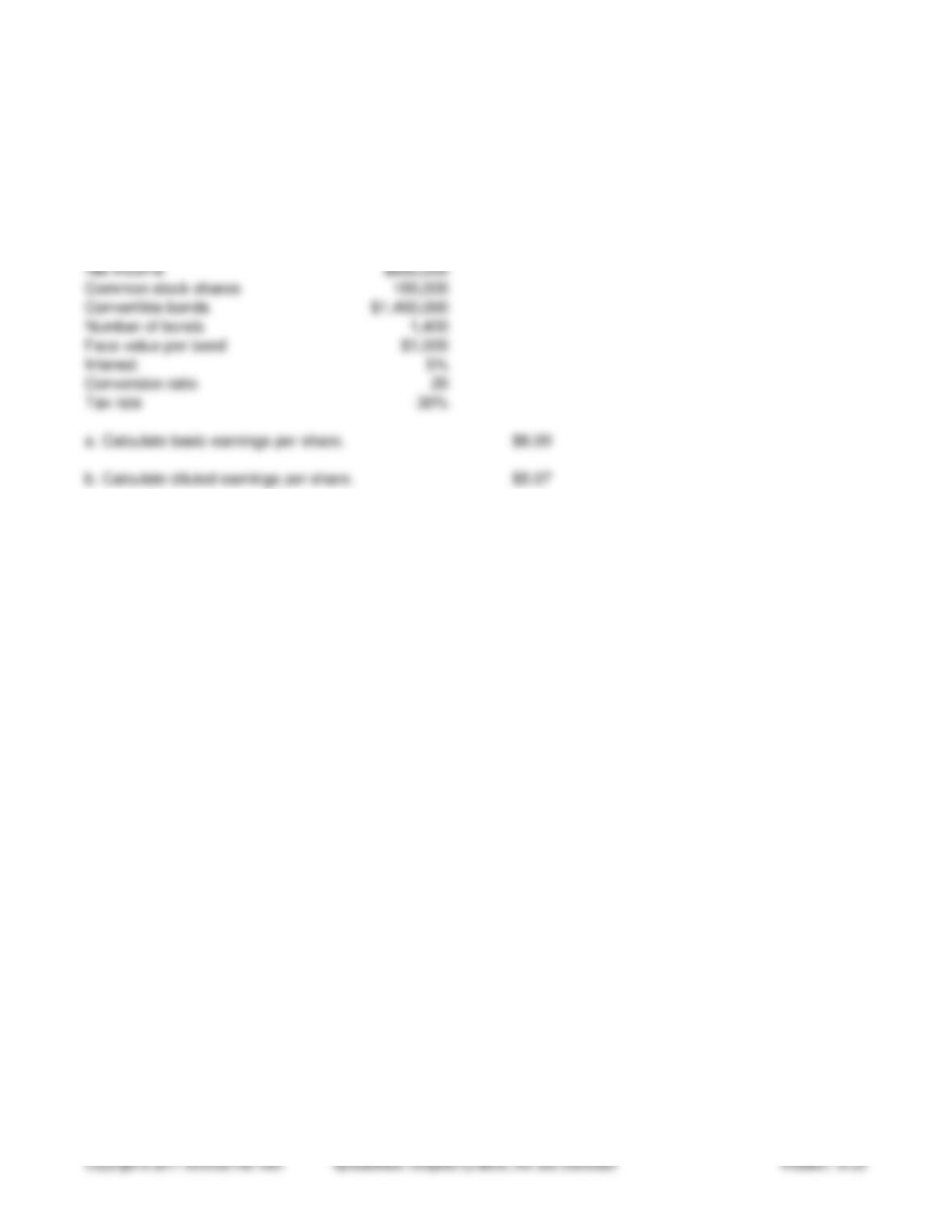
Net income $600,000
Common stock shares 100,000
Convertible bonds $1,400,000
Number of bonds 1,400
Face value per bond $1,000
Interest 5%
Conversion ratio 20
Tax rate 30%
a. Calculate basic earnings per share. $6.00
b. Calculate diluted earnings per share. $5.07
Solution

Problem 19-22
Objective: Conversion value and changing pure bond value
Student Name:
Course Name:
Student ID:
Course Number:
Tulsa Drilling Company has $1 million in 11 percent convertible bonds outstanding. Each bond has a $1,000
par value. The conversion ratio is 40, the stock price is $32, and the bonds mature in 10 years. The bonds are
currently selling at a conversion premium of $70 over the conversion value.
a. If the price of Tulsa Drilling Company common stock rises to $42 on this date next year, what would your
rate of return be if you bought a convertible bond today and sold it in one year? Assume that on this date next
year, the conversion premium has shrunk from $70 to $20.
b. Assume the yield on similar nonconvertible bonds has fallen to 8 percent at the time of sale. What would
the pure bond value be at that point? (Use semiannual analysis.) Would the pure bond value have a significant
effect on valuation then?
Foundations of Financial Management
Block, Hirt and Danielsen
Problem 19-22
Instructions
Enter formulas to complete the requirements of this problem.
Information
Conversion ratio 40
Stock price $32
Years till maturity 10
Conversion premium $70
Coupon rate 11%
a. If the price of Tulsa Drilling Company common stock rises to $42 on this date next year, what would your
rate of return be if you bought a convertible bond today and sold it in one year? Assume that on this date next
year, the conversion premium has shrunk from $70 to $20.
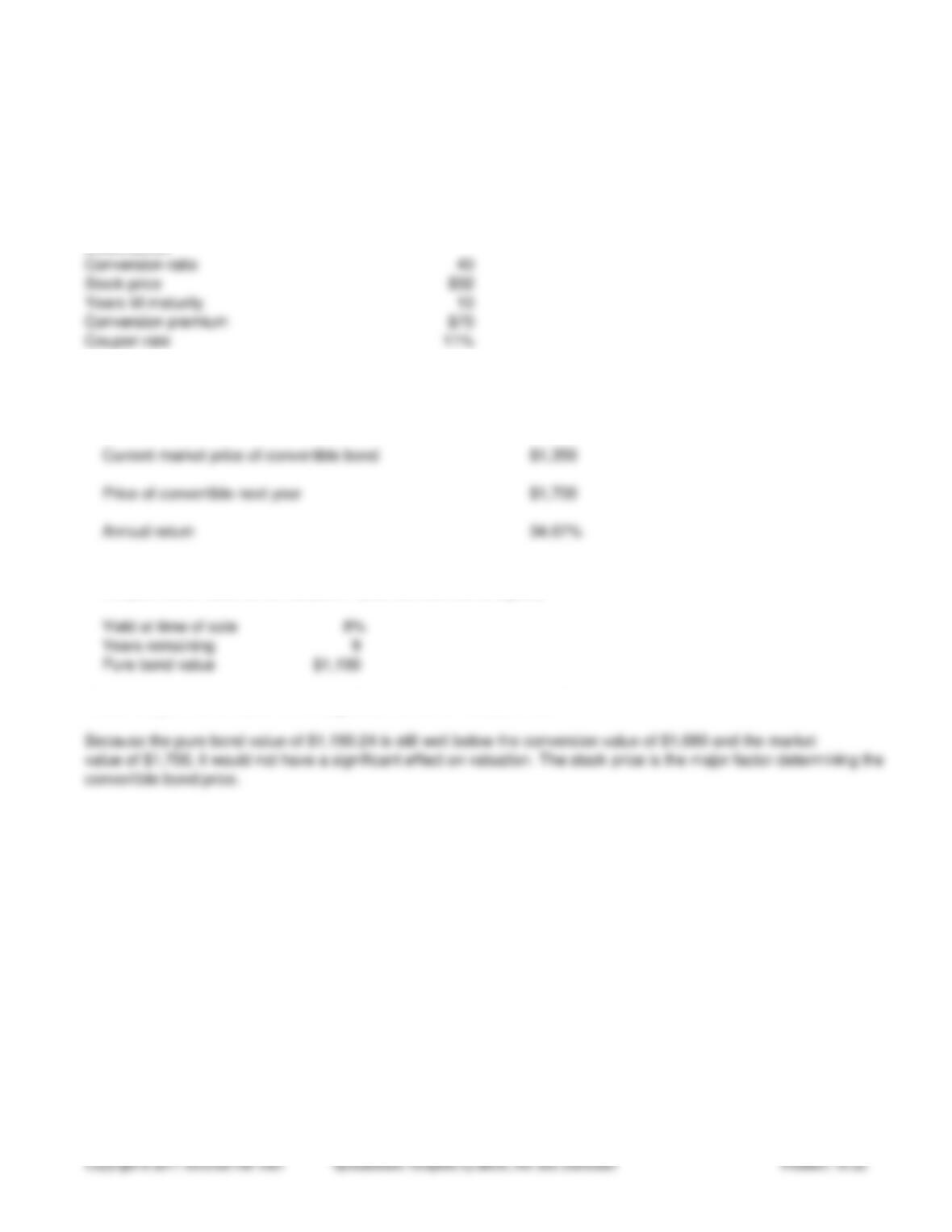
Current market price of convertible bond $1,350
Price of convertible next year $1,700
Annual return 34.07%
b. Assume the yield on similar nonconvertible bonds has fallen to 8 percent at the time of sale. What would
the pure bond value be at that point? (Use semiannual analysis.)
Yield at time of sale 8%
Years remaining 9
Pure bond value $1,190
Would the pure bond value have a significant effect on valuation then?
Because the pure bond value of $1,190.24 is still well below the conversion value of $1,680 and the market
value of $1,700, it would not have a significant effect on valuation. The stock price is the major factor determining the
convertible bond price.
Solution