Chapter 17: Common and Preferred Stock Financing
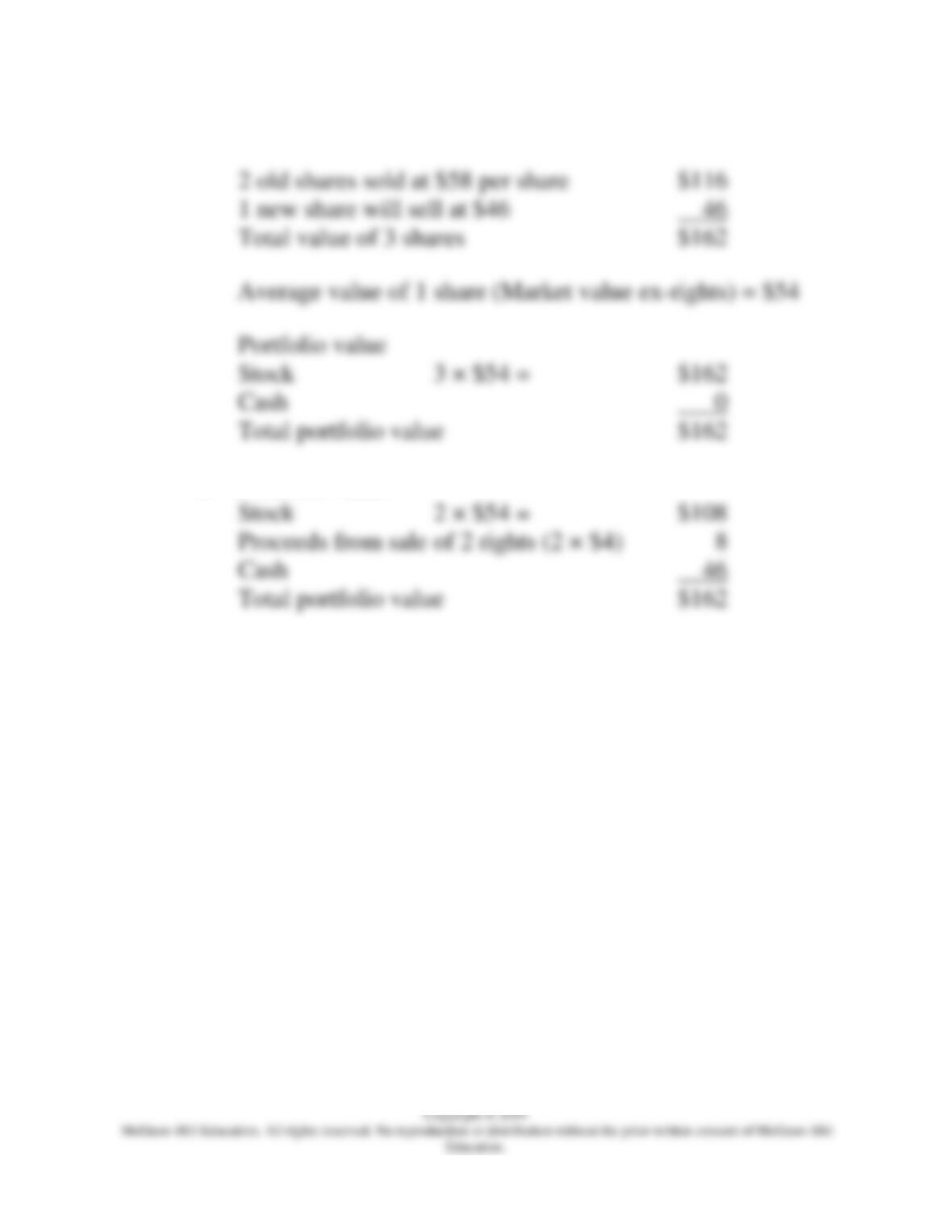
d. Portfolio value
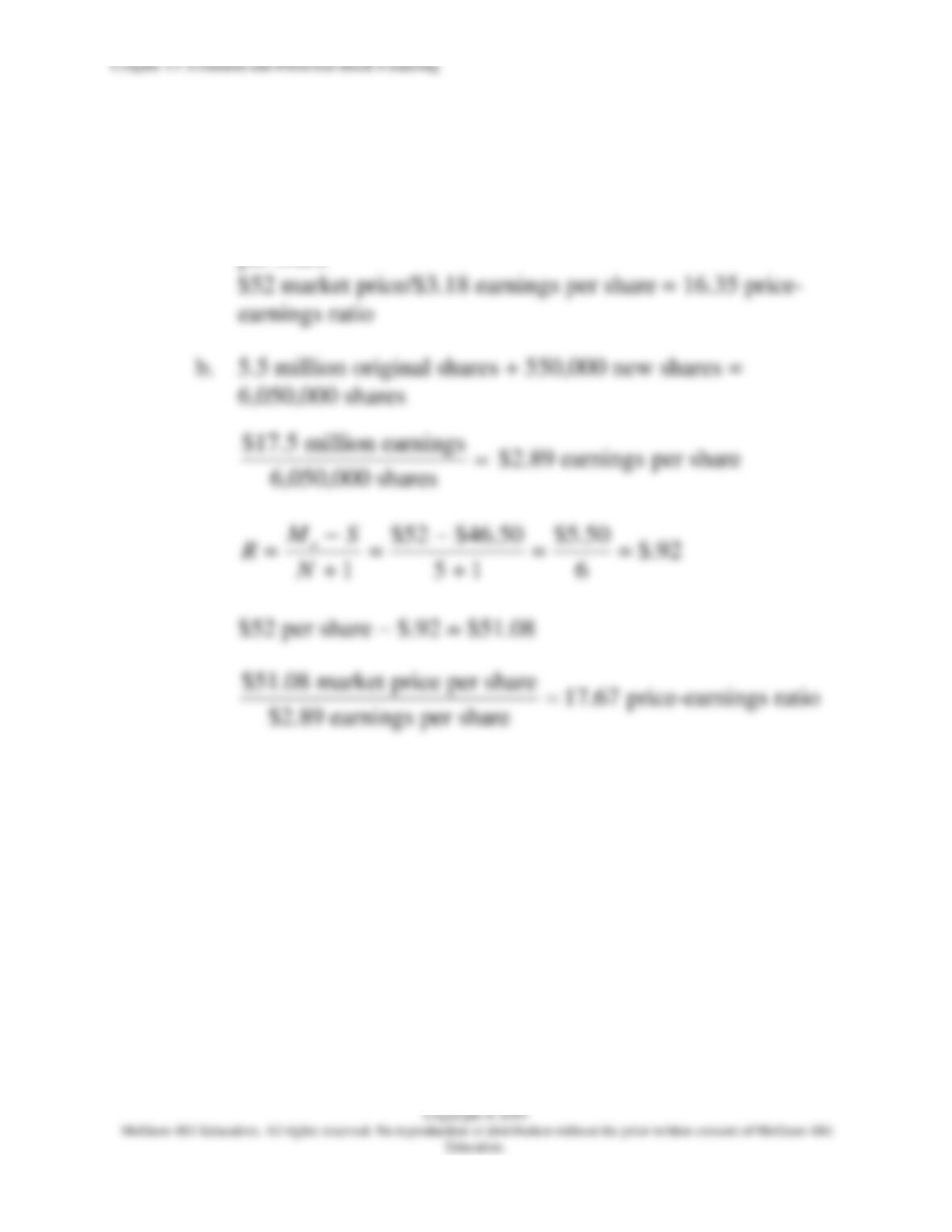
16. Relation of rights to EPS and the price-earnings ratio (LO17-3) Walker Machine Tools
has 5.5 million shares of common stock outstanding. The current market price of Walker
common stock is $52 per share rights-on. The company’s net income this year is $17.5
million. A rights offering has been announced in which 550,000 new shares will be sold at
$46.50 per share. The subscription price plus five rights is needed to buy one of the new
shares.
a. What are the earnings per share and price-earnings ratio before the new shares are
sold via the rights offering?
b. What would the earnings per share be immediately after the rights offering? What
would the price-earnings ratio be immediately after the rights offering? (Assume
there is no change in the market value of the stock, except for the change when the
stock begins trading ex-rights.) Round all answers to two places after the decimal
point.
Chapter 17: Common and Preferred Stock Financing
21. Borrowing funds to purchase preferred stock (LO17-5) The treasurer of Kelly Bottling
Company (a corporation) currently has $150,000 invested in preferred stock yielding 8
percent. He appreciates the tax advantages of preferred stock and is considering buying
$150,000 more with borrowed funds. The cost of the borrowed funds is 13 percent. He
suggests this proposal to his board of directors. They are somewhat concerned by the fact
that the treasurer will be paying 5 percent more for funds than the company will be earning
on the investment. Kelly Bottling is in a 35 percent tax bracket, with dividends taxed at
20 percent.
a. Compute the amount of the aftertax income from the additional preferred stock if it is
purchased.
b. Compute the aftertax borrowing cost to purchase the additional preferred stock. That
is, multiply the interest cost times (1 – T).
c. Should the treasurer proceed with his proposal?
d. If interest rates and dividend yields in the market go up six months after a decision to
purchase is made, what impact will this have on the outcome?
17-21. Solution:
Kelly Bottling Company
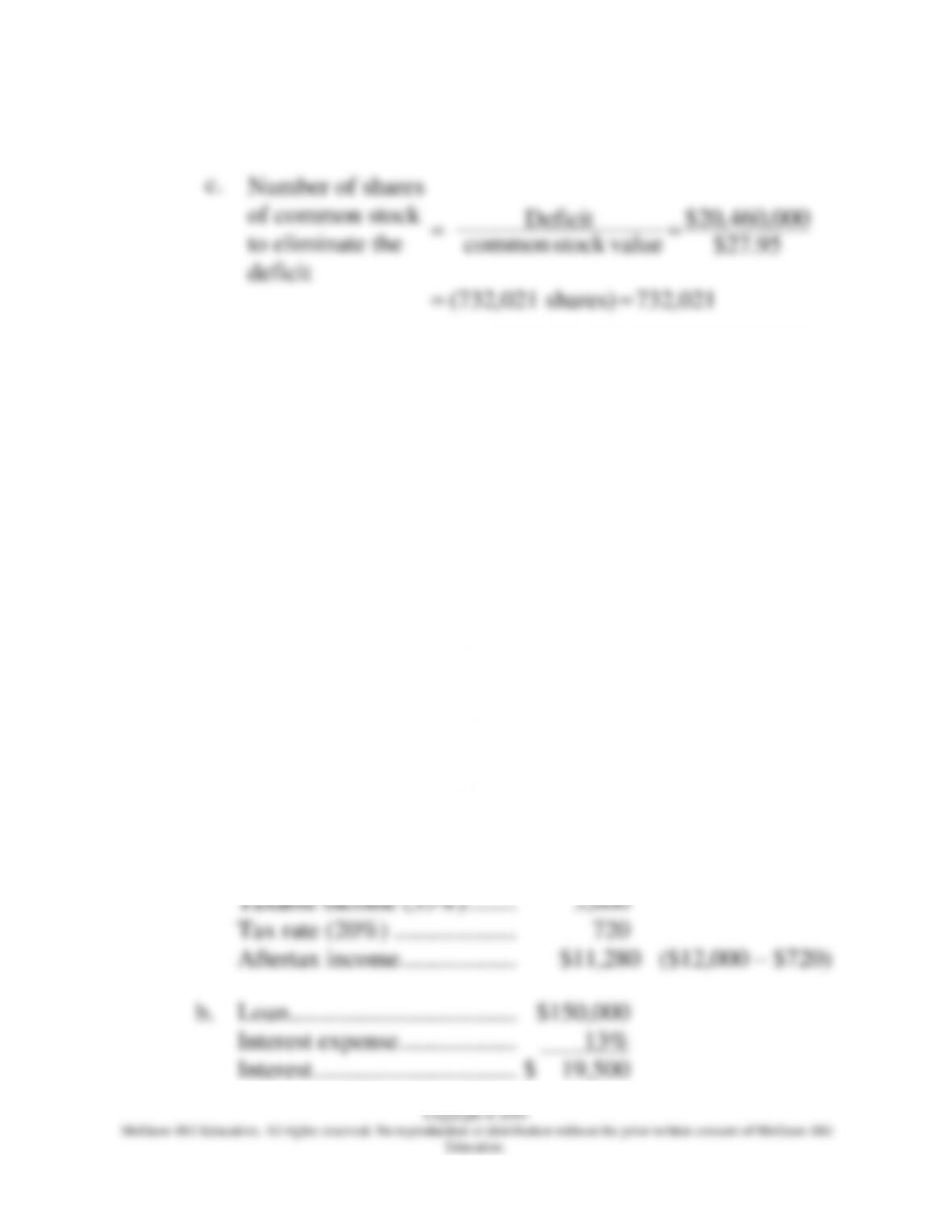
a. Preferred stock ……………….. $150,000
Dividend yield ………………… 8%
Dividend ………………………… $ 12,000
Chapter 17: Common and Preferred Stock Financing
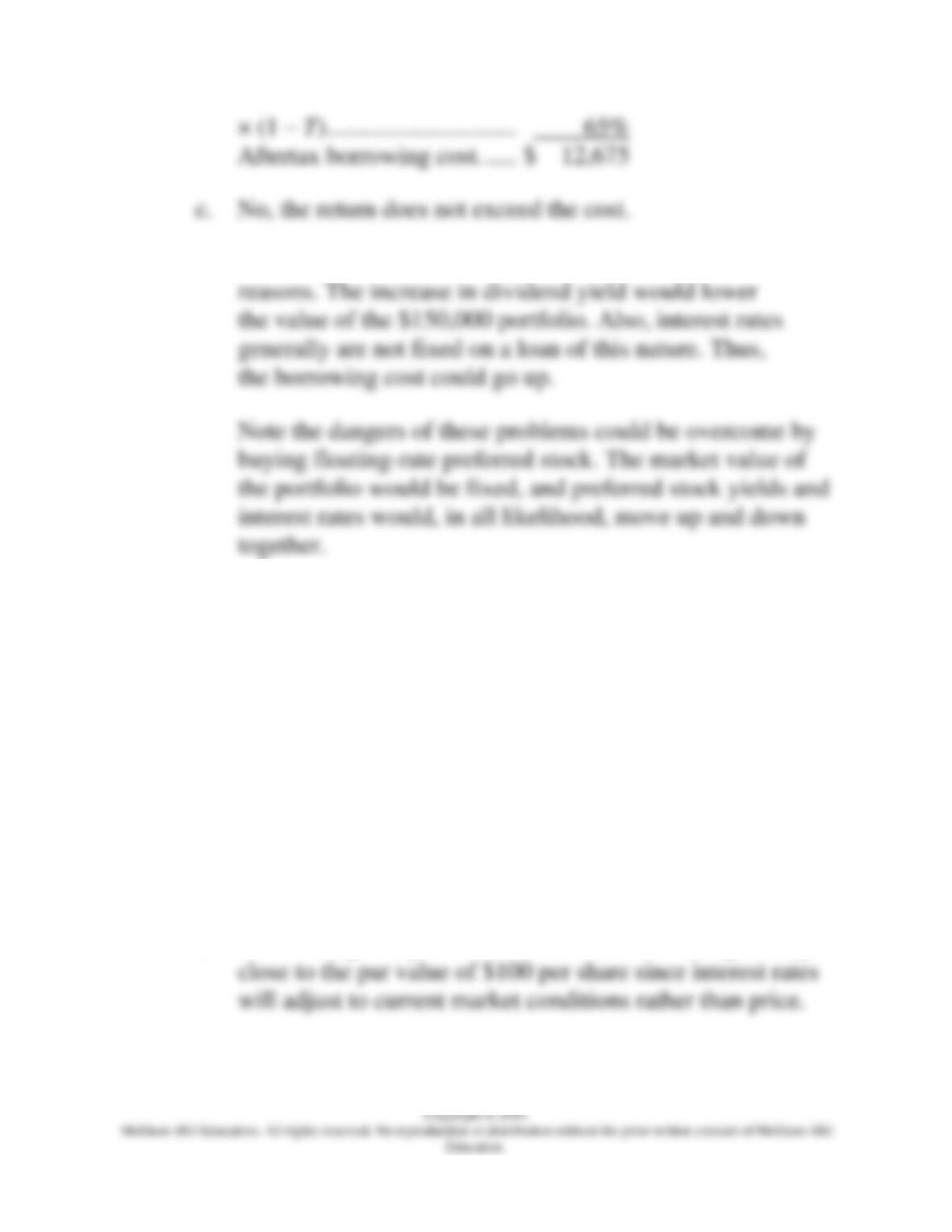
d. The outcome could become quite unfavorable for two
22. Floating-rate preferred stock (LO17-5) Barnes Air Conditioning Inc. has two classes of
preferred stock: floating rate preferred stock and straight (normal) preferred stock. Both
issues have a par value of $100. The floating-rate preferred stock pays an annual dividend
yield of 4 percent, and the straight preferred stock pays 5 percent. Since the issuance of the
two securities, interest rates have gone up by 2.50 percent for each issue. Both securities
will pay their year-end dividend today.
a. What is the price of the floating-rate preferred stock likely to be?
b. What is the price of the straight preferred stock likely to be? Refer back to Chapter 10
and use Formula 10-4 to answer this question.
17-22. Solution:
Barnes Air Conditioning Inc.
a. The floating rate preferred stock should be trading at very
b. Based on Formula 10-4, the price of straight preferred stock
will be:

Chapter 17: Common and Preferred Stock Financing
$5 $66.67
.075
P
P
P
D
PK
= = =
COMPREHENSIVE PROBLEM
Comprehensive Problem 1.
Crandall Corporation (rights offering and the impact on shareholders ) (LO17-3) The
Crandall Corporation currently has 100,000 shares outstanding that are selling at $50 per share. It
needs to raise $900,000. Net income after taxes is $500,000. Its vice president of finance and its
investment banker have decided on a rights offering, but are not sure how much to discount the
subscription price from the current market value. Discounts of 10 percent, 20 percent, and 40
percent have been suggested. Common stock is the sole means of financing for the Crandall
Corporation.
a. For each discount, determine the subscription price, the number of shares to be issued, and
the number of rights required to purchase one share. (Round to one place after the decimal
point where necessary.)
b. Determine the value of one right under each of the plans. (Round to two places after the
decimal point.)
c. Compute the earnings per share before and immediately after the rights offering under a
10 percent discount from the market price.
d. By what percentage has the number of shares outstanding increased?
e. Stockholder X has 100 shares before the rights offering and participated by buying 20 new
shares. Compute his total claim to earnings both before and after the rights offering (that is,
multiply shares by the earnings per share figures computed in part c).
f. Should Stockholder X be satisfied with this claim over a longer period of time?
CP 17-1. Solution:
Crandall Corp.
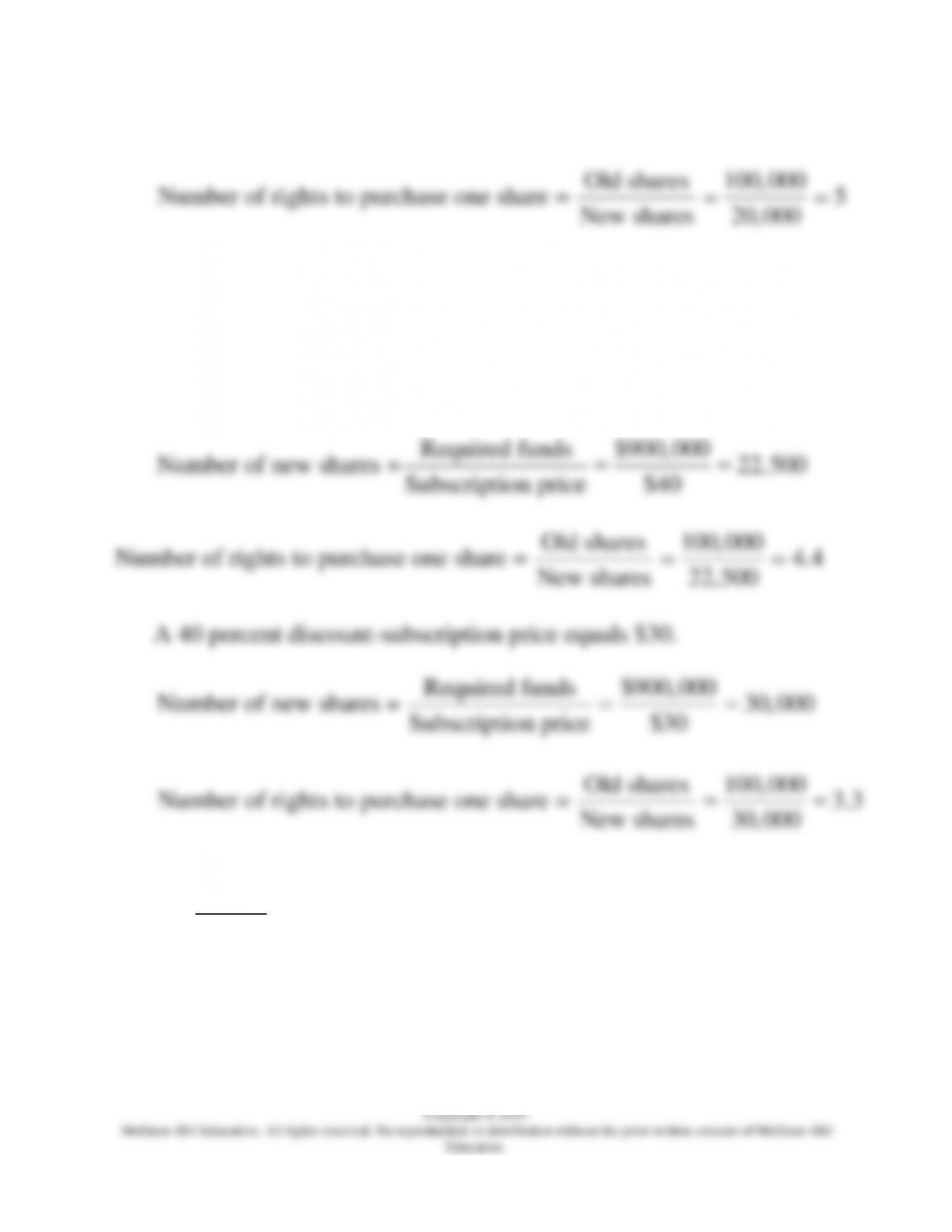
a. A 10 percent discount-subscription price equals $45.
Required funds $900,000
Subscription price $45
Chapter 17: Common and Preferred Stock Financing
Chapter 17: Common and Preferred Stock Financing
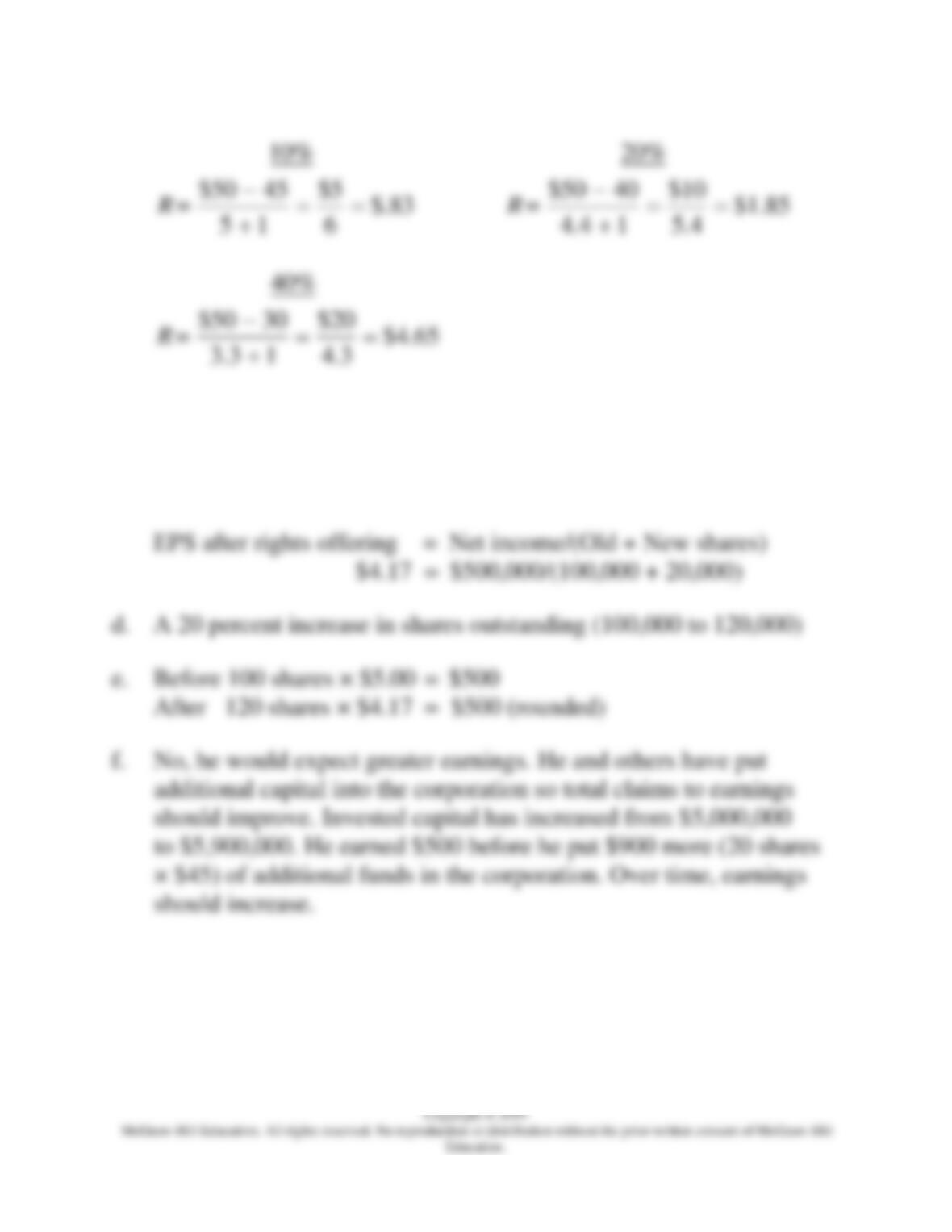
10%
$50 45 $5
= $.83
5 1 6
R−==
+
20%
$50 40 $10
= $1.85
4.4 1 5.4
R−==
+
40%
$50 30 $20
= $4.65
3.3 1 4.3
R−==
+
CP17-1. (Continued)
c. EPS before rights offering = Net income/Old shares
$500,000/100,000 = $5.00
COMPREHENSIVE PROBLEM
Comprehensive Problem 2.

Chapter 17: Common and Preferred Stock Financing
Electro Cardio Systems Inc. (poison pill strategy) (LO17-4) Dr. Robert Grossman founded
Electro Cardio Systems Inc. (ECS) in 2001. The principal purpose of the firm was to engage in
the research and development of heart pump devices. Although the firm did not show a profit
until 2006, by 2010 it reported aftertax earnings of $1,200,000. The company had gone public in
2004 at $10 a share. Investors were initially interested in buying the stock because of its future
prospects. By year-end 2010, the stock was trading at $42 per share because the firm had made
good on its promise to produce lifesaving heart pumps and, in the process, was now making
reasonable earnings. With 850,000 shares outstanding, earnings per share were $1.41.
Dr. Grossman and the members of the board of directors were initially pleased when another
firm, Parker Medical Products, began buying their stock. John Parker, the chairman and CEO of
Parker Medical Products, was thought to be a shrewd investor and his company’s purchase of
50,000 shares of ECS was taken as an affirmation of the success of the firm.
However, when Parker bought another 50,000 shares, Dr. Grossman and members of the
board of directors of ECS became concerned that John Parker and his firm might be trying to take
over ECS.
Upon talking to her attorney, Dr. Grossman was reminded that ECS had a poison pill
provision that took effect when any outside investor accumulated 25 percent or more of the shares
outstanding. Current stockholders, excluding the potential takeover company, were given the
privilege of buying up to 500,000 shares of ECS at 80 percent of current market value. Thus new
shares would be restricted to friendly interests.
The attorney also found that Dr. Grossman and “friendly” members of the board of directors
currently owned 175,000 shares of ECS.
a. How many more shares would Parker Medical Products need to purchase before the poison
pill provision would go into effect? Given the current price of ECS stock of $42, what would
be the cost to Parker to get up to that level?
b. ECS’s ultimate fear was that Parker Medical Products would gain over a 50 percent interest
in ECS’s outstanding shares. What would be the additional cost to Parker to get 50 percent
(plus 1 share) of the stock outstanding of ECS at the current market price of ECS stock? In
answering this question, assume Parker had previously accumulated the 25 percent position
discussed in a.
c. Now assume that Parker exceeds the number of shares you computed in part b and gets all the
way up to accumulating 625,000 shares of ECS. Under the poison pill provision, how many
shares must “friendly” shareholders purchase to thwart a takeover attempt by Parker? What
will be the total cost? Keep in mind that friendly interests already own 175,000 shares of ECS
and to maintain control, they must own one more share than Parker.
d. Would you say the poison pill is an effective deterrent in this case? Is the poison pill in the
best interest of the general stockholders (those not associated with the company)?