Chapter 16: Long-Term Debt and Lease Financing
Chapter 16
Long-Term Debt and Lease Financing
Discussion Questions
16-1.
Corporate debt has been expanding very dramatically in the last three decades.
What has been the impact on interest coverage, particularly since 1977?
In 1977, the average U.S. manufacturing corporation had its interest covered
almost eight times. By the 2000s, the ratio had been cut to less than half.
16-2.
What are some specific features of bond agreements?
The bond agreement specifies such basic items as the par value, the coupon
rate, and the maturity date.
16-3.
What is the difference between a bond agreement and a bond indenture?
The bond agreement covers a limited number of items, whereas the bond
indenture is a supplement that often contains over 100 pages of complicated
legal wording and specifies every minute detail concerning the bond issue. The
bond indenture covers such topics as pledged collateral, methods of repayment,
restrictions on the corporation, and procedures for initiating claims against the
corporation.
16-4.
Discuss the relationship between the coupon rate (original interest rate at time
of issue) on a bond and its security provisions.
The greater the security provisions afforded to a given class of bondholders, the
lower the coupon rate.
Chapter 16: Long-Term Debt and Lease Financing
Chapter 16
Problems
(Assume the par value of the bonds in the following problems is $1,000 unless otherwise
specified.)
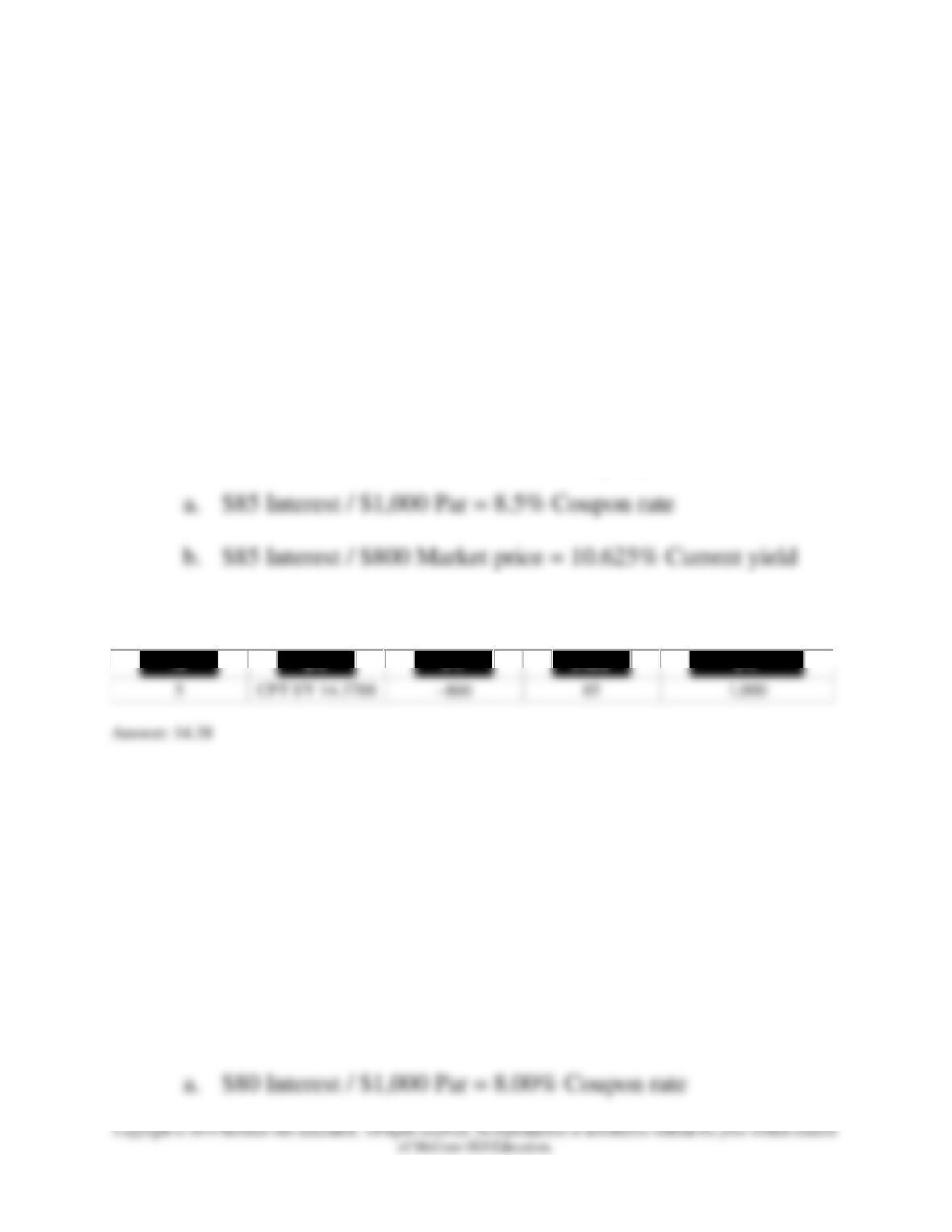
1. Bond yields (LO16-2) The Pioneer Petroleum Corporation has a bond outstanding with an
$85 annual interest payment, a market price of $800, and a maturity date in five years. Find
the following:
a. The coupon rate.
b. The current rate.
c. The yield to maturity.
16–1. Solution:
The Pioneer Petroleum Company
Calculator Solution:
(c)
N
I/Y
PV
PMT
FV
5
CPT I/Y 14.3788
–800
85
1,000
Answer: 14.38
2. Bond yields (LO16-2) Preston Corporation has a bond outstanding with an $80 annual
interest payment, a market price of $1,250, and a maturity date in 10 years. Assume the
par value of the bonds is $1,000.
Find the following:
a. The coupon rate.
b. The current rate.
c. The yield to maturity.
16–2. Solution:
Preston Corporation
Chapter 16: Long-Term Debt and Lease Financing
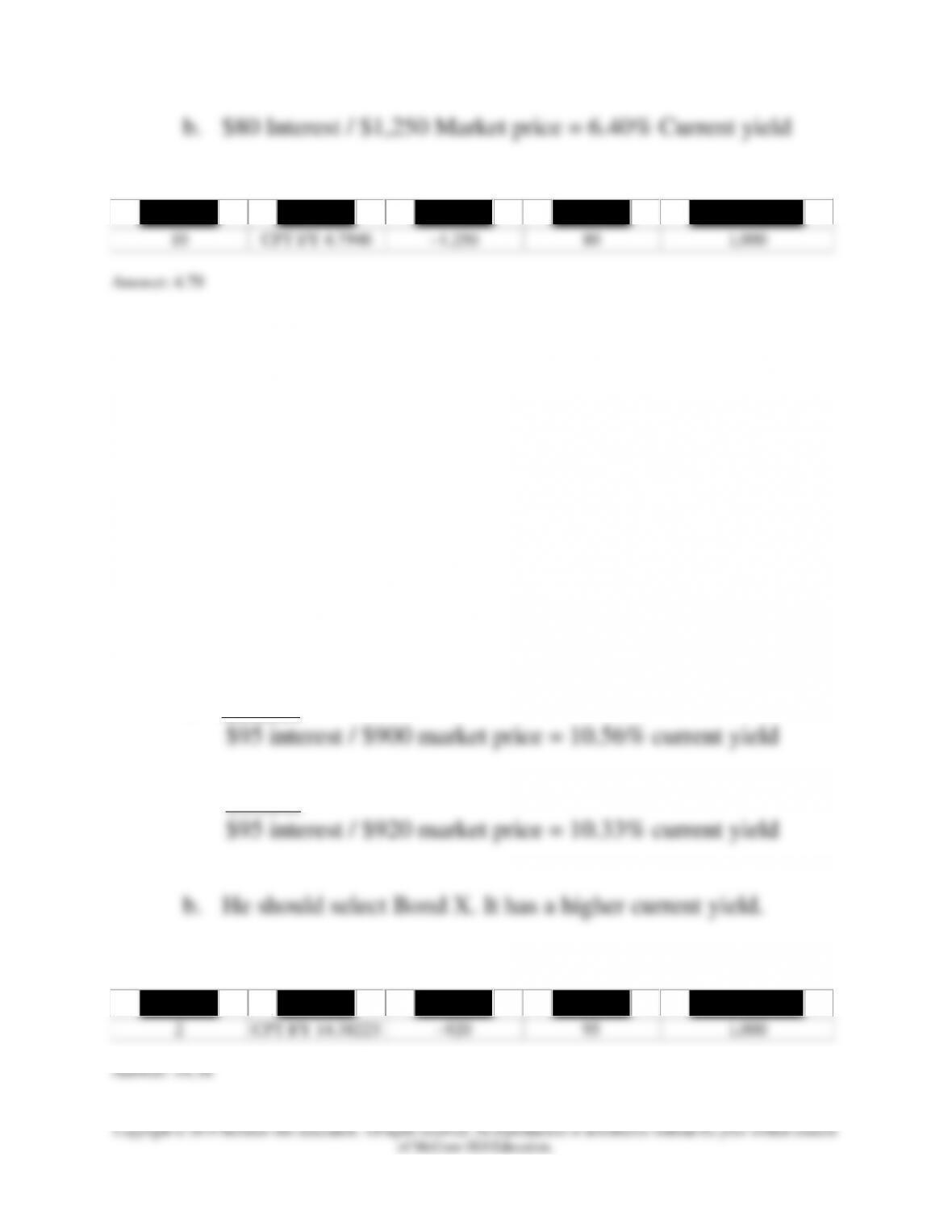
(c)
N
I/Y
PV
PMT
FV
10
CPT I/Y 4.7946
–1,250
80
1,000
Answer: 4.79
3. Bond yields (LO16-2) Harold Reese must choose between two bonds:
Bond X pays $95 annual interest and has a market value of $900. It has 10 years
to maturity.
Bond Z pays $95 annual interest and has a market value of $920. It has two years
to maturity.
a. Compute the current yield on both bonds.
b. Which bond should he select based on your answer to part a?
c. A drawback of current yield is that it does not consider the total life of the bond. For
example, the yield to maturity on Bond X is 11.21 percent. What is
the yield to maturity on Bond Z?
d. Has your answer changed between parts b and c of this question?
16–3. Solution:
a. Bond X
Bond Z
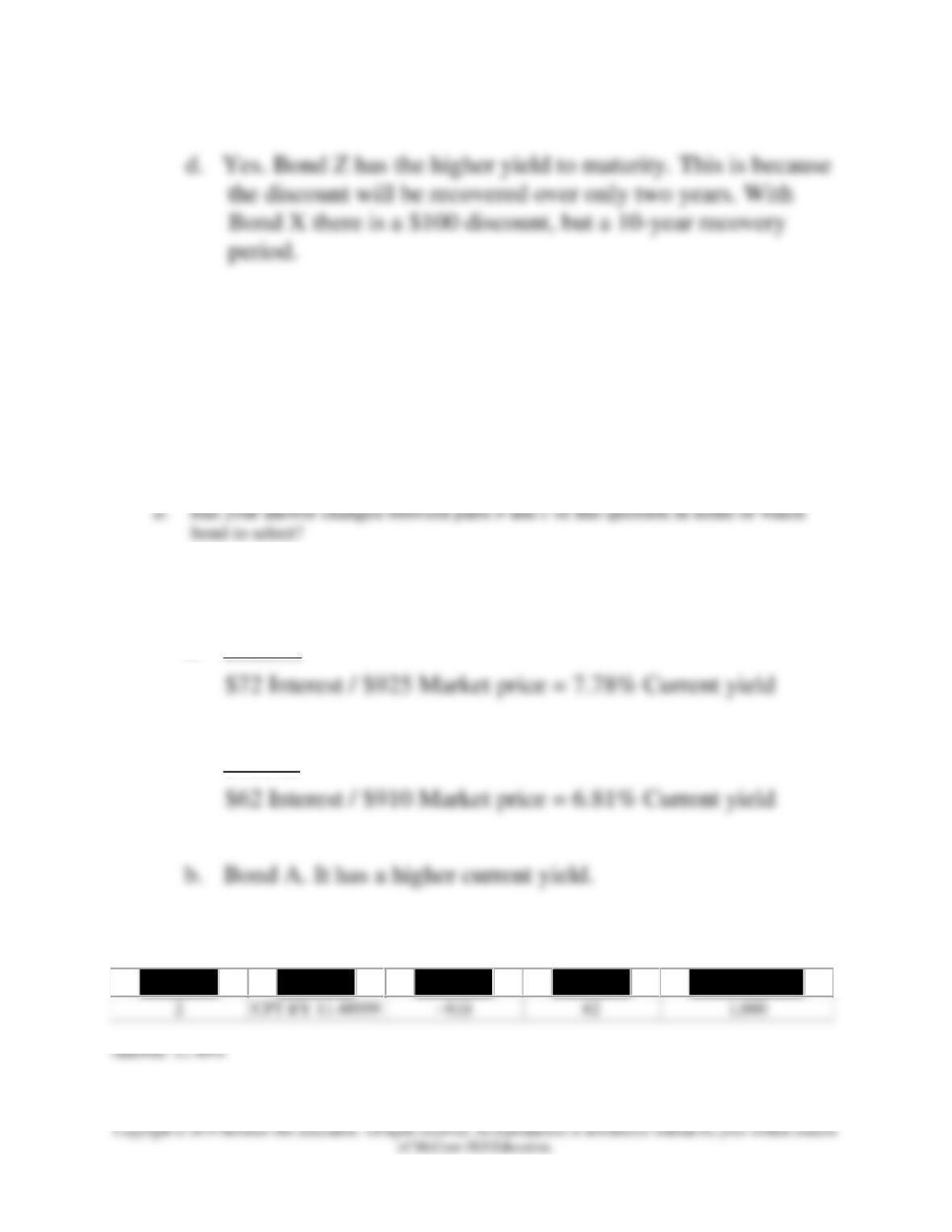
(c)
N
I/Y
PV
PMT
FV
2
CPT I/Y 14.38223
–920
95
1,000
Answer: 14.38
Chapter 16: Long-Term Debt and Lease Financing
4. Bond yields (LO16-2) An investor must choose between two bonds:
Bond A pays $72 annual interest and has a market value of $925. It has 10 years to
maturity. Bond B pays $62 annual interest and has a market value of $910. It has two years
to maturity. Assume the par value of the bonds is $1,000.
a. Compute the current yield on both bonds.
b. Which bond should she select based on your answer to part a?
c. A drawback of current yield is that it does not consider the total life of the bond. For
example, the yield to maturity on Bond A is 8.33 percent. What is the yield to
maturity on Bond B?
16–4. Solution:
a. Bond A
Bond B
(c)
N
I/Y
PV
PMT
FV
2
CPT I/Y 11.48959
–910
62
1,000
Answer: 11.49%

Chapter 16: Long-Term Debt and Lease Financing
5. Secured vs. unsecured debt (LO16-1) Match the yield to maturity in column 2 with the
security provisions (or lack thereof) in column 1. Higher returns tend to go with greater
risk.
(1)
(2)
Security Provision
Yield to Maturity
a. Debenture
a. 6.85%
b. Secured debt
b. 8.20%
c. Subordinated debenture
c. 7.76%
Chapter 16: Long-Term Debt and Lease Financing
b. Value of 58 bonds
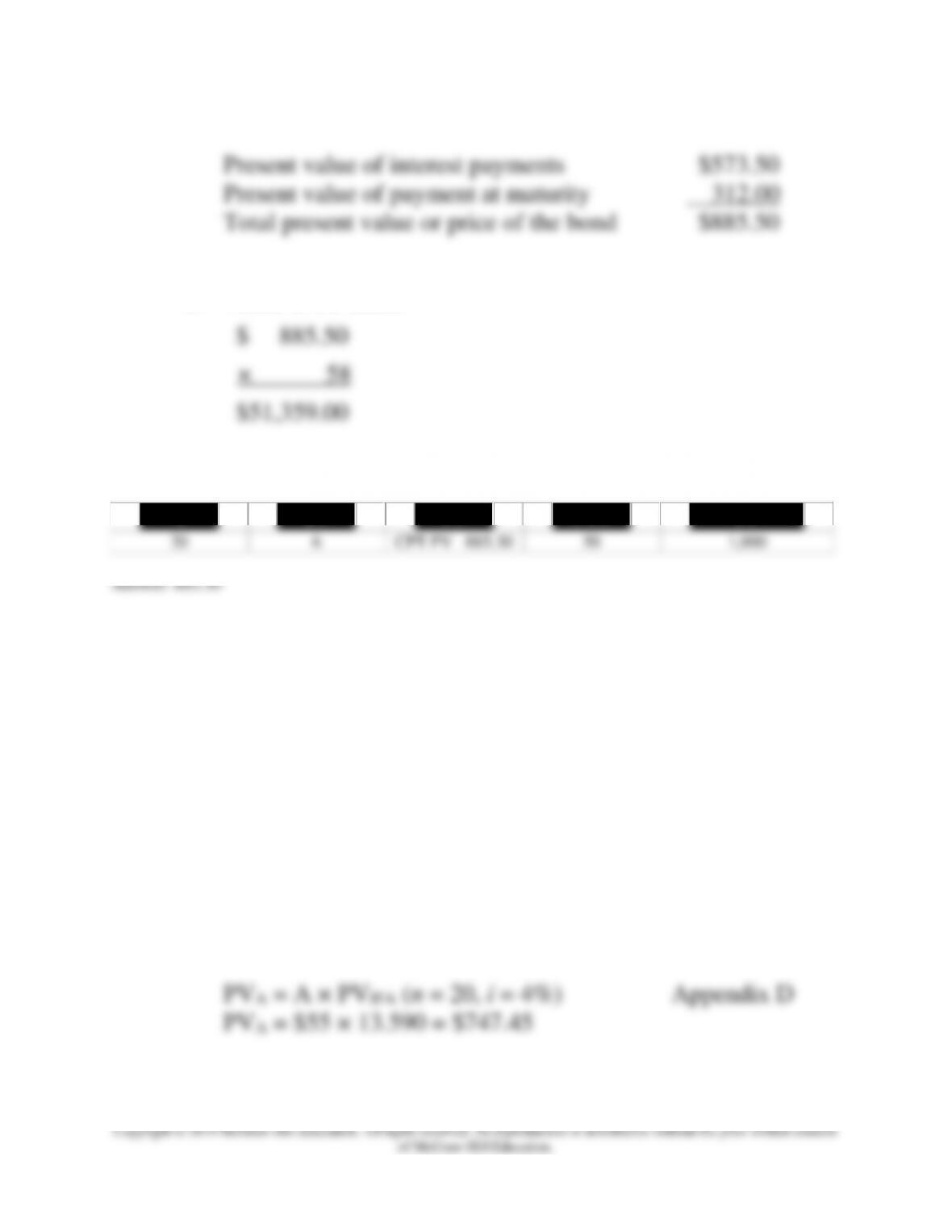
(a)
N
I/Y
PV
PMT
FV
20
6
CPT PV –885.30
50
1,000
Answer: 885.30
7. Bond value (LO16-2) Cox Media Corporation pays an 11 percent coupon rate on
debentures that are due in 10 years. The current yield to maturity on bonds of similar risk is
8 percent. The bonds are currently callable at $1,110. The theoretical value of the bonds
will be equal to the present value of the expected cash flow from the bonds.
a. Find the market value of the bonds using semiannual analysis.
b. Do you think the bonds will sell for the price you arrived at in part a? Why?
16–7. Solution:
Cox Media Corporation
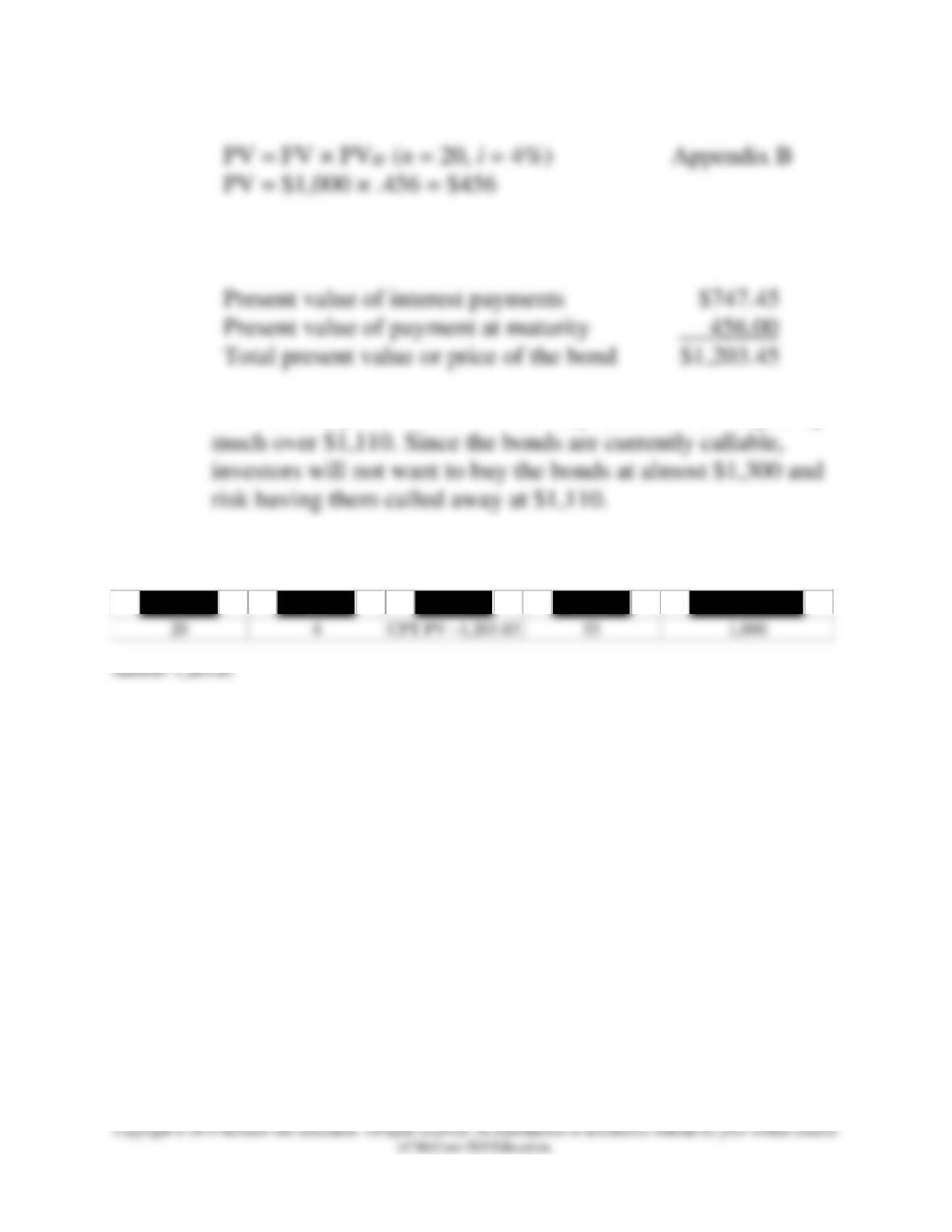
a. Present value of interest payments
Present value of principal payment at maturity
Chapter 16: Long-Term Debt and Lease Financing
Total present value
b. No. The call price of $1,110 will keep the bonds from getting
(a)
N
I/Y
PV
PMT
FV
20
4
CPT PV –1,203.85
55
1,000
Answer: 1,203.85
8. Effect of bond rating change (LO16-2) The yield to maturity for 10-year bonds is as
follows for four different bond rating categories:
Aaa
9.40% ……………………..
Aa2
10.00%
Aal
9.60% ……………………..
Aa3
10.60%
The bonds of Falter Corporation were rated as Aaa and issued at par a few weeks ago.
The bonds have just been downgraded to Aa2. Determine the new price of the bonds,
assuming a 10-year maturity and semiannual interest payments. (Refer to “Semiannual
Interest and Bond Prices” in Chapter 10 for a review if necessary.)
16–8. Solution:
Chapter 16: Long-Term Debt and Lease Financing
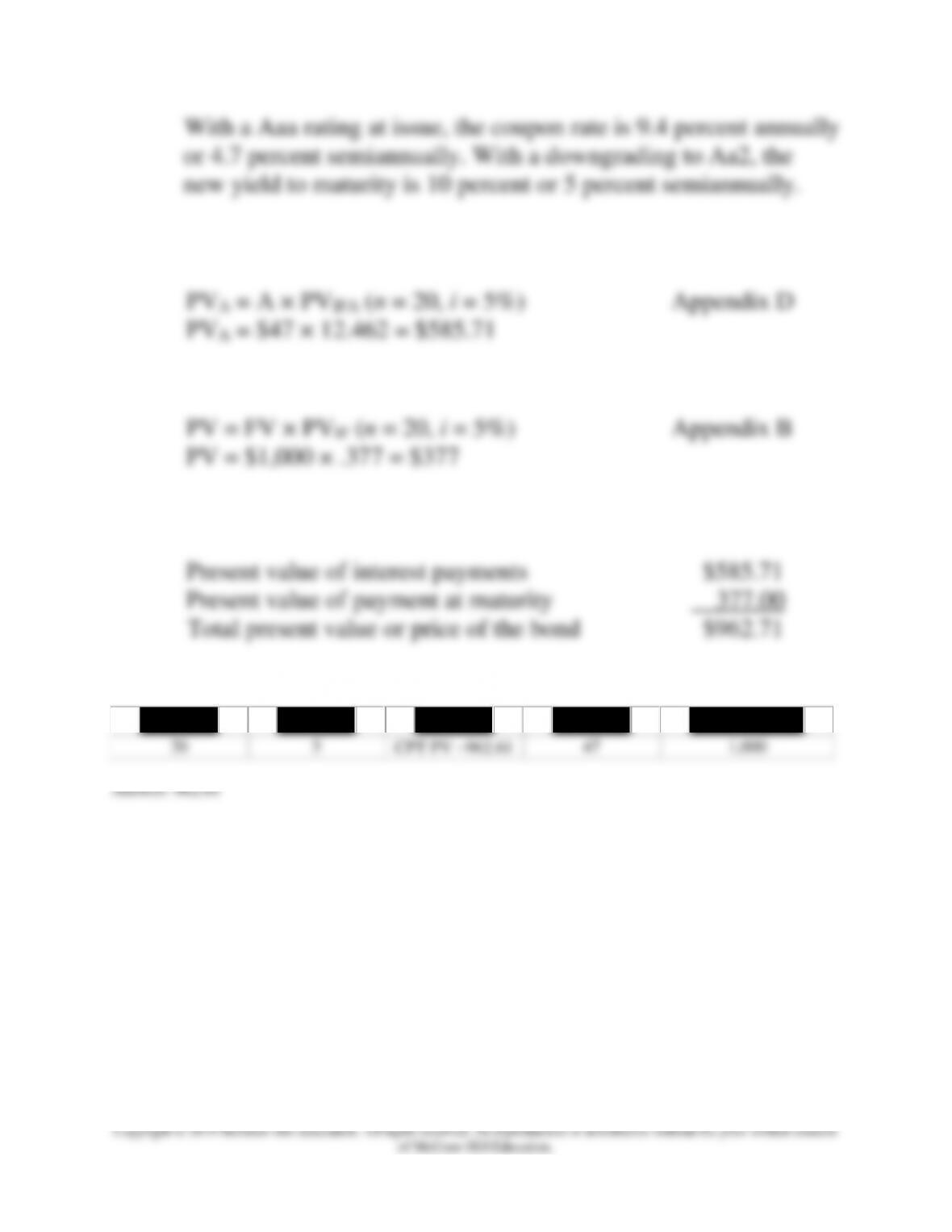
Present value of interest payments
Present value of principal payment at maturity
Total present value
N
I/Y
PV
PMT
FV
20
5
CPT PV –962.61
47
1,000
Answer: 962.61
9. Interest rates and bond ratings (LO16-2) Twenty-five-year B-rated bonds of Parker
Optical Company were initially issued at a 12 percent yield. After 10 years, the bonds have
been upgraded to Aa2. Such bonds are currently yielding 10 percent to maturity. Use Table
16-3 to determine the price of the bonds with 15 years remaining to maturity. (You do not
need the bond ratings to enter the table. just use the basic facts of the problem.)
Chapter 16: Long-Term Debt and Lease Financing
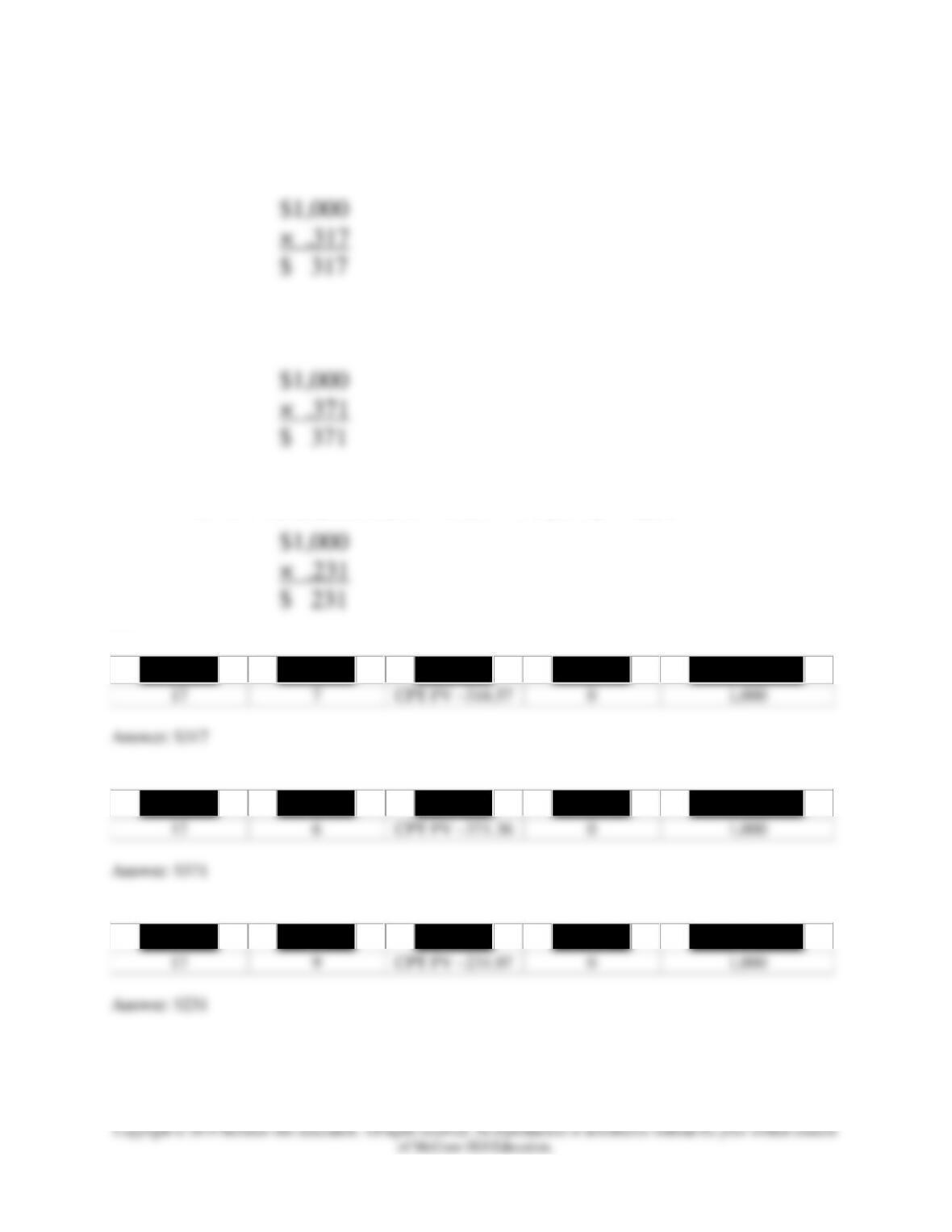
a. PV of $1,000 for n = 17, i = 7%, PVIF = .317
b. PV of $1,000 for n = 17, i = 6%, PVIF = .371
c. PV of $1,000 for n = 17, i = 9%, PVIF = .231
(a)
N
I/Y
PV
PMT
FV
17
7
CPT PV –316.57
0
1,000
Answer: $317
(b)
N
I/Y
PV
PMT
FV
17
6
CPT PV –371.36
0
1,000
Answer: $371
(c)
N
I/Y
PV
PMT
FV
17
9
CPT PV –231.07
0
1,000
Answer: $231
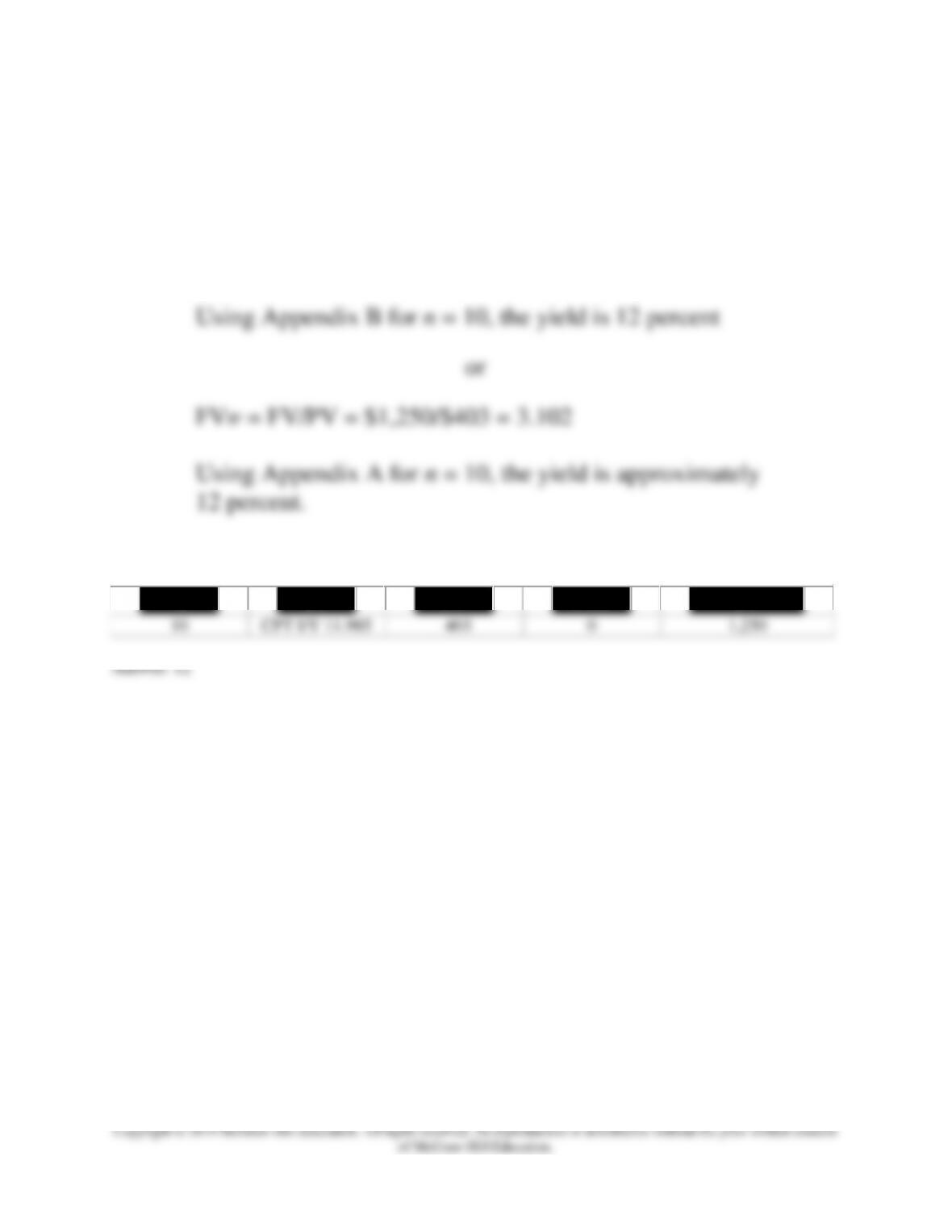
12. Zero-coupon bond Yield (LO16-2) Assume a zero-coupon bond that sells for $403 and
will mature in 10 years at $1,250. What is the effective yield to maturity? (Compute PVIF
Chapter 16: Long-Term Debt and Lease Financing
and go to Appendix B for the 10-year figure to find the answer, or compute FVIF and go to
Appendix A for the 10-year figure to find the answer. Either approach will work.)
16–12. Solution:
PVIF = PV/FV = $403/$1,250 = .322
N
I/Y
PV
PMT
FV
10
CPT I/Y 11.985
–403
0
1,250
Answer: 12
13. Floating rate bond (LO16-2) You buy an 8 percent, 25-year, $1,000-par-value floating
rate bond in 1999. By the year 2004, rates on bonds of similar risk are up to 11 percent.
What is your one best guess as to the value of the bond?
16–13. Solution:
With a floating rate bond, the rate the bond pays changes with
interest rates in the market. Therefore, the price of the bond
stays constant. The one best guess is $1,000.
14 Effect of inflation on purchasing power of bond (LO16-2) Seventeen years ago, the
Archer Corporation borrowed $6,500,000. Since then, cumulative inflation has been 65
percent (a compound rate of approximately 3 percent per year).
Chapter 16: Long-Term Debt and Lease Financing
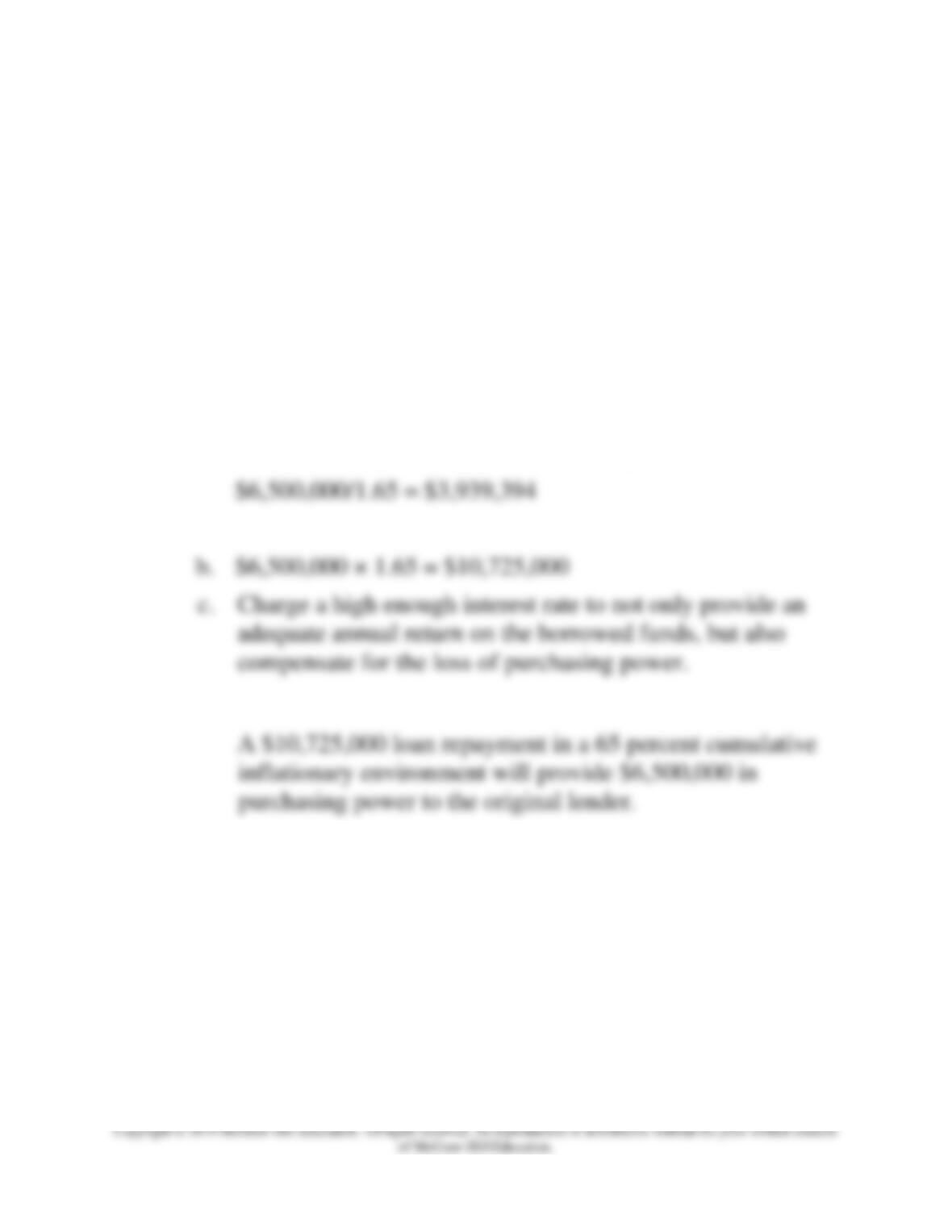
a. When the firm repays the original $6,500,000 loan this year, what will be the effective
purchasing power of the $6,500,000? (Hint: Divide the loan amount by one plus
cumulative inflation.)
b. To maintain the original $6,500,000 purchasing power, how much should the lender
be repaid? (Hint: Multiply the loan amount by one plus cumulative inflation.)
c. If the lender knows he will receive only $6,500,000 in payment after 17 years, how
might he be compensated for the loss in purchasing power? A descriptive answer is
acceptable.
16–14. Solution:
Archer Corporation
a. Loan amount/(1 + Cumulative inflation) =
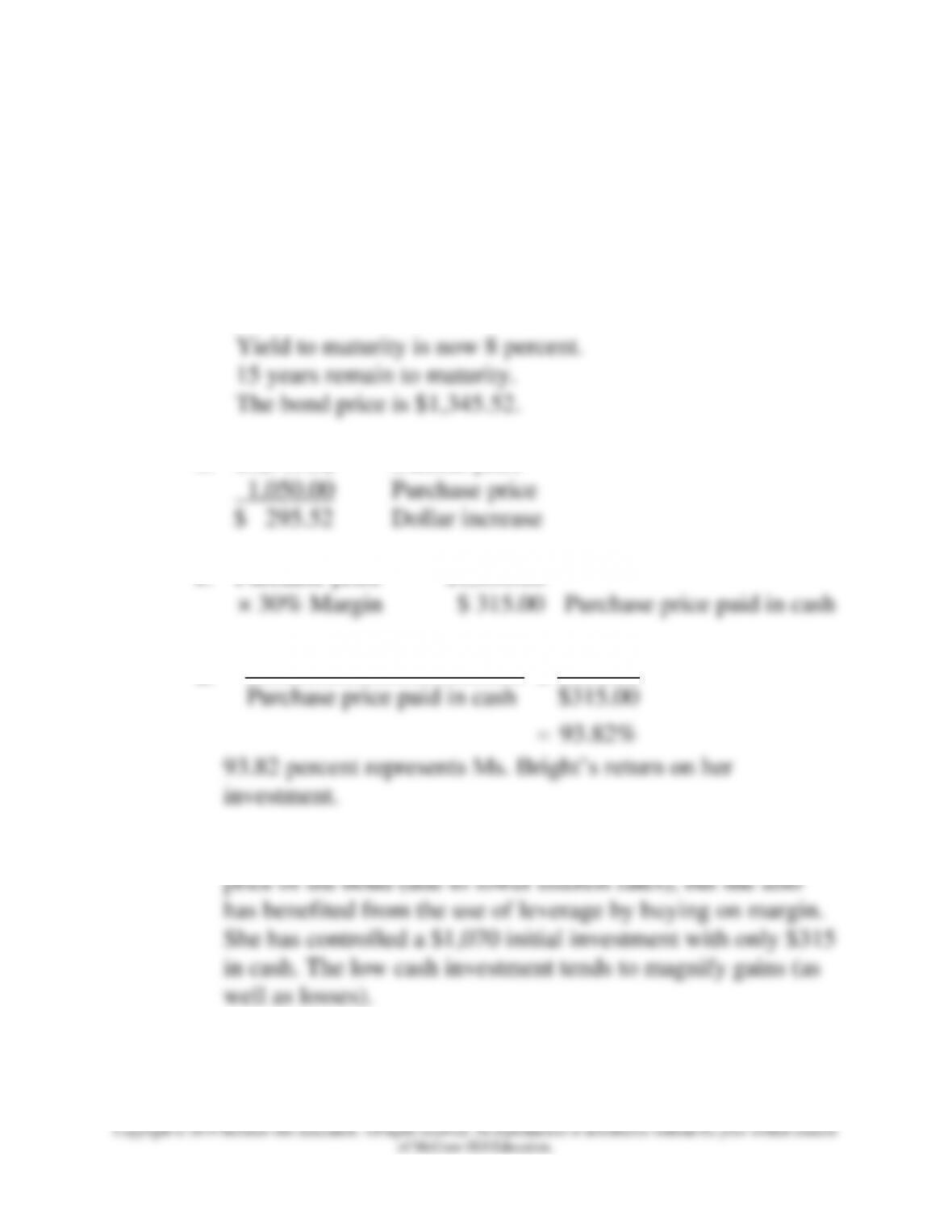
15. Profit potential associated with margin (LO16-2) A $1,000 par value bond was issued
25 years ago at a 12 percent coupon rate. It currently has 15 years remaining to maturity.
Interest rates on similar obligations are now 8 percent.
a. What is the current price of the bond? (Look up the answer in Table 16-3.)
b. Assume Ms. Bright bought the bond three years ago when it had a price of $1,050.
What is her dollar profit based on the bond’s current price?
c. Further assume Ms. Bright paid 30 percent of the purchase price in cash and borrowed
the rest (known as buying on margin). She used the interest payments from the bond
to cover the interest costs on the loan. How much of the purchase price of $1,050 did
Ms. Bright pay in cash?
Chapter 16: Long-Term Debt and Lease Financing
d. What is Ms. Bright’s percentage return on her cash investment? Divide the answer to
part b by the answer to part c.
e. Explain why her return is so high.
16–15. Solution:
Ms. Bright
a. The original bond was issued at 12 percent.
b. $1,345.52 Current price
c. Purchase price $1,050.00
d.
Dollar profit $295.52
Purchase price paid in cash $315.00
93.82%
=
=
e. Ms. Bright has not only benefited from an increase in the