
Problem 16-3 Problem 16-17
Spreadsheet Templates
MAIN MENU – CHAPTER 16
Spreadsheet Templates by Block, Hirt and Danielsen
Copyright © 2011 McGraw-Hill/Irwin and ANSR Source India Pvt Ltd. (www.ansrsourceindia.com)
Foundations of Financial Management
Long-Term Debt and Lease Financing

Problem 16-3
Objective: Bond yields
Student Name:
Course Name:
Student ID:
Course Number:
An investor must choose between two bonds:
Bond A pays $80 annual interest and has a market value of $800. It has 10 years to maturity.
Bond B pays $85 annual interest and has a market value of $900. It has two years to maturity.
a. Compute the current yield on both bonds.
b. Which bond should he select based on your answer to part a?
c. A drawback of current yield is that it does not consider the total life of the bond.
For example, the approximate yield to maturity on Bond A is 11.36 percent. What is the
approximate yield to maturity on Bond B?
d. Has your answer changed between parts b and c of this question in terms of which bond to select?
Foundations of Financial Management
Block, Hirt and Danielsen
Problem 16-3
Instructions
Enter formulas to complete the requirements of this problem.
Information
Annual Market Years to
Interest Value Maturity
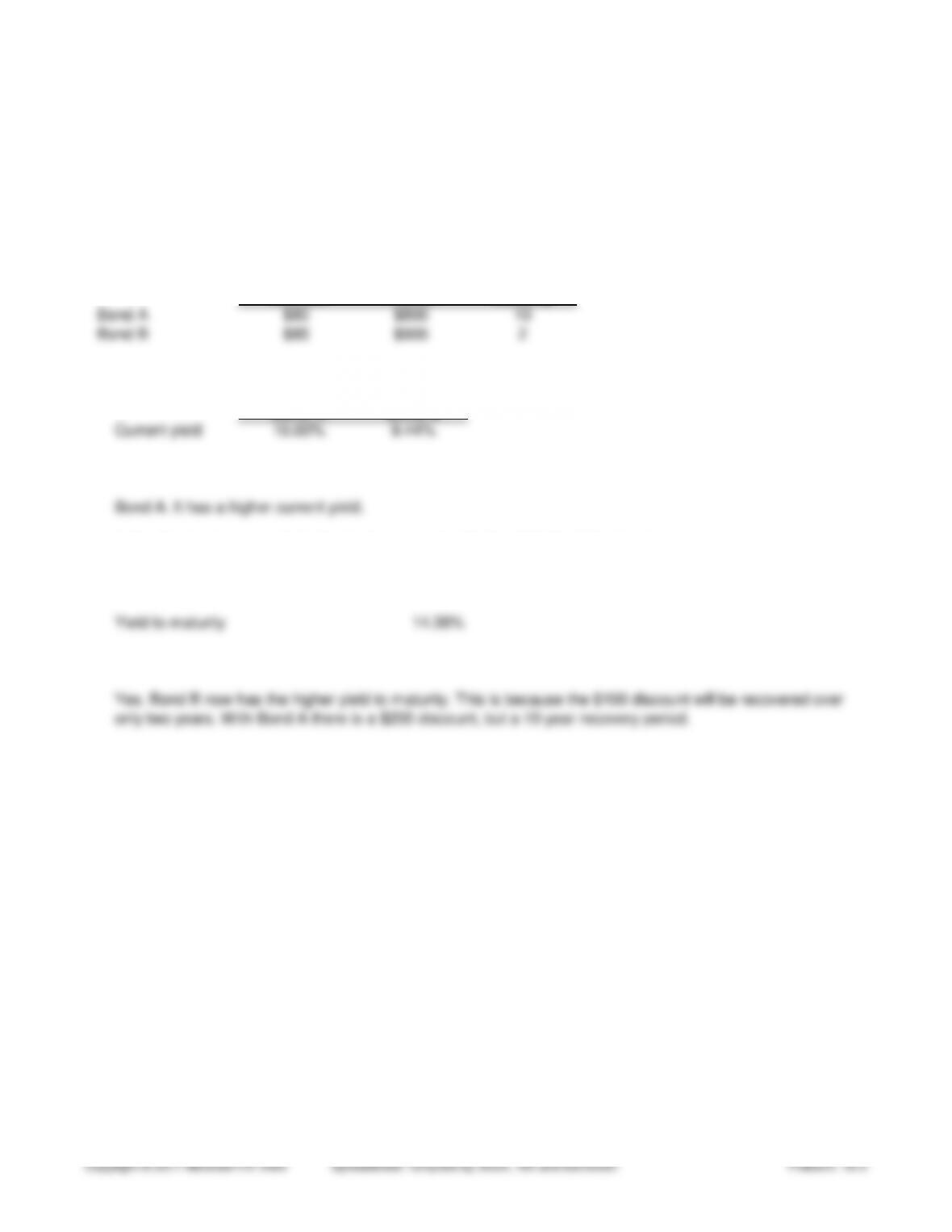
Bond A $80 $800 10
Bond B $85 $900 2
a. Compute the current yield on both bonds.
Bond A Bond B
Current yield 10.00% 9.44%
b. Which bond should he select based on your answer to part a?
Bond A. It has a higher current yield.
c. A drawback of current yield is that it does not consider the total life of the bond.
For example, the approximate yield to maturity on Bond A is 11.36 percent. What is the
approximate yield to maturity on Bond B?
Yield to maturity 14.36%
d. Has your answer changed between parts b and c of this question in terms of which bond to select?
Yes. Bond B now has the higher yield to maturity. This is because the $100 discount will be recovered over
only two years. With Bond A there is a $200 discount, but a 10-year recovery period.
Solution

Problem 16-17
Objective: Refunding decision
Student Name:
Course Name:
Student ID:
Course Number:
The Bowman Corporation has a $20 million bond obligation outstanding, which it is considering refunding.
Though the bonds were initially issued at 12 percent, the interest rates on similar issues have declined
to 10.5 percent. The bonds were originally issued for 20 years and have 15 years remaining. The new issue
would be for 15 years. There is an 8 percent call premium on the old issue. The underwriting cost on the
new $20 million issue is $570,000, and the underwriting cost on the old issue was $400,000. The company is
in a 35 percent tax bracket, and it will use a 7 percent discount rate (rounded after-tax cost of debt)
to analyze the refunding decision.
Should the old issue be refunded with new debt?
Foundations of Financial Management
Block, Hirt and Danielsen
Problem 16-17
Instructions
Use formulas and functions to complete the requirements of this problem.
Information
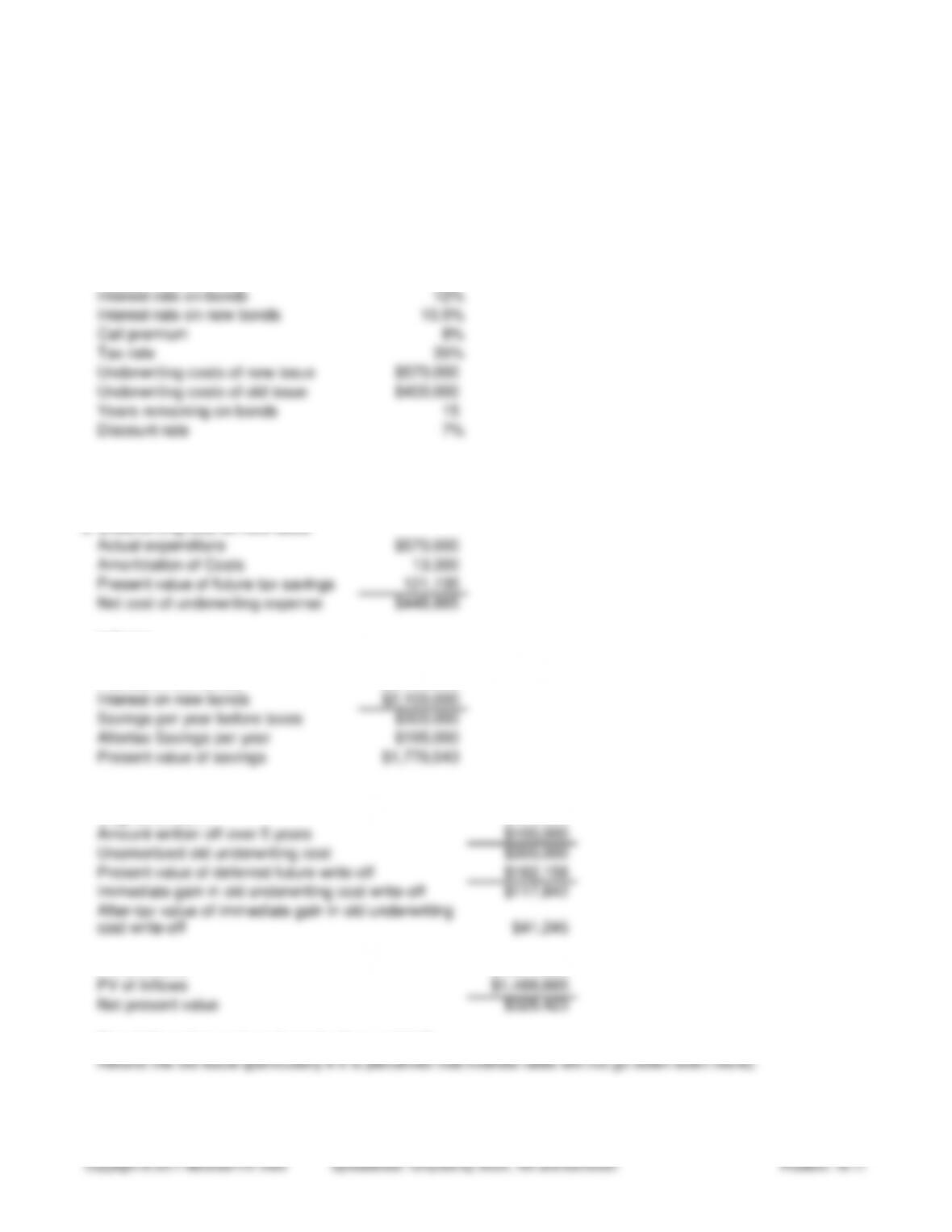
Bond obligation $20,000,000
Interest rate on bonds 12%
Interest rate on new bonds 10.5%
Call premium 8%
Tax rate 35%
Underwriting costs of new issue $570,000
Underwriting costs of old issue $400,000
Years remaining on bonds 15
Outflows
Present value of future tax savings 121,135
Net cost of underwriting expense $448,865
Inflows
3 Cost savings in lower interest rates:
Present value of savings $1,776,043
4 Underwriting cost on old issue
Original amount $400,000
After-tax value of immediate gain in old underwriting
cost write-off $41,245
PV of Inflows $1,817,288
PV of Inflows $1,488,865
Net present value $328,423
Should the old issue be refunded with new debt?
Refund the old issue (particularly if it is perceived that interest rates will not go down even more).
Solution