Chapter 15: Investment Banking: Public and Private Placement
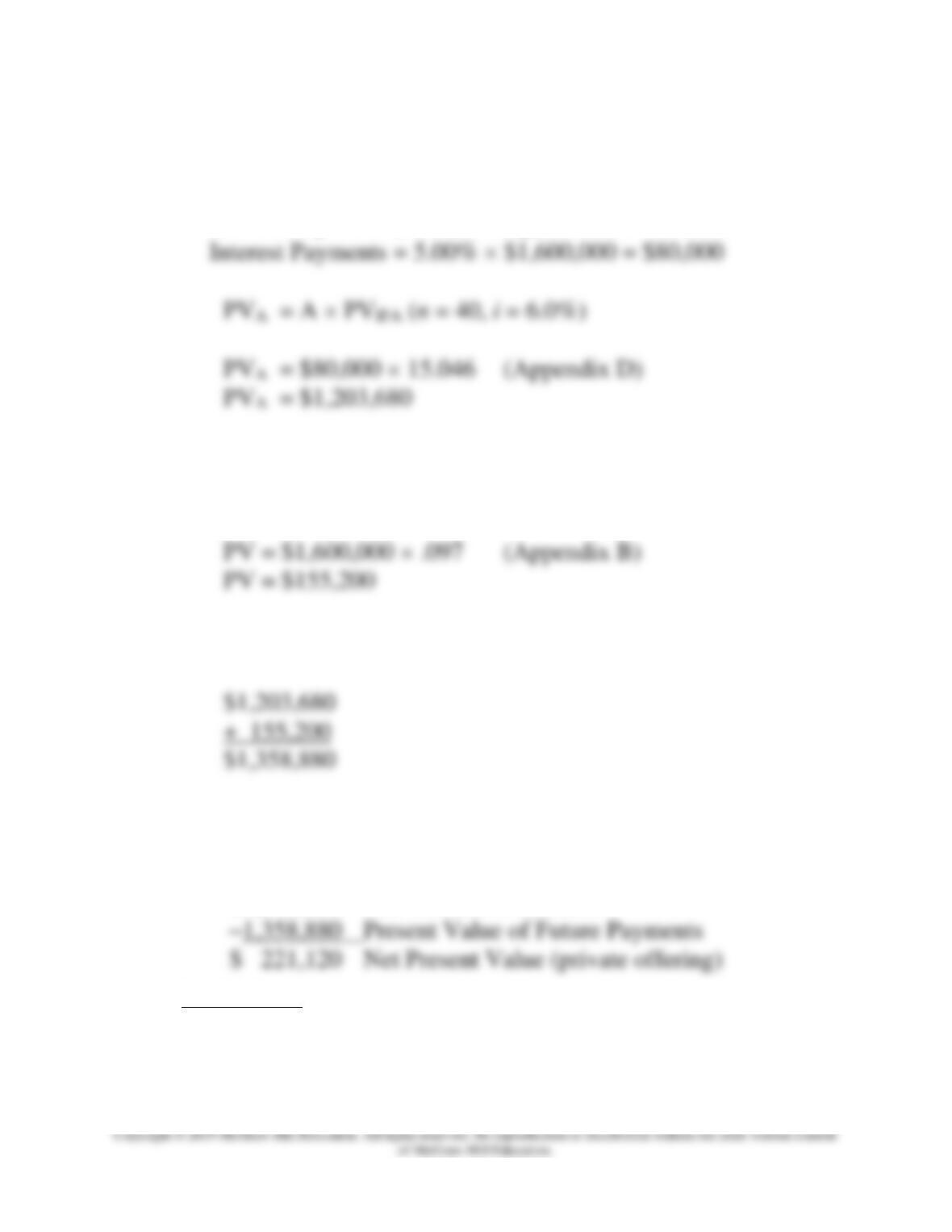
Present value of future interest payments
Interest Payments (semiannually) = 10%/2 = 5.00%
Present value of lump-sum payment at maturity
PV = FV PVIF (n = 40, i = 6.0%)
Total present value of interest and maturity payments
The net present value equals the net amount to Landers minus the
present value of future payments.
$1,580,000 Net Amount to Landers
Public Issue
Chapter 15: Investment Banking: Public and Private Placement
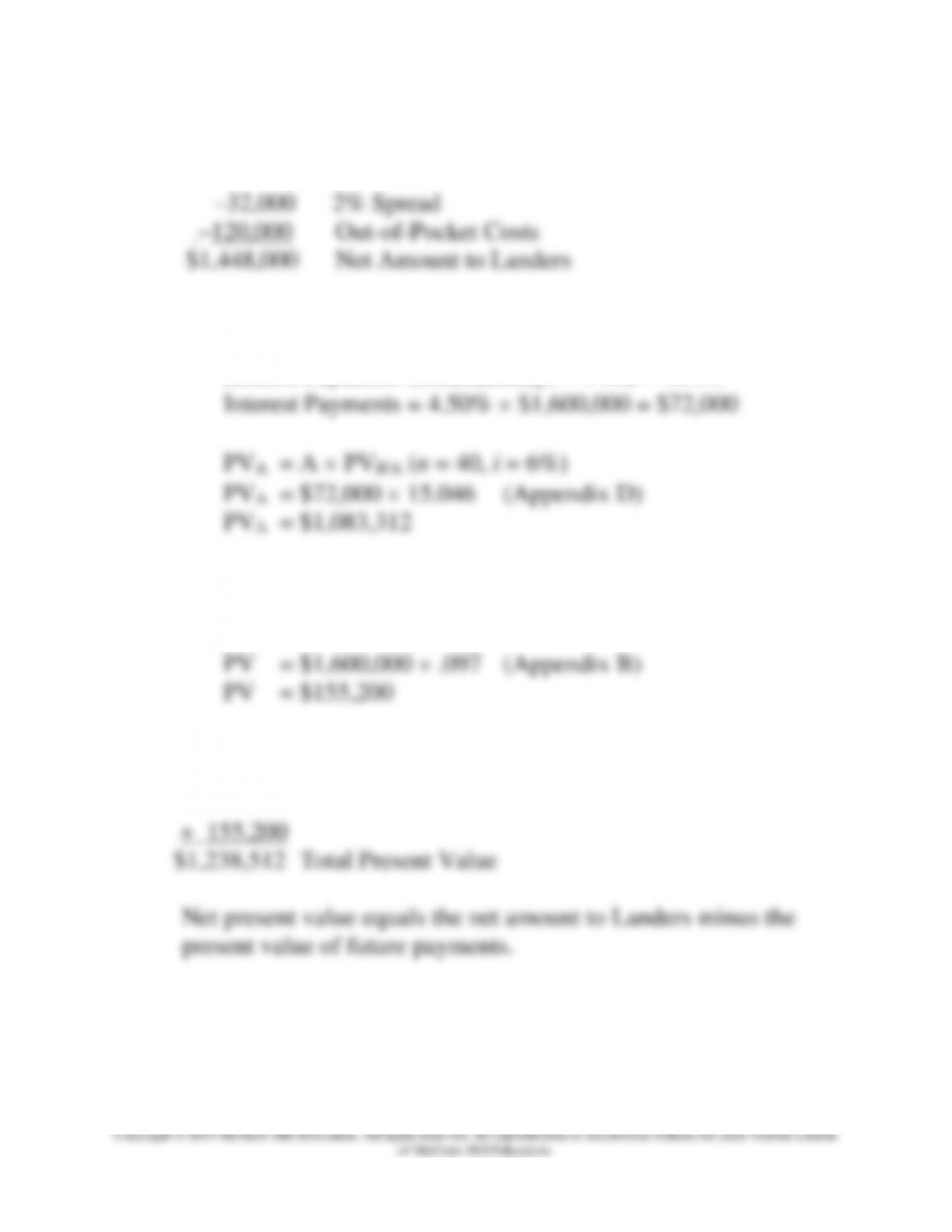
$1,600,000 Debt
Present value of future interest payments
Interest Payments (semiannually) = 9%/2 = 4.50%
Present value of lump-sum payment at maturity
PV = FV PVIF (n = 40, i = 6%)
Total present value of interest and maturity payments
$1,083,312
Chapter 15: Investment Banking: Public and Private Placement
$1,448,000 Net Amount to Landers
Calculator Solution:
Private Placement
N
I/Y
PV
PMT
FV
40
6
CPT PV
−1,359,259.25
80,000
1,600,000
Answer: $1,359,259
The net present value equals the net amount to Landers minus the
present value of future payments.
$ 1,580,000 Net Amount to Landers
–1,359,259 Present Value of Future Payments
$ 220,741 Net Present Value (private offering)
Public issue
N
I/Y
PV
PMT
FV
40
6
CPT PV −1,238,888.88
72,000
1,600,000
Answer:$ 1,238,889
$ 1,448,000 Net Amount to Landers
Chapter 15: Investment Banking: Public and Private Placement
Determine number of shares to be sold
b. The new shares will increase the total number of shares
outstanding and dilute EPS. This dilution effect may reduce
15-18. (Continued)
c. EPS = $19,000,000/4,000,000 = $4.75
d. Net income = $19,000,000 + 13% ($21,120,000)
e. In the long run, it appears that the company is better off
because of the additional investment. Earnings per share are
Chapter 15: Investment Banking: Public and Private Placement
Incremental Earnings / Net Proceeds =
$2,747,000/$18,740,000 = 14.66%
e. $3.43 (1.05) = $3.60 (5.00% increase in EPS)
Total Earnings = $3.60 × 2,900,000 Shares =
20. Dilution and rates of return (LO15-3) Tyson Iron Works is about to go public. It
currently has aftertax earnings of $4,400,000, and 4,200,000 shares are owned by the
present stockholders. The new public issue will represent 500,000 new shares. The new
shares will be priced to the public at $25 per share with a 3 percent spread on the offering
price. There will also be $280,000 in out-of-pocket costs to the corporation.
a. Compute the net proceeds to Tyson Iron Works.
b. Compute the earnings per share immediately before the stock issue.
c. Compute the earnings per share immediately after the stock issue.
d. Determine what rate of return must be earned on the net proceeds to the corporation so
there will not be a dilution in earnings per share during the year of going public.
Chapter 15: Investment Banking: Public and Private Placement
e. Determine what rate of return must be earned on the proceeds to the corporation so
there will be a 10 percent increase in earnings per share during the year of going public.
15–20. Solution:
Tyson Iron Works
a. $25 97% = $24.25 Net Price
$24.25 Net Price
d. There are now 4,700,000 shares outstanding. To maintain
e. $1.05 (1.10) = $1.16 (10% increase in EPS)
Chapter 15: Investment Banking: Public and Private Placement
21. Aftermarket for new public issue (LO15-4) I. B. Michaels has a chance to participate in a
new public offering by Hi-Tech Micro Computers. His broker informs him that demand for
the 700,000 shares to be issued is very strong. His broker’s firm is assigned 25,000 shares
in the distribution and will allow Michaels, a relatively good customer, 1.3 percent of its
25,000 share allocation.
The initial offering price is $30 per share. There is a strong aftermarket, and
the stock goes to $32 one week after issue. The first full month after issue,
Mr. Michaels is pleased to observe his shares are selling for $33.50. He is content to place
his shares in a lockbox and eventually use their anticipated increased value to help send his
son to college many years in the future. However, one year after the distribution, he looks
up the shares in The Wall Street Journal and finds they are trading at $28.50.
a. Compute the total dollar profit or loss on Mr. Michaels’ shares one week, one month,
and one year after the purchase. In each case, compute the profit or loss against the
initial purchase price.
b. Also compute the percentage gain or loss from the initial $30 price.
c. Why might a new public issue be expected to have a strong aftermarket?
15–21. Solution:
I. B. Michaels
a. Mr. Michaels’ Purchase = 1.3% 25,000 shares = 325 shares
Dollar profit or loss
1 week 325 Shares ($32 – $30) = $650.00 Profit
Chapter 15: Investment Banking: Public and Private Placement
c. A new public issue may be expected to have a strong after–
22. Leveraged buyout (LO15-5) The management of Mitchell Labs decided to go private in
2002 by buying all 2.80 million of its outstanding shares at $24.80 per share. By 2006,
management had restructured the company by selling off the petroleum research division
for $10.75 million, the fiber technology division for $8.45 million, and the synthetic
products division for $20 million. Because these divisions had been only marginally
profitable, Mitchell Labs is a stronger company after the restructuring. Mitchell is now able
to concentrate exclusively on contract research and will generate earnings per share of
$1.10 this year. Investment bankers have contacted the firm and indicated that if it
reentered the public market, the 2.80 million shares it purchased to go private could now be
reissued to the public at a P/E ratio of 15 times earnings per share.
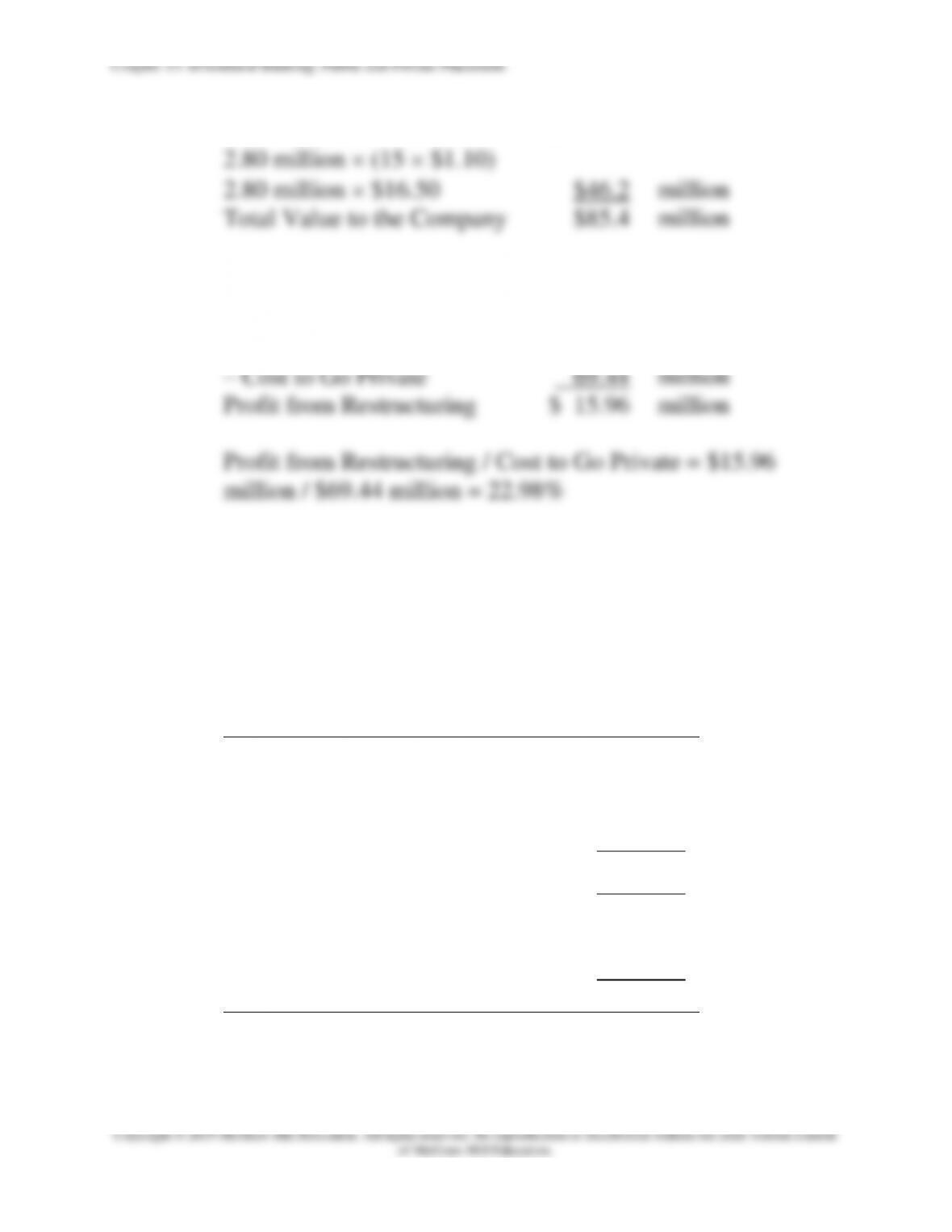
a. What was the initial cost to Mitchell Labs to go private?
b. What is the total value to the company from (1) the proceeds of the divisions that were
sold, as well as (2) the current value of the 2.80 million shares (based on current
earnings and an anticipated P/E of 15)?
c. What is the percentage return to the management of Mitchell Labs from the
restructuring? Use answers from parts a and b to determine this value.
15–22. Solution:
Mitchell Labs
b. Proceeds from sale of the divisions
Petroleum Research Division $10.75 million

Chapter 15: Investment Banking: Public and Private Placement
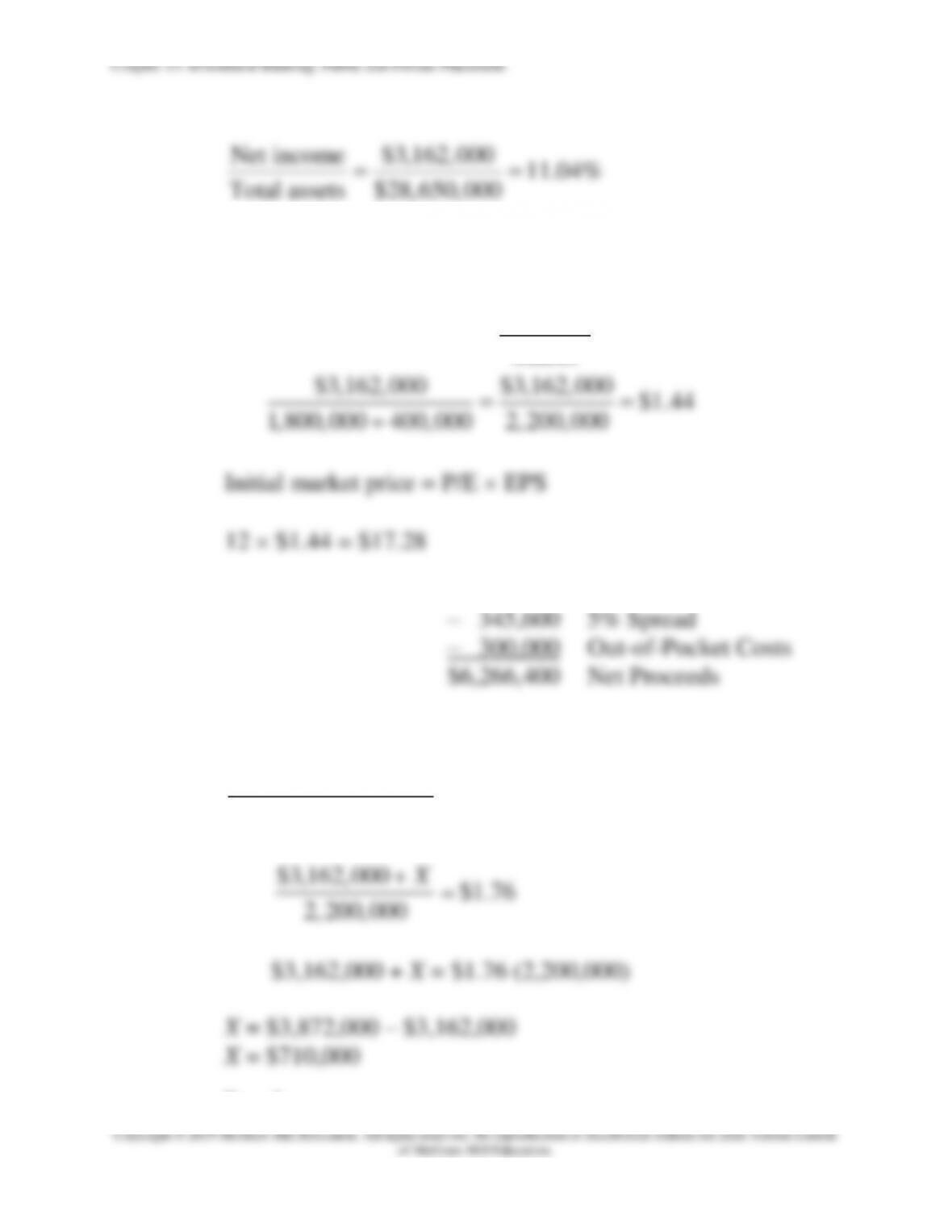
public offering? What will the initial market price of the stock be? Assume a price-
earnings ratio of 12, and use earnings per share after the distribution in the calculation.
e. Assuming an underwriting spread of 5 percent and out-of-pocket costs of $300,000,
what will net proceeds to the corporation be?
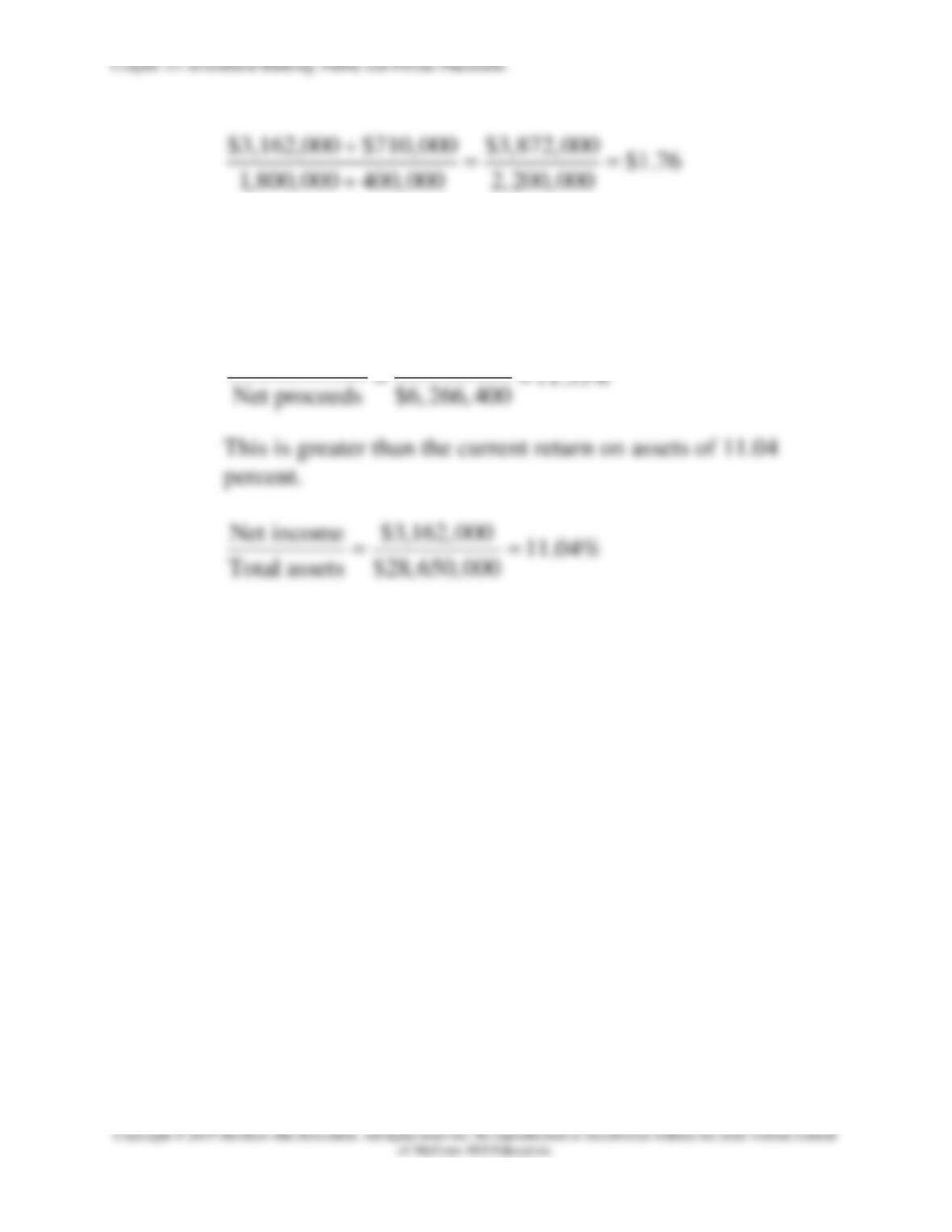
f. What return must the corporation now earn on the net proceeds to equal earnings per
share before the offering? How does this compare with the current return on the total
assets on the balance sheet?
CP 15-1. Solution:
New Public Offering
Bailey Corporation
Earnings
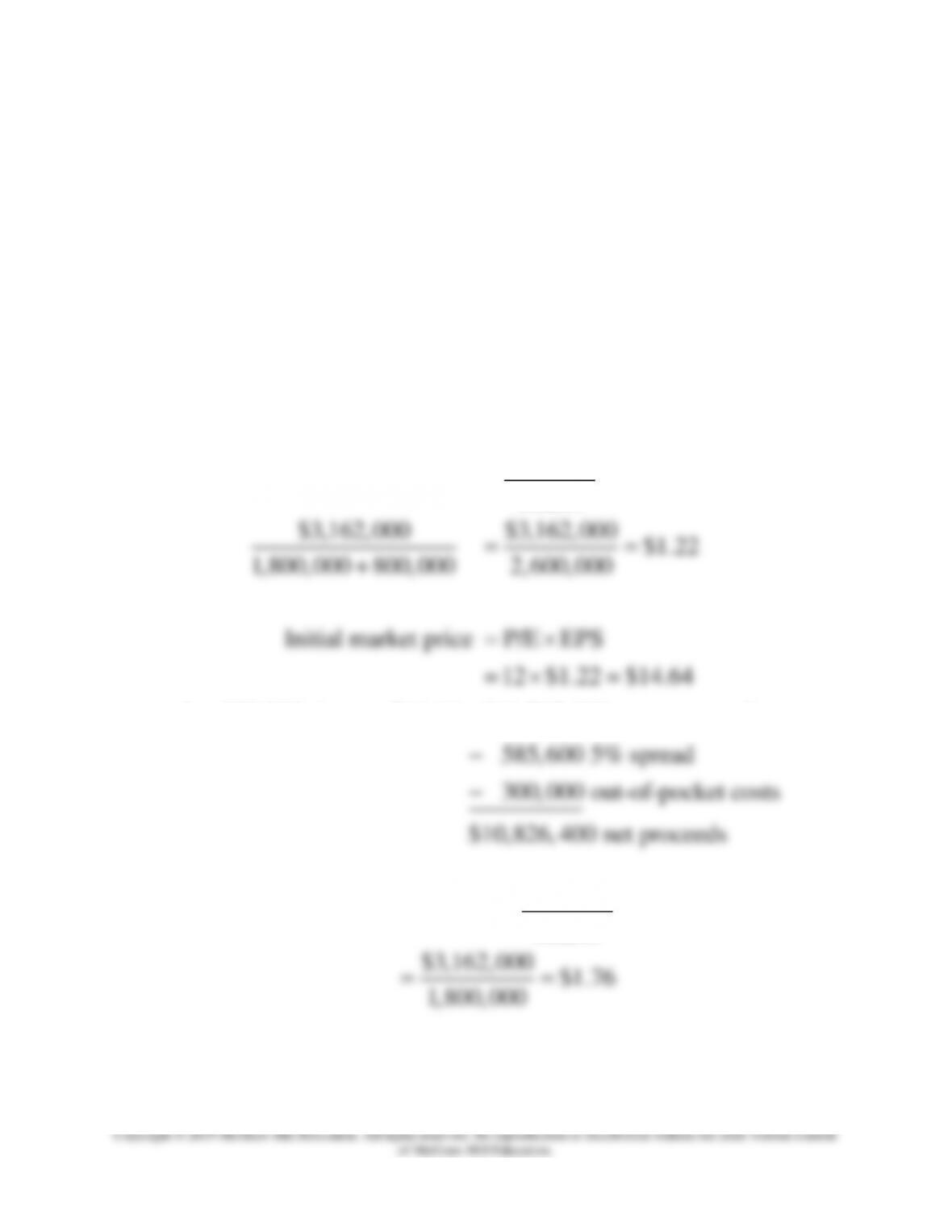
a. Earnings per share (after) Shares
$3,162,000 $3,162,000
$1.22
1,800,000 800,000 2,600,000
Initial market price P/E EPS
12 $1.22 $14.64
=
==
+
=
= =
b. 800,000 shares $14.64 $11,712,000 gross proceeds
585,600 5% spread
300,000 out-of-pocket costs
$10,826,400 net proceeds
=
−
−
Earnings
c. Earnings per share (before) Shares
$3,162,000 $1.76
1,800,000
=
==
Chapter 15: Investment Banking: Public and Private Placement
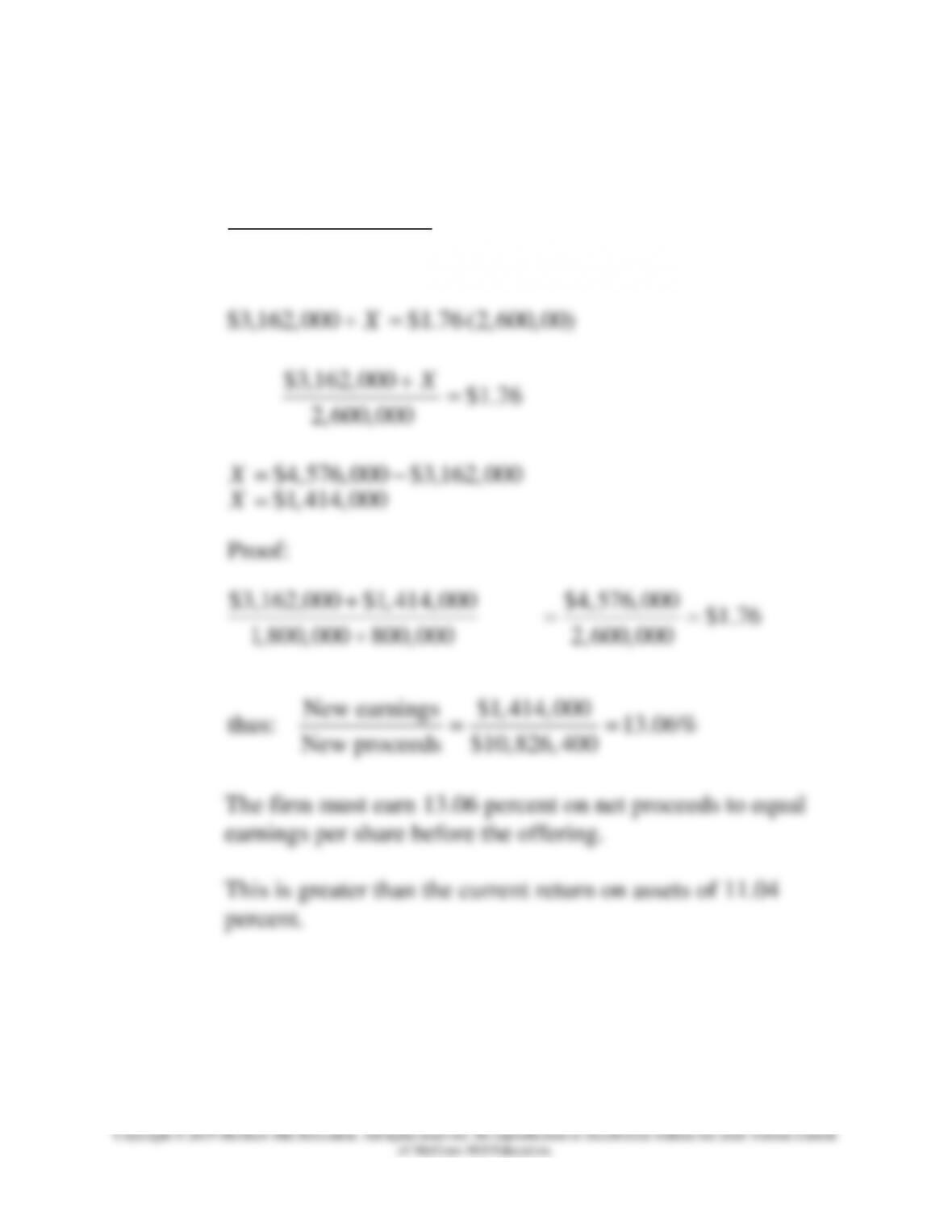
In order to earn $1.76 after the offering, the return on
$10,826,400 must produce new earnings equal to X.
$3,162,00 $1.76
1,800,000 800,000
$3,162,000 $1.76 (2,600,00)
X
X
+=
+
+=
$3,162,000 $1.76
X+=