
Problem 12-1 Problem 12-22 Problem 12-25
Copyright © 2011 McGraw-Hill/Irwin and ANSR Source India Pvt Ltd. (www.ansrsourceindia.com)
The Capital Budgeting Decision
Spreadsheet Templates
Foundations of Financial Management
MAIN MENU – CHAPTER 12
Spreadsheet Templates by Block, Hirt and Danielsen

Problem 12-1
Objective: Cash flow
Student Name:
Course Name:
Student ID:
Course Number:
Assume a corporation has earnings before depreciation and taxes of $100,000, and depreciation of $50,000, and that
it has a 30 percent tax bracket. Compute its cash flow using the format below.
Earnings before depreciation and taxes
Depreciation
Earnings before taxes
Taxes @ 30%
Earnings after taxes
Depreciation
Cash flow
Foundations of Financial Management
Block, Hirt and Danielsen
Problem 12-1
Instructions
Enter formulas to calculate cash flow.
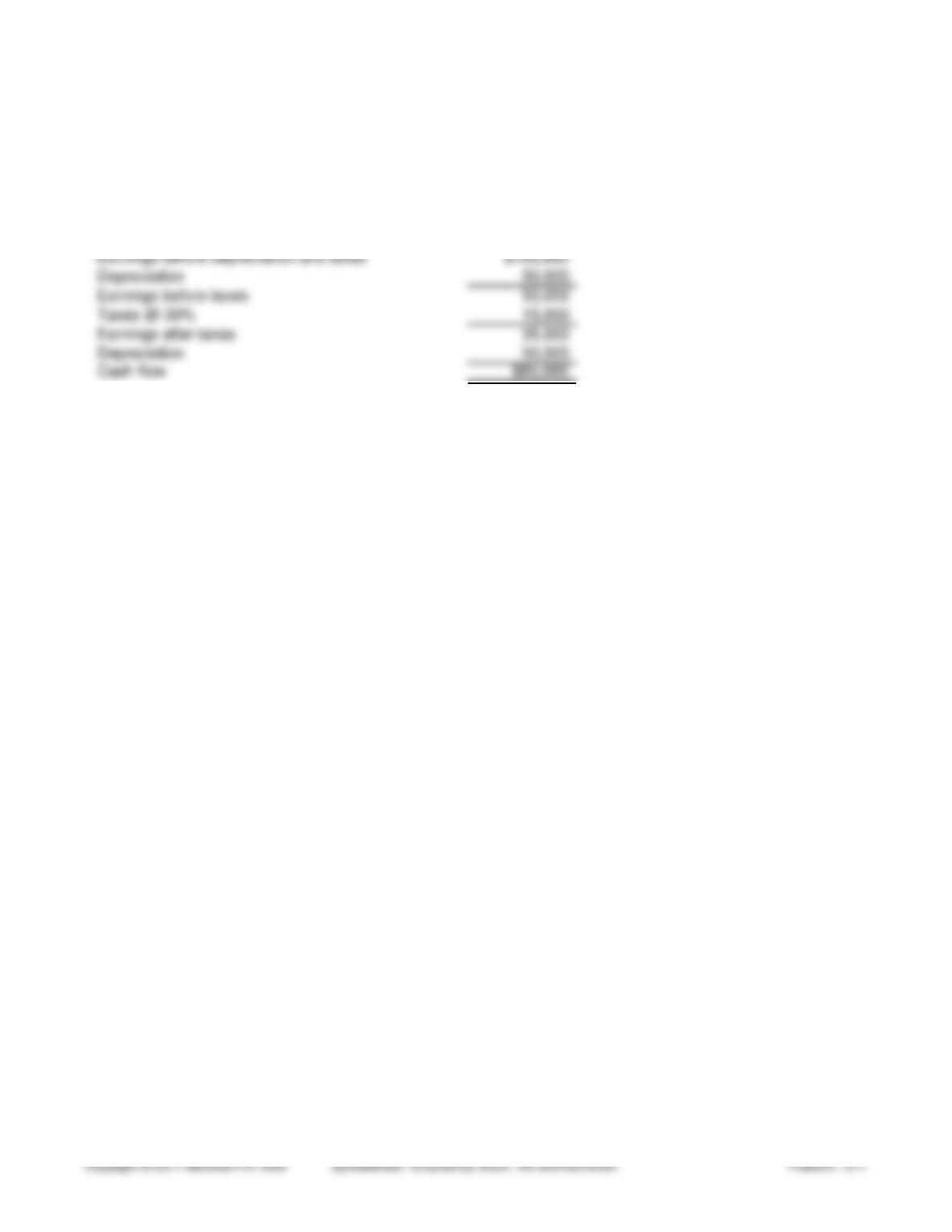
Earnings before depreciation and taxes $100,000
Depreciation 50,000
Earnings before taxes 50,000
Taxes @ 30% 15,000
Earnings after taxes 35,000
Depreciation 50,000
Cash flow $85,000
Solution

Problem 12-22
Objective: Capital rationing and mutually exclusive investments
Student Name:
Course Name:
Student ID:
Course Number:
The Suboptimal Glass Company uses a process of capital rationing in its decision making. The firm’s cost of capital
is 13 percent. It will invest only $60,000 this year. It has determined the internal rate of return for each of the
following projects.
Internal Rate
Project Project Size of Return
A$10,000 15.0%
B30,000 14.0%
C25,000 16.5%
D10,000 17.0%
E10,000 23.0%
F20,000 11.0%
G15,000 16.0%
a. Pick out the projects that the firm should accept.
b. If Projects D and E are mutually exclusive, how would that affect your overall answer?
That is, which projects would you accept in spending the $60,000?
Foundations of Financial Management
Block, Hirt and Danielsen
Problem 12-22
Instructions
Complete the table below to rank the investments in terms of IRR.
Rank the investments in terms of IRR.
Project
Project IRR Size Total Budget
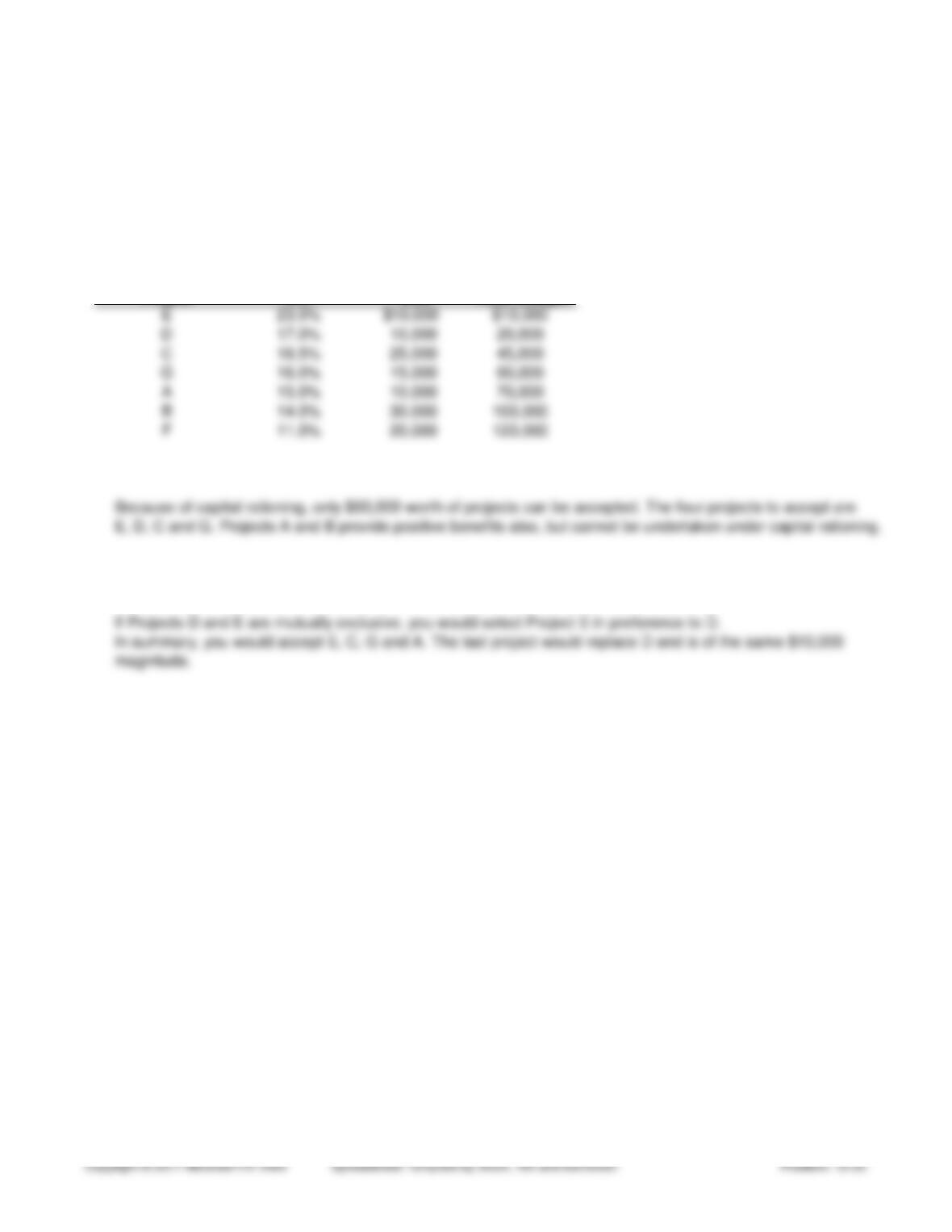
E23.0% $10,000 $10,000
D17.0% 10,000 20,000
C16.5% 25,000 45,000
G16.0% 15,000 60,000
A15.0% 10,000 70,000
B14.0% 30,000 100,000
F11.0% 20,000 120,000
a. Pick out the projects that the firm should accept.
Because of capital rationing, only $60,000 worth of projects can be accepted. The four projects to accept are
E, D, C and G. Projects A and B provide positive benefits also, but cannot be undertaken under capital rationing.
b. If Projects D and E are mutually exclusive, how would that affect your overall answer?
That is, which projects would you accept in spending the $60,000?
If Projects D and E are mutually exclusive, you would select Project E in preference to D.
In summary, you would accept E, C, G and A. The last project would replace D and is of the same $10,000
magnitude.
Solution

Problem 12-25
Objective: MACRS depreciation and cash flow
Student Name:
Course Name:
Student ID:
Course Number:
Telstar Communications is going to purchase an asset for $300,000 that will produce $140,000 per year for
the next four years in earnings before depreciation and taxes. The asset will be depreciated using the three-year
MACRS depreciation schedule in Table 12–9 on page 389. (This represents four years of depreciation based on the
half-year convention.) The firm is in a 35 percent tax bracket. Fill in the schedule below for the next four years.
Earnings before depreciation and taxes
Depreciation
Earnings before taxes
Taxes
Earnings after taxes
+ Depreciation
Cash flow
Foundations of Financial Management
Block, Hirt and Danielsen
Problem 12-25
Instructions
Enter formulas to complete the cash flow projections below.
Year 1 Year 2 Year 3 Year 4
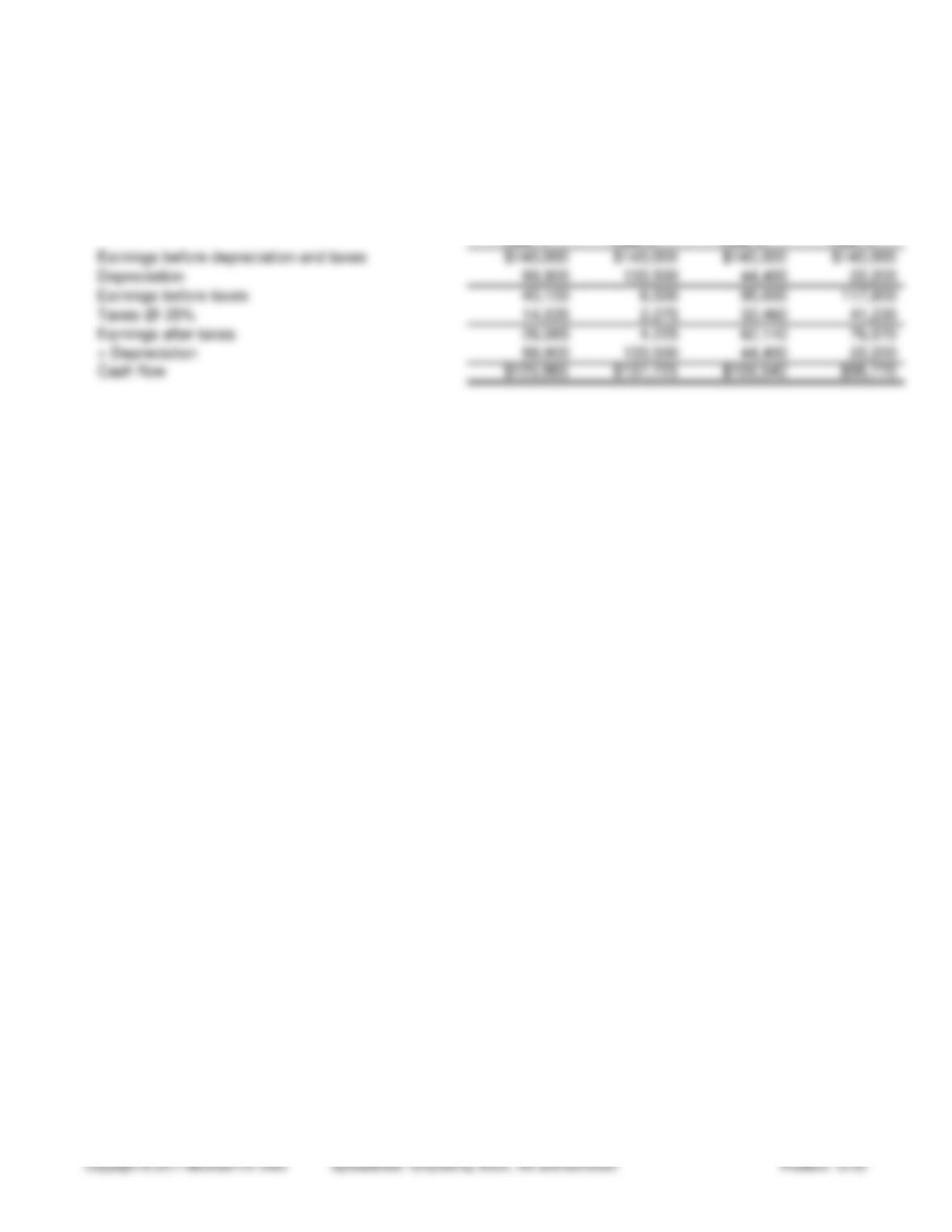
Earnings before depreciation and taxes $140,000 $140,000 $140,000 $140,000
Depreciation 99,900 133,500 44,400 22,200
Earnings before taxes 40,100 6,500 95,600 117,800
Taxes @ 35% 14,035 2,275 33,460 41,230
Earnings after taxes 26,065 4,225 62,140 76,570
+ Depreciation 99,900 133,500 44,400 22,200
Cash flow $125,965 $137,725 $106,540 $98,770
Solution