CHAPTER 2
FINANCIAL STATEMENTS, TAXES, AND
CASH FLOW
Answers to Concepts Review and Critical Thinking Questions
1. Liquidity measures how quickly and easily an asset can be converted to cash without significant loss
in value. It’s desirable for firms to have high liquidity so that they have a large factor of safety in
2. The recognition and matching principles in financial accounting call for revenues, and the costs
3. Historical costs can be objectively and precisely measured whereas market values can be difficult to
4. Depreciation is a noncash deduction that reflects adjustments made in asset book values in
5. Market values can never be negative. Imagine a share of stock selling for –$20. This would mean
that if you placed an order for 100 shares, you would get the stock along with a check for $2,000.
6. For a successful company that is rapidly expanding, for example, capital outlays will be large,
8. For example, if a company were to become more efficient in inventory management, the amount of
CHAPTER 2 – 2
9. If a company raises more money from selling stock than it pays in dividends in a particular period,
10. The adjustments discussed were purely accounting changes; they had no cash flow or market value
11. Enterprise value is the theoretical takeover price. In the event of a takeover, an acquirer would have
to take on the company’s debt but would pocket its cash. Enterprise value differs significantly from
12. In general, it appears that investors prefer companies that have a steady earnings stream. If true, this
encourages companies to manage earnings. Under GAAP, there are numerous choices for the way a
company reports its financial statements. Although not the reason for the choices under GAAP, one
Solutions to Questions and Problems
NOTE: All end of chapter problems were solved using a spreadsheet. Many problems require multiple
steps. Due to space and readability constraints, when these intermediate steps are included in this
solutions manual, rounding may appear to have occurred. However, the final answer for each problem is
found without rounding during any step in the problem.
Basic
1. To find owners’ equity, we must construct a balance sheet as follows:
Balance Sheet
CA $ 4,900 CL $ 4,100
We know that total liabilities and owners’ equity (TL & OE) must equal total assets of $32,200.
CHAPTER 2 – 3
2. The income statement for the company is:
Income Statement
Sales $796,000
Costs 327,000
3. One equation for net income is:
4. EPS = Net income/Shares = $310,470/80,000 = $3.88 per share
5. To calculate OCF, we first need the income statement:
Income Statement
Sales $46,200
Costs 23,100
6. Net capital spending = NFAend – NFAbeg + Depreciation
7. Change in NWC = NWCend – NWCbeg
8. Cash flow to creditors = Interest paid – Net new borrowing
CHAPTER 2 – 4
9. Cash flow to stockholders = Dividends paid – Net new equity
Note, APIS is the additional paid-in surplus.
10. Cash flow from assets = Cash flow to creditors + Cash flow to stockholders
Intermediate
11. To find the book value of current assets, we use: NWC = CA – CL. Rearranging to solve for
current assets, we get:
The market value of current assets and fixed assets is given, so:
Book value CA = $1,130,000 Market value CA = $1,150,000
12. To find the OCF, we first calculate net income.
Income Statement
Sales $305,000
Costs 176,000
Other expenses 8,900
CHAPTER 2 – 5
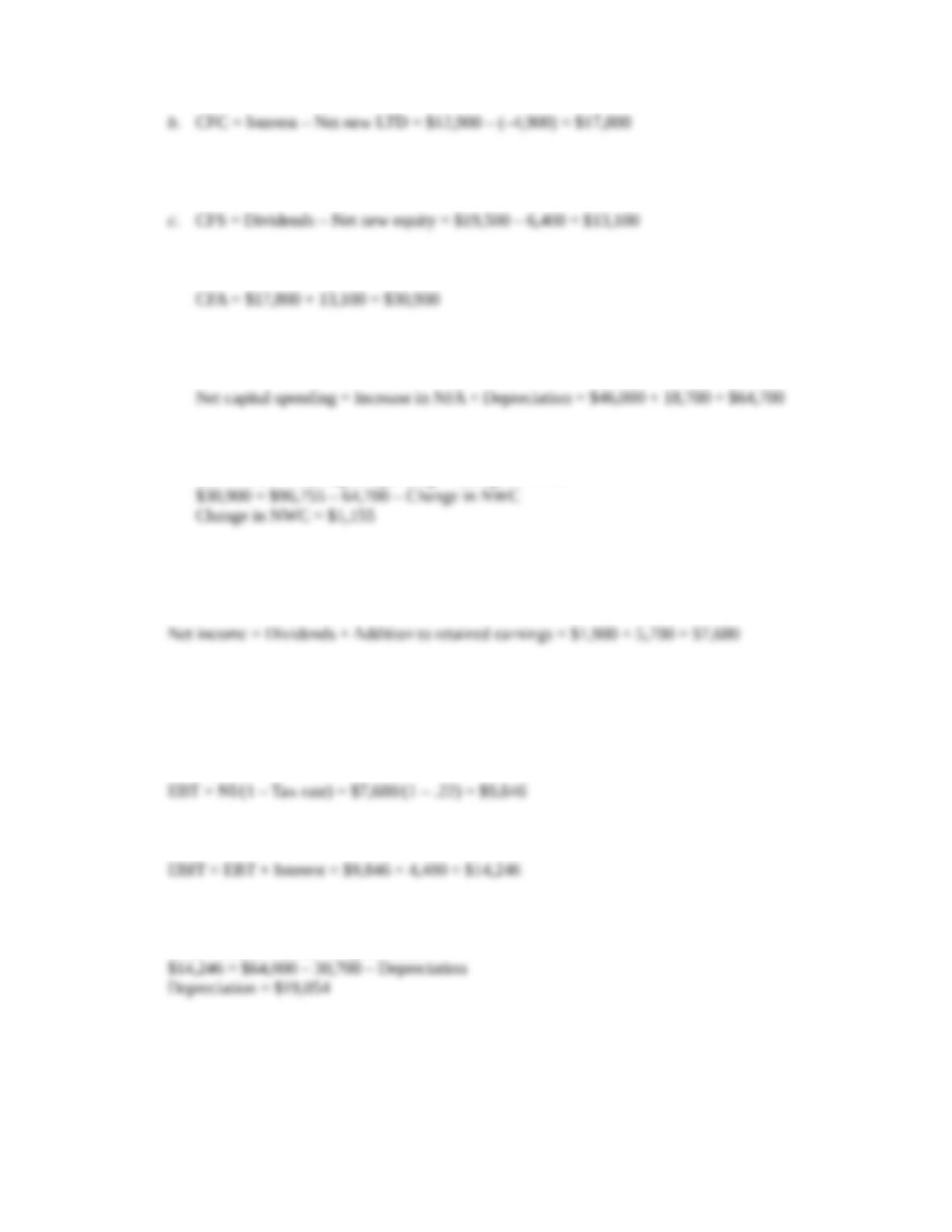
Note that the net new long-term debt is negative because the company repaid part of its long-
term debt.
d. We know that CFA = CFC + CFS, so:
CFA is also equal to OCF – Net capital spending – Change in NWC. We already know OCF.
Net capital spending is equal to:
Now we can use:
CFA = OCF – Net capital spending – Change in NWC
This means that the company increased its NWC by $1,155.
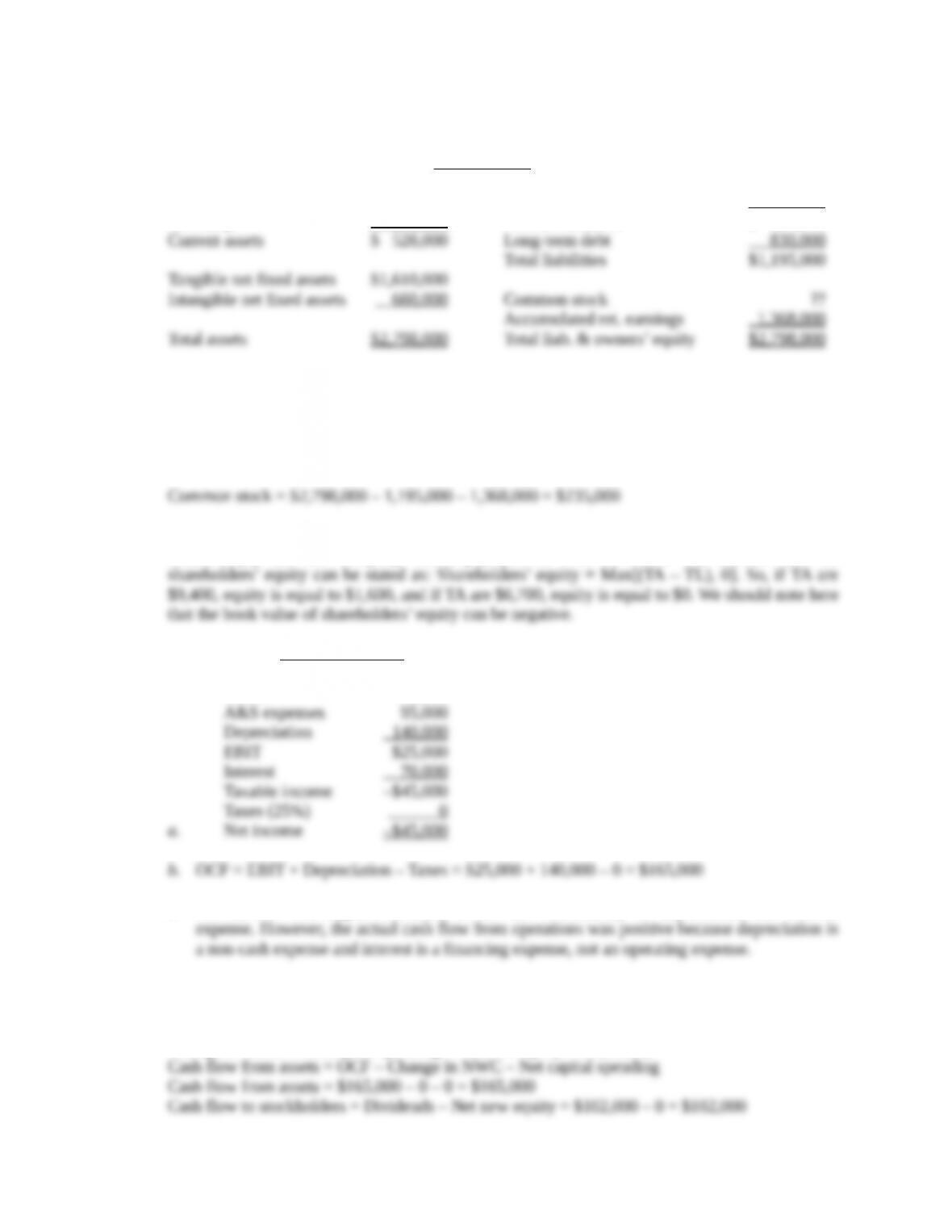
13. The solution to this question works the income statement backwards. Starting at the bottom:
Now, looking at the income statement:
EBT – EBT × Tax rate = Net income
Recognize that EBT × Tax rate is the calculation for taxes. Solving this for EBT yields:
Now you can calculate:
The last step is to use:
EBIT = Sales – Costs – Depreciation
CHAPTER 2 – 6
14. The balance sheet for the company looks like this:
Balance Sheet
Cash $ 127,000 Accounts payable $ 210,000
Accounts receivable 115,000 Notes payable 155,000
Inventory 286,000 Current liabilities $ 365,000
Total liabilities and owners’ equity is:
TL & OE = CL + LTD + Common stock + Retained earnings
Solving this equation for common stock gives us:
15. The market value of shareholders’ equity cannot be negative. A negative market value in this case
would imply that the company would pay you to own the stock. The market value of
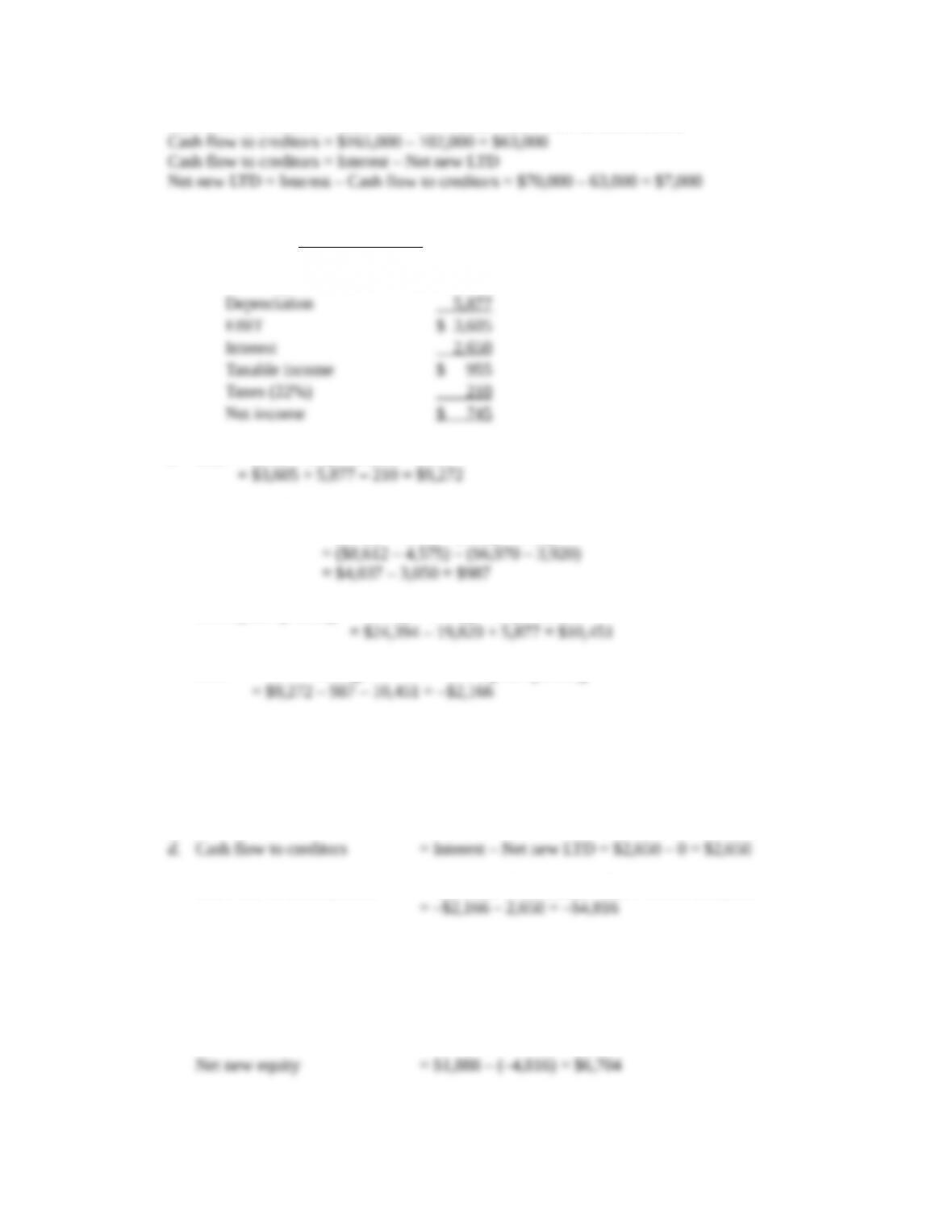
16. Income Statement
Sales $705,000
COGS 445,000
c. Net income was negative because of the tax deductibility of depreciation and interest
17. A firm can still pay out dividends if net income is negative; it just has to be sure there is sufficient
cash flow to make the dividend payments.
Change in NWC = Net capital spending = Net new equity = 0. (Given)
CHAPTER 2 – 7
Cash flow to creditors = Cash flow from assets – Cash flow to stockholders
18. a.
Income Statement
Sales $33,106
Cost of goods sold 23,624
b. OCF = EBIT + Depreciation – Taxes
c. Change in NWC = NWCend – NWCbeg
= (CAend – CLend) – (CAbeg – CLbeg)
Net capital spending = NFAend – NFAbeg + Depreciation
CFA = OCF – Change in NWC – Net capital spending
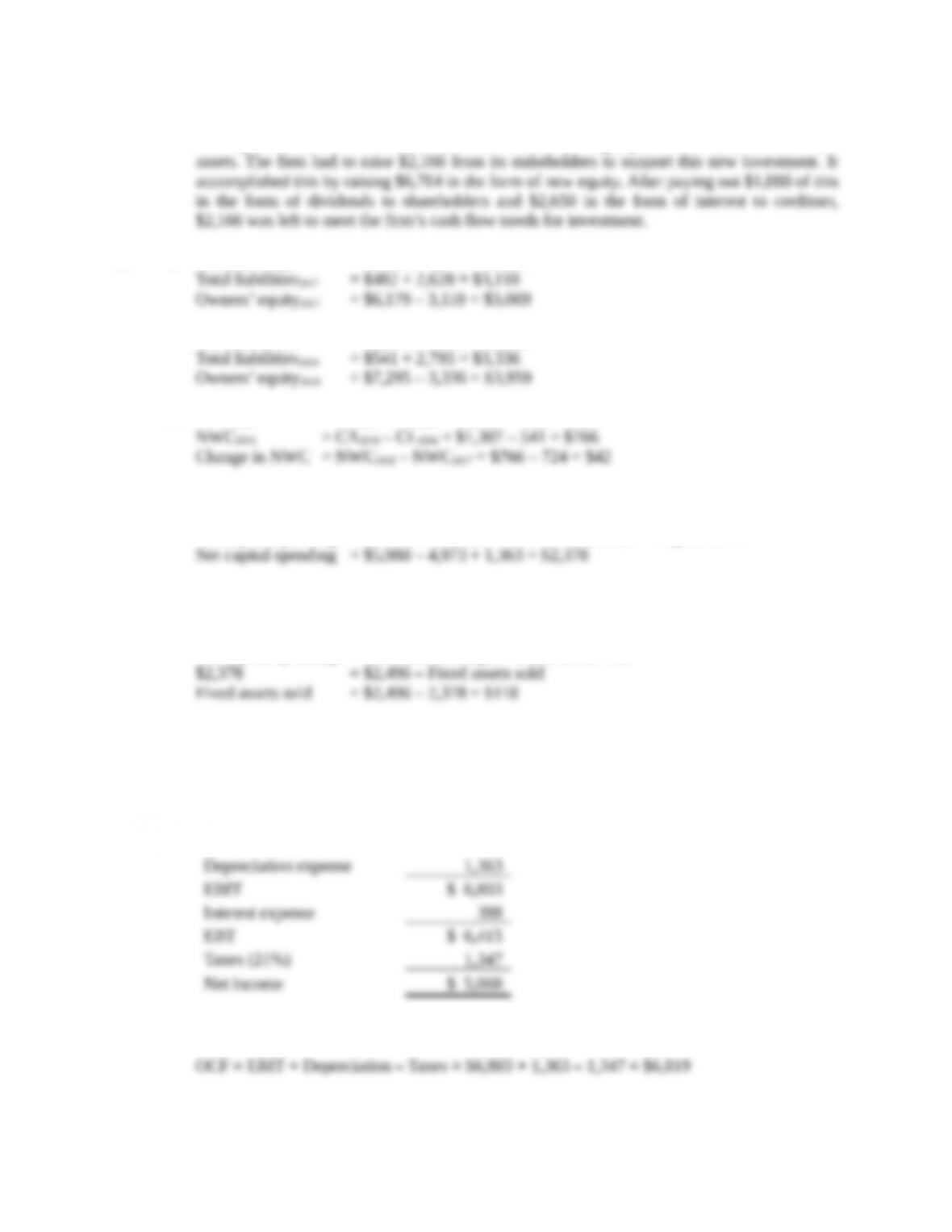
The cash flow from assets can be positive or negative, since it represents whether the firm
raised funds or distributed funds on a net basis. In this problem, even though net income and
OCF are positive, the firm invested heavily in both fixed assets and net working capital; it
had to raise a net $2,166 in funds from its stockholders and creditors to make these
investments.
Cash flow to stockholders = Cash flow from assets – Cash flow to creditors
We can also calculate the cash flow to stockholders as:
Cash flow to stockholders = Dividends – Net new equity
Solving for net new equity, we get:
CHAPTER 2 – 8
The firm had positive earnings in an accounting sense (NI > 0) and had positive cash flow
from operations. The firm invested $987 in new net working capital and $10,451 in new fixed
19. a. Total assets2017 = $1,206 + 4,973 = $6,179
Total assets2018 = $1,307 + 5,988 = $7,295
b. NWC2017 = CA2017 – CL2017 = $1,206 – 482 = $724
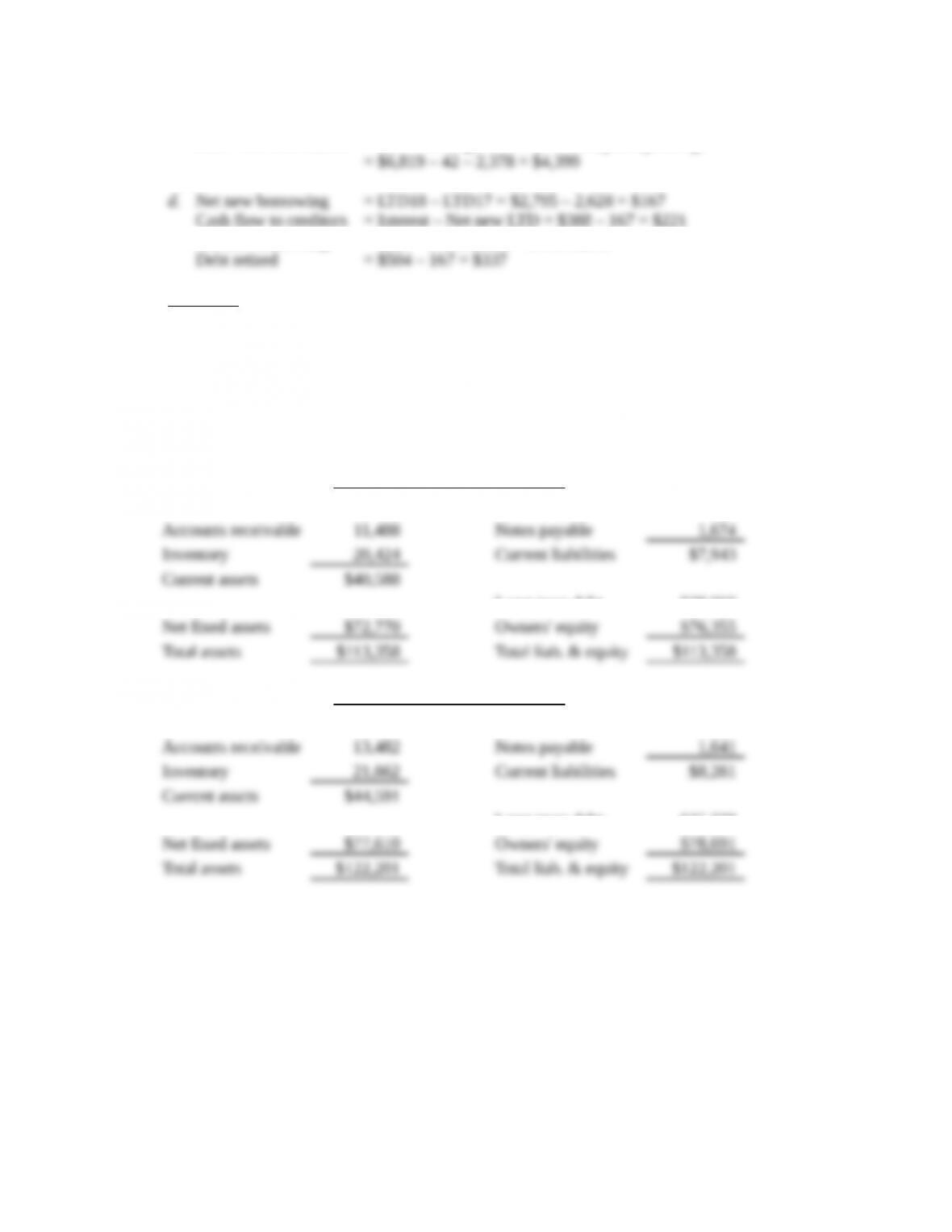
c. We can calculate net capital spending as:
Net capital spending = Net fixed assets2018 – Net fixed assets2017 + Depreciation
So, the company had a net capital spending cash flow of $2,378. We also know that net
capital spending is:
Net capital spending = Fixed assets bought – Fixed assets sold
To calculate the cash flow from assets, we must first calculate the operating cash flow. The
income statement is:
Income Statement
Sales $15,301
Costs 7,135
So, the operating cash flow is:
And the cash flow from assets is:
CHAPTER 2 – 9
Cash flow from assets = OCF – Change in NWC – Net capital spending.
Cash flow to creditors = Interest – Net new LTD = $388 – 167 = $221
Net new borrowing = $167 = Debt issued – Debt retired
Challenge
20. Net capital spending = NFAend – NFAbeg + Depreciation
= (NFAend – NFAbeg) + (Depreciation + ADbeg) – ADbeg
= (NFAend – NFAbeg)+ ADend – ADbeg
= (NFAend + ADend) – (NFAbeg + ADbeg)
= FAend – FAbeg
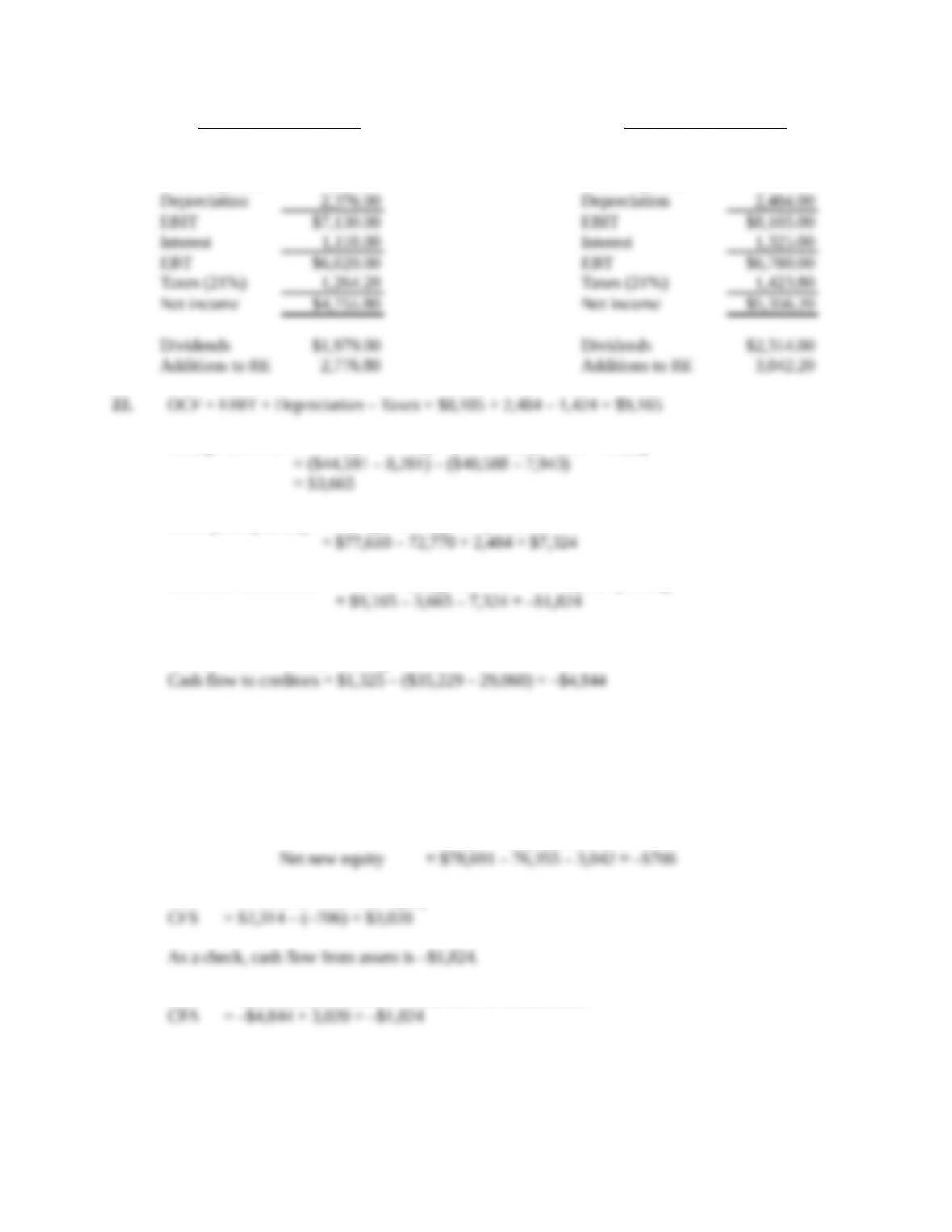
21.
Balance sheet as of Dec. 31, 2017
Cash $8,676 Accounts payable $6,269
Long-term debt $29,060
Balance sheet as of Dec. 31, 2018
Cash $9,247 Accounts payable $6,640
Long-term debt $35,229
CHAPTER 2 – 10
2017 Income Statement 2018 Income Statement
Sales $16,549.00 Sales $18,498.00
COGS 5,690.00 COGS 6,731.00
Other expenses 1,353.00 Other expenses 1,178.00
Change in NWC = NWCend – NWCbeg = (CA – CL) end – (CA – CL) beg
Net capital spending = NFAend – NFAbeg + Depreciation
Cash flow from assets = OCF – Change in NWC – Net capital spending
Cash flow to creditors = Interest – Net new LTD
Net new LTD = LTDend – LTDbeg
Net new equity = Common stockend – Common stockbeg
Common stock + Retained earnings = Total owners’ equity
Net new equity = (OE – RE)end – (OE – RE)beg
= OEend – OEbeg + REbeg – REend
REend = REbeg + Additions to RE18
Net new equity = OEend – OEbeg + REbeg – (REbeg + Additions to RE18)
= OEend – OEbeg – Additions to RE
CFS = Dividends – Net new equity
CFA = Cash to from creditors + Cash flow to stockholders
CHAPTER 26 – 11