© The McGraw-Hill Companies, Inc., 2018. All rights reserved.
Solutions Manual, Chapter 9 47
Case 9-27 (30 minutes)
It is difficult to imagine how Tom Kemper could ethically agree to go along
with reporting the favorable $21,000 variance for industrial engineering on
the final report, even if the bill were not actually received by the end of the
year. It would be misleading to exclude part of the final cost of the
contract. Collaborating in this attempt to mislead corporate headquarters
Individuals will differ in how they think Kemper should handle this
situation. In our opinion, he should firmly state that he is willing to call
Laura, but even if the bill does not arrive, he is ethically bound to properly
accrue the expenses on the report—which will mean an unfavorable
It is important to note that the problem may be a consequence of
inappropriate use of performance reports by corporate headquarters. If the
performance report is being used as a way of “beating up” managers,
© The McGraw-Hill Companies, Inc., 2018. All rights reserved.
48 Managerial Accounting, 16th Edition
Case 9-28 (45 minutes)
1. The flexible budget and spending variances would be computed as
follows:
Boyne University Motor Pool
Spending Variances
For the Month Ended March 31
Actual
Results
Flexible
Budget
Spending
Variances
Miles (q1) …………………………………. 63,000 63,000
A
utos (q2) ………………………………… 21 21
Gasoline ($0.15q1) ……………………… $ 9,350 $ 9,450 $100 F
2. The original report is based on a static budget approach that does not
allow for variations in the number of miles driven from month to month,
or for variations in the number of automobiles used. As a result, the
The performance report in part (1) above is more realistic because the
T
© The McGraw-Hill Companies, Inc., 2018. All rights reserved.
Solutions Manual, Chapter 9 49
Case 9-29 (75 minutes)
1. The cost formulas for The Little Theatre appear below, where q1 is the
number of productions and q2 is the number of performances:
o Actors’ and directors’ wages: $2,000q2. Variable with respect to the
o Stagehands’ wages: $300q2. Variable with respect to the number of
o Ticket booth personnel and ushers’ wages: $150q2. Variable with
o Scenery, costumes, and props: $18,000q1. Variable with respect to
o Theater hall rent: $500q2. Variable with respect to the number of
o Printed programs: $250q2. Variable with respect to the number of
o Publicity: $2,000q1. Variable with respect to the number of
o Administrative expenses: $32,400 + $1,080q1 +$40q2.
© The McGraw-Hill Companies, Inc., 2010. All rights reserved.
50 Managerial Accounting, 13th Edition
Case 9-29 (continued)
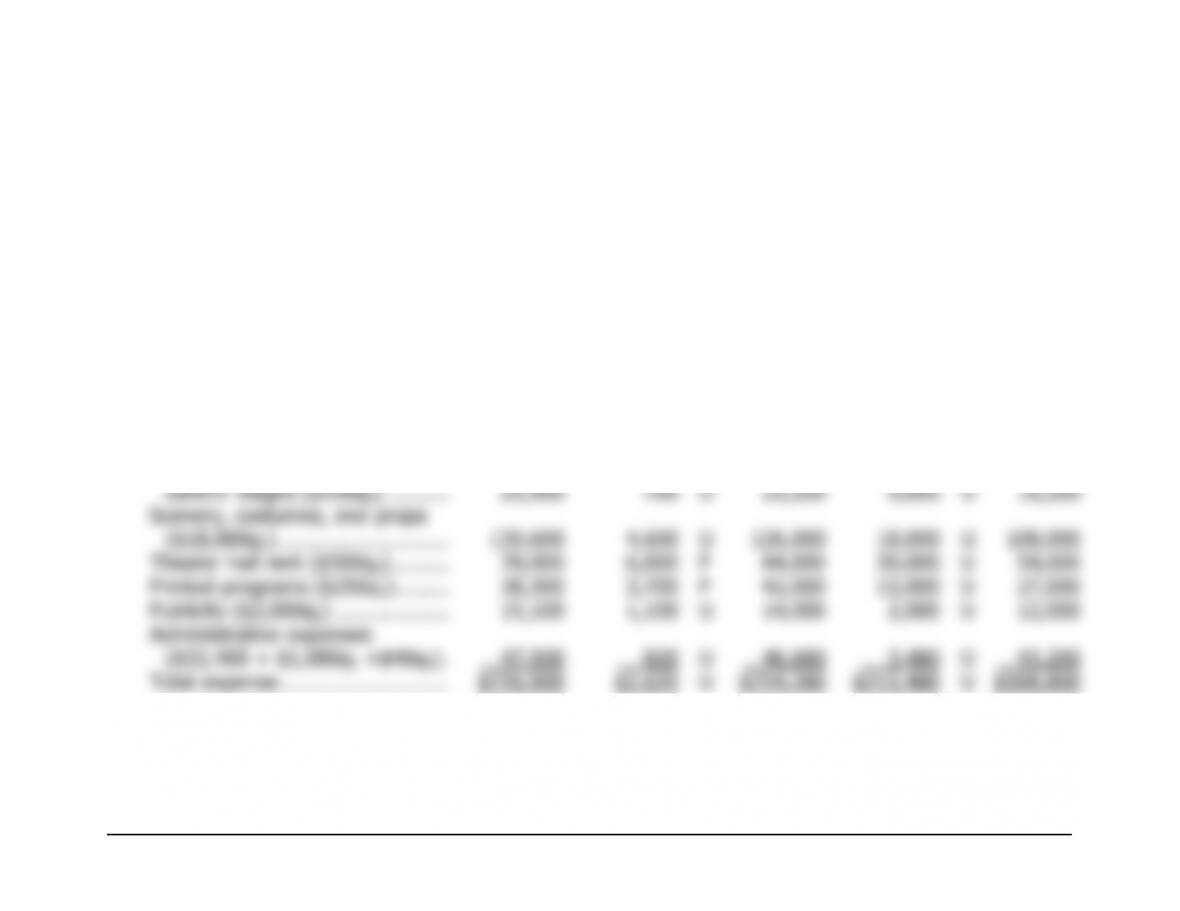
The flexible budget performance report follows:
T
he Little Theatre
Flexible Budget Performance Report
For the Year Ended December 31
Actual
Results
Spending
Variances
Flexible
Budget
Activity
Variances
Planning
Budget
Number of productions (q1) ……. 7 7 6
Number of performances (q2) …. 168 168 108
A
ctors’ and directors’ wa
g
es
($2,000q2) ……………………….. $341,800 $5,800 U $336,000 $120,000 U $216,000
Sta
g
ehands’ wa
g
es ($300q2) ….. 49,700 700 F 50,400 18,000 U 32,400
T
icket booth personnel and
T
A
T
© The McGraw-Hill Companies, Inc., 2010. All rights reserved.
Solutions Manual, Chapter 10 51
Case 9-29 (continued)
2. The overall unfavorable spending variance of $2,620 is a very small
percentage of the total cost, less than 0.4% (= $2,620 ÷ $724,280).
This suggests that costs are under control. In addition, the pattern of
the variances may reflect good management. The largest unfavorable
spending variances are for value-added activities (actors’ and directors’
3. Average costs may not be very good indicators of the additional costs of
any particular production or performance. The averages gloss over
considerable variations in costs. For example, a production of Peter
Rabbit may require only half a dozen actors and actresses and fairly
simple costumes and props. On the other hand, a production of