© The McGraw-Hill Companies, Inc., 2018. All rights reserved.
Solutions Manual, Chapter 7 41
Problem 7-17 (45 minutes)
1. Under the traditional direct labor-hour based costing system,
manufacturing overhead is applied to products using the predetermined
overhead rate computed as follows:
Estimated total manufacturin
g
overhead cost
Predetermined =
overhead rate Estimated total direct labor –hours
Consequently, the product margins using the traditional approach would
be computed as follows:
Xtrem
e
Pathfinde
r
T
ota
l
Sales ……………………………. $2,800,000 $7,920,000 $10,720,000
Direct materials ………………. 1,440,000 4,240,000 5,680,000
Direct labor ……………………. 480,000 960,000 1,440,000
© The McGraw-Hill Companies, Inc., 2018. All rights reserved.
42 Managerial Accounting, 16th Edition
Problem 7-17 (continued)
2. The first step is to determine the activity rates:
Activity Cost Pools
(a)
Total
Cost
(b)
Total Activity
(a) ÷ (b)
Activity Rate
Supportin
g
direct
*The Other activity cost pool is not shown above because it includes
Under the activity-based costing system, the product margins would be
computed as follows:
Xtrem
e
Pathfinde
r
T
ota
l
Sales ………………………….. $2,800,000 $7,920,000 $10,720,000
Direct materials …………….. 1,440,000 4,240,000 5,680,000
Direct labor ………………….. 480,000 960,000 1,440,000
g
© The McGraw-Hill Companies, Inc., 2018. All rights reserved.
Solutions Manual, Chapter 7 43
Problem 7-17 (continued)
3. The quantitative comparison is as follows:
XtremePathfinder
T
otal
T
raditional Cost Syste
m
(a)
Amount
(a) ÷ (c)
%
(b)
Amount
(b) ÷ (c)
%
(c)
Amount
Direct materials ………………….. $1,440,000 25.4% $4,240,000 74.6% $5,680,000
Direct labor …………….…………. 480,000 33.3% 960,000 66.7% 1,440,000
T
A
ctivit
y
–
Based Costin
g
Syste
m
Direct costs:
Direct materials ………………….. $1,440,000 25.4% $4,240,000 74.6% $5,680,000
Direct labor …………….…………. 480,000 33.3% 960,000 66.7% 1,440,000
Indirect costs:
T
T

© The McGraw-Hill Companies, Inc., 2018. All rights reserved.
44 Managerial Accounting, 16th Edition
Problem 7-17 (continued)
The traditional and activity-based cost assignments differ for two
reasons. First, the traditional system assigns all $1,980,000 of
manufacturing overhead to products. The ABC system assigns only
$1,881,000 (= $783,600 + $495,000 + $602,400) of manufacturing
overhead to products. The ABC system does not assign the $99,000 of
Other activity costs to products because they represent organization-
© The McGraw-Hill Companies, Inc., 2018. All rights reserved.
Solutions Manual, Chapter 7 45
Problem 7-18 (45 minutes)
1. The results of the first-stage allocation appear below:
Job Size
Estimating
and Job
Setup
Working on
Nonroutine
Jobs Other Totals
Wa
g
es and salaries ……… $150,000 $ 30,000 $ 90,000 $ 30,000 $ 300,000
Disposal fees ……………… 420,000 0 280,000 0 700,000
Equipment depreciation … 36,000 4,500 18,000 31,500 90,000
On-site supplies ………….. 30,000 15,000 5,000 0 50,000
2.
Activity Cost Pool
(a)
Total Cost
(b)
Total Activity
(a) ÷ (b)
Activity Rate
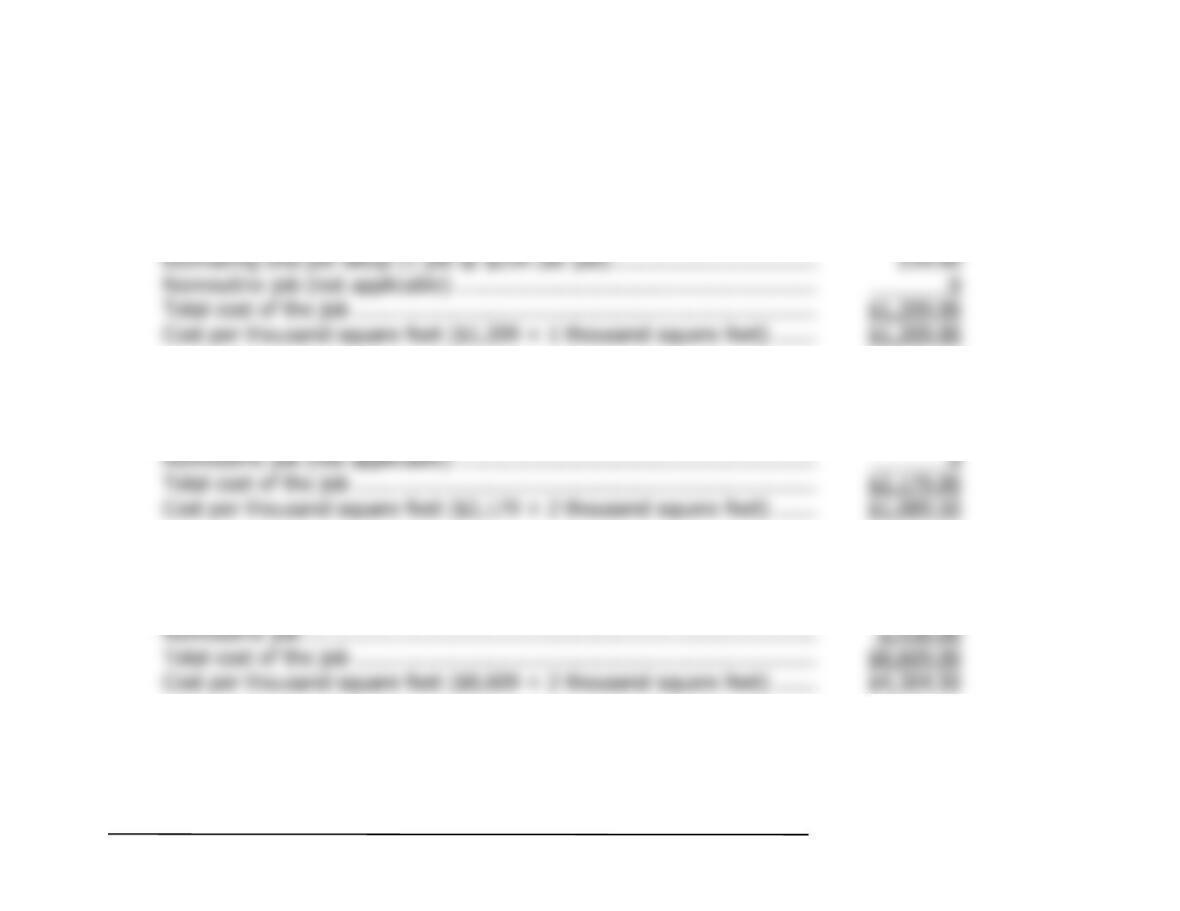
Job size …………….. $776,000 800 thousand square feet $970 per thousand square feet
Estimatin
g
and
j
ob
© The McGraw-Hill Companies, Inc., 2018. All rights reserved.
46 Managerial Accounting, 16th Edition
Problem 7-18 (continued)
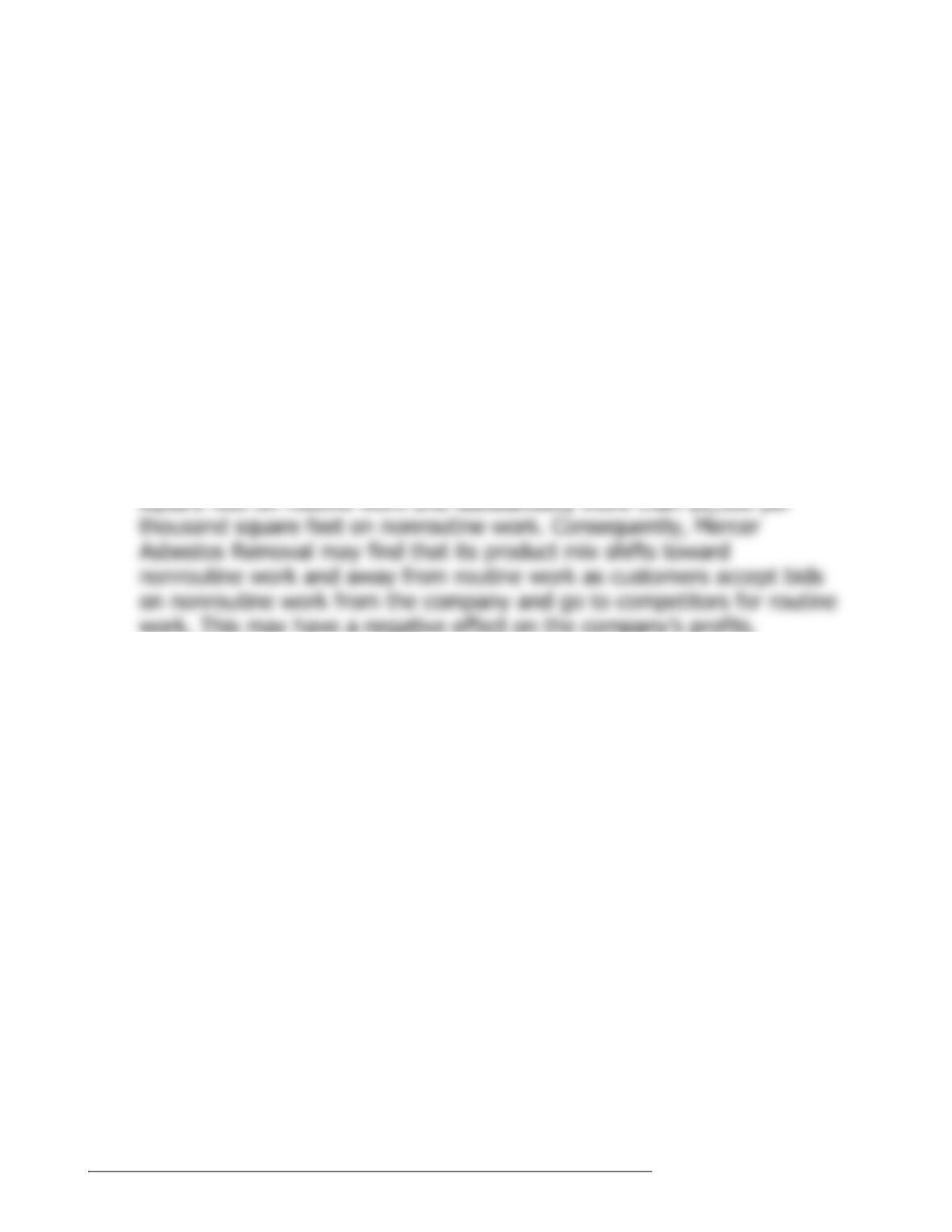
3. The costs of each of the jobs can be computed as follows using the activity rates computed above:
a.
Routine one thousand square foot
j
ob
:
Job size (1 thousand square feet @ $970 per thousand square feet) …. $ 970.00
b.
Routine two thousand square foot
j
ob
:
Job size (2 thousand square feet @ $970 per thousand square feet) …. $1,940.00
Estimatin
g
and
j
ob setup (1
j
ob @ $239 per
j
ob) ………………………….. 239.00
c.
Nonroutine two thousand square foot
j
ob
:
Job size (2 thousand square feet @ $970 per thousand square feet) …. $1,940.00
Estimatin
g
and
j
ob setup (1
j
ob @ $239 per
j
ob) ………………………….. 239.00
g
j
j
j
© The McGraw-Hill Companies, Inc., 2018. All rights reserved.
Solutions Manual, Chapter 7 47
Problem 7-18 (continued)
4. The objectivity of the interview data can be questioned because the on-
site work supervisors were undoubtedly trying to prove their case about
the cost of nonroutine jobs. Nevertheless, the activity-based costing
data certainly suggest that dramatic differences exist in the costs of
jobs. While some of the costs may be difficult to adjust in response to
Savvy competitors are likely to bid less than $2,500 per thousand
square feet on routine work and substantially more than $2,500 per
thousand square feet on nonroutine work. Consequently, Mercer
© The McGraw-Hill Companies, Inc., 2018. All rights reserved.
48 Managerial Accounting, 16th Edition
Problem 7-19 (20 minutes)
1. The cost of serving the local commercial market according to the ABC model can be determined as
follows:
Activity Cost Pool
(a)
Activity Rate
(b)
Activity
(a) × (b)
ABC Cost
$257,625
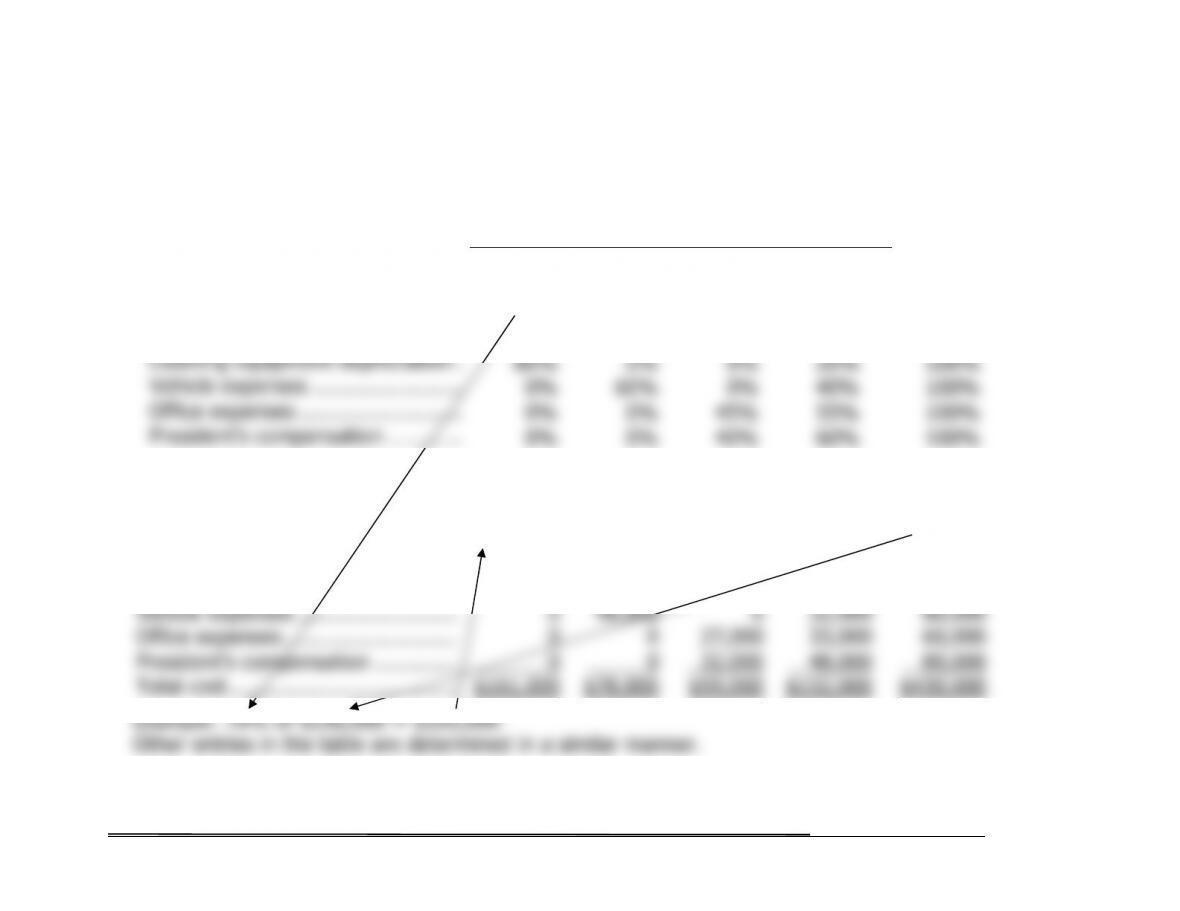
2. The margin earned serving the local commercial market is negative, as shown below:
Profitability Analysi
s
Sales …………………………………………… $180,000
Costs:
A
nimation concept ……………………….. $151,000
A
3. It appears that the local commercial market is losing money and the company would be better off
dropping this market segment. However, as discussed in the previous problem, not all of the costs
A
A
© The McGraw-Hill Companies, Inc., 2018. All rights reserved.
Solutions Manual, Chapter 7 49
Problem 7-20 (45 minutes)
1. The first-stage allocation of costs to activity cost pools appears below:
Distribution of Resource Consumption
Across Activity Cost Pools
Cleaning
Carpets
Travel
to Jobs
Job
Support Other Total
Wa
g
es ………………………………… 70% 20% 0% 10% 100%
Cleanin
g
supplies …………………… 100% 0% 0% 0% 100%
Cleaning
Carpets
Travel
to Jobs
Job
Support Other Total
Wa
g
es …………………………………. $105,000 $30,000 $ 0 $ 15,000 $150,000
Cleanin
g
supplies ……………………. 40,000 0 0 0 40,000
Cleanin
g
equipment depreciation .. 16,000 0 0 4,000 20,000
g
© The McGraw-Hill Companies, Inc., 2018. All rights reserved.
50 Managerial Accounting, 16th Edition
Problem 7-20 (continued)
2. The activity rates are computed as follows:
Activity Cost Pool
(a)
Total Cost
(b)
Total Activity
(a) ÷ (b)
Activity Rate
Cleanin
g
carpets .. $161,000 20,000 hundred
$8.05 per hundred
3. The cost for the Flying N Ranch job is computed as follows:
Activity Cost Pool
(a)
Activity Rate
(b)
Activity
(a) × (b)
ABC Cost
Cleanin
g
carpets .. $8.05 per hundred
5 hundred
$ 40.25
4. The margin earned on the job can be easily computed by using the
costs calculated in part (3) above.
Sales …………………… $140.00
Costs:
g