© The McGraw-Hill Companies, Inc., 2018. All rights reserved.
Solutions Manual, Chapter 7 31
Exercise 7-13 (30 minutes)
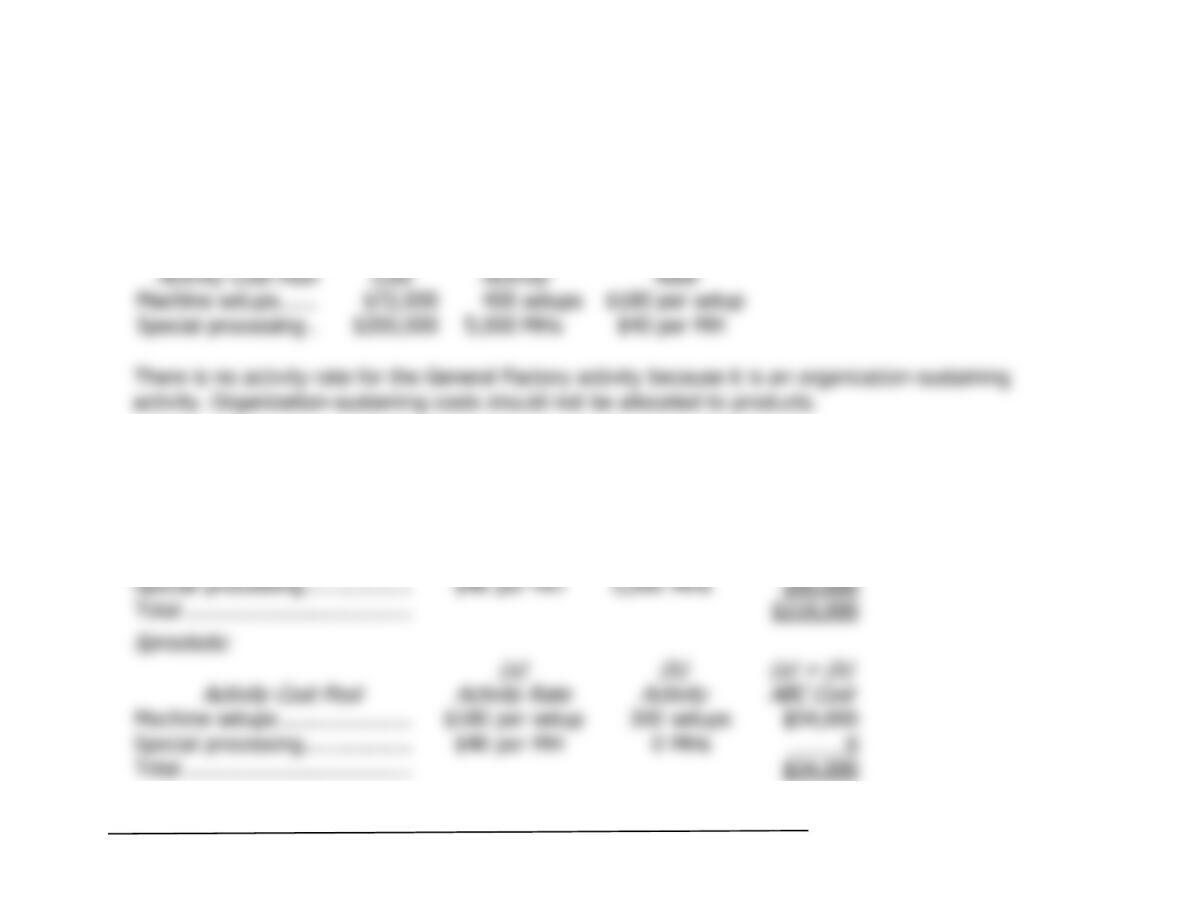
1. Activity rates are computed as follows:
(a)
Estimated
Overhead
(b)
Expected
(a) ÷ (b)
Activity
2. Overhead is assigned to the two products as follows:
Hubs:
Activity Cost Pool
(a)
Activity Rate
(b)
Activity
(a) × (b)
ABC Cost
Machine setups ………………… $180 per setup 100 setups $ 18,000

© The McGraw-Hill Companies, Inc., 2018. All rights reserved.
32 Managerial Accounting, 16th Edition
Exercise 7-13 (continued)
Hubs Sprockets
Direct materials ……………………………. $32.00 $18.00
Direct labor:
$15 per DLH × 0.80 DLHs per unit …. 12.00
© The McGraw-Hill Companies, Inc., 2018. All rights reserved.
Solutions Manual, Chapter 7 33
Exercise 7-14 (30 minutes)
1. The first step is to determine the activity rates:
Activity Cost Pools
(a)
Total Cost
(b)
Total Activity
(a) ÷ (b)
Activity Rate
Servin
g
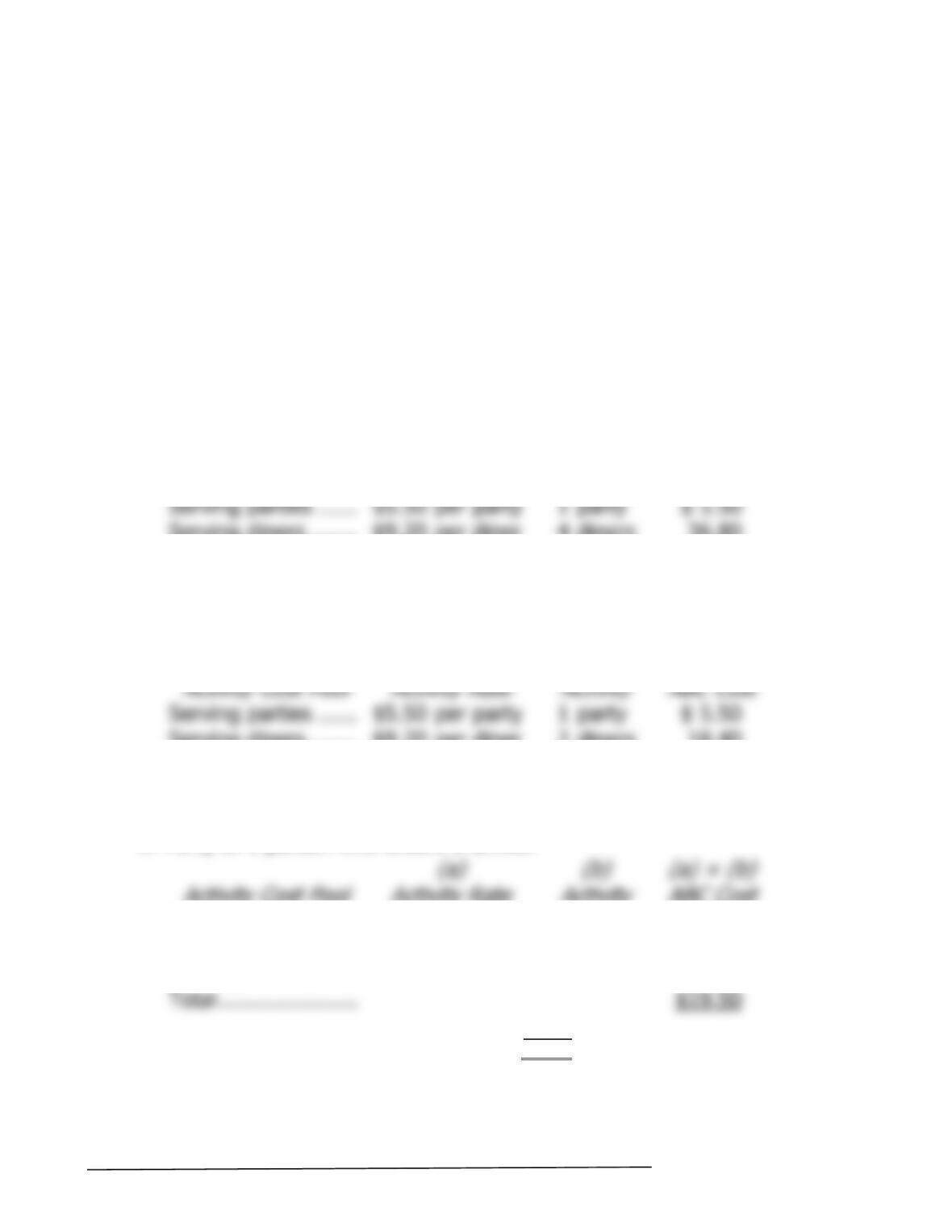
parties ……. $33,000 6,000 parties $5.50 per party
According to the activity-based costing system, the cost of serving each
of the parties can be computed as follows:
a. Party of 4 persons who order a total of 3 drinks:
Activity Cost Pool
(a)
Activity Rate
(b)
Activity
(a) × (b)
ABC Cost
Servin
g
parties …… $5.50 per party 1 party $ 5.50
g
g
T
b. Party of 2 persons who order no drinks:
Activity Cost Pool
(a)
Activity Rate
(b)
Activity
(a) × (b)
ABC Cost
Servin
g
parties …… $5.50 per party 1 party $ 5.50
g
g
T
c. Party of 1 person who orders 2 drinks:
Activity Cost Pool
(a)
Activity Rate
(b)
Activity
(a) × (b)
ABC Cost
g
g
Servin
g
drinks ……. $2.40 per drink 2 drinks 4.80
T
otal ………………… $19.50
g
g
© The McGraw-Hill Companies, Inc., 2018. All rights reserved.
34 Managerial Accounting, 16th Edition
Exercise 7-14 (continued)
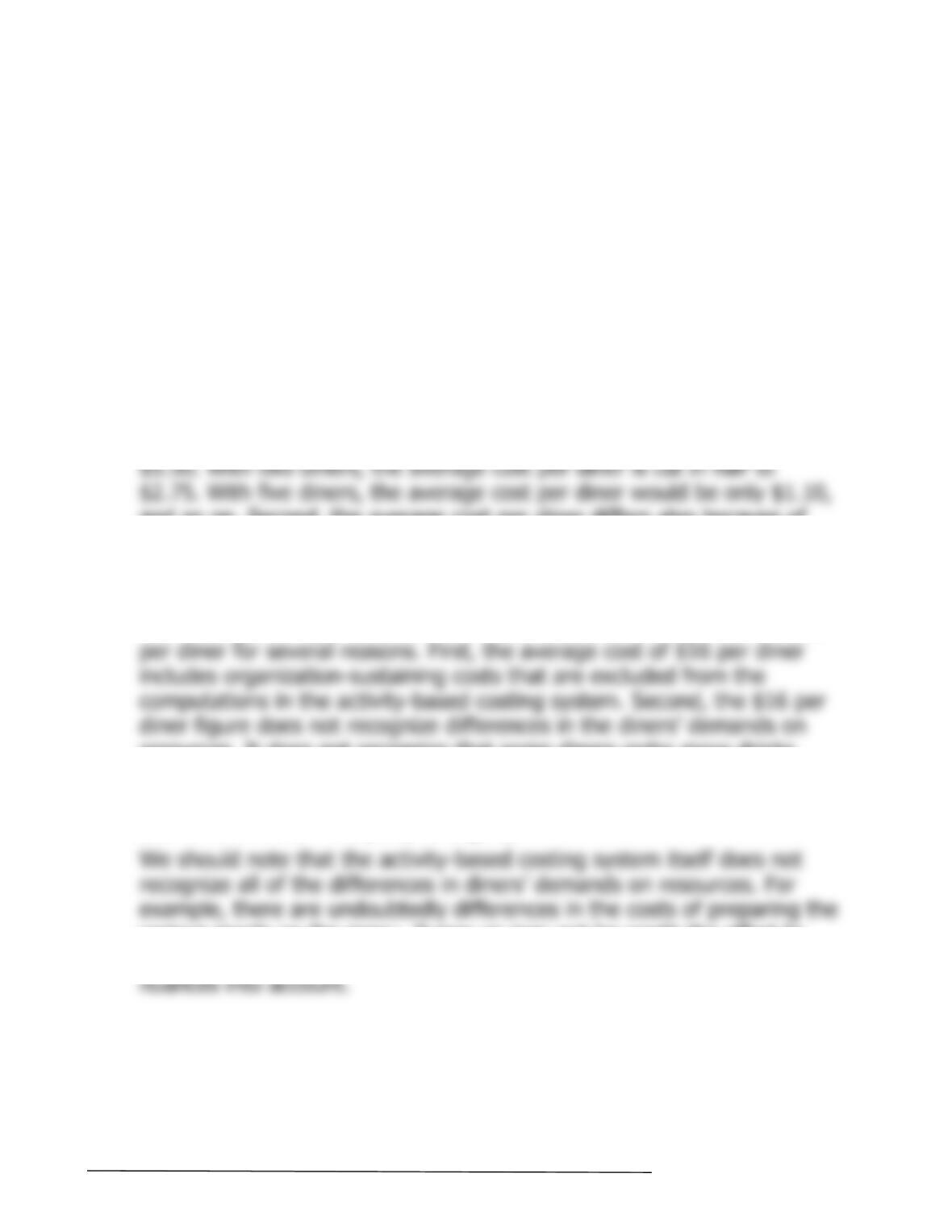
2. The average cost per diner for each party can be computed by dividing
the total cost of the party by the number of diners in the party as
follows:
3. The average cost per diner differs from party to party under the activity-
based costing system for two reasons. First, the cost of serving a party
($5.50) does not depend on the number of diners in the party.
Therefore, the average cost per diner of this activity decreases as the
number of diners in the party increases. With only one diner, the cost is
The average cost per diner differs from the overall average cost of $16
per diner for several reasons. First, the average cost of $16 per diner
includes organization-sustaining costs that are excluded from the
computations in the activity-based costing system. Second, the $16 per
We should note that the activity-based costing system itself does not
recognize all of the differences in diners’ demands on resources. For
build a more detailed activity-based costing system that would take such
nuances into account.
© The McGraw-Hill Companies, Inc., 2018. All rights reserved.
Solutions Manual, Chapter7 35
Exercise 7-15 (30 minutes)
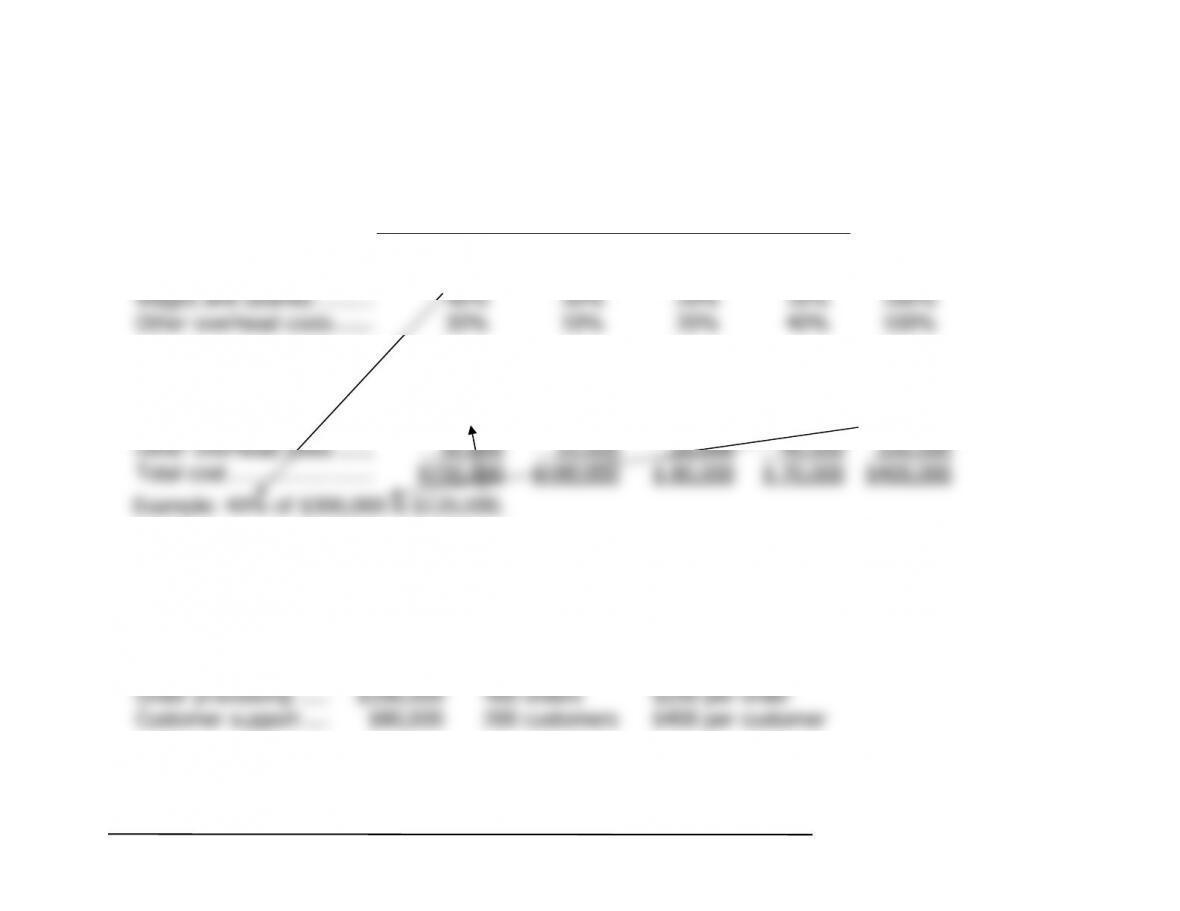
1. First-stage allocations of overhead costs to the activity cost pools:
Distribution of Resource Consumption
Across Activity Cost Pools
Supporting
Direct Labor
Order
Processing
Customer
Support Other Totals
Direct Labor
Support
Order
Processing
Customer
Support Other Totals
Wa
g
es and salaries ……… $120,000 $ 90,000 $ 60,000 $ 30,000 $300,000
2. Computation of activity rates:
Activity Cost Pools
(a)
Total Cost
(b)
Total Activity
(a) ÷ (b)
Activity Rate
Supportin
g
direct
labor ……………….. $150,000 20,000 DLHs
$7.50
per DLH
g
© The McGraw-Hill Companies, Inc., 2018. All rights reserved.
36 Managerial Accounting, 16th Edition
Exercise 7-15 (continued)
3. Computation of the overhead costs for the Shenzhen Enterprises order:
Activity Cost Pool
(a)
Activity Rate
(b)
Activity
(a) × (b)
ABC Cost
Supportin
g
direct
labor …………….. $7.50 per DLH 20 DLHs* $150
4. The customer margin for Shenzhen Enterprises is computed as follows:
Customer Mar
g
i
n
—
A
BC Analysi
s
Sales (10 units × $300 per unit) ……………….. $3,000
Costs:
Direct materials ($180 per unit × 10 units) … $1,800
Direct labor ($50 per unit × 10 units) ……….. 500

© The McGraw-Hill Companies, Inc., 2018. All rights reserved.
Solutions Manual, Chapter 7 37
Problem 7-16 (45 minutes)
1. Under the traditional direct labor-dollar based costing system,
manufacturing overhead is applied to products using the predetermined
overhead rate computed as follows:
Estimated total manufacturin
g
overhead cost
Predetermined =
overhead rate Estimated total direct labor dollars
The product margins using the traditional approach would be computed
as follows:
B
30
0
T
50
0
T
ota
l
Sales ……………………………. $1,400,000 $700,000 $2,100,000
Direct materials …………..….. 436,300 251,700 688,000
Direct labor …………..……….. 200,000 104,000 304,000
Manufacturin
g
overhead
applied @ $2.00 per direct

© The McGraw-Hill Companies, Inc., 2018. All rights reserved.
38 Managerial Accounting, 16th Edition
Problem 7-16 (continued)
2. The first step is to determine the activity rates:
Activity Cost Pools
(a)
Total
Cost
(b)
Total Activity
(a) ÷ (b)
Activity Rate
Machinin
g
………….. $213,500 152,500 MH $1.40 per MH
*The Other activity cost pool is not shown above because it includes
Under the activity-based costing system, the product margins would be
computed as follows:
B
30
0
T
50
0
T
ota
l
Sales ……………………………. $1,400,000 $700,000 $2,100,000
Direct materials ……………… 436,300 251,700 688,000
Direct labor …………………… 200,000 104,000 304,000
g
© The McGraw-Hill Companies, Inc., 2018. All rights reserved.
Solutions Manual, Chapter 7 39
Problem 7-16 (continued)
3. The quantitative comparison is as follows:
B300
T
500
T
otal
T
raditional Cost Syste
m
(a)
Amount
(a) ÷ (c)
%
(b)
Amount
(b) ÷ (c)
%
(c)
Amount
Direct materials …………………… $436,300 63.4% $251,700 36.6% $ 688,000
Direct labor ………………………… 200,000 65.8% 104,000 34.2% 304,000
T
T
A
ctivit
y
–
Based Costin
g
Syste
m
Direct costs:
Direct materials …………………… $436,300 63.4% $251,700 36.6% $ 688,000
Direct labor ………………………… 200,000 65.8% 104,000 34.2% 304,000
A
dvertisin
g
expense ……………… 50,000 33.3% 100,000 66.7% 150,000
Indirect costs:
T
© The McGraw-Hill Companies, Inc., 2018. All rights reserved.
40 Managerial Accounting, 16th Edition
Problem 7-16 (continued)
The traditional and activity-based cost assignments differ for three
reasons. First, the traditional system assigns all $608,000 of
manufacturing overhead to products. The ABC system assigns only
$491,000 (= $213,500 + $157,500 + $120,000) of manufacturing
overhead to products. The ABC system does not assign the $117,000 of
Other activity costs to products because they represent organization-
sustaining costs. Second, the traditional system uses one unit-level