© The McGraw-Hill Companies, Inc., 2018. All rights reserved.
Solutions Manual, Chapter 6 71
Case 6-30 (continued)
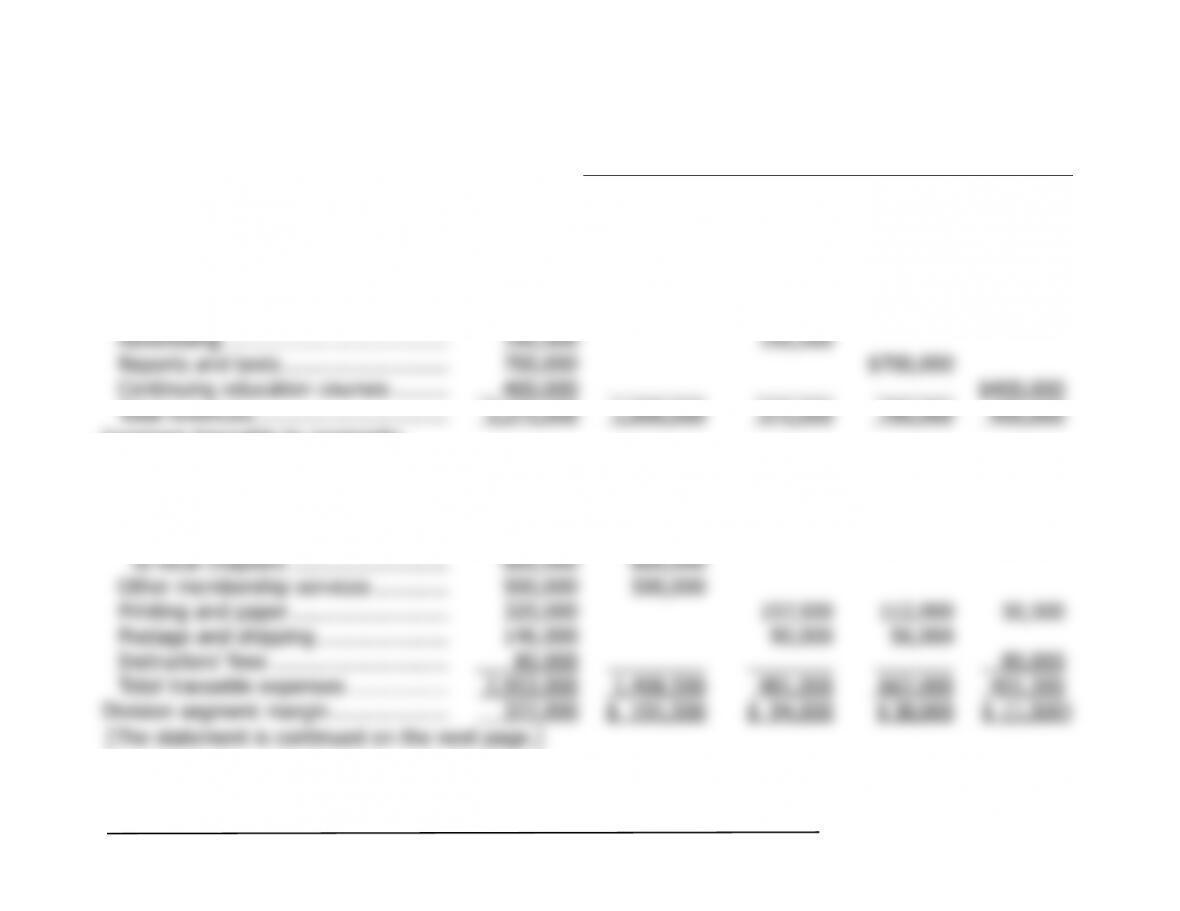
Division
Association
Total Membership
Magazine
Subscriptions
Books &
Reports
Continuing
Education
Sales:
Membership dues …………………….. $2,000,000 $1,600,000 $400,000
Non-member ma
g
azine
subscriptions ………………………… 75,000 75,000
Expenses traceable to se
g
ments:
Salaries ………………………………….. 840,000 210,000 150,000 300,000 180,000
Personnel costs ……………………….. 210,000 52,500 37,500 75,000 45,000
Occupancy costs ………………………. 257,000 46,000 46,000 119,000 46,000
Reimbursement of member costs

© The McGraw-Hill Companies, Inc., 2018. All rights reserved.
72 Managerial Accounting, 16th Edition
Case 6-30 (continued)
[Continuation of the segmented income statement.]
Division
Association
Total Membership
Magazine
Subscriptions
Books &
Reports
Continuing
Education
Division se
g
ment mar
g
in ………………. 322,000 $ 191,500 $94,000 $3
8
,000 $ (1,500)
Common expenses not traceable to divisions:
Salaries
—
corporate staff ……………. 80,000
Personnel costs ……………………….. 20,000
T
© The McGraw-Hill Companies, Inc., 2018. All rights reserved.
Solutions Manual, Appendix 6A 73
Case 6-30 (continued)
2. While we do not favor the allocation of common costs to segments, the
most common reason given for this practice is that segment managers
Arguments against allocation of all costs:
• Allocation bases will need to be chosen arbitrarily because no cause-
• Management may be misled into eliminating a profitable segment
• Segment managers usually have little control over common costs.
• Allocations of common costs undermine the credibility of performance
Appendix 6A
Super-Variable Costing
Exercise 6A-1 (10 minutes)
1. a. The unit product cost under super-variable costing would include
b. The super-variable costing income statement would be:
Sales (20,000 units × $50 per unit)……….. $1,000,000
© The McGraw-Hill Companies, Inc., 2018. All rights reserved.
Solutions Manual, Appendix 6A 75
Exercise 6A-2 (20 minutes)
1. a. The unit product cost under super-variable costing would include
b. The super-variable costing income statement would be:
Sales (52,000 units × $40 per unit)……….. $2,080,000
V
ariable cost of
g
oods sold
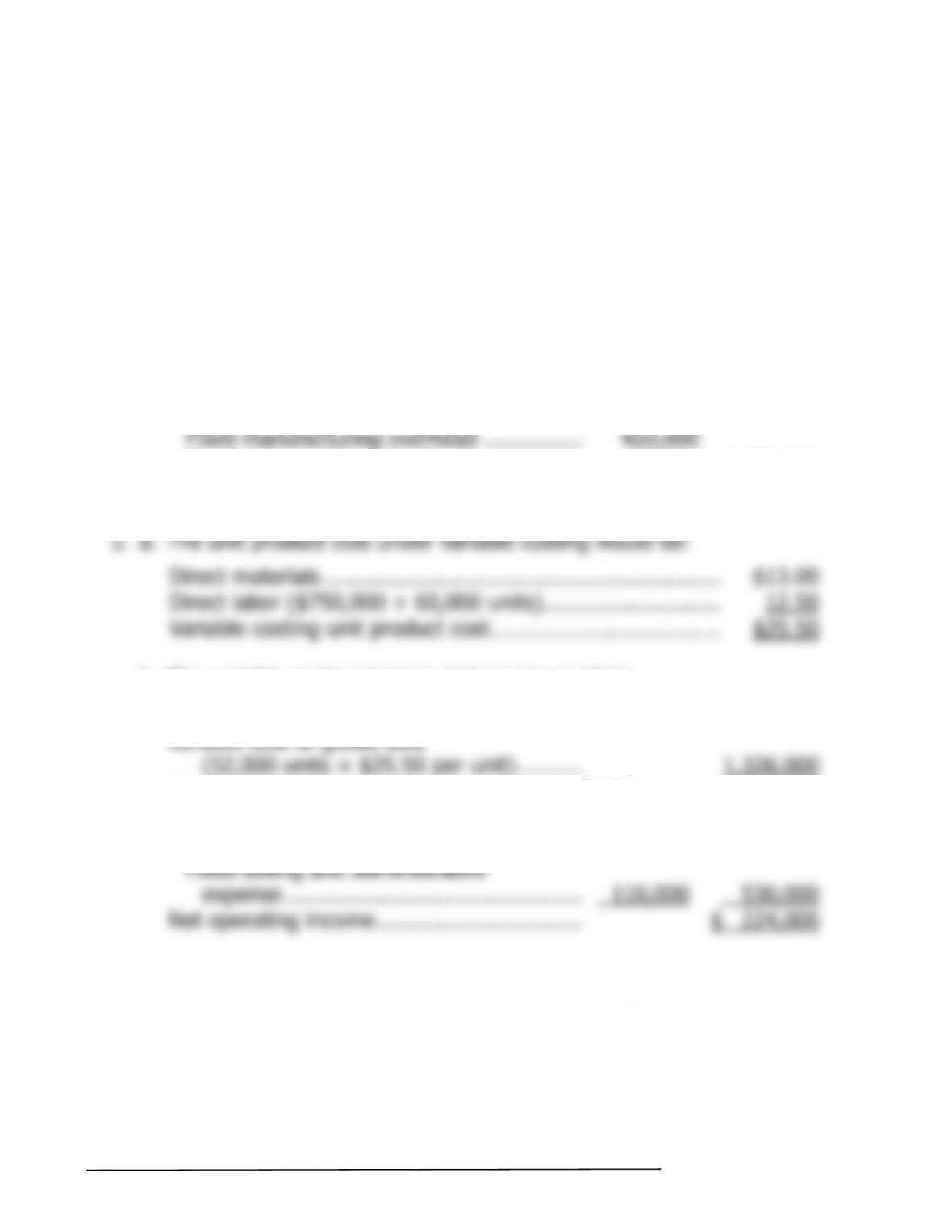
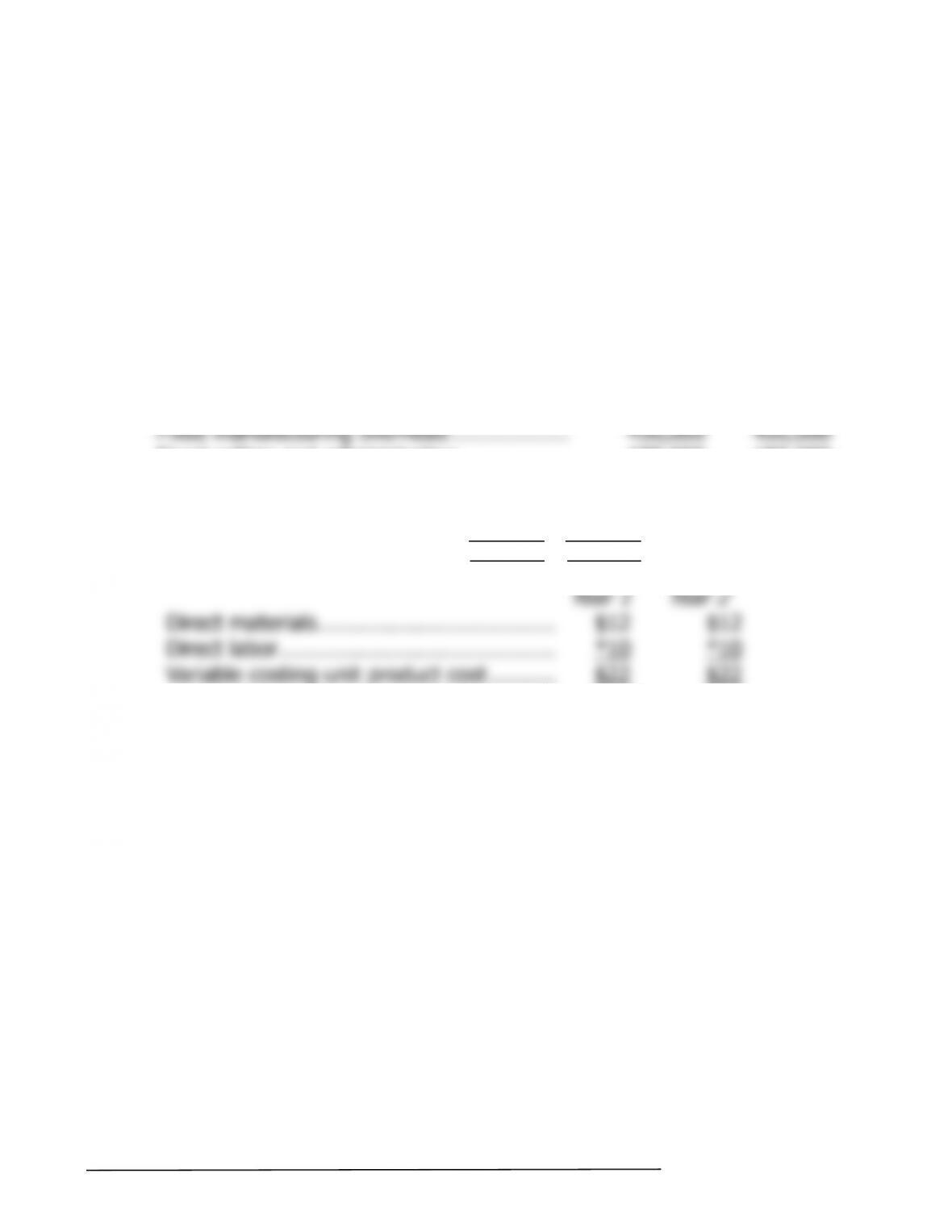
2. a. The unit product cost under variable costing would be:
Direct materials …………………………………………………… $13.00
b. The variable costing income statement would be:
Sales (52,000 units × $40 per unit)……….. $2,080,000
V
ariable cost of
g
oods sold
© The McGraw-Hill Companies, Inc., 2018. All rights reserved.
76 Managerial Accounting, 16th Edition
Exercise 6A-2 (continued)
3. The difference between the super-variable costing and variable costing
net operating incomes is explained as follows:
Units in ending inventory = Units in beginning inventory + Units
Direct labor cost deferred in (released from) inventory = Direct labor
Super-variable costin
g
net operatin
g
income ……….……. $124,000
A
dd direct labor cost deferred in inventory under
V
© The McGraw-Hill Companies, Inc., 2018. All rights reserved.
Solutions Manual, Appendix 6A 77
Exercise 6A-3 (20 minutes)
1. a. Under super-variable costing, the unit product cost for both years
1. b.
Year 1 Year 2
Sales (@ $50 per unit) ………………………….. $2,000,000 $3,000,000
V
ariable cost of
g
oods sold (@ $12 per unit) 480,000 720,000
Contribution mar
g
in …………………………….. 1,520,000 2,280,000
Fixed expenses:
T
2. a. The unit product costs under variable costing:
Y
ear
1
Y
ear
2
V