© The McGraw-Hill Companies, Inc., 2018. All rights reserved.
Solutions Manual, Chapter 6 61
Problem 6-26 (continued)
4. The following points should be brought to management’s attention:
a. Sales in the West are much lower than in the other two regions. This
b. The West is spending about half as much for advertising as the
c. The East apparently is selling a large amount of low-margin items.
d. The East appears to be overstaffed. Its salaries are about 50%
e. The East is not covering its own traceable costs. Attention should be
f. Apparently, the salespeople in all three regions are on a salary basis.
© The McGraw-Hill Companies, Inc., 2018. All rights reserved.
62 Managerial Accounting, 16th Edition
Problem 6-27 (30 minutes)
1. Because of soft demand for the Brazilian Division’s product, the
inventory should be drawn down to the minimum level of 50 units.
Drawing inventory down to the minimum level would require production
as follows during the last quarter:
Desired inventory, December 31 ………. 50 units
This plan would save inventory carrying costs such as storage (rent,
insurance), interest, and obsolescence.
The number of units scheduled for production will not affect the
reported net operating income or loss for the year if variable costing is
in use. All fixed manufacturing overhead cost will be treated as an
2. To maximize the Brazilian Division’s operating income, Mr. Cavalas could
produce as many units as storage facilities will allow. By building
inventory to the maximum level, Mr. Cavalas would be able to defer a
portion of the year’s fixed manufacturing overhead costs to future years
through the inventory account, rather than having all of these costs
appear as charges on the current year’s income statement. Building
inventory to the maximum level of 1,000 units would require production
as follows during the last quarter:
Desired inventory, December 31 …. 1,000 units
© The McGraw-Hill Companies, Inc., 2018. All rights reserved.
Solutions Manual, Chapter 6 63
Problem 6-27 (continued)
3. By setting a production schedule that will maximize his division’s net
operating income—and maximize his own bonus—Mr. Cavalas would be
acting against the best interests of the company as a whole. The extra
The company’s bonus plan undoubtedly is intended to increase the
company’s profits by increasing sales and controlling expenses. If Mr.
In sum, producing as much as possible so as to maximize the division’s
© The McGraw-Hill Companies, Inc., 2018. All rights reserved.
64 Managerial Accounting, 16th Edition
Problem 6-28 (45 minutes)
1.
Total
Company
Cook–
book
Travel
Guide
Handy
Speller
Sales ………………………………. $300,000 $90,000 $150,000 $60,000
V
ariable expenses:
Printin
g
cost …………………… 102,000 27,000 63,000 12,000
Sales commissions …………… 30,000 9,000 15,000 6,000
T
T
raceable fixed expenses:
A
dvertisin
g
…………………….. 36,000 13,500 19,500 3,000
Salaries …………………………. 33,000 18,000 9,000 6,000
T
Common fixed expenses:
General sales ………………….. 18,000
General administration ……… 42,000
—
T
* $9,000 × 30%, 50%, and 20%, respectively.
** 48,000 square feet × $3 per square foot = $144,000; $144,000 ÷ 12
© The McGraw-Hill Companies, Inc., 2018. All rights reserved.
Solutions Manual, Chapter 6 65
Problem 6-28 (continued)
2. a. No, the cookbook line should not be eliminated. The cookbook is
covering all of its own costs and is generating an $18,000 segment
b.
Coo
k
–
book
T
ravel
Guide
Handy
Speller
Contribution mar
g
in (a) ……………… $54,000 $72,000 $42,000
g
It is probably unwise to focus all available resources on promoting the
travel guide. The company is already spending more on the
promotion of this product than on the other two products combined.
Furthermore, the travel guide has the lowest contribution margin ratio
of the three products. Therefore, a dollar of sales of the travel guide
© The McGraw-Hill Companies, Inc., 2018. All rights reserved.
66 Managerial Accounting, 16th Edition
Case 6-29 (45 minutes)
1. a. Under variable costing, only the variable manufacturing costs are included in product costs.
Y
ear
1
Y
ear
2
Y
ear
3
Direct materials ……………………………… $32 $32 $32
V
V
1. b. The variable costing income statements appear below:
Y
ear 1
Y
ear 2
Y
ear 3
Sales (@ $75 per unit) …………………………………..……
.
$6,000,000 $6,750,000 $5,625,000
V
ariable expenses:
Variable cost of
g
oods sold @ $56 per unit …………….
.
4,480,000 5,040,000 4,200,000
Variable sellin
g
and administrative @ $3 per unit …….
.
240,000 270,000 225,000
T
otal variable expenses …………………………………..…..
.
4,720,000 5,310,000 4,425,000
.
T
2.a. and 2.b.
The answers to 2a and 2b are the same as 1a and 1b because the unit product costs are the same
© The McGraw-Hill Companies, Inc., 2018. All rights reserved.
Solutions Manual, Chapter 6 67
Case 6-29 (continued)
3. a. The unit product costs under absorption costing:
Y
ear
1
Ye
ar
2
Y
ear
3
Direct materials ……………………………… $32.00 $32.00 $32.00
Direct labor …………………………………… 20.00 20.00 20.00
V
ariable manufacturin
g
overhead ………. 4.00 4.00 4.00
A
3. b. The absorption costing income statements appear below (FIFO):
Y
ear
1
Y
ear
2
Y
ear
3
Sales (@ $75 per unit) ……………………… $6,000,000 $6,750,000 $5,625,000
Cost of
g
oods sold …………………………… 5,008,000 5,788,000 4,821,500
Gross mar
g
in ………………………………….. 992,000 962,000 803,500
Sellin
g
and administrative expenses
© The McGraw-Hill Companies, Inc., 2018. All rights reserved.
68 Managerial Accounting, 16th Edition
Case 6-29 (continued)
4. a. The unit product costs under absorption costing:
Y
ear
1
Y
ear
2
Y
ear
3
Direct materials ……………………………… $32.00 $32.00 $32.00
Direct labor …………………………………… 20.00 20.00 20.00
V
ariable manufacturin
g
overhead ………. 4.00 4.00 4.00
A
4. b. The absorption costing income statements appears below (LIFO):
Y
ear
1
Y
ear
2
Y
ear
3
Sales ……………………………………………. $6,000,000 $6,750,000 $5,625,000
Cost of
g
oods sold …………………………… 5,008,000 5,799,000 4,818,750
Gross mar
g
in ………………………………….. 992,000 951,000 806,250
© The McGraw-Hill Companies, Inc., 2018. All rights reserved.
Solutions Manual, Chapter 6 69
Case 6-30 (75 minutes)
1. See the segmented statement on the second following page.
Supporting computations for the statement are given below:
Sales:
Membership dues (20,000 × $100) …………………….. $2,000,000
A
ssi
g
ned to Ma
g
azine Subscriptions Division
A
g
Reports and texts (28,000 × $25) ………………………. $ 700,000
Continuin
g
education courses:
T
T
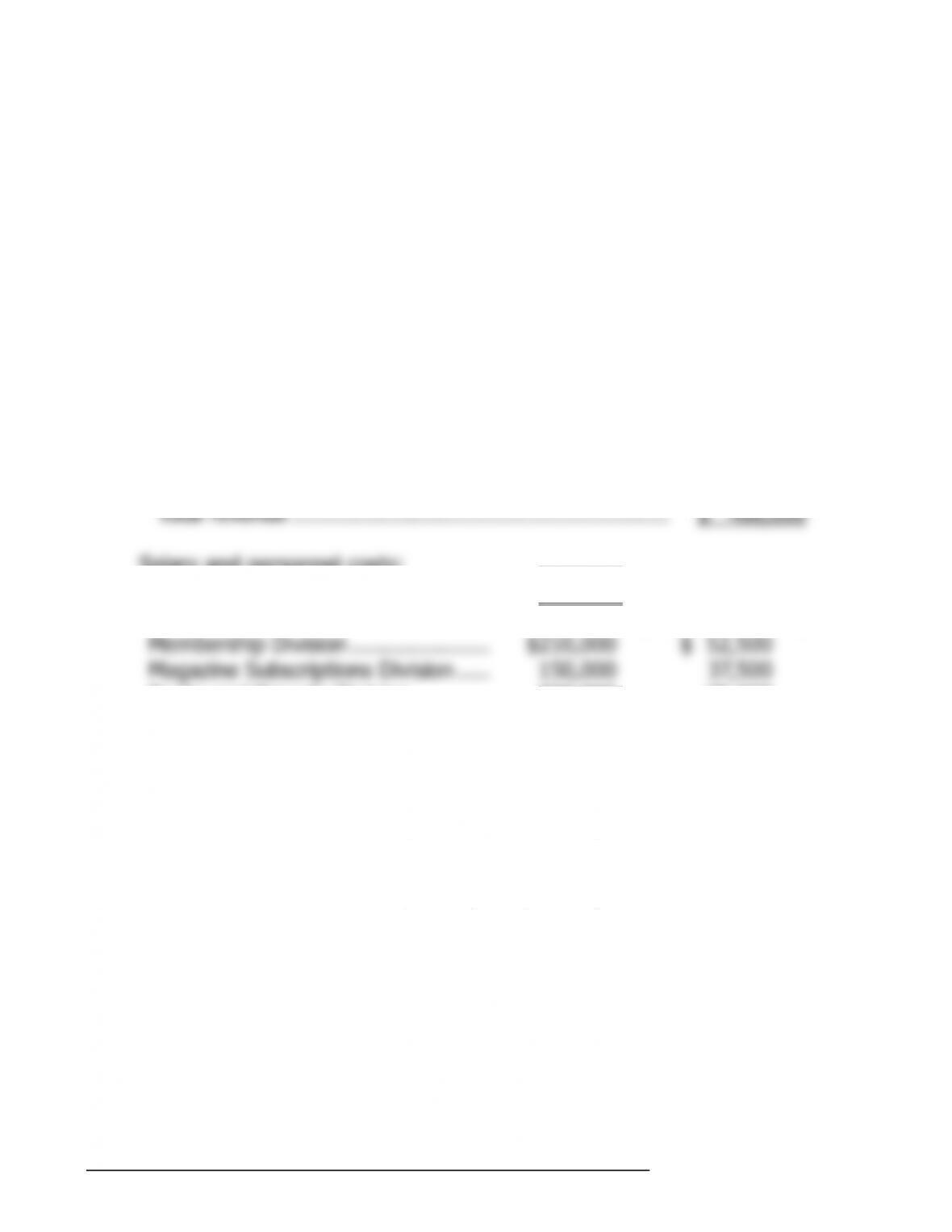
Salary and personnel costs:
Salaries
Personnel Costs
(25% of Salaries)
Membership Division ………………… $210,000 $ 52,500
Ma
g
azine Subscriptions Division ….. 150,000 37,500
Books and Reports Division………… 300,000 75,000
g
T
T
© The McGraw-Hill Companies, Inc., 2018. All rights reserved.
70 Managerial Accounting, 16th Edition
Case 6-30 (continued)
Some may argue that, except for the $50,000 in rental cost directly
attributed to the Books and Reports Division, occupancy costs are
common costs that should not be allocated. The correct treatment of
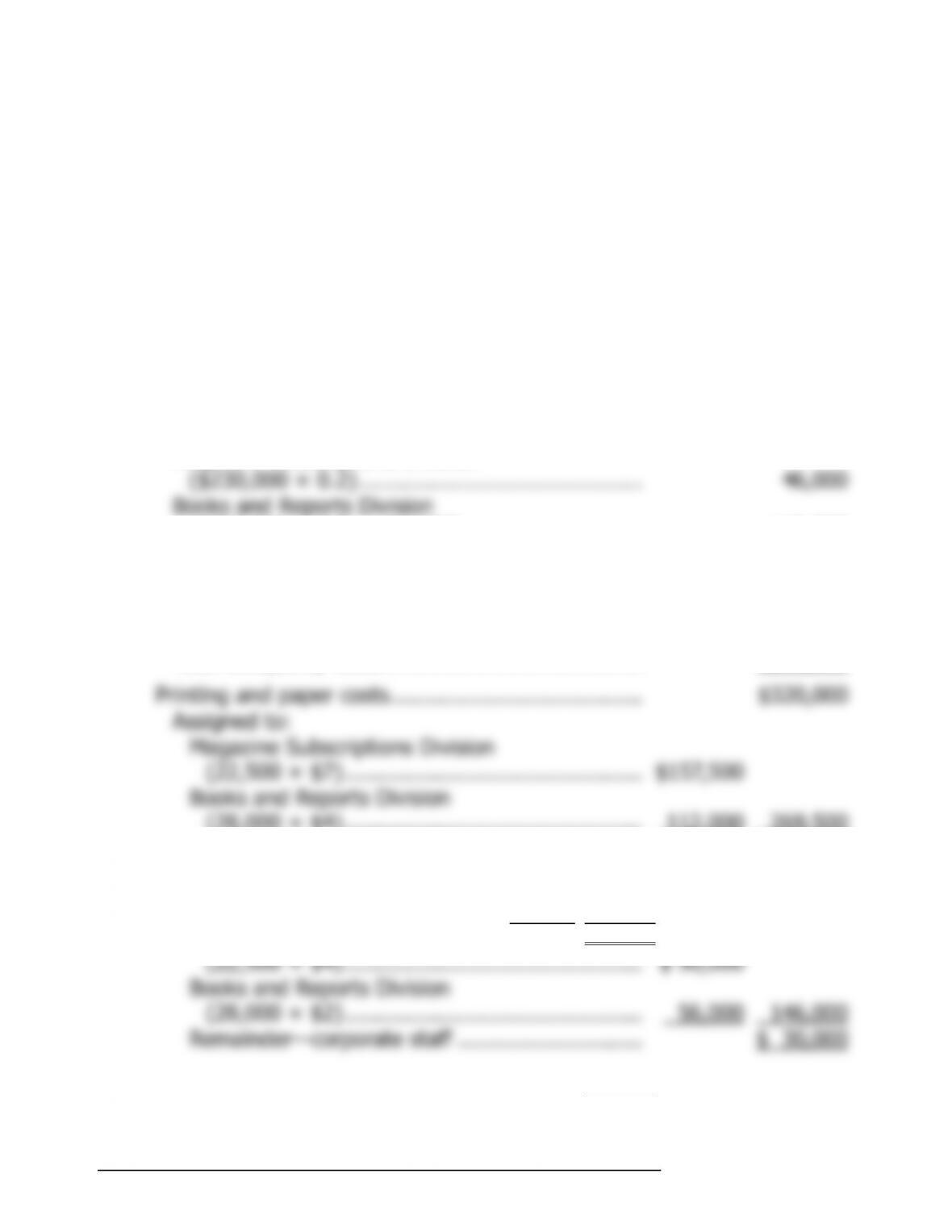
Occupancy costs ($230,000 allocated + $50,000 direct to the Books
and Reports Division = $280,000):
A
llocated to:
Membership Division
($230,000 × 0.2) ……………………………………. $ 46,000
Ma
g
azine Subscriptions Division
($230,000 × 0.2) ……………………………………. 46,000
g
T
A
ssi
g
ned to:
Ma
g
azine Subscriptions Division
(22,500 × $7) ……………………………………… $157,500
Books and Reports Division
(28,000 × $4) ……………………………………… 112,000 269,500
Remainder
—
Continuin
g
Education Division …… $ 50,500
A
g
g
—