© The McGraw-Hill Companies, Inc., 2018. All rights reserved.
Solutions Manual, Chapter 6 31
Exercise 6-13 (20 minutes)
1. The company is using variable costing. The computations are:
Variable
Costing
Absorption
Costing
Direct materials …………………….. $ 9 $ 9
Direct labor ………………………….. 10 10
2. a. No, $72,000 is not the correct figure to use because variable costing
b. The Finished Goods inventory account should be stated at $90,000,
which represents the absorption cost of the 3,000 unsold units. Thus,
the account should be increased by $18,000 for external reporting
© The McGraw-Hill Companies, Inc., 2018. All rights reserved.
32 Managerial Accounting, 16th Edition
Exercise 6-14 (30 minutes)
1. Under variable costing, only the variable manufacturing costs are
included in product costs.
Direct materials ……………………… $ 50
Direct labor …………………………… 80
2. The variable costing income statement appears below:
Sales (19,000 units × $210 per unit) …………. $3,990,000
V
ariable expenses:
Variable cost of
g
oods sold (19,000 units ×
$150 per unit) ………………………………….. $2,850,000
)
3. The break-even point in units sold can be computed using the
contribution margin per unit as follows:
Sellin
g
price per unit ………….. $210
V
ariable cost per unit …………. 160
V
V
© The McGraw-Hill Companies, Inc., 2018. All rights reserved.
Solutions Manual, Chapter 6 33
Exercise 6-15 (20 minutes)
1. Under absorption costing, all manufacturing costs (variable and fixed)
are included in product costs.
Direct materials ……………………………………. $ 50
2. The absorption costing income statement appears below:
Sales (19,000 units × $210 per unit) …………………. $3,990,000
Cost of
g
oods sold (19,000 units × $185 per unit) … 3,515,000
Gross mar
g
in ……………………………………………….. 475,000
Sellin
g
and administrative expenses
© The McGraw-Hill Companies, Inc., 2018. All rights reserved.
34 Managerial Accounting, 16th Edition
Exercise 6-16 (20 minutes)
1. The companywide break-even point is computed as follows:
Dollar sales for company
to break even = Traceable fixed expenses + Common fixed expenses
Overall CM ratio
The break-even point for the Chicago office is computed as follows:
Dollar sales for a
segment to break even = Segment traceable fixed expenses
Segment CM ratio
© The McGraw-Hill Companies, Inc., 2018. All rights reserved.
Solutions Manual, Chapter 6 35
Exercise 6-16 (continued)
The break-even point for the Minneapolis office is computed as follows:
Dollar sales for a
segment to break even = Segment traceable fixed expenses
Segment CM ratio
2. $75,000 × 40% CM ratio = $30,000 increased contribution margin in
Minneapolis. Because the fixed costs in the office and in the company as
It is not correct to multiply the $75,000 increase in sales by Minneapolis’
© The McGraw-Hill Companies, Inc., 2018. All rights reserved.
36 Managerial Accounting, 16th Edition
Exercise 6-16 (continued)
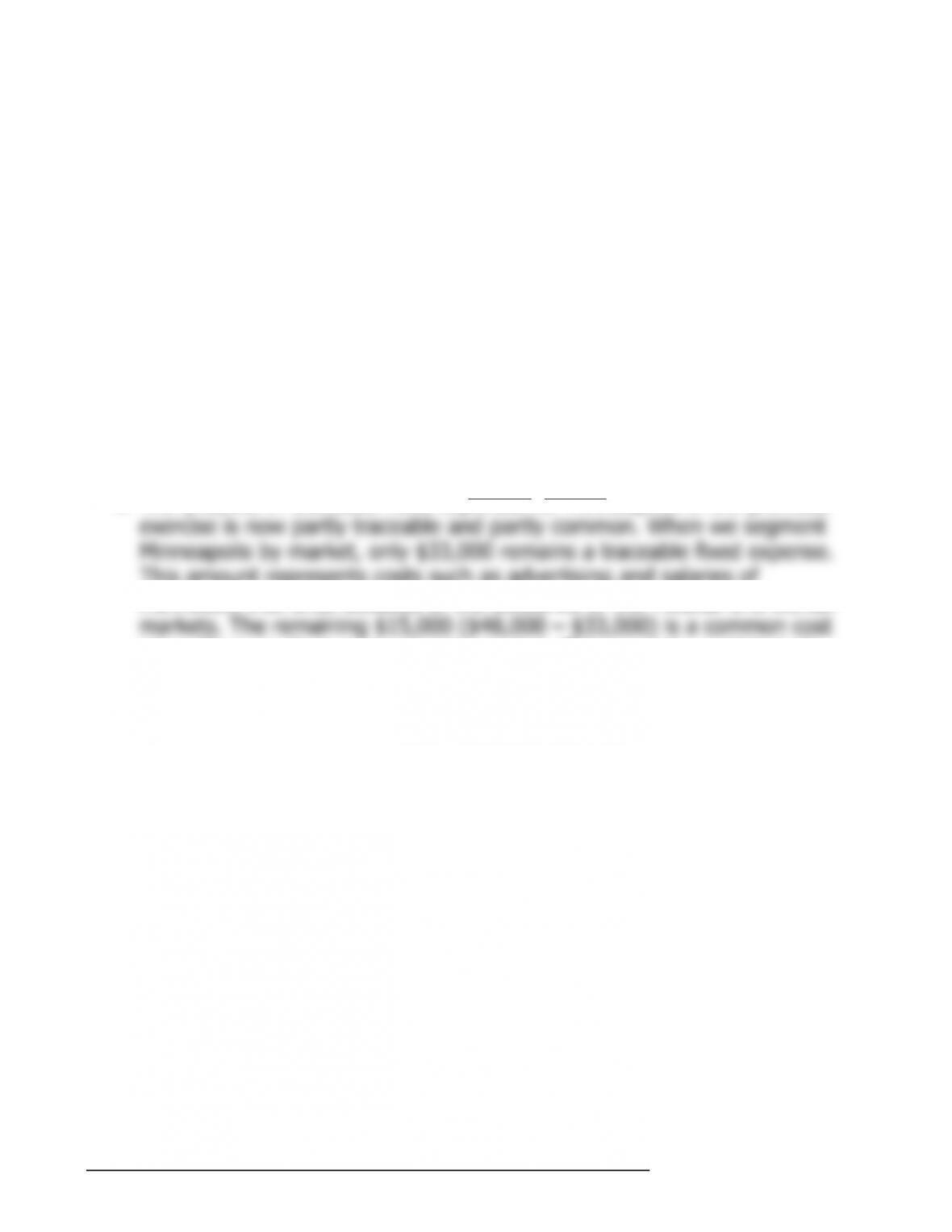
3. a. The segmented income statement follows:
Segments
Total Company Chicago
Minneapolis
Amount % Amount % Amount %
Sales ……………………. $500,000 100.0 $200,000 100 $300,000 100
V
ariable expenses ……. 240,000 48.0 60,000 30 180,000 60
Contribution mar
g
in …. 260,000 52.0 140,000 70 120,000 40
T
raceable fixed
b. The segment margin ratio rises and falls as sales rise and fall due to
In contrast to the segment ratio, the contribution margin ratio for a
© The McGraw-Hill Companies, Inc., 2018. All rights reserved.
Solutions Manual, Chapter 6 37
Exercise 6-17 (15 minutes)
1. and 2. The profit impacts in both markets are as follows:
Medical Dental
Increased sales ……………………………..……… $40,000 $35,000
Market CM ratio ……………………………………. × 36% × 48%
4. The $48,000 in traceable fixed expenses for Minneapolis in the previous
exercise is now partly traceable and partly common. When we segment
Minneapolis by market, only $33,000 remains a traceable fixed expense.
This amount represents costs such as advertising and salaries of
© The McGraw-Hill Companies, Inc., 2018. All rights reserved.
38 Managerial Accounting, 16th Edition
Problem 6-18 (45 minutes)
1. The break-even point in units sold can be computed using the
contribution margin per unit as follows:
Break-even unit sales = Fixed expenses ÷ Unit contribution margin
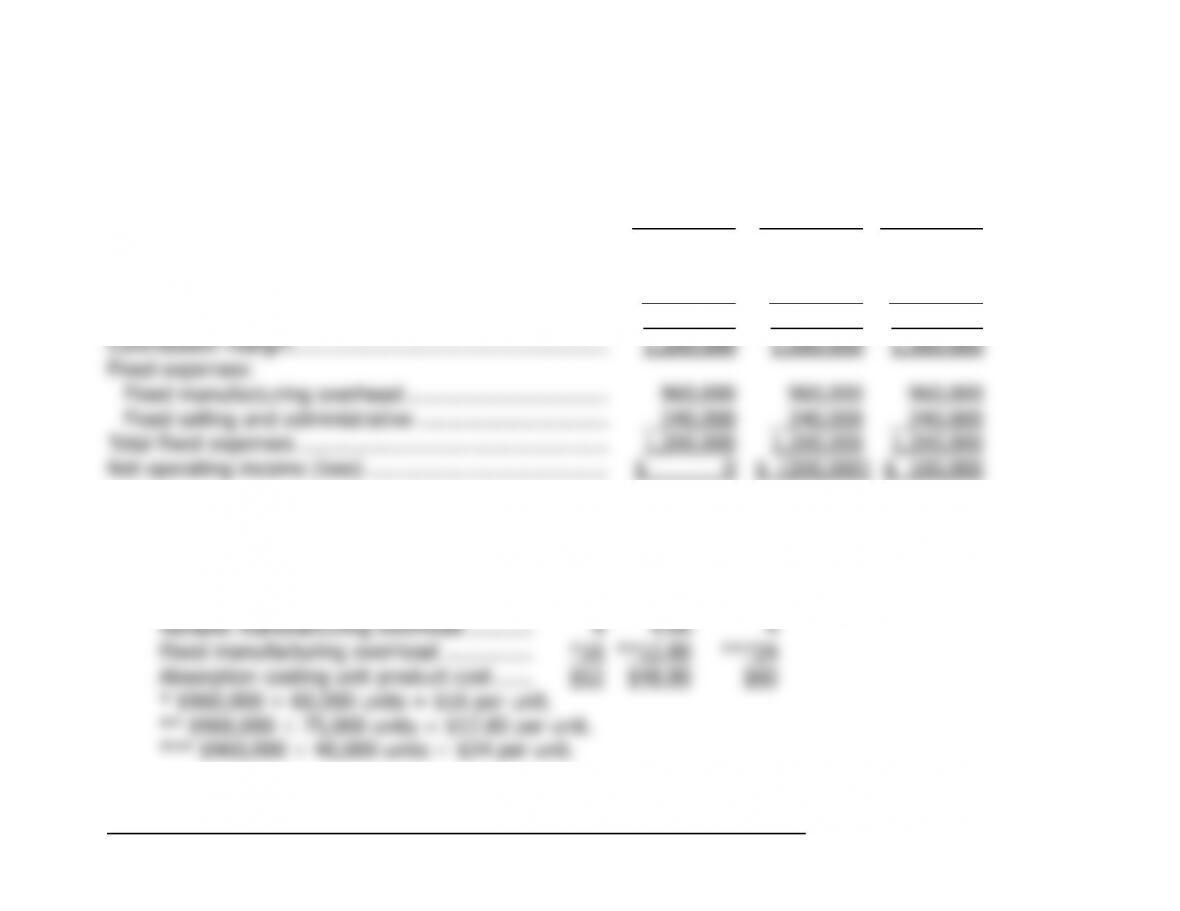
2. a. Under variable costing, only the variable manufacturing costs are
included in product costs.
Y
ear
1
Y
ear
2
Y
ear
3
Direct materials ……………………………… $20 $20 $20
Direct labor …………………………………… 12 12 12
© The McGraw-Hill Companies, Inc., 2018. All rights reserved.
Solutions Manual, Chapter 6 39
Problem 6-18 (continued)
2. b. The variable costing income statements appear below:
Y
ear
1
Y
ear
2
Y
ear
3
Sales (@ $58 per unit) ………………………………………. $3,480,000 $2,900,000 $3,770,000
V
ariable expenses:
Variable cost of
g
oods sold @ $36 per unit ………….. 2,160,000 1,800,000 2,340,000
Variable sellin
g
and administrative @ $2 per unit…… 120,000 100,000 130,000
T
otal variable expenses ………………………………….….. 2,280,000 1,900,000 2,470,000
T
3. a. The unit product costs under absorption costing:
Y
ear
1
Y
ear
2
Y
ear
3
Direct materials ……………………………… $20 $20.00 $20
Direct labor …………………………………… 12 12.00 12
V
A
© The McGraw-Hill Companies, Inc., 2018. All rights reserved.
40 Managerial Accounting, 16th Edition
Problem 6-18 (continued)
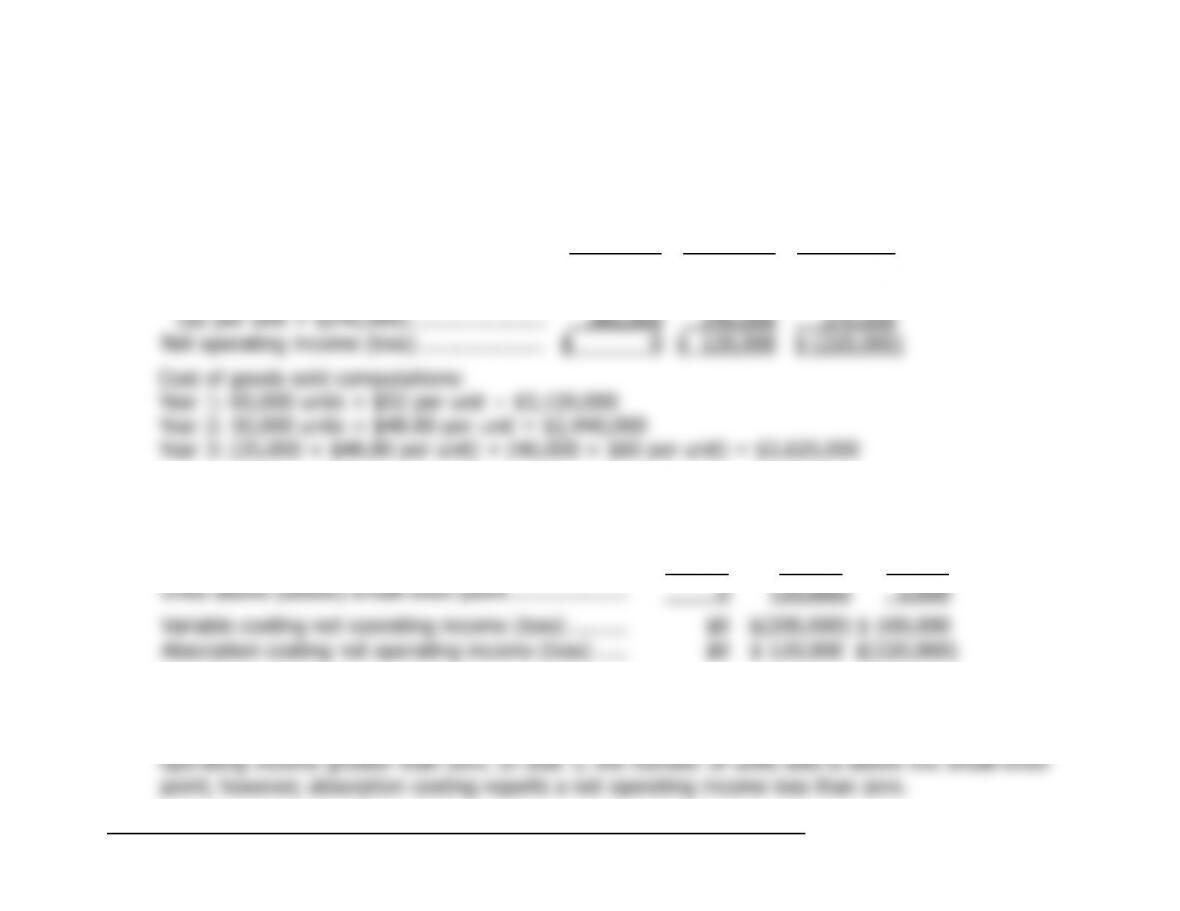
3. b. The absorption costing income statements appears below:
Y
ear
1
Y
ear
2
Y
ear
3
Sales ……………………………………………. $3,480,000 $2,900,000 $3,770,000
Cost of
g
oods sold …………………………… 3,120,000 2,440,000 3,620,000
Gross mar
g
in ………………………………….. 360,000 460,000 150,000
Sellin
g
and administrative expenses
4.
Y
ear
1
Y
ear
2
Y
ear
3
Units sold …………………………………………….……. 60,000 50,000 65,000
Break-even point in units ………………………………. 60,000 60,000 60,000
The absorption costing net operating incomes in years 2 and 3 are counterintuitive. In year 2, the
number of units sold is below the break-even point; however, absorption costing reports a net