
© The McGraw-Hill Companies, Inc., 2018. All rights reserved.
Solutions Manual, Chapter 6 21
Exercise 6-5 (continued)
3. The break-even point for the South region is computed as follows:
Dollar sales for a
segment to break even = Segment traceable fixed expenses
Segment CM ratio
© The McGraw-Hill Companies, Inc., 2018. All rights reserved.
22 Managerial Accounting, 16th Edition
Exercise 6-6 (30 minutes)
1. a. The unit product cost under absorption costing would be:
Direct materials …………………………………………………… $ 6
Direct labor ………………………………………….…………….. 9
A
b. The absorption costing income statement:
Sales (20,000 units × $50 per unit)…………………….. $1,000,000
Cost of
g
oods sold (20,000 units × $30 per unit)……. 600,000
2. a. The unit product cost under variable costing would be:
Direct materials ……………………… $ 6
V
V
b. The variable costing income statement:
Sales (20,000 units × $50 per unit)……….. $1,000,000
V
ariable expenses:
Variable cost of
g
oods sold
V
T
© The McGraw-Hill Companies, Inc., 2018. All rights reserved.
Solutions Manual, Chapter 6 23
Exercise 6-7 (10 minutes)
The completed segmented income statement should appear as follows:
Divisions
Total Company North South
Amount % Amount % Amount %
Sales ………………………………………. $500,000 100.0 $300,000 100.0 $200,000 100.0
V
ariable expenses ………………………. 270,000 54.0 150,000 50.0 120,000 60.0
T
T

© The McGraw-Hill Companies, Inc., 2018. All rights reserved.
24 Managerial Accounting, 16th Edition
Exercise 6-8 (10 minutes)
Sales were above the company’s break-even sales and yet the company
sustained a loss. The apparent contradiction is explained by the fact that
the CVP analysis is based on variable costing, whereas the income reported
to shareholders is prepared using absorption costing. Because sales were
above the break-even point, the variable costing net operating income
© The McGraw-Hill Companies, Inc., 2018. All rights reserved.
Solutions Manual, Chapter 6 25
Exercise 6-9 (30 minutes)
1. a. Under variable costing, only the variable manufacturing costs are
included in product costs.
Y
ear
1
Y
ear
2
Direct materials ……………………………… $25 $25
Direct labor …………………………………… 15 15
V
g
V
1. b.
Year 1 Year 2
Sales ………………………………………………… $2,400,000 $3,000,000
V
ariable expenses:
Variable cost of
g
oods sold @ $45 per unit 1,800,000 2,250,000
Variable sellin
g
and administrative @ $2
per unit ………………………………………… 80,000 100,000
T
T
2. a. The unit product costs under absorption costing:
Y
ear
1
Y
ear
2
Direct materials ……………………………… $25 $25.00
Direct labor …………………………………… 15 15.00
V
ariable manufacturin
g
overhead ………. 5 5.00
A
© The McGraw-Hill Companies, Inc., 2018. All rights reserved.
26 Managerial Accounting, 16th Edition
Exercise 6-9 (continued)
2. b. The absorption costing income statements appears below:
Y
ear
1
Y
ear
2
Sales (see requirement 1(b)) ……………… $2,400,000 $3,000,000
Cost of
g
oods sold …………………………… *2,000,000 **2,550,000
Gross mar
g
in ………………………………….. 400,000 450,000
3. The net operating incomes are reconciled as follows:
Y
ear
1
Y
ear
2
Units in be
g
innin
g
inventory…………………… 0 10,000
+ Units produced ………………………………… 50,000 40,000
Y
ear
1
Y
ear
2
Fixed manufacturin
g
overhead in endin
g
inventory (10,000 units × $5 per unit) .….. $50,000 $ 0
Deduct: Fixed manufacturin
g
overhead in
beginning inventory (10,000 units × $5
Y
ear
1
Y
ear
2
V
ariable costin
g
net operatin
g
income ……… $190,000 $320,000
A
dd: Fixed manufacturin
g
overhead cost
deferred in inventory under absorption
© The McGraw-Hill Companies, Inc., 2018. All rights reserved.
Solutions Manual, Chapter 6 27
Exercise 6-10 (20 minutes)
1. The companywide break-even point is computed as follows:
Dollar sales for company
to break even = Traceable fixed expenses + Common fixed expenses
Overall CM ratio
2. The break-even point for the East region is computed as follows:
Dollar sales for a
segment to break even = Segment traceable fixed expenses
Segment CM ratio
© The McGraw-Hill Companies, Inc., 2018. All rights reserved.
28 Managerial Accounting, 16th Edition
Exercise 6-10 (continued)
3. The break-even point for the West region is computed as follows:
Dollar sales for a
segment to break even = Segment traceable fixed expenses
Segment CM ratio
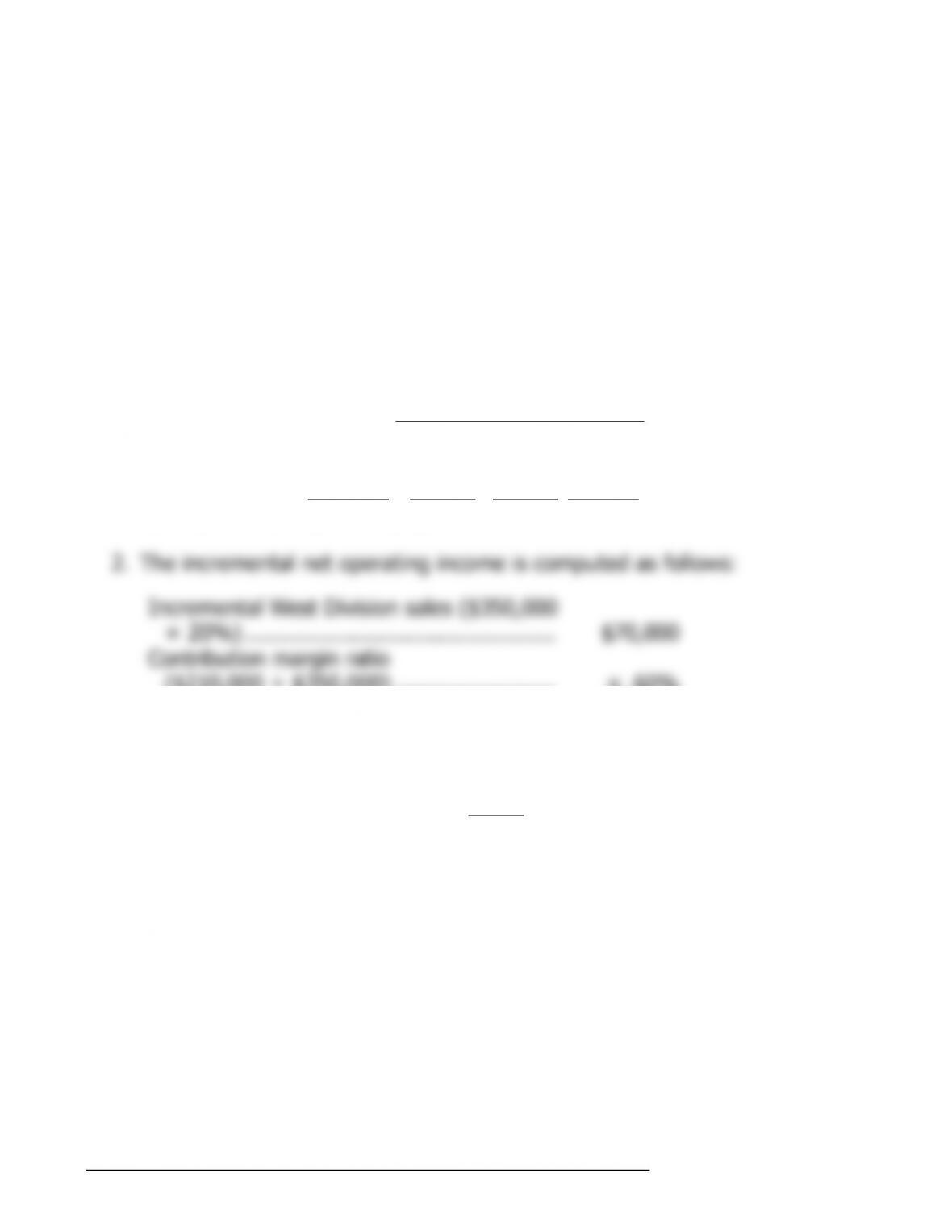
4. The new segmented income statement is computed as follows:
T
ota
l
Company East West
Sales ……………………………… $510,000 $250,000 $260,000
V
ariable expenses* ………..….. 369,000 200,000 169,000
T
* East: $250,000 × 0.80 variable expense ratio = $200,000.
West: $260,000 × 0.65 variable expense ratio = $169,000.
5. No, a company should not allocate its common fixed expenses to
© The McGraw-Hill Companies, Inc., 2018. All rights reserved.
Solutions Manual, Chapter 6 29
Exercise 6-11 (20 minutes)
1.
Divisio
n
T
otal
Company East Central West
Sales ……………………….. $1,000,000 $250,000 $400,000 $350,000
V
ariable expenses ……….. 390,000 130,000 120,000 140,000
Contribution mar
g
in …….. 610,000 120,000 280,000 210,000
T
2. The incremental net operating income is computed as follows:
Incremental West Division sales ($350,000
× 20%) ……………………………………..… $70,000
Contribution mar
g
in ratio
($210,000 ÷ $350,000) …………………… × 60%
© The McGraw-Hill Companies, Inc., 2018. All rights reserved.
30 Managerial Accounting, 16th Edition
Exercise 6-12 (20 minutes)
1. Sales (35,000 units × $25 per unit) …………… $875,000
V
ariable expenses:
Variable cost of
g
oods sold
(35,000 units × $12 per unit*) …………….. $420,000
Variable sellin
g
and administrative expenses
(35,000 units × $2 per unit) ……………….. 70,000 490,000
Contribution mar
g
in ………………………………. 385,000
Fixed expenses:
T
2. The difference in net operating income can be explained by the $20,000
in fixed manufacturing overhead deferred in inventory under the
absorption costing method:
Units in ending inventory = Units in beginning inventory + Units
Manufacturing overhead deferred in (released from) inventory = Fixed
manufacturing overhead in ending inventory – Fixed manufacturing
V
ariable costin
g
net operatin
g
income………………….. $15,000
A
dd fixed manufacturin
g
overhead cost deferred in
A
V