© The McGraw-Hill Companies, Inc., 2018. All rights reserved.
Solutions Manual, Chapter 6 11
The Foundational 15
1. and 2.
The unit product costs under variable costing and absorption costing are
computed as follows:
Variable
Costing
Absorption
Costing
Direct materials……………………….. $24 $24
Direct labor ……………………………. 14 14
V
3. and 4.
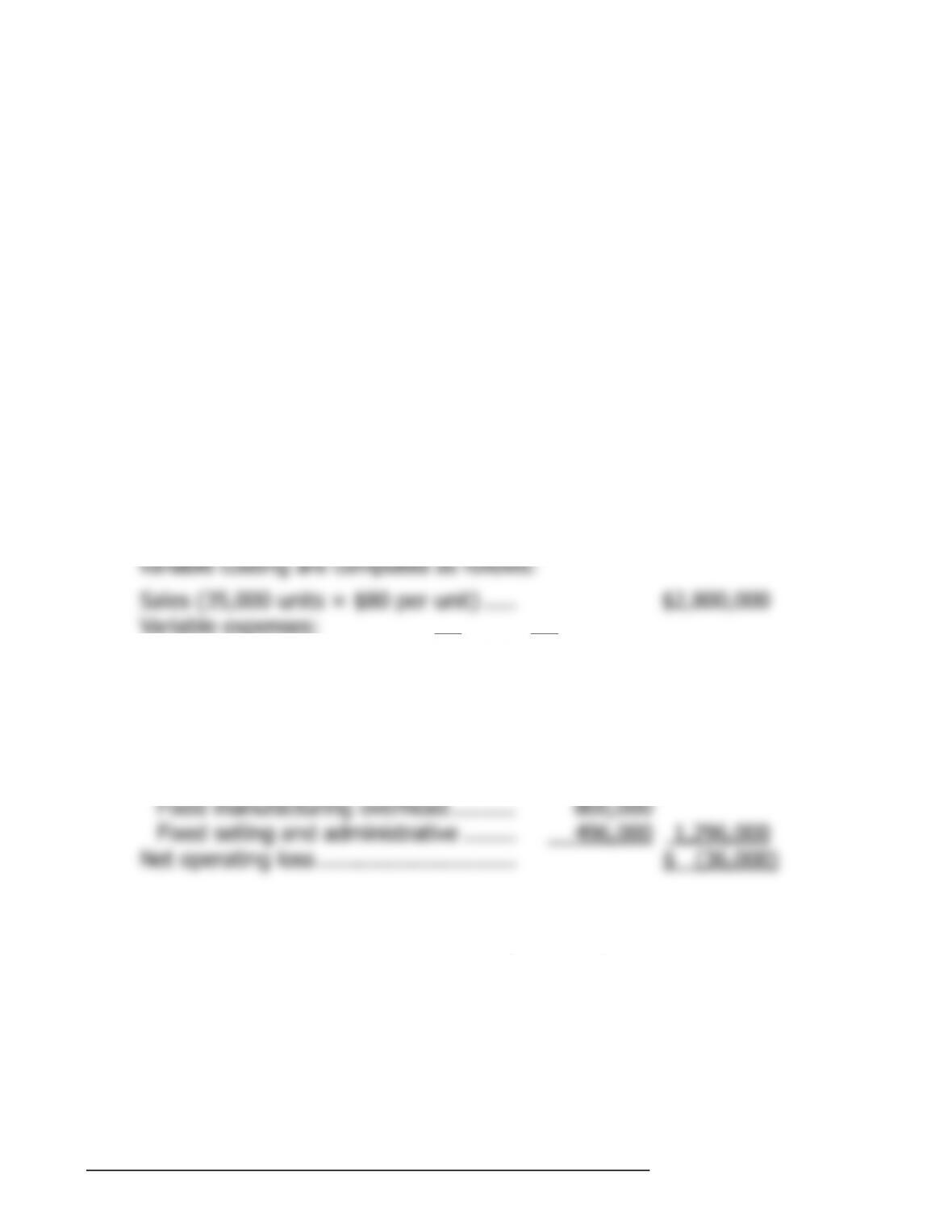
The total contribution margin and net operating income (loss) under
variable costing are computed as follows:
Sales (35,000 units × $80 per unit) ….. $2,800,000
V
ariable expenses:
Variable cost of
g
oods sold
© The McGraw-Hill Companies, Inc., 2018. All rights reserved.
12 Managerial Accounting, 16th Edition
The Foundational 15 (continued)
5. and 6.
The total gross margin and net operating income under absorption
costing are computed as follows:
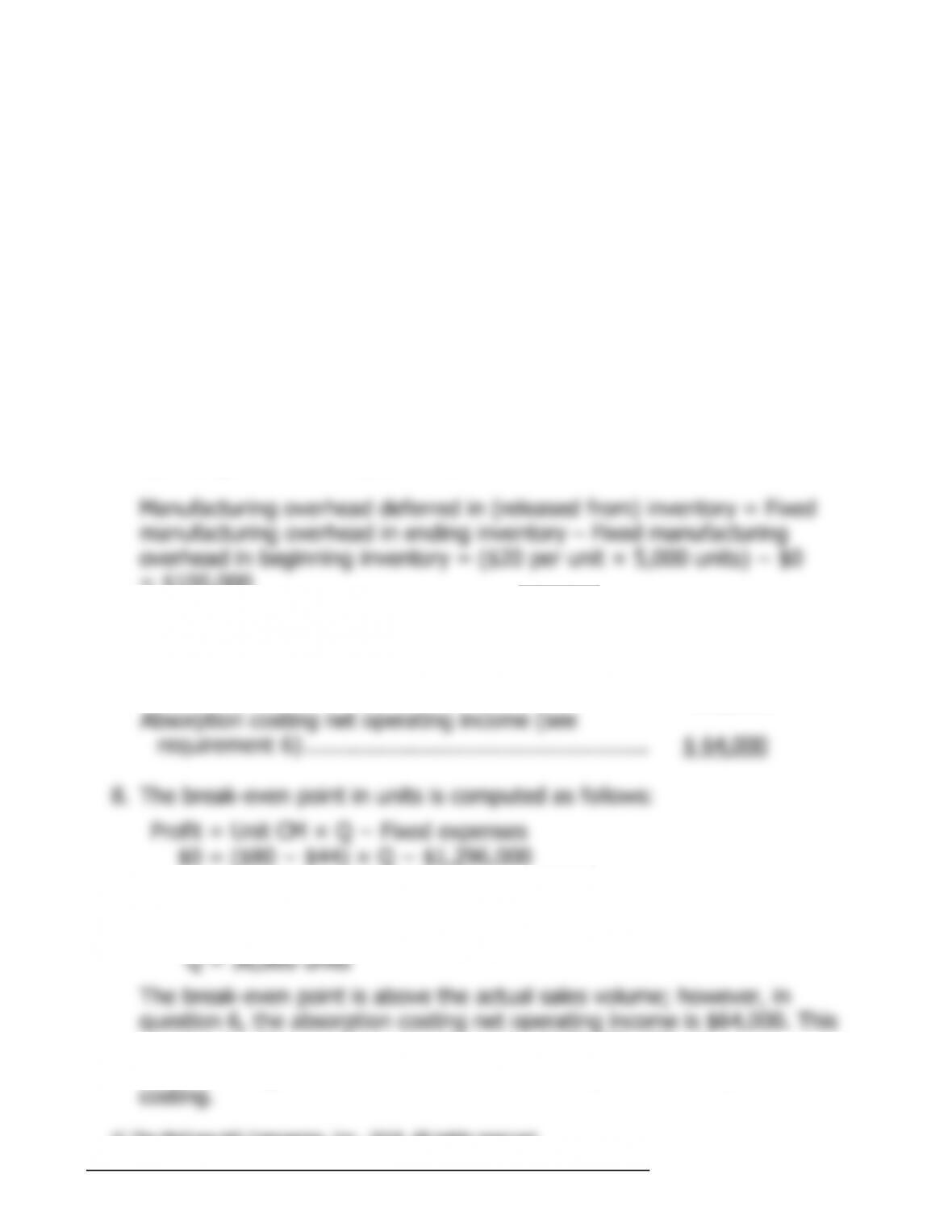
7. The difference between the absorption and variable costing net
operating incomes is explained as follows:
Manufacturing overhead deferred in (released from) inventory = Fixed
manufacturing overhead in ending inventory – Fixed manufacturing
8. The break-even point in units is computed as follows:
Profit = Unit CM × Q − Fixed expenses
$0 = ($80 − $44) × Q − $1,296,000
The break-even point is above the actual sales volume; however, in
question 6, the absorption costing net operating income is $64,000. This
© The McGraw-Hill Companies, Inc., 2018. All rights reserved.
Solutions Manual, Chapter 6 13
The Foundational 15 (continued)
9. The break-even point of 36,000 units would remain the same. This
occurs because the contribution margin per unit is the same regardless
10. and 11.
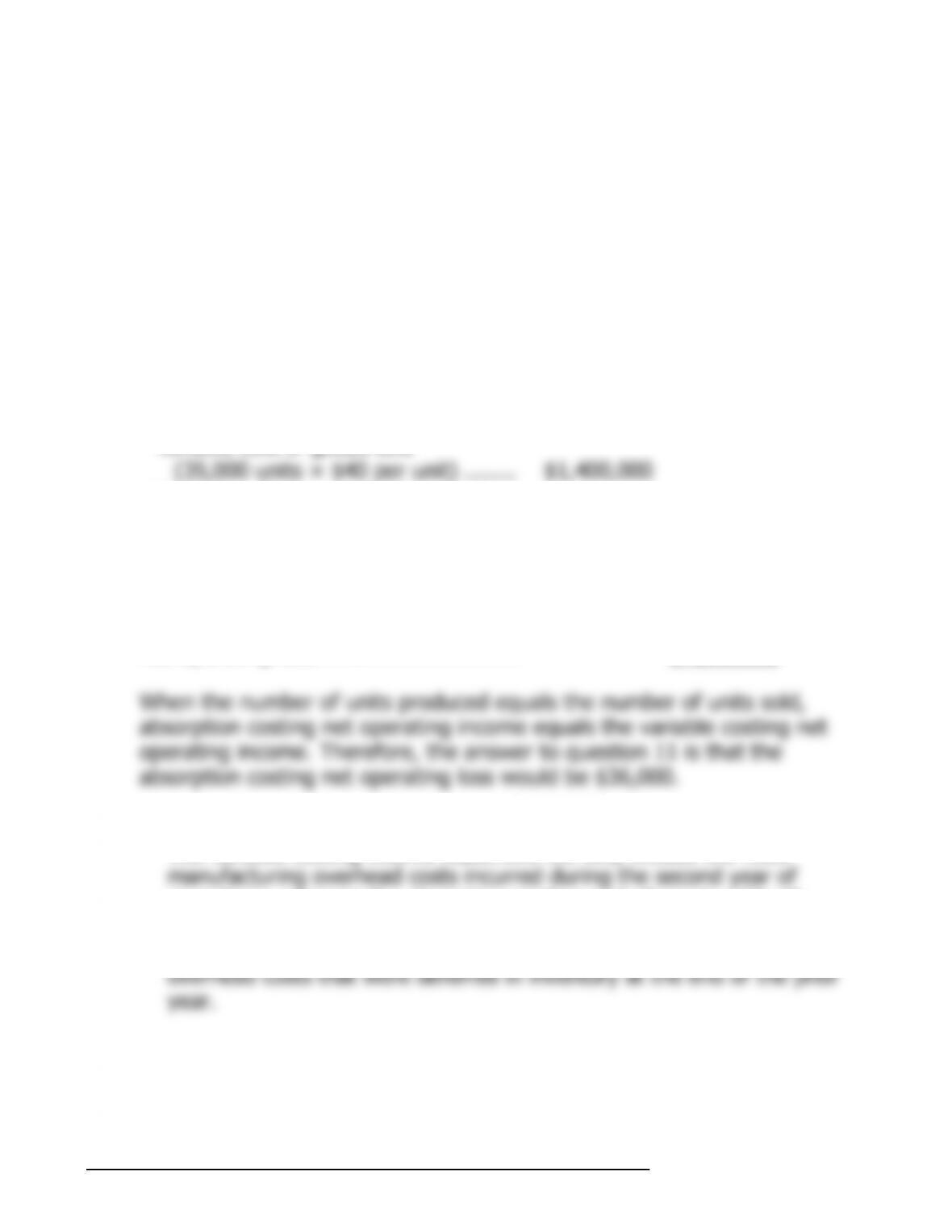
The variable costing net operating income would be the same as the
answer to question 4 as shown below:
Sales …………………………………………. $2,800,000
V
ariable expenses:
Variable cost of
g
oods sold
(35,000 units × $40 per unit) …….. $1,400,000
When the number of units produced equals the number of units sold,
absorption costing net operating income equals the variable costing net
12. Absorption costing income will be lower than variable costing income.
The variable costing income statement will only include the fixed
manufacturing overhead costs incurred during the second year of
© The McGraw-Hill Companies, Inc., 2018. All rights reserved.
14 Managerial Accounting, 16th Edition
The Foundational 15 (continued)
13. The segment margins for the East and West regions are computed as
follows:
T
ota
l
Company East West
Sales* ……………………………….. $2,800,000 $2,000,000 $800,000
V
ariable expenses** ……………… 1,540,000 1,100,000 440,000
Contribution mar
g
in ……………… 1,260,000 900,000 360,000
T
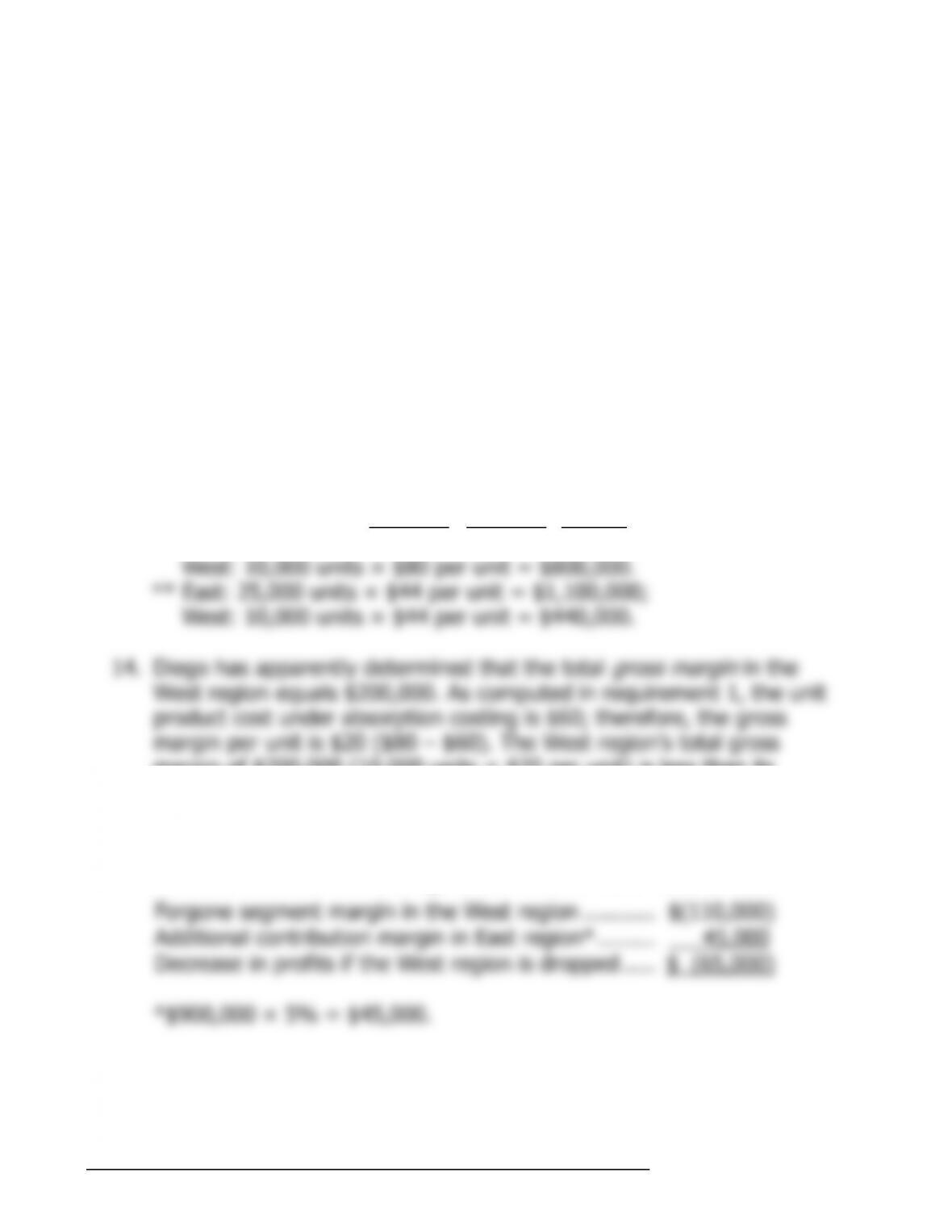
14. Diego has apparently determined that the total
gross margin
in the
West region equals $200,000. As computed in requirement 1, the unit
product cost under absorption costing is $60; therefore, the gross
margin per unit is $20 ($80 – $60). The West region’s total gross
margin of $200,000 (10,000 units × $20 per unit) is less than its
A

© The McGraw-Hill Companies, Inc., 2018. All rights reserved.
Solutions Manual, Chapter 6 15
The Foundational 15 (continued)
15. The profit impact is computed as follows:
A
dditional advertisin
g
……………………………………..
.
$(30,000)
A
© The McGraw-Hill Companies, Inc., 2018. All rights reserved.
16 Managerial Accounting, 16th Edition
Exercise 6-1 (15 minutes)
1. Under absorption costing, all manufacturing costs (variable and fixed)
are included in product costs.
Direct materials …………………………………………………. $100
Direct labor ………………………………………….…………… 320
2. Under variable costing, only the variable manufacturing costs are
included in product costs.
Direct materials …………………………………………………. $100
Direct labor ………………………………………….…………… 320
© The McGraw-Hill Companies, Inc., 2018. All rights reserved.
Solutions Manual, Chapter 6 17
Exercise 6-2 (20 minutes)
1. Fixed manufacturing overhead cost deferred in inventory = 25 units in
2. The variable costing income statement appears below:
Sales ………………………………………………….. $191,250
V
ariable expenses:
Variable cost of
g
oods sold
(225 units sold × $460* per unit) …………. $103,500
Variable selling and administrative expenses
* Variable cost of
g
oods sold per unit:
Direct materials ……………………………………….. $100
Direct labor …………………………………………….. 320
The difference in net operating income between variable and absorption
costing can be explained by the deferral of fixed manufacturing
overhead cost in inventory that has taken place under the absorption
© The McGraw-Hill Companies, Inc., 2018. All rights reserved.
18 Managerial Accounting, 16th Edition
Exercise 6-3 (20 minutes)
1.
Y
ear
1
Y
ear
2
Y
ear
3
Be
g
innin
g
inventories ………. 200 170 180
Fixed manufacturin
g
overhead in ending
inventories (@$560 per
Fixed manufacturin
g
overhead in beginning
Fixed manufacturin
g
overhead deferred in
(released from)
V
ariable costin
g
net
A
A
dd (deduct) fixed
manufacturing overhead
cost deferred in (released
2a. and 2b.
Because absorption costing net operating income was greater than
variable costing net operating income in Year 4, inventories must have
increased during the year and, hence, fixed manufacturing overhead
© The McGraw-Hill Companies, Inc., 2018. All rights reserved.
Solutions Manual, Chapter 6 19
Exercise 6-4 (10 minutes)
T
ota
l
Company Weedban Greengrow
Sales* ……………………………. $300,000 $90,000 $210,000
V
ariable expenses** ………….. 183,000 36,000 147,000
T
* Weedban: 15,000 units × $6.00 per unit = $90,000.
Greengrow: 28,000 units × $7.50 per unit = $210,000.
© The McGraw-Hill Companies, Inc., 2018. All rights reserved.
20 Managerial Accounting, 16th Edition
Exercise 6-5 (10 minutes)
1. The companywide break-even point is computed as follows:
Dollar sales for company
to break even = Traceable fixed expenses + Common fixed expenses
Overall CM ratio
=
$120,000 + $50,000
2. The break-even point for the North region is computed as follows:
Dollar sales for a
segment to break even = Segment traceable fixed expenses
Segment CM ratio