© The McGraw-Hill Companies, Inc., 2018. All rights reserved.
Solutions Manual, Chapter 6 1
Chapter 6
Variable Costing and Segment Reporting:
Tools for Management
Solutions to Questions
6-1 Absorption and variable costing differ in
how they handle fixed manufacturing overhead.
Under absorption costing, fixed manufacturing
manufacturing overhead costs are included in
product costs, along with direct materials, direct
labor, and variable manufacturing overhead. If
some of the units are not sold by the end of the
costs with revenues than variable costing. They
argue that all manufacturing costs must be
6-5 Advocates of variable costing argue that
one say that these costs are part of the costs of
the products? These costs are incurred to have
the capacity to make products during a
particular period and should be charged against
absorption and variable costing. When
6-7 If production exceeds sales, absorption
costing will usually show higher net operating
income than variable costing. When production
6-8 If fixed manufacturing overhead cost is
the level of production without any increase in
sales. If production exceeds sales, units of
© The McGraw-Hill Companies, Inc., 2018. All rights reserved.
2 Managerial Accounting, 16th Edition
6-10 Differences in reported net operating
income between absorption and variable costing
arise because of changing levels of inventory. In
Lean Production, goods are produced strictly to
6-11 A segment is any part or activity of an
organization about which a manager seeks cost,
6-13 A traceable fixed cost of a segment is a
cost that arises specifically because of the
existence of that segment. If the segment were
eliminated, the cost would disappear. A common
costs of a department would include the salary
of the department’s supervisor and depreciation
of machines used exclusively by the department.
Examples of common fixed costs would include
building, corporate image advertising, and
6-14 The contribution margin is the difference
between sales revenue and variable expenses.
The segment margin is the amount remaining
after deducting traceable fixed expenses from
6-15 If common fixed costs were allocated to
segments, then the costs of segments would be
overstated and their margins would be
6-16 There are often limits to how far down
an organization a cost can be traced. Therefore,
fixed costs that are traceable to a segment may
become common as that segment is divided into
6-17 No, a company should not allocate its
common fixed costs to business segments.
These costs are not traceable to individual
© The McGraw-Hill Companies, Inc., 2018. All rights reserved.
Solutions Manual, Chapter 6 3
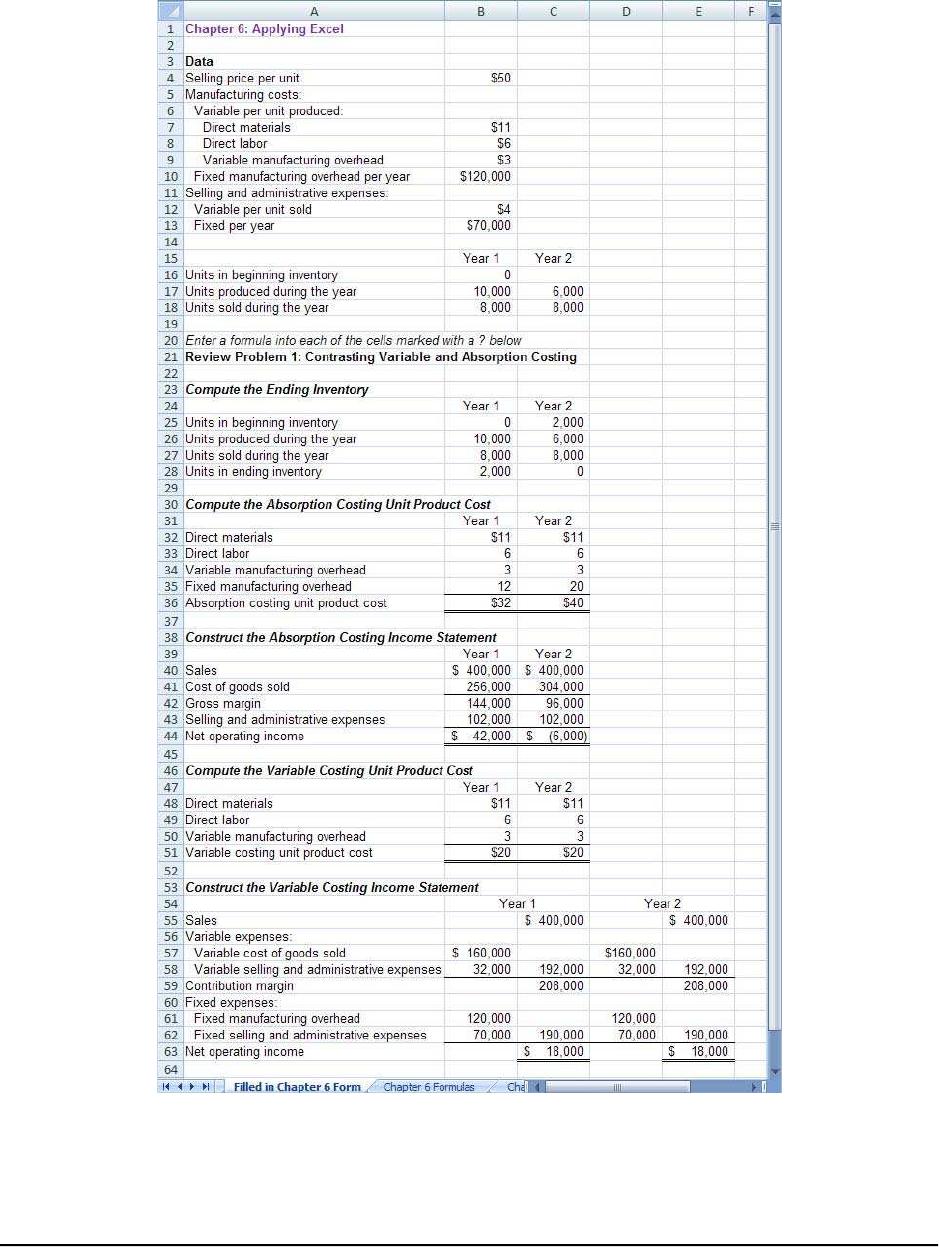
Chapter 6: Applying Excel
The completed worksheet is shown below.
© The McGraw-Hill Companies, Inc., 2018. All rights reserved.
4 Managerial Accounting, 16th Edition
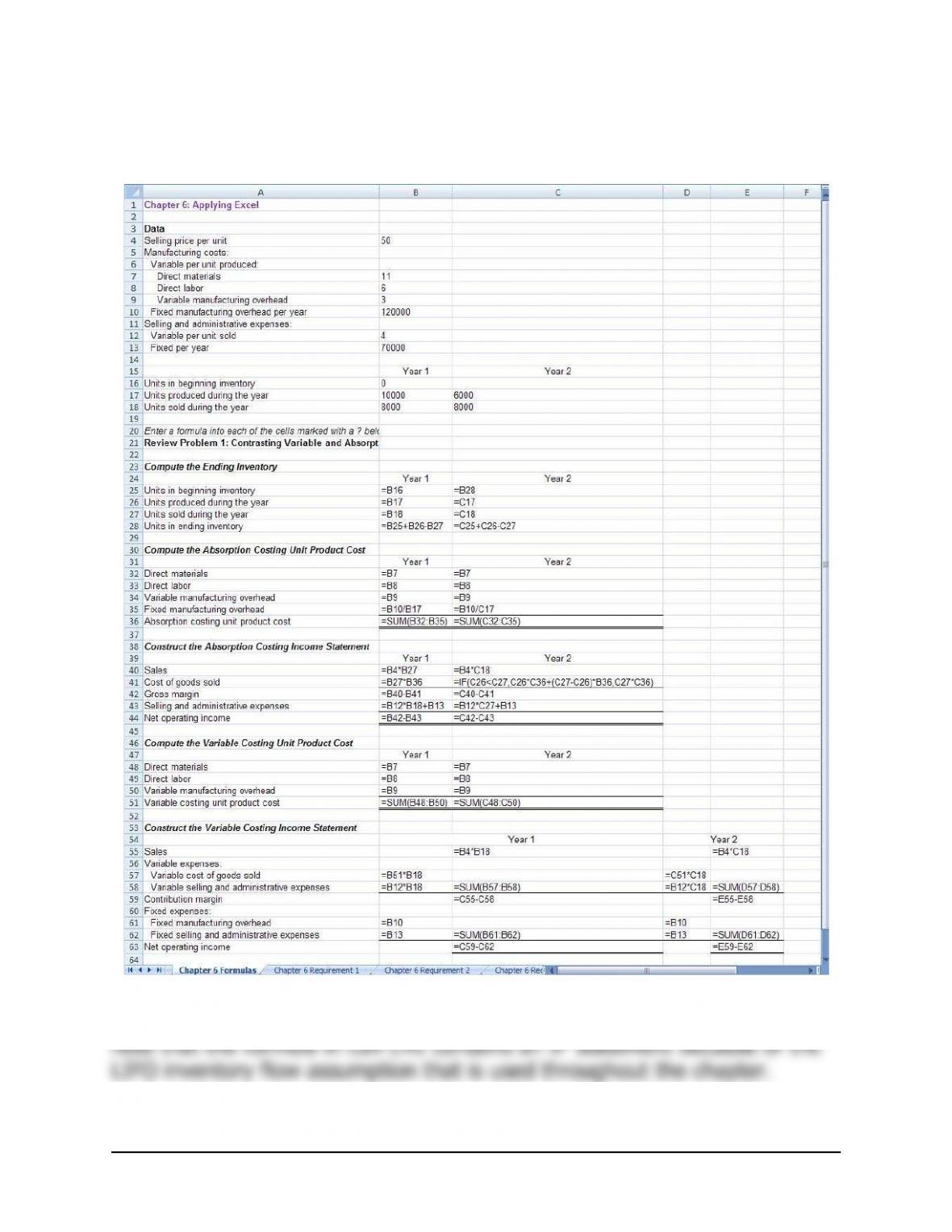
Chapter 6: Applying Excel (continued)
The completed worksheet, with formulas displayed, is shown below.
Note: This worksheet assumes that the beginning inventory in Year 1 is
zero. If this were not true, the worksheet would have to be modified. Also
© The McGraw-Hill Companies, Inc., 2018. All rights reserved.
Solutions Manual, Chapter 6 5
Chapter 6: Applying Excel (continued)
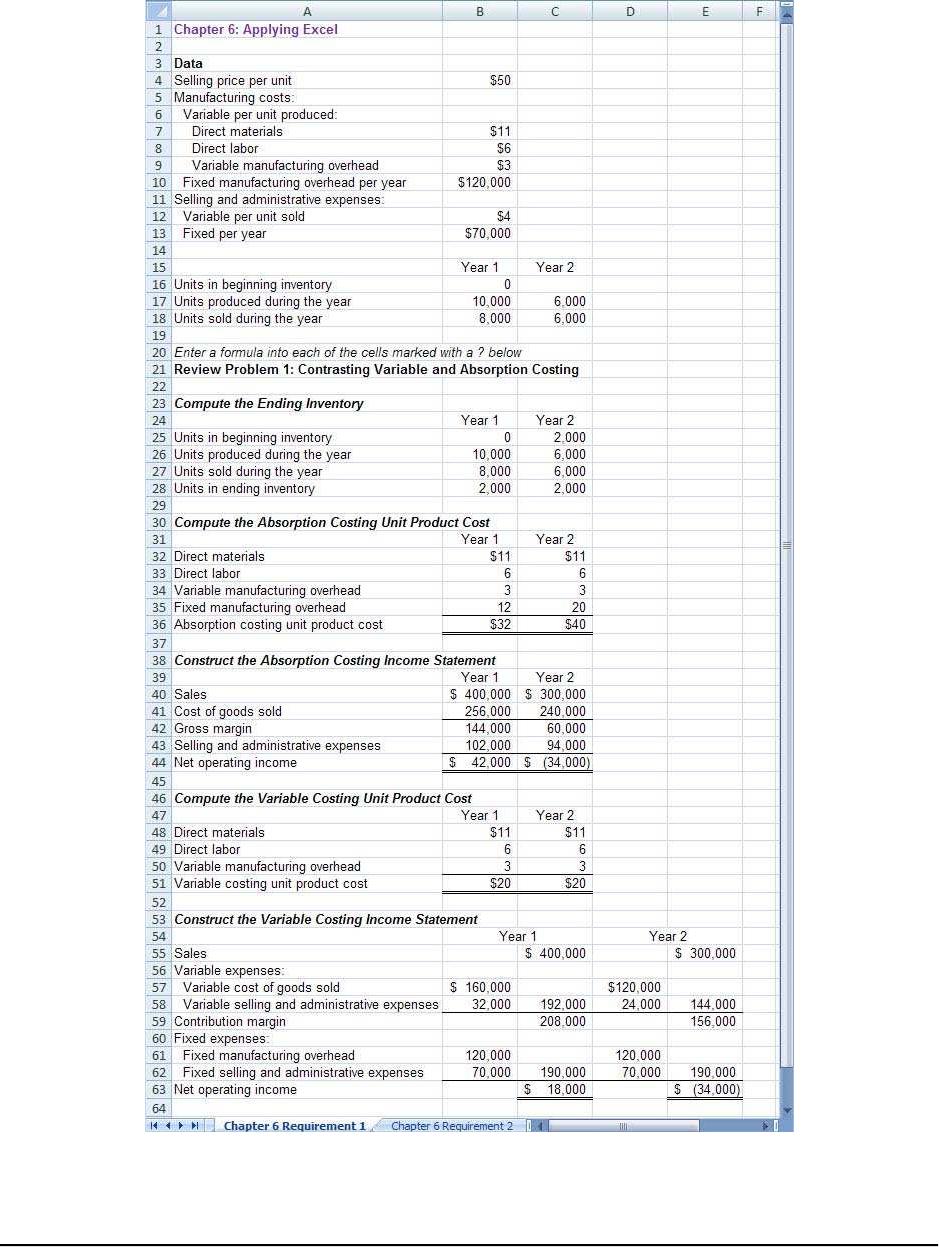
1. When the units sold in Year 2 are changed to 6,000, the result is:

© The McGraw-Hill Companies, Inc., 2018. All rights reserved.
6 Managerial Accounting, 16th Edition
Chapter 6: Applying Excel (continued)
If the units produced equals the units sold, under the LIFO assumption,
all of the fixed manufacturing overhead from Year 2 flows to the income
© The McGraw-Hill Companies, Inc., 2018. All rights reserved.
Solutions Manual, Chapter 6 7
Chapter 6: Applying Excel (continued)
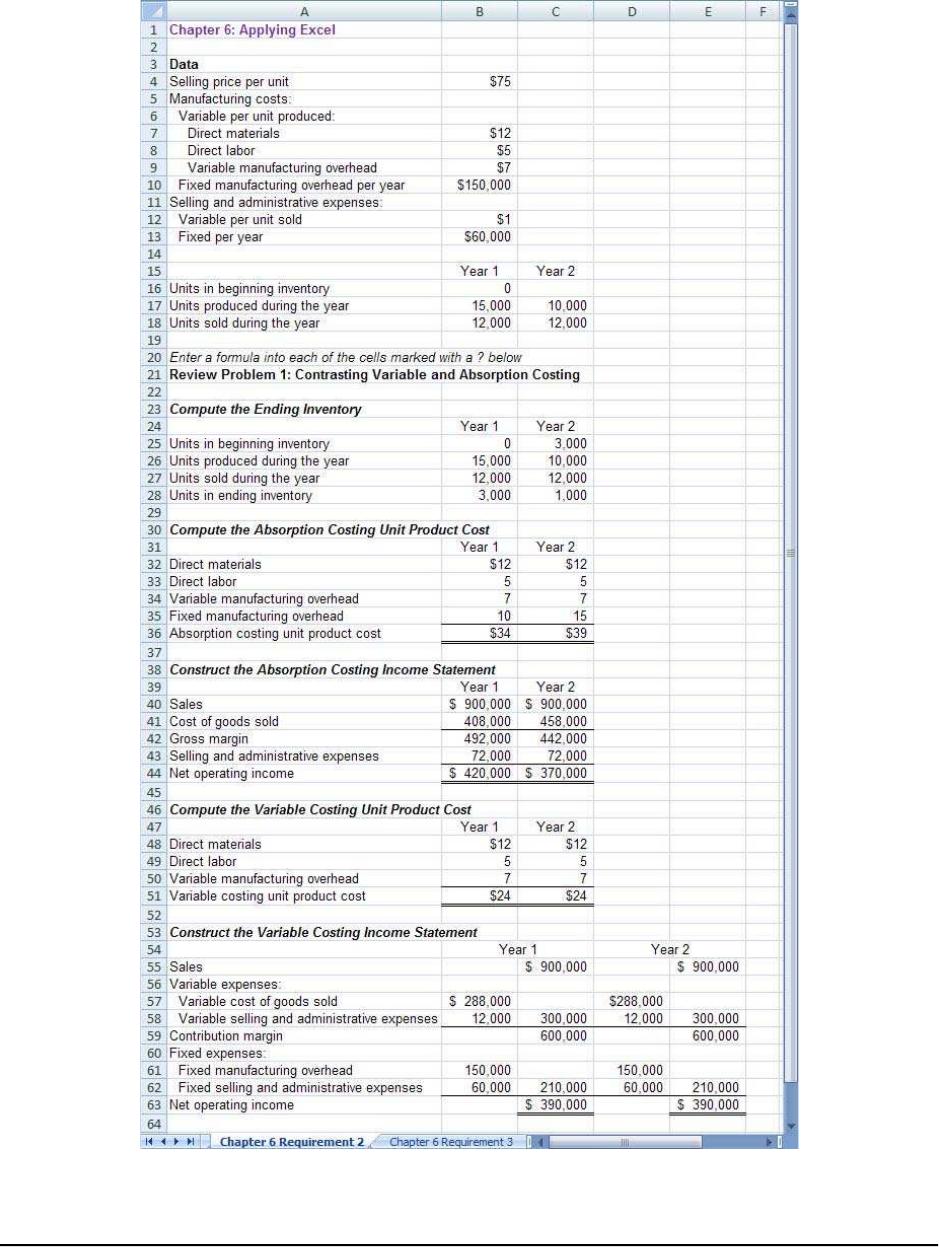
2. With the changes in the data, the worksheet should look like this:
© The McGraw-Hill Companies, Inc., 2018. All rights reserved.
8 Managerial Accounting, 16th Edition
Chapter 6: Applying Excel (continued)
The variable costing net operating income is the same in Year 1 and
Year 2 because the sales are the same in the two years—12,000 units.
Absorption costing net operating income exceeds variable costing net
© The McGraw-Hill Companies, Inc., 2018. All rights reserved.
Solutions Manual, Chapter 6 9
Chapter 6: Applying Excel (continued)
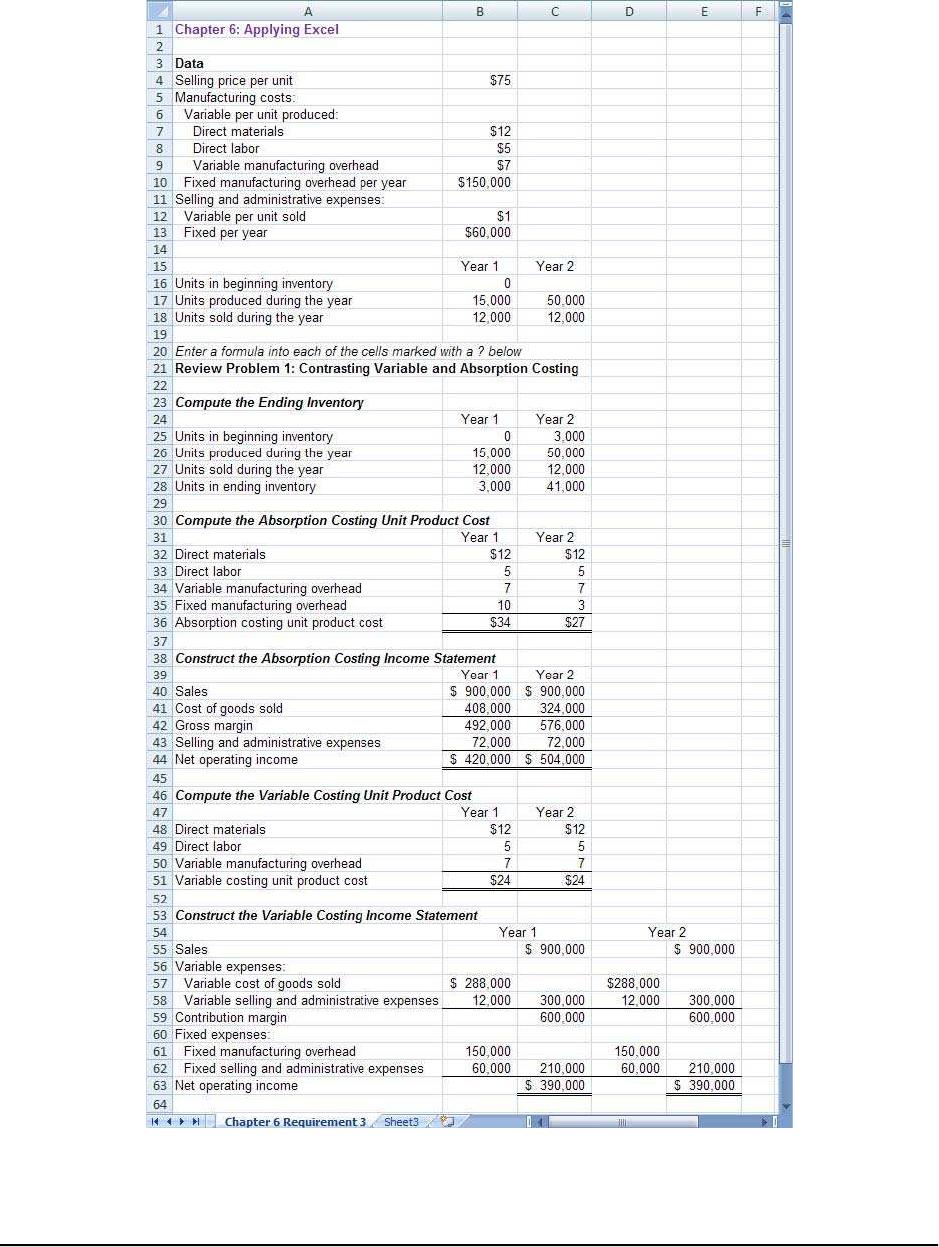
3. With the increase in units produced in Year 2, the result is:
© The McGraw-Hill Companies, Inc., 2018. All rights reserved.
10 Managerial Accounting, 16th Edition
Chapter 6: Applying Excel (continued)
Increasing the production in Year 2 to 50,000 units while keeping
everything else the same—including the unit sales—would result in
absorption costing net operating income of $504,000 and payment of
the bonus. However, it would also result in huge ending inventories that
exceed the normal sales by several times. These huge inventories are