© The McGraw-Hill Companies, Inc., 2018. All rights reserved.
Solutions Manual, Chapter 5 61
Problem 5-26 (continued)
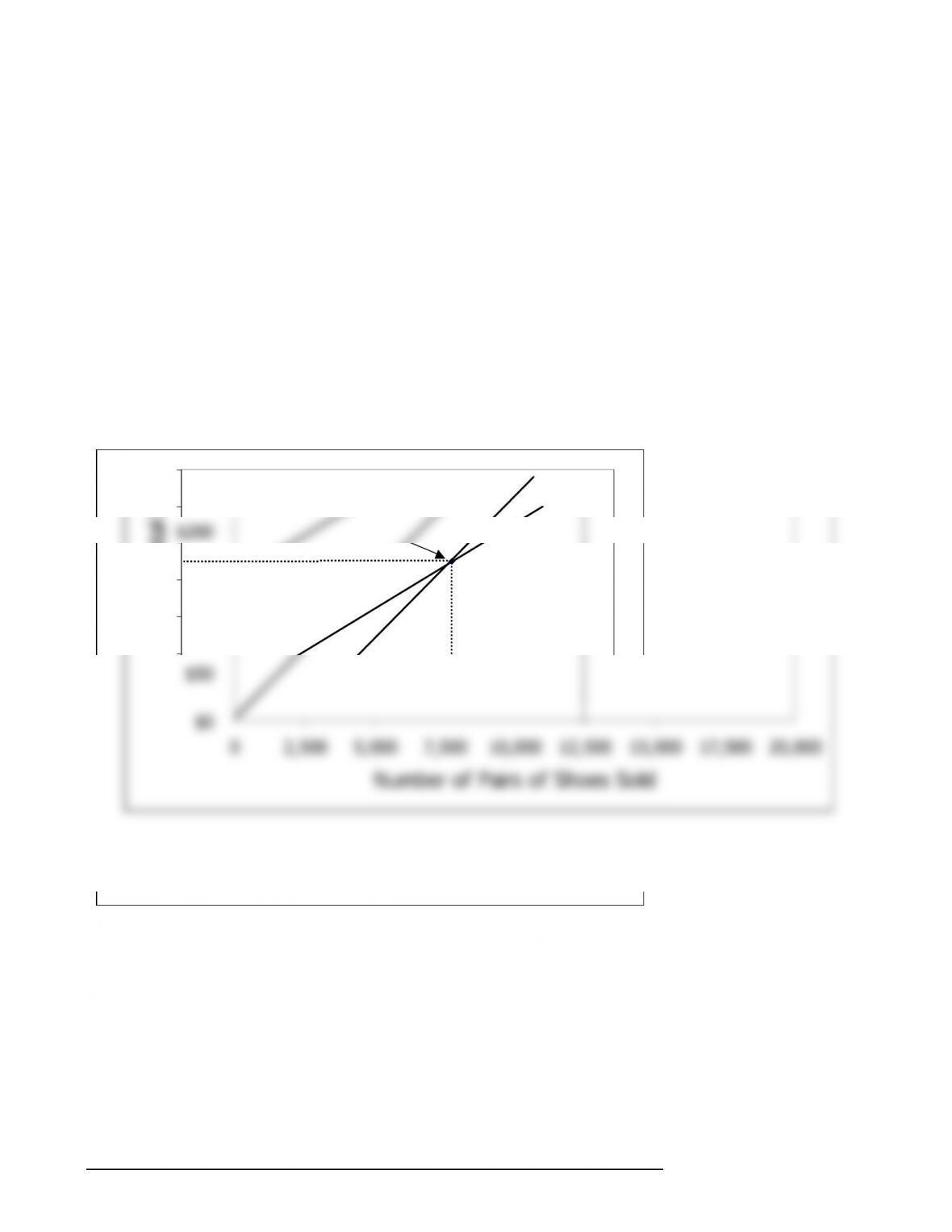
2. Cost-volume-profit graph:
$300
$350
$400
$450
$500
Break–even point:
Total Sales
Total
© The McGraw-Hill Companies, Inc., 2018. All rights reserved.
62 Managerial Accounting, 16th Edition
Problem 5-26 (continued)
4. The variable expenses will now be $18.75 per pair, and the contribution
margin will be $11.25 per pair.
Profit = Unit CM × Q − Fixed expenses
$0 = ($30.00 − $18.75) × Q − $150,000
Alternative solution:
Fixed expenses
Unit sales to =
break even CM per unit
$150,000
= = 13,333 pairs
0.375
5. The simplest approach is:
A
ctual sales ………………………….. 15,000 pairs
Brea
k
-even sales …………………… 12,500 pairs
–
© The McGraw-Hill Companies, Inc., 2018. All rights reserved.
Solutions Manual, Chapter 5 63
Problem 5-26 (continued)
6. The new variable expenses will be $13.50 per pair.
Profit = Unit CM × Q − Fixed expenses
$0 = ($30.00 − $13.50) × Q
–
($150,000 + $31,500)
Although the change will lower the break-even point from 12,500 pairs
to 11,000 pairs, the company must consider whether this reduction in
the break-even point is more than offset by the possible loss in sales
arising from having the sales staff on a salaried basis. Under a salary
arrangement, the sales staff has less incentive to sell than under the
© The McGraw-Hill Companies, Inc., 2018. All rights reserved.
64 Managerial Accounting, 16th Edition
Problem 5-27 (45 minutes)
1. a.
Hawaiian
Fantasy
(20,000 units)
Tahitian
Joy
(5,000 units) Total
Amount % Amount % Amount %
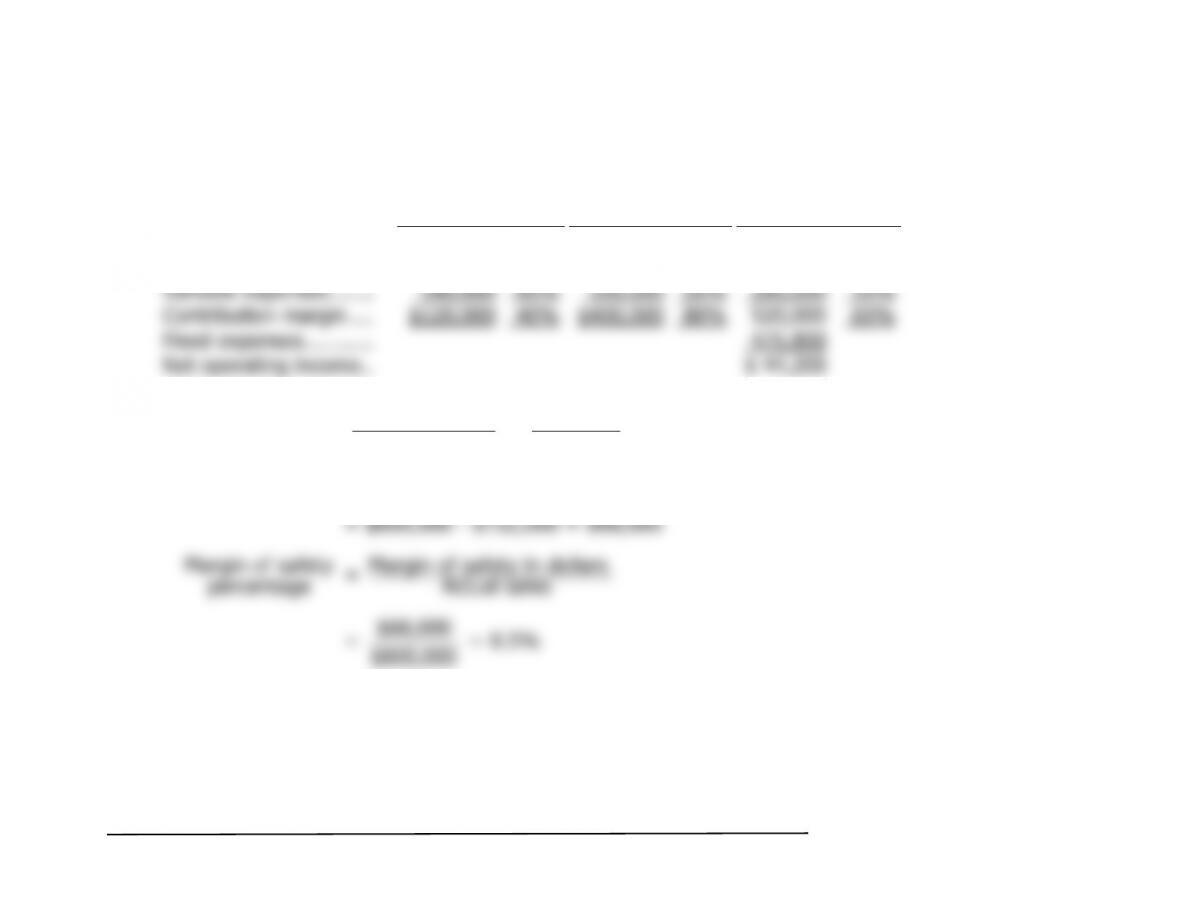
Sales ……………………. $300,000 100% $500,000 100% $800,000 100%
b. Fixed expenses $475,800
Dollar sales to = = = $732,000
break even CM ratio 0.65
Mar
g
in of safety = Actual sales – Break-even sales
© The McGraw-Hill Companies, Inc., 2018. All rights reserved.
Solutions Manual, Chapter 5 65
Problem 5-27 (continued)
2. a.
Hawaiian
Fantasy
(20,000 units)
Tahitian
Joy
(5,000 units)
Samoan
Delight
(10,000 units)
Total
Amount % Amount % Amount % Amount %
Sales ……………. $300,000 100% $500,000 100% $450,000 100% $1,250,000 100.0%
V
ariable
© The McGraw-Hill Companies, Inc., 2018. All rights reserved.
66 Managerial Accounting, 16th Edition
Problem 5-27 (continued)
b. Fixed expenses $475,800
Dollar sales to = = = $975,000
break even CM ratio 0.488
Mar
g
in of safety = Actual sales – Break-even sales
3. The reason for the increase in the break-even point can be traced to the
decrease in the company’s overall contribution margin ratio when the
third product is added. Note from the income statements above that this
This problem shows the somewhat tenuous nature of break-even
analysis when the company has more than one product. The analyst
It should be pointed out to the president that even though the break-
even point is higher with the addition of the third product, the
company’s margin of safety is also greater. Notice that the margin of
© The McGraw-Hill Companies, Inc., 2018. All rights reserved.
Solutions Manual, Chapter 5 67
Problem 5-28 (60 minutes)
1.
Carbex, Inc.
Income Statement For
A
pril
Standard Deluxe Total
Amount % Amount % Amount %
Sales ……………………… $240,000 100 $150,000 100 $390,000 100.0
V
ariable expenses:
Production ……………. 60,000 25 60,000 40 120,000 30.8
Sales commission …… 36,000 15 22,500 15 58,500 15.0
T
A
A
T
Carbex, Inc.
Income Statement For May
Standard Deluxe Total
Amount % Amount % Amount %
Sales ……………………… $60,000 100 $375,000 100 $435,000 100.0
V
ariable expenses:
Production ……………. 15,000 25 150,000 40 165,000 37.9
Sales commission …… 9,000 15 56,250 15 65,250 15.0
T
otal variable expenses . 24,000 40 206,250 55 230,250 52.9
A
A
T
© The McGraw-Hill Companies, Inc., 2018. All rights reserved.
68 Managerial Accounting, 16th Edition
Problem 5-28 (continued)
2. The sales mix has shifted over the last year from Standard sets to
Deluxe sets. This shift has caused a decrease in the company’s overall
3. Sales commissions could be based on contribution margin rather than
on sales price. A flat rate on total contribution margin, as the text
a. The break-even in dollar sales can be computed as follows:
Dollar sales to = = = $350,000
b. The break-even point in May would be higher than the break-even
point in April. This occurs because the sales mix has shifted from the
© The McGraw-Hill Companies, Inc., 2018. All rights reserved.
Solutions Manual, Chapter 5 69
Problem 5-29 (60 minutes)
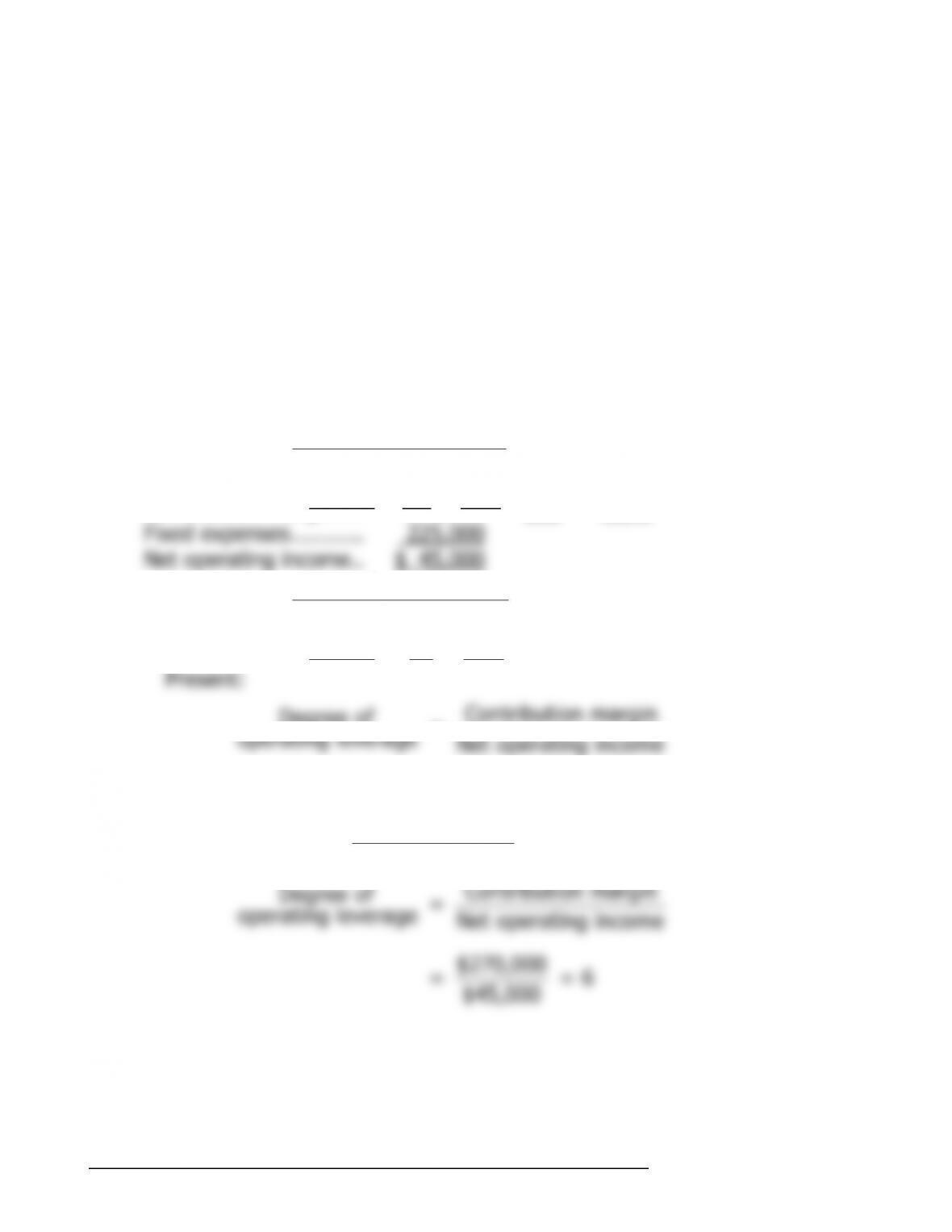
1. The income statements would be:
Present
Amount Per Unit %
Sales ……………………. $450,000 $30 100%
V
ariable expenses ……. 315,000 21 70%
Proposed
Amount Per Unit %
Sales ……………………. $450,000 $30 100%
V
ariable expenses* ….. 180,000 12 40%
2. a. Degree of operating leverage:
Present:
Contribution margin
Degree of
=
operating leverage Net operating income
© The McGraw-Hill Companies, Inc., 2018. All rights reserved.
70 Managerial Accounting, 16th Edition
Problem 5-29 (continued)
b. Dollar sales to break even:
Present:
Fixed expenses
Dollar sales to =
break even CM ratio
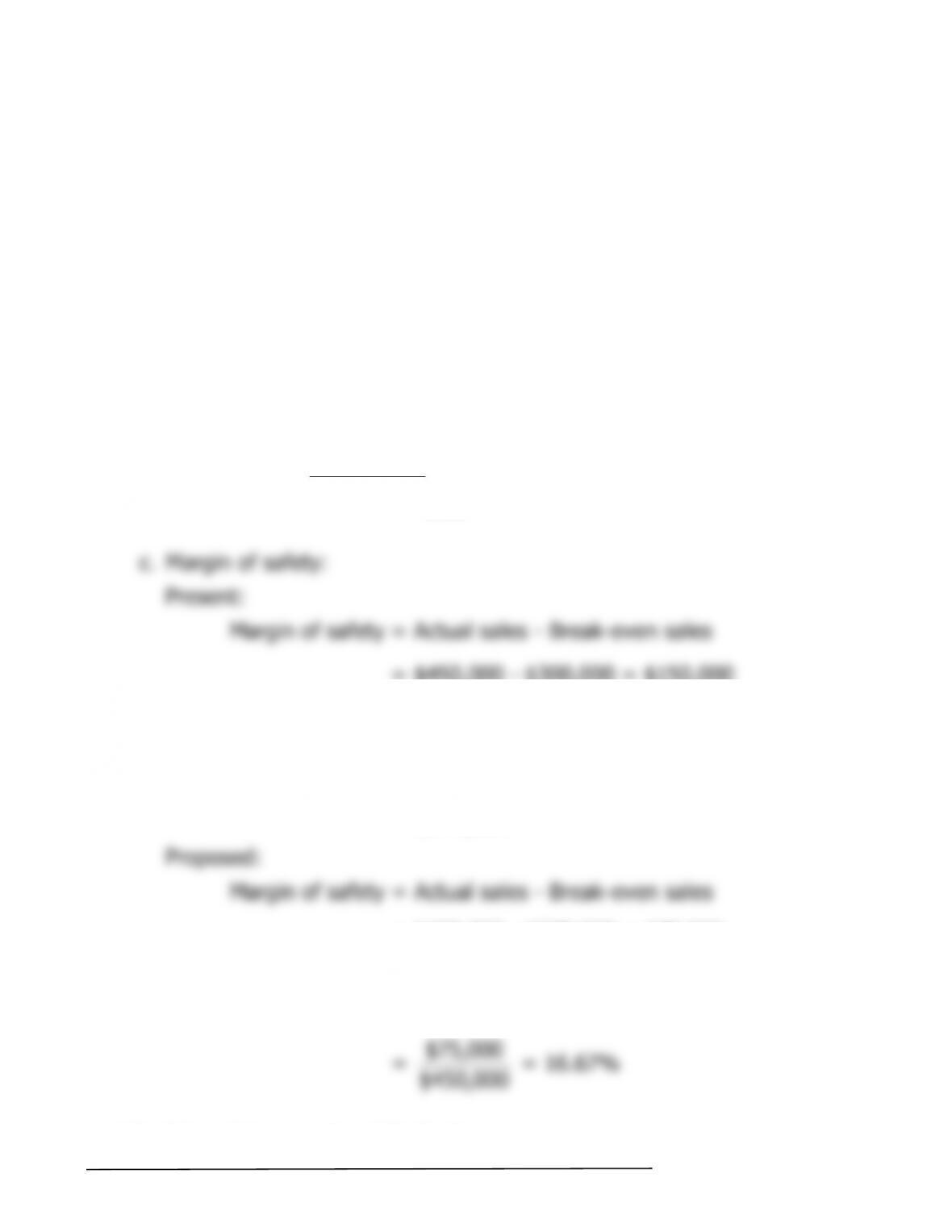
c. Margin of safety:
Present:
Mar
g
in of safety = Actual sales – Break-even sales
= $450,000 – $300,000 = $150,000
Proposed:
Mar
g
in of safety = Actual sales – Break-even sales
= $450,000 – $375,000 = $75,000