© The McGraw-Hill Companies, Inc., 2018. All rights reserved.
Solutions Manual, Chapter 5 51
Problem 5-22 (60 minutes)
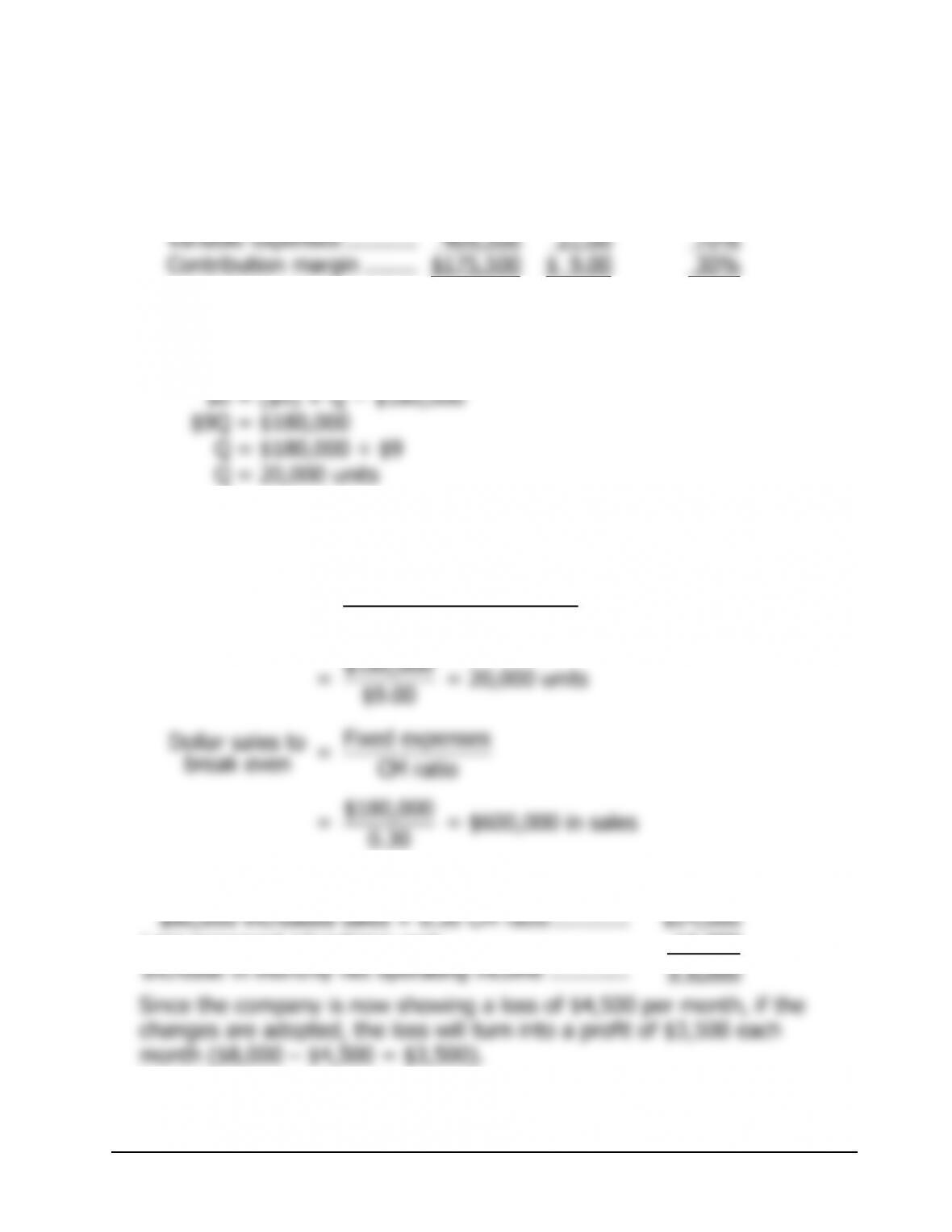
1. The CM ratio is 30%.
Total Per Unit Percent of Sales
Sales (19,500 units) …….. $585,000 $30.00 100%
The break-even point is:
Profit = Unit CM × Q − Fixed expenses
$0 = ($30 − $21) × Q − $180,000
20,000 units × $30 per unit = $600,000 in sales
Alternative solution:
Fixed expenses
Unit sales to =
break even Unit contribution margin
2. Incremental contribution mar
g
in:
Less increased advertisin
g
cost ………………………. 16,000
© The McGraw-Hill Companies, Inc., 2018. All rights reserved.
52 Managerial Accounting, 16th Edition
Problem 5-22 (continued)
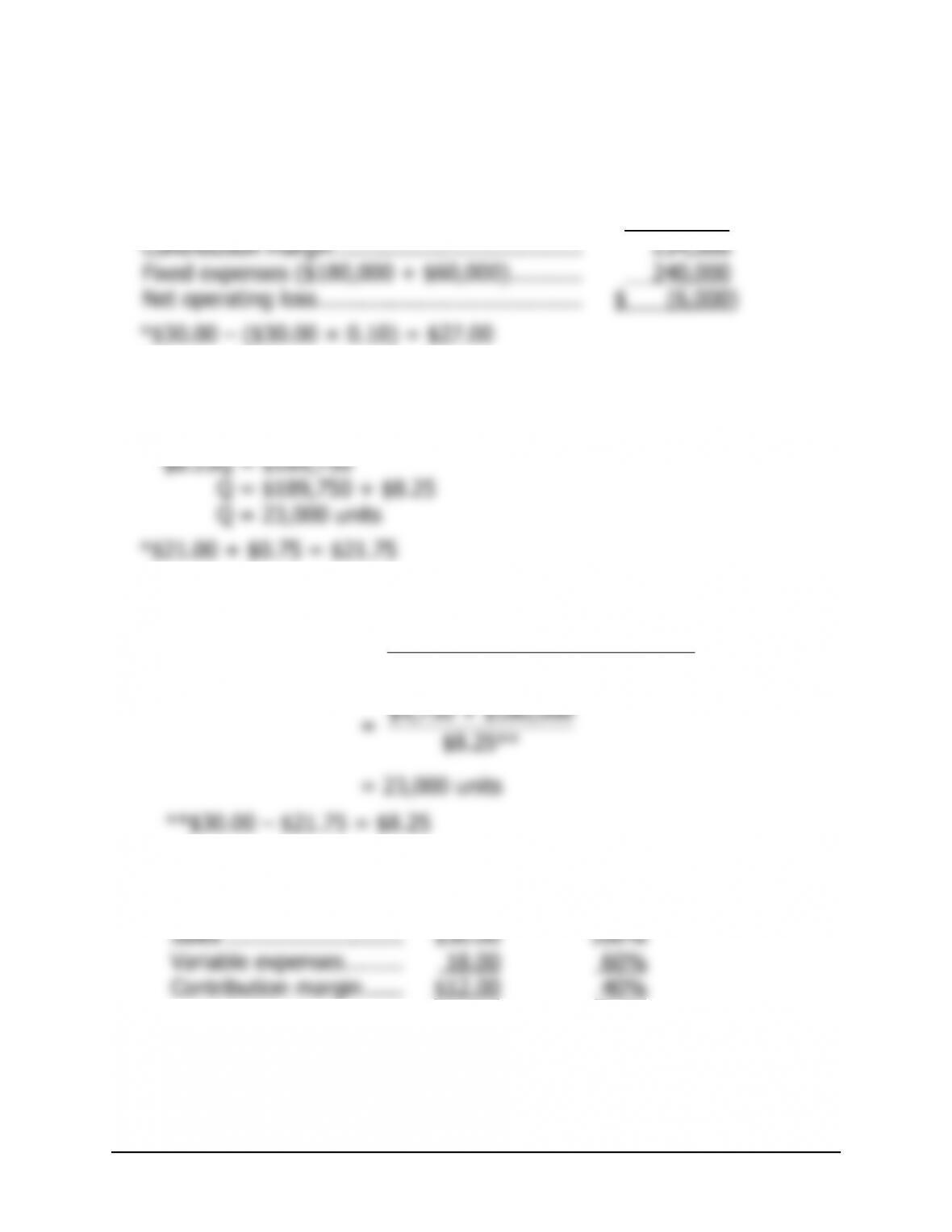
3. Sales (39,000 units @ $27.00 per unit*)…….. $1,053,000
V
ariable expenses
(39,000 units @ $21.00 per unit) ……………. 819,000
4. Profit = Unit CM × Q − Fixed expenses
$9,750 = ($30.00 − $21.75) × Q − $180,000
$9,750 = ($8.25) × Q − $180,000
Alternative solution:
T
ar
g
et profit + Fixed expenses
Unit sales to attain =
target profit CM per unit
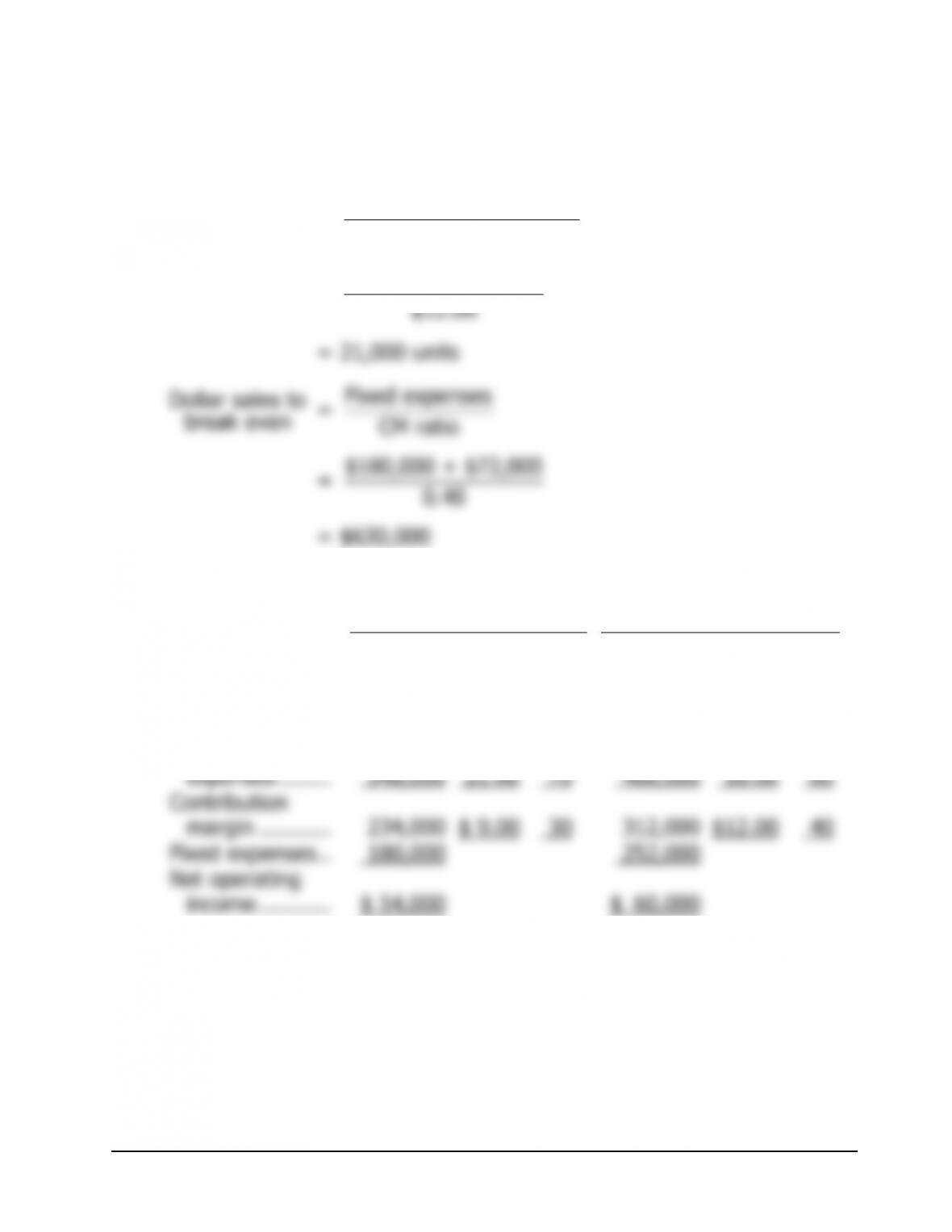
5. a. The new CM ratio would be:
Per Unit Percent of Sales
V
© The McGraw-Hill Companies, Inc., 2018. All rights reserved.
Solutions Manual, Chapter 5 53
Problem 5-22 (continued)
The new break-even point would be:
Fixed expenses
Unit sales to =
break even Unit contribution mar
g
in
$180,000 + $72,000
=
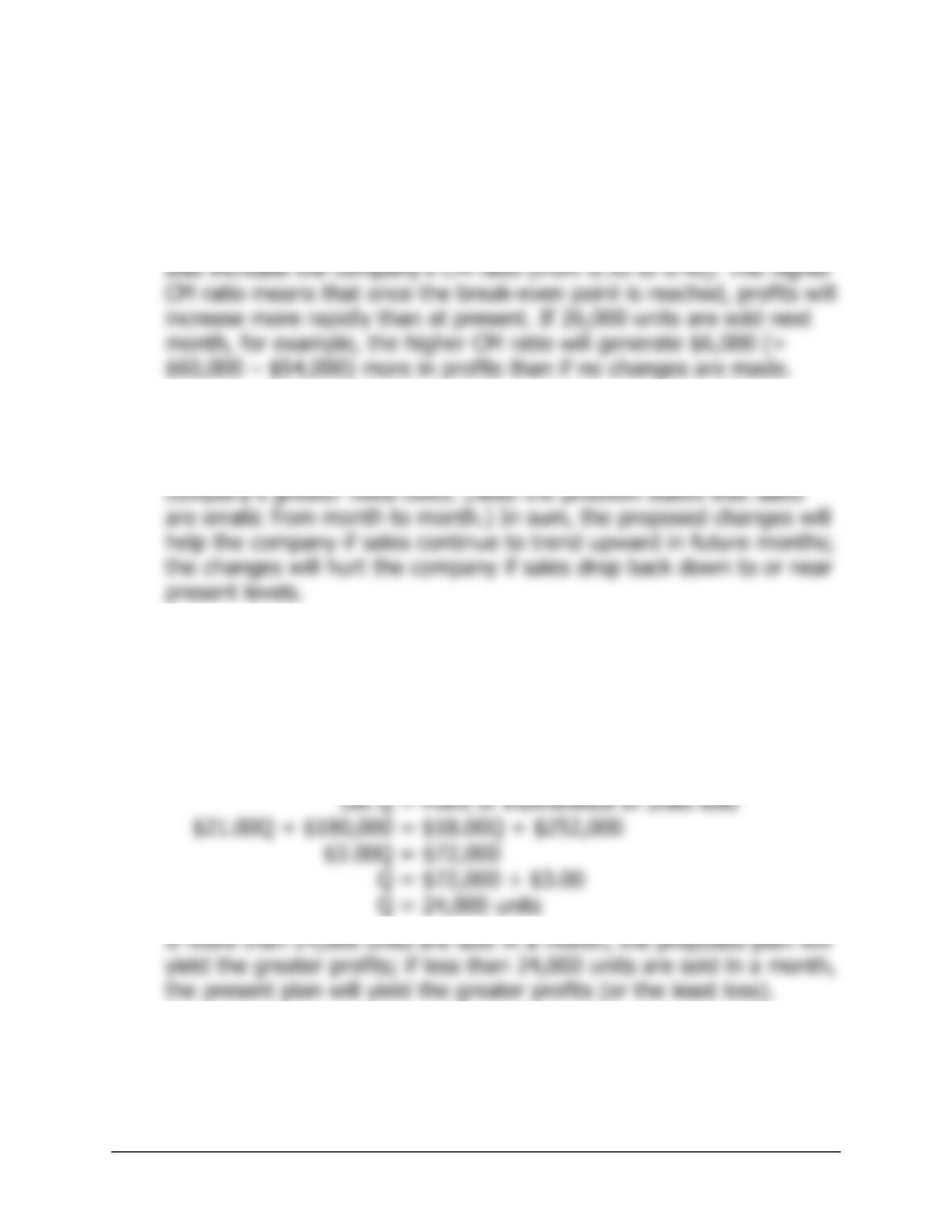
b. Comparative income statements follow:
Not Automated Automated
Total
Per
Unit % Total
Per
Unit %
Sales (26,000
units) …………. $780,000 $30.00 100 $780,000 $30.00 100
V
ariable
© The McGraw-Hill Companies, Inc., 2018. All rights reserved.
54 Managerial Accounting, 16th Edition
Problem 5-22 (continued)
c. Whether or not the company should automate its operations depends
on how much risk the company is willing to take and on prospects for
future sales. The proposed changes would increase the company’s
fixed costs and its break-even point. However, the changes would
The greatest risk of automating is that future sales may drop back
down to present levels (only 19,500 units per month), and as a
result, losses will be even larger than at present due to the
Note to the Instructor: Although it is not asked for in the problem,
if time permits you may want to compute the point of indifference
between the two alternatives in terms of units sold; i.e., the point
where profits will be the same under either alternative. At this point,
total revenue will be the same; hence, we include only costs in our
equation:
© The McGraw-Hill Companies, Inc., 2018. All rights reserved.
Solutions Manual, Chapter 5 55
Problem 5-23 (60 minutes)
1. The CM ratio is 60%:
2. Fixed expenses
Dollar sales to =
break even CM ratio
3. $75,000 increased sales × 0.60 CM ratio = $45,000 increased
4a. The degree of operating leverage is calculated as follows:
4. Contribution mar
g
in
Degree of
=
operating leverage Net operatin
g
income
4b. 4 × 20% = 80% increase in net operating income. In dollars, this
© The McGraw-Hill Companies, Inc., 2018. All rights reserved.
56 Managerial Accounting, 16th Edition
Problem 5-23 (continued)
5. This year’s net operating income is computed as follows:
Sales (25,000 units × $18 per unit)……………….. $450,000
V
ariable expenses (25,000 units × $8 per unit) … 200,000
6. Expected total contribution mar
g
in:
20,000 units × 1.25 × $11.00 per unit* …………………… $275,000
Present total contribution mar
g
in ……………………………… 240,000
–
© The McGraw-Hill Companies, Inc., 2018. All rights reserved.
Solutions Manual, Chapter 5 57
Problem 5-24 (30 minutes)
1. The contribution margin per sweatshirt would be:
Sellin
g
price …………………………………….. $13.50
V
ariable expenses:
Purchase cost of the sweatshirts…………. $8.00
2. Since an order has been placed, there is now a “fixed” cost associated
with the purchase price of the sweatshirts (i.e., the sweatshirts can’t be
returned). For example, an order of 75 sweatshirts requires a “fixed”
g
V
© The McGraw-Hill Companies, Inc., 2018. All rights reserved.
58 Managerial Accounting, 16th Edition
Problem 5-25 (45 minutes)
1. The contribution margin per unit on the first 16,000 units is:
Per Unit
Sales price …………………….. $3.00
The contribution margin per unit on anything over 16,000 units is:
Per Unit
Sales price …………………….. $3.00
Thus, for the first 16,000 units sold, the total amount of contribution
margin generated would be:
16,000 units × $1.75 per unit = $28,000
Since the fixed costs on the first 16,000 units total $35,000, the $28,000
contribution margin above is not enough to permit the company to
Fixed costs on the first 16,000 units ………………….. $35,000
Less contribution mar
g
in from the first 16,000 units 28,000
© The McGraw-Hill Companies, Inc., 2018. All rights reserved.
Solutions Manual, Chapter 5 59
Problem 5-25 (continued)
The additional sales of units required to cover these fixed costs would
be:
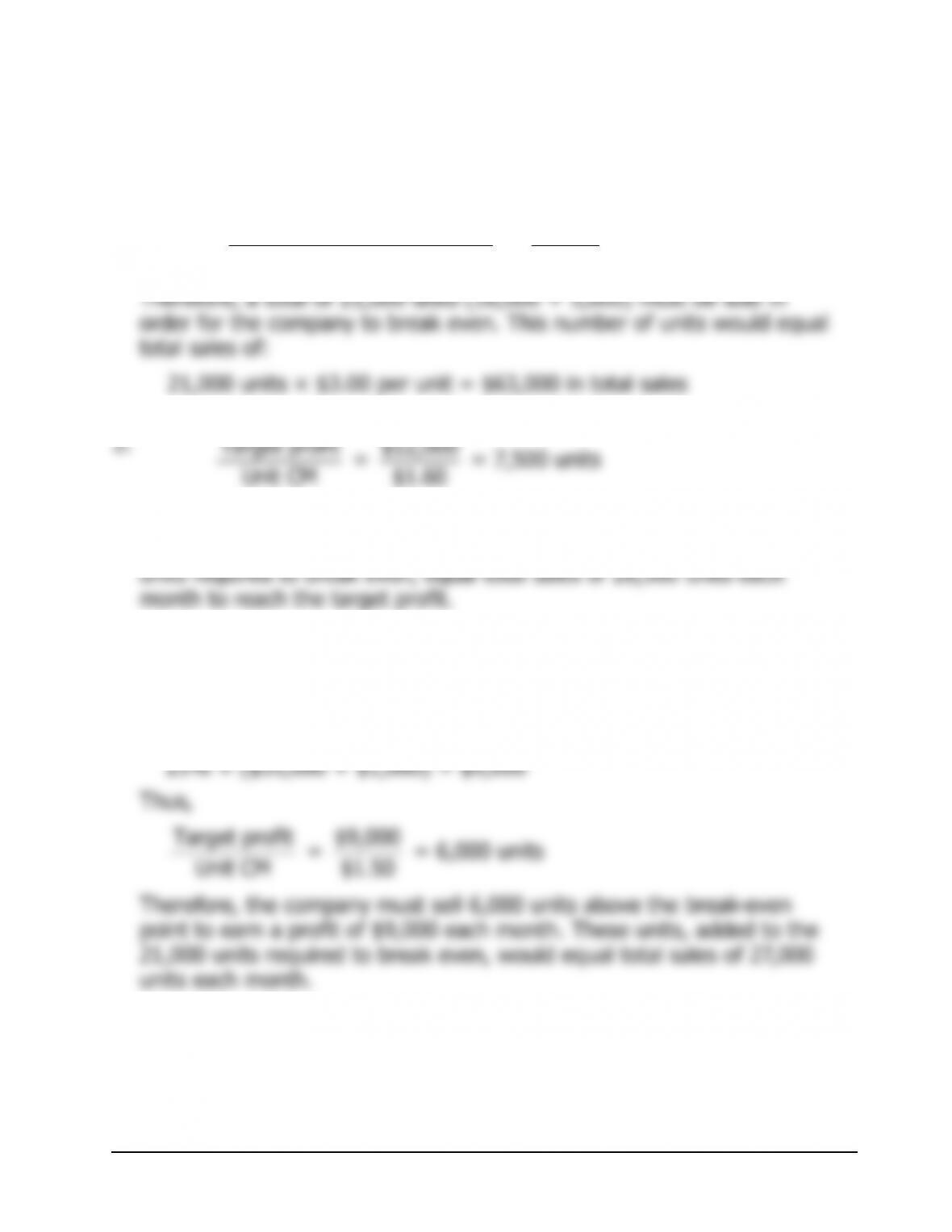
Total remaining fixed costs $8,000
= = 5,000 units
Unit CM on added units $1.60
Thus, the company must sell 7,500 units above the break-even point to
earn a profit of $12,000 each month. These units, added to the 21,000
3. If a bonus of $0.10 per unit is paid for each unit sold in excess of the
break-even point, then the contribution margin on these units would
drop from $1.60 to $1.50 per unit.
The desired monthly profit would be:
© The McGraw-Hill Companies, Inc., 2018. All rights reserved.
60 Managerial Accounting, 16th Edition
Problem 5-26 (60 minutes)
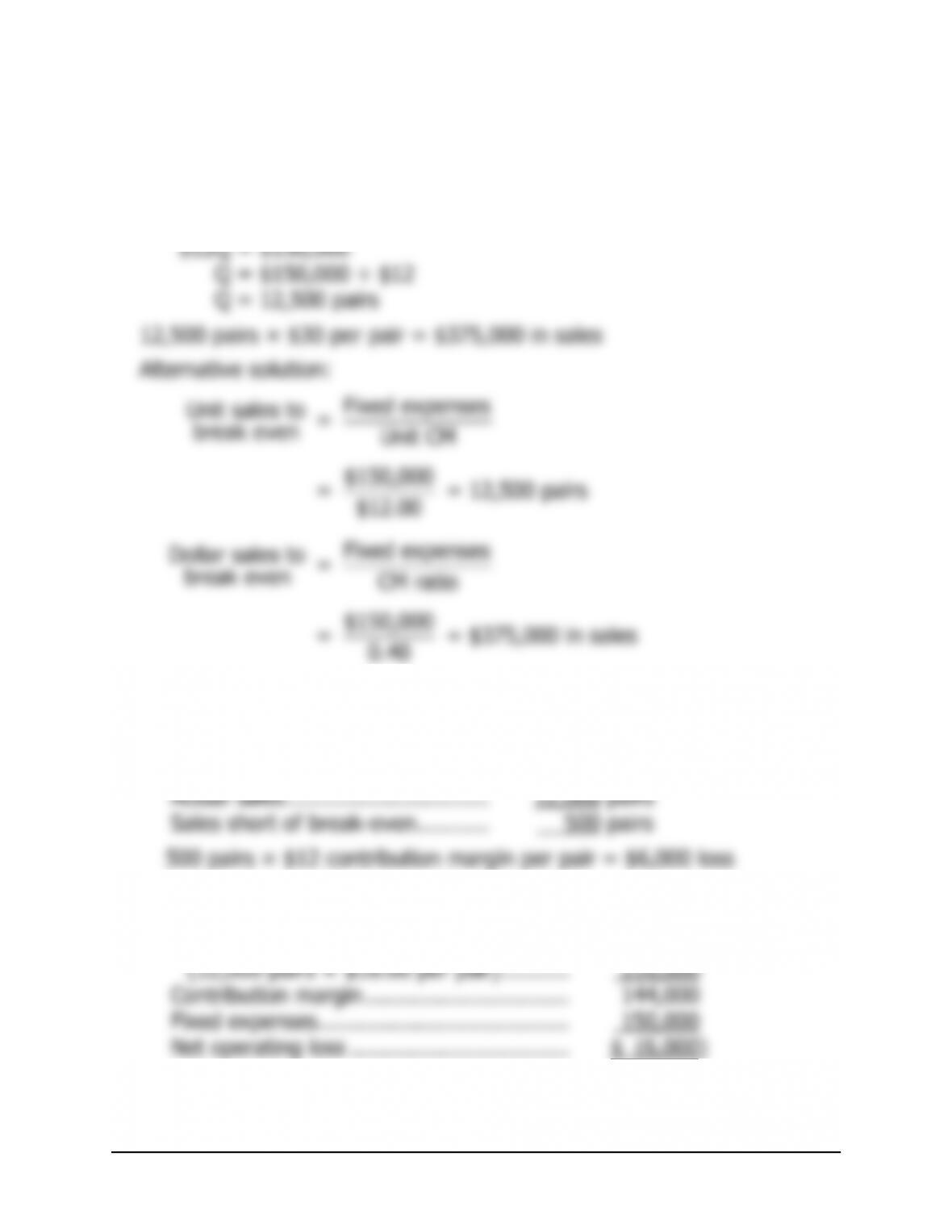
1. Profit = Unit CM × Q − Fixed expenses
$0 = ($30 − $18) × Q − $150,000
$0 = ($12) × Q − $150,000
2. See the graph on the following page.
3. The simplest approach is:
Brea
k
-even sales ………………….. 12,500 pairs
A
Alternative solution:
Sales (12,000 pairs × $30.00 per pair) …. $360,000
V
ariable expenses