© The McGraw-Hill Companies, Inc., 2018. All rights reserved.
Solutions Manual, Chapter 5 41
Exercise 5-18 (continued)
4. Margin of safety in dollar terms:
Margin of safety = Total sales – Break-even sales
in dollars
5. The CM ratio is 60% [= ($30 – $12) ÷ $30].
Expected total contribution mar
g
in: ($500,000 × 60%) .. $300,000
Alternative solution:
$50,000 incremental sales × 60% CM ratio = $30,000
© The McGraw-Hill Companies, Inc., 2018. All rights reserved.
42 Managerial Accounting, 16th Edition
Problem 5-19 (45 minutes)
1. Sales (15,000 units × $70 per unit)…………………. $1,050,000
V
ariable expenses (15,000 units × $40 per unit) … 600,000
Contribution mar
g
in …………………………………….. 450,000
Fixed expenses ………………………………………..…. 540,000
Net operatin
g
loss ……………………………………….. $ (90,000)
2. Fixed expenses
Unit sales to=
break even Unit contribution margin
$540,000
3. See the next page.
4. At a selling price of $58 per unit, the contribution margin is $18 per unit.
Therefore:
Fixed expenses
Unit sales to =
break even Unit contribution mar
g
in
© The McGraw-Hill Companies, Inc., 2018. All rights reserved.
Solutions Manual, Chapter 5 43
Problem 5-19 (continued)
3.
Unit
Selling
Price
Unit
Variable
Expense
Unit
Contribution
Margin
Volume
(Units)
Total
Contribution
Margin
Fixed
Expenses
Net operating
income (loss)
$70 $40 $30 15,000 $450,000 $540,000 $ (90,000)
$68 $40 $28 20,000 $560,000 $540,000 $ 20,000
$66 $40 $26 25,000 $650,000 $540,000 $110,000
$64 $40 $24 30,000 $720,000 $540,000 $180,000
© The McGraw-Hill Companies, Inc., 2018. All rights reserved.
44 Managerial Accounting, 16th Edition
Problem 5-20 (75 minutes)
1. a. Sellin
g
price ……………….. $25 100%
V
ariable expenses ………… 15 60%
Contribution mar
g
in ……… $10 40%
Profit = Unit CM × Q − Fixed expenses
Alternative solution:
Fixed expenses
Unit sales to =
break even Unit contribution mar
g
in
b. The degree of operating leverage is:
Contribution margin
Degree of =
operating leverage Net operating income
2. The new CM ratio will be:
Sellin
g
price ……………….. $25 100%
V
g
© The McGraw-Hill Companies, Inc., 2018. All rights reserved.
Solutions Manual, Chapter 5 45
Problem 5-20 (continued)
Alternative solution:
Fixed expenses
Unit sales to =
break even Unit contribution mar
g
in
3. Profit = Unit CM × Q − Fixed expenses
$90,000 = $7 × Q − $210,000
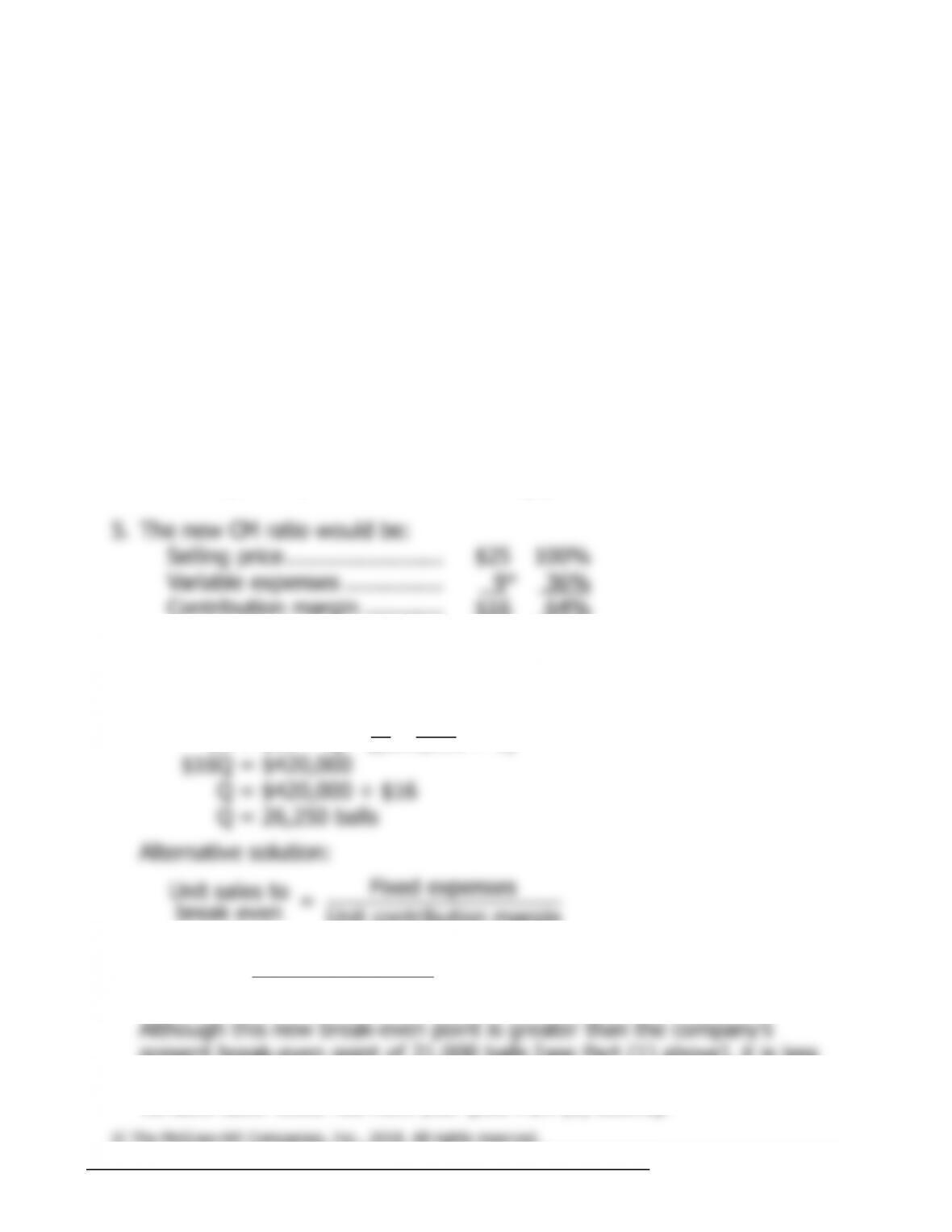
Thus, sales will have to increase by 12,857 balls (= 42,857 balls –
30,000 balls = 12,857 balls) to earn the same amount of net operating
income as last year. The computations above and in part (2) show the
dramatic effect that increases in variable costs can have on an
organization. The effects on Northwood Company are summarized
below:
Present Expected
© The McGraw-Hill Companies, Inc., 2018. All rights reserved.
46 Managerial Accounting, 16th Edition
Problem 5-20 (continued)
4. The contribution margin ratio last year was 40%. If we let P equal the
new selling price, then:
P = $18 + 0.40P
0.60P = $18
V
Therefore, to maintain a 40% CM ratio, a $3 increase in variable costs
would require a $5 increase in the selling price.
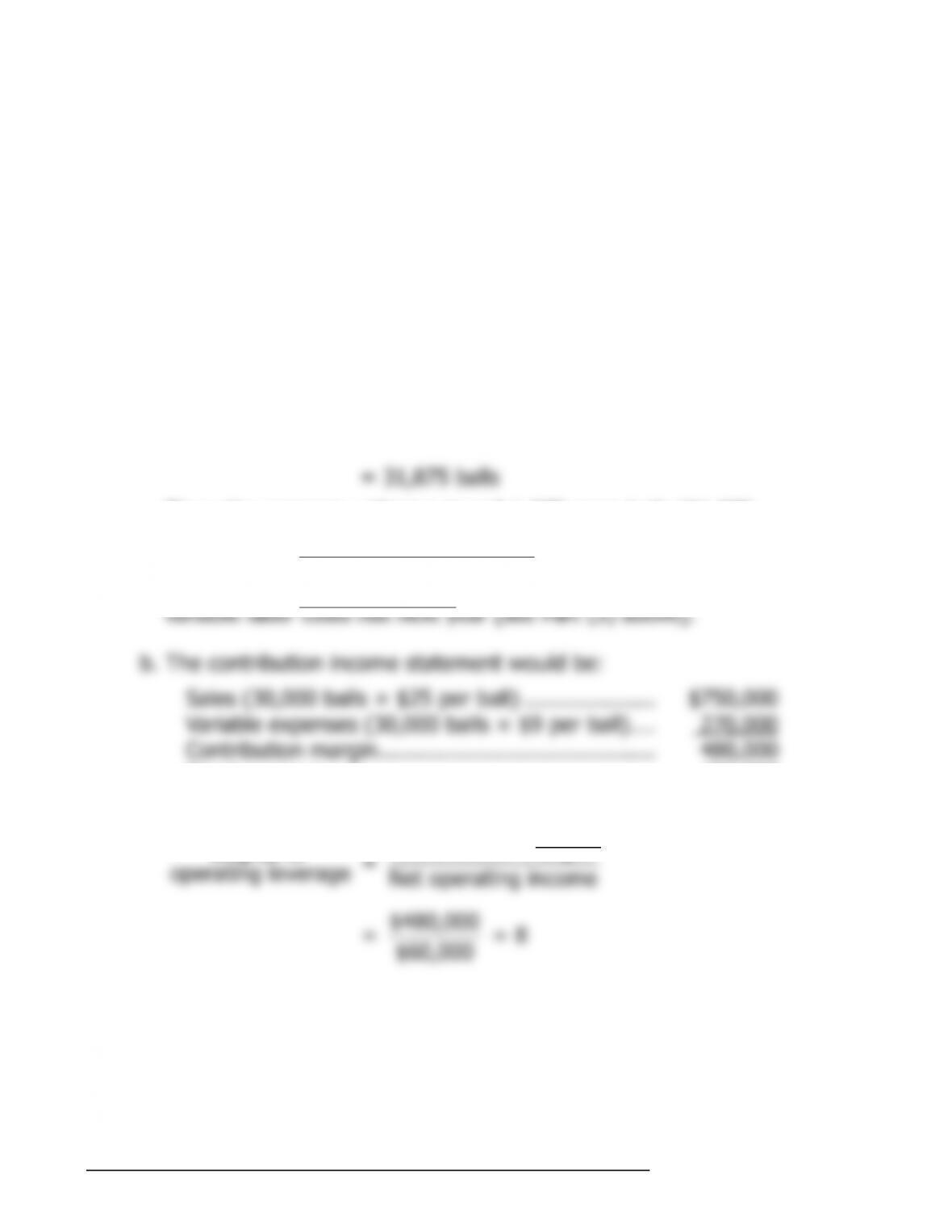
5. The new CM ratio would be:
Sellin
g
price …………………… $25 100%
V
ariable expenses …………… 9* 36%
–
Alternative solution:
Fixed expenses
Unit sales to =
break even Unit contribution margin
Although this new break-even point is greater than the company’s
present break-even point of 21,000 balls [see Part (1) above], it is less
g
© The McGraw-Hill Companies, Inc., 2018. All rights reserved.
Solutions Manual, Chapter 5 47
Problem 5-20 (continued)
6. a. Profit = Unit CM × Q − Fixed expenses
$90,000 = $16 × Q − $420,000
Alternative solution:
Unit sales to attain
T
arget profit + Fixed expenses
=
target profit Unit contribution margin
$90,000 + $420,000
=
b. The contribution income statement would be:
Sales (30,000 balls × $25 per ball) ……………….. $750,000
V
ariable expenses (30,000 balls × $9 per ball)…. 270,000

© The McGraw-Hill Companies, Inc., 2018. All rights reserved.
48 Managerial Accounting, 16th Edition
Problem 5-20 (continued)
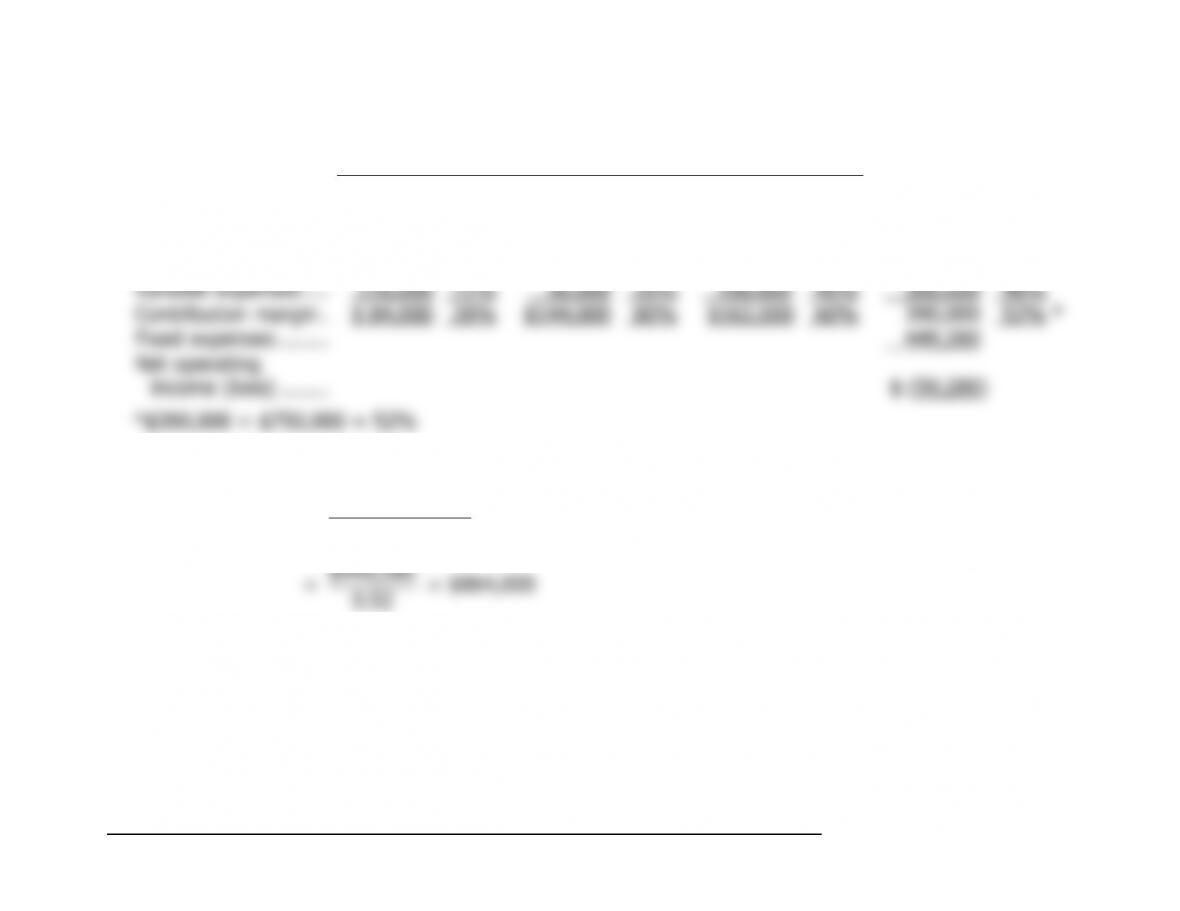
c. This problem illustrates the difficulty faced by some companies. When
variable labor costs increase, it is often difficult to pass these cost
increases along to customers in the form of higher prices. Thus,
There is no clear answer as to whether one should have been in favor
© The McGraw-Hill Companies, Inc., 2018. All rights reserved.
Solutions Manual, Chapter 5 49
Problem 5-21 (30 minutes)
1.
Product
White Fragrant Loonzain Total
Percenta
g
e of total
sales ……………….. 40% 24% 36% 100%
Sales ………………….. $300,000 100% $180,000 100% $270,000 100% $750,000 100%
2. Break-even sales would be:
Fixed expenses
Dollar sales to =
break even CM ratio
© The McGraw-Hill Companies, Inc., 2018. All rights reserved.
50 Managerial Accounting, 16th Edition
Problem 5-21 (continued)
3. Memo to the president:
Although the company met its sales budget of $750,000 for the month,
the mix of products changed substantially from that budgeted. This is
the reason the budgeted net operating income was not met, and the
As shown by these data, sales shifted away from Fragrant Rice, which
provides our greatest contribution per dollar of sales, and shifted toward
White Rice, which provides our least contribution per dollar of sales.
Although the company met its budgeted level of sales, these sales
provided considerably less contribution margin than we had planned,