© The McGraw-Hill Companies, Inc., 2018. All rights reserved.
Solutions Manual, Chapter 5 21
Exercise 5-4 (10 minutes)
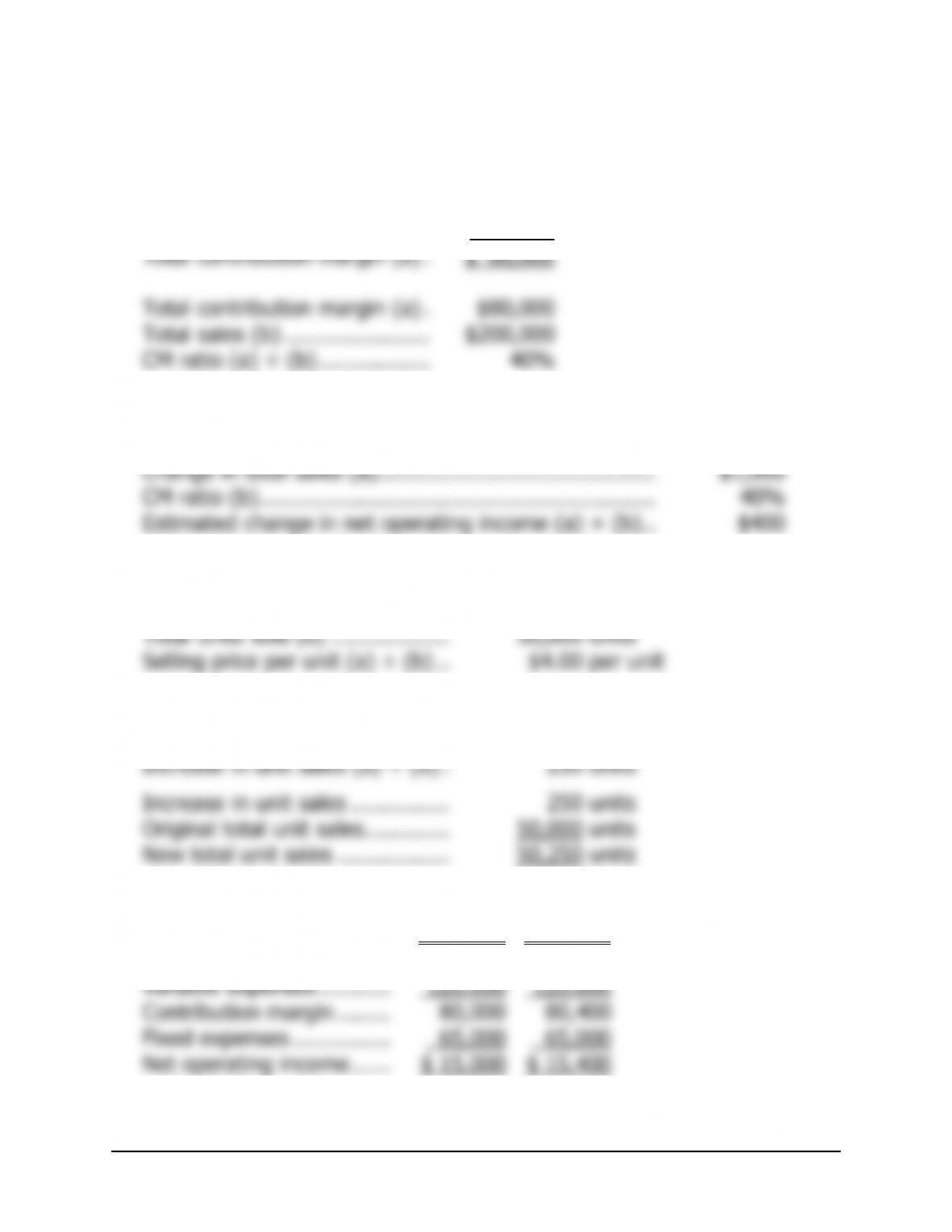
1. The company’s contribution margin (CM) ratio is:
T
otal sales ………………………. $200,000
T
otal variable expenses ……… 120,000
T
otal contribution mar
g
in (a) . $ 80,000
2. The change in net operating income from an increase in total sales of
$1,000 can be estimated by using the CM ratio as follows:
This computation can be verified as follows:
T
otal sales (a) ……………………. $200,000
T
g
Increase in total sales (a) ……… $1,000
Sellin
g
price per unit (b) ……….. $4.00 per unit
Original New
T
otal unit sales …………… 50,000 50,250
Sales ……………………….. $200,000 $201,000
V
T
T
© The McGraw-Hill Companies, Inc., 2018. All rights reserved.
22 Managerial Accounting, 16th Edition
Exercise 5-5 (20 minutes)
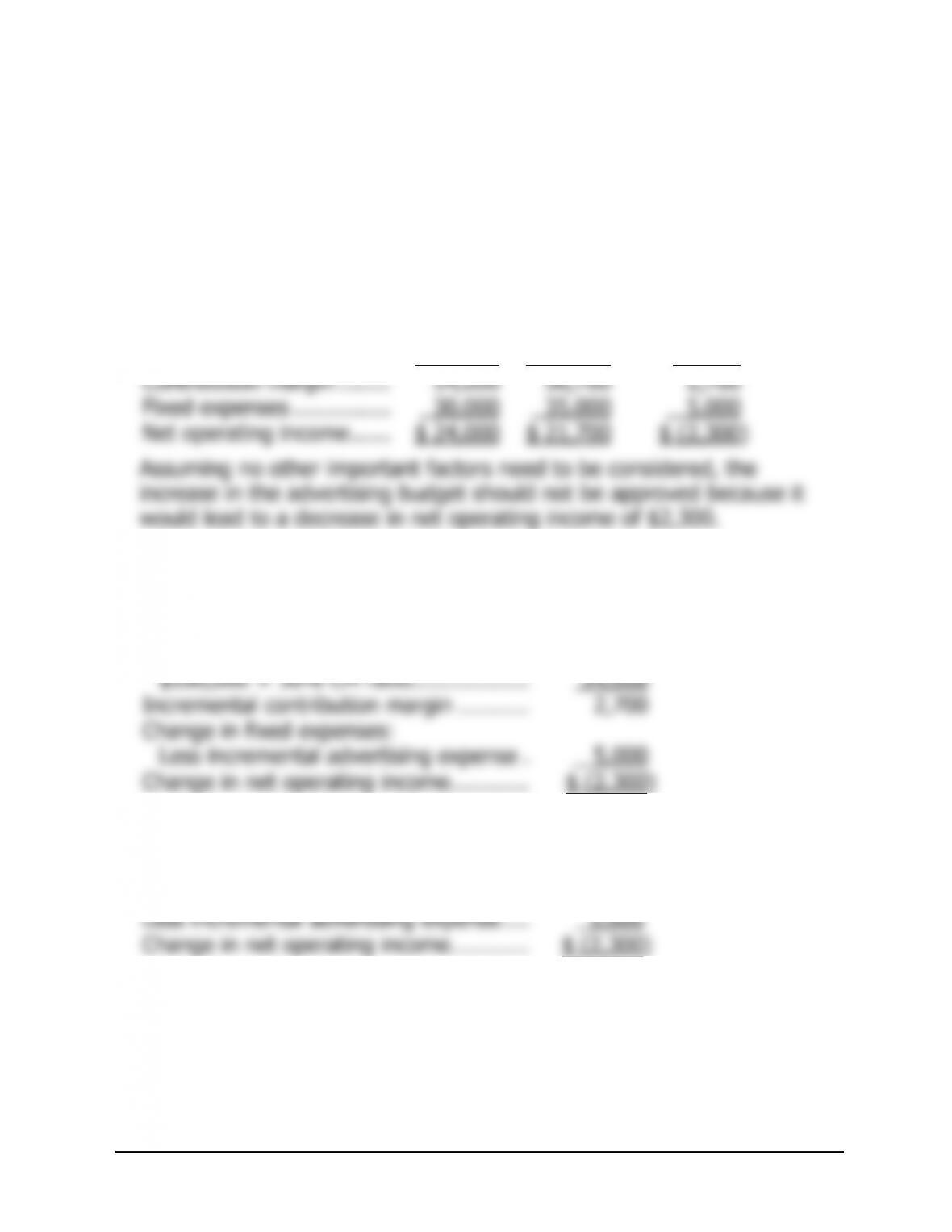
1. The following table shows the effect of the proposed change in monthly
advertising budget:
Sales With
Additional
Current Advertising
Sales Budget Difference
Sales ……………………….. $180,000 $189,000 $ 9,000
V
ariable expenses ……….. 126,000 132,300 6,300
Alternative Solution 1
Expected total contribution mar
g
in:
$189,000 × 30% CM ratio ……………… $56,700
g
Present total contribution mar
g
in:
Alternative Solution 2
Incremental contribution mar
g
in:
$9,000 × 30% CM ratio ………………… $2,700
© The McGraw-Hill Companies, Inc., 2018. All rights reserved.
Solutions Manual, Chapter 5 23
Exercise 5-5 (continued)
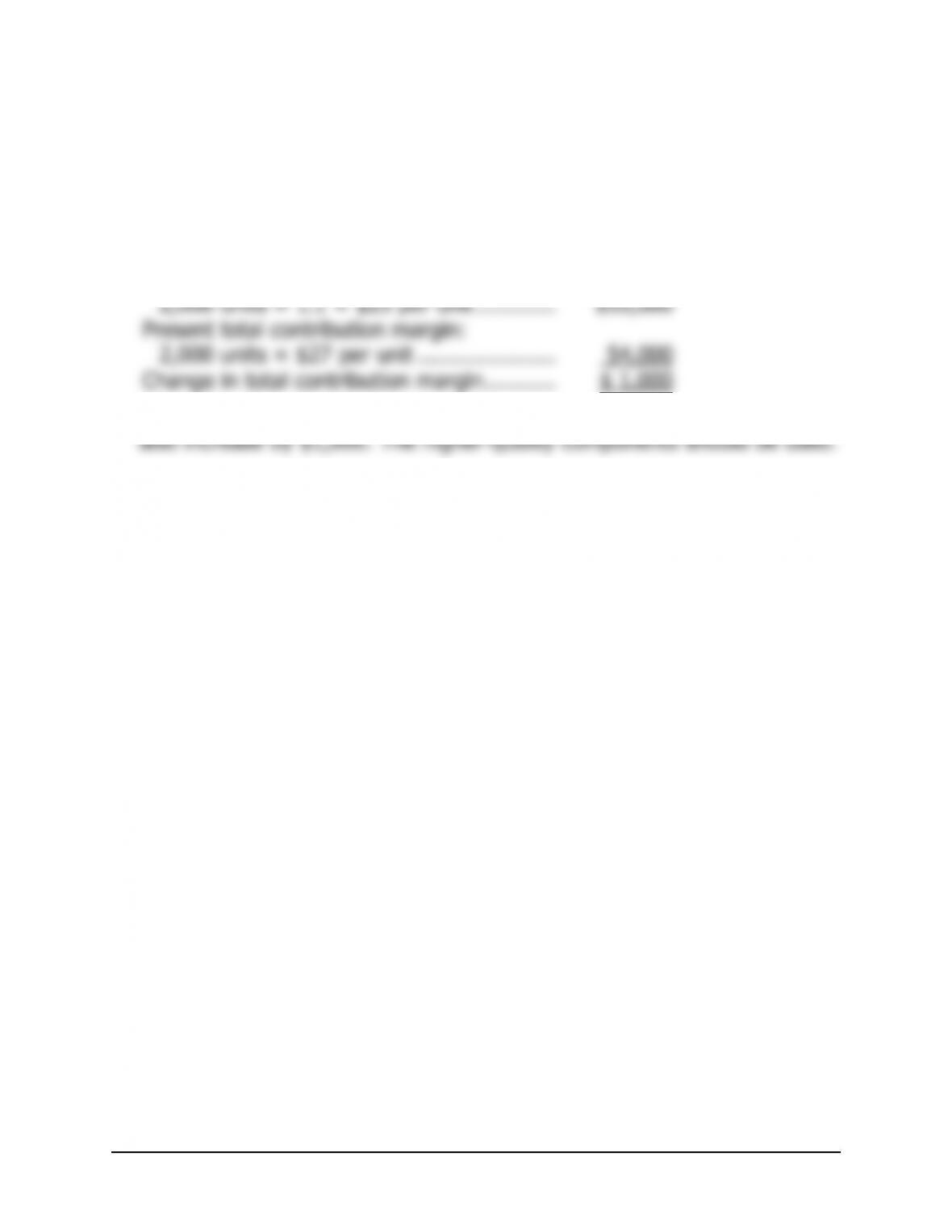
2. The $2 increase in variable expense will cause the unit contribution
margin to decrease from $27 to $25 with the following impact on net
operating income:
Expected total contribution mar
g
in with the
higher-quality components:
Assuming no change in fixed expenses, the net operating income will
© The McGraw-Hill Companies, Inc., 2018. All rights reserved.
24 Managerial Accounting, 16th Edition
Exercise 5-6 (20 minutes)
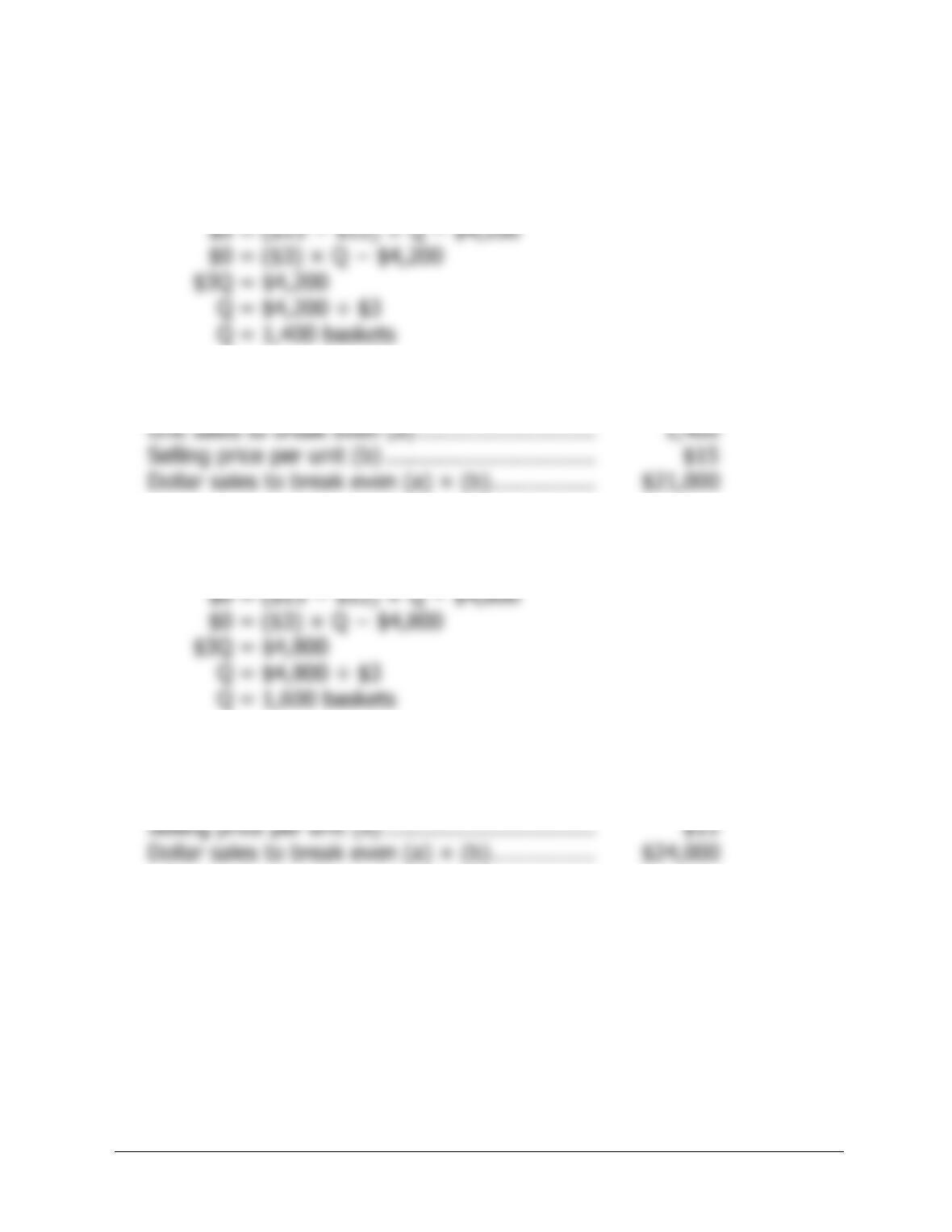
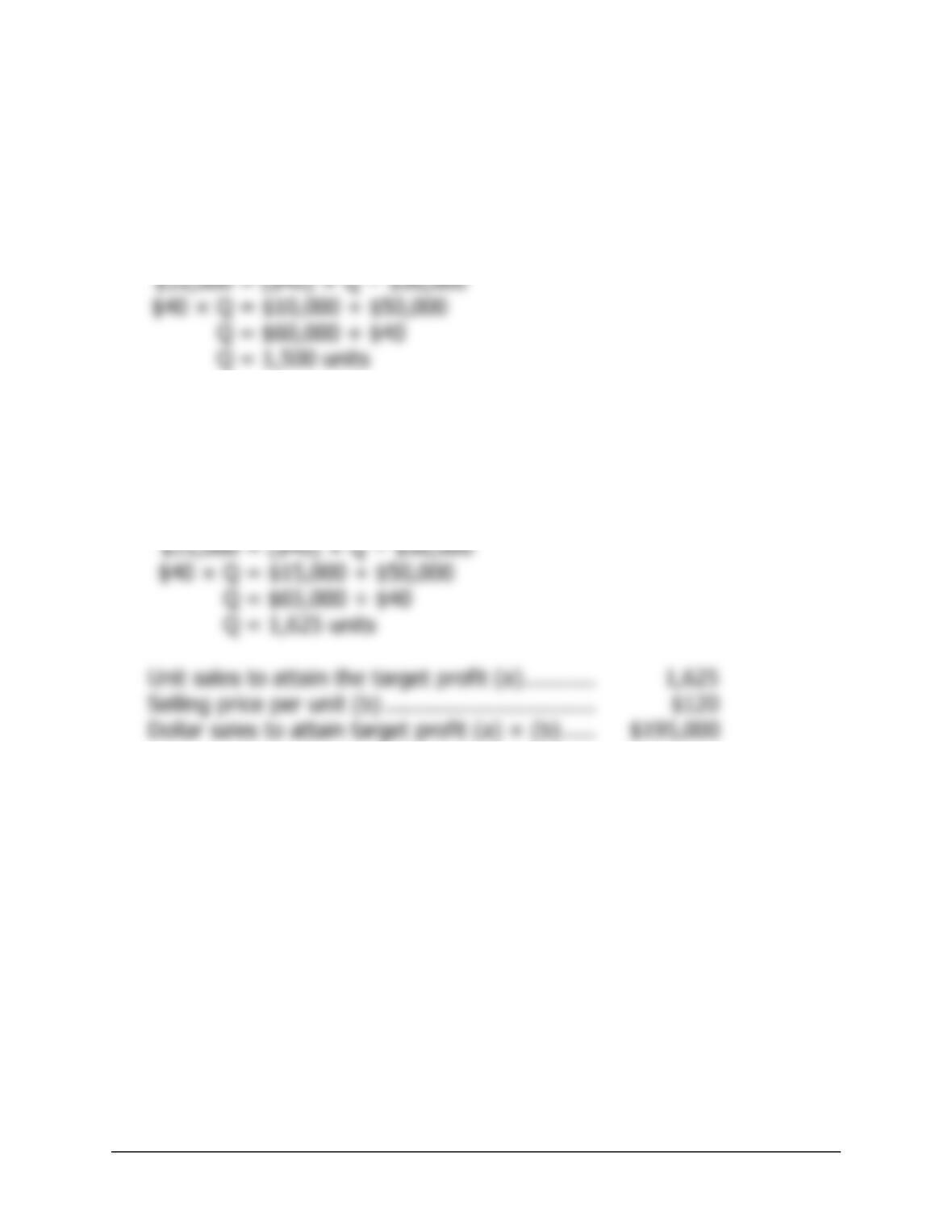
1. The break-even point in unit sales, Q, is computed as follows:
Profit = Unit CM × Q − Fixed expenses
2. The break-even point in dollar sales is computed as follows:
3. The new break-even point in unit sales, Q, is computed as follows:
Profit = Unit CM × Q − Fixed expenses
The break-even point in dollar sales is computed as follows:
Unit sales to break even (a)……………………… 1,600
© The McGraw-Hill Companies, Inc., 2018. All rights reserved.
Solutions Manual, Chapter 5 25
Exercise 5-7 (10 minutes)
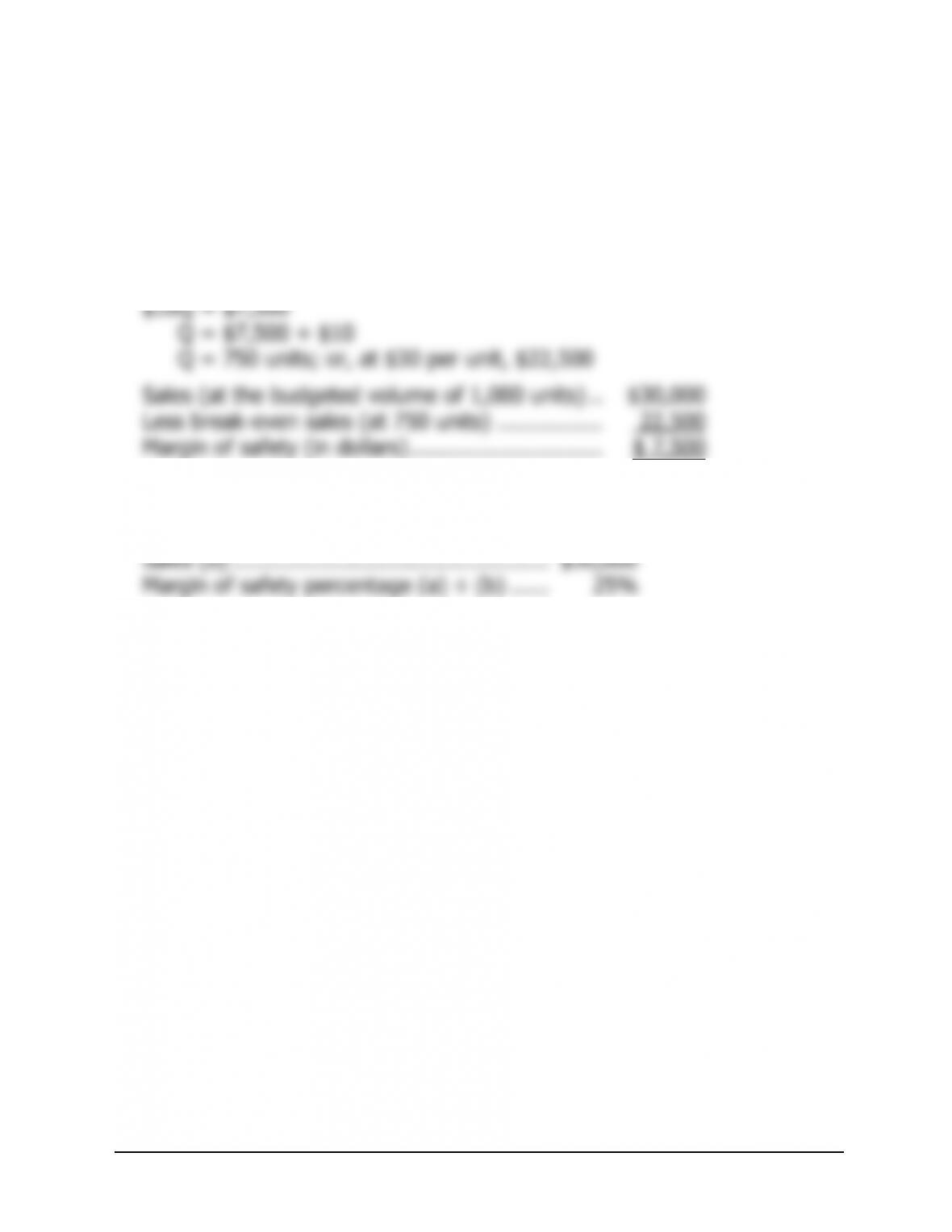
1. The required unit sales, Q, to attain the target profit is computed as
follows:
Profit = Unit CM × Q − Fixed expenses
$10,000 = ($120 − $80) × Q − $50,000
2. One approach to solving this requirement is to compute the unit sales
required to attain the target profit and then multiply this quantity by the
selling price per unit:
Profit = Unit CM × Q − Fixed expenses
$15,000 = ($120 − $80) × Q − $50,000
© The McGraw-Hill Companies, Inc., 2018. All rights reserved.
26 Managerial Accounting, 16th Edition
Exercise 5-8 (10 minutes)
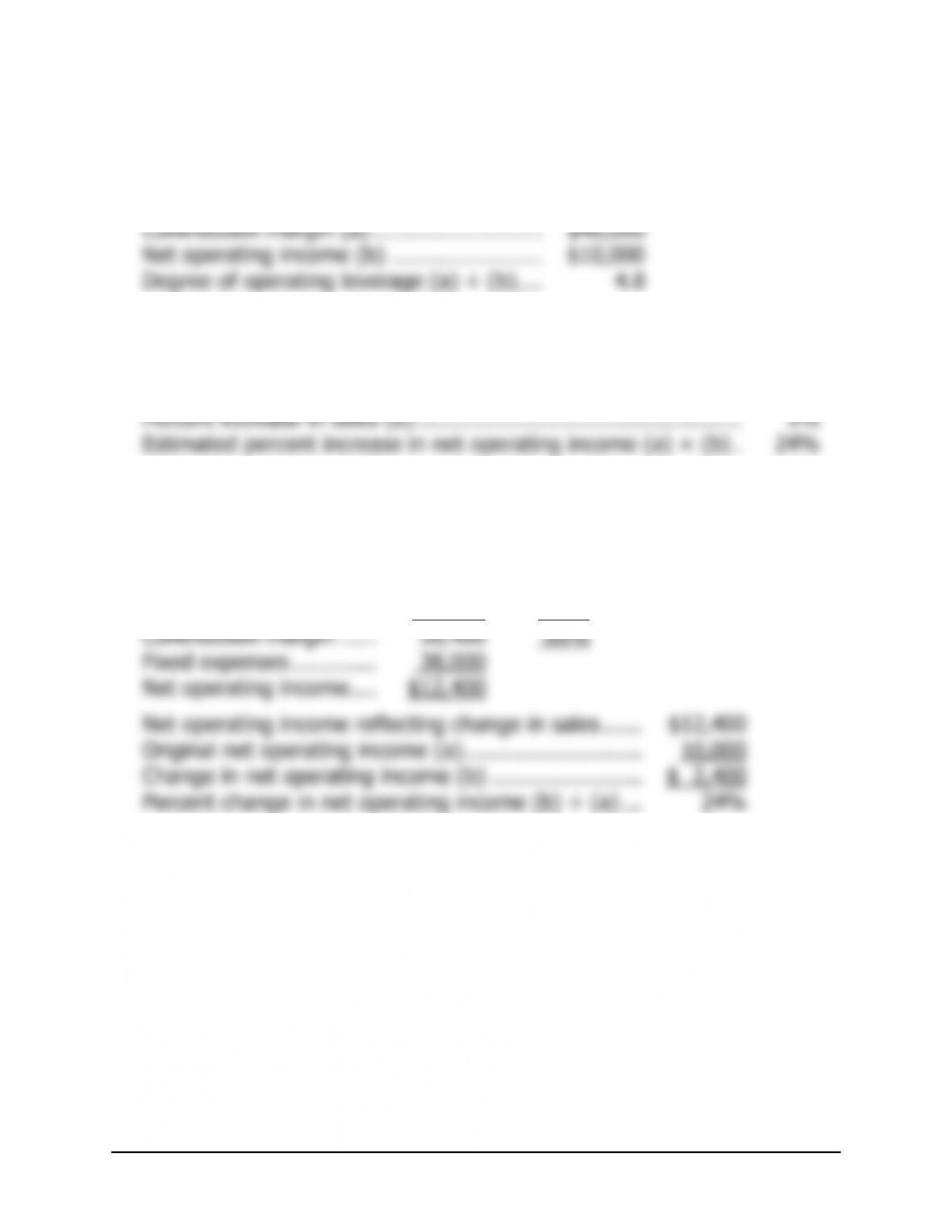
1. To compute the margin of safety, we must first compute the break-even
unit sales.
Profit = Unit CM × Q − Fixed expenses
$0 = ($30 − $20) × Q − $7,500
$0 = ($10) × Q − $7,500
2. The margin of safety as a percentage of sales is as follows:
Mar
g
in of safety (in dollars) (a)……………. $7,500
g
g
© The McGraw-Hill Companies, Inc., 2018. All rights reserved.
Solutions Manual, Chapter 5 27
Exercise 5-9 (20 minutes)
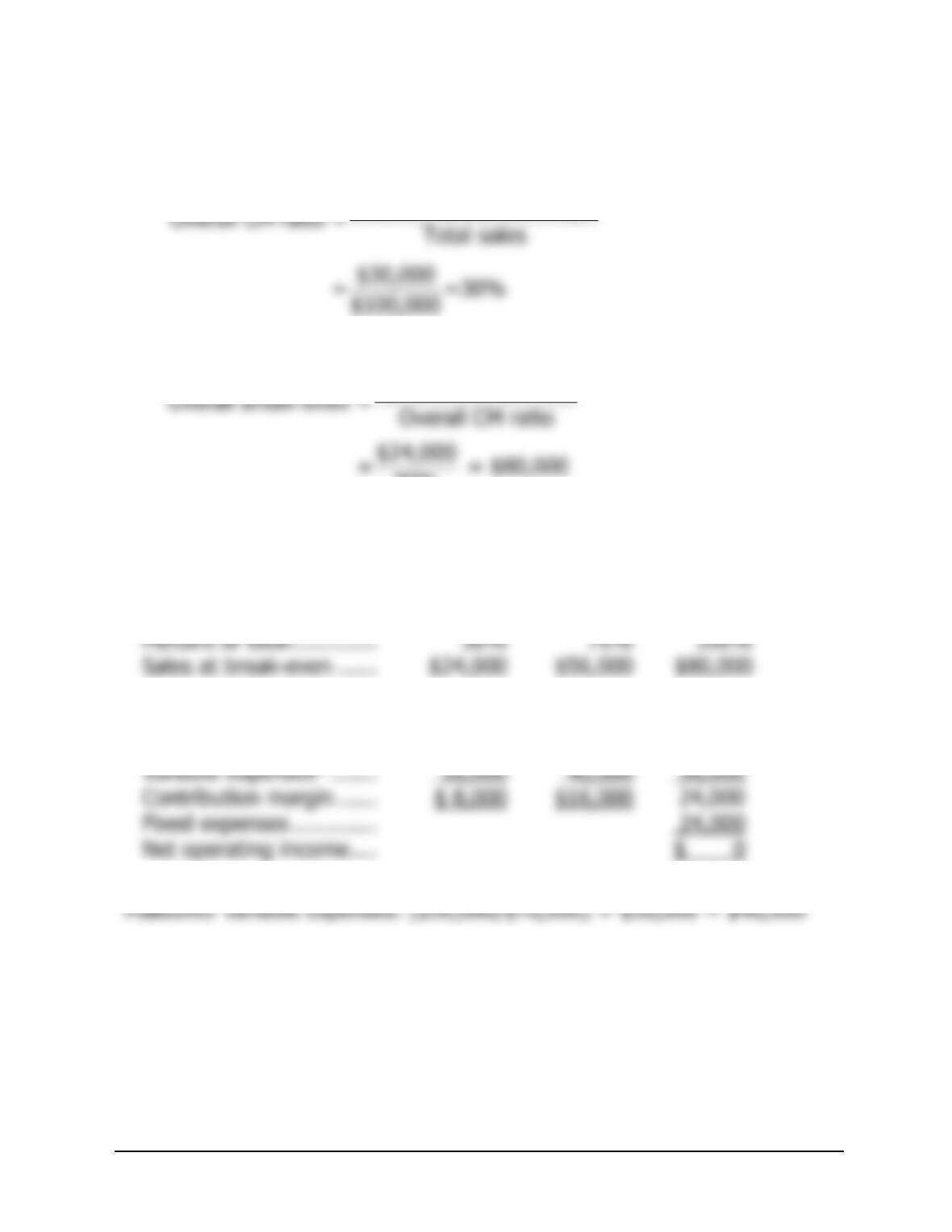
1. The company’s degree of operating leverage would be computed as
follows:
2. A 5% increase in sales should result in a 24% increase in net operating
income, computed as follows:
De
g
ree of operatin
g
levera
g
e (a) …………………………………… 4.8
3. The new income statement reflecting the change in sales is:
Amount
Percent
of Sales
Sales ……………………… $84,000 100%
V
ariable expenses ……… 33,600 40%
g
g
g
© The McGraw-Hill Companies, Inc., 2018. All rights reserved.
28 Managerial Accounting, 16th Edition
Exercise 5-10 (20 minutes)
1. The overall contribution margin ratio can be computed as follows:
T
otal contribution mar
g
in
2. The overall break-even point in dollar sales can be computed as follows:
T
otal fixed expenses
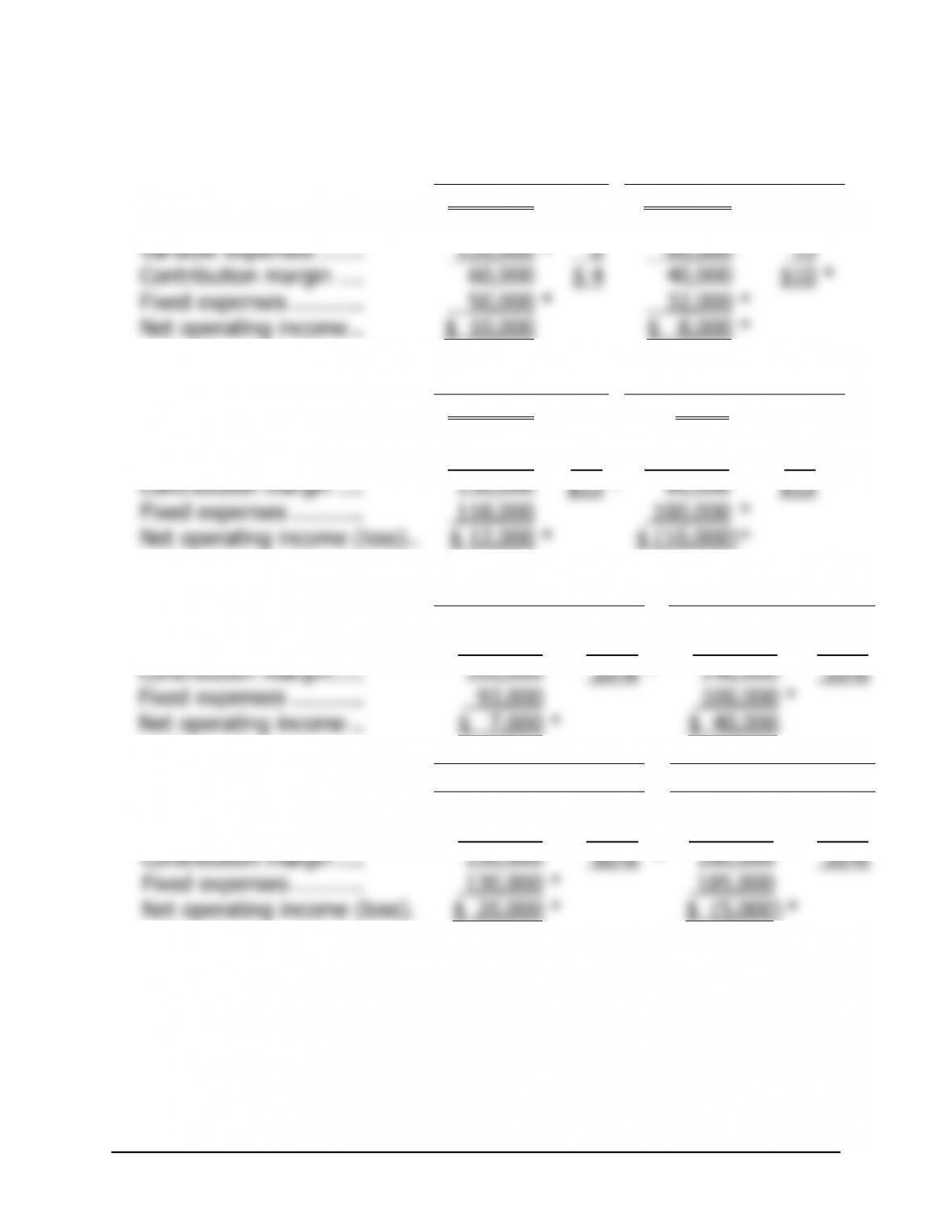
3. To construct the required income statement, we must first determine
the relative sales mix for the two products:
Claimjumper Makeover Total
Ori
g
inal dollar sales ……. $30,000 $70,000 $100,000
Claimjumper Makeover Total
Sales ……………………… $24,000 $56,000 $80,000
V
*Claimjumper variable expenses: ($24,000/$30,000) × $20,000 = $16,000
© The McGraw-Hill Companies, Inc., 2018. All rights reserved.
Solutions Manual, Chapter 5 29
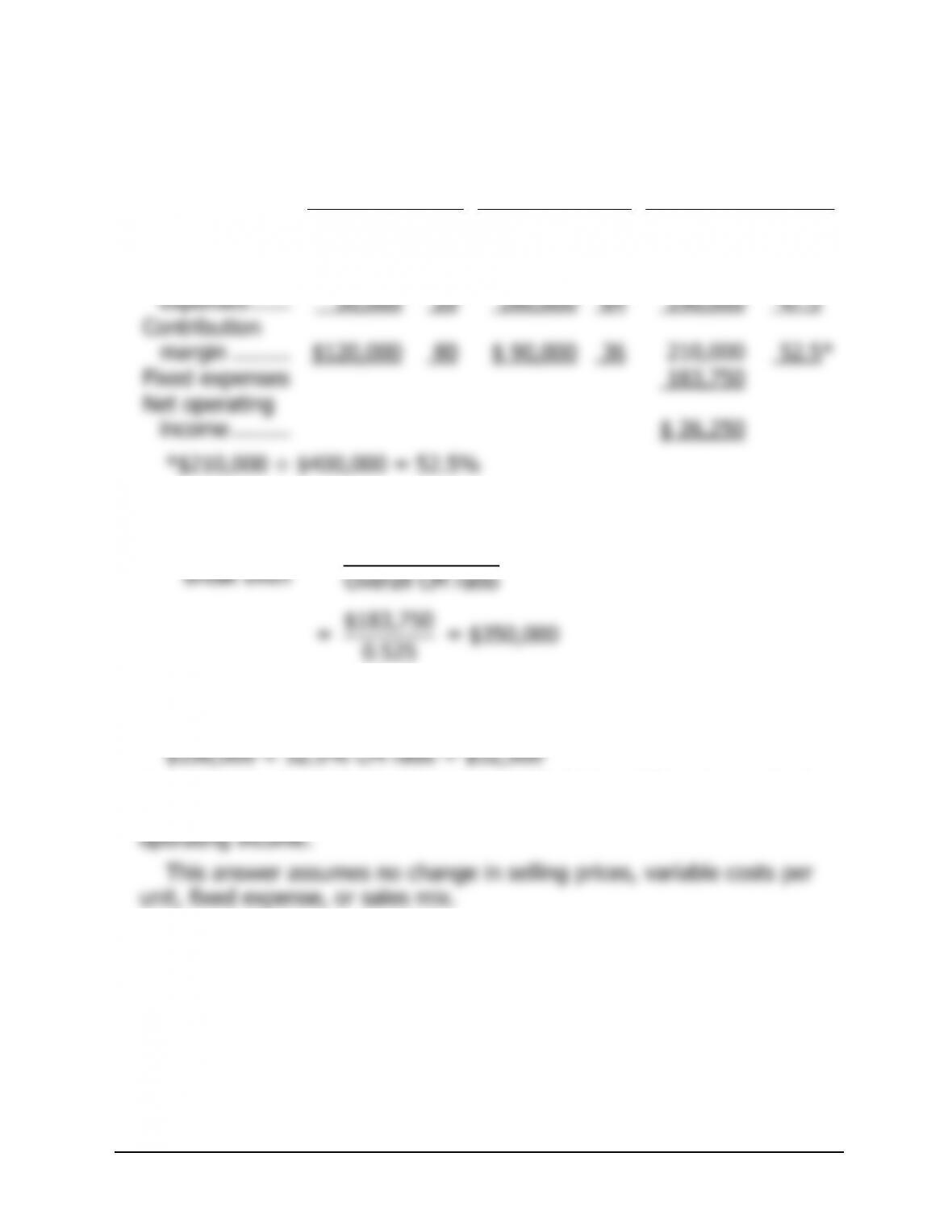
Exercise 5-11 (20 minutes)
a.
Case #1 Case #2
Number of units sold … 15,000 * 4,000
Sales …………………….. $180,000 * $12 $100,000 * $25
Case #3 Case #4
Number of units sold … 10,000 * 6,000 *
Sales …………………….. $200,000 $20 $300,000 * $50
V
ariable expenses ……. 70,000 * 7 210,000 35
b.
Case #1 Case #2
Sales …………………….. $500,000 * 100% $400,000 * 100%
V
ariable expenses ……. 400,000 80% 260,000 * 65%
Case #3 Case #4
Sales ……………………. $250,000 100% $600,000 * 100%
V
ariable expenses ……. 100,000 40% 420,000 * 70%
*Given
V
© The McGraw-Hill Companies, Inc., 2018. All rights reserved.
30 Managerial Accounting, 16th Edition
Exercise 5-12 (30 minutes)
1.
Flight Dynamic Sure Shot Total Company
Amount % Amount % Amount %
Sales ………….. $150,000 100 $250,000 100 $400,000 100.0
V
ariable
2. The break-even point for the company as a whole is:
Fixed expenses
Dollar sales to =
3. The additional contribution margin from the additional sales is computed
as follows:
Assuming no change in fixed expenses, all of this additional contribution
margin of $52,500 should drop to the bottom line as increased net