© The McGraw-Hill Companies, Inc., 2018. All rights reserved.
78 Managerial Accounting, 16th Edition
Exercise 2B-2 (continued)
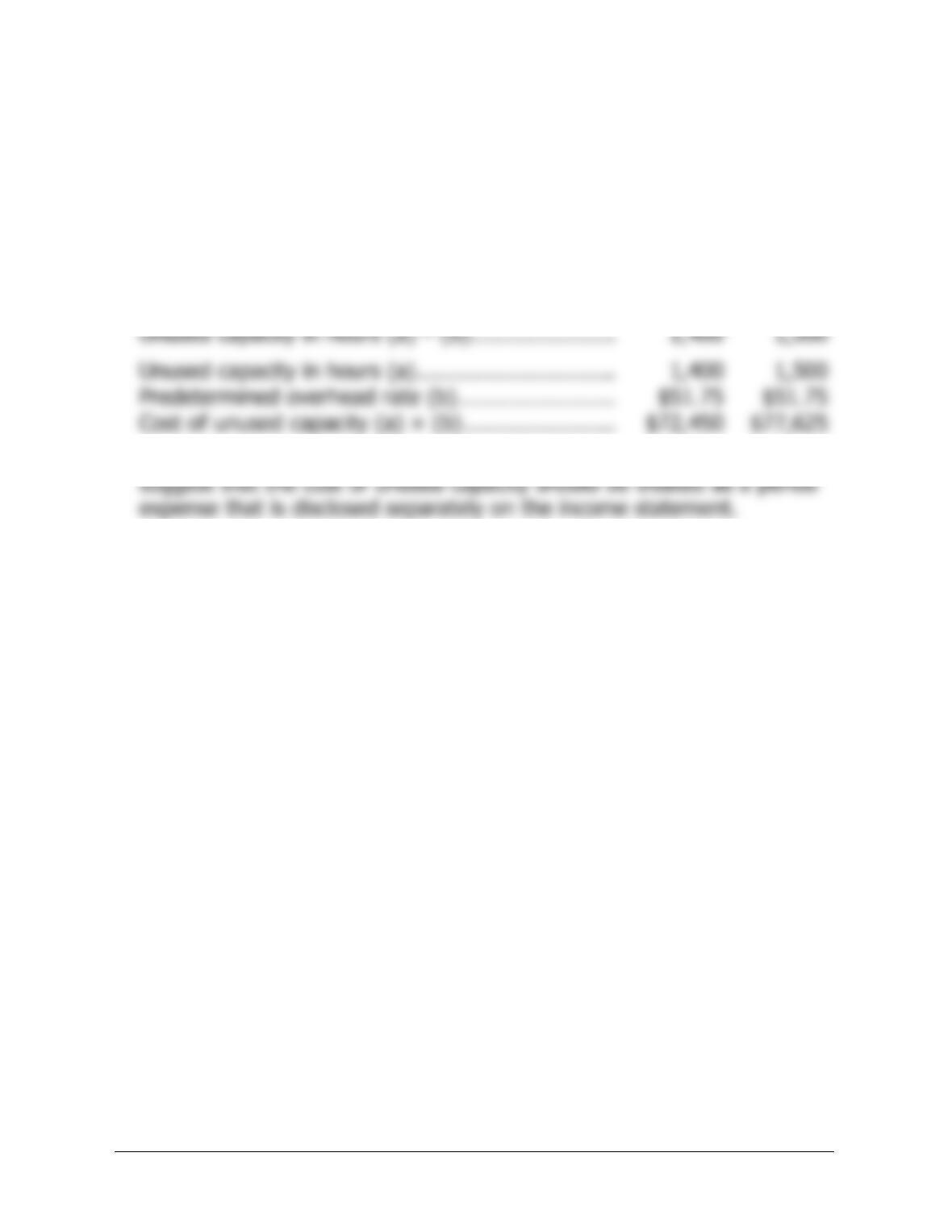
4. If the actual overhead cost and the actual professional staff hours
charged to clients’ accounts turn out to be exactly as estimated, the cost
of unused capacity would be calculated as shown below.
Last Year This Year
A
mount of the allocation base at capacity (a) …… 6,000 6,000
A
ctual amount of the allocation base (b) …………. 4,600 4,500
Proponents of this method of computing predetermined overhead rates
–
© The McGraw-Hill Companies, Inc., 2018. All rights reserved.
Solutions Manual, Appendix 2B 79
Problem 2B-3 (60 minutes)
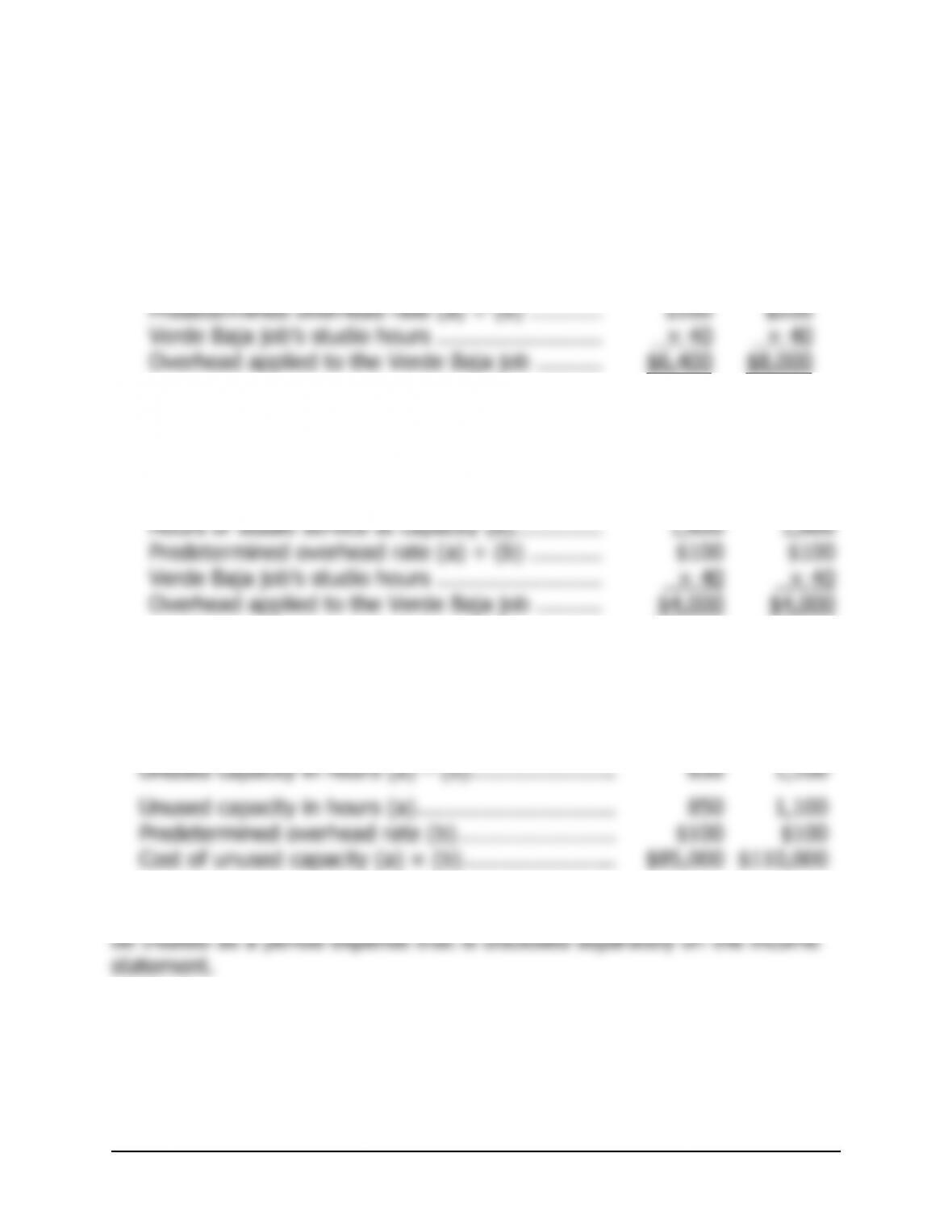
1. The overhead applied to the Verde Baja job is computed as follows:
Last
Year
This
Year
Estimated studio overhead cost (a) …………….. $160,000 $160,000
Estimated hours of studio service (b) ………….. 1,000 800
V
2. If the predetermined overhead rate is based on the hours of studio ser-
vice at capacity, the computations would be:
Last Year This Year
Estimated studio overhead cost at capacity (a). $160,000 $160,000
V
3. The cost of unused capacity for both years is computed as follows:
Last Year This Year
A
mount of the allocation base at capacity (a) …… 1,600 1,600
A
ctual amount of the allocation base (b) …………. 750 500
–
Proponents of this method suggest that the cost of unused capacity should
© The McGraw-Hill Companies, Inc., 2018. All rights reserved.
80 Managerial Accounting, 16th Edition
Problem 2B-3 (continued)
4. Platinum Track’s fundamental problem is the competition that is drawing
customers away. The competition is able to offer the latest equipment,
Under the conventional approach in which the predetermined overhead
rate is based on the estimated studio hours, the apparent cost of the
Verde Baja job has increased between last year and this year. That hap-
pens because the company is losing business to competitors and there-
Under the alternative approach, the overhead cost of the Verde Baja job
is stable at $4,000 and lower than the costs reported under the conven-
tional method. Under the conventional method, managers may be mis-
led into thinking that they are actually losing money on the Verde Baja
job and they might refuse such jobs in the future—another sure road to
While basing the predetermined rate on capacity rather than on esti-
© The McGraw-Hill Companies, Inc., 2018. All rights reserved.
Solutions Manual, Appendix 2B 81
Case 2B-4 (120 minutes)
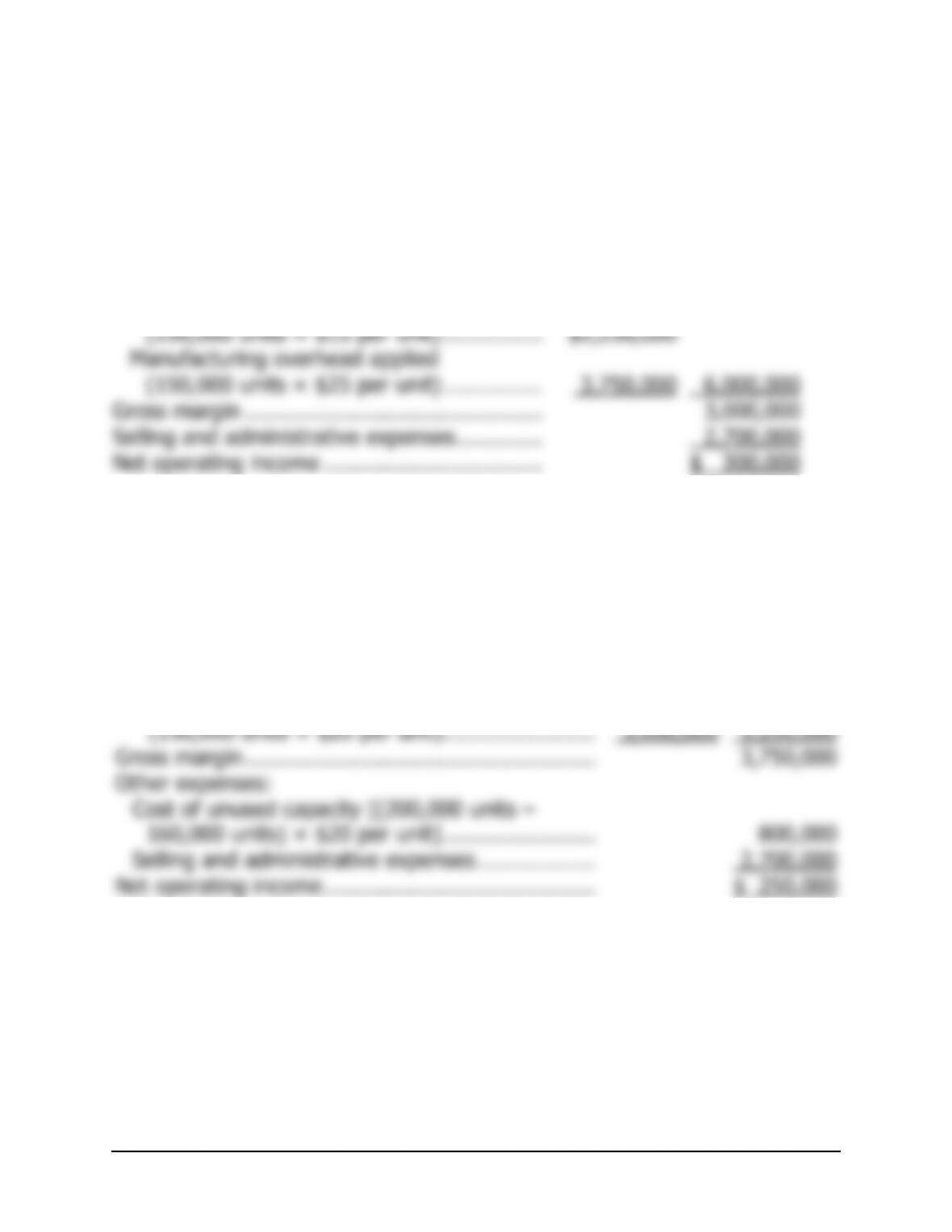
1a.
Vault Hard Drives, Inc.
Income Statement: Traditional Approach
Sales (150,000 units × $60 per unit) ……….. $9,000,000
Cost of
g
oods sold:
Variable manufacturin
g
1b.
Vault Hard Drives, Inc.
Income Statement: New Approach
Sales (150,000 units × $60 per unit) ………………. $9,000,000
Cost of
g
oods sold:
Variable manufacturin
g
(150,000 units × $15 per unit)………………….. $2,250,000
Manufacturin
g
overhead applied
g
© The McGraw-Hill Companies, Inc., 2018. All rights reserved.
82 Managerial Accounting, 16th Edition
Case 2B-4 (continued)
2. Under the traditional approach, all of the company’s fixed manufacturing
overhead must be included in either cost of goods sold (in the income
statement) or ending inventory (in the balance sheet) at the end of an
Since the company has net operating income of $300,000 when it pro-
duces 160,000 units and sells 150,000 units, it needs to produce enough
additional units, beyond 160,000 units, to raise net operating by
A
dditional net operatin
g
income required to attain tar
g
et
net operating income ($500,000 – $300,000) (a) …….. $200,000
Fixed overhead applied to each unit of additional inven-
A
A
* Although overapplied overhead is not explored in detail until the next
chapter, astute students may be curious to know that this answer of
© The McGraw-Hill Companies, Inc., 2018. All rights reserved.
Solutions Manual, Appendix 2B 83
Case 2B-4 (continued)
3. Under the new approach, all of the company’s fixed manufacturing
overhead must be included in either cost of goods sold (in the income
statement), ending inventory (in the balance sheet), or cost of unused
Since the company has net operating income of $250,000 when it pro-
duces 160,000 units and sells 150,000 units, it needs to produce
enough additional units, beyond 160,000 units, to raise net operating
A
dditional net operatin
g
income required to attain tar
g
et
net operating income ($500,000 – $250,000) (a) ………. $250,000
Fixed overhead applied to each unit of additional inven-
A
A
4. Net operating income is more volatile under the new method than under
the old method. The reason for this is that the reported profit per unit
sold is higher under the new method by $5, the difference in the prede-
© The McGraw-Hill Companies, Inc., 2018. All rights reserved.
84 Managerial Accounting, 16th Edition
Case 2B-4 (continued)
5. The “hat trick” is a bit harder to perform under the new method. Under
the old method, the target net operating income can be attained by pro-
ducing an additional 8,000 units. Under the new method, the production
would have to be increased by 12,500 units. Again, this is a conse-
6. One can argue that whether the “hat trick” is unethical depends on the
level of sophistication of the owners of the company and others who
read the financial statements. If they understand the effects of excess
production on net operating income and are not misled, it can be ar-
gued that the hat trick is not unethical. However, if that were the case,
there does not seem to be any reason to use the hat trick. Why would
In our opinion, the hat trick is unethical unless there is a good reason
for increasing production other than to artificially boost the current pe-