© The McGraw-Hill Companies, Inc., 2018. All rights reserved.
Solutions Manual, Appendix 2A 71
Case 2A-6 (continued)
Before we can determine the amount of overhead cost to assign to
the products we must first determine the activity for each of the
products in the six activity centers. The necessary computations fol-
low:
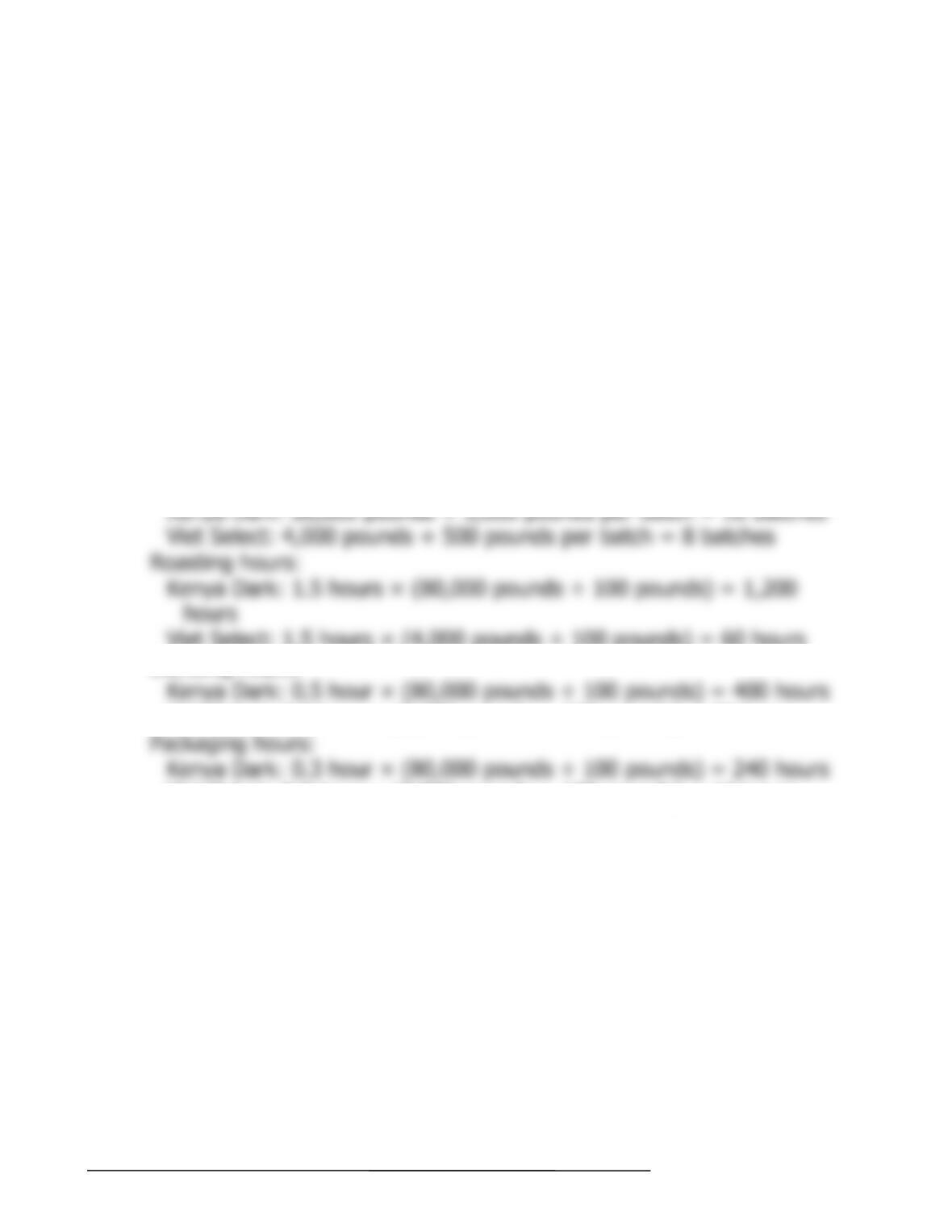
Number of purchase orders:
Number of batches:
Roastin
g
hours:
Blendin
g
hours:
Packa
g
in
g
hours:
© The McGraw-Hill Companies, Inc., 2018. All rights reserved.
72 Managerial Accounting, 16th Edition
Case 2A-6 (continued)
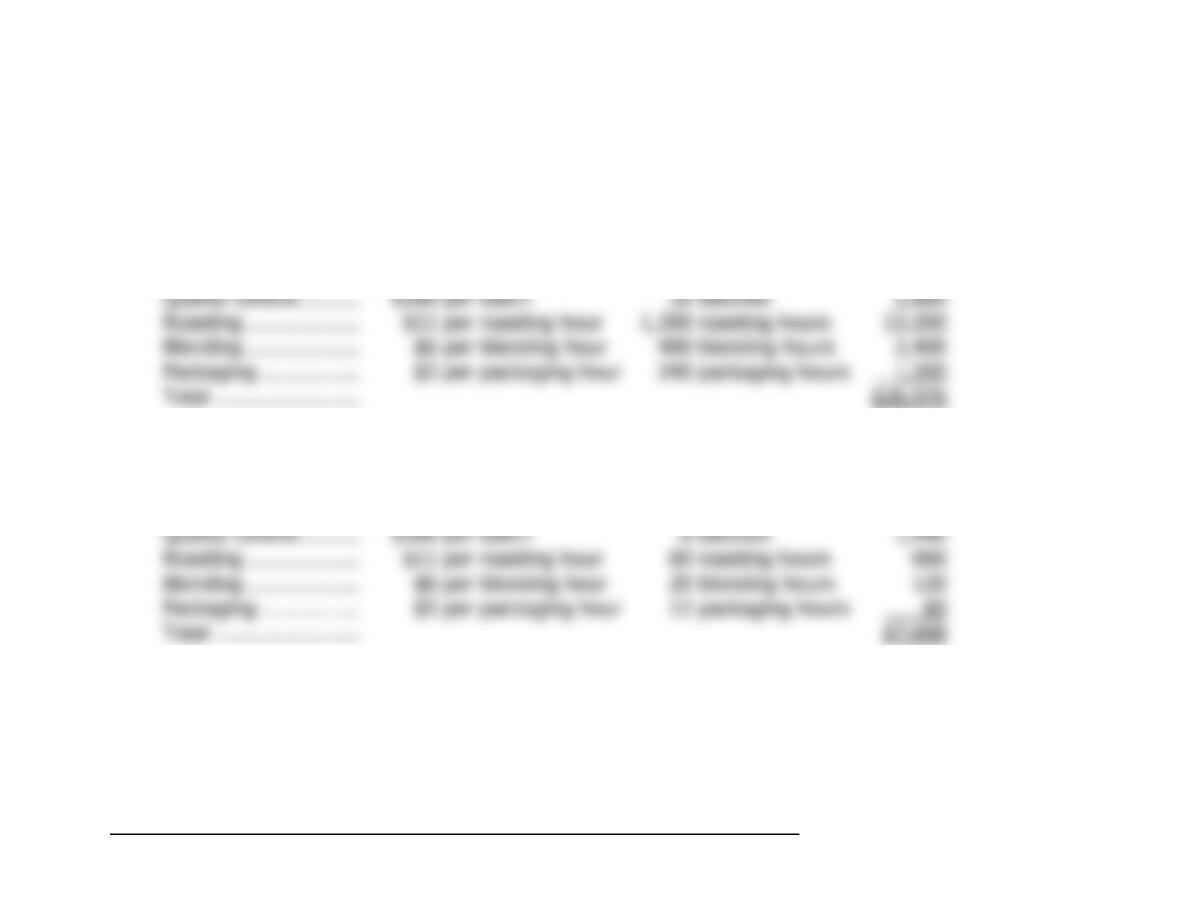
The overhead applied to each product can be determined as follows:
Kenya Dar
k
A
ctivity Cost Poo
l
Activity Rate Expected Activity Amount
Purchasin
g
…………… $280 per orde
r
4 orders $ 1,120
Material handlin
g
…… $193 per setup 32 setups 6,176
V
iet Selec
t
A
ctivity Cost Poo
l
Activity Rate Expected Activity Amount
Purchasin
g
…………… $280 per orde
r
8 orders $2,240
Material handlin
g
…… $193 per setup 16 setups 3,088
© The McGraw-Hill Companies, Inc., 2018. All rights reserved.
Solutions Manual, Appendix 2A 73
Case 2A-6 (continued)
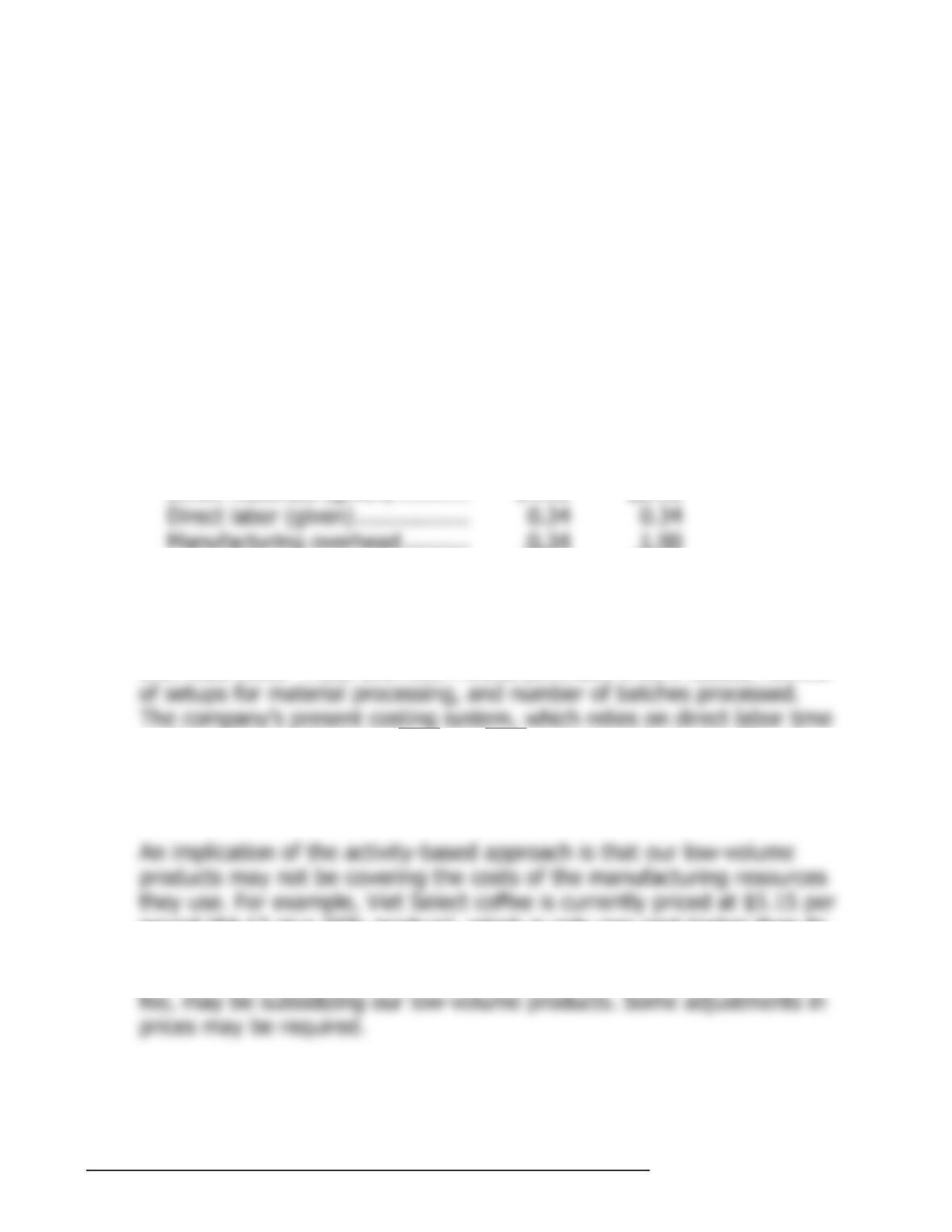
b. According to the activity-based absorption costing system, the manu-
facturing overhead cost per pound is:
Kenya
Dark
Viet
Select
c. The unit product costs according to the activity-based absorption
costing system are:
Kenya
Dark
Viet
Select
Direct materials (
g
iven) ……….. $4.50 $2.90
3. MEMO TO THE PRESIDENT: Analysis of JSI’s data shows that several
activities other than direct labor drive the company’s manufacturing
overhead costs. These activities include purchase orders issued, number
of setups for material processing, and number of batches processed.
An implication of the activity-based approach is that our low-volume
products may not be covering the costs of the manufacturing resources
they use. For example, Viet Select coffee is currently priced at $5.15 per
© The McGraw-Hill Companies, Inc., 2018. All rights reserved.
74 Managerial Accounting, 16th Edition
Case 2A-6 (continued)
ALTERNATIVE SOLUTION:
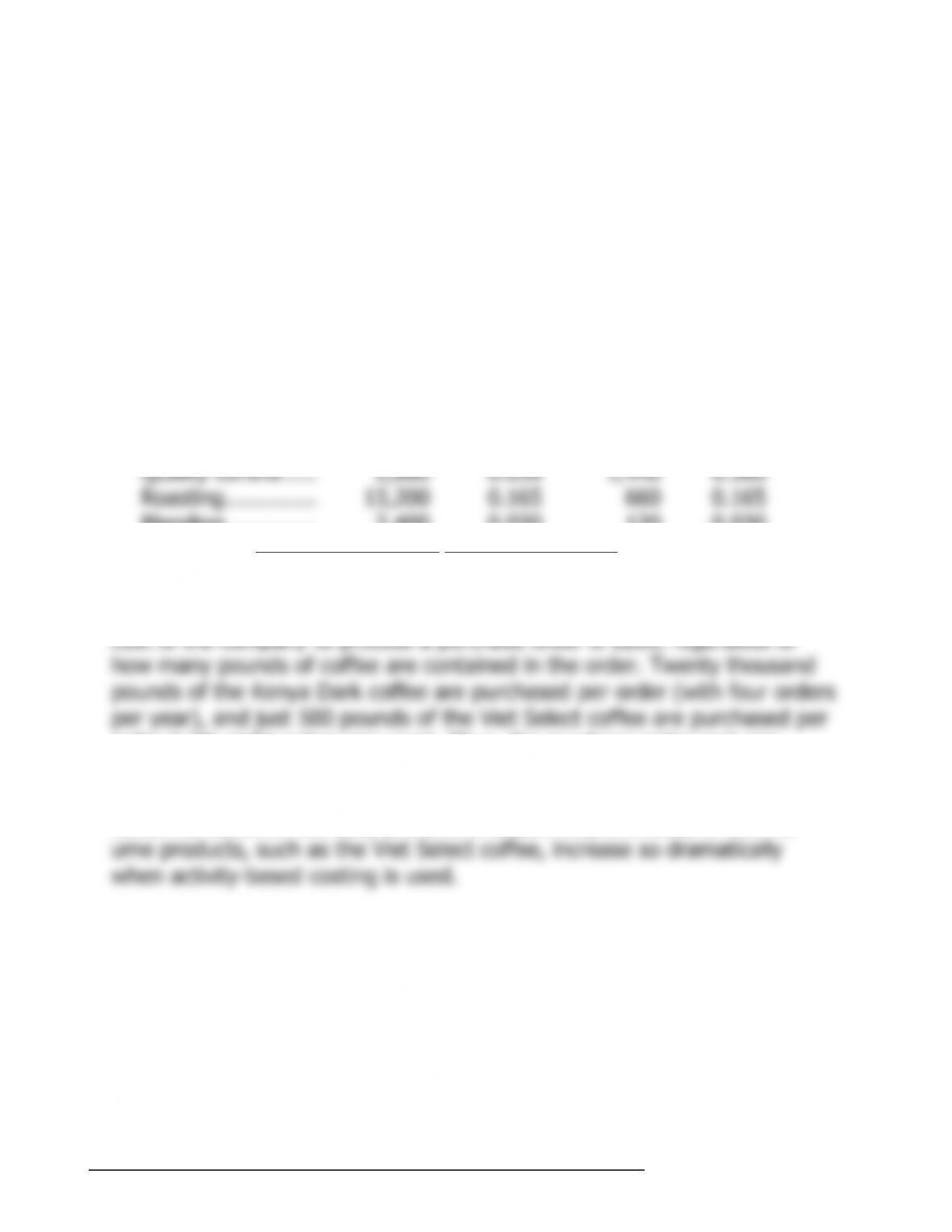
Most students will compute the manufacturing overhead cost per pound
of the two coffees as shown above. However, the per pound cost can
Kenya Dark Viet Select
Total
Per Pound
(÷ 80,000) Total
Per Pound
(÷ 4,000)
Purchasin
g
………. $ 1,120 $0.014 $2,240 $0.560
Material handlin
g
. 6,176 0.077 3,088 0.772
Note particularly how batch size impacts unit cost data. For example, the
cost to the company to process a purchase order is $280, regardless of
how many pounds of coffee are contained in the order. Twenty thousand
pounds of the Kenya Dark coffee are purchased per order (with four orders
© The McGraw-Hill Companies, Inc., 2018. All rights reserved.
Solutions Manual, Appendix 2B 75
Appendix 2B
The Predetermined Overhead Rate
and Capacity
Exercise 2B-1 (20 minutes)
1. There were no beginning or ending inventories, so all of the jobs were
started, finished, and sold during the month. Therefore cost of goods
sold equals the total manufacturing cost. We can verify that by compu-
ting the cost of goods sold as shown below:
Manufacturin
g
costs char
g
ed to
j
obs:
Direct materials ……………………………………. $ 5,350
T
g
A
26,510
Deduct: Endin
g
work in process inventory ……. 0
Cost of
g
oods manufactured……………………… $26,510
Be
g
innin
g
finished
g
oods inventory …………….. $ 0
A
g
At the end of the month, the cost of unused capacity is computed as
shown below:
A
mount of the allocation base at capacity (a). 180 hours
A
ctual amount of the allocation base (b) ……. 150 hours
–
© The McGraw-Hill Companies, Inc., 2018. All rights reserved.
76 Managerial Accounting, 16th Edition
Exercise 2B-1 (continued)
Consequently, the income statement, prepared for internal management
purposes, would appear as follows:
Wixis Cabinets
Income Statement
Sales …………………………………………… $43,740
Cost of
g
oods sold (see above) ………….. 26,510
2. When the predetermined overhead rate is based on capacity, unused
capacity costs ordinarily arise because manufacturing overhead usually
contains significant amounts of fixed costs. Suppose, for example, that
manufacturing overhead includes $10,000 of fixed costs and the capac-
© The McGraw-Hill Companies, Inc., 2018. All rights reserved.
Solutions Manual, Appendix 2B 77
Exercise 2B-2 (30 minutes)
1. The overhead applied to Mrs. Brinksi’s account would be computed as
follows:
Last Year This Year
Estimated overhead cost (a) ……………………….. $310,500 $310,500
Estimated professional staff hours (b) …………… 4,600 4,500
2. If the actual overhead cost and the actual professional hours charged
turn out to be exactly as estimated there would be no cost of unused
capacity.
Last Year This Year
Predetermined overhead rate (see above) ……… $67.50 $69.00
A
ctual professional staff hours char
g
ed to cli-
A
3. If the predetermined overhead rate is based on the professional staff
hours available, the computations would be:
Last Yea
r
T
his Yea
r
Estimated overhead cost (a) ………………………… $310,500 $310,500
Professional staff hours available (b)……..……….. 6,000 6,000