© The McGraw-Hill Companies, Inc., 2018. All rights reserved.
Solutions Manual, Chapter 2 41
Problem 2-16 (30 minutes)
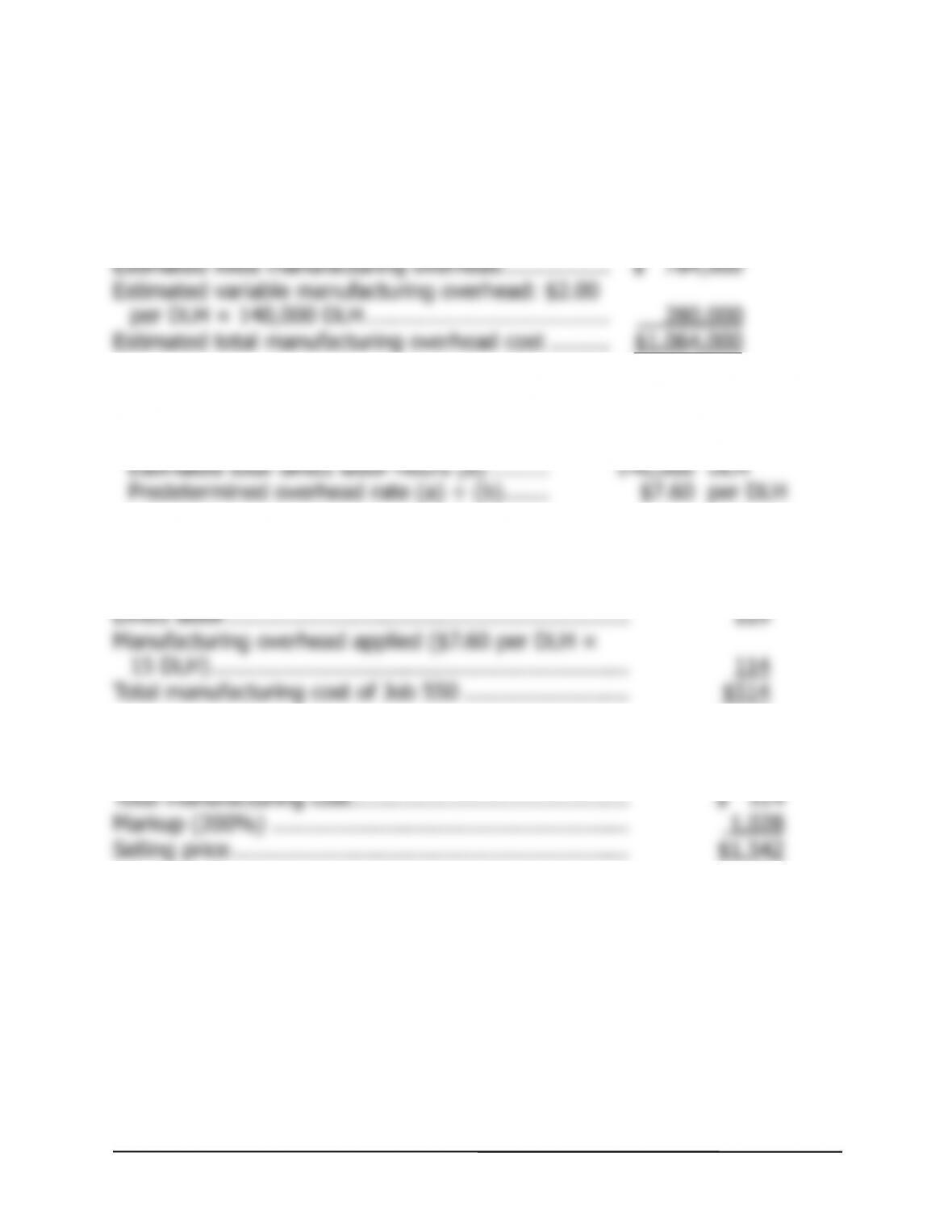
1a. The estimated total overhead cost is computed as follows:
Y = $784,000 + ($2.00 per DLH)(140,000 DLHs)
The predetermined overhead rate is computed as follows:
Estimated total manufacturin
g
overhead (a) $1,064,000
1b. Total manufacturing cost assigned to Job 550:
Direct materials ………………………………………………. $175
1c. The selling price for Job 550 is computed as follows:
Job 55
0
g
© The McGraw-Hill Companies, Inc., 2018. All rights reserved.
42 Managerial Accounting, 16th Edition
Problem 2-16 (continued)
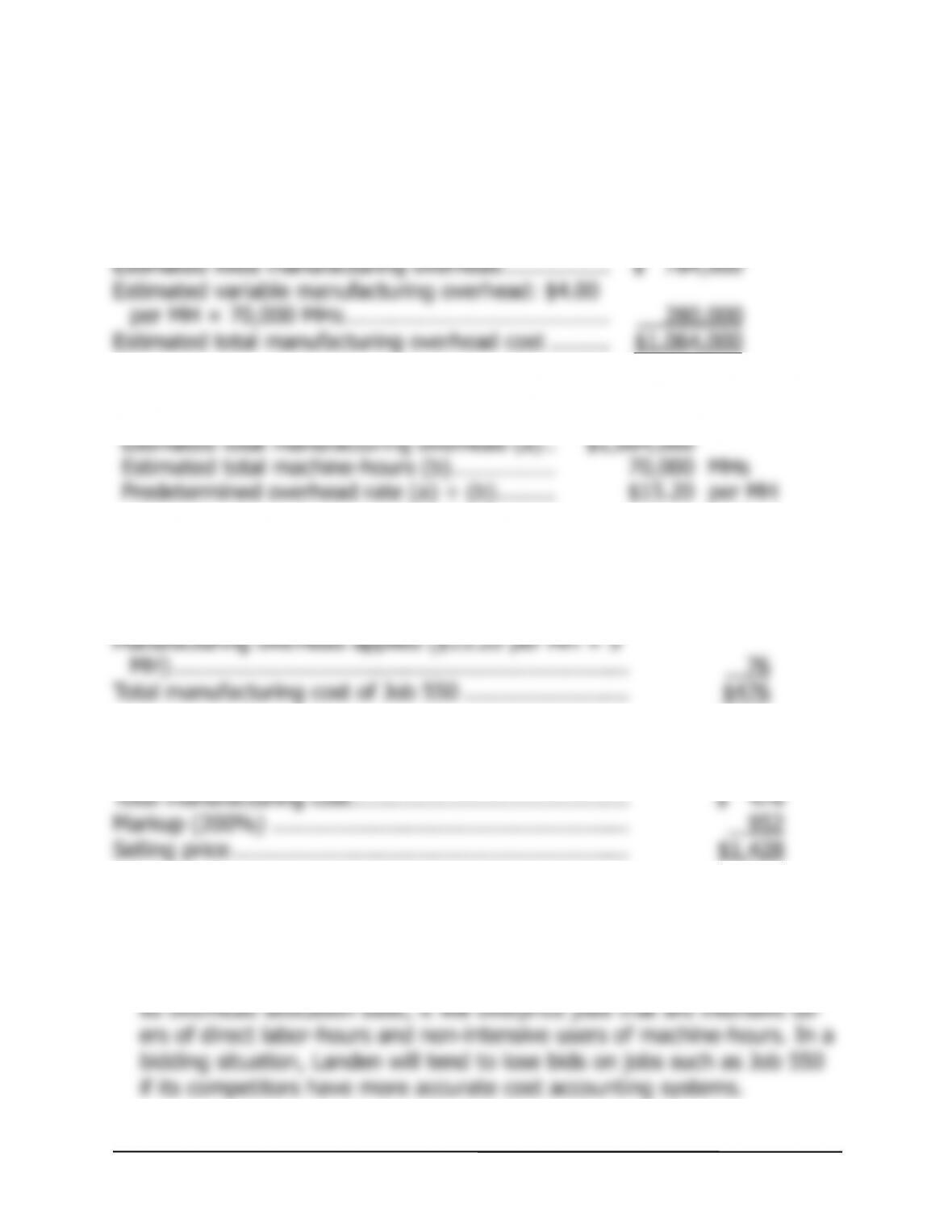
2a. The estimated total overhead cost is computed as follows:
Y = $784,000 + ($4.00 per MH)(70,000 MHs)
The predetermined overhead rate is computed as follows:
2b. Total manufacturing cost assigned to Job 550:
Direct materials ………………………………………………. $175
Direct labor ……………………………………………………. 225
2c. The selling price for Job 550 is computed as follows:
Job 55
0
3. The price for Job 550 using direct labor-hours as the allocation base
($1,542) is $114 higher than the price derived using machine-hours as
the allocation base ($1,428). If machine-hours is the better choice for
an allocation base, then if Landen continues to use direct labor-hours as
© The McGraw-Hill Companies, Inc., 2018. All rights reserved.
Solutions Manual, Chapter 2 43
Problem 2-17 (20 minutes)
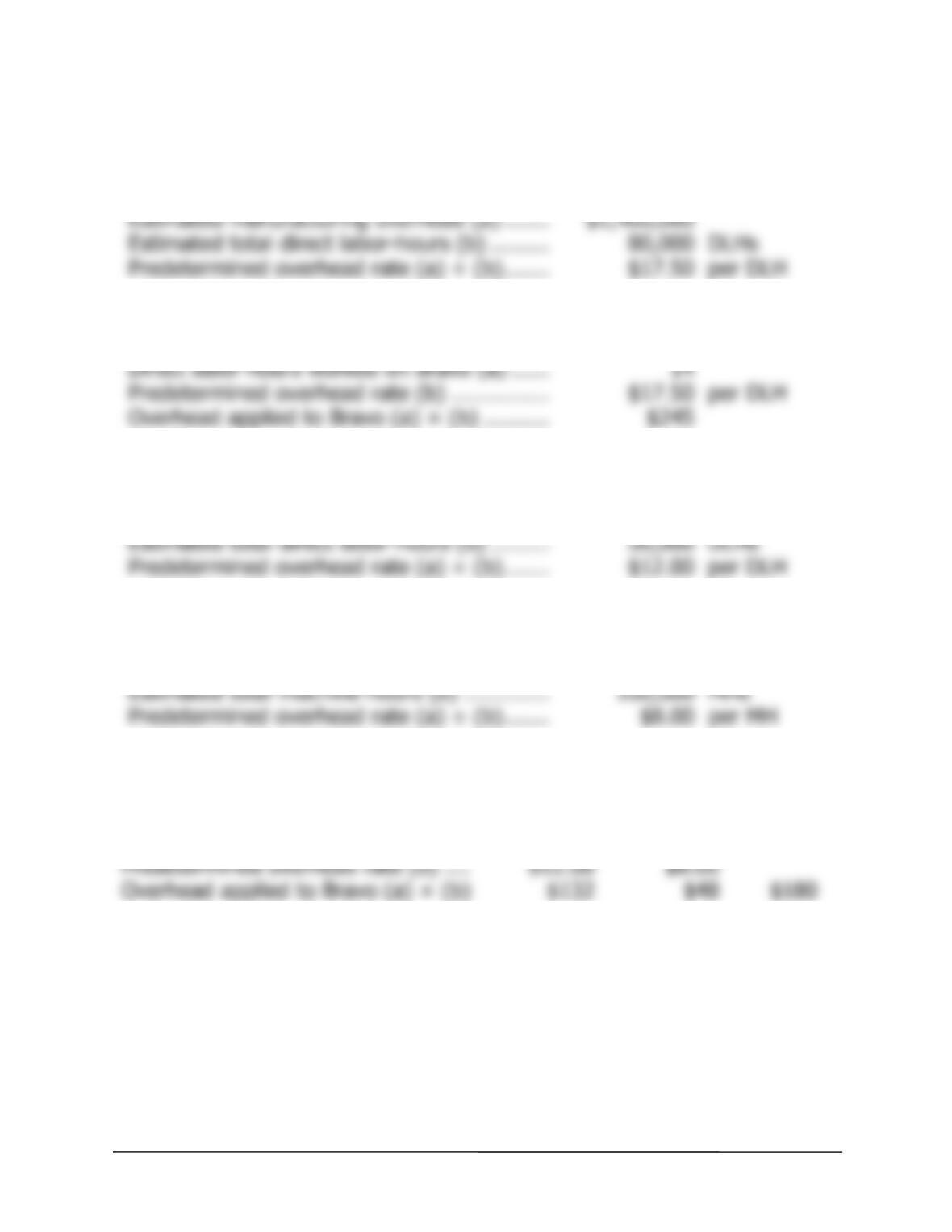
1. The predetermined plantwide overhead rate is computed as follows:
The overhead applied to Job Bravo is computed as follows:
2. The predetermined overhead rate in Assembly is computed as follows:
Estimated manufacturin
g
overhead (a) ……. $600,000
The predetermined overhead rate in Fabrication is computed as follows:
Estimated manufacturin
g
overhead (a) ……. $800,000
The overhead applied to Job Bravo is computed as follows:
A
ssembly Fabrication
T
otal
Quantity of allocation base used (a) 11 6
© The McGraw-Hill Companies, Inc., 2018. All rights reserved.
44 Managerial Accounting, 16th Edition
Problem 2-18 (15 minutes)
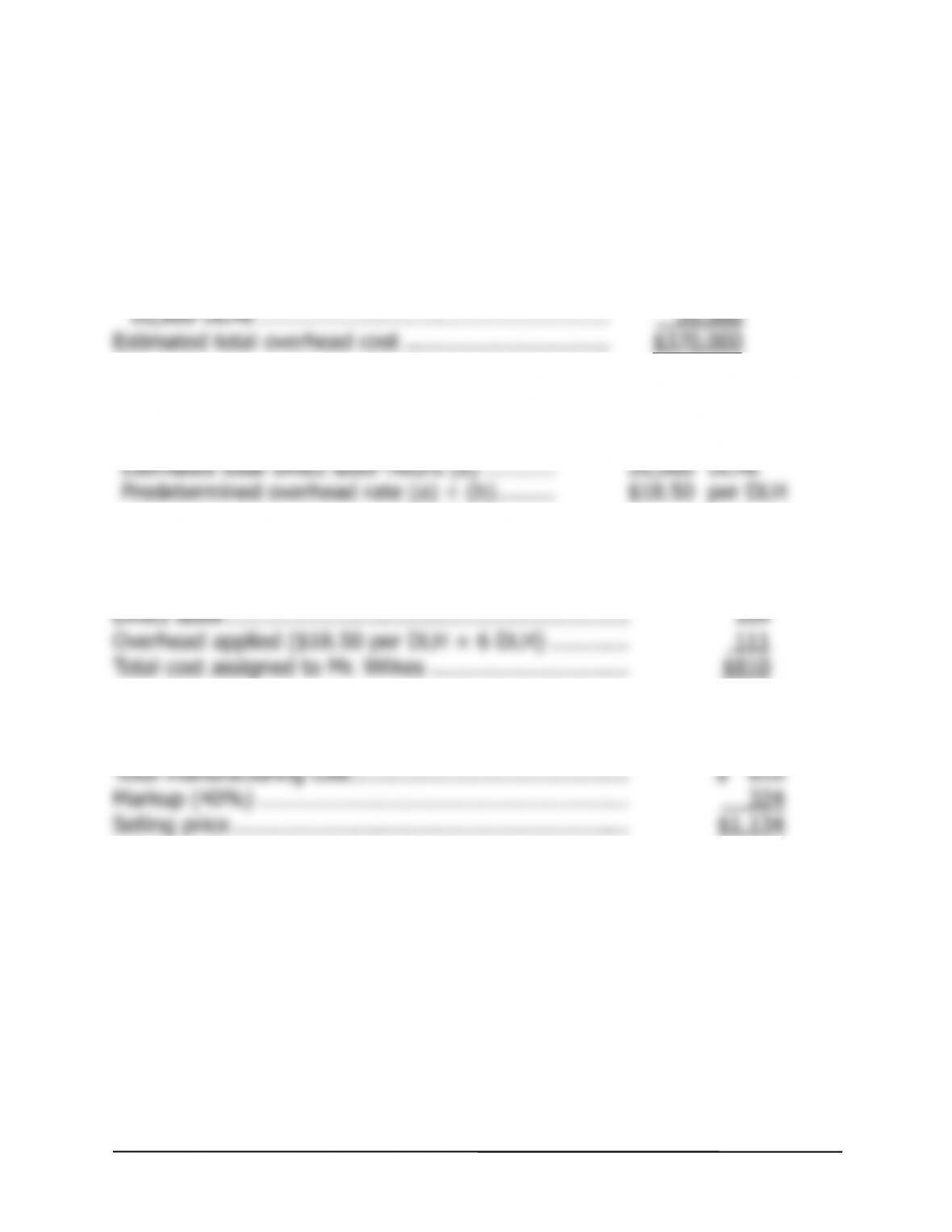
1. The estimated total overhead cost is computed as follows:
Y = $350,000 + ($1.00 per DLH)(20,000 DLHs)
Estimated fixed overhead ……………………………….. $350,000
Estimated variable overhead: $1.00 per DLH ×
The predetermined overhead rate is computed as follows:
Estimated total overhead (a)…………………… $370,000
2. Total manufacturing cost assigned to Mr. Wilkes:
Direct materials ………………………………………………. $590
3. The price charged to Mr. Wilkes is computed as follows:
Job 55
0
© The McGraw-Hill Companies, Inc., 2018. All rights reserved.
Solutions Manual, Chapter 2 45
Problem 2-19 (20 minutes)
1. Molding Department:
The estimated total manufacturing overhead cost in the Molding Depart-
ment is computed as follows:
Y = $497,000 + $1.50 per MH × 70,000 MHs
The predetermined overhead rate is computed as follows:
Painting Department:
The estimated total manufacturing overhead cost in the Painting Depart-
ment is computed as follows:
Y = $615,000 + $2.00 per DLH × 60,000 DLHs
The predetermined overhead rate is computed as follows:
© The McGraw-Hill Companies, Inc., 2018. All rights reserved.
46 Managerial Accounting, 16th Edition
Problem 2-19 (continued)
2. Moldin
g
Department overhead applied:
3. Total cost of Job 205:
Molding
Dept.
Painting
Dept. Total
Direct materials ……………………. $ 770 $1,332 $2,102
T
Unit product cost for Job 205:
T
otal manufacturin
g
cost (a)………………… $6,072
T
© The McGraw-Hill Companies, Inc., 2018. All rights reserved.
Solutions Manual, Chapter 2 47
Problem 2-20 (45 minutes)
1a. The first step is to calculate the total estimated overhead costs in ICU
and Other:
ICU: Using the equation
Y
=
a
+
bX
, the estimated total overhead cost
would be calculated as follows:
Other: Using the equation
Y
=
a
+
bX
, the estimated total overhead cost
would be calculated as follows:
The second step is to combine the estimated overhead costs in ICU and
Other ($3,672,000 + $15,728,000 = $19,400,000) to enable calculating the
predetermined overhead rate as follows:
© The McGraw-Hill Companies, Inc., 2018. All rights reserved.
48 Managerial Accounting, 16th Edition
Problem 2-20 (continued)
1b. The total cost assign to Patients A and B is computed as follows:
Patient A Patient B
2a. The overhead rate in ICU is computed as follows:
Y = $3,200,000 + ($236 per patient-day)(2,000 patient-days)
The predetermined overhead rate is computed as follows:
Estimated total overhead (a) …………… $3,672,000
The overhead rate in Other is computed as follows:
Y = $14,000,000 + ($96 per patient-day)(18,000 patient-days)
The predetermined overhead rate is computed as follows:
© The McGraw-Hill Companies, Inc., 2018. All rights reserved.
Solutions Manual, Chapter 2 49
Problem 2-20 (continued)
2b.
T
he total cost assi
g
ned to Patient A:
Direct materials ………………………………………. $ 4,500
Direct labor ………………………………………….… 25,000
T
he total cost assi
g
ned to Patient B:
Direct materials ………………………………………. $ 6,200
Direct labor ………………………………………….… 36,000
T
3. Relying on just one predetermined overhead rates overlooks the fact
that some departments are more intensive users of overhead resources
than others. As the name implies, patients in the ICU require more in-
T
© The McGraw-Hill Companies, Inc., 2018. All rights reserved.
50 Managerial Accounting, 16th Edition
Problem 2-21 (30 minutes)
1. The plantwide predetermined overhead rate is computed as follows:
The overhead applied to Job A is computed as follows:
Direct labor-hours worked on Job A (a) …… 15
The overhead applied to Job B is computed as follows:
Direct labor-hours worked on Job B (a) …… 9
2. The predetermined overhead rate in Machining is computed as follows:
Estimated manufacturin
g
overhead (a) ……. $500,000
The predetermined overhead rate in Assembly is computed as follows:
Estimated manufacturin
g
overhead (a) ……. $100,000
The overhead applied to Job A is computed as follows:
Machinin
g
A
ssembly
T
otal
Quantity of allocation base used (a) 11 10