© The McGraw-Hill Companies, Inc., 2018. All rights reserved.
Solutions Manual, Chapter 2 31
Exercise 2-12 (20 minutes)
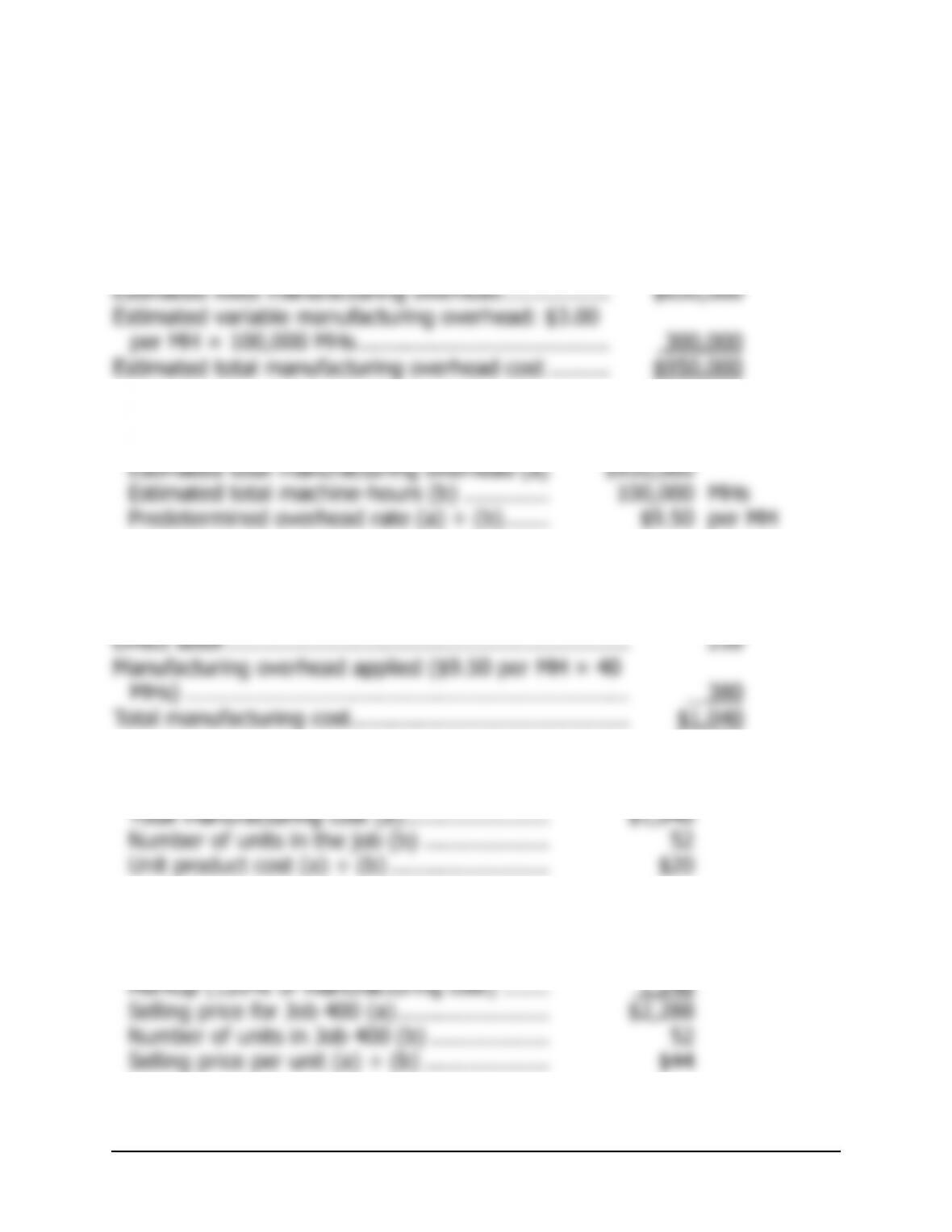
1. The estimated total manufacturing overhead cost is computed as fol-
lows:
Y = $650,000 + ($3.00 per MH)(100,000 MHs)
The plantwide predetermined overhead rate is computed as follows:
2. Total manufacturing cost assigned to Job 400:
Direct materials ………………………………………………. $ 450
T
3. The unit product cost of Job 400 is computed as follows:
T
g
4. The selling price per unit is computed as follows:
T
otal manufacturin
g
cost ……………………… $1,040
© The McGraw-Hill Companies, Inc., 2018. All rights reserved.
32 Managerial Accounting, 16th edition
Exercise 2-12 (continued)
5. Possible critiques of Moody’s pricing tactics include (1) relying on a
plantwide overhead rate to allocate overhead costs to jobs may distort
the cost base used for cost-plus pricing, (2) relying on an absorption ap-
© The McGraw-Hill Companies, Inc., 2018. All rights reserved.
Solutions Manual, Chapter 2 33
Exercise 2-13 (20 minutes)
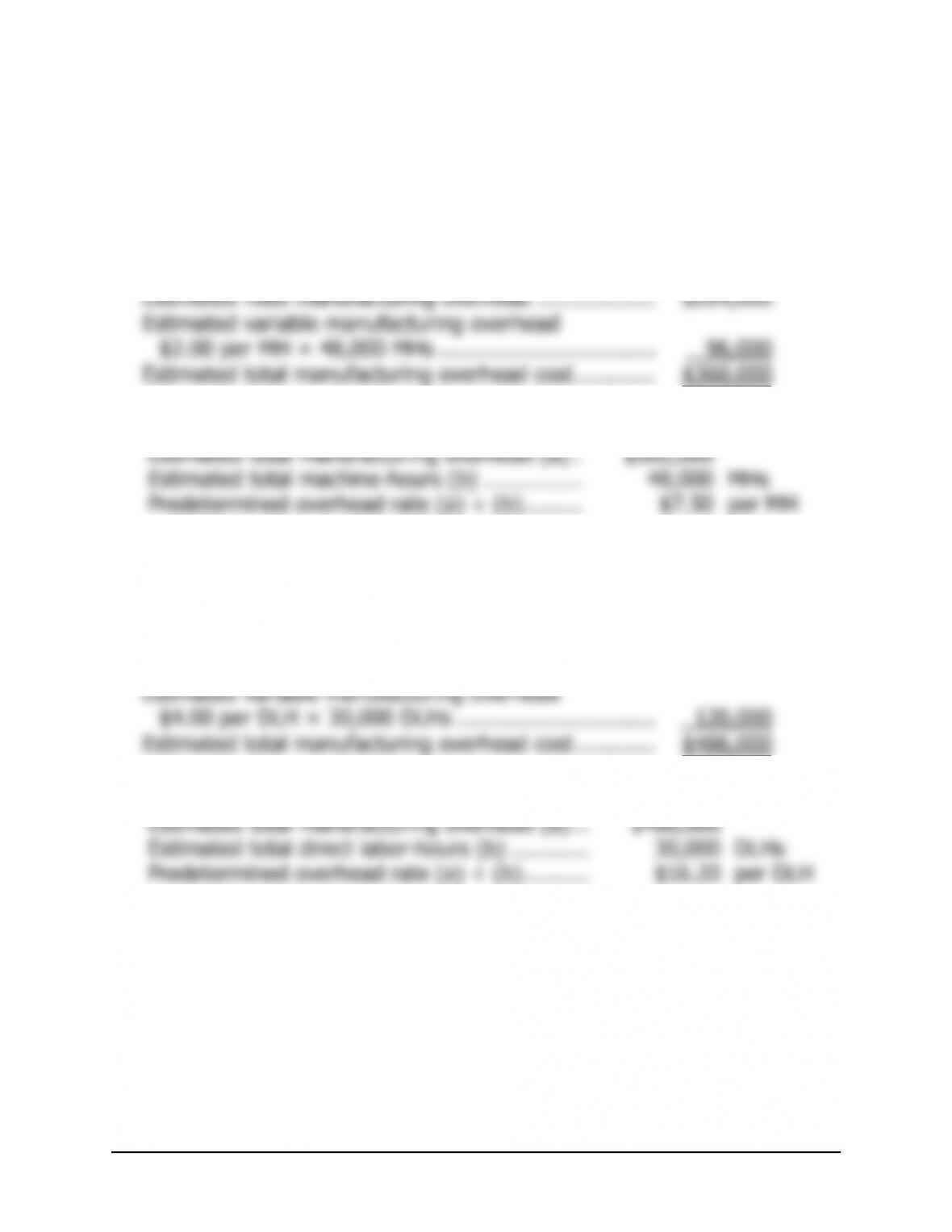
1. Cutting Department:
The estimated total manufacturing overhead cost in the Cutting Depart-
ment is computed as follows:
Y = $264,000 + ($2.00 per MH)(48,000 MHs)
The predetermined overhead rate is computed as follows:
Finishing Department:
The estimated total manufacturing overhead cost in the Finishing De-
partment is computed as follows:
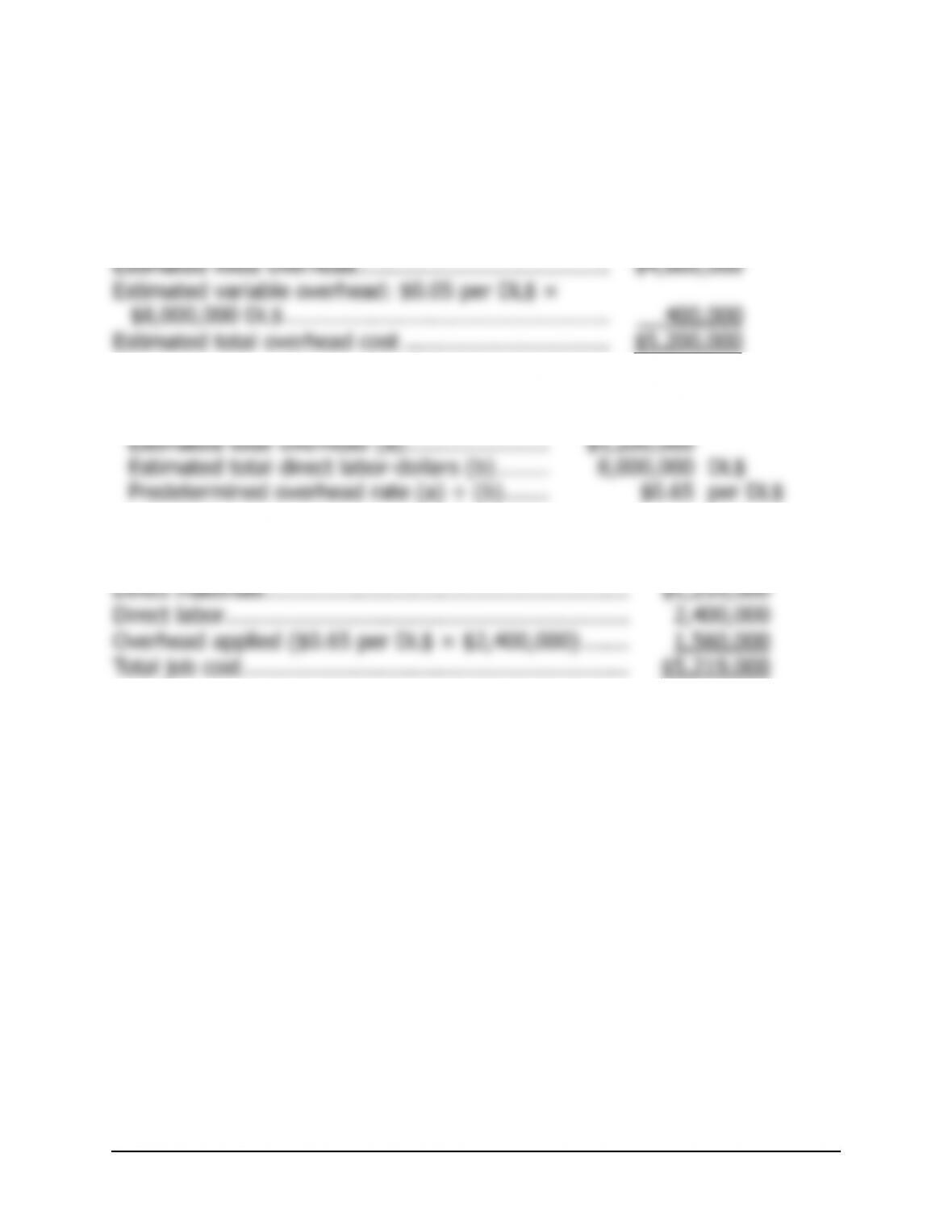
Y = $366,000 + ($4.00 per DLH)(30,000 DLHs)
Estimated fixed manufacturin
g
overhead ……………… $366,000
The predetermined overhead rate is computed as follows:
g
© The McGraw-Hill Companies, Inc., 2018. All rights reserved.
34 Managerial Accounting, 16th edition
Exercise 2-13 (continued)
2.
T
otal manufacturin
g
cost assi
g
ned to Job 203:
Direct materials ($500 + $310)……………………. $ 810
Direct labor ($108 + $360)…………………………. 468
3. Yes; if some jobs require a large amount of machine time and a small
amount of labor time, they would be charged substantially less overhead
T
g
© The McGraw-Hill Companies, Inc., 2018. All rights reserved.
Solutions Manual, Chapter 2 35
Exercise 2-14 (10 minutes)
1. The estimated total overhead cost is computed as follows:
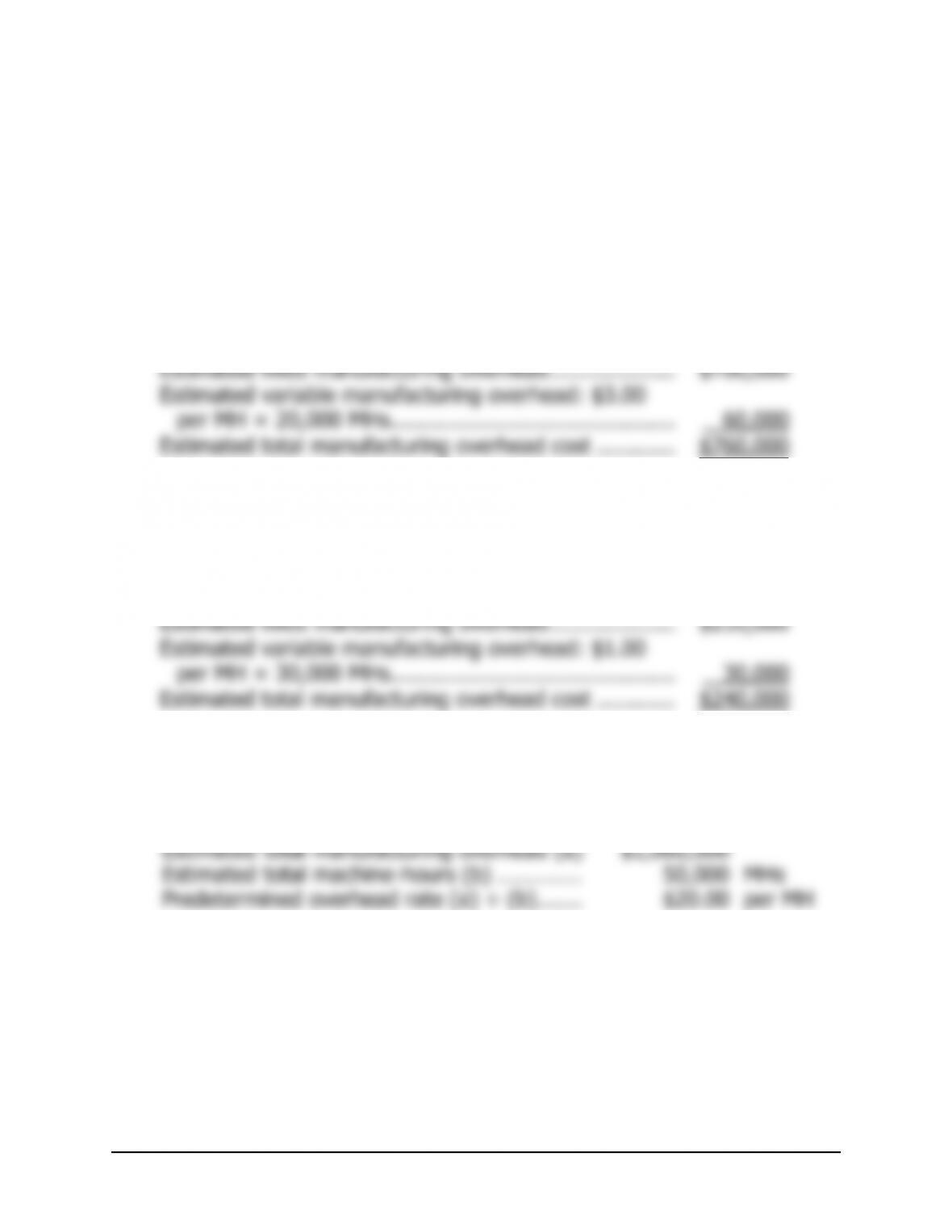
Y = $4,800,000 + ($0.05 per DL$)($8,000,000)
The predetermined overhead rate is computed as follows:
2. Total cost assigned to
You Can Say That Again
:
© The McGraw-Hill Companies, Inc., 2018. All rights reserved.
36 Managerial Accounting, 16th edition
Exercise 2-15 (45 minutes)
1a. The first step is to calculate the estimated total overhead costs in
Molding and Fabrication:
Molding: Using the equation
Y
=
a
+
bX
, the estimated total manufac-
turing overhead cost would be calculated as follows:
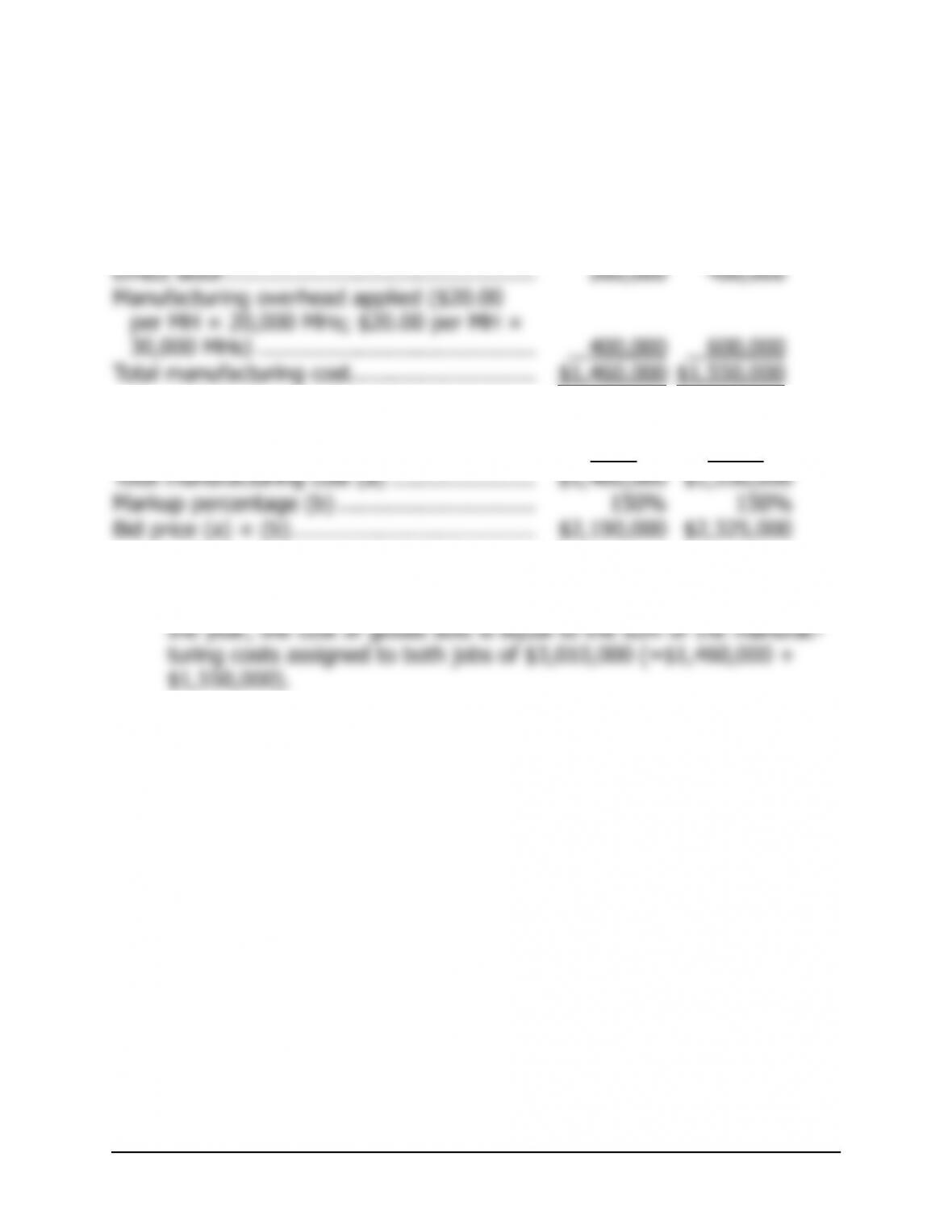
Y = $700,000 + ($3.00 per MH)(20,000 MHs)
Fabrication: Using the equation
Y
=
a
+
bX
, the estimated total manu-
facturing overhead cost would be calculated as follows:
Y = $210,000 + ($1.00 per MH)(30,000 MHs)
The second step is to combine the estimated manufacturing overhead
costs in Molding and Fabrication ($760,000 + $240,000 = $1,000,000)
to enable calculating the predetermined overhead rate as follows:
© The McGraw-Hill Companies, Inc., 2018. All rights reserved.
Solutions Manual, Chapter 2 37
Exercise 2-15 (continued)
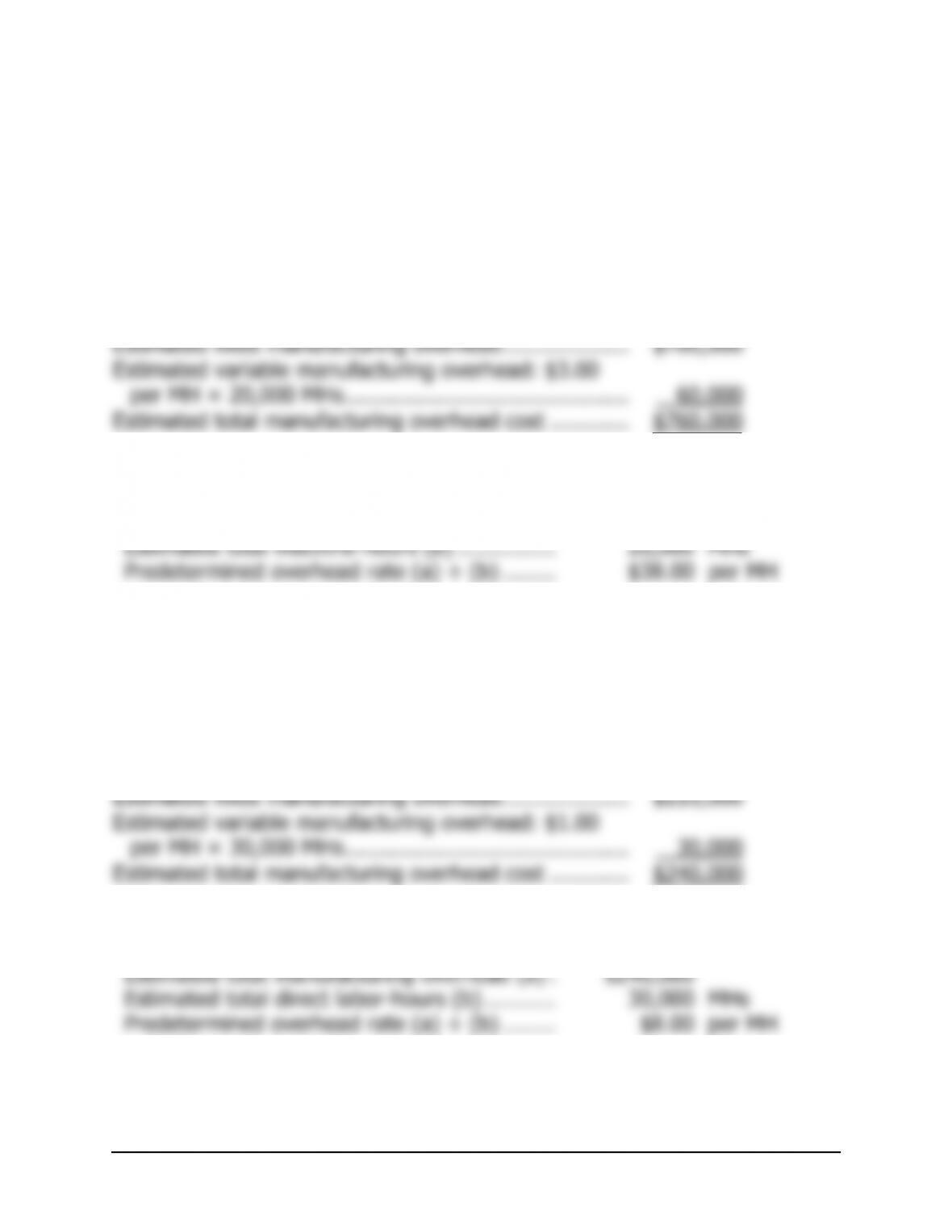
1b. Total manufacturing cost assigned to Jobs D-70 and C-200:
D
–
7
0
C
–
2
0
0
Direct materials ………………………………….. $ 700,000 $ 550,000
1c. Bid prices for Jobs D-70 and
C
-200:
D
–
7
0
C
–
2
0
0
1d. Because the company has no beginning or ending inventories and
only Jobs D-70 and C-200 were started, completed, and sold during
© The McGraw-Hill Companies, Inc., 2018. All rights reserved.
38 Managerial Accounting, 16th edition
Exercise 2-15 (continued)
2a. Molding Department:
Using the equation
Y
=
a
+
bX
, the estimated total manufacturing over-
head cost would be depicted as follows:
Y = $700,000 + ($3.00 per MH)(20,000 MHs)
The predetermined overhead rate is computed as follows:
Estimated total manufacturin
g
overhead (a) . $760,000
Fabrication Department:
Using the equation
Y
=
a
+
bX
, the estimated total manufacturing over-
head cost would be depicted as follows:
Y = $210,000 + ($1.00 per MH)(30,000 MHs)
The predetermined overhead rate is computed as follows:
g
© The McGraw-Hill Companies, Inc., 2018. All rights reserved.
Solutions Manual, Chapter 2 39
Exercise 2-15 (continued)
2b. Total manufacturing costs assigned to Jobs D-70 and C-200:
D
–
7
0
C
–
2
0
0
Direct materials ………………………………………. $ 700,000 $ 550,000
Direct labor ………………………………………….... 360,000 400,000
Moldin
g
Department (14,000 MHs × $38 per
2c. Bid prices for Jobs D-70 and C-200:
D
–
7
0
C
–
2
0
0
2d. Because the company has no beginning or ending inventories and
only Jobs D-70 and C-200 were started, completed, and sold during
3. The plantwide and departmental approaches for applying manufacturing
overhead costs to products produce identical cost of goods sold figures.
However, these two approaches lead to different bid prices for Jobs D-
70 and C-200. The bid price for Job D-70 using the departmental ap-
proach is $270,000 (=$2,460,000 ‒ $2,190,000) higher than the bid
© The McGraw-Hill Companies, Inc., 2018. All rights reserved.
40 Managerial Accounting, 16th Edition
Exercise 2-15 (continued)
Whether a job-order costing system relies on plantwide overhead cost allo-
cation or departmental overhead cost allocation does not usually have an
important impact on the accuracy of the cost of goods sold reported for the
company as a whole. However, it can have a huge impact on internal deci-