© The McGraw-Hill Companies, Inc., 2018. All rights reserved.
Solutions Manual, Chapter 2 1
Chapter 2
Job-Order Costing: Calculating Unit Product
Costs
Questions
2-1 Job-order costing is used in situations
2-2 In absorption costing, all manufacturing
2-3 Normal costing systems apply overhead
costs to jobs by multiplying a predetermined
2-5 The first step is to estimate the total
amount of the allocation base (the denominator)
that will be required for next period’s estimated
level of production. The second step is to esti-
ufacturing overhead costs applied to the job.
When a job is completed, the job cost sheet is
manager’s salary cannot be traced to a particular
product or job, but rather are incurred as a result
2-8 If actual manufacturing overhead cost is
applied to jobs, the company must wait until the
2-9 The measure of activity used as the allo-
cation base should drive the overhead cost; that
is, the allocation base should cause the overhead
may not be sold at prices sufficient to cover all
© The McGraw-Hill Companies, Inc., 2018. All rights reserved.
2 Managerial Accounting, 16th edition
2-11 No, you would not expect the total ap-
plied overhead for a period to equal the actual
overhead for that period. This is because the ap-
2-13 A plantwide overhead rate is a single
overhead rate used throughout a plant. In a mul-
tiple overhead rate system, each production de-
© The McGraw-Hill Companies, Inc., 2018. All rights reserved.
Solutions Manual, Chapter 2 3
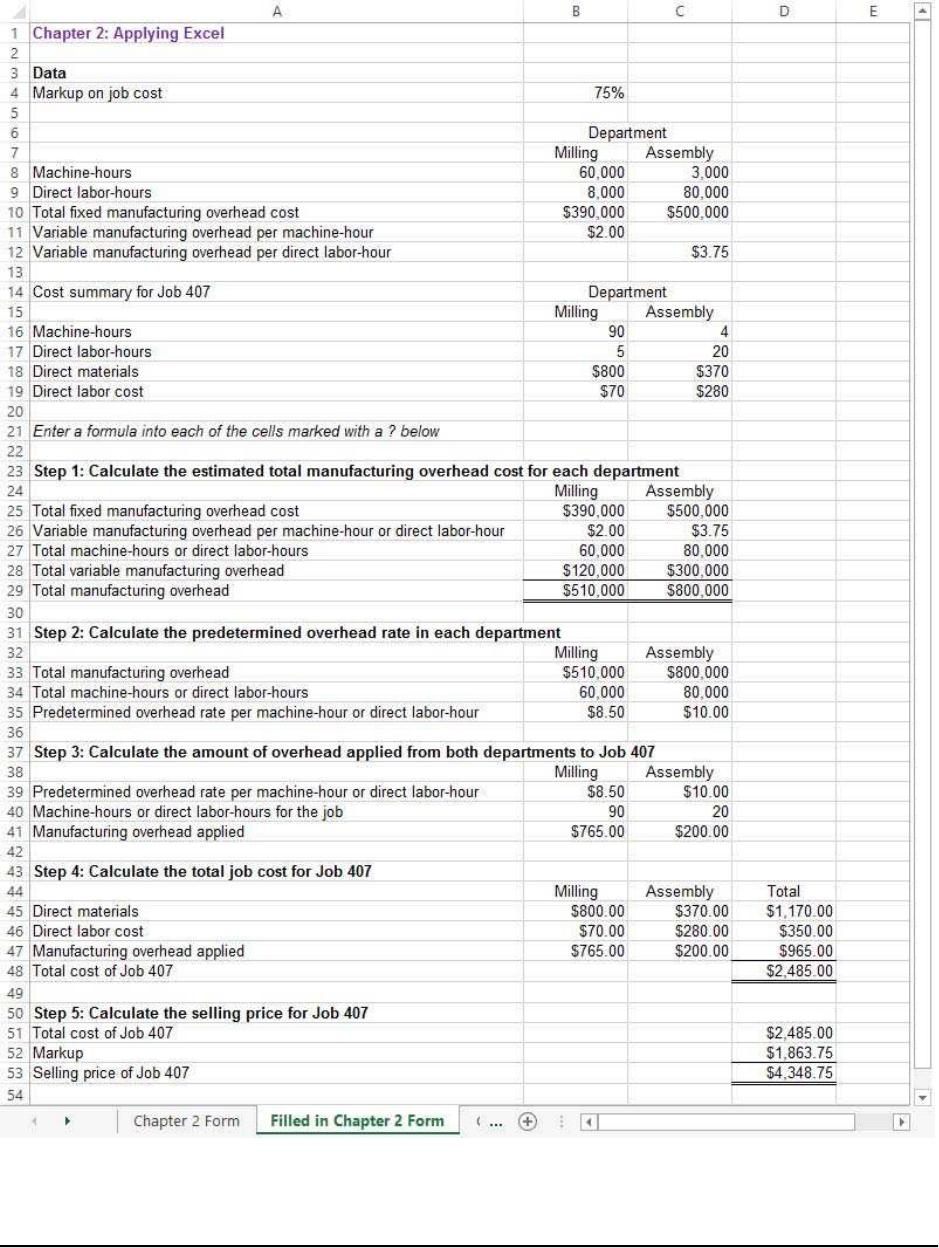
Chapter 2: Applying Excel
The completed worksheet is shown below.
© The McGraw-Hill Companies, Inc., 2018. All rights reserved.
4 Managerial Accounting, 16th edition
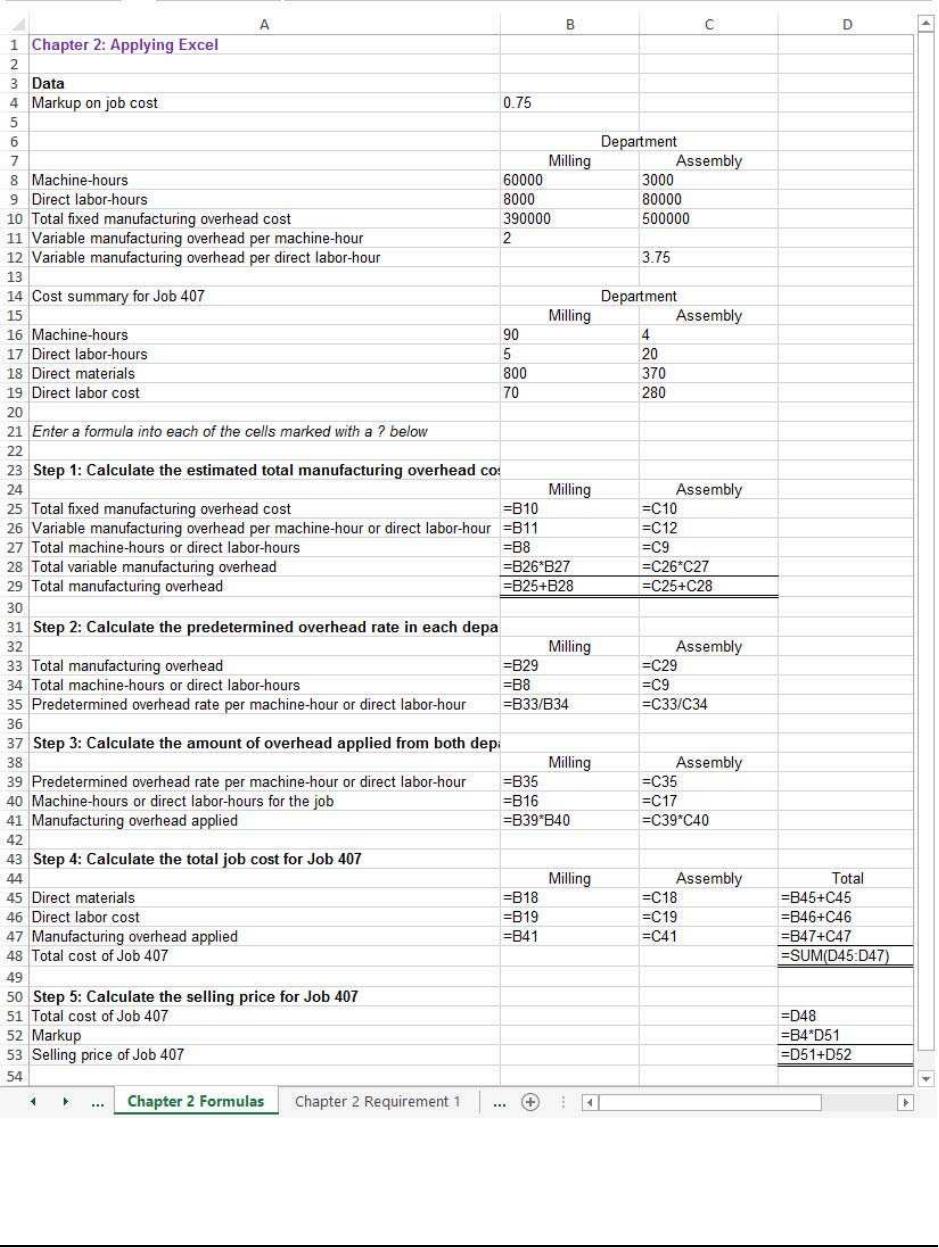
Chapter 2: Applying Excel (continued)
The completed worksheet, with formulas displayed, is shown below.

© The McGraw-Hill Companies, Inc., 2018. All rights reserved.
Solutions Manual, Chapter 2 5
Chapter 2: Applying Excel (continued)
[Note: To display formulas in Excel 2013, select File > Options > Advanced
© The McGraw-Hill Companies, Inc., 2018. All rights reserved.
6 Managerial Accounting, 16th edition
Chapter 2: Applying Excel (continued)
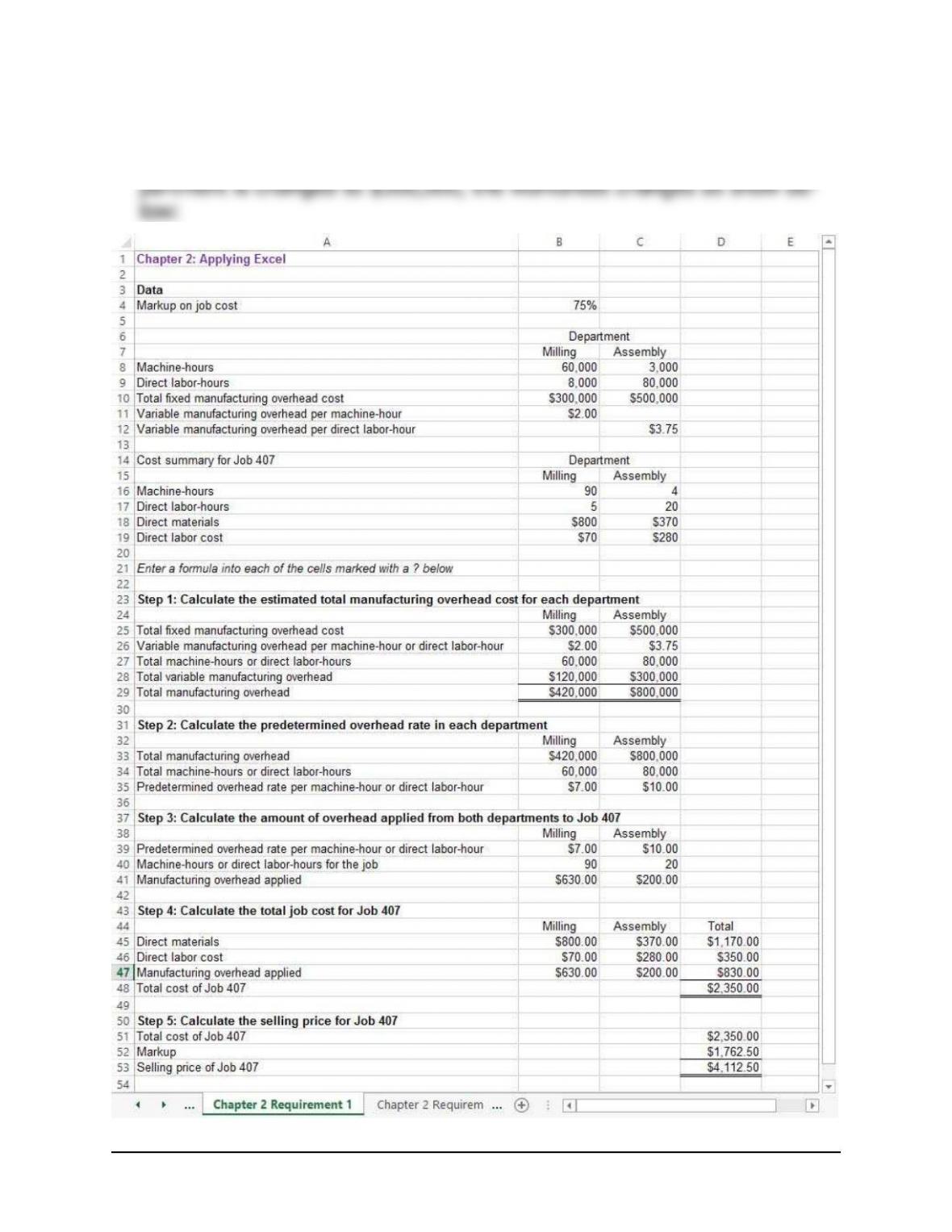
1. When the total fixed manufacturing overhead cost for the Milling De-
© The McGraw-Hill Companies, Inc., 2018. All rights reserved.
Solutions Manual, Chapter 2 7
Chapter 2: Applying Excel (continued)
The selling price of Job 407 has dropped from $4,348.75 to $4,112.50
because the fixed manufacturing overhead in the Milling Department de-
creased from $390,000 to $300,000. This reduced the predetermined
© The McGraw-Hill Companies, Inc., 2018. All rights reserved.
8 Managerial Accounting, 16th edition
Chapter 2: Applying Excel (continued)
© The McGraw-Hill Companies, Inc., 2018. All rights reserved.
Solutions Manual, Chapter 2 9
Chapter 2: Applying Excel (continued)
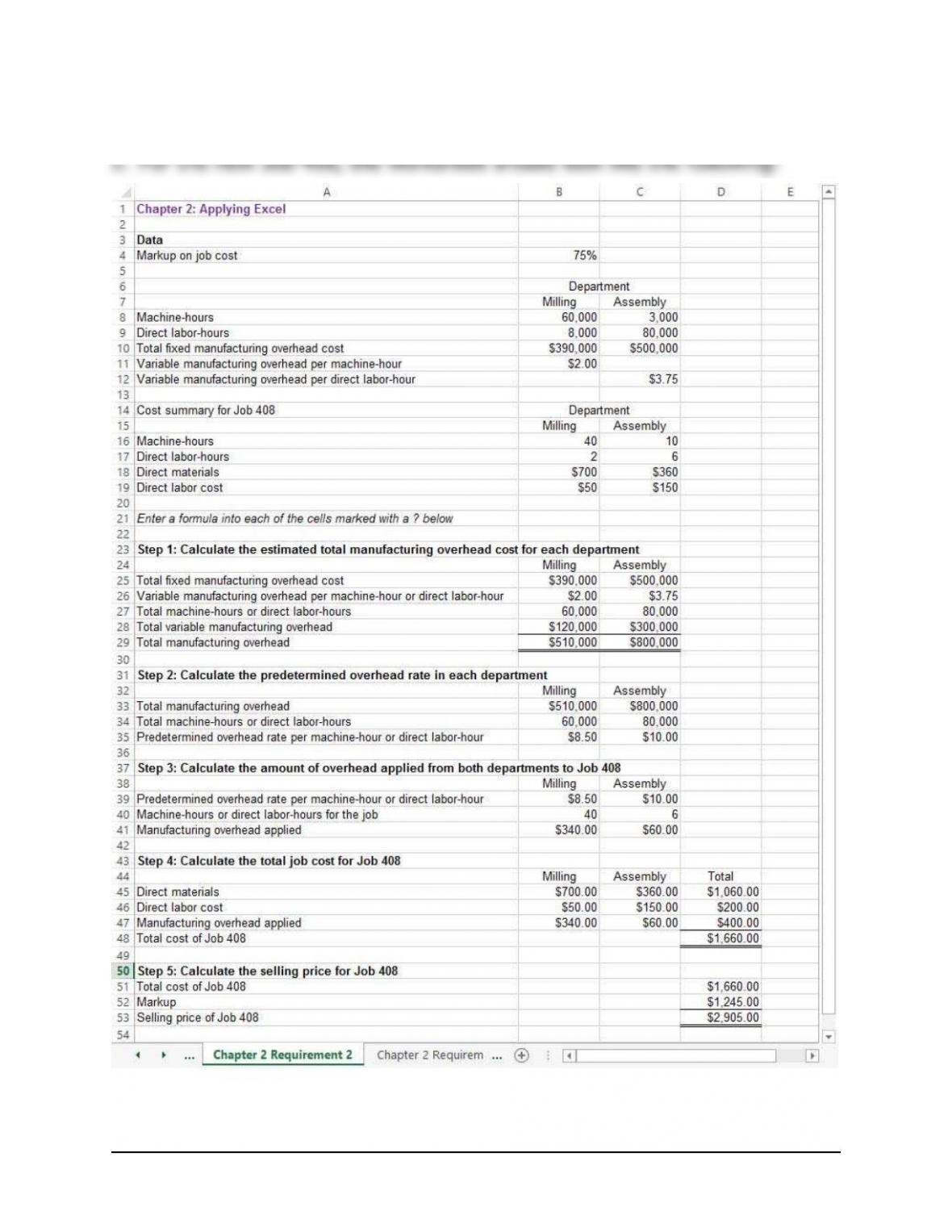
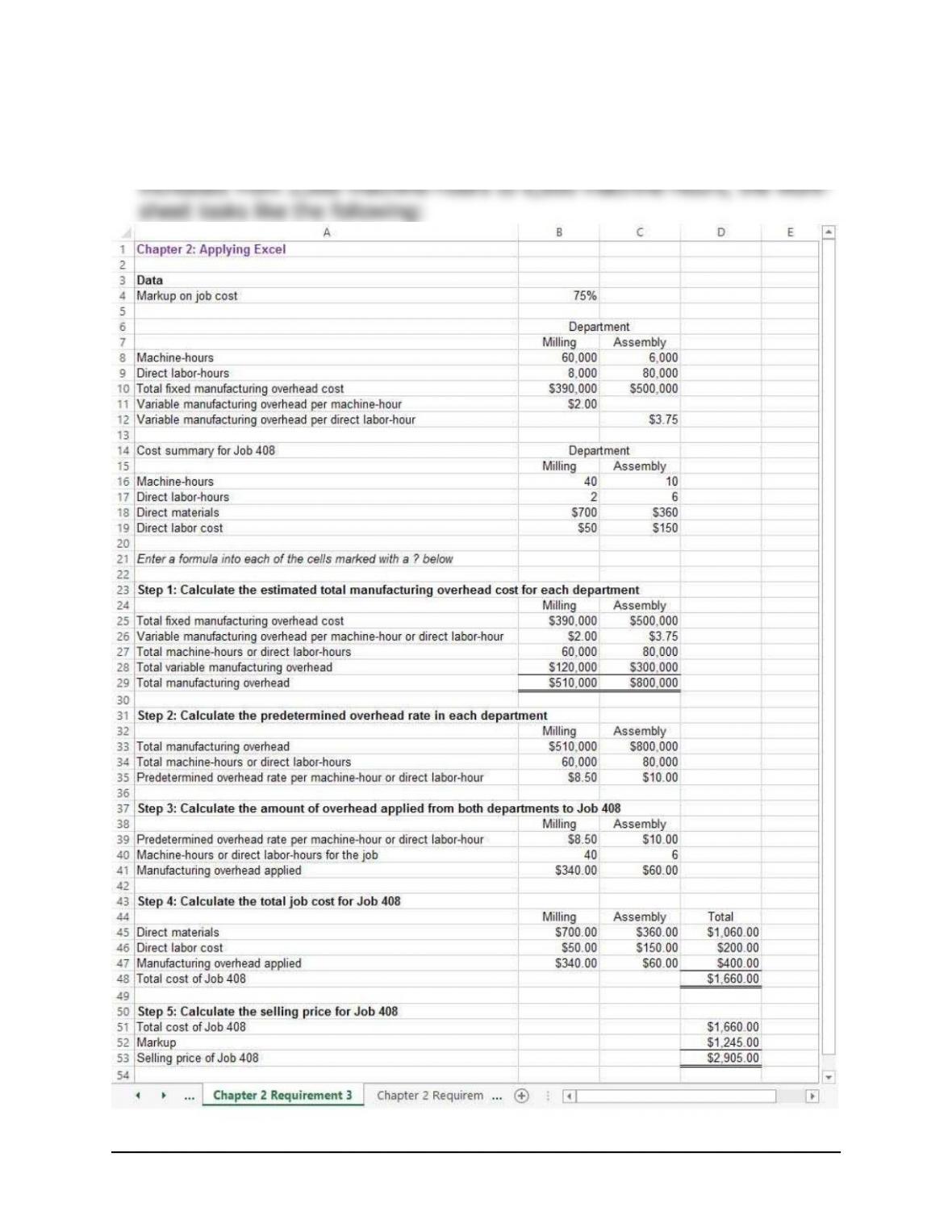
3. When the total number of machine-hours in the Assembly Department
© The McGraw-Hill Companies, Inc., 2018. All rights reserved.
10 Managerial Accounting, 16th edition
Chapter 2: Applying Excel (continued)
The selling price for Job 408 is not affected by this change. The reason
for this is that the total number of machine-hours in the Assembly De-
partment has no effect on any cost. There would have been a change in
costs and in the selling price if the total machine-hours in the Milling De-