© The McGraw-Hill Companies, Inc., 2018
Solutions Manual, Chapter 13 11
The Foundational 15 (continued)
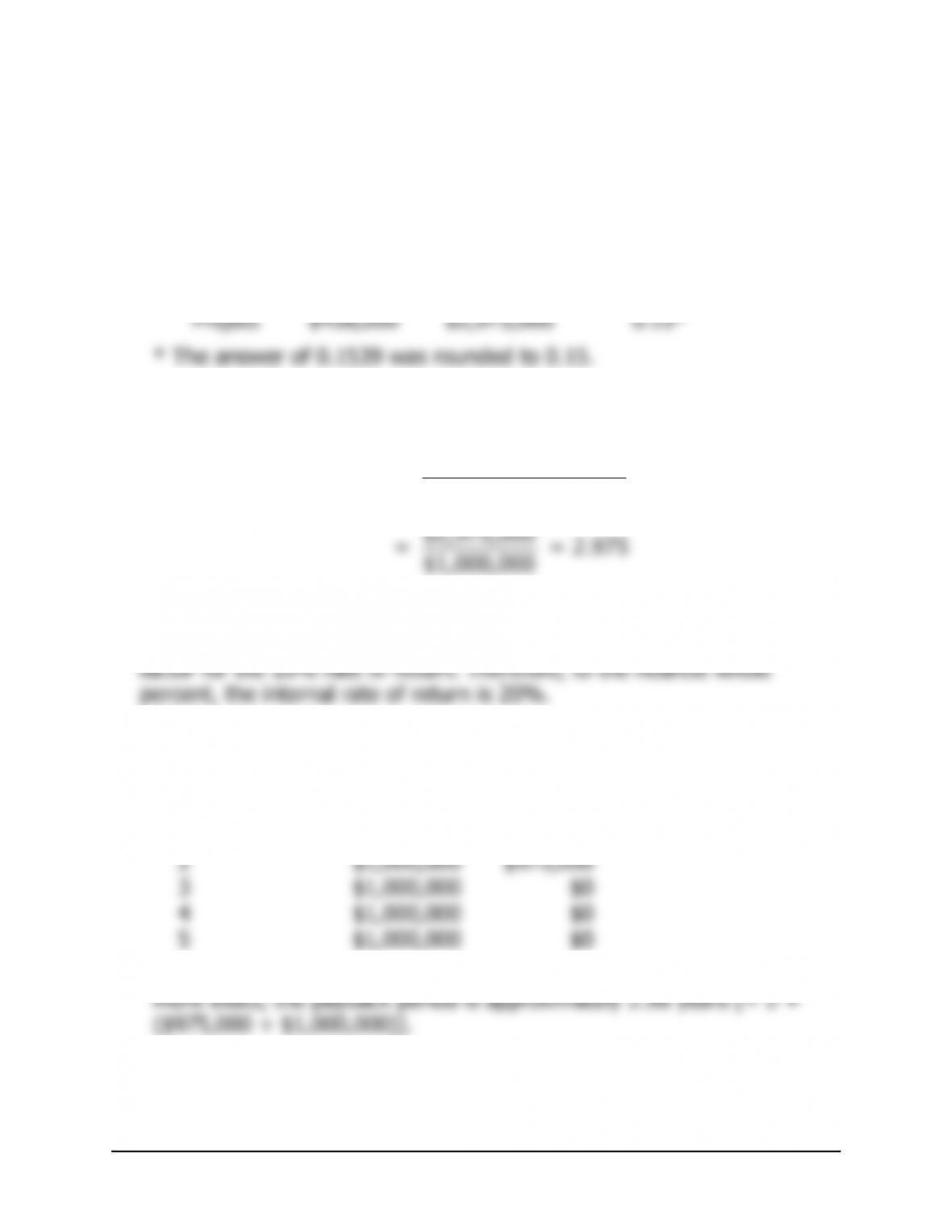
5. The project profitability index for the project is:
Item
Net Present
Value
(a)
Investment
Required
(b)
Project
Profitability
Index
(a) ÷ (b)
6. The project’s internal rate of return is:
Investment required
Factor of the internal =
rate of return
A
nnual cash inflow
Looking in Exhibit 13B-2, and scanning along the five-period line, we
can see that the factor computed above, 2.975, is closest to 2.991, the
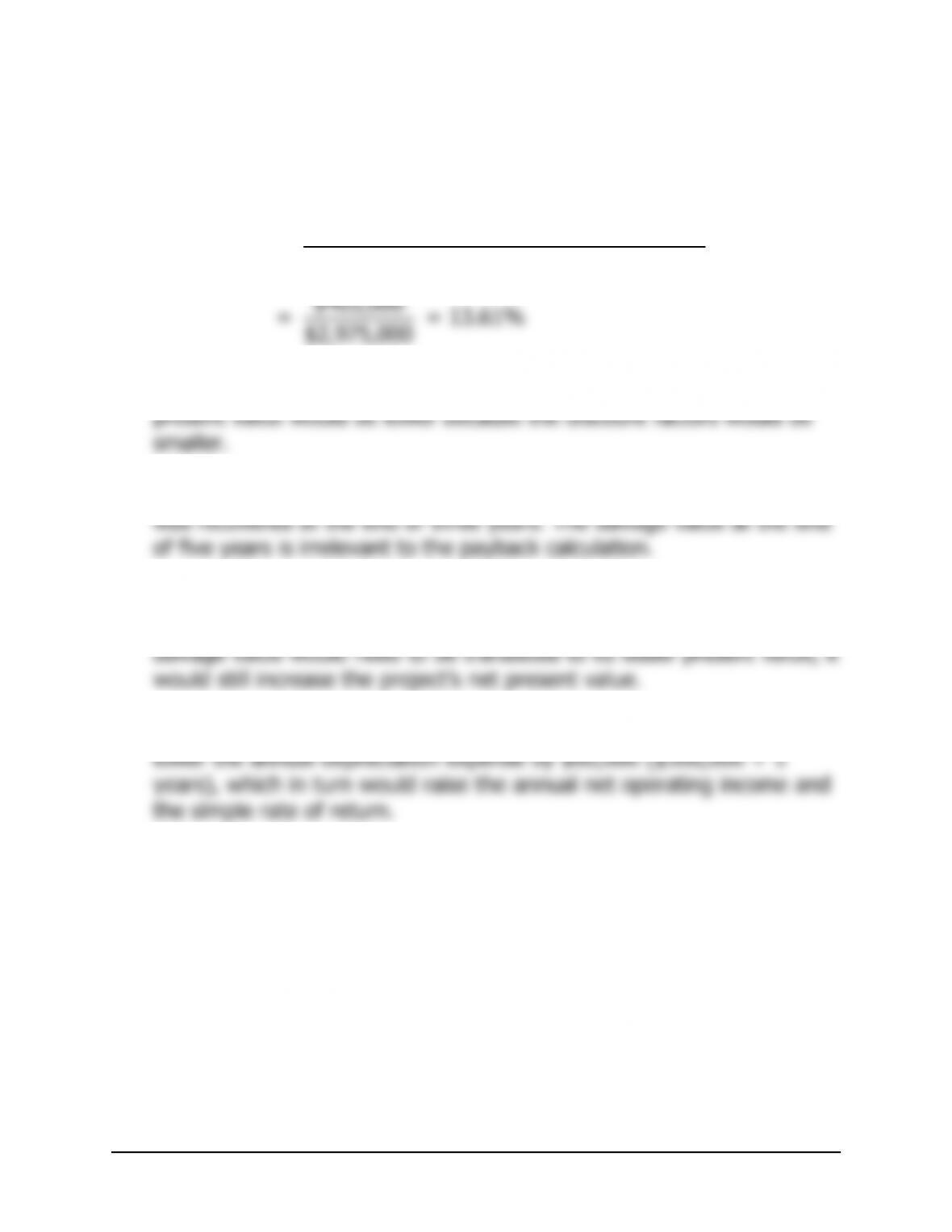
7. The payback period is determined as follows:
Year Investment
Cash
Inflow
Unrecovered
Investment
1 $2,975,000 $1,000,000 $1,975,000
The investment in the project is fully recovered in the 3rd year. To be
© The McGraw-Hill Companies, Inc., 2018
12 Managerial Accounting, 16th Edition
The Foundational 15 (continued)
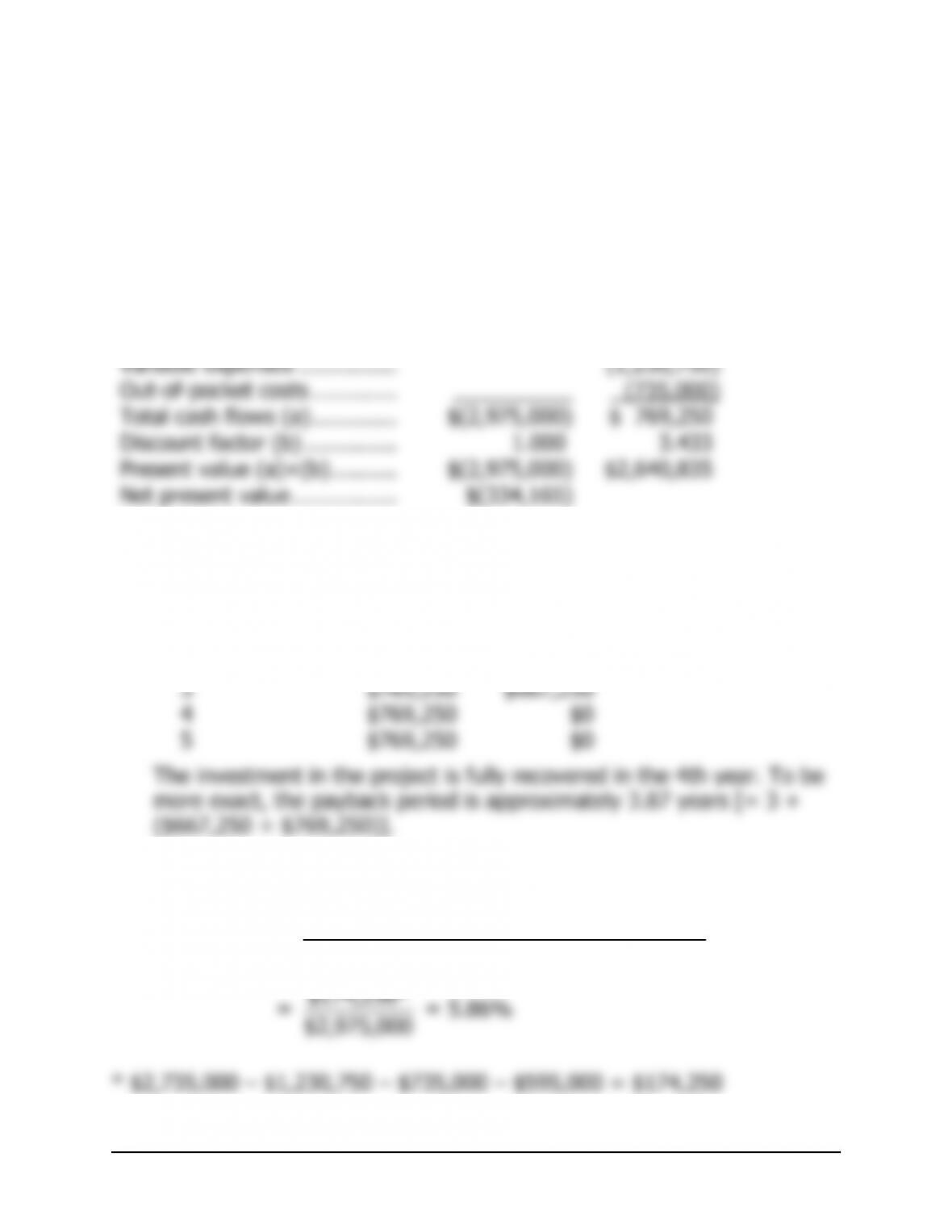
8. The simple rate of return is computed as follows:
A
nnual incremental net operatin
g
income
Simple rate =
of return Initial investment
9. If the discount rate was 16%, instead of 14%, the project’s net
10. The payback period would be the same because the initial investment
11. The net present value would be higher because a $300,000 salvage
value translates into a larger cash inflow in the fifth year. Although the
12. The simple rate of return would be higher. The salvage value would
© The McGraw-Hill Companies, Inc., 2018
Solutions Manual, Chapter 13 13
The Foundational 15 (continued)
13. The new annual variable expense would be $1,230,750 ($2,735,000 ×
45%). The project’s actual net present value would be computed as
follows:
Now
Years
1-5
Purchase of equipment …….. $(2,975,000)
Sales ……………………………. $2,735,000
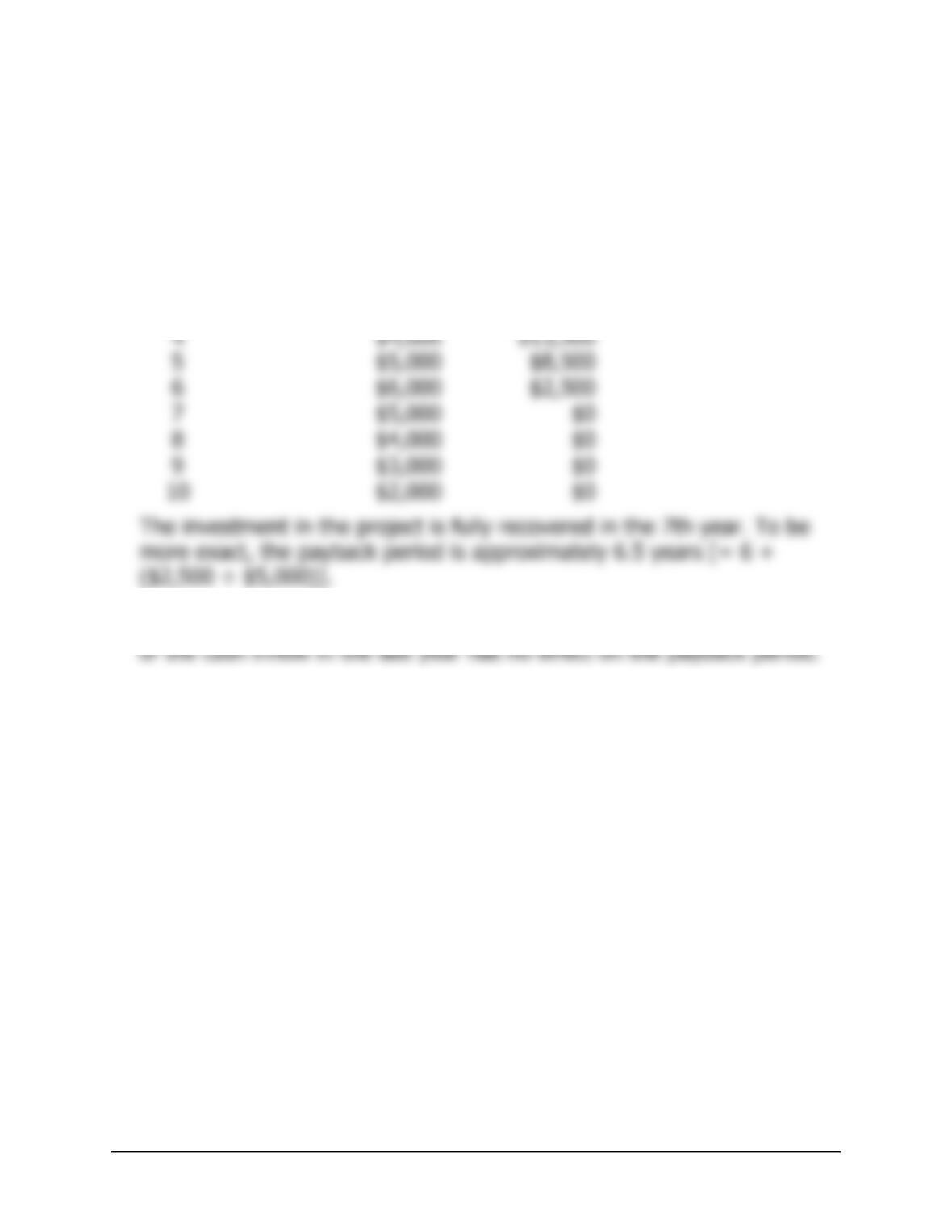
14. The payback period is computed as follows:
Year Investment
Cash
Inflow
Unrecovered
Investment
1 $2,975,000 $769,250 $2,205,750
2 $769,250 $1,436,500
15. The simple rate of return is computed as follows:
A
nnual incremental net operatin
g
income
Simple rate =
of return Initial investment
© The McGraw-Hill Companies, Inc., 2018
14 Managerial Accounting, 16th Edition
Exercise 13-1 (10 minutes)
1. The payback period is determined as follows:
Year Investment Cash Inflow
Unrecovered
Investment
1 $15,000 $1,000 $14,000
2 $8,000 $2,000 $20,000
3 $2,500 $17,500
2. Because the investment is recovered prior to the last year, the amount
© The McGraw-Hill Companies, Inc., 2018
Solutions Manual, Chapter 13 15
Exercise 13-2 (10 minutes)
1.
Now
Years
1-5
Purchase of machine ………………… $(27,000)
Reduced operating costs ……………. ________ $7,000
2.
Item
Cash
Flow Years
Total
Cash
Flows
© The McGraw-Hill Companies, Inc., 2018
16 Managerial Accounting, 16th Edition
Exercise 13-3 (20 minutes)
1.
A
nnual savin
g
s in part-time help ………………………. $3,800
A
dded contribution mar
g
in from expanded sales
2. Investment required
Factor of the internal =
rate of return
A
nnual cash inflow
3. Looking in Exhibit 13B-2, and scanning along the six-period line, we can
4. The cash flows will not be even over the six-year life of the machine
because of the extra $9,125 inflow in the sixth year. Therefore, the
rate of is 22%:
Now Years
1-6
Year
6
Purchase of machine …………………… $(18,600)
Reduced part-time help ……………….. $3,800
Added contribution margin ……………. 1,200
A
© The McGraw-Hill Companies, Inc., 2018
Solutions Manual, Chapter 13 17
Exercise 13-4 (15 minutes)
The equipment’s net present value without considering the intangible
benefits would be:
Item Year(s)
Amount of
Cash Flows
20%
Factor
Present Value
of Cash Flows
The annual value of the intangible benefits would have to be great enough
to offset a $630,000 negative present value for the equipment. This annual
value can be computed as follows:

© The McGraw-Hill Companies, Inc., 2018
18 Managerial Accounting, 16th Edition
Exercise 13-5 (10 minutes)
1. The project profitability index for each proposal is:
Proposal
Number
Net Present
Value
(a)
Investment
Required
(b)
Project Profitability
Index
(a) (b)
A
$36,000 $90,000 0.40
2. The ranking is:
Proposal
Number
Project Profitability
Index
C 0.50
A
Note that proposal D has the highest net present value, but it ranks
lowest in terms of the project profitability index.
© The McGraw-Hill Companies, Inc., 2018
Solutions Manual, Chapter 13 19
Exercise 13-6 (10 minutes)
1. The annual depreciation expense is computed as follows:
Cost of the new machine (a)…………………. $120,000
2. The annual incremental net operating income is computed as follows:
Operatin
g
cost of old machine……………….. $ 30,000
Less operatin
g
cost of new machine ……….. 12,000
3. The initial investment is computed as follows:
Cost of the new machine ……………………… $120,000
4. The simple rate of return is computed as follows:
A
nnual incremental net operatin
g
income
Simple rate =
of return Initial investment
© The McGraw-Hill Companies, Inc., 2018
20 Managerial Accounting, 16th Edition
Exercise 13-7 (15 minutes)
1. Project A:
Now
Years
1-6
Year
6
Purchase of equipment …….. $(100,000)
Annual cash inflows …………. $21,000
Salvage value ………………… _______ ______ $8,000
2. Project B:
Now
Years
1-6
Year
6
Working capital invested …… $(100,000)
Annual cash inflows …………. $16,000
Working capital released …… _______ ______ $100,000
3. The $100,000 should be invested in Project B rather than in Project A.