© The McGraw-Hill Companies, Inc., 2018. All rights reserved.
Solutions Manual, Chapter 12 61
Case 12-29 (45 minutes)
1. As much yarn as possible should be processed into sweaters. Products
should be processed further so long as the added revenues from further
processing are greater than the added costs. In this case, the added
revenues and costs are:
Per Sweater
A
–
A
2. The company should process the wool yarn into sweaters because the
company will gain $2.20 in contribution margin for each spindle of yarn
that is further processed into a sweater. The fixed manufacturing
3. The lowest price the company should accept is $27.80 per sweater. The
simplest approach to this answer is:
A more involved approach to the same answer is to reason as follows:
If the wool yarn is sold outright, then the company will realize a
contribution margin of $9.40 per spindle:
Per Spindle
Sellin
g
price …………………….. $20.00
V
ariable expenses:

© The McGraw-Hill Companies, Inc., 2018. All rights reserved.
62 Managerial Accounting, 16th Edition
Case 12-29 (continued)
This $9.40 is an opportunity cost. The price of the sweaters must be
high enough to cover this opportunity cost. In addition, the company
must be able to cover all of its variable costs from the time the raw wool
is purchased until the sweater is completed. Therefore, the minimum
price is:
V
ariable costs of producin
g
a spindle of yarn:
A
T
—
© The McGraw-Hill Companies, Inc., 2018. All rights reserved.
Solutions Manual, Chapter 12 63
Case 12-30 (90 minutes)
1. The original cost of the facilities at Clayton is a sunk cost and should be
ignored in any decision. The decision being considered here is whether to
continue operations at Clayton. The only relevant costs are the future
facility costs that would be affected by this decision. If the facility were
shut down, the Clayton facility has no resale value. In addition, if the
Clayton facility were sold, the company would have to rent additional
space at the remaining processing centers. On the other hand, if the
The costs that are relevant in the decision to shut down the Clayton
facility are:
In addition, there would be costs of moving the equipment from Clayton
and there might be some loss of sales due to disruption of services. In
2. Haley’s self-interest is to focus on the performance report that probably
plays an instrumental role in how her boss evaluates her performance.
So, even though closing down the Clayton facility would result in a
decline in overall company profits, from Haley’s standpoint it would
© The McGraw-Hill Companies, Inc., 2018. All rights reserved.
64 Managerial Accounting, 16th Edition
Case 12-30 (continued)
Financial Performance
After Shutting Down the Clayton Facility
Rocky Mountain Region
Total
Sales …………………………………………………… $50,000,000
Sellin
g
and administrative expenses:
Direct labor ………………………………………… 32,000,000
Variable overhead ………………………………… 850,000
Equipment depreciation …………………………. 3,900,000
If the Clayton facility is shut down, BSC’s profits will decline, employees
will lose their jobs, and customers will at least temporarily suffer some
While Romeros is not a management accountant, the Standards of
Ethical Conduct for Management Accountants still provide useful
guidelines. By recommending closing the Clayton facility, Romeros will
have to violate the Credibility Standard, which requires the disclosure of
In sum, it is difficult to describe the recommendation to close the

© The McGraw-Hill Companies, Inc., 2018. All rights reserved.
Solutions Manual, Chapter 12 65
Case 12-30 (continued)
It should be noted that the performance report required by corporate
headquarters is likely to lead to other problems such as the one
illustrated here. The arbitrary allocations of corporate and regional
3. Prices should be set ignoring the depreciation on the Clayton facility. As
argued in part (1) above, the real cost of using the Clayton facility is
© The McGraw-Hill Companies, Inc., 2018. All rights reserved.
66 Managerial Accounting, 16th Edition
Case 12-31 (90 minutes)
1. The lowest price Wesco could bid for the one-time special order of
20,000 pounds (20 lots) and still exactly cover its incremental
manufacturing costs is calculated as follows:
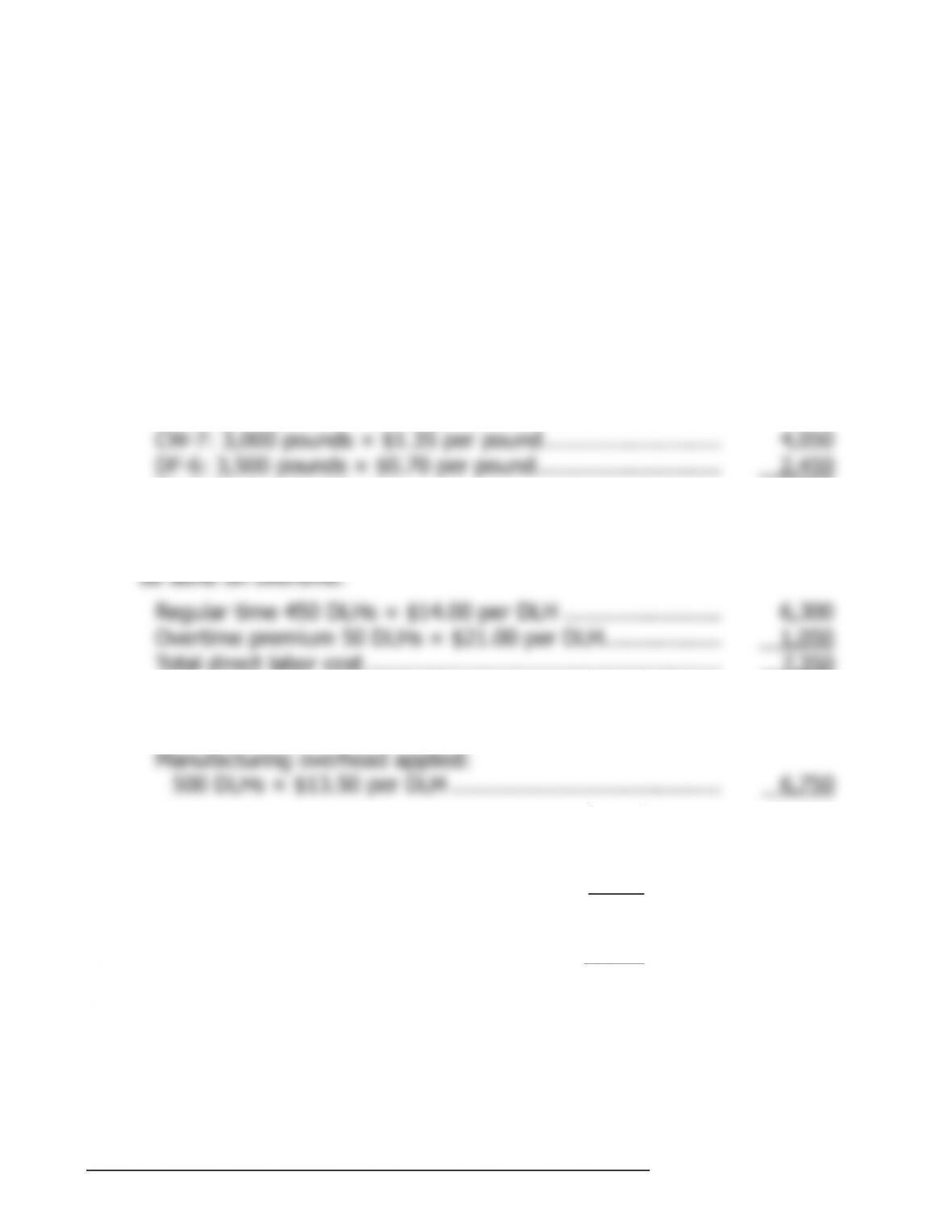
Direct materials:
A
G-5: 300 pounds per lot × 20 lots = 6,000 pounds.
Substitute BH-3 on a one-for-one basis to its total of 3,500
pounds. If BH-3 is not used in this order, it will be salvaged
DF-6: 175 pounds per lot × 20 lots = 3,500 pounds. Use
3,000 pounds in inventory at $0.60 per pound ($0.70
market price – $0.10 handling charge), and purchase the
remaining 500 pounds (= 3,500 pounds – 3,000 pounds)
T
would have to be used for the remaining 100 hours.
400 DLHs × $14.00 per DLH…………………….………………… 5,600
T
Overhead: This special order will not increase fixed overhead costs.
Therefore, only the variable overhead is relevant.
T
T
–
© The McGraw-Hill Companies, Inc., 2018. All rights reserved.
Solutions Manual, Chapter 12 67
Case 12-31 (continued)
2. In this part, we calculate the price for recurring orders of 20,000 pounds
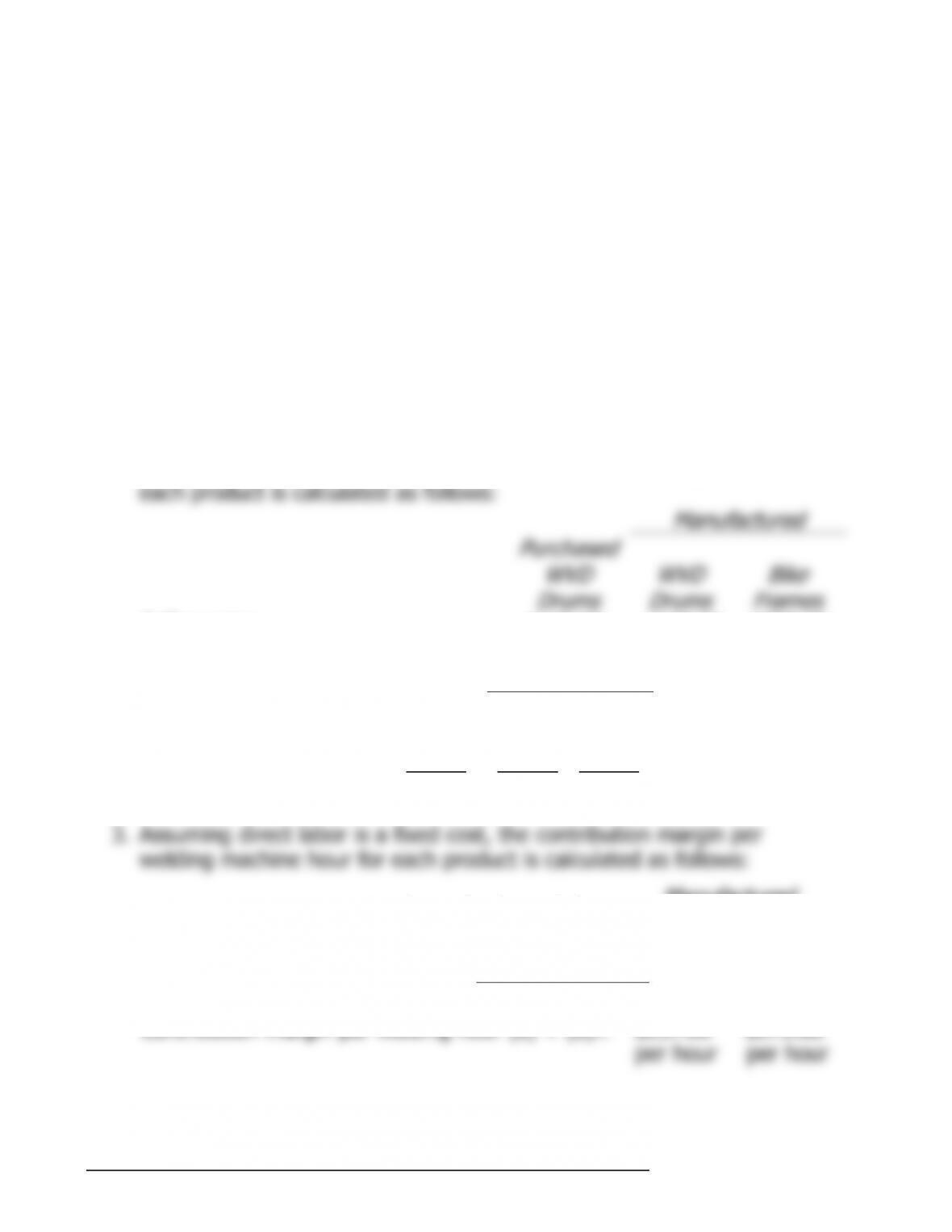
Direct materials: Because the initial order will exhaust existing
inventories of BH-3 and DF-6 and new supplies would have to be
purchased, all raw materials should be charged at their expected
future cost, which is the current market price.
Direct labor: 90% (i.e., 450 DLHs) of the production of a batch can be
done on regular time; but the remaining production (i.e., 50 DLHs) must
be done on overtime.
Overhead: The full manufacturing cost includes both fixed and variable
manufacturing overhead.
Manufacturin
g
overhead applied:
500 DLHs × $13.50 per DLH ……………………………….…. 6,750
© The McGraw-Hill Companies, Inc., 2018. All rights reserved.
68 Managerial Accounting, 16th Edition
Case 12-32 (120 minutes)
1. The product margins computed by the accounting department for the
drums and bike frames should not be used in the decision of which
product to make. The product margins are lower than they should be
due to the presence of allocated fixed common costs that are irrelevant
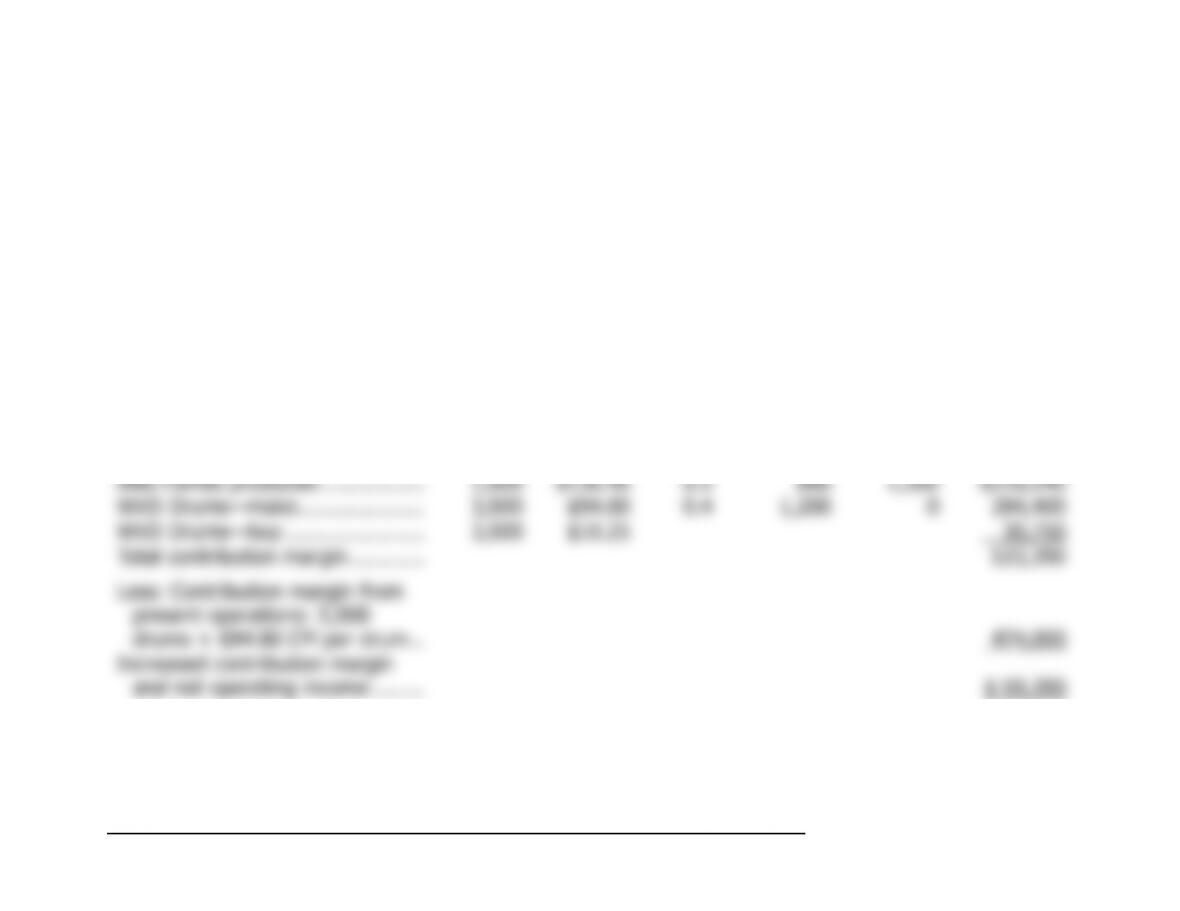
2. Assuming direct labor is a fixed cost, the contribution margin per unit for
each product is calculated as follows:
Manufactured
Purchased
WVD
Drums
WVD
Drums
Bike
Frames
Sellin
g
price ………………………………. $149.00 $149.00 $239.00
V
ariable costs:
Direct materials ……………………….. 138.00 52.10 99.40
T
3. Assuming direct labor is a fixed cost, the contribution margin per
welding machine hour for each product is calculated as follows:
Manufactured
WVD
Drums
Bike
Frames
© The McGraw-Hill Companies, Inc., 2018. All rights reserved.
Solutions Manual, Chapter 12 69
Case 12-32 (continued)
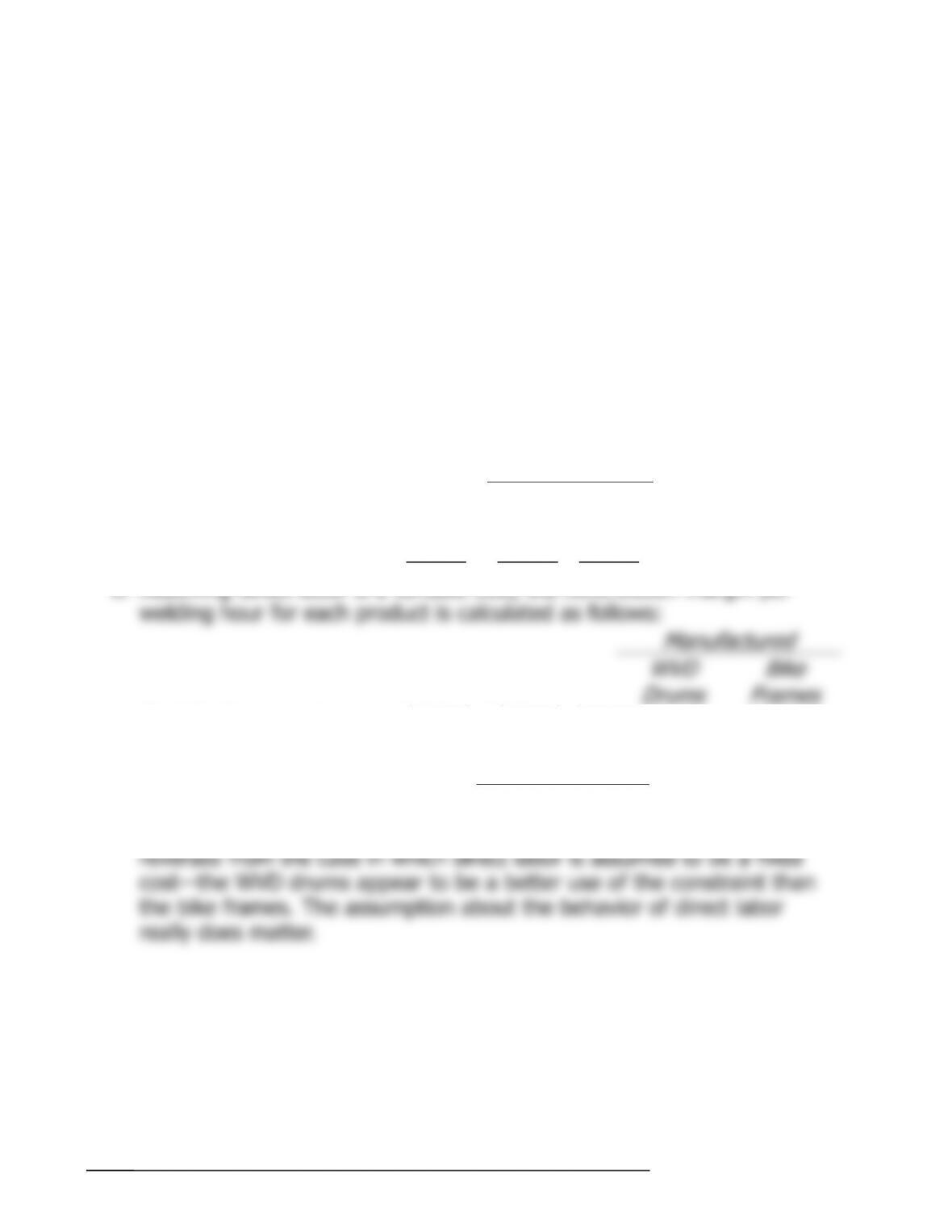
4. Because the contribution margin per unit of the constrained resource (i.e., welding time) is larger
for the bike frames than for the WVD drums, the frames make the most profitable use of the
welding machine (assuming direct labor is a fixed cost). Consequently, the company should
manufacture as many bike frames as possible up to demand and then use any leftover capacity to
produce WVD drums. Buying the drums from the outside supplier can fill any remaining unsatisfied
demand for WVD drums. The necessary calculations are carried out below.
(a) (b) (c) (a) × (c) (a) × (b)
Quantity
Unit
Contri-
bution
Margin
Welding
Time
per Unit
Total
Welding
Time
Balance
of
Welding
Time
Total
Contri-
bution
T
otal hours available ……………… 2,000
—
T
—
© The McGraw-Hill Companies, Inc., 2018. All rights reserved.
70 Managerial Accounting, 16th Edition
Case 12-32 (continued)
5. Assuming direct labor is a variable cost, the contribution margin per unit
for each product is calculated as follows:
Manufactured
Purchased
WVD
Drums
WVD
Drums
Bike
Frames
Sellin
g
price ……………………………. $149.00 $149.00 $239.00
V
ariable costs:
g
6.
Assuming direct labor is a variable cost, the contribution margin per
welding hour for each product is calculated as follows:
Manufactured
WVD
Drums
Bike
Frames
Contribution mar
g
in per unit (above) (a)………. $91.20 $107.60
g
T