© The McGraw-Hill Companies, Inc., 2018. All rights reserved.
Solutions Manual, Chapter 12 51
Problem 12-25 (continued)
5. Because the additional capacity would be used to produce the Mike doll,
6. Additional output could be obtained in a number of ways including
working overtime, adding another shift, expanding the workforce,
Note: Some would argue that direct labor is a fixed cost in this situation
and should be excluded when computing the contribution margin per
unit. However, when deciding which products to emphasize, no harm is
done by misclassifying a fixed cost as a variable cost—providing that the
© The McGraw-Hill Companies, Inc., 2018. All rights reserved.
52 Managerial Accounting, 16th Edition
Problem 12-26 (60 minutes)
1. and 2.
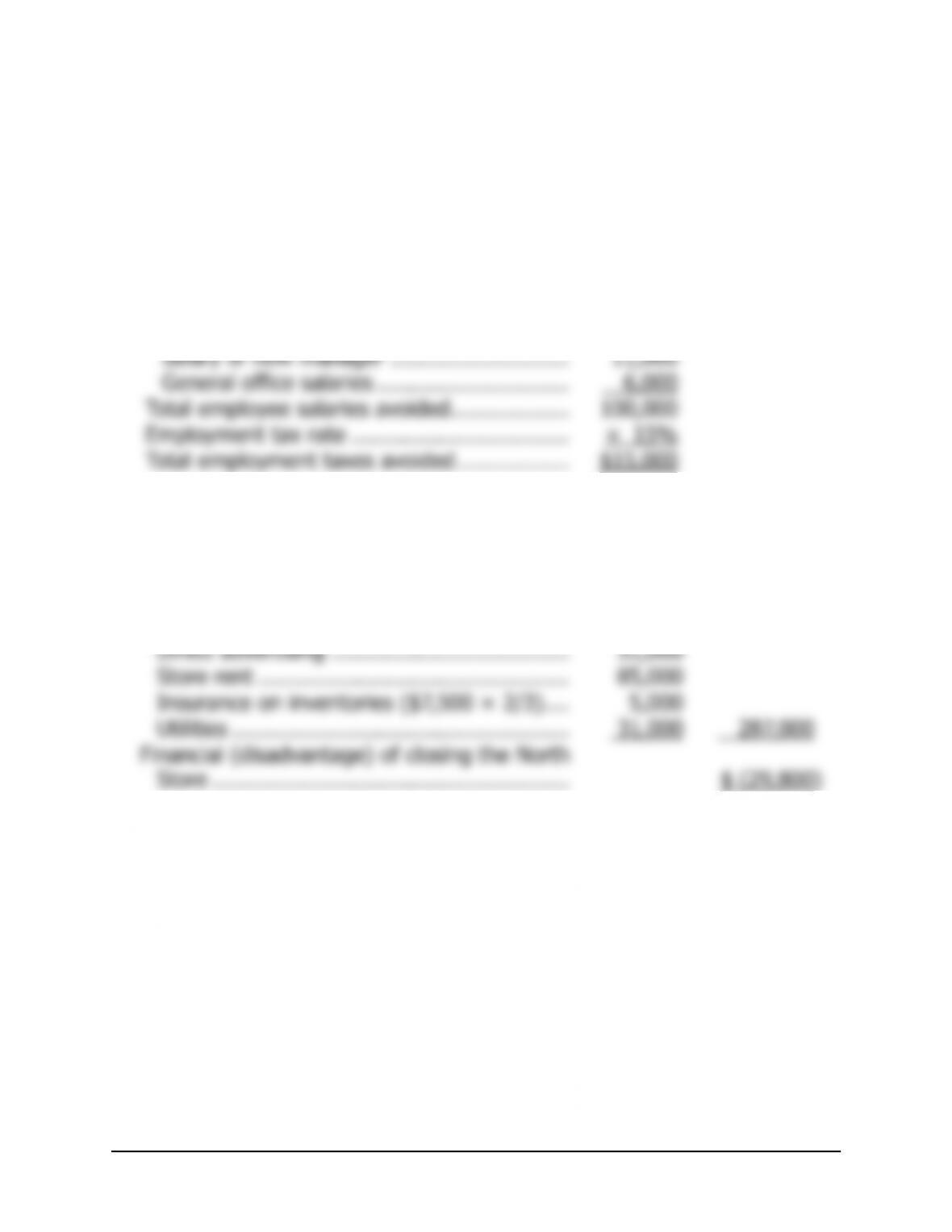
The avoided employee salaries and employment taxes are computed as
follows:
Sales salaries …………………………………… $70,000
Delivery salaries ……………………………….. 4,000
Store mana
g
ement salaries…………………. 9,000
Salary of new mana
g
er ……………………… 11,000
General office salaries ……………………….. 6,000
T
otal employee salaries avoided……………… 100,000
Employment tax rate …………………………… × 15%
T
otal employment taxes avoided…………….. $15,000
3. The simplest approach to the solution is:
Gross mar
g
in lost if the store is closed………… $(316,800)
Costs that can be avoided:
Employee salaries (see requirement 1) …… $100,000
Employment taxes (see requirement 2) …. $15,000
© The McGraw-Hill Companies, Inc., 2018. All rights reserved.
Solutions Manual, Chapter 12 53
Problem 12-26 (continued)
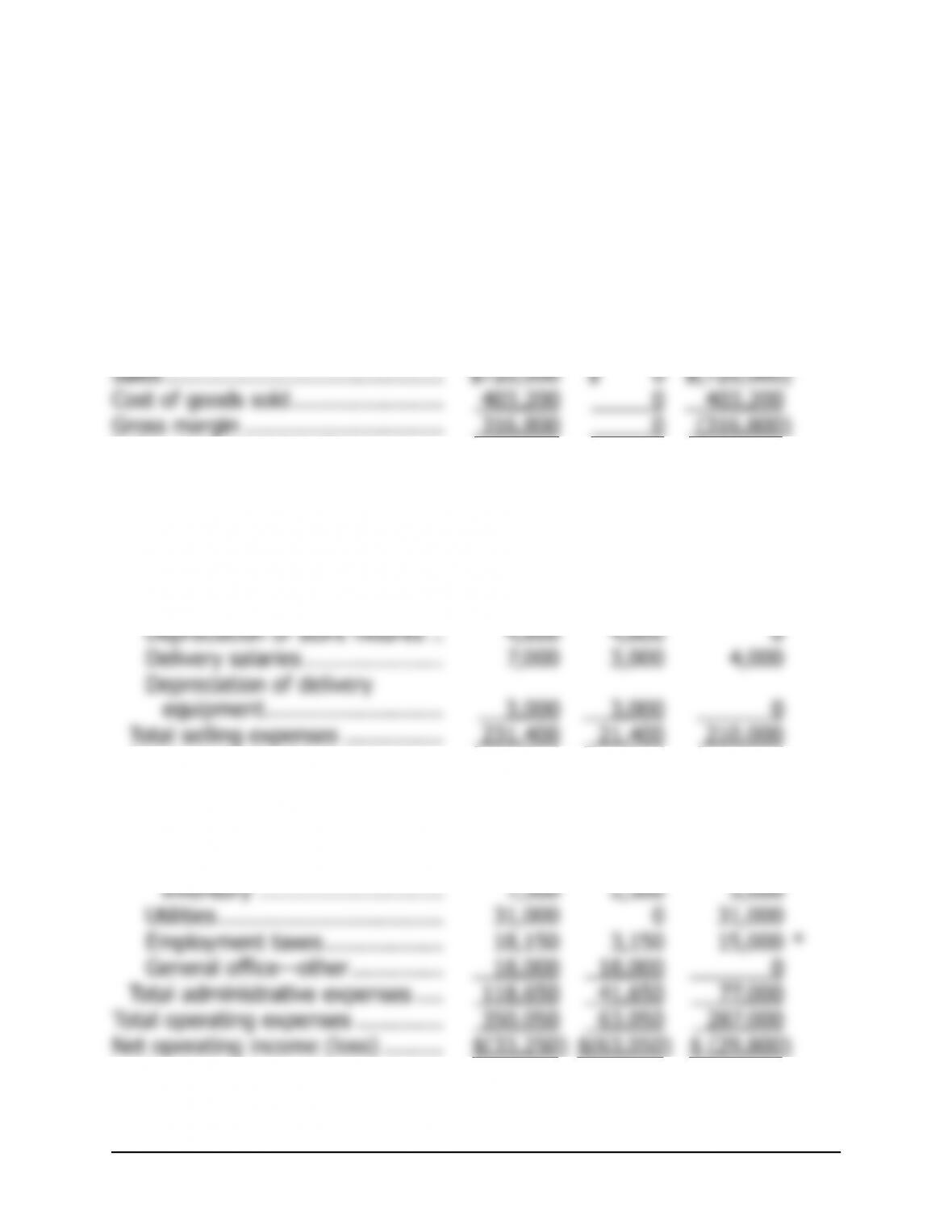
Alternative Solution (Total cost approach):
North
Store
Kept
Open
North
Store
Closed
Difference:
Net
Operating
Income
Increase or
(Decrease)
Sellin
g
and administrative
expenses:
Sellin
g
expenses:
Sales salaries ……………………. 70,000 0 70,000
Direct advertisin
g
………………. 51,000 0 51,000
General advertisin
g
…………….. 10,800 10,800 0
Store rent ………………………… 85,000 0 85,000
T
A
dministrative expenses:
Store mana
g
ement salaries ….. 21,000 12,000 9,000
Salary of new mana
g
er ……….. 11,000 0 11,000
General office salaries …………. 12,000 6,000 6,000
Insurance on fixtures and
—
T
T
*See the computation on the prior page.
© The McGraw-Hill Companies, Inc., 2018. All rights reserved.
54 Managerial Accounting, 16th Edition
Problem 12-26 (continued)
4. Based on the data in requirement (3), the North Store should not be
closed. The company would be $29,800 worse off per quarter if it closed
the North Store. If the store space cannot be subleased or the lease
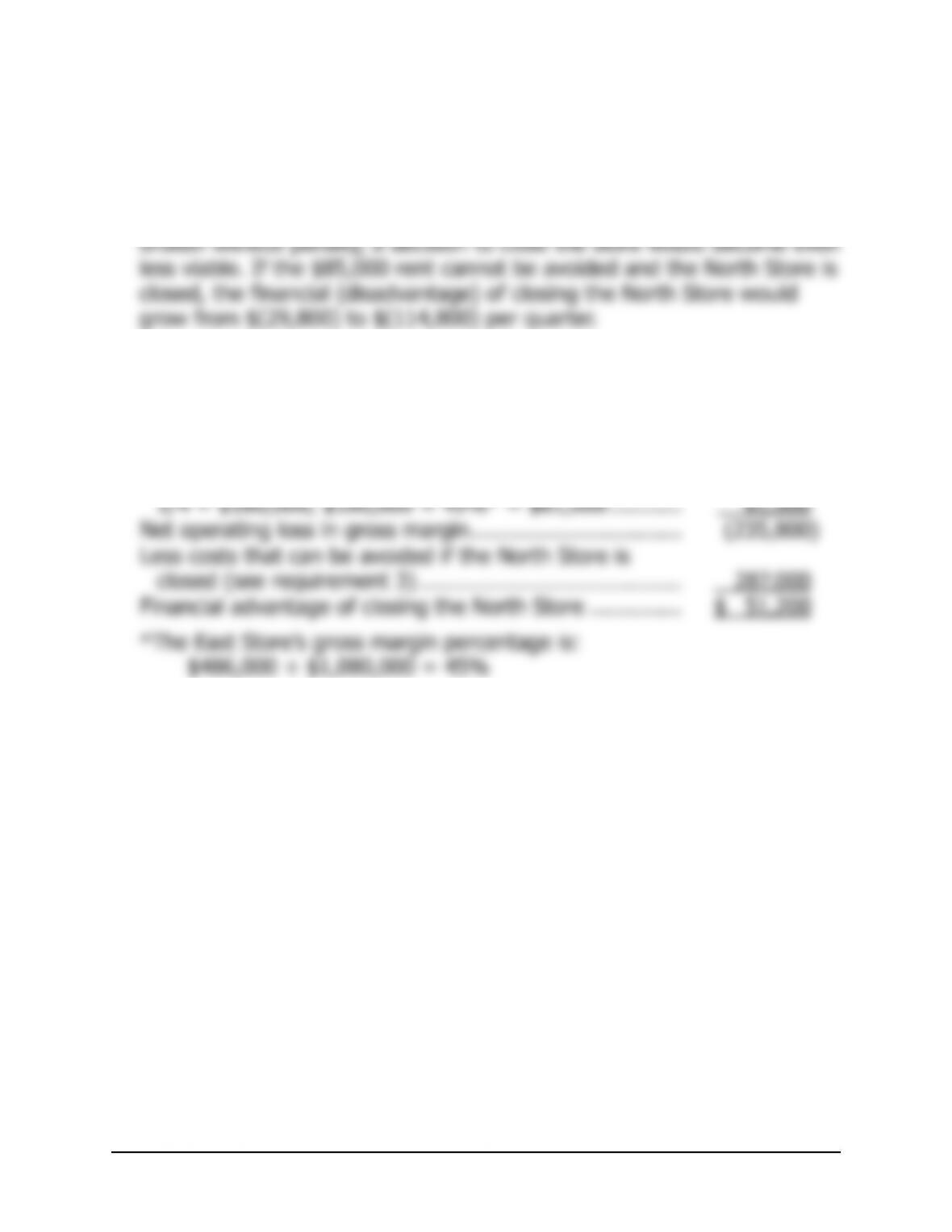
5. Under these circumstances, the North Store should be closed. The
computations are as follows:
Gross mar
g
in lost if the North Store is closed (see
requirement 3) ………………………………………………… $(316,800)
Gross mar
g
in
g
ained from the East Store: $720,000 ×
Problem 12-27 (60 minutes)
1. The incremental revenue per jar from further processing of the Grit 337
is:
Sellin
g
price of the silver polish, per
j
ar…………….. $4.00
g
j
2. The incremental contribution margin per jar:
Incremental revenue per
j
ar…………………………… $3.50
Incremental variable costs per
j
ar:
© The McGraw-Hill Companies, Inc., 2018. All rights reserved.
56 Managerial Accounting, 16th Edition
Problem 12-27 (continued)
3. Only the cost of advertising and the cost of the production supervisor
are avoidable if production of the silver polish is discontinued.
Therefore, the number of jars of silver polish that must be sold each
month to justify continued processing of the Grit 337 into silver polish
is:
If 10,000 jars of silver polish can be sold each month, the company
would be indifferent between selling it or selling all of the Grit 337 as a
cleaning powder. If the sales of the silver polish are greater than 10,000
4. and 5.
The financial advantage (disadvantage) is computed as follows:
9,000
jars
1
1
,50
0
jars
Incremental contribution mar
g
in per
j
ar (a)…
.
$0.70 $0.70
g
Incremental contribution mar
g
in ………………
.
$6,300 $8,050
© The McGraw-Hill Companies, Inc., 2018. All rights reserved.
Solutions Manual, Chapter 12 57
Problem 12-28 (60 minutes)
1. The $2.80 per drum general overhead cost is not relevant to the
decision because this cost will be the same regardless of whether the
company decides to make or buy the drums. Also, the present
Differential Costs
Per Drum
Total Differential Costs—
60,000 Drums
Make Buy Make Buy
Outside supplier
’
s price .. $18.00 $1,080,000
Direct materials …………. $10.35 $621,000
Direct labor
($6.00 × 70%) ……….. 4.20 252,000
V
ariable overhead
T
© The McGraw-Hill Companies, Inc., 2018. All rights reserved.
58 Managerial Accounting, 16th Edition
Problem 12-28 (continued)
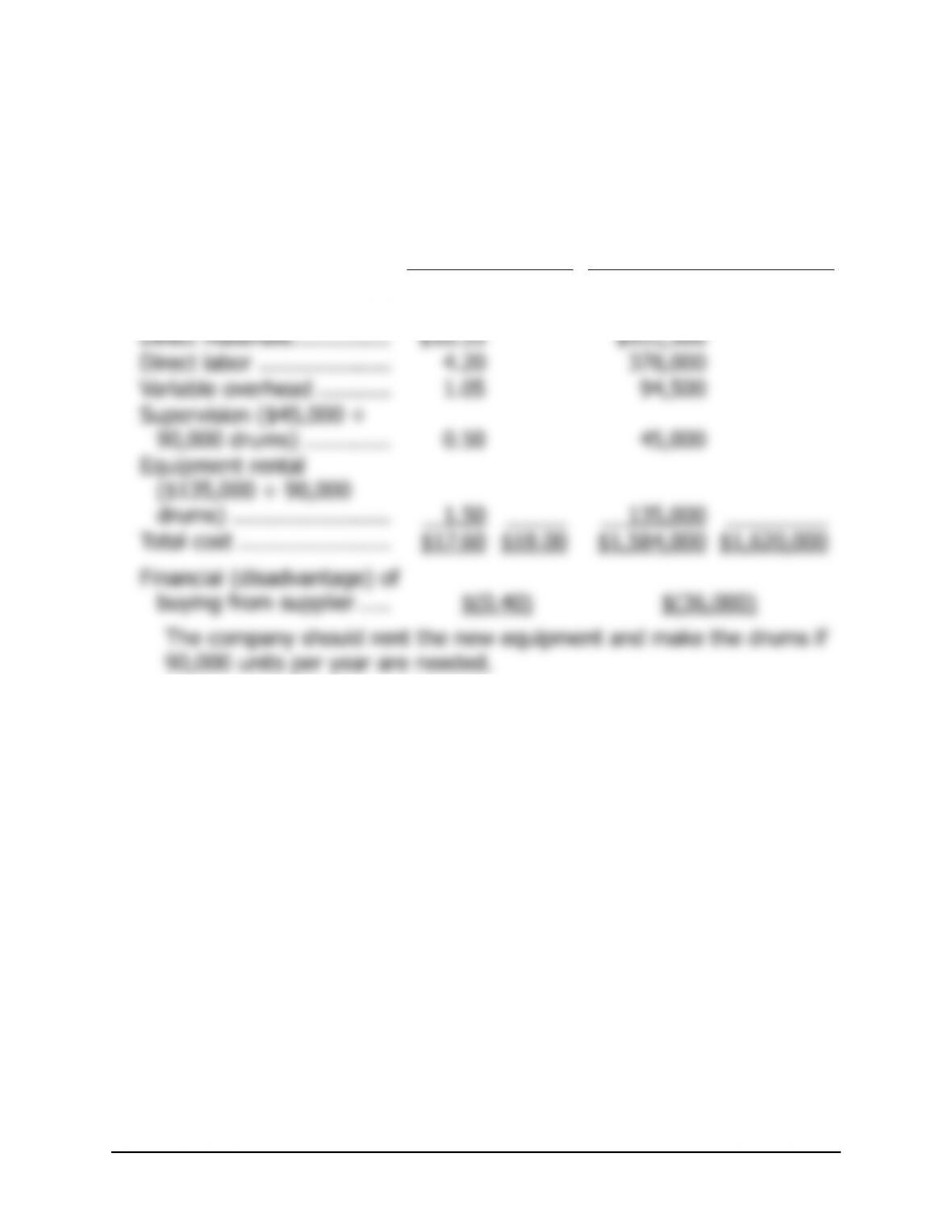
2. Notice that unit costs for both supervision and equipment rental
decrease with the greater volume because these fixed costs are spread
over more units.
Differential
Cost Per Drum
Total Differential Cost—
75,000 Drums
Make Buy Make Buy
Outside supplier
’
s price …. $18.00 $1,350,000
V
T
© The McGraw-Hill Companies, Inc., 2018. All rights reserved.
Solutions Manual, Chapter 12 59
Problem 12-28 (continued)
3. Again, notice that the unit costs for both supervision and equipment
rental decrease with the greater volume of units.
Differential
Costs Per Drum
Total Differential Cost—
90,000 Drums
Make Buy Make Buy
Outside supplier
’
s price …. $18.00 $1,620,000
V
T
© The McGraw-Hill Companies, Inc., 2018. All rights reserved.
60 Managerial Accounting, 16th Edition
Problem 12-28 (continued)
4. Other factors that the company should consider include:
Will volume in future years increase, or will it remain constant at
Can quality control be maintained if the drums are purchased from
Can the company begin making the drums again if the supplier
What is the labor outlook in the supplier’s industry (e.g., are frequent
If the outside supplier’s offer is accepted and the need for drums