© The McGraw-Hill Companies, Inc., 2018. All rights reserved.
Solutions Manual, Chapter 12 41
Problem 12-21 (30 minutes)
1. Contribution mar
g
in lost if the fli
g
ht is
discontinued …………………………………………..… $(12,950)
Fli
g
ht costs that can be avoided if the fli
g
ht is
discontinued:
The following costs are not relevant to the decision:
Cost Reason
Salaries, fli
g
ht crew Fixed annual salaries, which will
not change.
g
g
© The McGraw-Hill Companies, Inc., 2018. All rights reserved.
42 Managerial Accounting, 16th Edition
Problem 12-21 (continued)
Alternative Solution:
Keep the
Flight
Drop the
Flight
Difference:
Net
Operating
Income
Increase or
(Decrease)
T
icket revenue ……………………………….. $14,000 $ 0 $(14,000)
V
ariable expenses …………………………… 1,050 0 1,050
Contribution mar
g
in ………………………… 12,950 0 (12,950)
Less fli
g
ht expenses:
Salaries, fli
g
ht crew ………………………. 1,800 1,800 0
T
2. The goal of increasing the seat occupancy could be obtained by
eliminating flights with a lower-than-average seat occupancy. By
eliminating these flights and keeping the flights with a higher-than-
average seat occupancy, the overall average seat occupancy for the
company as a whole would be improved. This could reduce profits in at
g
© The McGraw-Hill Companies, Inc., 2018. All rights reserved.
Solutions Manual, Chapter 12 43
Problem 12-22 (30 minutes)
1. Because the fixed costs will not change as a result of the order, they are
not relevant to the decision. The cost of the new machine is relevant,
and this cost will have to be recovered by the current order because
there is no assurance of future business from the retail chain.
Unit
Total—
5,000 units
Sales from the order ($50 × 84%) …………………. $42 $210,000
Less costs associated with the order:
Direct materials ……………………………………….. 15 75,000
T
2. Sales from the order:
Reimbursement for costs of production (variable
production costs of $26 plus fixed manufacturing
overhead cost of $9 = $35 per unit; $35 per unit ×
5,000 units) …………………………………………………. $175,000
Fixed fee ($1.80 per unit × 5,000 units)……………….. 9,000
T
—
3. Sales:
From the U.S. Army (above)………………………………. $184,000
From re
g
ular channels ($50 per unit × 5,000 units) … 250,000
Net decrease in revenue ………………………………..……. (66,000)
Less variable sellin
g
expenses avoided if the Army
’
s
© The McGraw-Hill Companies, Inc., 2018. All rights reserved.
44 Managerial Accounting, 16th Edition
Problem 12-23 (60 minutes)
1. The starting point for answering requirement 1 is separating the
manufacturing overhead per unit of $1.40 into its variable and fixed
components. The variable manufacturing overhead per box of Chap-Off
would be $0.50, as shown below:
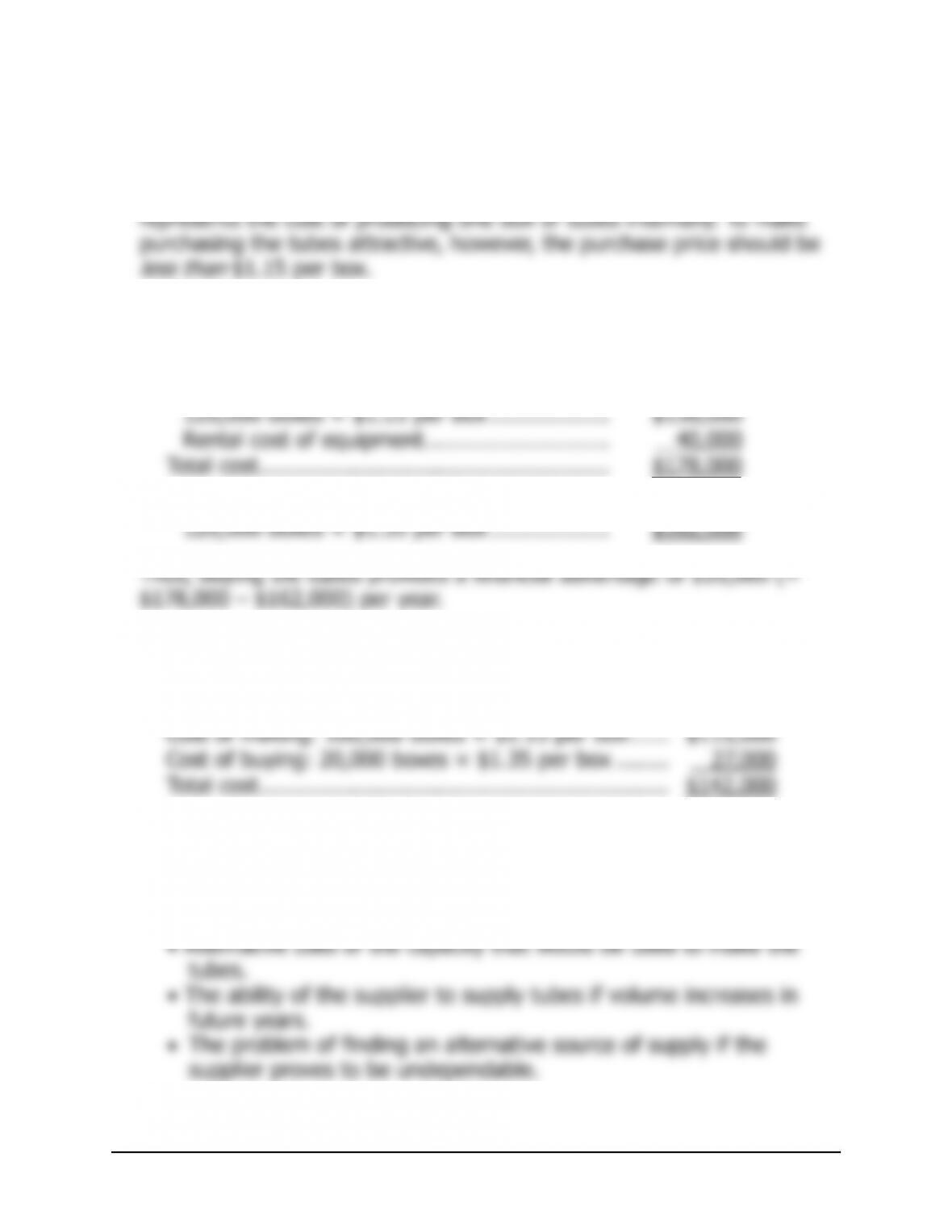
The avoidable manufacturing cost per box of Chap-Off is computed as
follows:
Cost avoided by purchasin
g
the tubes:
2. The financial (disadvantage) per box of Chap-Off is computed as
follows:
Financial (disadvanta
g
e) per box of Chap-Off ……………. $(0.20)
3. The financial (disadvantage) of outsourcing 100,000 boxes of Chap-Off
is computed as follows:
g
g
4. Silven should make the tubes because the price paid to the supplier
© The McGraw-Hill Companies, Inc., 2018. All rights reserved.
Solutions Manual, Chapter 12 45
Problem 12-23 (continued)
5. The maximum purchase price would be $1.15 per box. The company
would not be willing to pay more than this amount because the $1.15
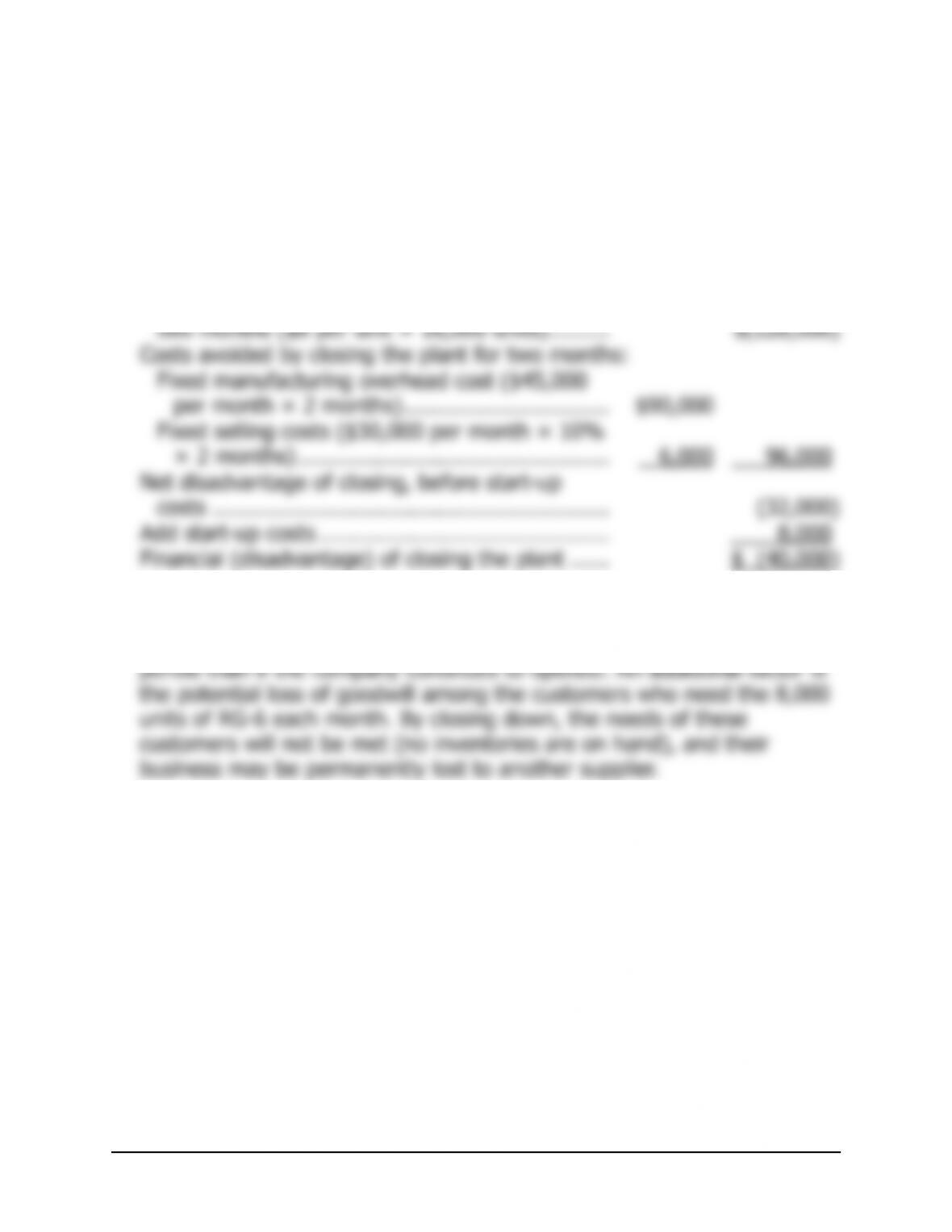
6. At a volume of 120,000 boxes, the company should buy the tubes. The
computations are:
Cost of makin
g
120,000 boxes of tubes:
Cost of buyin
g
120,000 boxes of tubes:
7. Under these circumstances, the company should make 100,000 boxes of
tubes and purchase the remaining 20,000 boxes of tubes from the
outside supplier. The costs would be as follows:
g
g
8. Management should take into account at least the following additional
factors:
The ability of the supplier to meet required delivery schedules.
The quality of the tubes purchased from the supplier.
© The McGraw-Hill Companies, Inc., 2018. All rights reserved.
46 Managerial Accounting, 16th Edition
Problem 12-24 (45 minutes)
1. Product RG-6 has a contribution margin of $8 per unit (= $22 – $14). If
the plant closes, this contribution margin will be lost on the 16,000 units
(= 8,000 units per month × 2 months) that could have been sold during
the two-month period. However, the company will be able to avoid some
fixed costs as a result of closing down. The analysis is:
Contribution mar
g
in lost by closin
g
the plant for
2. No, the company should not close the plant; it should continue to
operate at the reduced level of 8,000 units produced and sold each
month. Closing will result in a $40,000 greater loss over the two-month
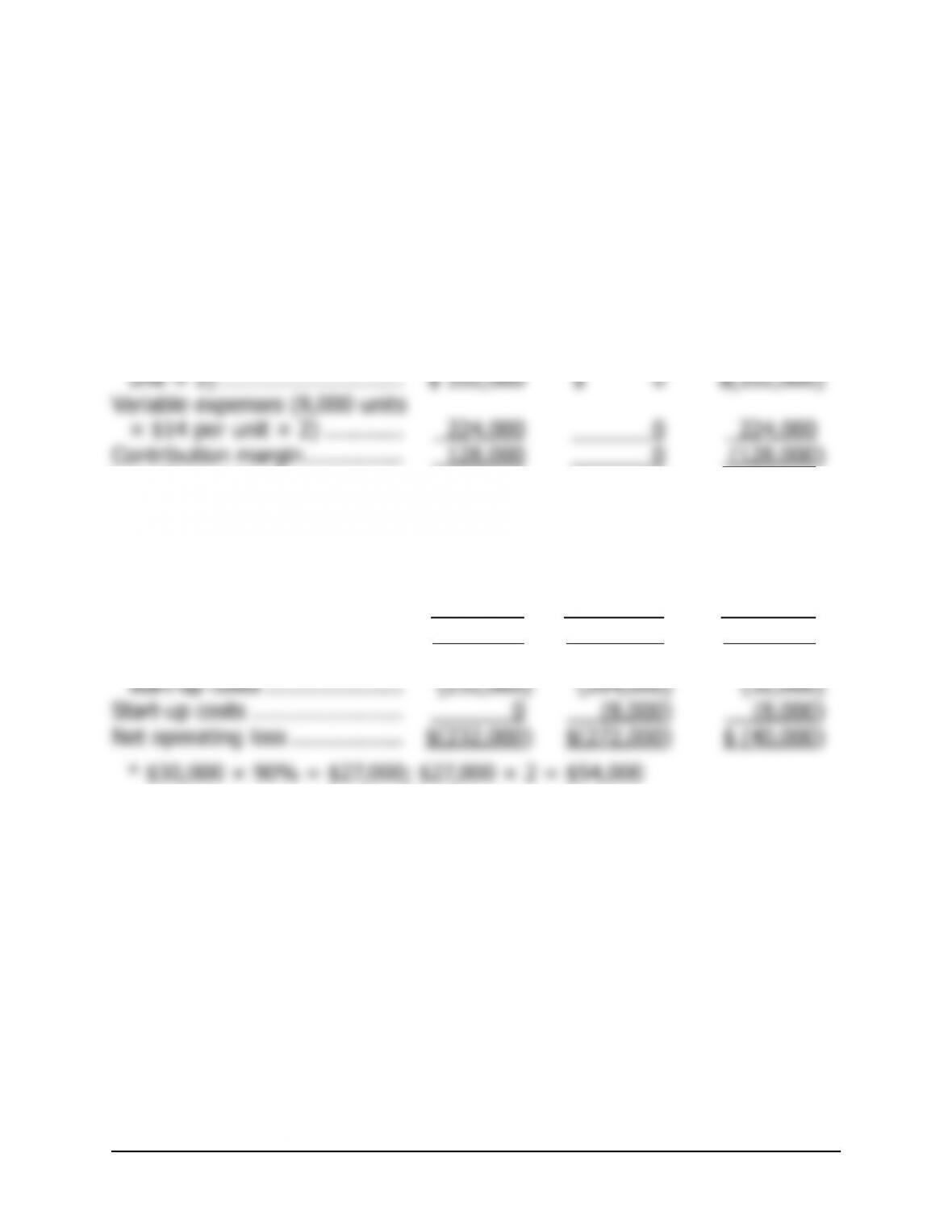
Problem 12-24 (continued)
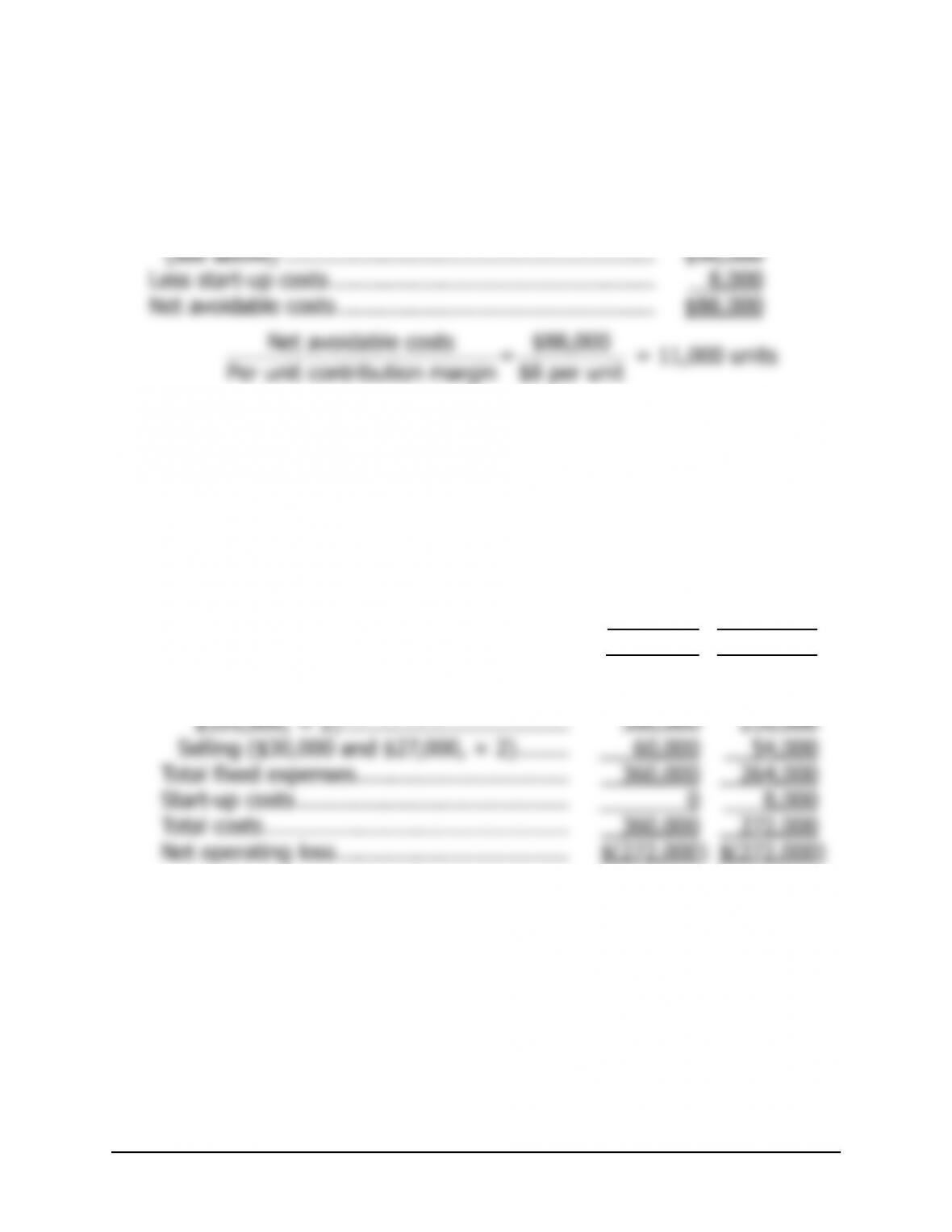
Alternative Solution:
Plant
Kept
Open
Plant
Closed
Difference:
Net
Operating
Income
Increase or
(Decrease)
Sales (8,000 units × $22 per
V
Less fixed costs:
Fixed manufacturin
g
overhead costs ($150,000
× 2) ………………………….. 300,000 210,000 90,000
Fixed sellin
g
costs
($30,000 × 2) ……………… 60,000 54,000 * 6,000
T
otal fixed costs ……………….. 360,000 264,000 96,000
Net operatin
g
loss before
g
© The McGraw-Hill Companies, Inc., 2018. All rights reserved.
48 Managerial Accounting, 16th Edition
Problem 12-24 (continued)
3. Birch Company will be indifferent if it can sell 11,000 units over the two-
month period. The computations are:
Cost avoided by closin
g
the plant for two months
Verification:
Operate at
11,000
Units for
Two
Months
Close for
Two
Months
Sales (11,000 units × $22 per unit) ………. $ 242,000 $ 0
V
ariable expenses (11,000 units × $14
per unit) ………………………………………. 154,000 0
Contribution mar
g
in ………………………….. 88,000 0
Fixed expenses:
Manufacturin
g
overhead ($150,000 and
T
T
© The McGraw-Hill Companies, Inc., 2018. All rights reserved.
Solutions Manual, Chapter 12 49
Problem 12-25 (60 minutes)
1.
Debbie Trish Sarah Mike
Sewin
g
Kit
Direct labor cost per unit (a)…. $6.40 $4.00 $11.20 $8.00 $3.20
2 .
Debbie Trish Sarah Mike
Sewin
g
Kit
V
ariable overhead per hour (a) $2.00 $2.00 $2.00 $2.00 $2.00
V
3 .
Debbie Trish Sarah Mike
Sewin
g
Kit
Sellin
g
price ……………………… $16.70 $7.50 $26.60 $14.00 $9.60
V
ariable costs:
Direct materials ……………….. 4.30 1.10 6.44 2.00 3.20
Direct labor …………………….. 6.40 4.00 11.20 8.00 3.20
T
© The McGraw-Hill Companies, Inc., 2018. All rights reserved.
50 Managerial Accounting, 16th Edition
Problem 12-25 (continued)
4. The first step is to compute how many direct labor-hours would be
committed to each of the five products as follows:
A
mount of constrained resource available…………….. 130,000 hours
Less: Hours required for production of 325,000 units
of the Sewing Kit @0.20 hours per unit ……………. 65,000 hours
Remainin
g
constrained resource available…………….. 65,000 hours
Less: Hours required for production of 50,000 units
g
g
g
The second step is to multiple the direct labor-hours committed to each
product by its respective contribution margin per direct labor–hour as
shown below:
Sewin
g
Kit Debbie Sarah Trish Mike
Contribution
margin per DLH
T
The highest total contribution margin that the company can earn is
g