© The McGraw-Hill Companies, Inc., 2018. All rights reserved.
Solutions Manual, Chapter 12 31
Exercise 12-14 (20 minutes)
1.
A
vera
g
e fixed cost per mile ($3,200* ÷ 10,000 miles)….. $0.32
V
ariable operatin
g
cost per mile ……………………………… 0.14
A
vera
g
e cost per mile ………………………………………..…. $0.46
T
2. The variable operating cost is relevant in this situation. The depreciation
is not relevant because it is a sunk cost. However, any decrease in the
resale value of the car due to its use is relevant. The automobile tax and
3. When figuring the incremental cost of the more expensive car, the
relevant costs include the purchase price of the new car (net of the
resale value of the old car) and the increases in the fixed costs of
insurance and automobile tax and license. The original purchase price of
A
© The McGraw-Hill Companies, Inc., 2018. All rights reserved.
32 Managerial Accounting, 16th Edition
Exercise 12-15 (30 minutes)
The financial (disadvantage) of discontinuing the bilge pump product line is
computed as follows:
Contribution mar
g
in lost if the line is dropped …. $(460,000)
Fixed costs that can be avoided:
A
g
g
g
The same solution can be obtained by preparing comparative income
statements:
Keep
Product
Line
Drop
Product
Line
Difference:
Net
Operating
Income
Increase or
(Decrease)
Sales ………………………………………. $850,000 $ 0 $(850,000)
V
ariable expenses:
T
g
Fixed expenses:
A
dvertisin
g
(for the bil
g
e pump
product line) ………………………… 270,000 0 270,000
Depreciation of equipment…………. 80,000 80,000 0
g
T
$
© The McGraw-Hill Companies, Inc., 2018. All rights reserved.
Solutions Manual, Chapter 12 33
Exercise 12-16 (30 minutes)
1. The relevant costs of a hunting trip would be:
T
ravel expense (100 miles @ $0.21 per mile) $21
This answer assumes that Bill would not be drinking the bottle of
The money lost in the poker game is not relevant because Bill would
2. If Bill gets lucky and bags another two ducks, all of his costs are likely to
be the same as they were on his last trip. Therefore, it doesn’t cost him
3. In a decision of whether to give up hunting entirely, more of the costs
listed by John are relevant. If Bill did not hunt, he would not need to
pay for: gas, oil, and tires; shotgun shells; the hunting license; and the
These three requirements illustrate the slippery nature of costs. A cost
that is relevant in one situation can be irrelevant in the next. None of
the costs are relevant when we compute the cost of bagging two
T
© The McGraw-Hill Companies, Inc., 2018. All rights reserved.
34 Managerial Accounting, 16th Edition
Exercise 12-17 (10 minutes)
Contribution mar
g
in lost if the Linens Department is dropped:
Lost from the Linens Department …..……………………………… $(600,000)
Lost from the Hardware Department (10% × $2,100,000) ….. (210,000)
© The McGraw-Hill Companies, Inc., 2018. All rights reserved.
Solutions Manual, Chapter 12 35
Problem 12-18 (60 minutes)
1. Sellin
g
price per unit ……………………………………. $32
V
ariable expenses per unit…………………………….. 18 *
Contribution mar
g
in per unit ………………………….. $14
*$10.00 + $4.50 + $2.30 + $1.20 = $18.00
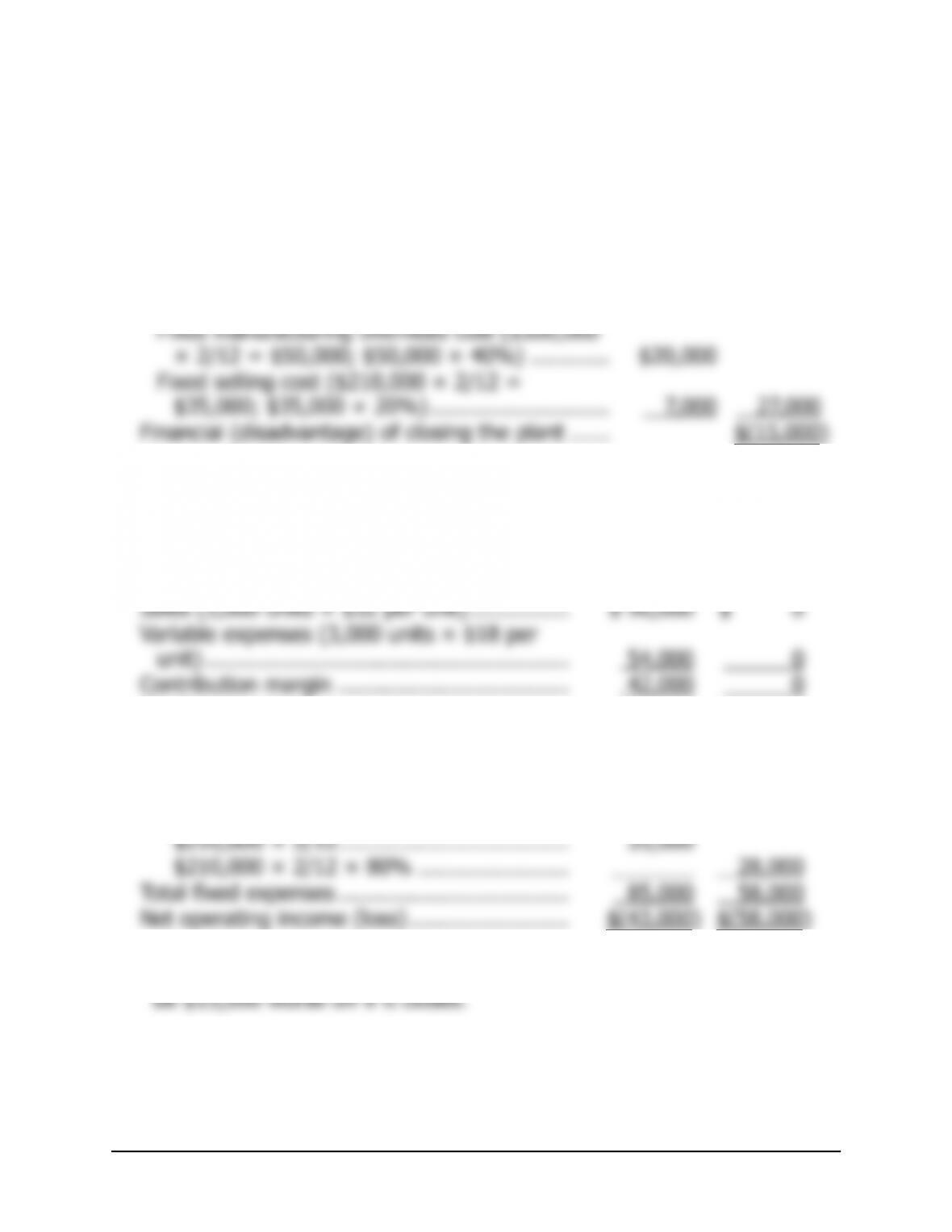
Yes, the increase in fixed selling expenses would be justified.
2.
V
ariable manufacturin
g
cost per unit ……………….. $16.80 *
Import duties per unit ………………………………….. 1.70
3. The relevant cost is $1.20 per unit, which is the variable selling expense
per Dak. Because the irregular units have already been produced, all
production costs (including the variable production costs) are sunk. The
4. If the plant operates at 30% of normal levels, then only 3,000 units will
be produced and sold during the two-month period:
g
© The McGraw-Hill Companies, Inc., 2018. All rights reserved.
36 Managerial Accounting, 16th Edition
Problem 12-18 (continued)
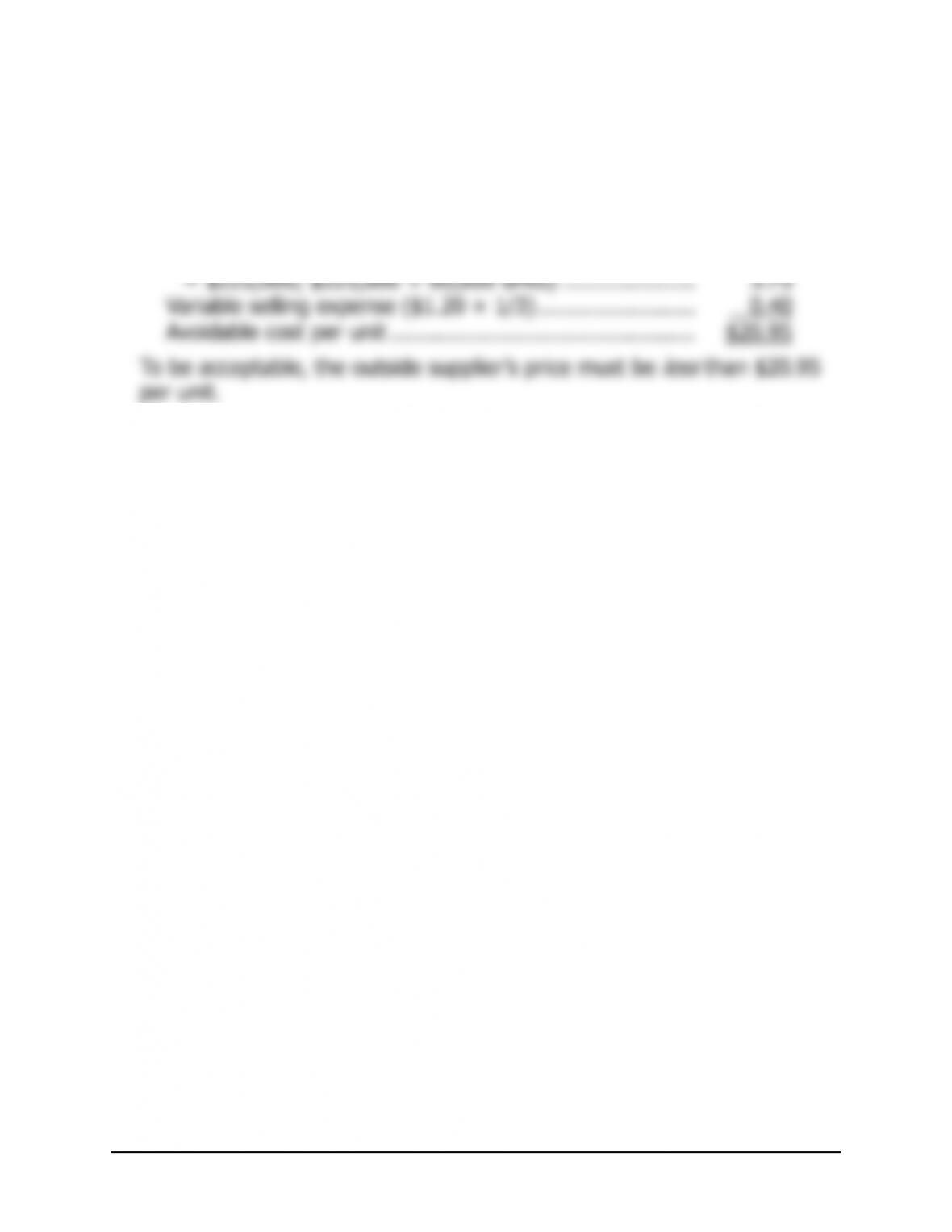
Given this information, the simplest approach to solving 4a, 4b, and 4c
is:
Contribution mar
g
in lost if the plant is closed
(3,000 units × $14 per unit) …..…………………. $(42,000)
Fixed costs that can be avoided if the plant is
closed:
Some students will take a longer approach such as that shown below:
Continue
to
Operate
Close the
Plant
Fixed expenses:
Fixed manufacturin
g
overhead cost:
$300,000 × 2/12 …………………………….. 50,000
$300,000 × 2/12 × 60% ………………….. 30,000
Fixed sellin
g
expense:
4d. The company should not close the plant for two months because it will
g
g
© The McGraw-Hill Companies, Inc., 2018. All rights reserved.
Solutions Manual, Chapter 12 37
Problem 12-18 (continued)
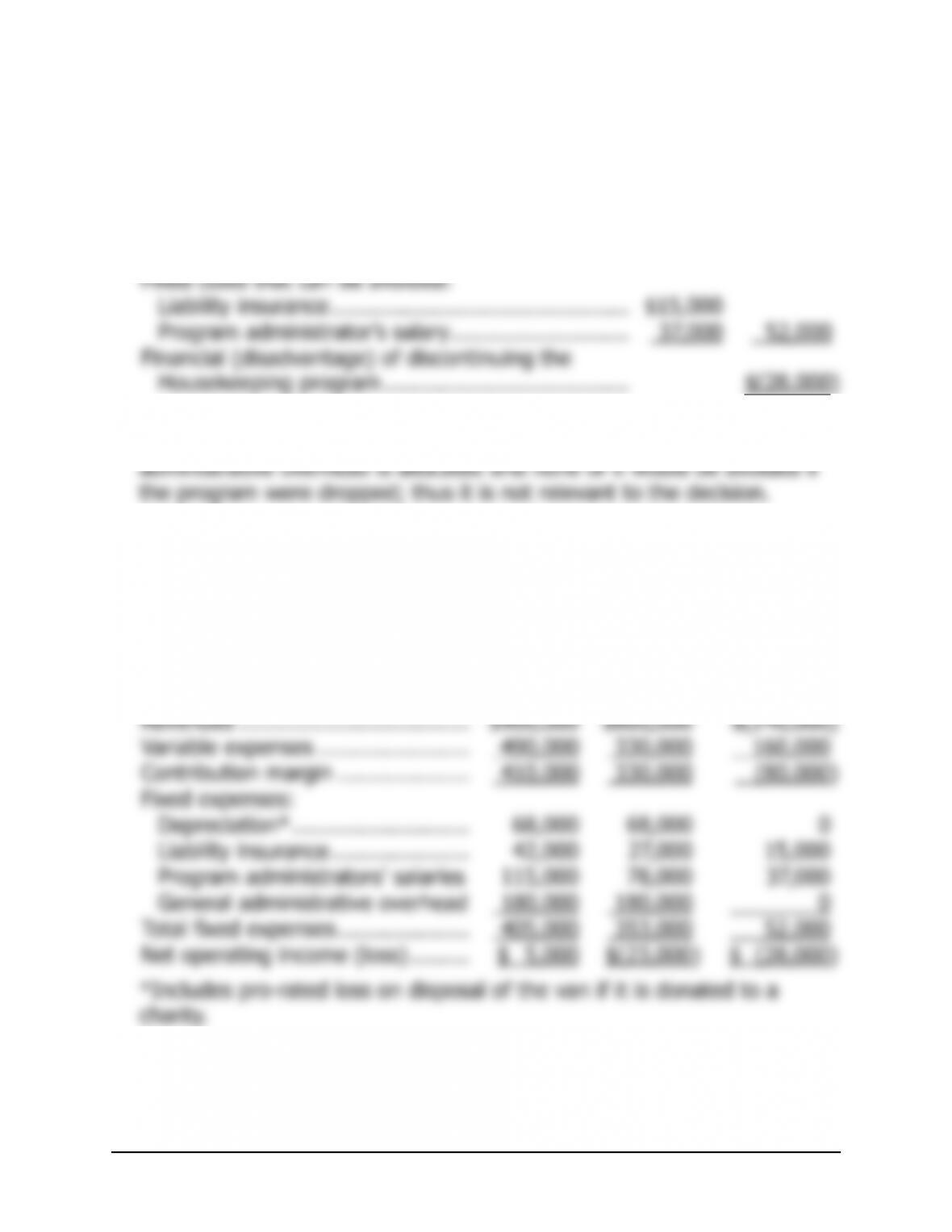
5. The relevant costs are those that can be avoided by purchasing from the
outside supplier. These costs are:
V
ariable manufacturin
g
cost per unit……………………… $16.80
Fixed manufacturin
g
overhead cost ($300,000 × 75%
V
A
© The McGraw-Hill Companies, Inc., 2018. All rights reserved.
38 Managerial Accounting, 16th Edition
Problem 12-19 (60 minutes)
1. The financial (disadvantage) of discontinuing the Housekeeping program
is calculated as follows:
Contribution mar
g
in lost if the Housekeepin
g
program is dropped …………………………………… $(80,000)
Depreciation on the van is a sunk cost and the van has no salvage value
since it would be donated to another organization. The general
The same result can be obtained with the alternative analysis below:
Current
Total
Total If
House-
keepin
g
Is
Dropped
Difference:
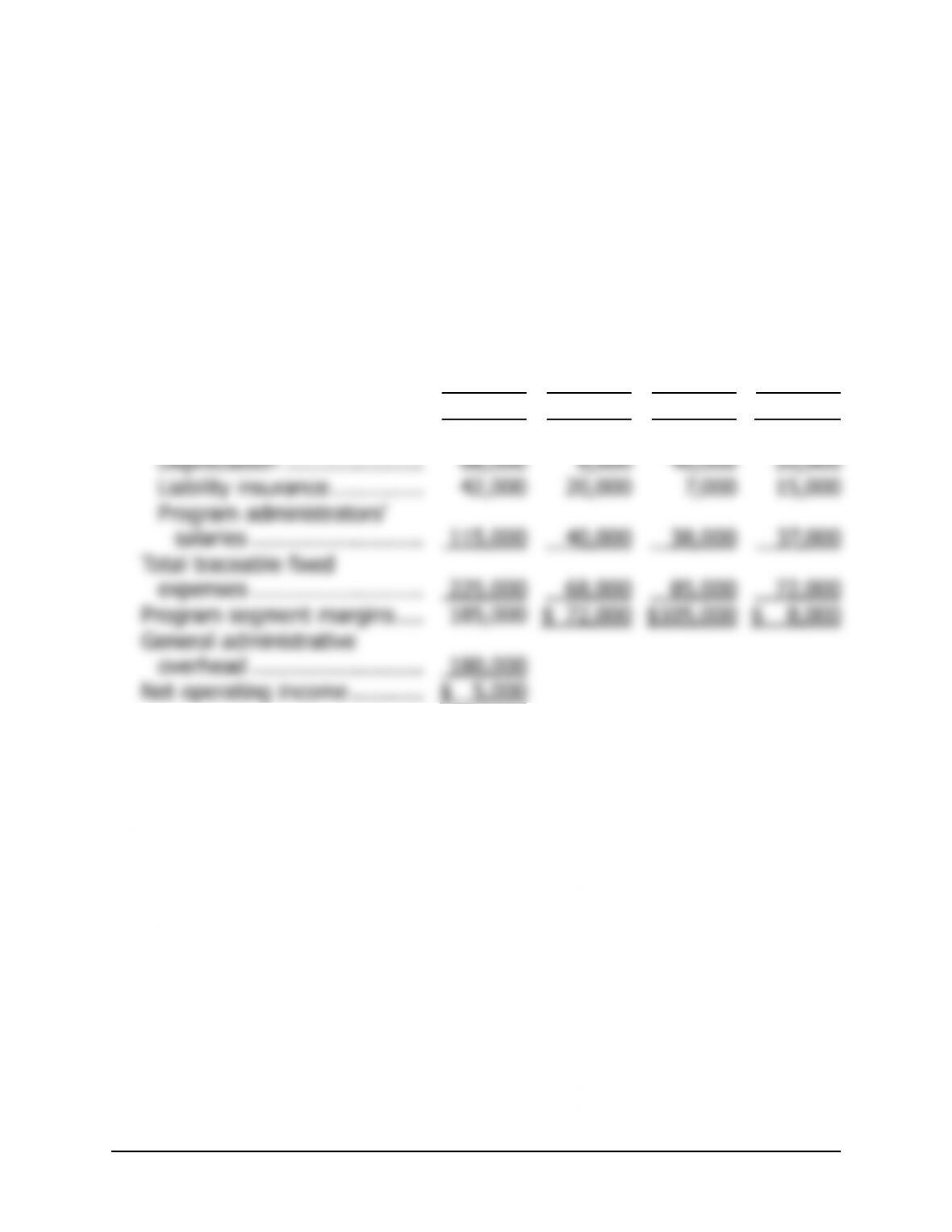
Net
Operating
Income
Increase or
(Decrease)
g
© The McGraw-Hill Companies, Inc., 2018. All rights reserved.
Solutions Manual, Chapter 12 39
Problem 12-19 (continued)
2. To give the administrator of the entire organization a clearer picture of
the financial viability of each of the organization’s programs, the general
administrative overhead should not be allocated. It is a common cost
that should be deducted from the total program segment margin. A
better income statement would be:
Total
Home
Nursing
Meals On
Wheels
House-
keeping
Revenues ………………….…… $900,000 $260,000 $400,000 $240,000
V
ariable expenses ……………. 490,000 120,000 210,000 160,000
Contribution mar
g
in …………. 410,000 140,000 190,000 80,000
T
raceable fixed expenses:
T
© The McGraw-Hill Companies, Inc., 2018. All rights reserved.
40 Managerial Accounting, 16th Edition
Problem 12-20 (15 minutes)
1.
Per 16-Ounce
T-Bone
Sales from further processin
g
:
Sales price of one filet mi
g
non (6 ounces ×
$12.00 per pound ÷ 16 ounces per pound) … $4.50
Sales price of one New York cut (8 ounces ×
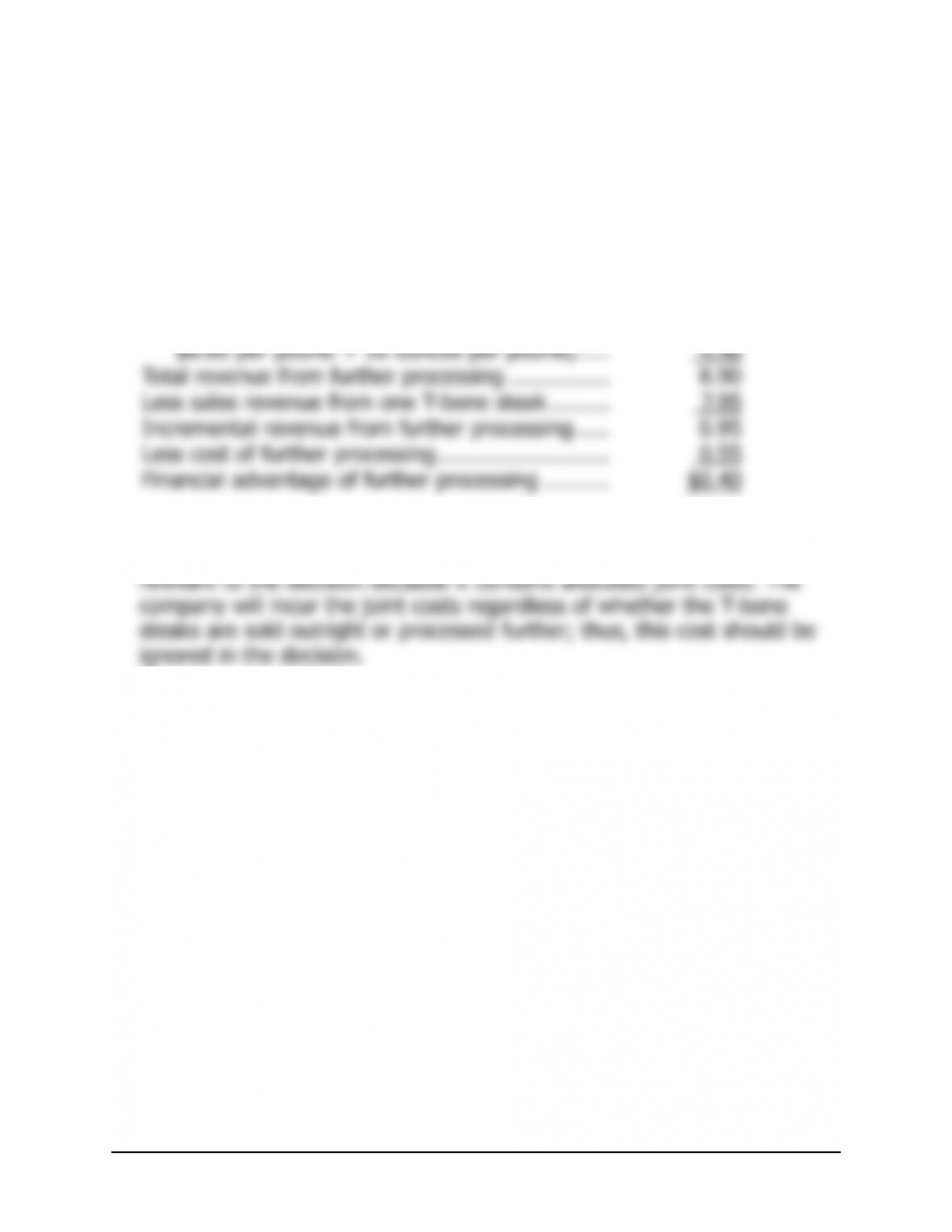
2. The T-bone steaks should be processed further into the filet mignon and
the New York cut. The $4.15 “profit” per pound shown in the text is not