© The McGraw-Hill Companies, Inc., 2018. All rights reserved.
Solutions Manual, Chapter 12 21
Exercise 12-6 (20 minutes)
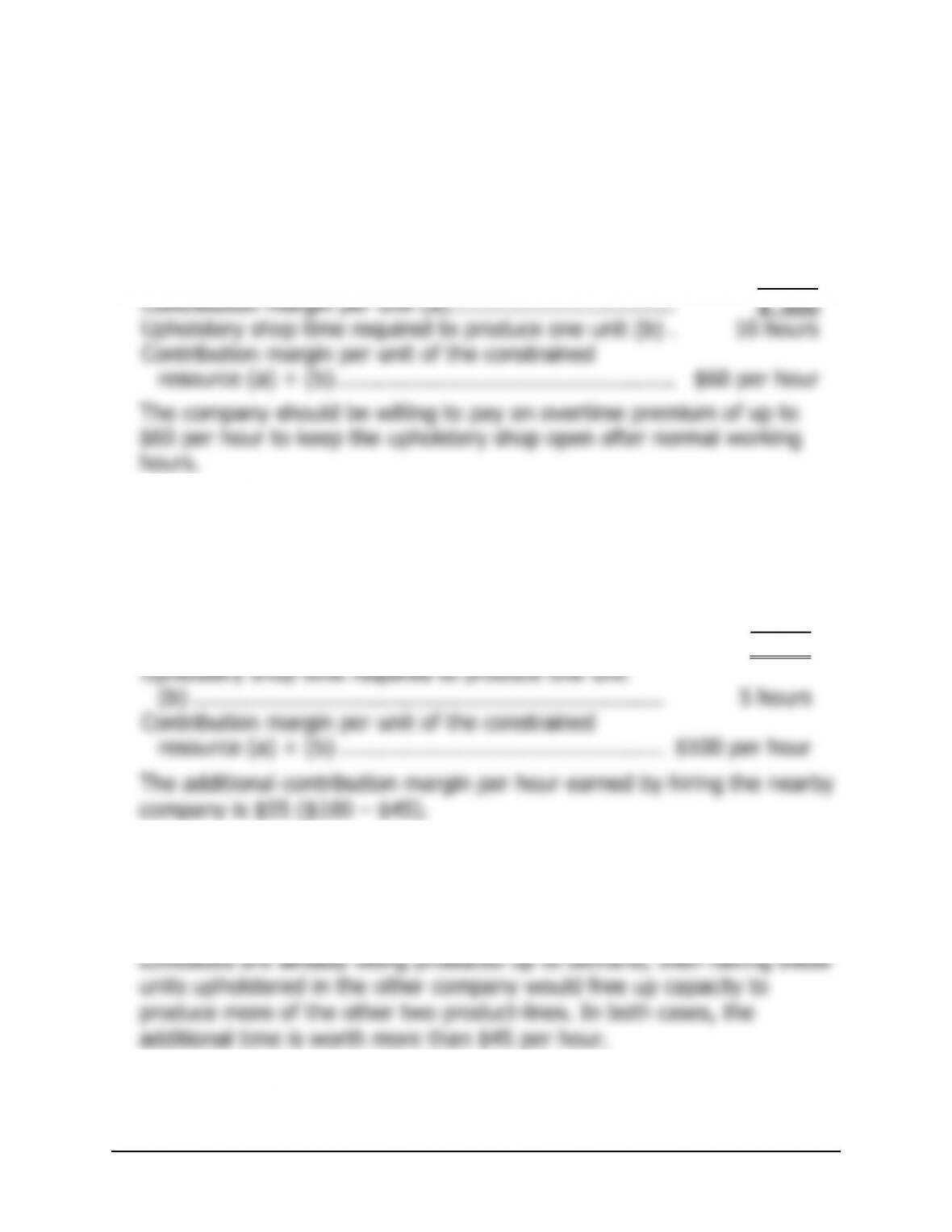
1. The value of relaxing the constraint can be determined by computing
the contribution margin per unit of the constrained resource:
Sofa
Sellin
g
price per unit ………………………………………..… $1,800
Variable cost per unit ……………………….………..………. 1,200
2. To answer this question, it is desirable to compute the contribution
margin per unit of the constrained resource for the Love Seat:
Love Seat
Sellin
g
price per unit ………………………………………...
.
$1,500
Variable cost per unit ……………………….………..……..
.
1,000
Contribution mar
g
in per unit (a)…………………………..
.
$ 500
g
3. The offer by the nearby upholstering company to upholster furniture for
$45 per hour should be accepted. The time would be used to upholster
Loveseats. If this increases the total production and sales of Loveseats,
the time would be worth $100 per hour—a net gain of $55 per hour. If
g
g
© The McGraw-Hill Companies, Inc., 2018. All rights reserved.
22 Managerial Accounting, 16th Edition
Exercise 12-7 (10 minutes)
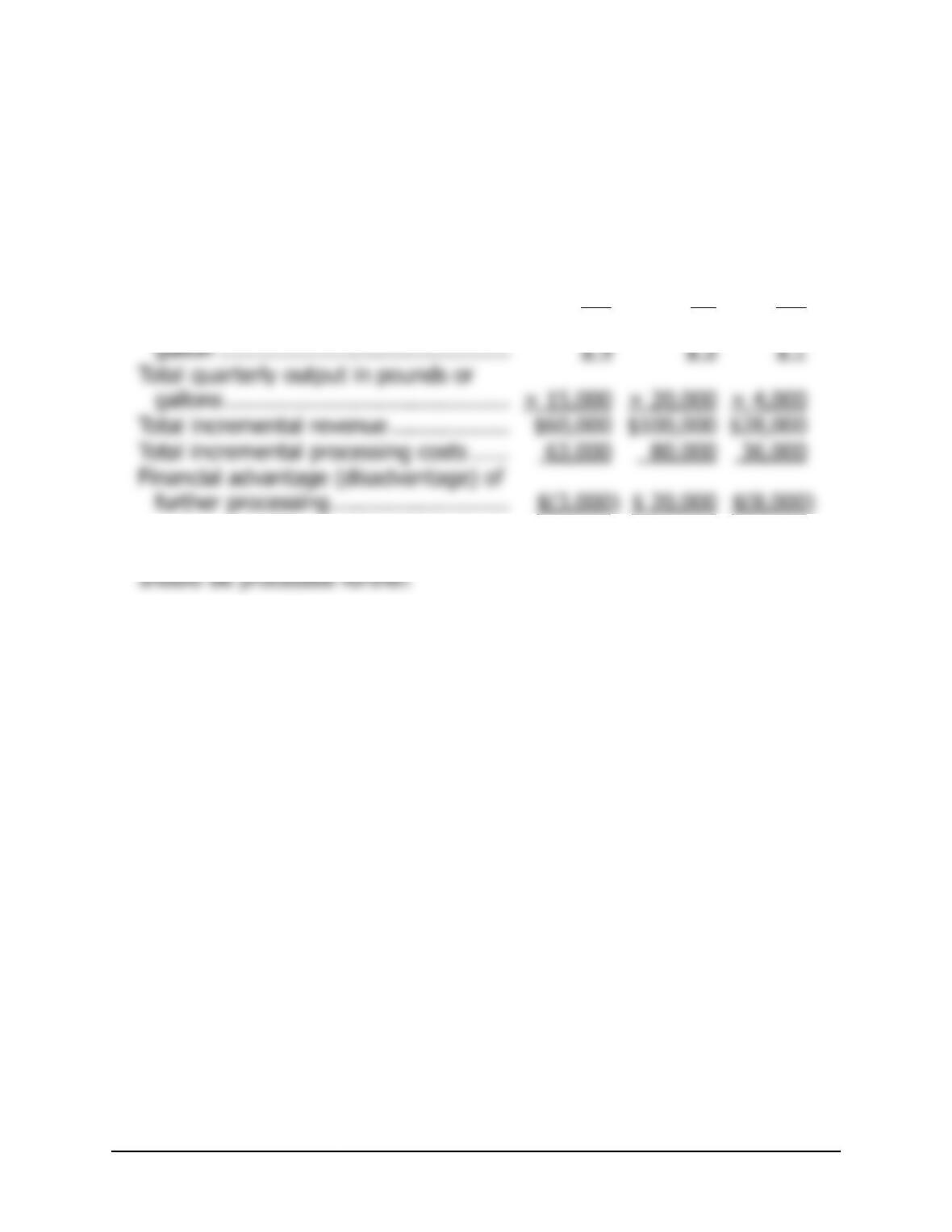
1. The financial advantage (disadvantage) of further processing each
product is calculated as follows:
A B C
Sellin
g
price after further processin
g
… $20 $13 $32
Sellin
g
price at the split-off point …….. 16 8 25
Incremental revenue per pound or
2. Products A and C should be sold at the split-off point. Only product B
© The McGraw-Hill Companies, Inc., 2018. All rights reserved.
Solutions Manual, Chapter 12 23
Exercise 12-8 (30 minutes)
1.
A B C
(1) Contribution mar
g
in per unit……………………… $54 $100 $60
(2) Direct material cost per unit ……………………… $24 $80 $32
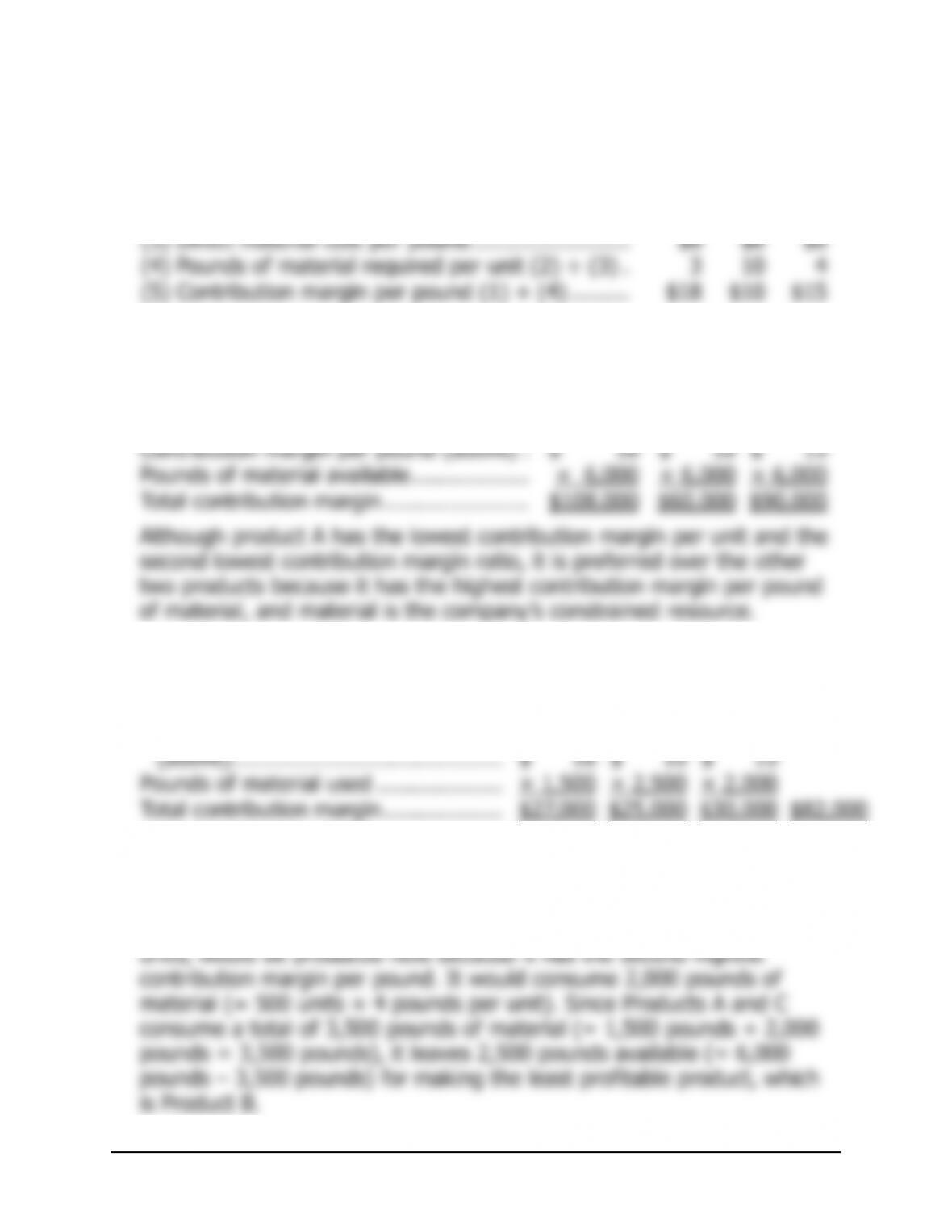
2. If the company has unlimited demand for all three products, it should
concentrate all of its available material on product A, which would yield the
highest total contribution margin of $108,000 computed as follows:
A B C
g
3. If customer demand is limited to 500 units per product the maximum
contribution margin of $82,000 is computed as follows:
A B C Total
Contribution mar
g
in per pound
Product A would be produced first because it earns the highest
contribution margin per pound. Since Product A has customer demand
of 500 units, it would consume 1,500 pounds of material (= 500 units ×
3 pounds per unit). Product C, which also has customer demand of 500
g
© The McGraw-Hill Companies, Inc., 2018. All rights reserved.
24 Managerial Accounting, 16th Edition
Exercise 12-8 (continued)
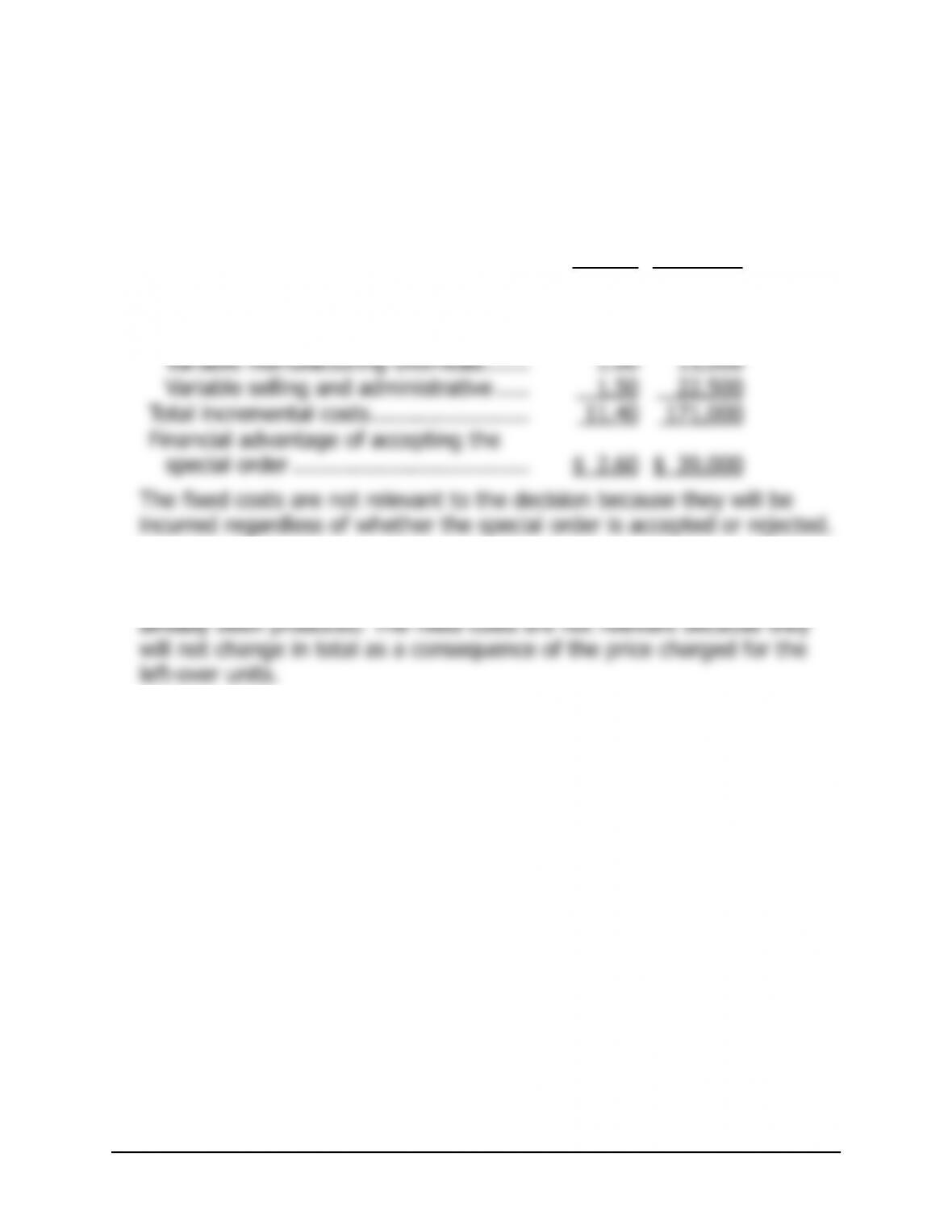
4. Assuming Barlow has customer demand of 500 units per product line
and that it has already used its 6,000 pounds in an optimal fashion, any
additional raw materials would have to be used to make more of
© The McGraw-Hill Companies, Inc., 2018. All rights reserved.
Solutions Manual, Chapter 12 25
Exercise 12-9 (15 minutes)
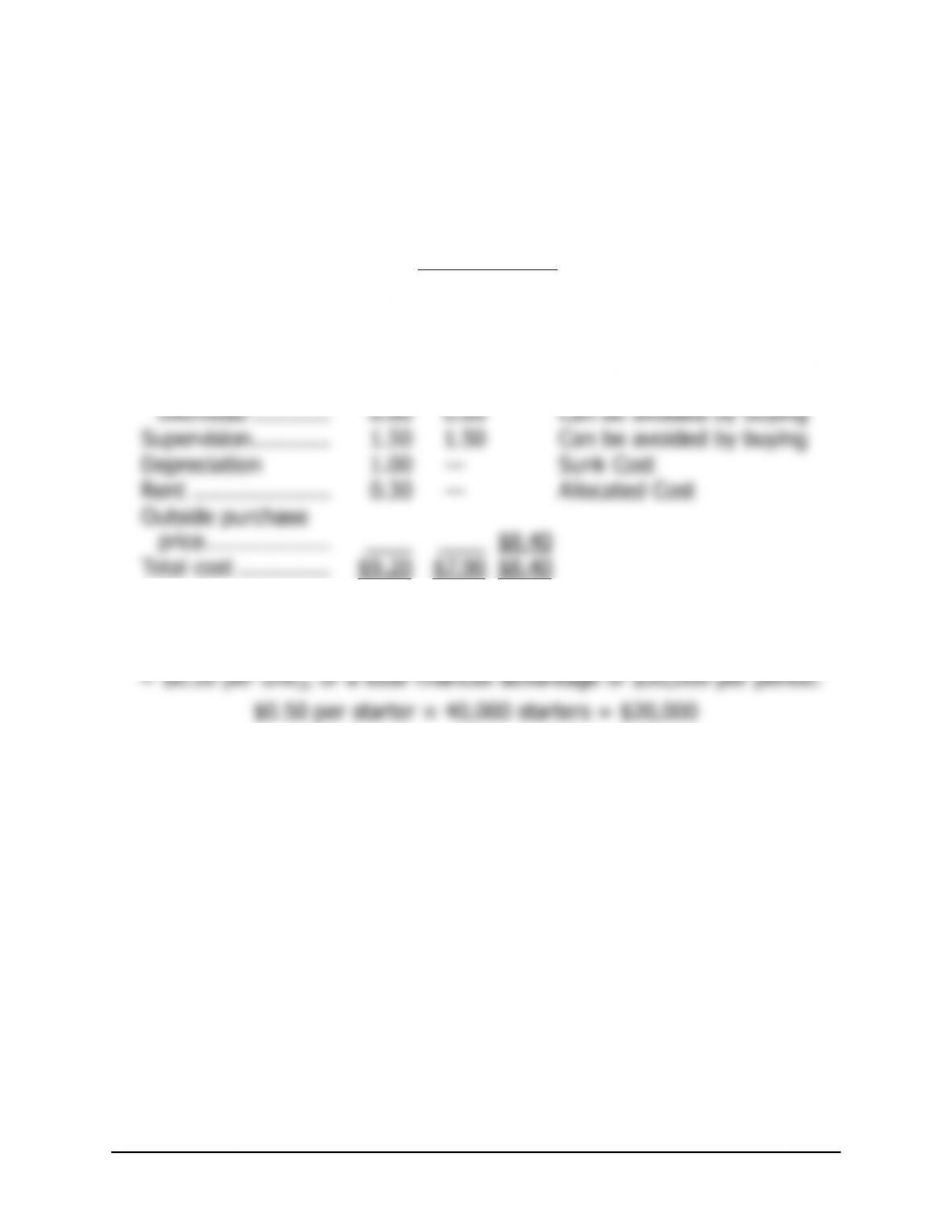
1. The financial advantage is computed as follows:
Per Unit
15,000
Units
Incremental sales …………………………. $14.00 $210,000
Incremental costs:
Direct materials ………………………….. 5.10 76,500
Direct labor ……………………………….. 3.80 57,000
2. The relevant cost is $1.50 (the variable selling and administrative
expenses). All other variable costs are sunk because the units have
© The McGraw-Hill Companies, Inc., 2018. All rights reserved.
26 Managerial Accounting, 16th Edition
Exercise 12-10 (15 minutes)
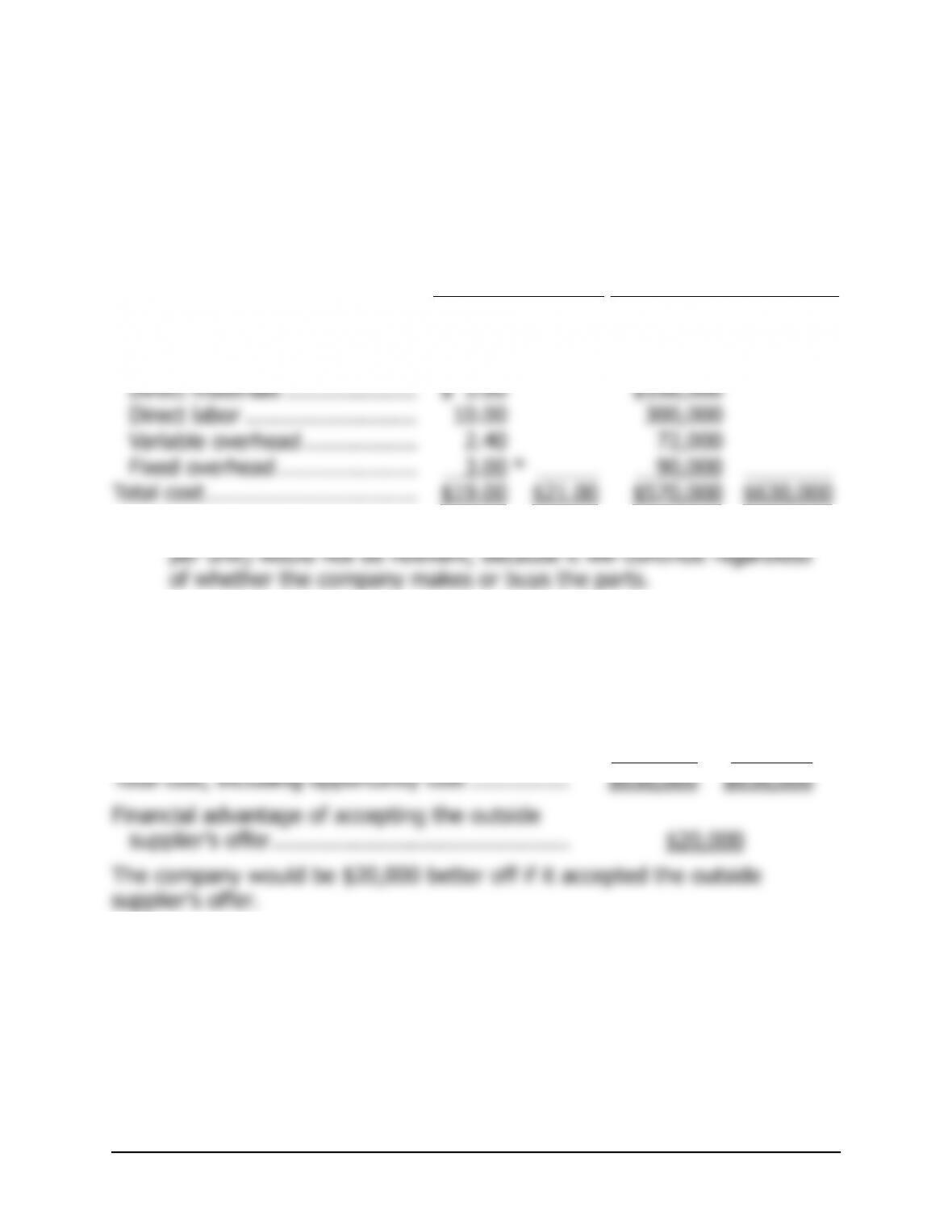
The financial advantage per unit and in total is computed as follows:
“Cost”
Per
Differential
Costs
Unit Make Buy Explanation
Direct materials ….. $3.10 $3.10 Can be avoided by buyin
g
Direct labor ……….. 2.70 2.70 Can be avoided by buyin
g
V
ariable
manufacturing
—
—
A
T
The company should make the starters, rather than continuing to buy
from the outside supplier. Making the starters provides a per unit
financial advantage of $0.50 per starter ($8.40 per unit – $7.90 per unit
g
© The McGraw-Hill Companies, Inc., 2018. All rights reserved.
Solutions Manual, Chapter 12 27
Exercise 12-11 (20 minutes)
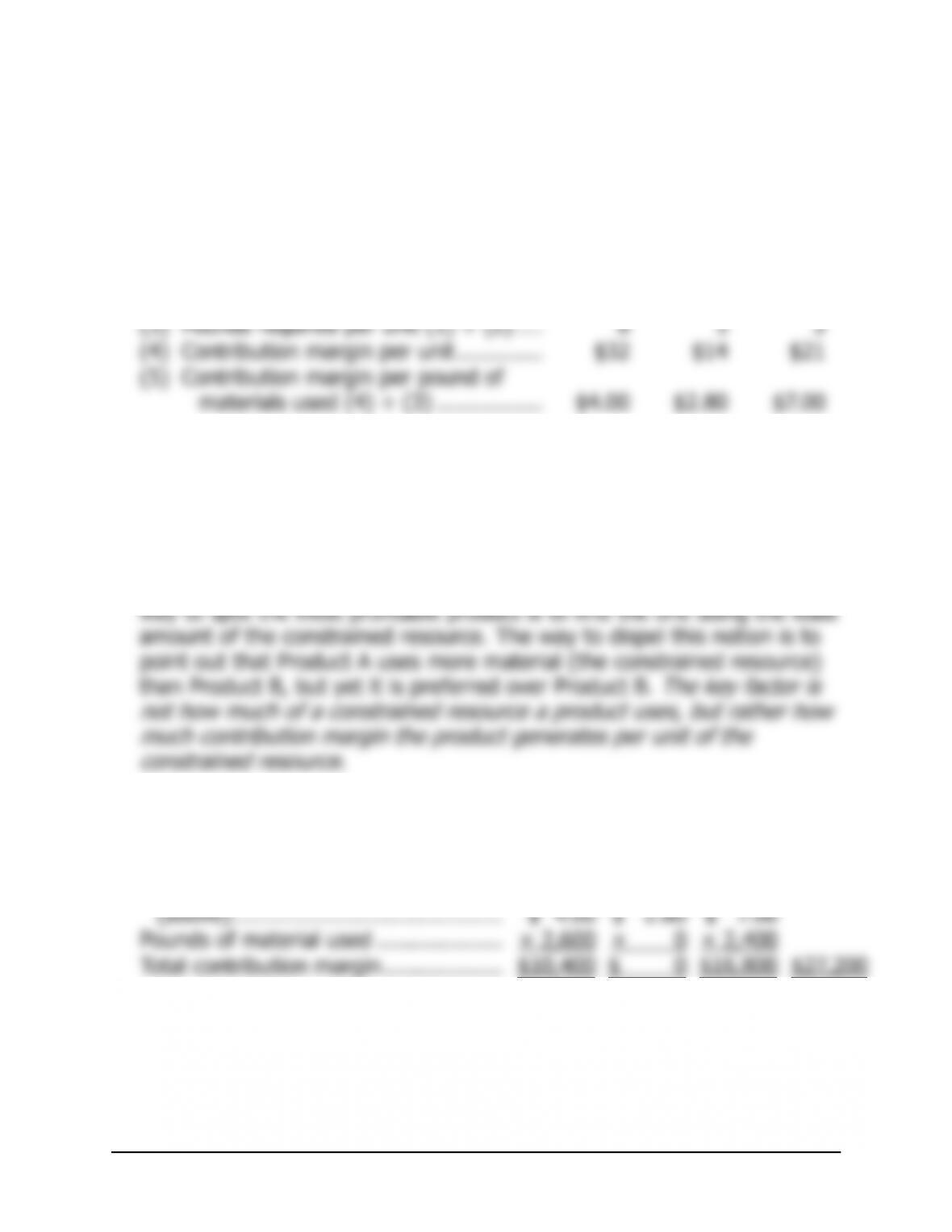
The costs that can be avoided as a result of purchasing from the outside
are relevant in a make-or-buy decision. The analysis is:
Per Unit
Differential
Costs 30,000 Units
Make Buy Make Buy
Cost of purchasin
g
………………. $21.00 $630,000
Cost of makin
g
:
T
*
T
he remainin
g
$6 of fixed overhead cost ($9 per unit × 2/3 = $6
per unit) would not be relevant, because it will continue re
g
ardless
of whether the company makes or buys the parts.
The $80,000 rental value of the space being used to produce part S-6 is an
opportunity cost of continuing to produce the part internally. Thus, the
complete analysis is:
Make Buy
T
otal cost, as above …………………………………. $570,000 $630,000
Rental value of the space (opportunity cost)….. 80,000
T
g
© The McGraw-Hill Companies, Inc., 2018. All rights reserved.
28 Managerial Accounting, 16th Edition
Exercise 12-12 (15 minutes)
1. The contribution margin per pound of the constraining resource for each
product is computed as follows:
Product
A
Product
B
Product
C
(1) Direct materials required per unit …… $24 $15 $9
(2) Cost per pound ………………………….. $3 $3 $3
g
2. The company should accept orders first for Product C, second for
Product A, and third for Product B.
Because Product C uses the least amount of material per unit of the
three products, and because it is the most profitable of the three in
terms of its use of materials, some students will immediately assume
that this is an infallible relationship. That is, they will assume that the
3. If customer demand is limited to 800 units per product the maximum
contribution margin of $27,200 is computed as follows:
A B C Total
Contribution mar
g
in per pound
g
© The McGraw-Hill Companies, Inc., 2018. All rights reserved.
Solutions Manual, Chapter 12 29
Exercise 12-12 (continued)
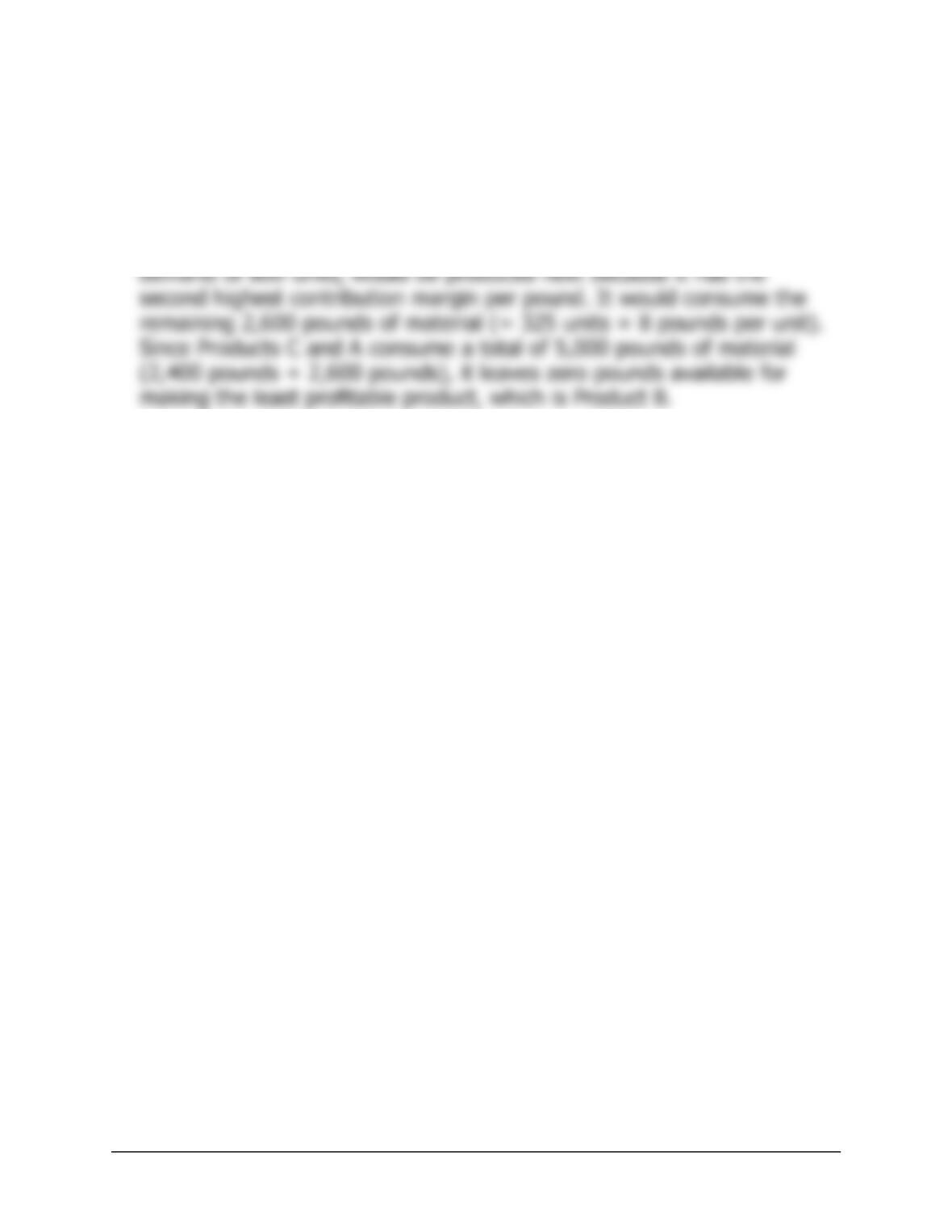
3. Product C would be produced first because it earns the highest
contribution margin per pound. Given that Product C has customer
demand of 800 units, it would consume 2,400 pounds of material (=
800 units × 3 pounds per unit). Product A, which also has customer
© The McGraw-Hill Companies, Inc., 2018. All rights reserved.
30 Managerial Accounting, 16th Edition
Exercise 12-13 (10 minutes)
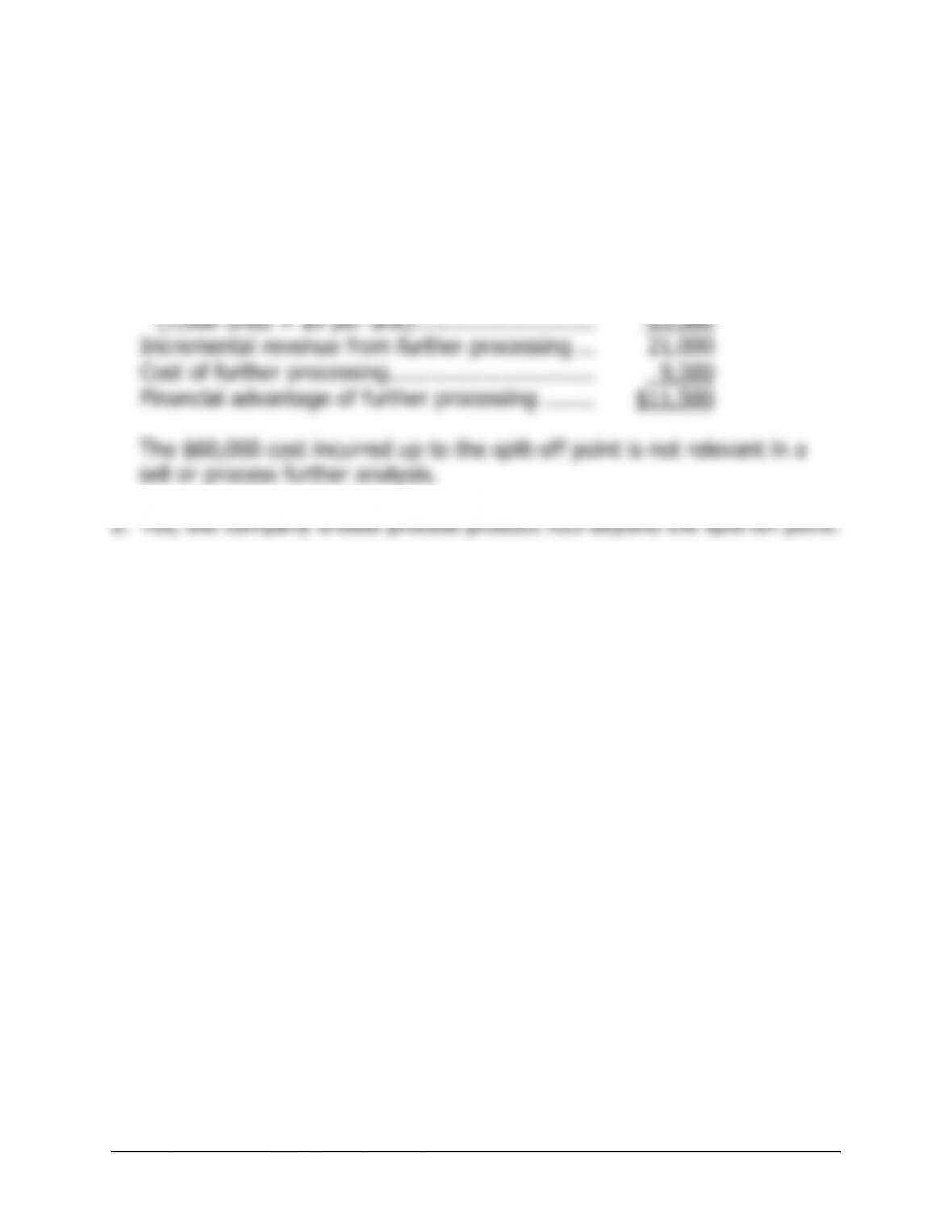
1. The financial advantage of further processing X15 is computed as
follows:
Sales value after further processin
g
(7,000 units × $12 per unit) ……………………. $84,000
Sales value at the split-off point
g
g