© The McGraw-Hill Companies, Inc., 2018. All rights reserved.
Solutions Manual, Chapter 12 11
The Foundational 15 (continued)
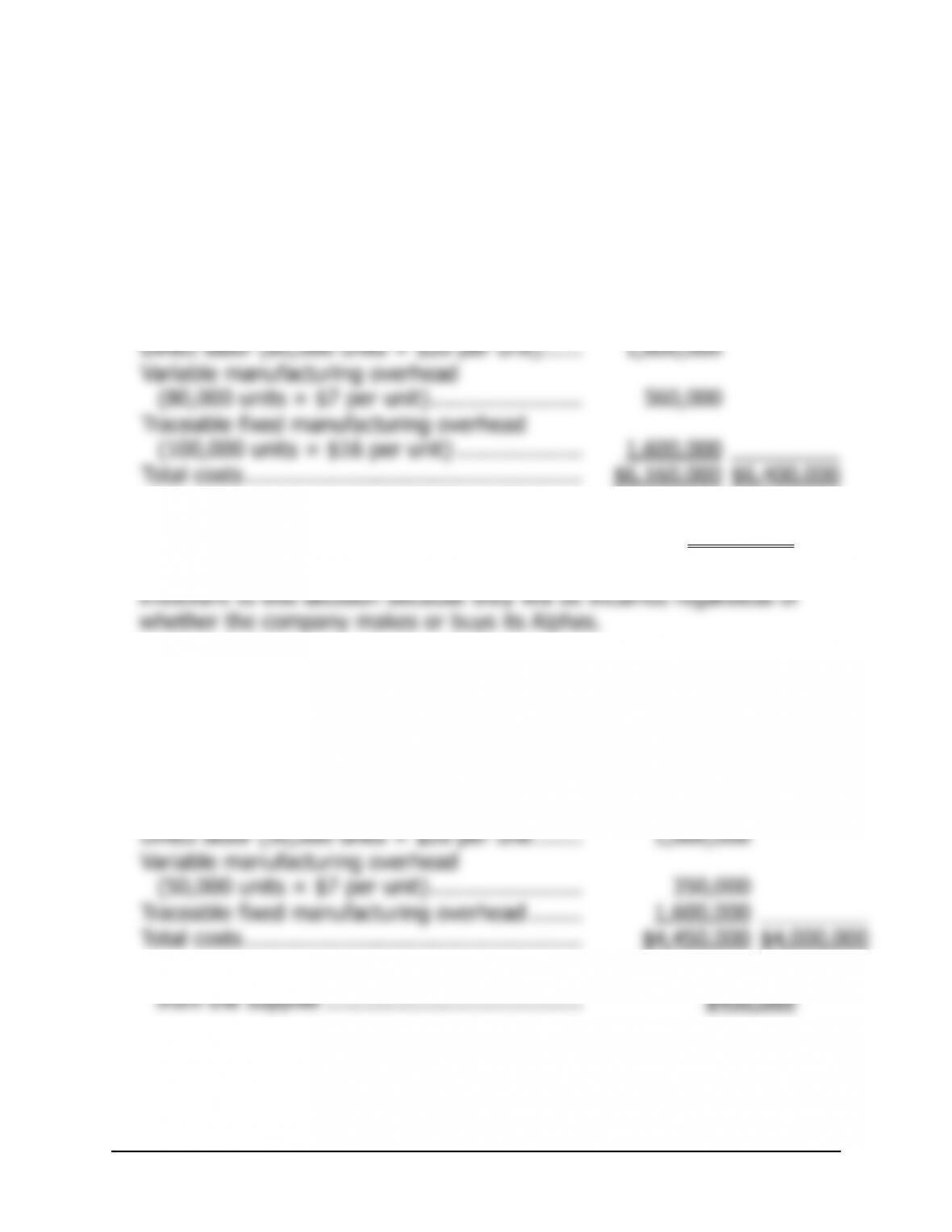
9. The financial (disadvantage) of buying 80,000 Alphas from a supplier
rather than making them is computed as follows:
Make Buy
Cost of purchasin
g
(80,000 units × $80 per
unit) ………………………………………………… $6,400,000
Direct materials (80,000 units × $30 per unit) $2,400,000
T
T
Financial (disadvanta
g
e) of buyin
g
80,000
Alphas from a supplier …………………………. $(240,000)
Note to instructors: Emphasize that the variable selling expenses are
10. The financial advantage of buying 50,000 Alphas from a supplier rather
than making them is computed as follows:
Make Buy
Cost of purchasin
g
(50,000 units × $80 per unit)
$4,000,000
Direct materials (50,000 units × $30 per unit) $1,500,000
V
T
T
Financial advanta
g
e of buyin
g
50,000
A
lphas
V
© The McGraw-Hill Companies, Inc., 2018. All rights reserved.
12 Managerial Accounting, 16th Edition
The Foundational 15 (continued)
Note to instructors: Emphasize that the variable selling expenses are
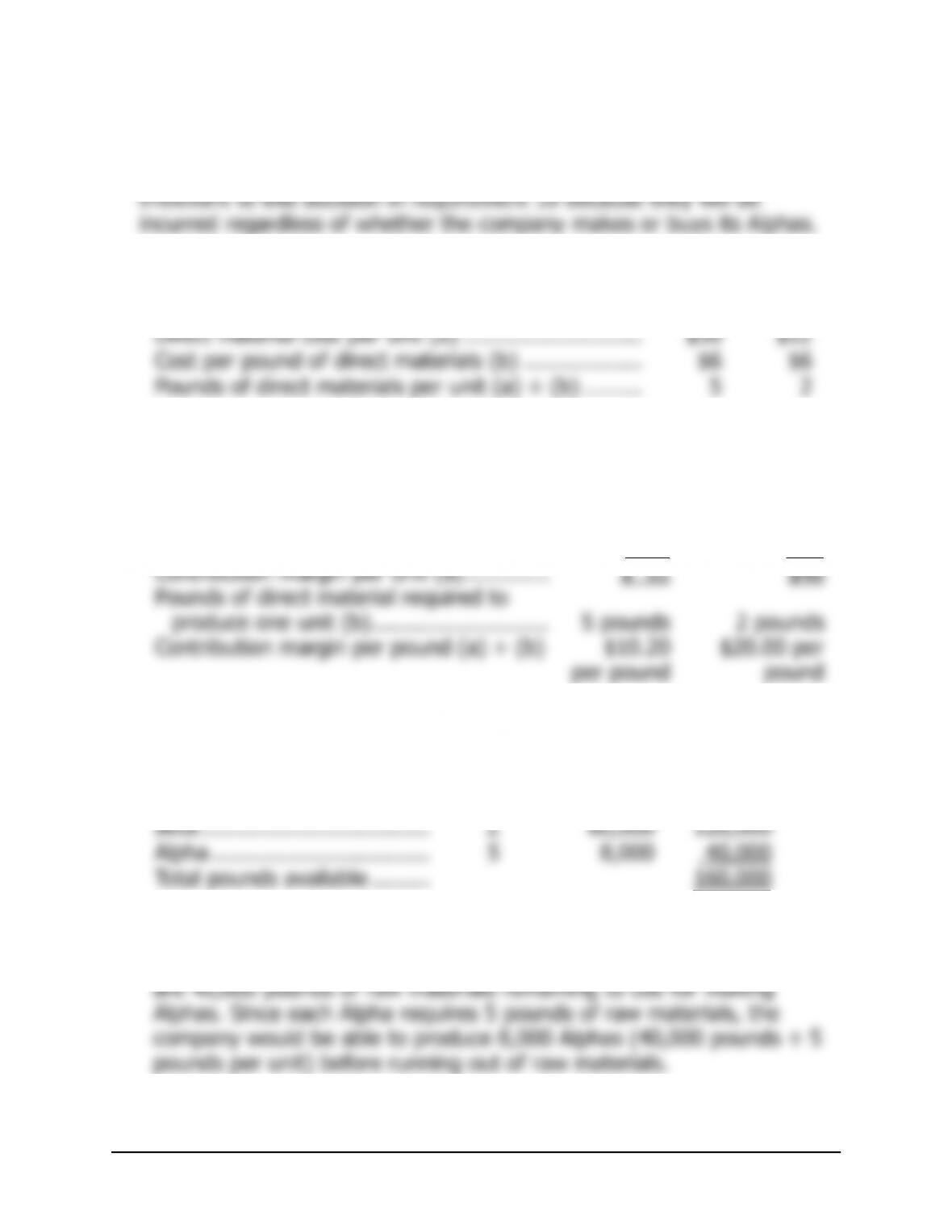
11. The pounds of raw material per unit are computed as follows:
A
lph
a
Bet
a
12. The contribution margins per pound of raw materials are computed as
follows:
Alpha Beta
Sellin
g
price per unit ……………………….. $120 $80
Variable cost per unit ………………………. 69 40
13. The optimal number of units to produce would be computed as
follows:
Product
Pounds
Per Unit
Units
Produced
Total
Pounds
The company should produce Beta first because it earns the highest
contribution margin per pound of raw materials. After customer
demand for Beta has been satisfied by producing 60,000 units, there
© The McGraw-Hill Companies, Inc., 2018. All rights reserved.
Solutions Manual, Chapter 12 13
The Foundational 15 (continued)
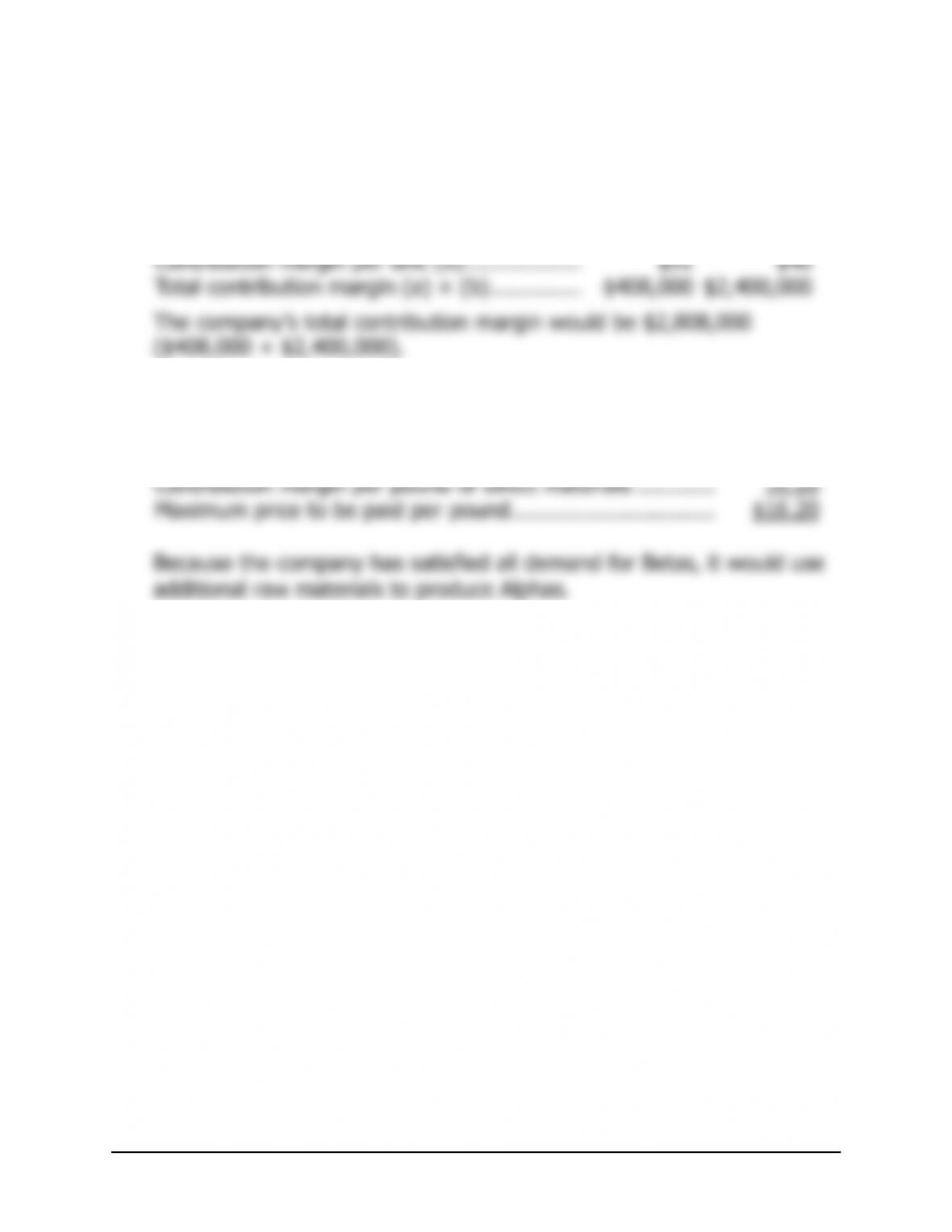
14. The total contribution margin would be computed as follows:
A
lph
a
Bet
a
Number of units produced (a) ………………..
.
8,000 60,000
15. The maximum price per pound is computed as follows:
A
lph
a
Re
g
ular direct material cost per pound ………………………. $ 6.00
© The McGraw-Hill Companies, Inc., 2018. All rights reserved.
14 Managerial Accounting, 16th Edition
Exercise 12-1 (15 minutes)
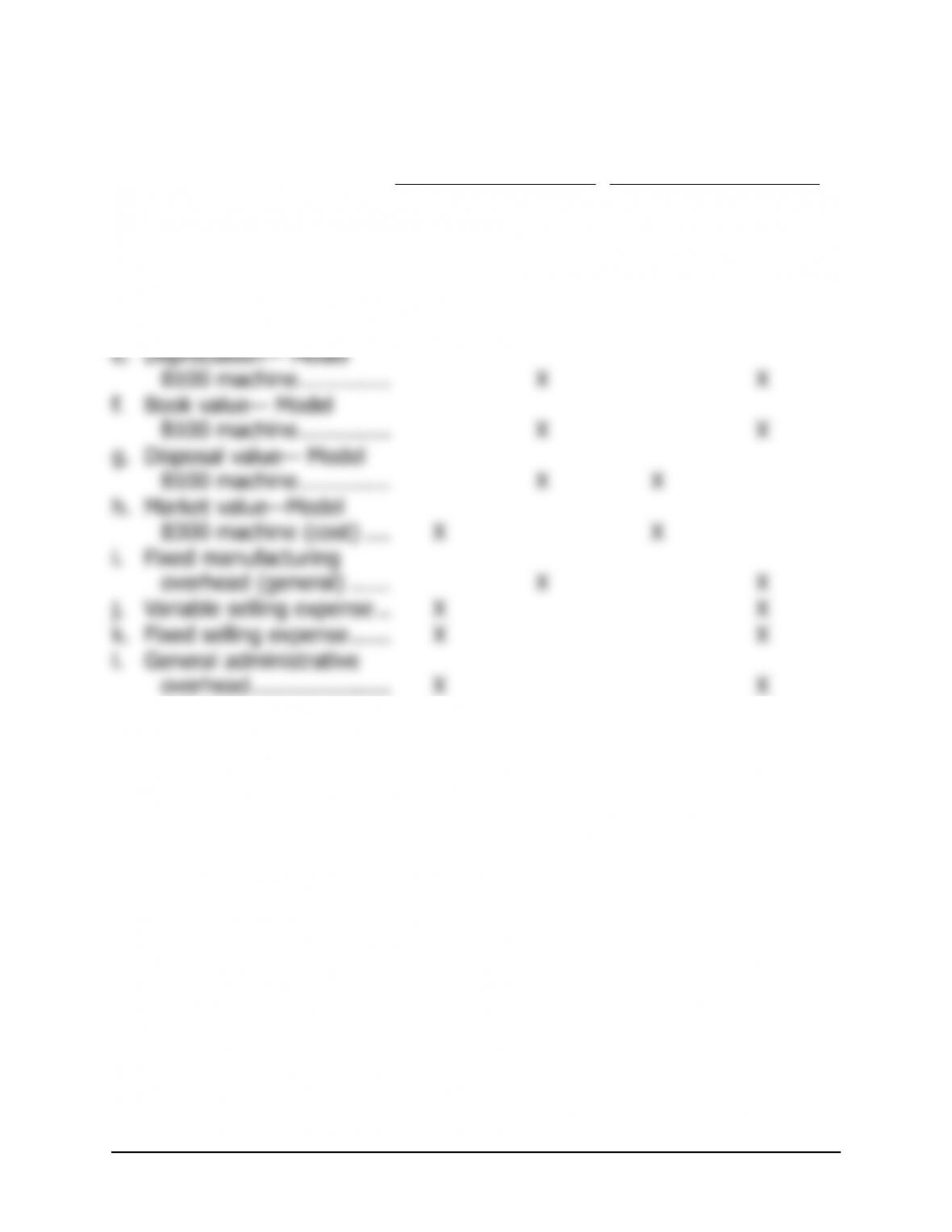
Case A Case B
Item Relevant Irrelevant Relevant Irrelevant
a. Sales revenue ……………. X X
b. Direct materials ………….. X X
c. Direct labor ……………….. X X
d.
V
ariable manufacturin
g
overhead ………………… X X
—
g
—
—
j
V
—
© The McGraw-Hill Companies, Inc., 2018. All rights reserved.
Solutions Manual, Chapter 12 15
Exercise 12-2 (30 minutes)
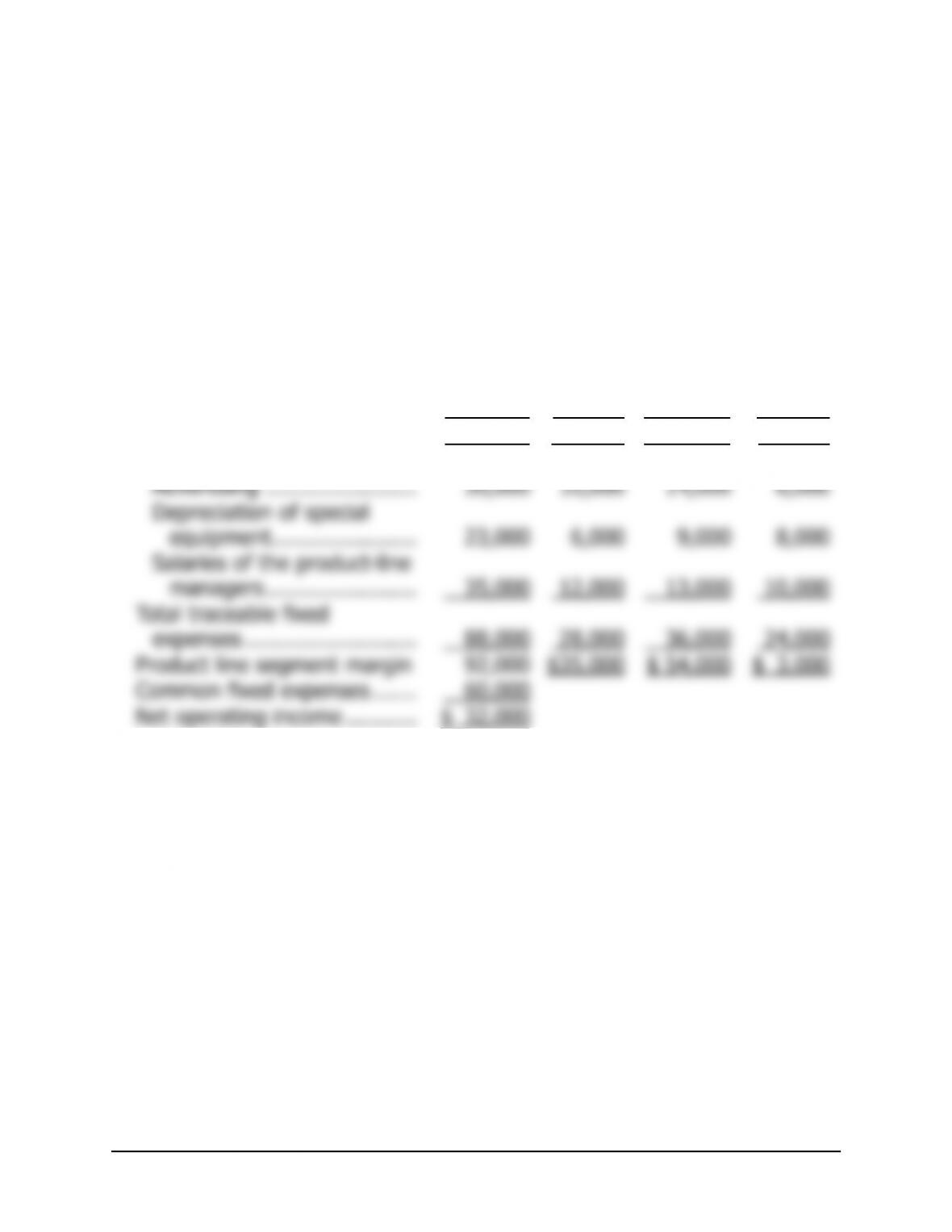
1. The financial (disadvantage) of discontinuing the racing bikes is
computed as follows:
Lost contribution mar
g
in …………………………. $(27,000)
Fixed costs that can be avoided:
A
The depreciation of the special equipment is a sunk cost and is not
relevant to the decision. The common costs are allocated and will
Alternative Solution:
Current
Total
Total If
Racing
Bikes Are
Dropped
Difference:
Net
Operating
Income
Increase or
(Decrease)
Sales …………………………………… $300,000 $240,000 $(60,000)
V
ariable expenses ………………….. 120,000 87,000 33,000
Contribution mar
g
in ……………….. 180,000 153,000 (27,000)
Fixed expenses:
A
T
© The McGraw-Hill Companies, Inc., 2018. All rights reserved.
16 Managerial Accounting, 16th Edition
Exercise 12-2 (continued)
2. No, production and sale of the racing bikes should not be discontinued.
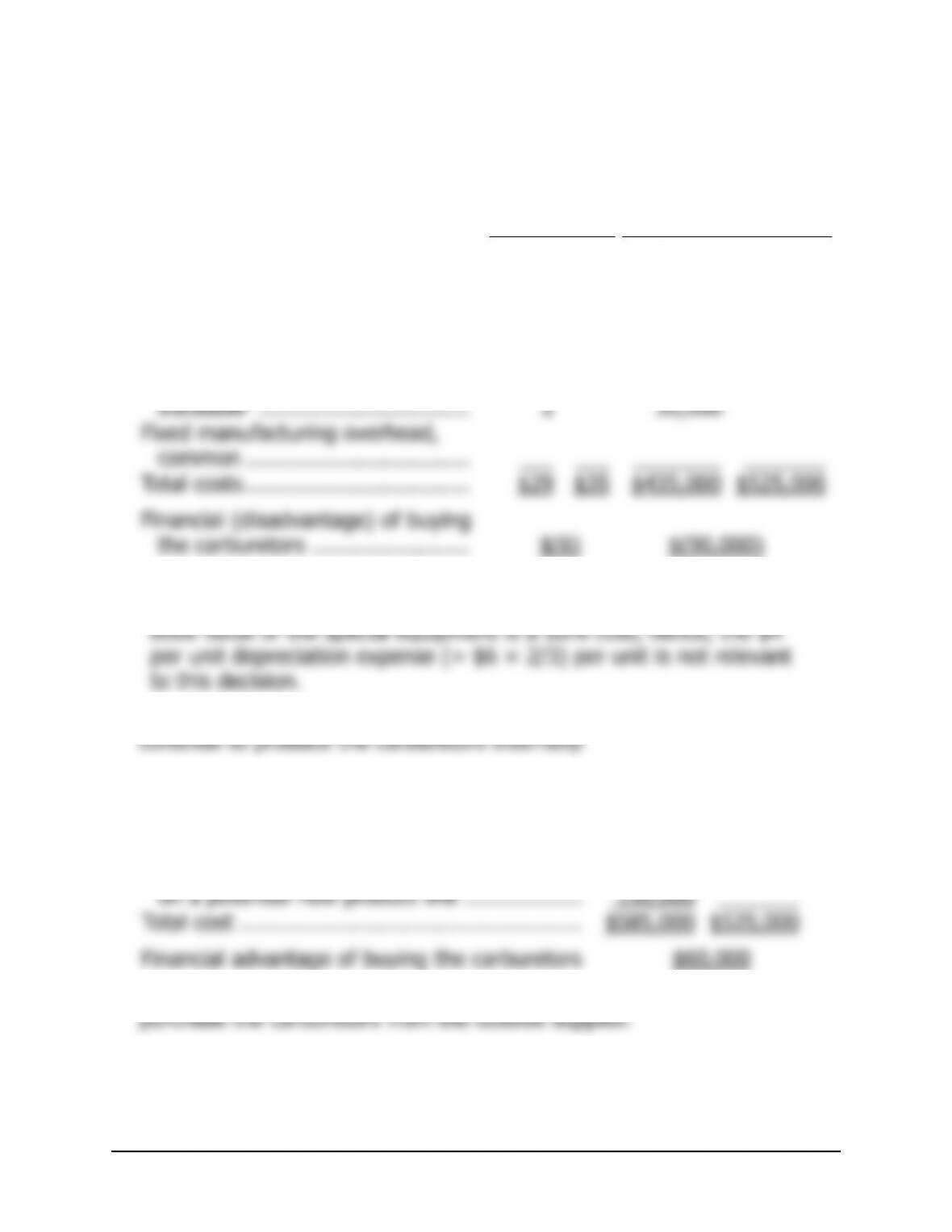
3. The segmented report can be improved by eliminating the allocation of
the common fixed expenses. Following the format introduced in Chapter
6 for a segmented income statement, a better report would be:
Total
Dirt
Bikes
Mountain
Bikes
Racing
Bikes
Sales ……………………………. $300,000 $90,000 $150,000 $60,000
V
ariable manufacturin
g
and
selling expenses ……………. 120,000 27,000 60,000 33,000
Contribution mar
g
in …………. 180,000 63,000 90,000 27,000
T
raceable fixed expenses:
A
T
© The McGraw-Hill Companies, Inc., 2018. All rights reserved.
Solutions Manual, Chapter 12 17
Exercise 12-3 (30 minutes)
1.
Per Unit
Differential
Costs 15,000 units
Make Buy Make Buy
Cost of purchasin
g
…………………. $35 $525,000
Direct materials …………………….. $14 $210,000
Direct labor ………………………….. 10 150,000
V
ariable manufacturin
g
overhead . 3 45,000
Fixed manufacturin
g
overhead,
T
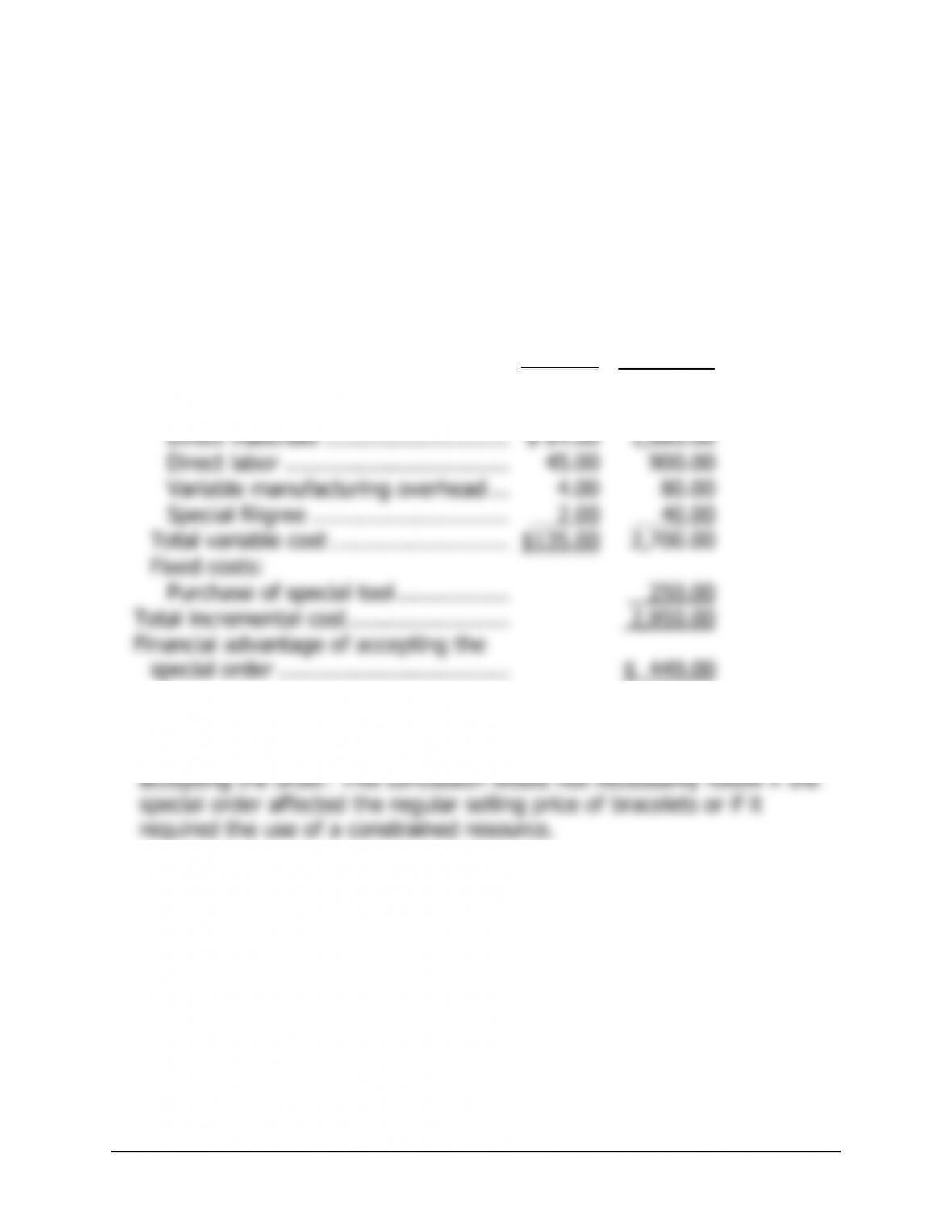
1 Only the supervisory salaries of $2 per unit (= $6 per unit × 1/3)
can be avoided if the carburetors are purchased. The remaining
2. Based on these data, the company should reject the offer and should
3.
Make Buy
Cost of purchasin
g
(see requirement 1) ……… $525,000
Cost of makin
g
(see requirement 1) ………….. $435,000
T
Opportunity cost
—
se
g
ment mar
g
in fore
g
one
4. Given the new assumption, the company should accept the offer and
g
© The McGraw-Hill Companies, Inc., 2018. All rights reserved.
18 Managerial Accounting, 16th Edition
Exercise 12-4 (15 minutes)
1. Only the incremental costs and benefits are relevant. In particular, only
the variable manufacturing overhead and the cost of the special tool are
relevant overhead costs in this situation. The other manufacturing
overhead costs are fixed and are not affected by the decision.
Per Unit
Total
for 20
Bracelets
Incremental revenue …………………….. $169.95 $3,399.00
Incremental costs:
Variable costs:
2. Even though the price for the special order is below the company’s
regular price for such an item, the company would be better off
© The McGraw-Hill Companies, Inc., 2018. All rights reserved.
Solutions Manual, Chapter 12 19
Exercise 12-5 (20 minutes)
1. The most profitable use of the constrained resource is determined by
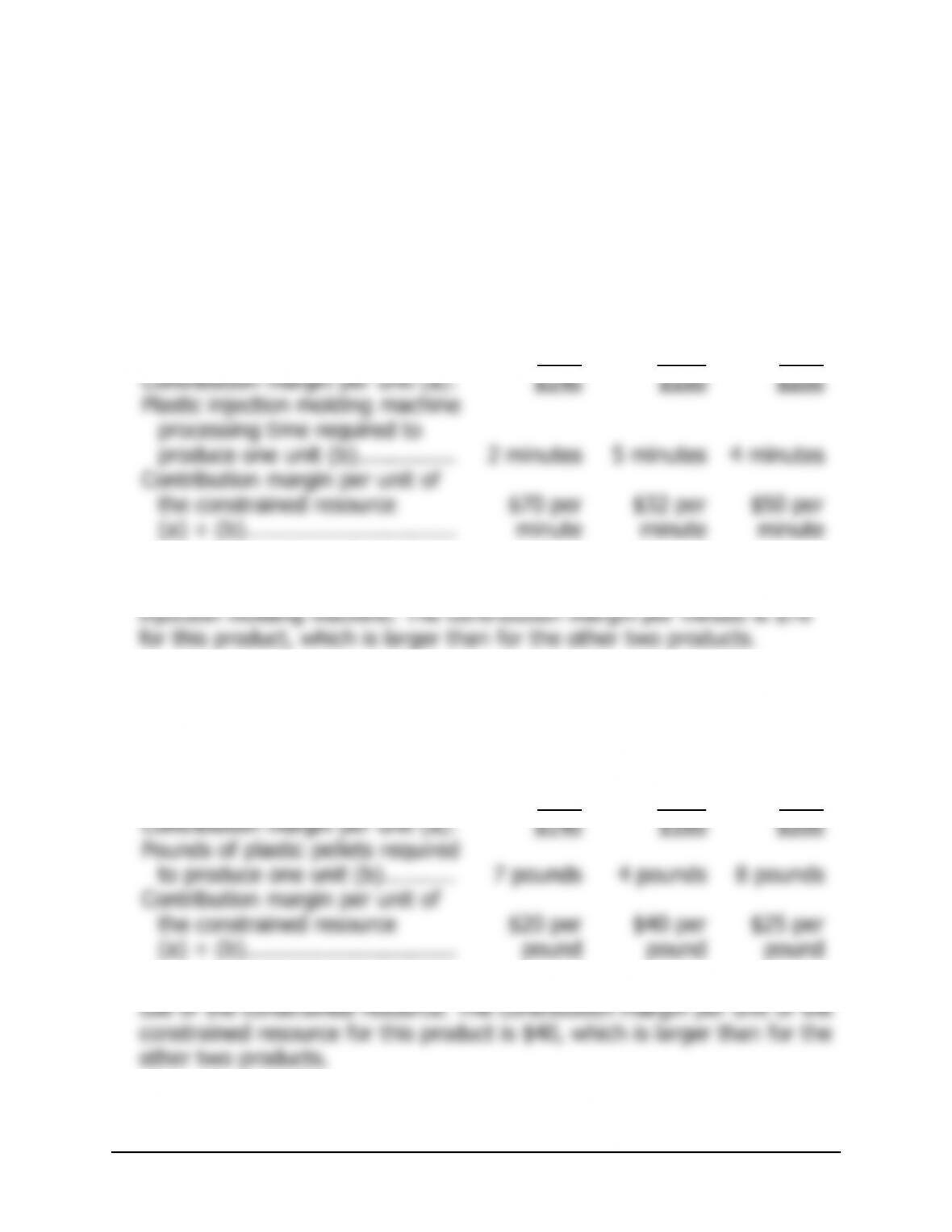
the contribution margin per unit of the constrained resource. In part 1,
the constrained resource is time on the plastic injection molding
machine. Therefore, the analysis would proceed as follows:
Ski Golf Fishing
Guard Guard Guard
Sellin
g
price per unit …………….. $200 $300 $255
Variable cost per unit ………..….. 60 140 55
2. Production of the Ski Guard product would be the most profitable use of
the constrained resource which is, in this case, time on the plastic
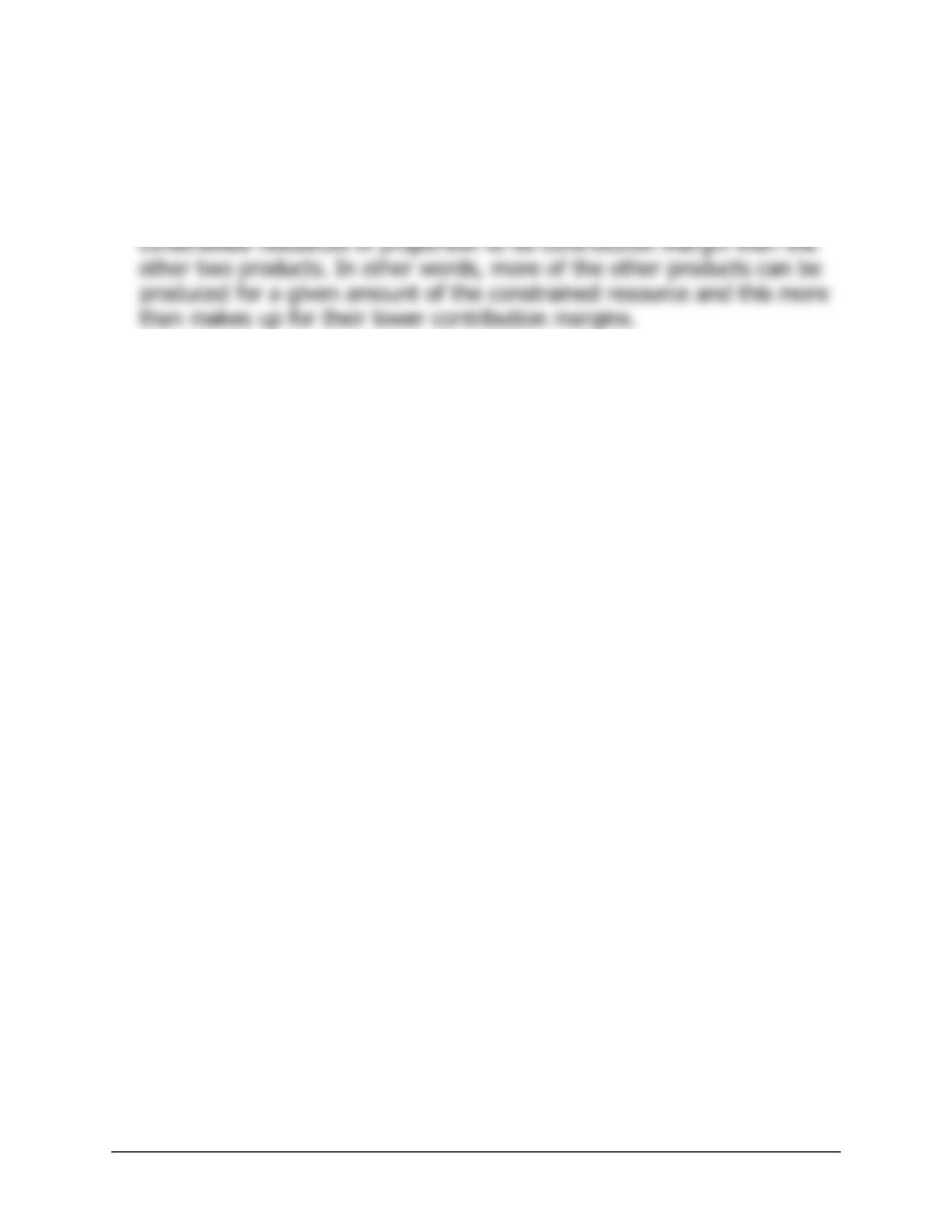
3. In this part, the constraint is the available pounds of plastic pellets.
Ski Golf Fishing
Guard Guard Guard
Sellin
g
price per unit …………….. $200 $300 $255
Variable cost per unit ………..….. 60 140 55
4. In this case, production of the Golf Guard would be the most profitable
© The McGraw-Hill Companies, Inc., 2018. All rights reserved.
20 Managerial Accounting, 16th Edition
Exercise 12-5 (continued)
5. The Fishing Guard product has the largest unit contribution margin, but
it is not the most profitable use of the constrained resource in either
case above. This happens because the Fishing Guard uses more of the