© The McGraw-Hill Companies, Inc., 2018. All rights reserved.
Solutions Manual, Chapter 12 91
Problem 12A-10 (45 minutes)
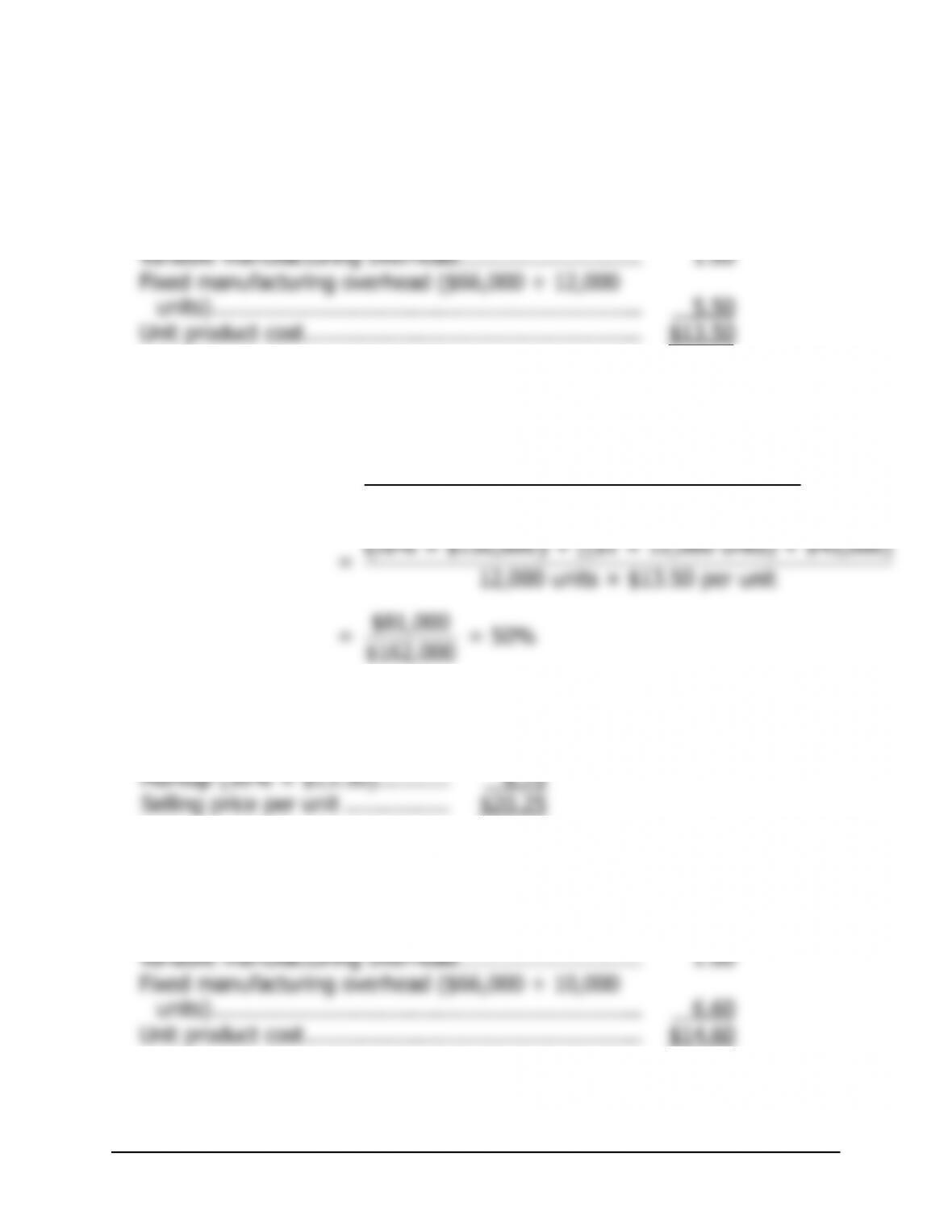
1. The unit product cost is computed as follows:
Direct materials …………………………………………….. $ 4.00
Direct labor ………………………………………………….. 3.00
2. The markup percentage is computed as follows:
(
)
Required ROI Selling and administraive
+
× Investment expenses
Markup percentage =
on absorption cost Unit sales × Unit product cost
3. The selling price is computed as follows:
Unit product cost ………………… $13.50
4. The revised unit product cost is computed as follows:
Direct materials …………………………………………….. $ 4.00
Direct labor ………………………………………………….. 3.00
© The McGraw-Hill Companies, Inc., 2018. All rights reserved.
92 Managerial Accounting, 16th Edition
Problem 12A-10 (continued)
4. continued
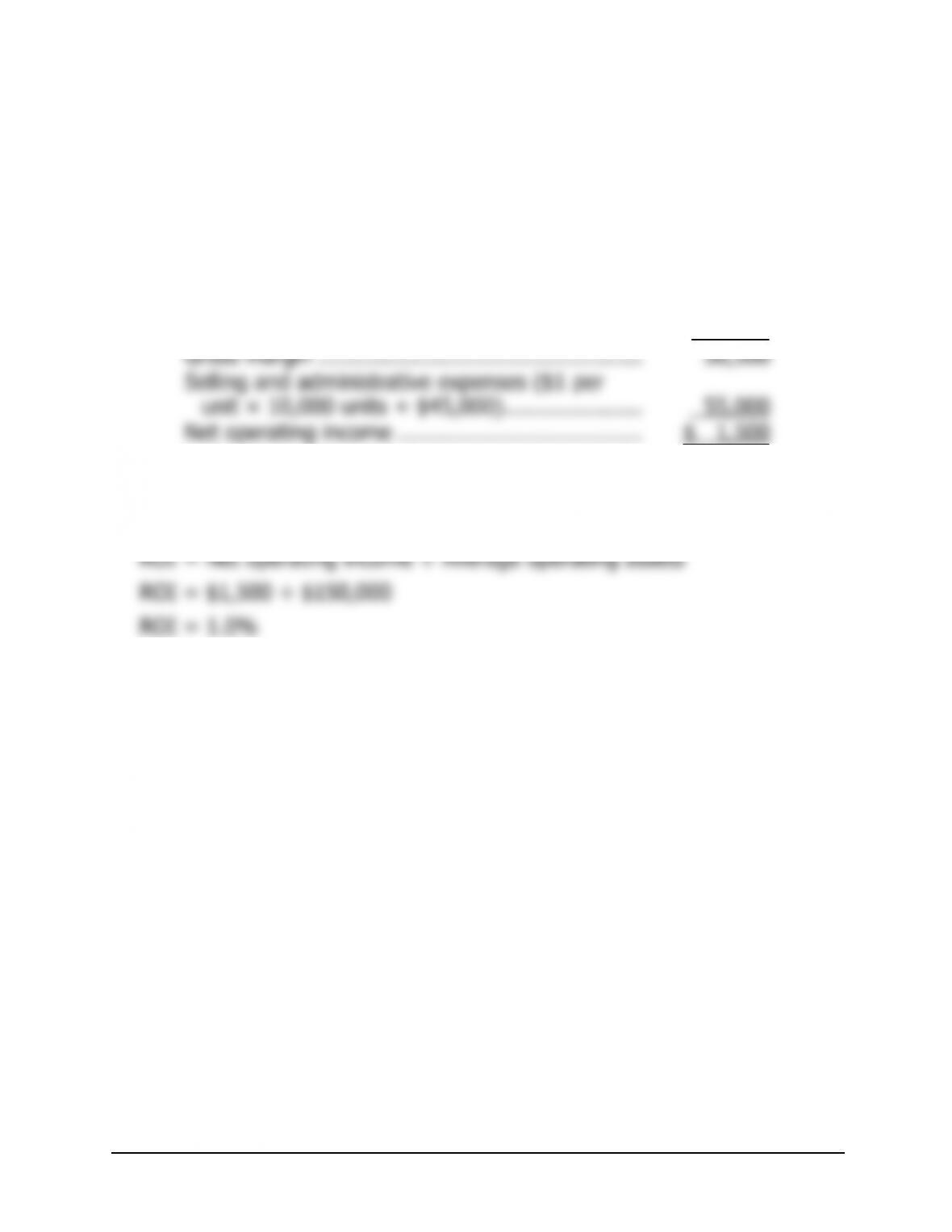
The net operating income at a sales volume of 10,000 units is computed
as follows:
Sales (10,000 units × $20.25 per unit)…………. $202,500
Cost of
g
oods sold (10,000 units × $14.60 per
unit) ………………………………………………….. 146,000
The return on investment (ROI) at a sales volume of 10,000 units is
computed as follows:
© The McGraw-Hill Companies, Inc., 2018. All rights reserved.
Solutions Manual, Chapter 12 93
Problem 12A-10 (continued)
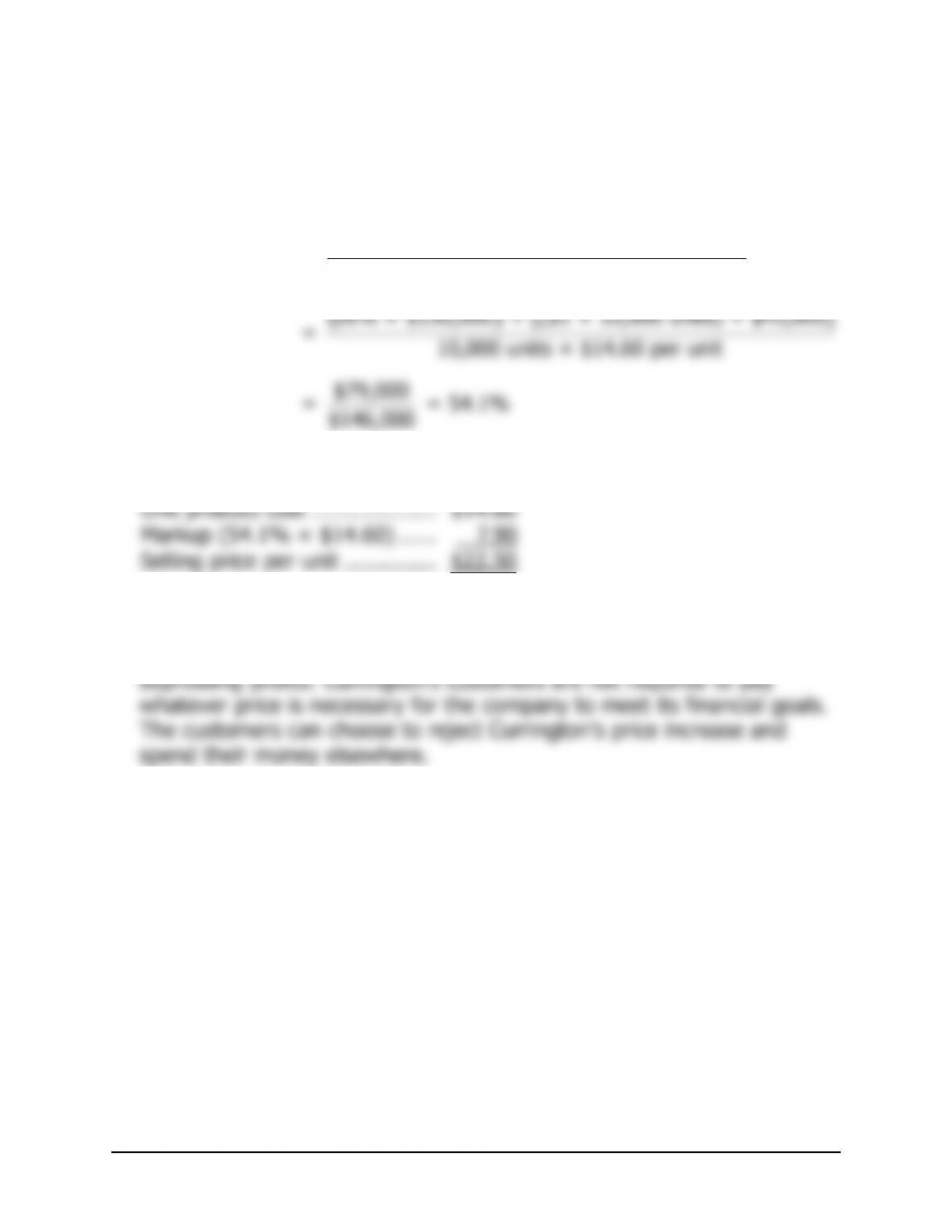
5. The revised markup percentage would be computed as follows:
(
)
Required ROI Selling and administraive
+
× Investment expenses
Markup percentage =
on absorption cost Unit sales × Unit product cost
The revised selling price would be computed as follows:
It is quite possible that customers will be displeased with the price
increase of $2.25 per unit (= $22.50 per unit – $20.25 per unit). This
may cause sales volume to drop below 10,000 units, thereby further
© The McGraw-Hill Companies, Inc., 2018. All rights reserved.
94 Managerial Accounting, 16th Edition
Problem 12A-11 (45 minutes)
1. Pro
j
ected sales (100 machines × $4,950 per machine) . $495,000
T
ar
g
et cost per machine ($405,000 ÷ 100 machines) … $4,050
Less National Restaurant Supply’s variable sellin
g
cost
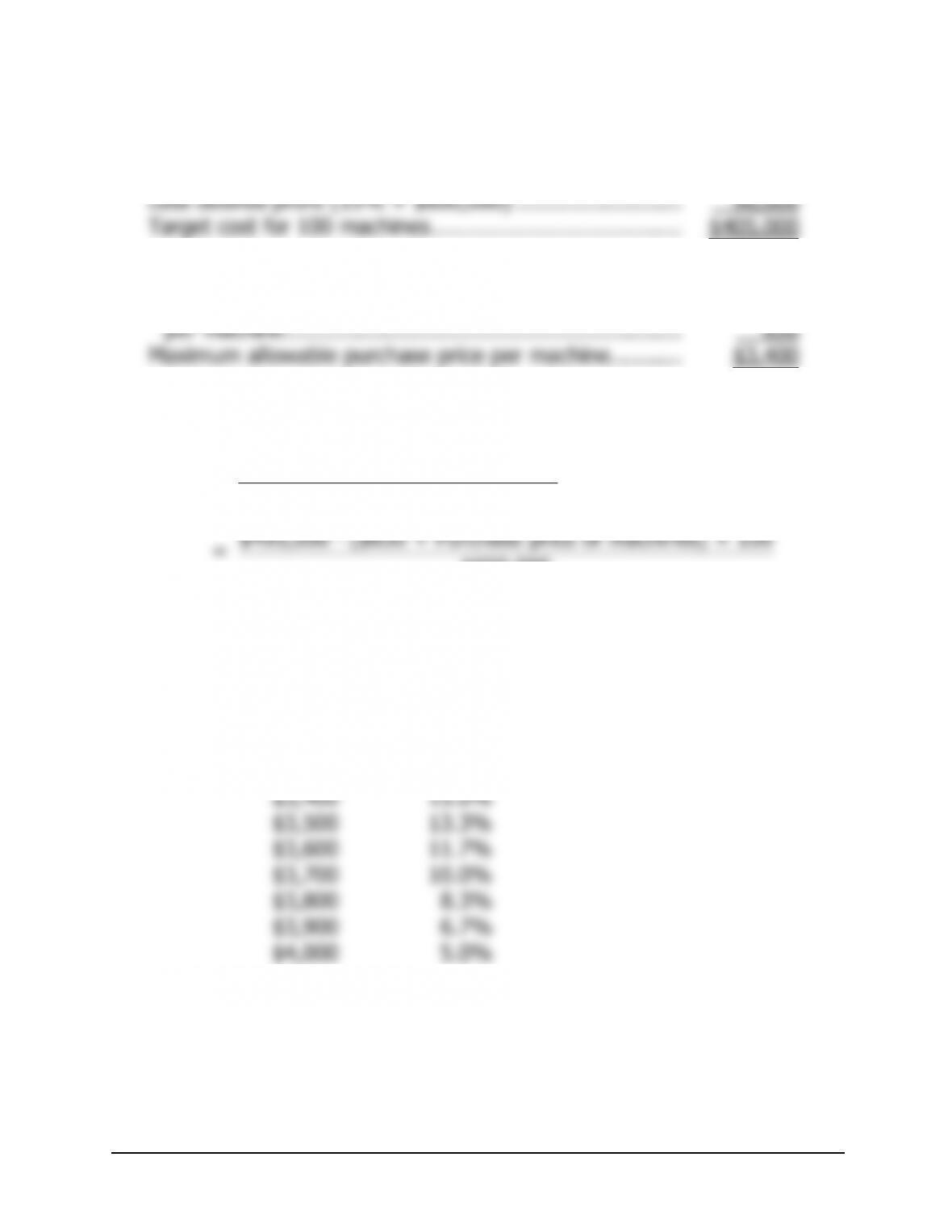
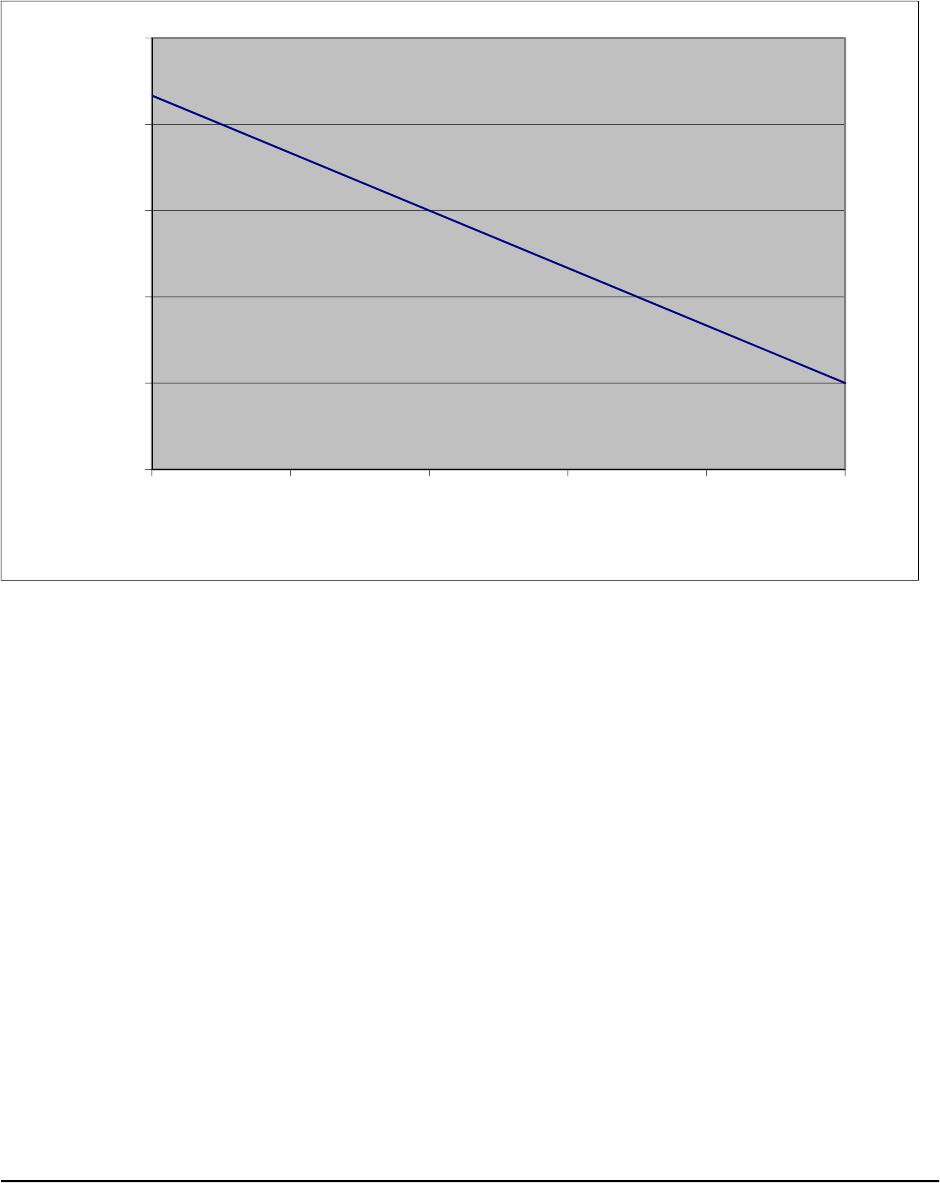
2. The relation between the purchase price of the machine and ROI can
be developed as follows:
Total projected sales – Total cost
ROI = Investment
The above formula can be used to compute the ROI for purchase prices
between $3,000 and $4,000 (in increments of $100) as follows:
Purchase price ROI
$3,000 21.7%
$3,100 20.0%
$3,200 18.3%
$3,300 16.7%
T
g
© The McGraw-Hill Companies, Inc., 2018. All rights reserved.
Solutions Manual, Chapter 12 95
Problem 12A-11 (continued)
Using the above data, the relation between purchase price and ROI can
be plotted as follows:
0.0%
5.0%
10.0%
15.0%
20.0%
25.0%
$3,000 $3,200 $3,400 $3,600 $3,800 $4,000
Realized ROI
Purchase price
© The McGraw-Hill Companies, Inc., 2018. All rights reserved.
96 Managerial Accounting, 16th Edition
Problem 12A-11 (continued)
3. A number of options are available in addition to simply giving up on
adding the new sorbet machines to the company’s product lines. These
options include:
• Check the projected unit sales figures. Perhaps more units could be
• Modify the selling price. This does not necessarily mean increasing the
• Improve the selling process to decrease the variable selling costs.
• Rethink the investment that would be required to carry this new
• Does the company really need a 15% ROI? Does it cost the company