© The McGraw-Hill Companies, Inc., 2018 All rights reserved.
Solutions Manual, Chapter 12 1
Chapter 12
Differential Analysis: The Key to Decision
Making
Solutions to Questions
12-1 A relevant cost is a cost that differs in
12-2 An incremental cost (or benefit) is the
change in cost (or benefit) that will result from
some proposed action. An opportunity cost is
12-3 No. Variable costs are relevant costs
12-5 No. A variable cost is a cost that varies
in total amount in direct proportion to changes
12-6 No. Only those future costs that differ
12-7 Only those costs that would be avoided
12-8 Not necessarily. An apparent loss may
be the result of allocated common costs or of
sunk costs that cannot be avoided if the product
as a result of dropping the product is less than
that situation the product may be retained if it
promotes the sale of other products.
12-9 Allocations of common fixed costs can
12-10 If a company decides to make a part
internally rather than to buy it from an outside
products and get them into the hands of
customers could be a constraint. Some examples
are machine time, direct labor time, floor space,
affected, profits are maximized when the total
contribution margin is maximized. A company
12-13 Joint products are two or more products
that are produced from a common input. Joint
© The McGraw-Hill Companies, Inc., 2018. All rights reserved.
2 Managerial Accounting, 16th Edition
among joint products for decision-making
purposes. If joint costs are allocated among the
joint products, then managers may think they
are avoidable costs of the end products.
12-16 Most costs of a flight are either sunk
costs, or costs that do not depend on the
number of passengers on the flight.
© The McGraw-Hill Companies, Inc., 2018. All rights reserved.
Solutions Manual, Chapter 12 3
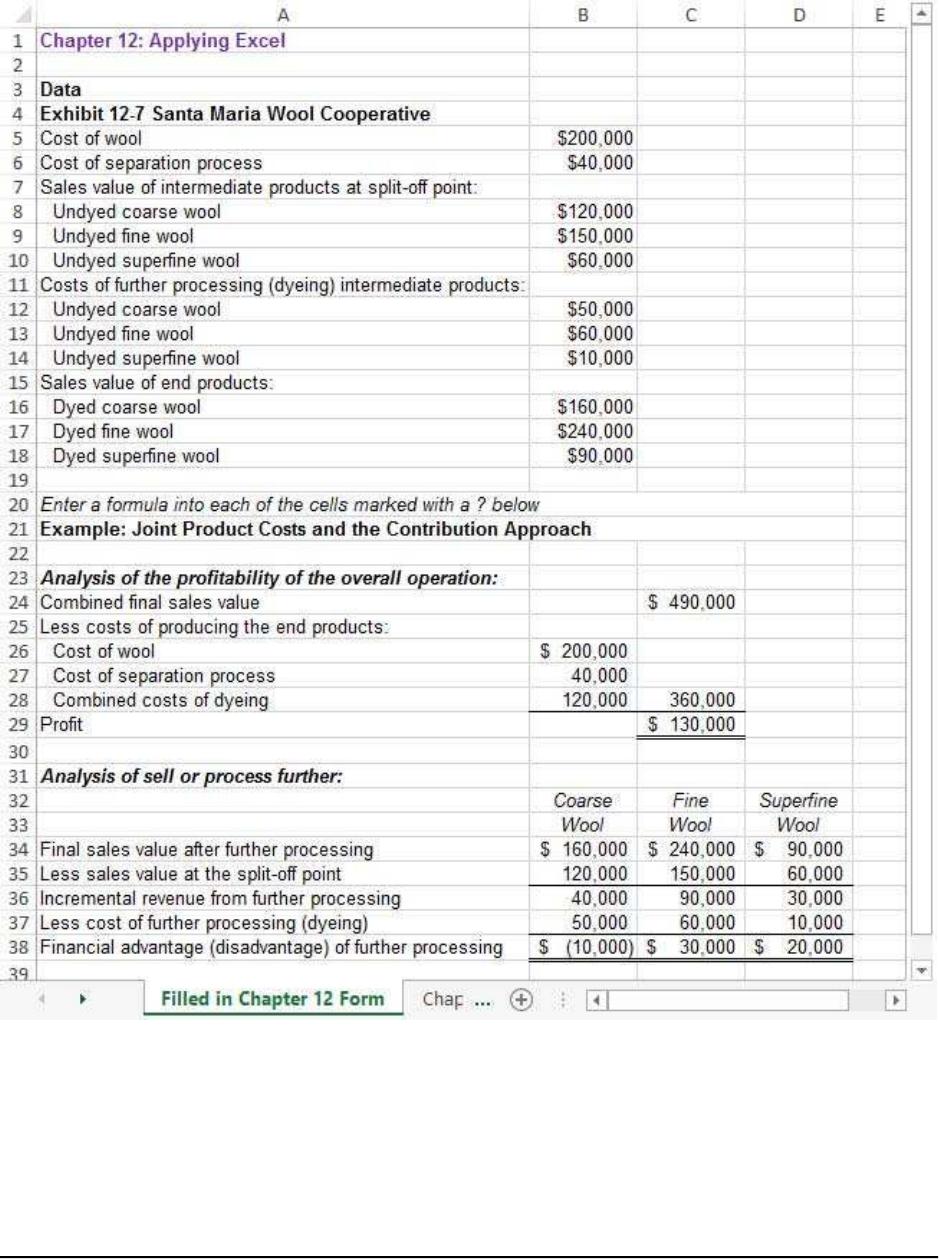
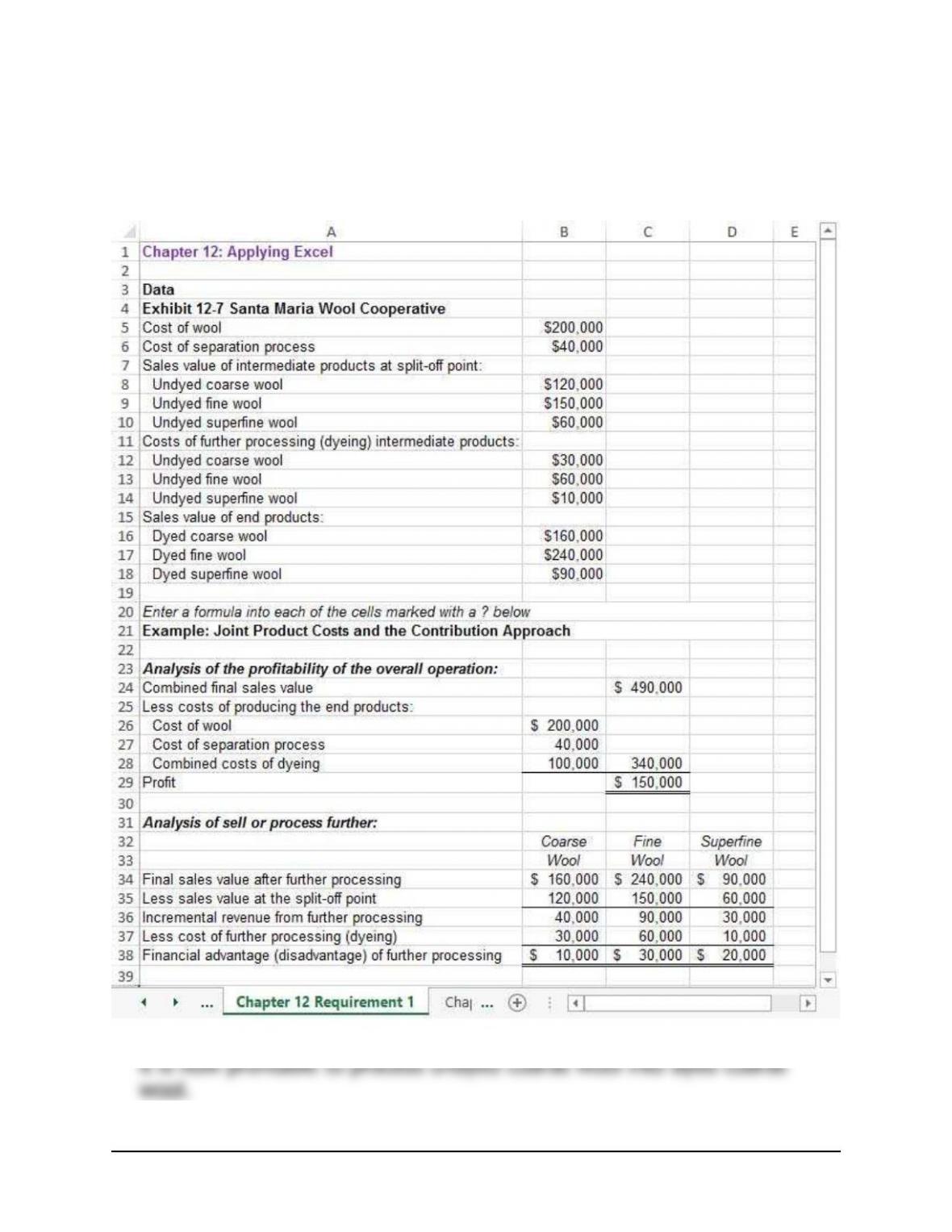
Chapter 12: Applying Excel
The completed worksheet is shown below.
© The McGraw-Hill Companies, Inc., 2018. All rights reserved.
4 Managerial Accounting, 16th Edition
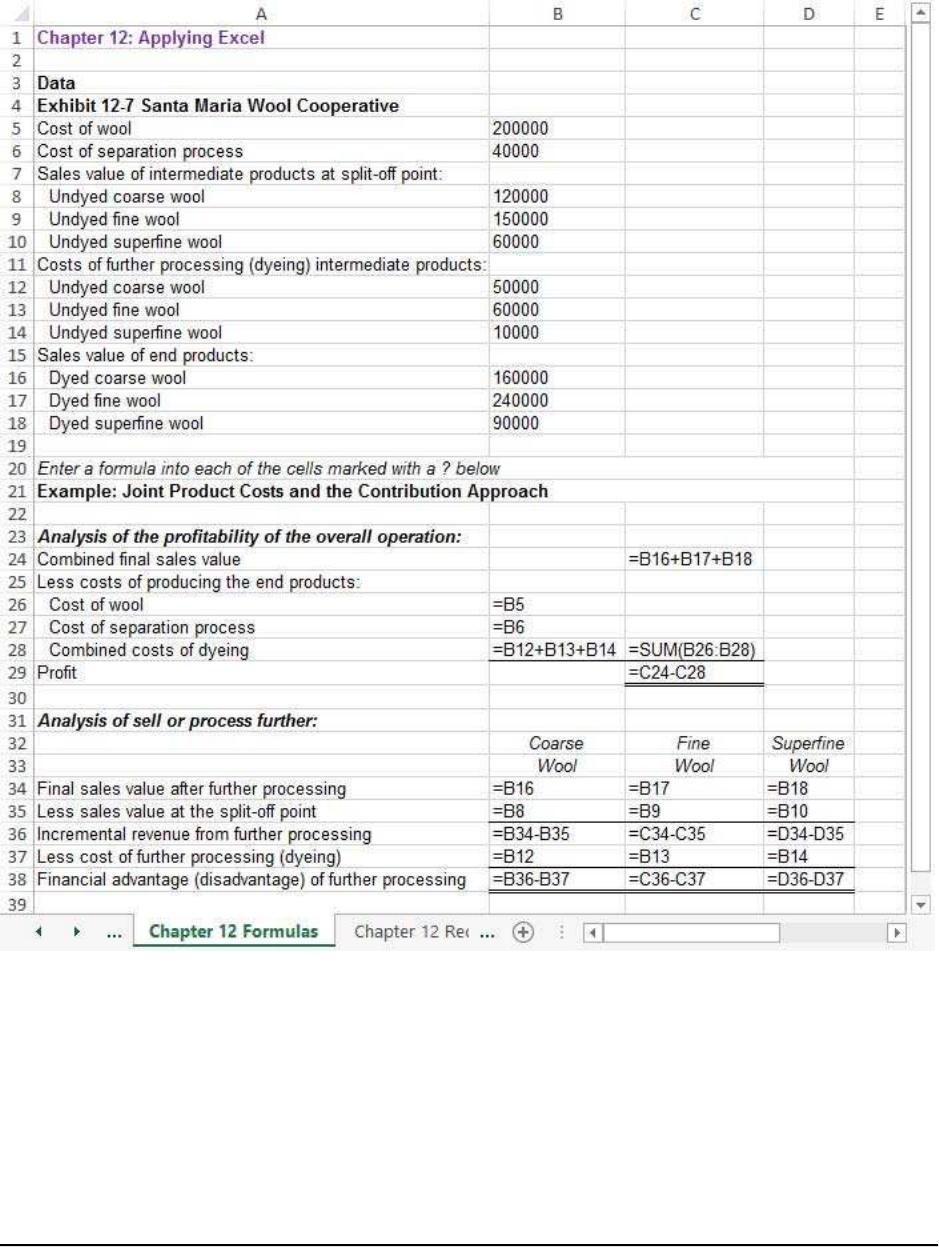
Chapter 12: Applying Excel (continued)
The completed worksheet, with formulas displayed, is shown below.
© The McGraw-Hill Companies, Inc., 2018. All rights reserved.
Solutions Manual, Chapter 12 5
Chapter 12: Applying Excel (continued)
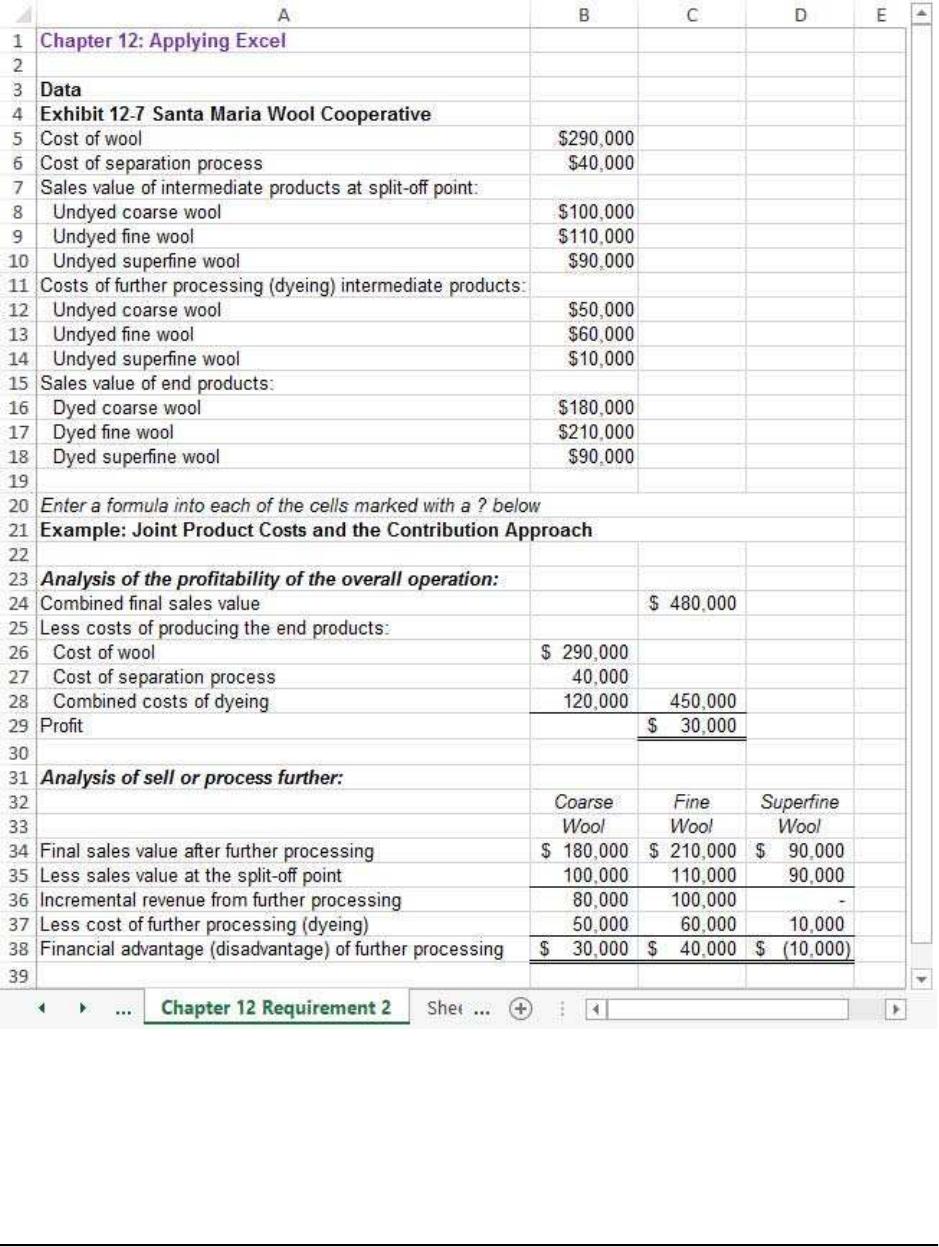
1. With the change in the cost of further processing undyed course wool,
the result is:
With the reduction in the cost of further processing undyed coarse wool,
© The McGraw-Hill Companies, Inc., 2018. All rights reserved.
6 Managerial Accounting, 16th Edition
Chapter 12: Applying Excel (continued)
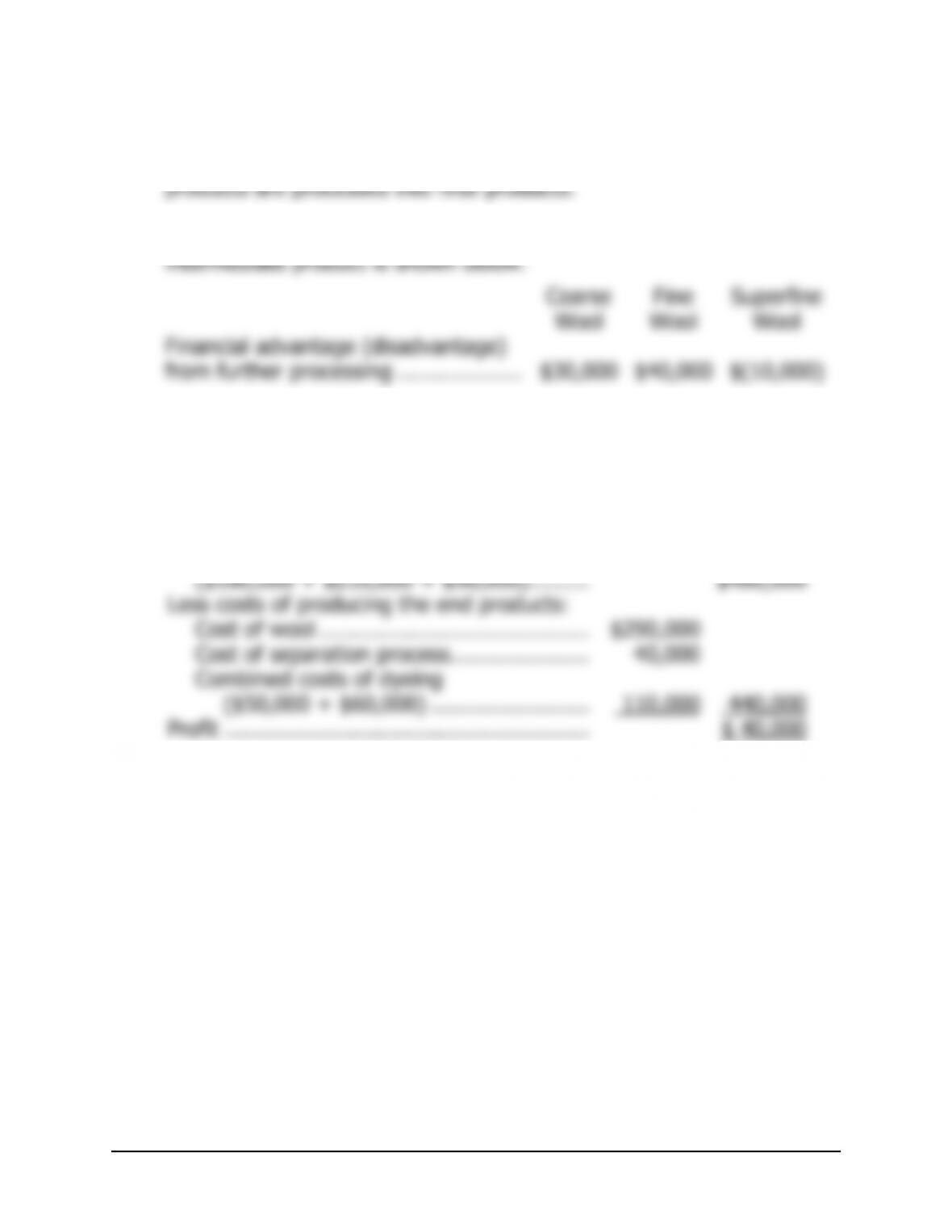
2. With the revised data, the worksheet should look like this:
© The McGraw-Hill Companies, Inc., 2018. All rights reserved.
Solutions Manual, Chapter 12 7
Chapter 12: Applying Excel (continued)
a. The profit of the overall operation is now $30,000 if all intermediate
b. The financial advantage (disadvantage) from further processing each
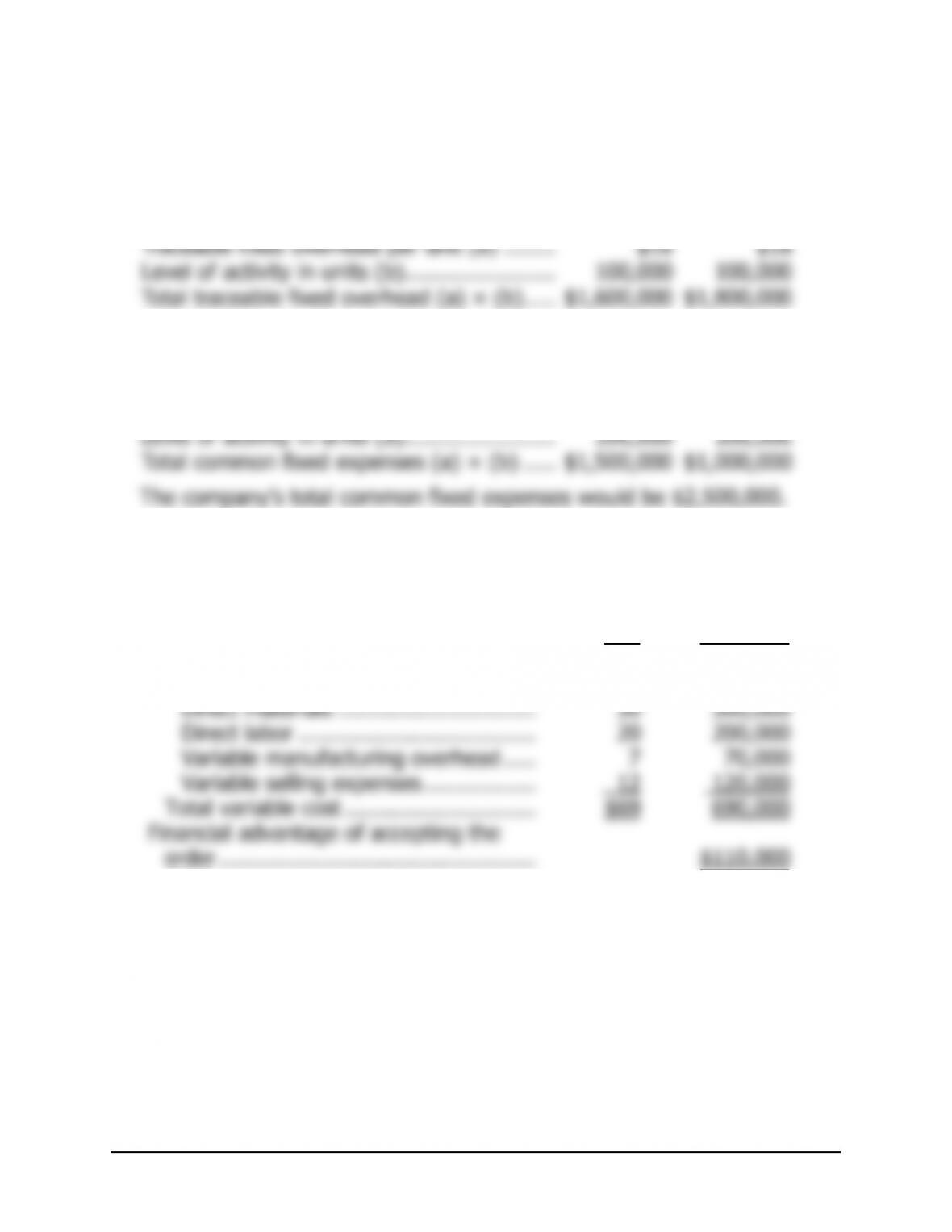
c. To maximize profit, the company should process undyed coarse wool
into dyed coarse wool and undyed fine wool into dyed fine wool.
However, undyed superfine wool should be sold as is rather than
processed into dyed superfine wool. If this plan is followed, the
overall profit of the company should be $40,000 as shown below:
Combined sales value
© The McGraw-Hill Companies, Inc., 2018. All rights reserved.
8 Managerial Accounting, 16th Edition
The Foundational 15
1. The total traceable fixed manufacturing overhead for Alpha and Beta is
computed as follows:
A
lph
a
Bet
a
2. The total common fixed expenses is computed as follows:
A
lph
a
Bet
a
Common fixed expenses per unit (a) ……… $15 $10
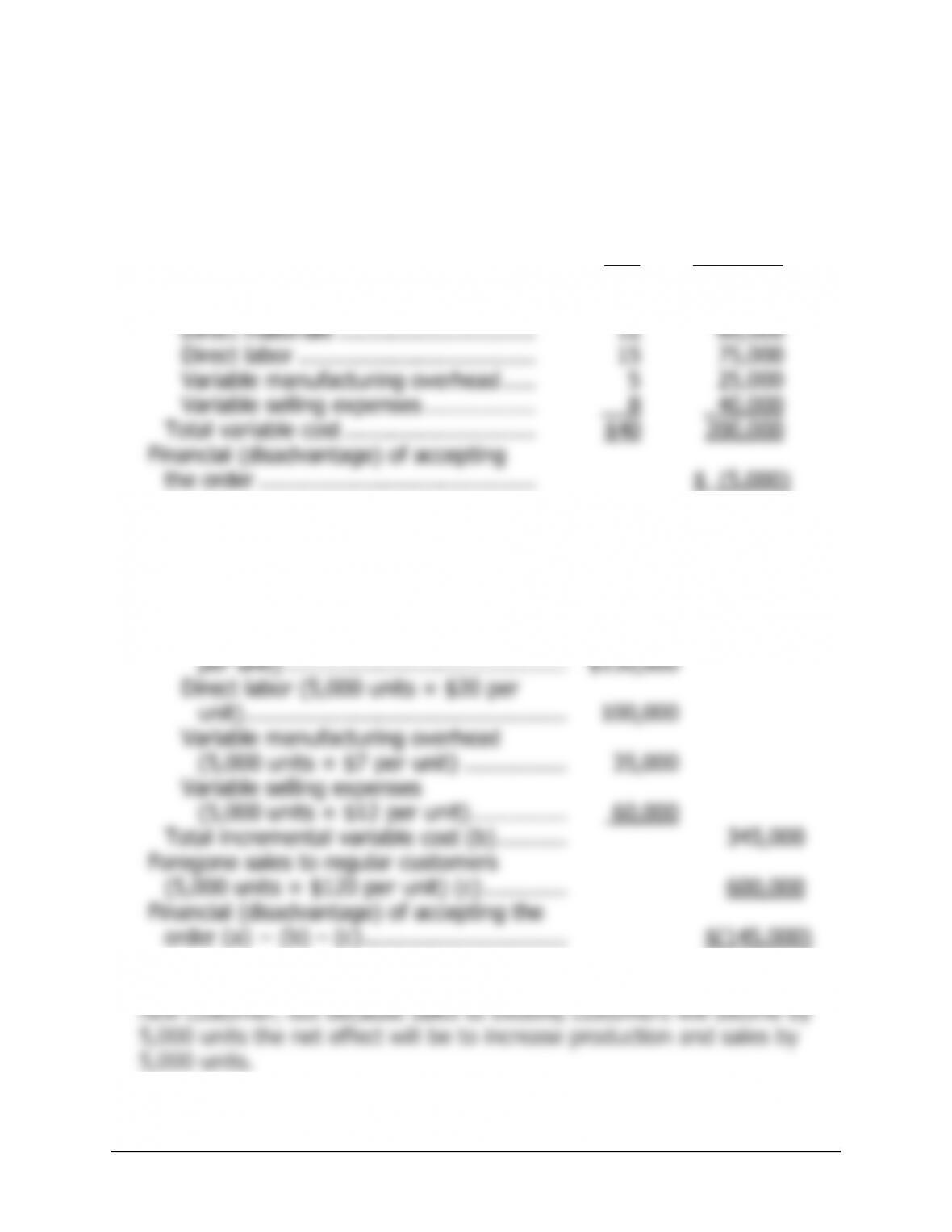
3. The financial advantage of accepting the order is computed as follows:
Per Total
Unit 10,000 units
Incremental revenue ………………………. $80 $800,000
Incremental costs:
Variable costs:
© The McGraw-Hill Companies, Inc., 2018. All rights reserved.
Solutions Manual, Chapter 12 9
The Foundational 15 (continued)
4. The financial (disadvantage) is computed as follows:
Per Total
Unit 5,000 units
Incremental revenue ………………………. $39 $195,000
Incremental costs:
Variable costs:
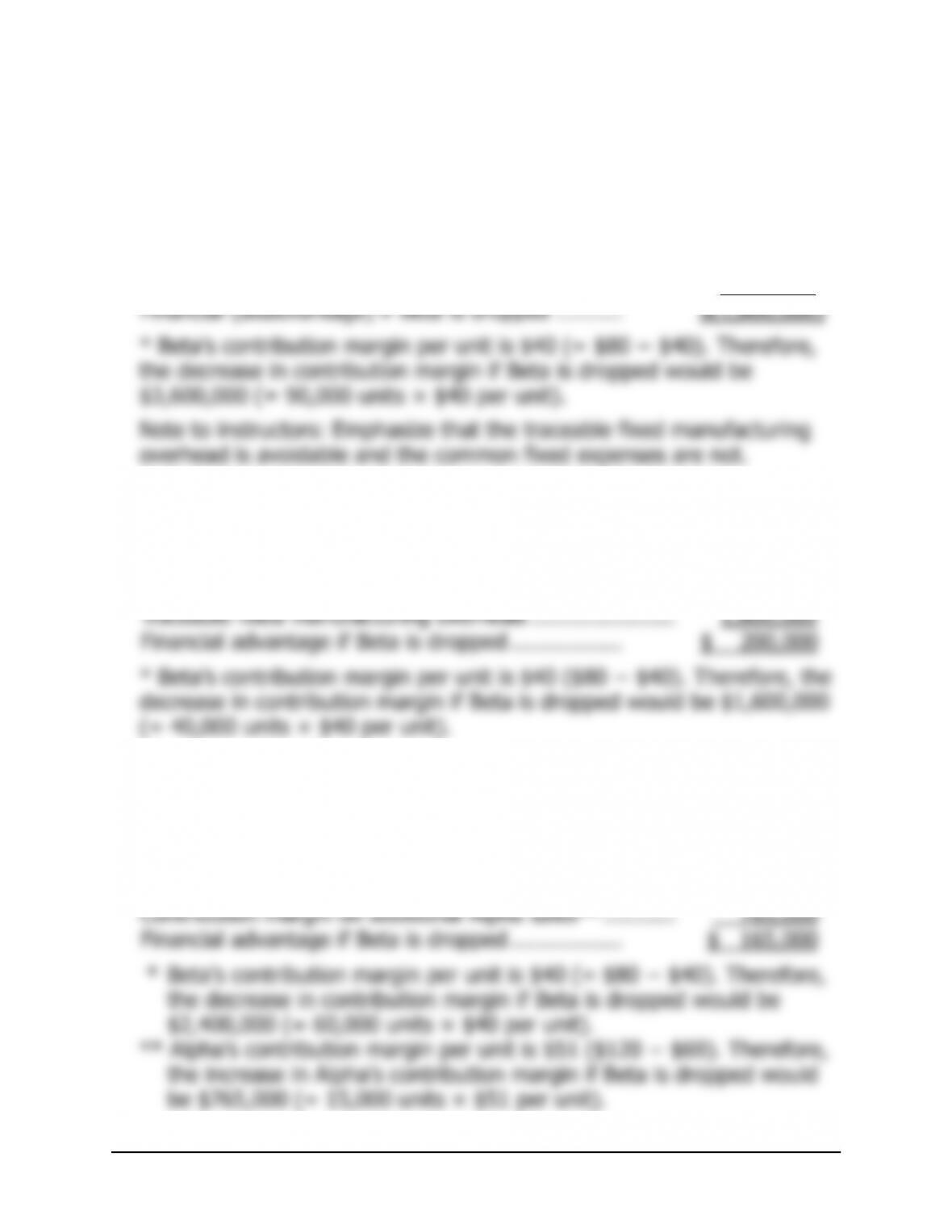
5. The financial (disadvantage) is computed as follows:
Incremental revenue
(10,000 units × $80 per unit) (a) …………
.
$800,000
Incremental variable costs:
Direct materials (5,000 units × $30
.
Note to instructors: There will be additional sales of 10,000 units to the
© The McGraw-Hill Companies, Inc., 2018. All rights reserved.
10 Managerial Accounting, 16th Edition
The Foundational 15 (continued)
6. The financial (disadvantage) of dropping the Beta product line is
computed as follows:
Contribution mar
g
in lost if the Beta product line is
dropped* ……………………………………………………….. $(3,600,000)
T
raceable fixed manufacturin
g
overhead ………………….. 1,800,000
7. The financial advantage of dropping the Beta product line is computed
as follows:
Contribution mar
g
in lost if the Beta product line is
dropped* ……………………………………………………….
.
$(1,600,000)
T
g
.
8. The financial advantage of dropping the Beta product line is computed
as follows:
Contribution mar
g
in lost if the Beta product line is
dropped* ……………………………………………………….
.
$(2,400,000)
T
raceable fixed manufacturin
g
overhead ………………….
.
1,800,000
g