© The McGraw-Hill Companies, Inc., 2018. All rights reserved.
Solutions Manual, Appendix 11A 61
Problem 11A-4 (continued)
3. The Pulp Division has idle capacity, so transfers from the Pulp Division
to the Carton Division do not cut into normal sales of pulp to outsiders.
In this case, the minimum price as far as the Carton Division is
The Carton Division can buy pulp from an outside supplier for $63 a ton
and would be unwilling to pay more than that for pulp in an internal
4. Yes, $59 is a bona fide outside price. Even though $59 is less than the
Pulp Division’s $60 “full cost” per unit, it is within the range given in Part
3 and therefore will provide some contribution to the Pulp Division.
5,000 tons × $17 per ton = $85,000 potential increased profits
5. No, the Carton Division should be free to go outside and get the best
price it can. Even though this would result in lower profits for the
© The McGraw-Hill Companies, Inc., 2018. All rights reserved.
62 Managerial Accounting, 16th Edition
Problem 11A-4 (continued)
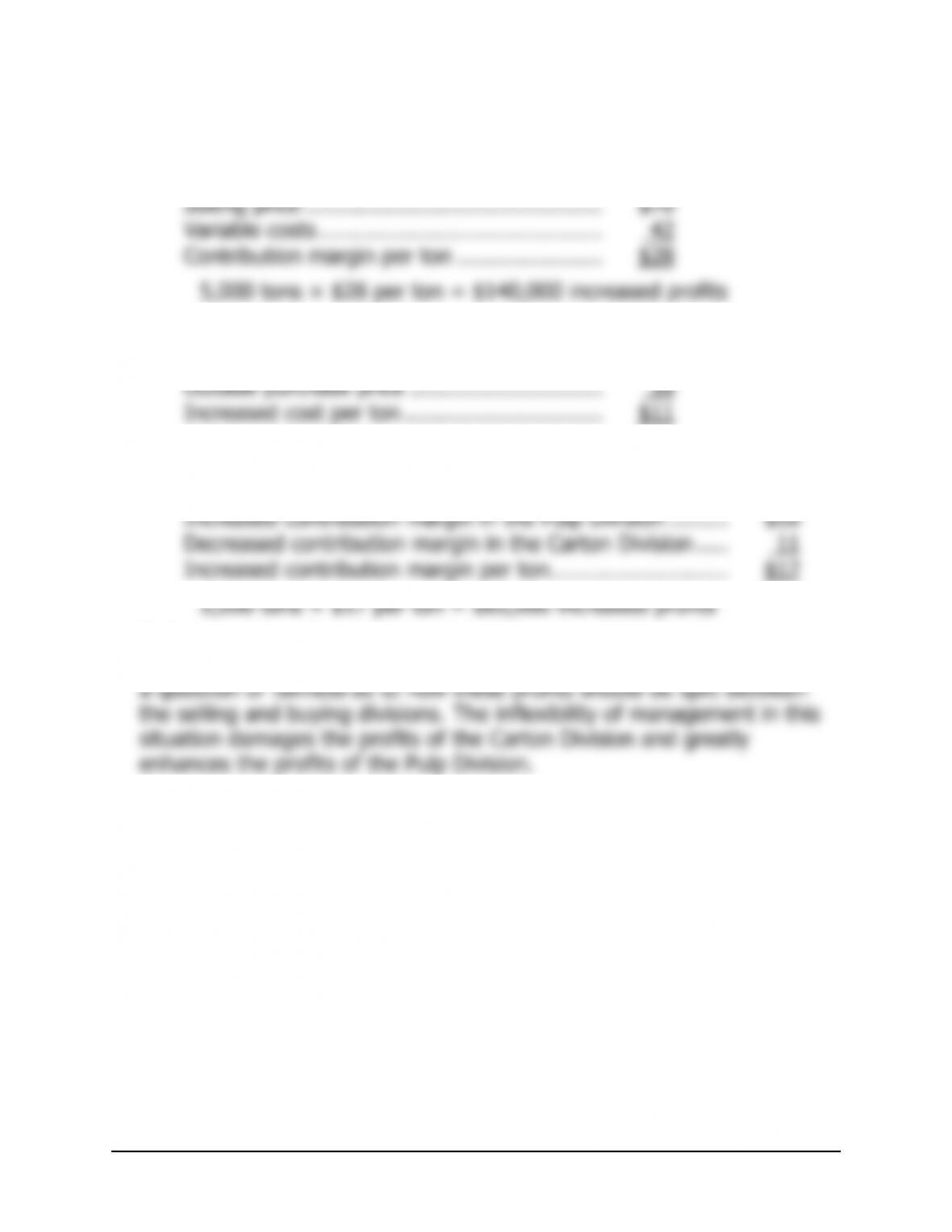
6. The Pulp Division will have an increase in profits:
The Carton Division will have a decrease in profits:
Inside purchase price………………………….. $70
5,000 tons × $11 per ton = $55,000 decreased profits
The company as a whole will have an increase in profits:
So long as the selling division has idle capacity, profits in the company
as a whole will increase if internal transfers are made. However, there is
© The McGraw-Hill Companies, Inc., 2018. All rights reserved.
Solutions Manual, Appendix 11A 63
Problem 11A-5 (45 minutes)
1. The Quark Division will probably reject the $340 price because it is
below the division’s variable cost of $350 per set. This variable cost
includes the $140 transfer price from the Screen Division, which in turn
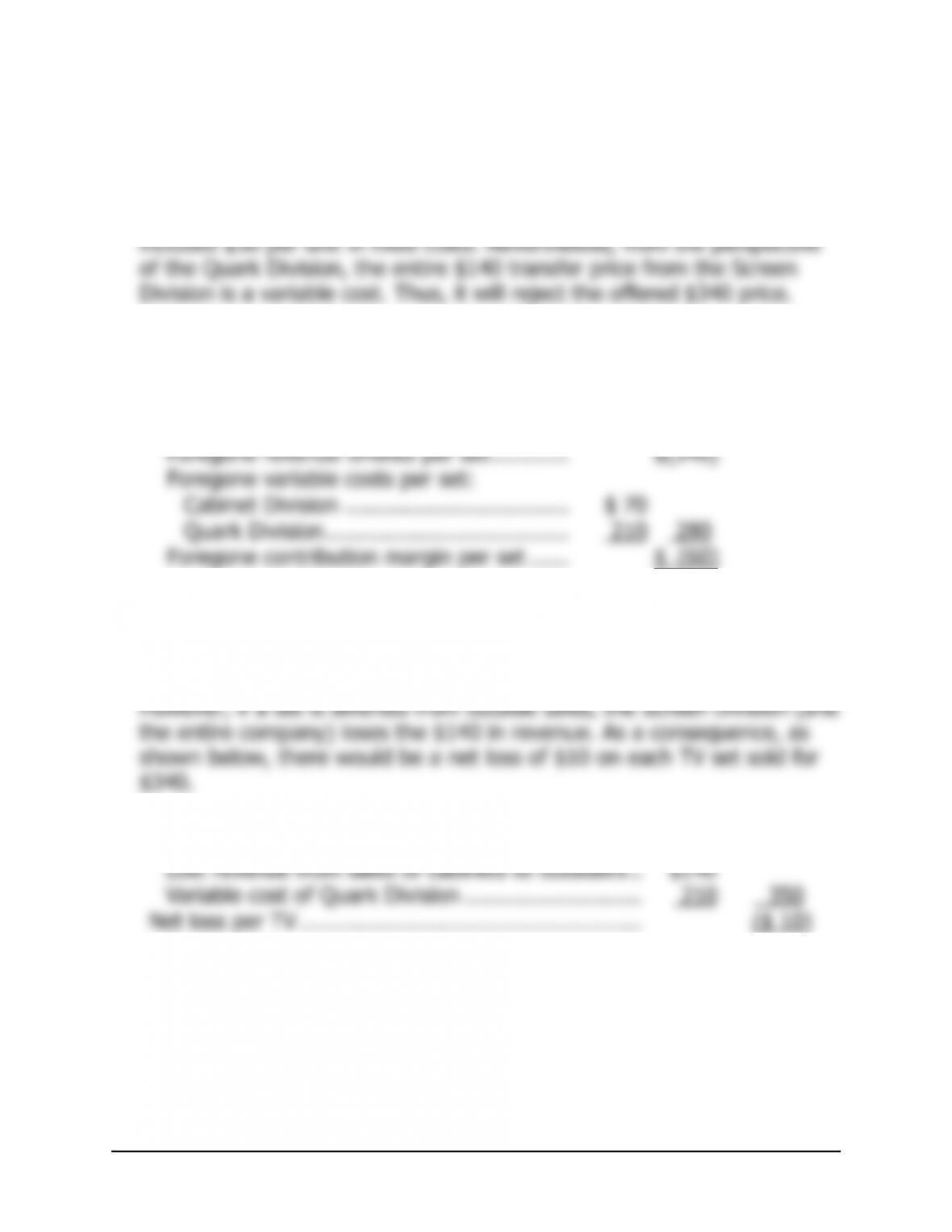
2. If both the Screen Division and the Quark Division have idle capacity,
then from the perspective of the entire company the $340 offer should
be accepted. By rejecting the $340 price, the company will lose $60 in
potential contribution margin per set:
3. If the Screen Division is operating at capacity, any screens transferred
to the Quark Division to fill the overseas order will have to be diverted
from outside customers. Whether a screen is sold to outside customers
or is transferred to the Quark Division, its production cost is the same.
Price offered per set ……………………………………… $340
Less:
© The McGraw-Hill Companies, Inc., 2018. All rights reserved.
64 Managerial Accounting, 16th Edition
Problem 11A-5 (continued)
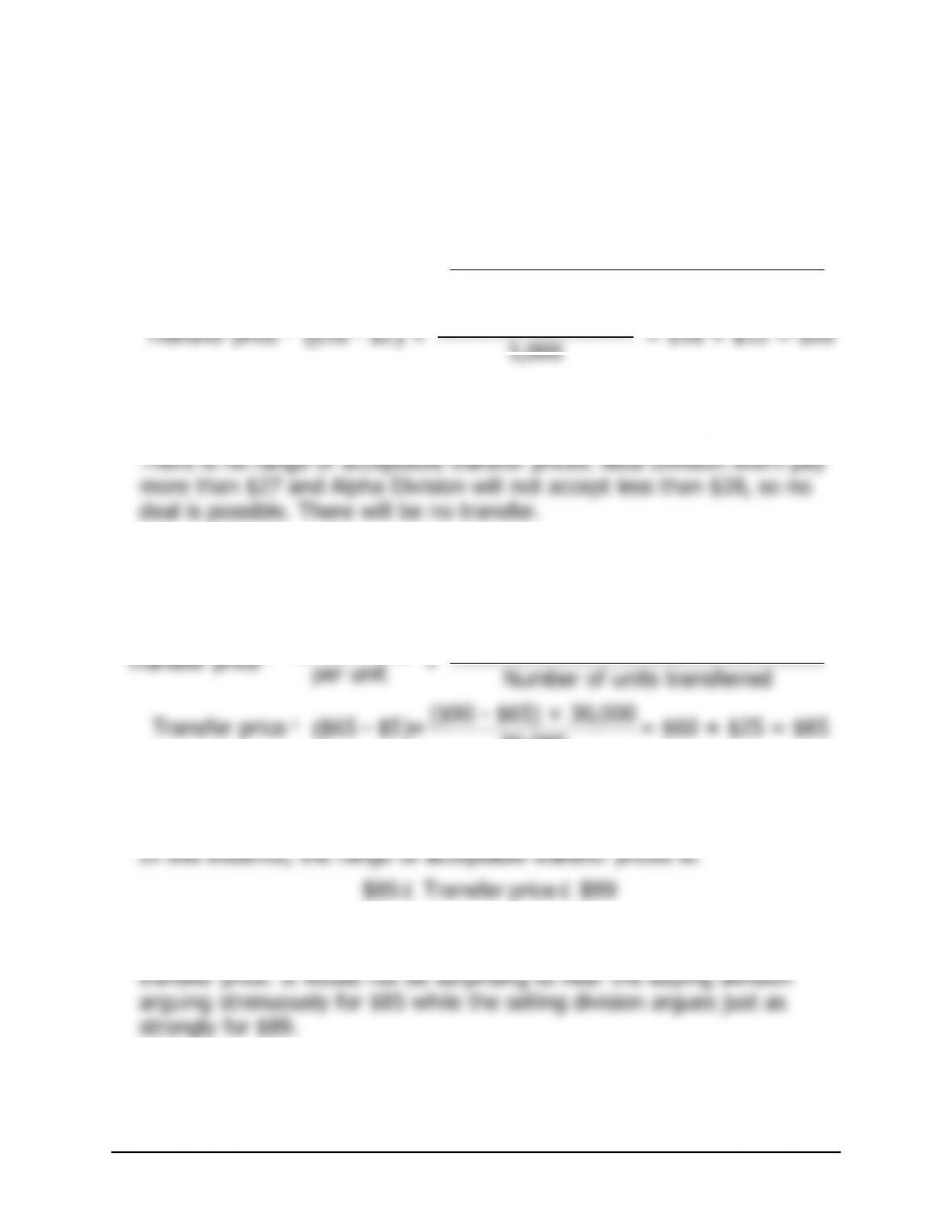
4. When the selling division has no idle capacity, as in part (3), market
price works very well as a transfer price. The cost to the company of a
transfer when there is no idle capacity is the lost revenue from sales to
outsiders. If the market price is used as the transfer price, the buying
When the selling division has idle capacity, the cost to the company of
the transfer is just the variable cost of producing the item. If the market
price is used as the transfer price, the manager of the buying division
© The McGraw-Hill Companies, Inc., 2018. All rights reserved.
Solutions Manual, Appendix 11A 65
Problem 11A-6 (60 minutes)
1a, 1b, and 1c:
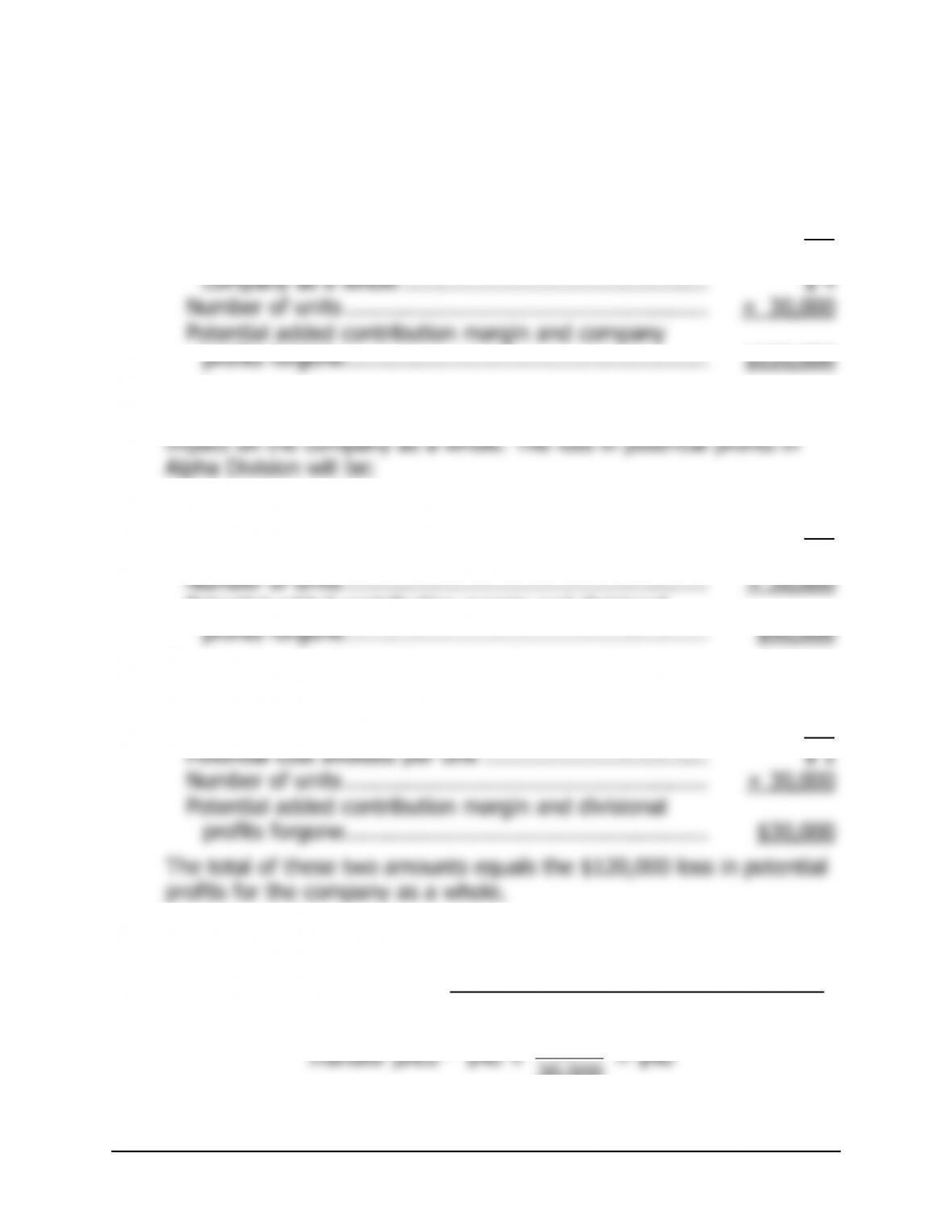
From the standpoint of the selling division, Alpha Division:
Total contribution mar
g
in on lost sales
Variable cost
Transfer price +
per unit Number of units transferred
³
But, from the standpoint of the buying division, Beta Division:
£Transfer price Cost of buying from outside supplier = $27
2a, 2b, and 2c.
From the standpoint of the selling division, Alpha Division:
Total contribution mar
g
in on lost sales
Variable cost
30,000
From the standpoint of the buying division, Beta Division:
£Transfer price Cost of buying from outside supplier = $89
Even though both managers would be better off with
any
transfer price
within this range, they may disagree about the exact amount of the
© The McGraw-Hill Companies, Inc., 2018. All rights reserved.
66 Managerial Accounting, 16th Edition
Problem 11A-6 (continued)
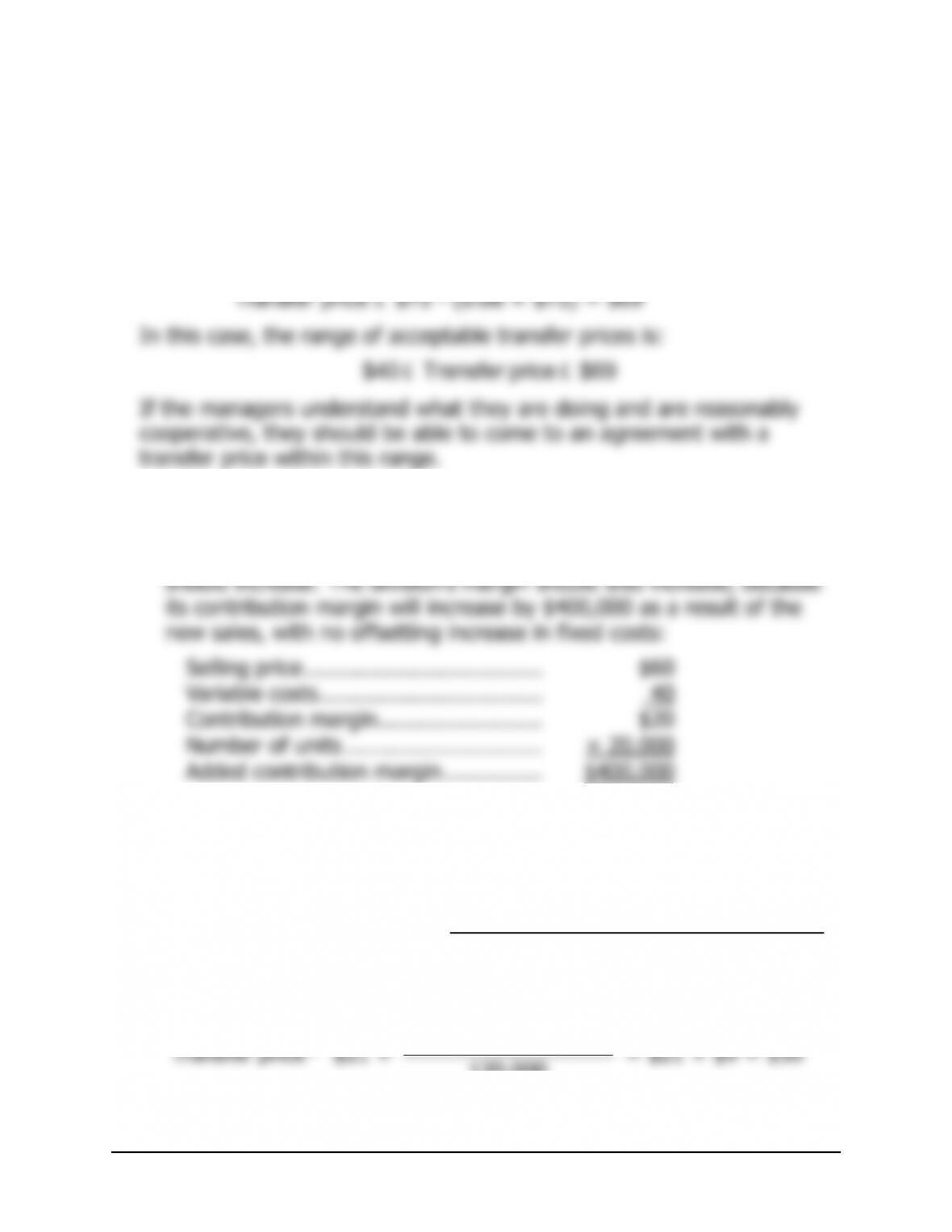
2d. The loss in potential profits to the company as a whole will be:
Beta Division
’
s outside purchase price …………………… $89
A
lpha Division
’
s variable cost on the internal transfer .. 85
Potential added contribution mar
g
in lost to the
Another way to derive the same answer is to look at the loss in
potential profits for each division and then total the losses for the
Su
gg
ested sellin
g
price per unit…………………………… $88
A
lpha Division
’
s variable cost on the internal transfer .. 85
Potential added contribution mar
g
in per unit ………….. $ 3
Potential added contribution mar
g
in and divisional
gg
g
3a. From the standpoint of the selling division, Alpha Division:
Total contribution mar
g
in on lost sales
Variable cost
Transfer price +
per unit Number of units transferred
³
$0
20,000
g
© The McGraw-Hill Companies, Inc., 2018. All rights reserved.
Solutions Manual, Appendix 11A 67
Problem 11A-6 (continued)
3b and 3c.
From the standpoint of the buying division, Beta Division:
Transfer price Cost of buying from outside supplier
£
3d. Alpha Division’s ROI should increase. The division has idle capacity, so
selling 20,000 units a year to Beta Division should cause no increase
in the division’s operating assets. Therefore, Alpha Division’s turnover
Thus, with both the margin and the turnover increasing, the division’s
ROI would also increase.
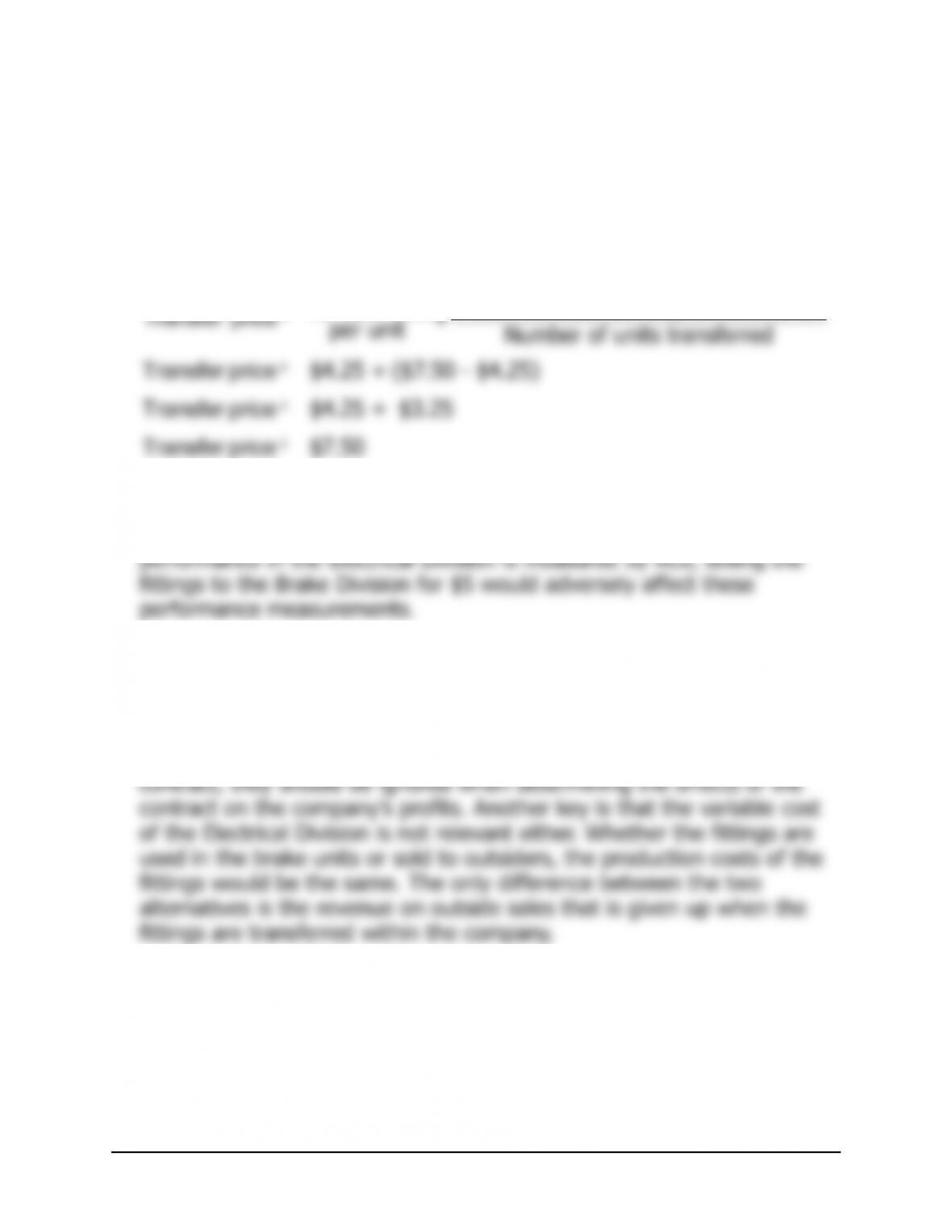
4. From the standpoint of the selling division, Alpha Division:
Total contribution margin on lost sales
Variable cost
Transfer price +
per unit Number of units transferred
³
()
$50 – $26 × 45,000
120,000
© The McGraw-Hill Companies, Inc., 2018. All rights reserved.
68 Managerial Accounting, 16th Edition
Case 11A-7 (60 minutes)
1. The Electrical Division is presently operating at capacity; therefore, any
sales of X52 electrical fittings to the Brake Division will require that the
Electrical Division give up an equal number of sales to outside
customers. Using the transfer pricing formula, we get a minimum
transfer price of:
Total contribution mar
g
in on lost sales
Variable cost
Thus, the Electrical Division should not supply the fitting to the Brake
Division for $5 each. The Electrical Division must give up revenues of
$7.50 on each fitting that it sells internally. Because management
2. The key is to realize that the $8 in fixed overhead and administrative
costs contained in the Brake Division’s $49.50 “cost” per brake unit is
not relevant. There is no indication that winning this contract would
actually affect any of the fixed costs. If these costs would be incurred
regardless of whether or not the Brake Division gets the airplane brake