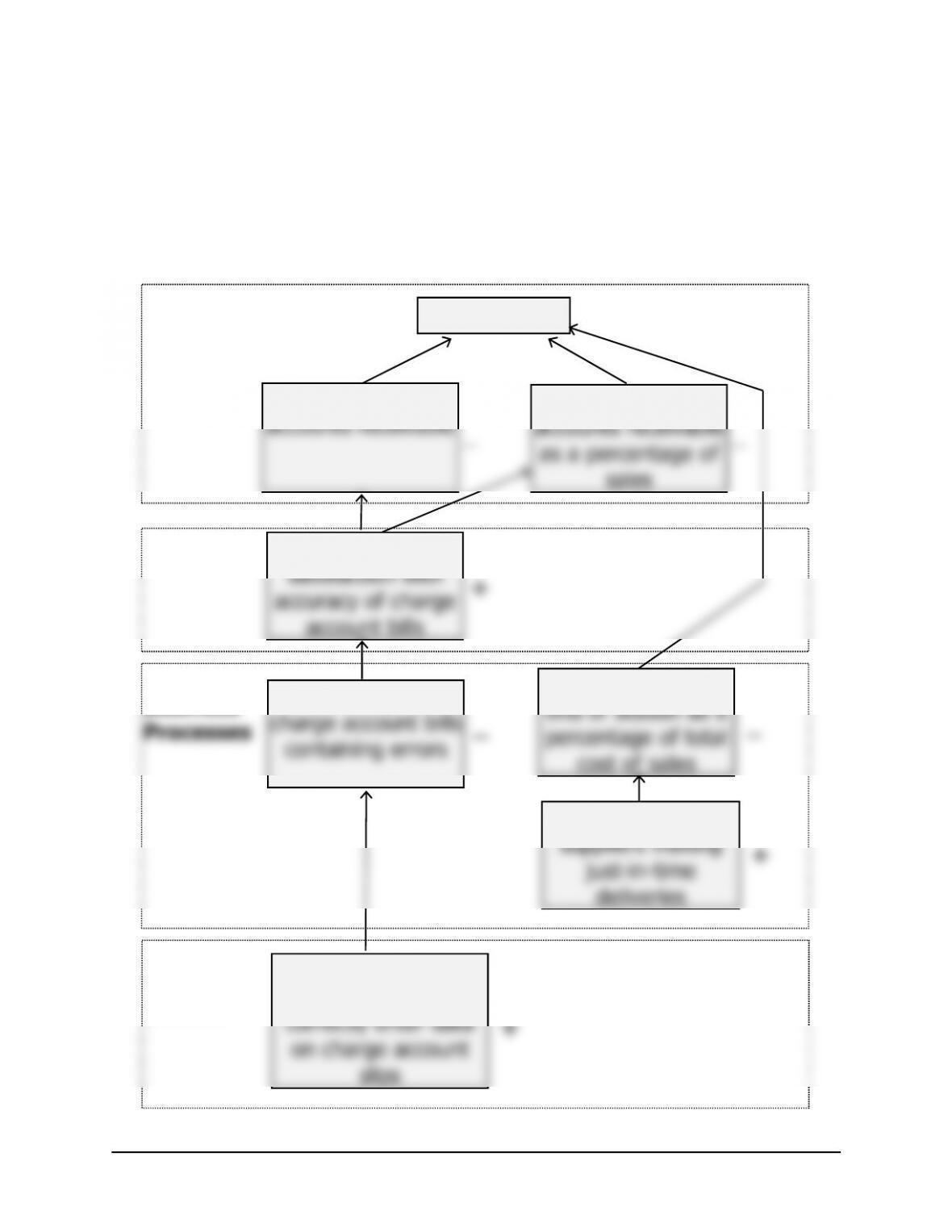
Learning
and
Growth
Internal
Business
Customer
Financial
Case 11-23 (60 minutes)
1. Student answers may differ concerning which category—learning and
growth, internal business processes, customers, or financial—a
particular performance measure belongs to.
Total profit
Average age of
Written-off
Customer
Percentage of
Unsold inventory at
Percentage of
Percentage of sales
clerks trained to
+
© The McGraw-Hill Companies, Inc., 2018. All rights reserved.
52 Managerial Accounting, 16th Edition
Case 11-23 (continued)
A number of the performance measures suggested by managers have
not been included in the above balanced scorecard. The excluded
performance measures may have an impact on total profit, but they are
2. The results of operations can be exploited for information about the
company’s strategy. Each link in the balanced scorecard should be
regarded as a hypothesis of the form “If …, then …”. For example, the
balanced scorecard on the previous page contains the hypothesis “If
customers express greater satisfaction with the accuracy of their charge
In general, the most important results are those that provide evidence
inconsistent with the hypotheses embedded in the balanced scorecard.
© The McGraw-Hill Companies, Inc., 2018. All rights reserved.
Solutions Manual, Chapter 11 53
Case 11-23 (continued)
3. a. This evidence is inconsistent with two of the hypotheses underlying
the balanced scorecard. The first of these hypotheses is “If customers
express greater satisfaction with the accuracy of their charge account
bills, then the average age of accounts receivable will improve.” The
second of these hypotheses is “If customers express greater
satisfaction with the accuracy of their charge account bills, then there
will be improvement in bad debts.” There are a number of possible
b. This evidence is inconsistent with three hypotheses. The first of these
is “If the average age of receivables declines, then profits will
increase.” The second hypothesis is “If the written-off accounts
Again, there are a number of possible explanations for the lack of
results consistent with the hypotheses. Managers may have
decreased the average age of receivables by simply writing off old
accounts earlier than was done previously. This would actually
decrease reported profits in the short term. Bad debts as a
© The McGraw-Hill Companies, Inc., 2018. All rights reserved.
54 Managerial Accounting, 16th Edition
Case 11-23 (continued)
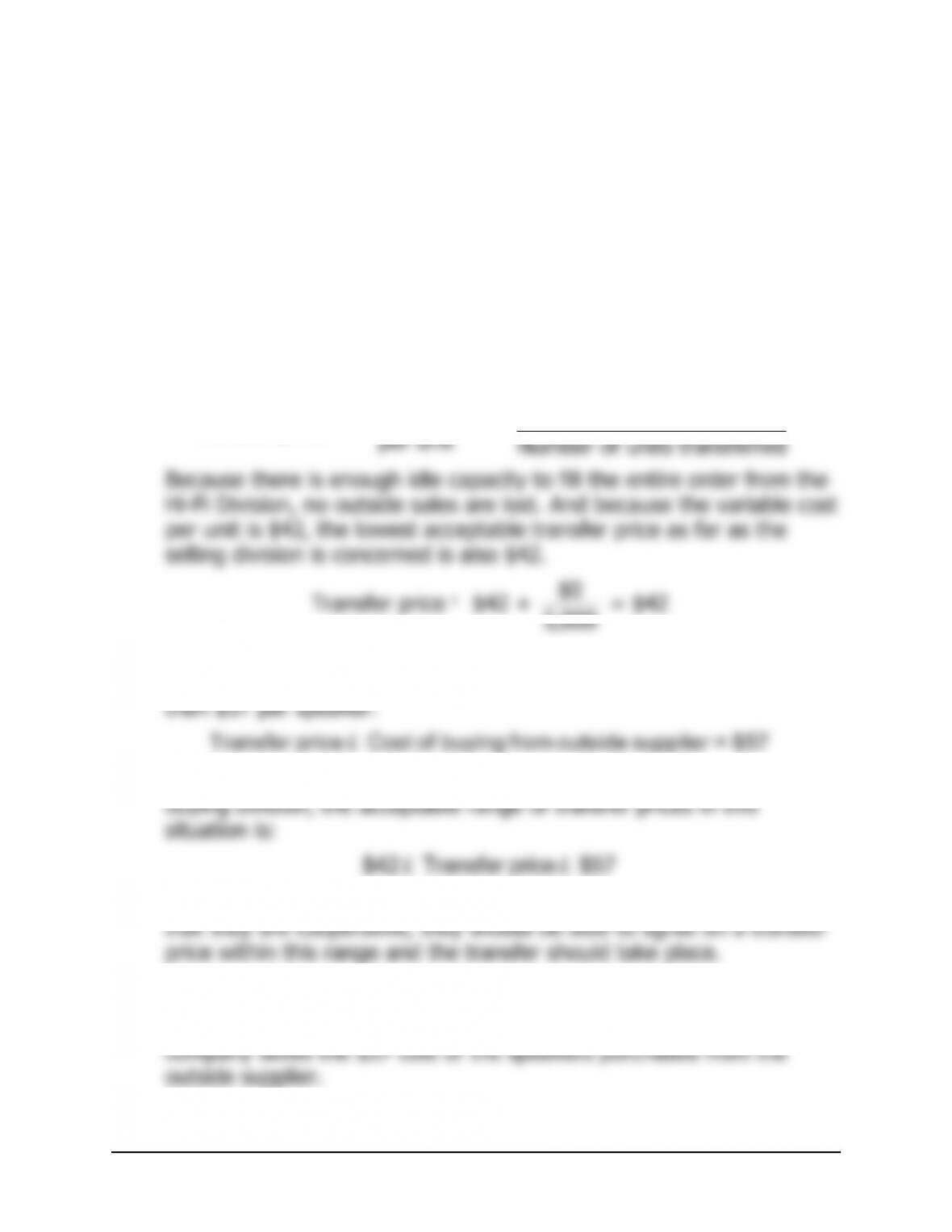
The reduction in unsold inventories at the end of the season as a
percentage of cost of sales could have occurred for a number of
reasons that are not necessarily good for profits. For example,
managers may have been too cautious about ordering goods to
restock low inventories—creating stockouts and lost sales. Or,
© The McGraw-Hill Companies, Inc., 2018. All rights reserved.
Solutions Manual, Appendix 11A 55
Appendix 11A
Transfer Pricing
Exercise 11A-1 (30 minutes)
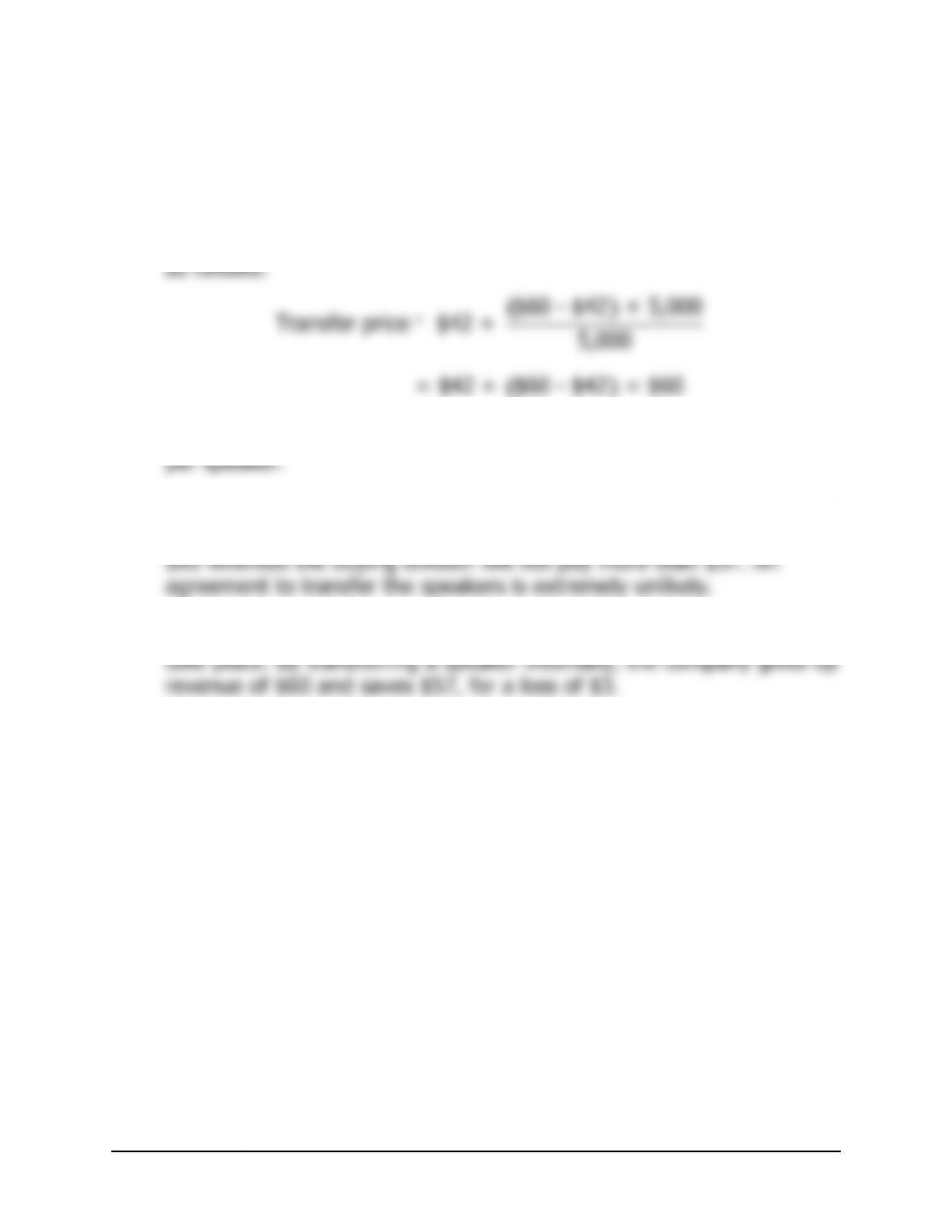
1. a. The lowest acceptable transfer price from the perspective of the
selling division is given by the following formula:
T
otal contribution mar
g
in
on lost sales
Variable cost
Transfer price +
³
b. The Hi-Fi division can buy a similar speaker from an outside supplier
for $57. Therefore, the Hi-Fi Division would be unwilling to pay more
c. Combining the requirements of both the selling division and the
Assuming that the managers understand their own businesses and
d. From the standpoint of the entire company, the transfer should take
place. The cost of the speakers transferred is only $42 and the
© The McGraw-Hill Companies, Inc., 2018. All rights reserved.
56 Managerial Accounting, 16th Edition
Exercise 11A-1 (continued)
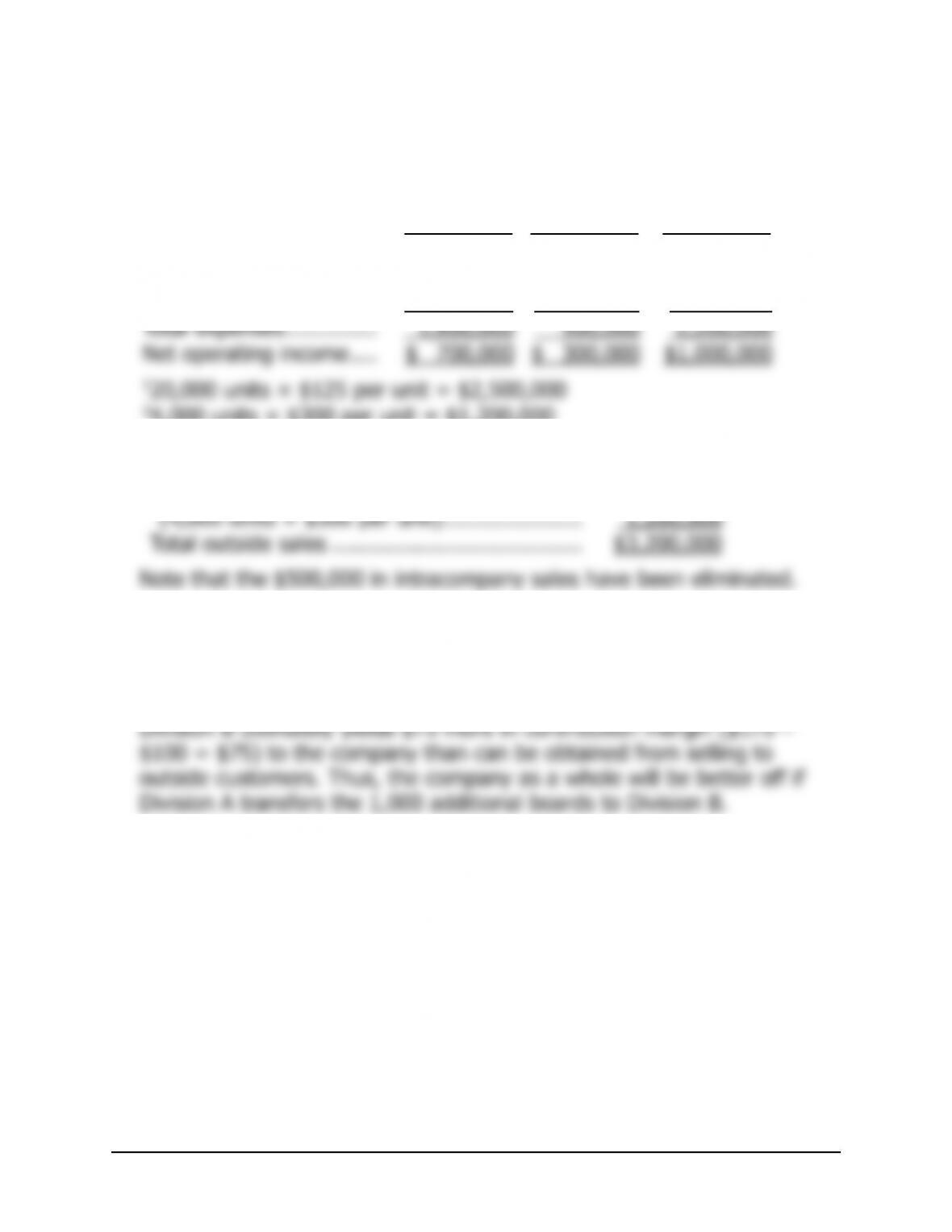
2. a. Each of the 5,000 units transferred to the Hi-Fi Division must displace
a sale to an outsider at a price of $60. Therefore, the selling division
would demand a transfer price of at least $60. This can also be
computed using the formula for the lowest acceptable transfer price
b. As before, the Hi-Fi Division would be unwilling to pay more than $57
c. The requirements of the selling and buying divisions in this instance
are incompatible. The selling division must have a price of at least
d. From the standpoint of the entire company, the transfer should not
© The McGraw-Hill Companies, Inc., 2018. All rights reserved.
Solutions Manual, Appendix 11A 57
Exercise 11A-2 (20 minutes)
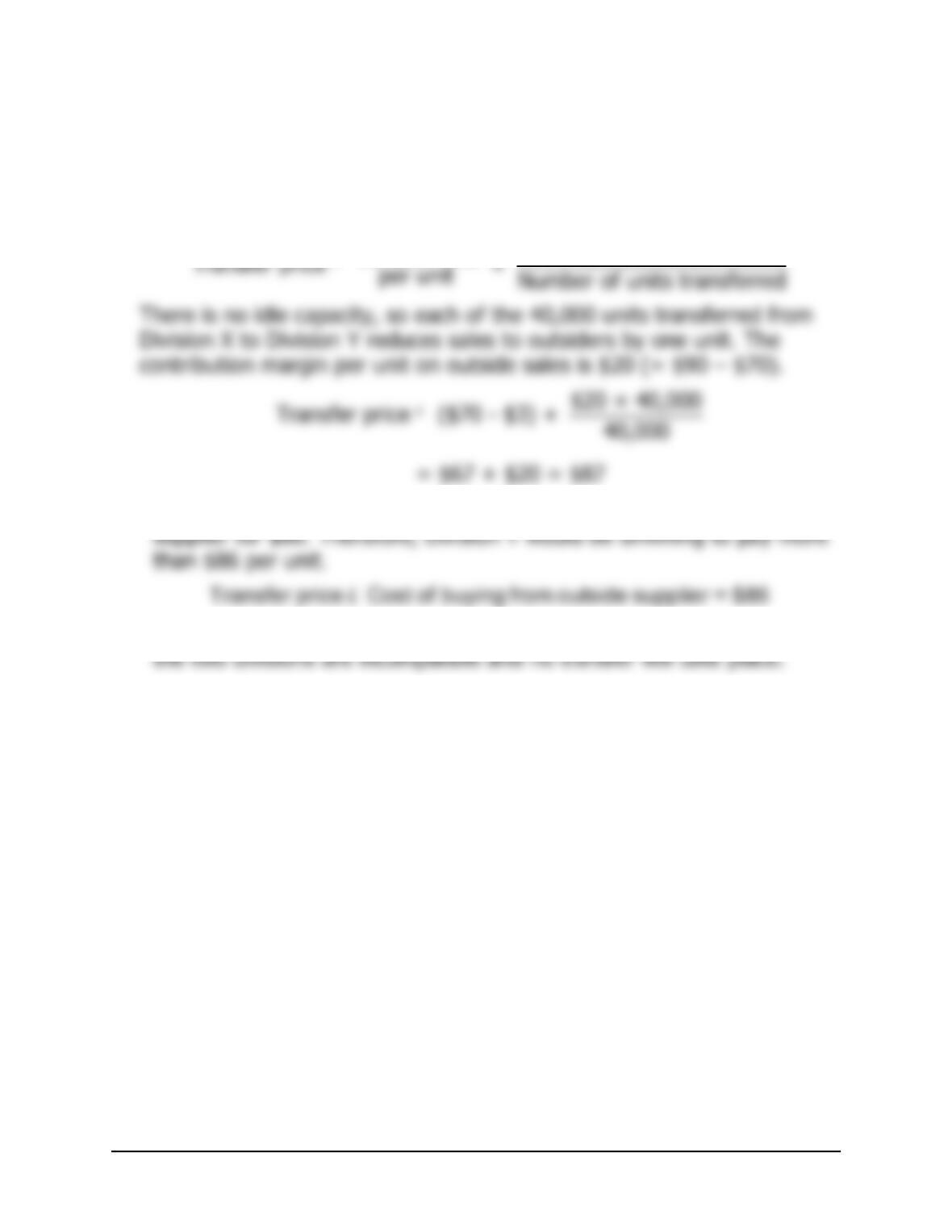
1.
Division A Division B
Total
Company
Sales ……………………… $2,500,0001$1,200,0002$3,200,0003
Expenses:
A
dded by the division . 1,800,000 400,000 2,200,000
T
ransfer price paid …… 500,000
3Division A outside sales
(16,000 units × $125 per unit) ………………. $2,000,000
Division B outside sales
T
2. Division A should transfer the 1,000 additional circuit boards to Division
B. Note that Division B’s processing adds $175 to each unit’s selling
price (B’s $300 selling price – A’s $125 selling price = $175 increase),
but it adds only $100 in cost. Therefore, each board transferred to
T
© The McGraw-Hill Companies, Inc., 2018. All rights reserved.
58 Managerial Accounting, 16th Edition
Exercise 11A-3 (20 minutes)
1a. The lowest acceptable transfer price from the perspective of the selling
division is given by the following formula:
T
otal contribution mar
g
in
on lost sales
Variable cost
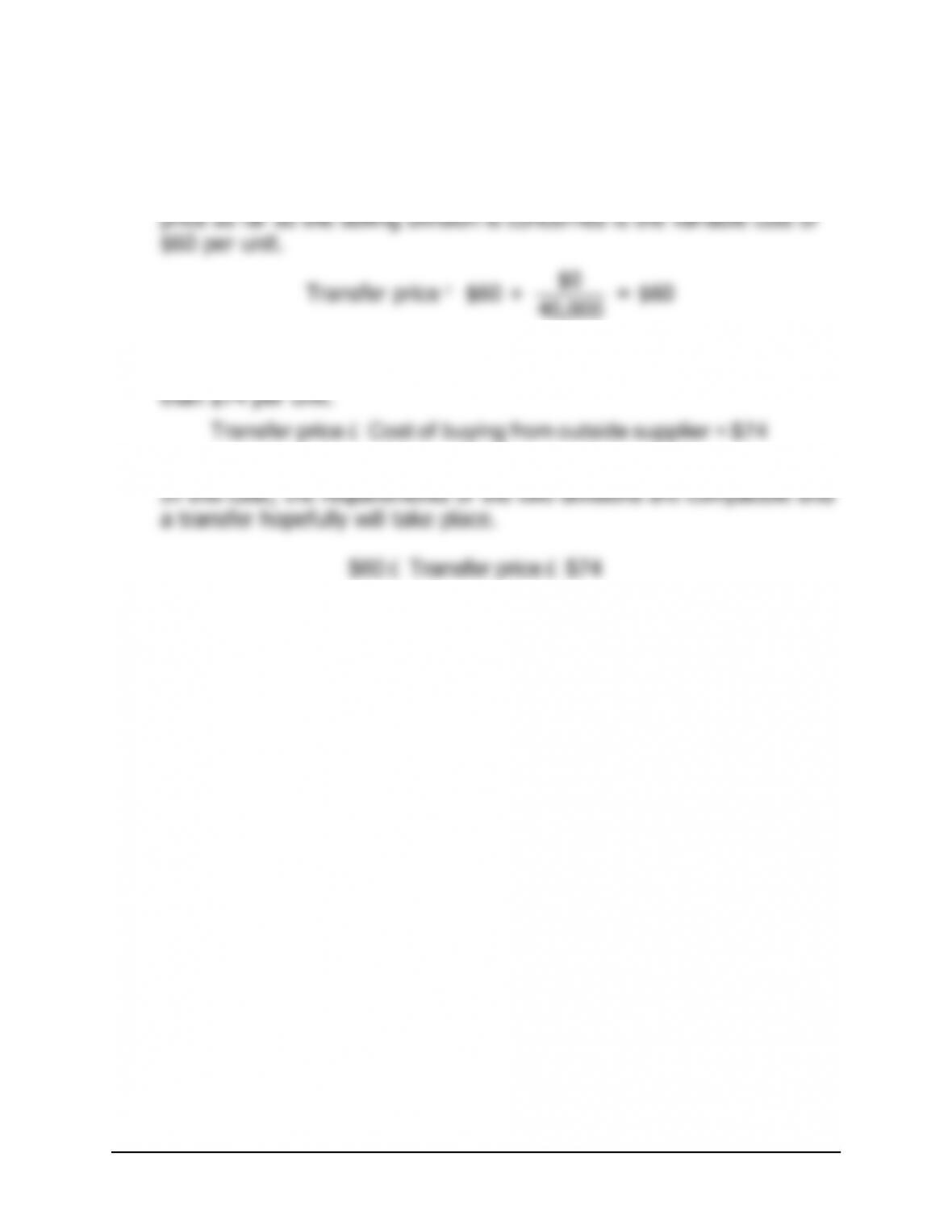
1b. The buying division, Division Y, can buy a similar unit from an outside
1c. There is no range of acceptable transfer prices. The requirements of
© The McGraw-Hill Companies, Inc., 2018. All rights reserved.
Solutions Manual, Appendix 11A 59
Exercise 11A-3 (continued)
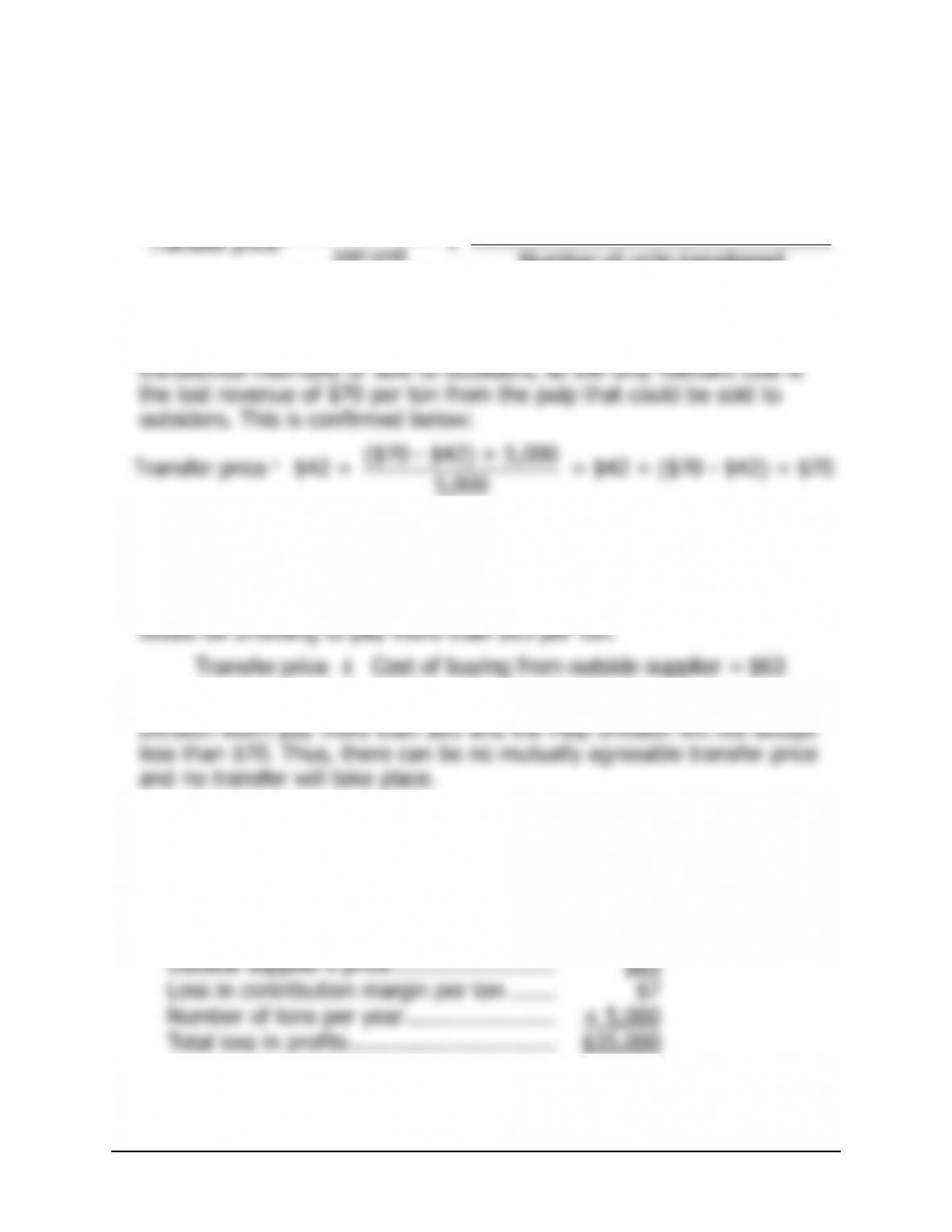
2a. In this case, Division X has enough idle capacity to satisfy Division Y’s
demand. Therefore, there are no lost sales and the lowest acceptable
2b. The buying division, Division Y, can buy a similar unit from an outside
supplier for $74. Therefore, Division Y would be unwilling to pay more
2c. As shown below, the range of acceptable transfer prices is $60 to $74.
© The McGraw-Hill Companies, Inc., 2018. All rights reserved.
60 Managerial Accounting, 16th Edition
Problem 11A-4 (60 minutes)
1. The lowest acceptable transfer price from the perspective of the selling
division is given by the following formula:
Variable cost
The Pulp Division has no idle capacity, so transfers from the Pulp
Division to the Carton Division would cut directly into normal sales of
pulp to outsiders. The costs are the same whether the pulp is
Therefore, the Pulp Division will refuse to transfer at a price less than
$70 a ton.
The Carton Division can buy pulp from an outside supplier for $70 a ton,
less a 10% quantity discount of $7, or $63 a ton. Therefore, the Division
The requirements of the two divisions are incompatible. The Carton
2. The price being paid to the outside supplier, net of the quantity
discount, is only $63. If the Pulp Division meets this price, then profits in
the Pulp Division and in the company as a whole will drop by $35,000
per year:
Lost revenue per ton ………………………. $70