© The McGraw-Hill Companies, Inc., 2018. All rights reserved.
Solutions Manual, Chapter 11 31
Problem 11-14 (30 minutes)
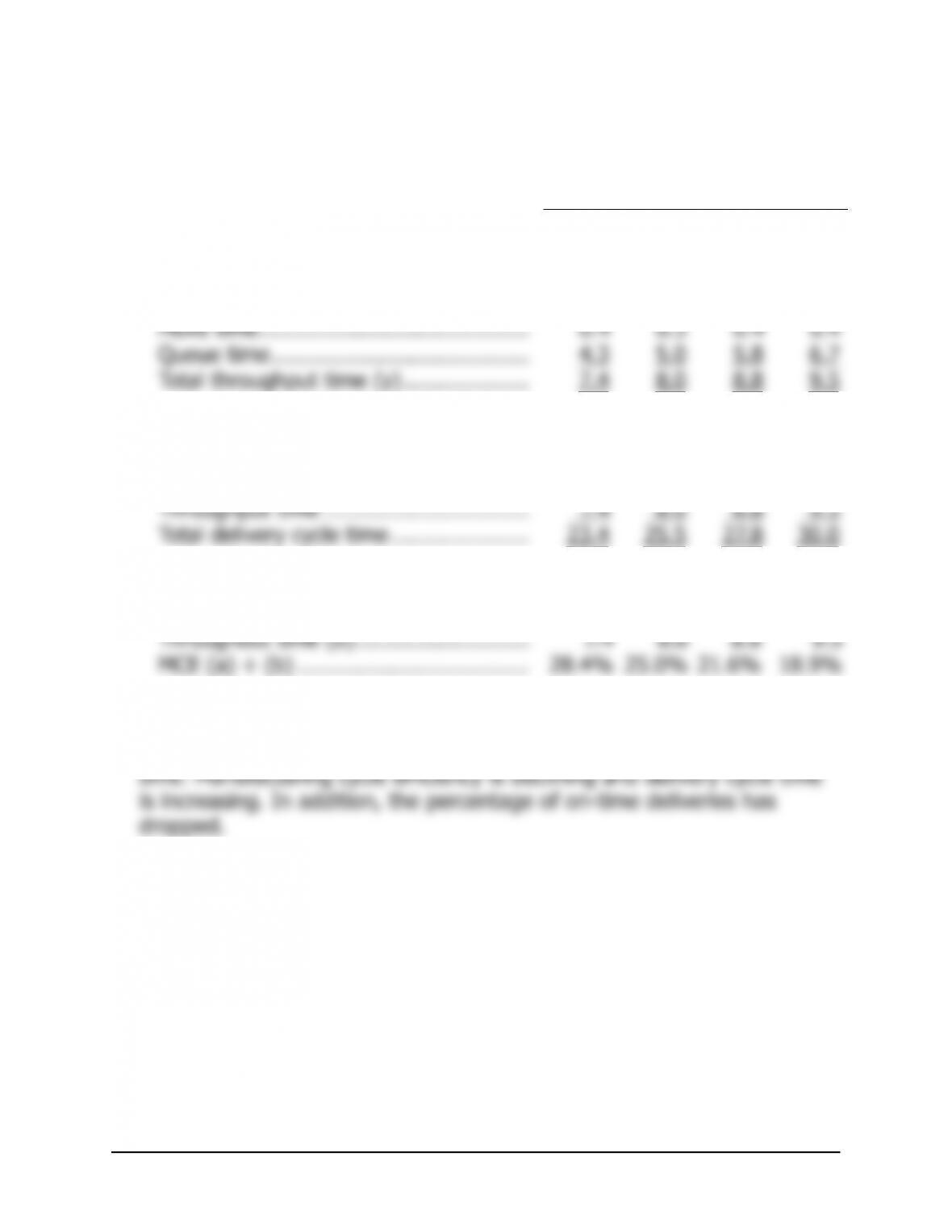
1. a., b., and c.
Month
1 2 3 4
T
hrou
g
hput time
—
days:
Process time (x) ………………………….. 2.1 2.0 1.9 1.8
Inspection time …………………………… 0.6 0.7 0.7 0.6
T
Delivery cycle time
—
days:
Wait time from order to start of
production ……………………………….. 16.0 17.5 19.0 20.5
T
g
T
Manufacturin
g
cycle efficiency (MCE):
Process time (a) ………………………….. 2.1 2.0 1.9 1.8
T
g
2. All of the performance measures display unfavorable trends. Throughput
time per unit is increasing—largely because of an increase in queue
© The McGraw-Hill Companies, Inc., 2018. All rights reserved.
32 Managerial Accounting, 16th Edition
Problem 11-14 (continued)
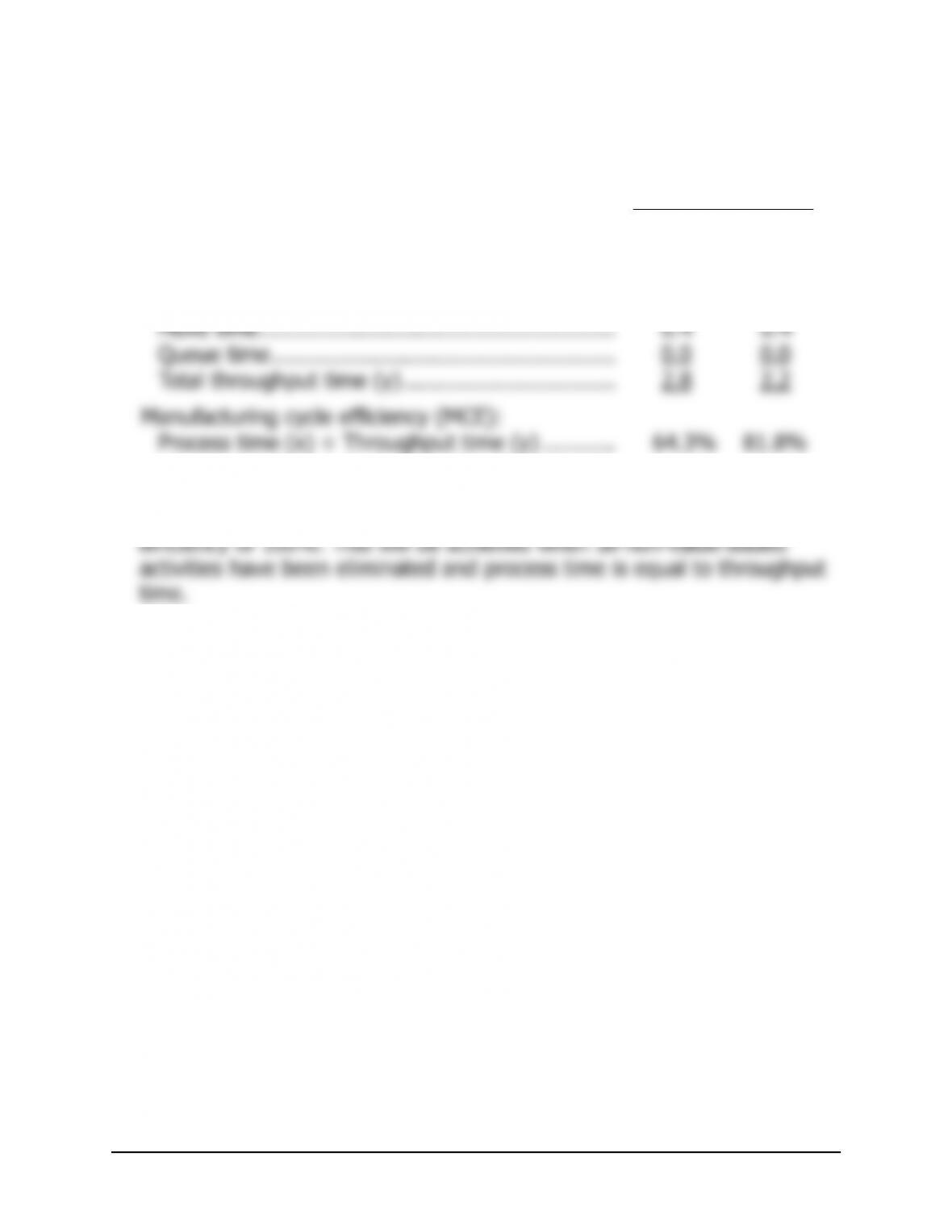
3. a. and b.
Month
5 6
T
hrou
g
hput time
—
days:
Process time (x) ……………………………………… 1.8 1.8
Inspection time ………………………………………. 0.6 0.0
T
As a company reduces non-value-added activities, the manufacturing
cycle efficiency increases rapidly. The goal, of course, is to have an
© The McGraw-Hill Companies, Inc., 2018. All rights reserved.
Solutions Manual, Chapter 11 33
Problem 11-15 (20 minutes)
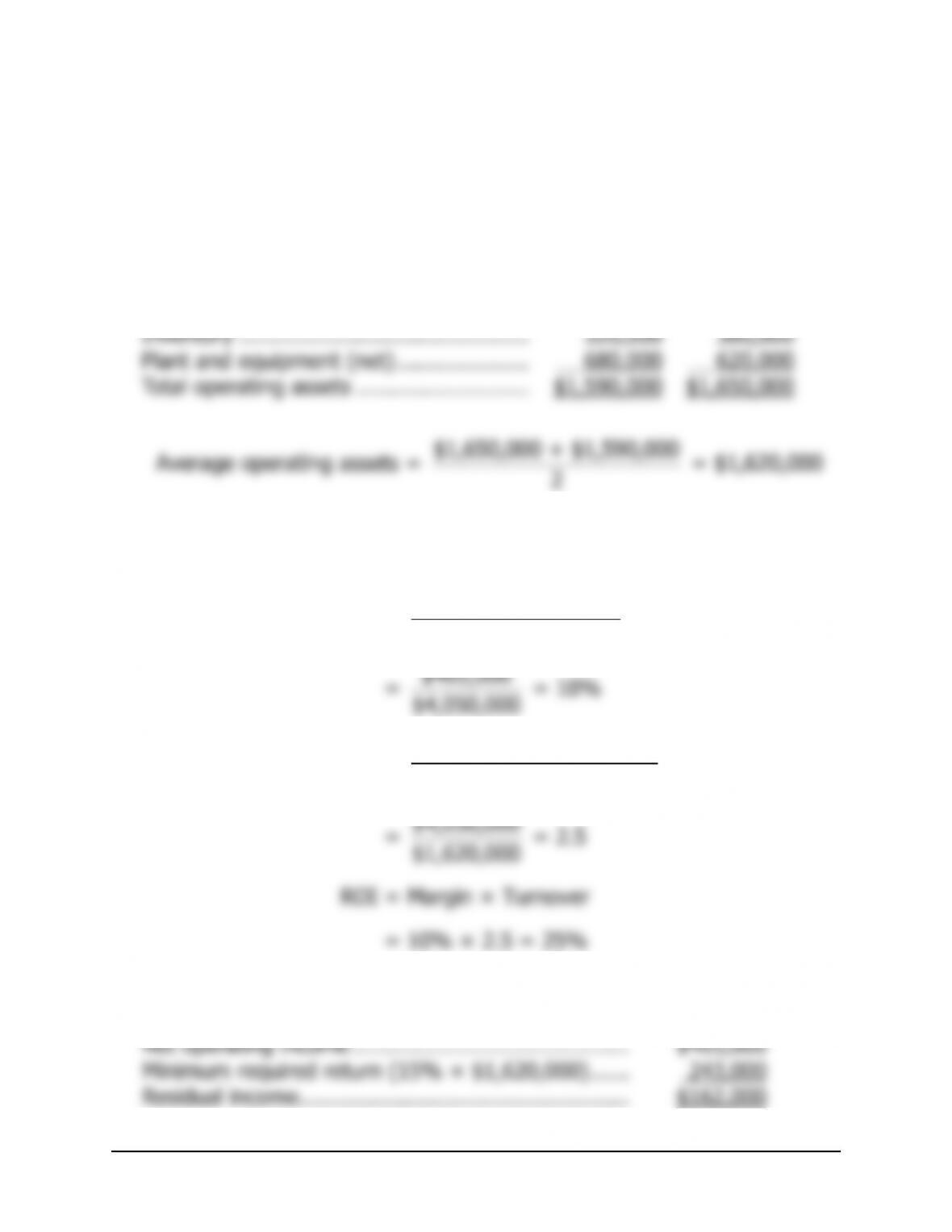
1. Operating assets do not include investments in other companies or in
undeveloped land.
Beginning
Balances
Ending
Balances
Cash …………………………………………… $ 140,000 $ 120,000
A
ccounts receivable ………………………… 450,000 530,000
T
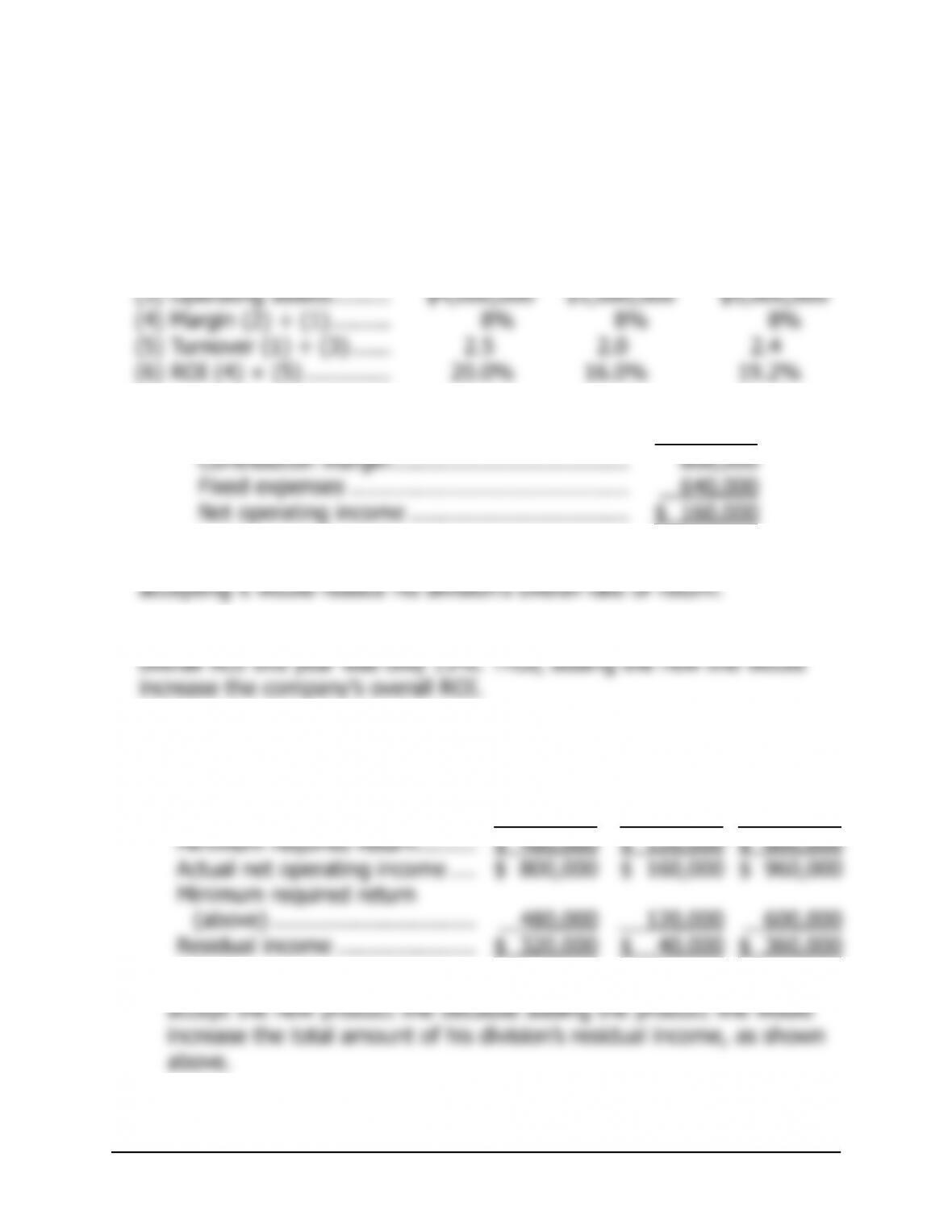
2. The margin, turnover, and return on investment (ROI) are calculated as
follows:
Net operating income
Margin = Sales
Sales
Turnover=
A
vera
g
e operatin
g
assets
3. The residual income is calculated as follows:
© The McGraw-Hill Companies, Inc., 2018. All rights reserved.
34 Managerial Accounting, 16th Edition
Problem 11-16 (45 minutes)
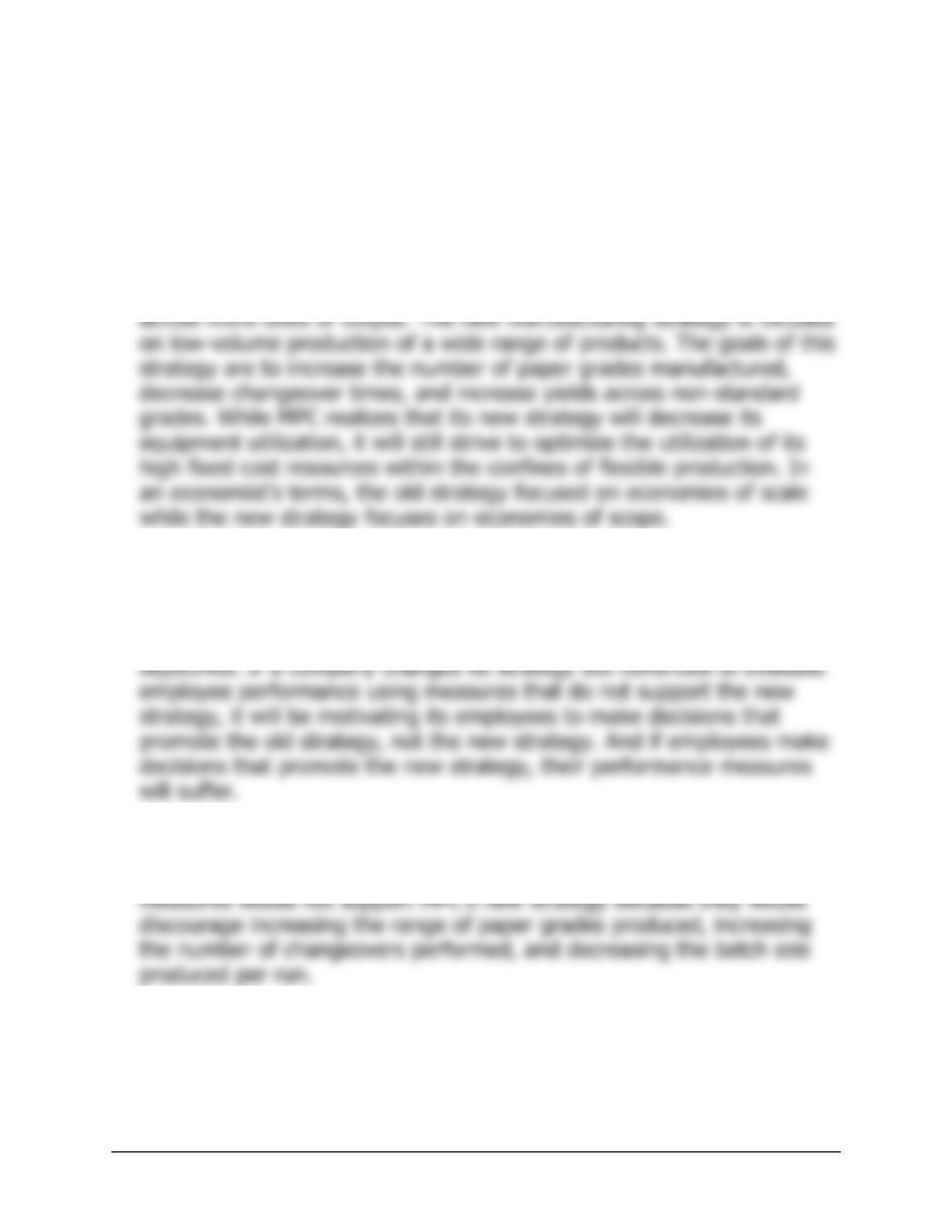
1. MPC’s previous manufacturing strategy was focused on high-volume
production of a limited range of paper grades. The goal of this strategy
was to keep the machines running constantly to maximize the number
of tons produced. Changeovers were avoided because they lowered
equipment utilization. Maximizing tons produced and minimizing
changeovers helped spread the high fixed costs of paper manufacturing
2. Employees focus on improving those measures that are used to evaluate
their performance. Therefore, strategically-aligned performance
measures will channel employee effort towards improving those aspects
of performance that are most important to obtaining strategic
Some performance measures that would be appropriate for MPC’s old
strategy include: equipment utilization percentage, number of tons of
paper produced, and cost per ton produced. These performance
© The McGraw-Hill Companies, Inc., 2018. All rights reserved.
Solutions Manual, Chapter 11 35
Problem 11-16 (continued)
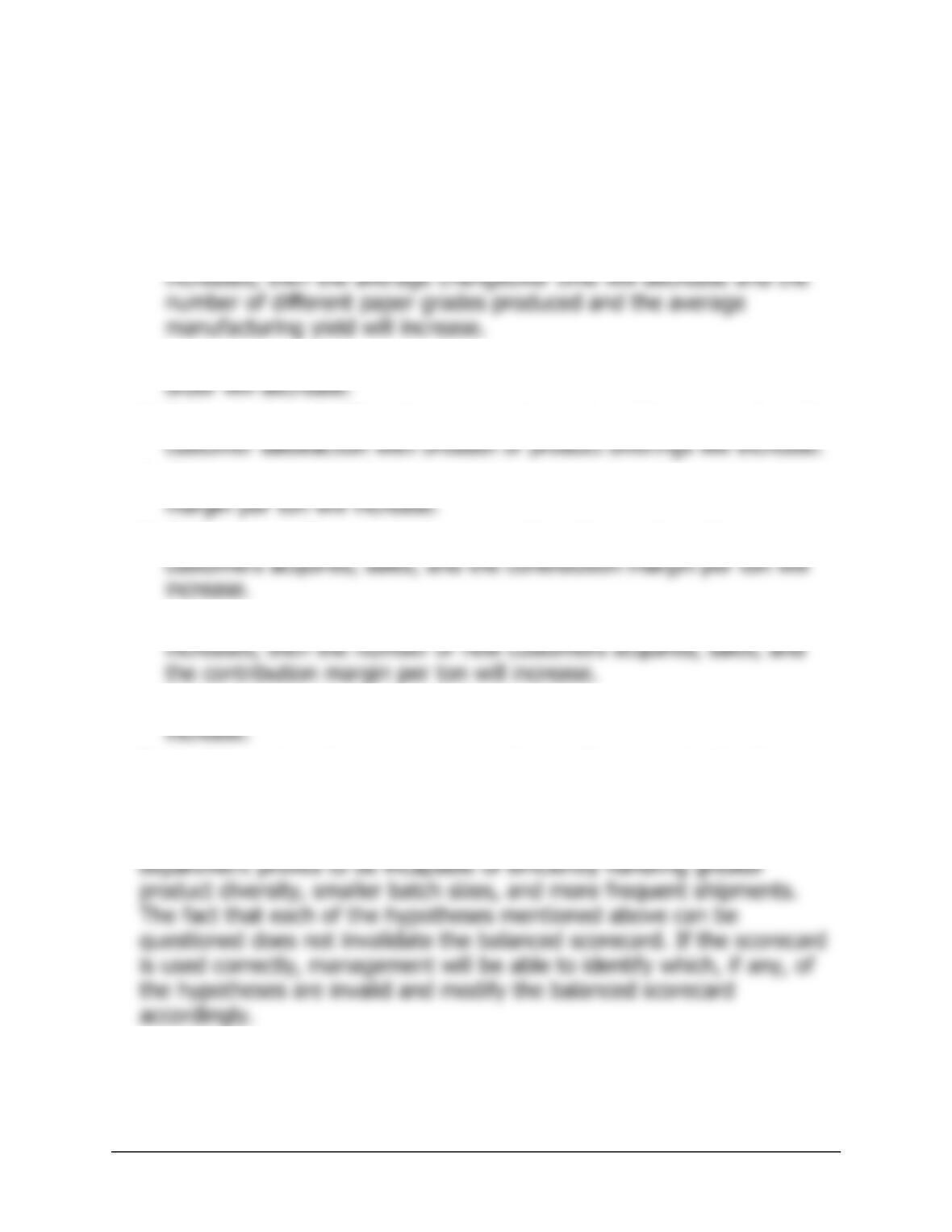
3. Students’ answers may differ in some details from this solution.
Sales Contribution
margin per ton
Financial
Time to fill
Customer satisfaction with
Number of new
customers acquired
Customer
– +
+
+ +
© The McGraw-Hill Companies, Inc., 2018. All rights reserved.
36 Managerial Accounting, 16th Edition
Problem 11-16 (continued)
4. The hypotheses underlying the balanced scorecard are indicated by the
arrows in the diagram. Reading from the bottom of the balanced
scorecard, the hypotheses are:
° If the number of employees trained to support the flexibility strategy
° If the average changeover time decreases, then the time to fill an
° If the number of different paper grades produced increases, then the
° If the average manufacturing yield increases, then the contribution
° If the time to fill an order decreases, then the number of new
° If the customer satisfaction with breadth of product offerings
° If the number of new customers acquired increases, then sales will
Each of these hypotheses can be questioned. For example, the time to
fill an order is a function of additional factors above and beyond
changeover times. Thus, MPC’s average changeover time could decrease
while its time to fill an order increases if, for example, the shipping
© The McGraw-Hill Companies, Inc., 2018. All rights reserved.
Solutions Manual, Chapter 11 37
Problem 11-17 (30 minutes)
1. Breaking the ROI computation into two separate elements reveals
important relationships that otherwise might remain hidden. First, the
importance of asset turnover as a key element to overall profitability is
emphasized. Prior to use of the ROI formula, managers tended to allow
operating assets to swell to excessive levels. Second, the importance of
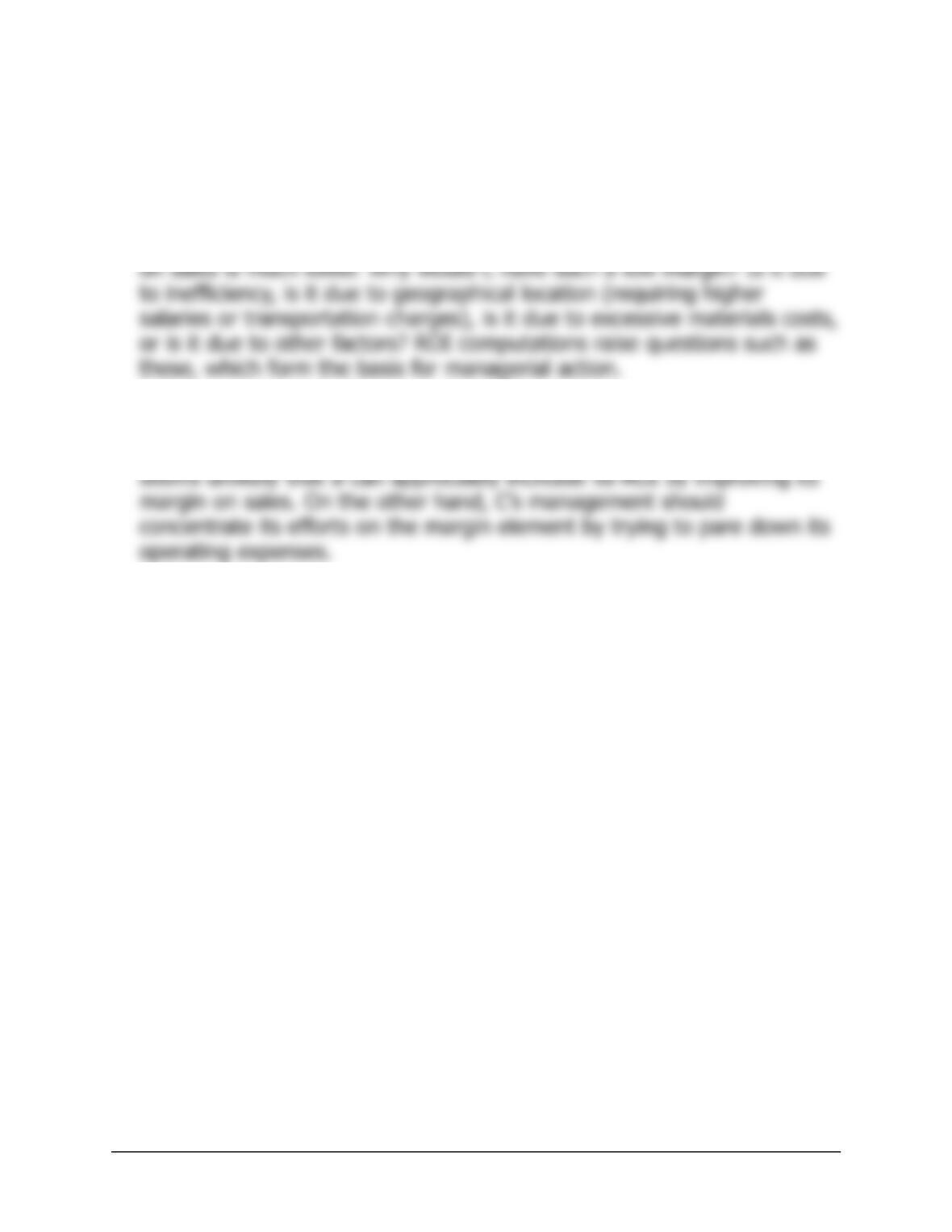
2. The missing information is as follows:
Companies in the Same Industr
y
A
B
C
Sales (a) ………………….…….. $600,000 * $500,000 * $2,000,000
Net operatin
g
income (b)……. $84,000 * $70,000 * $70,000
*Given.
NAA Report No. 35
states (p. 35):
“Introducing sales to measure level of operations helps to disclose
specific areas for more intensive investigation. Company B does as well
as Company A in terms of profit margin, for both companies earn 14%
on sales. But Company B has a much lower turnover of capital than
does Company A. Whereas a dollar of investment in Company A
© The McGraw-Hill Companies, Inc., 2018. All rights reserved.
38 Managerial Accounting, 16th Edition
Problem 11-17 (continued)
Thus, by including sales specifically in ROI computations the manager is
able to discover possible problems, as well as reasons underlying a
strong or a weak performance. Looking at Company A compared to
Company C, notice that C’s turnover is the same as A’s, but C’s margin
To summarize, in order to bring B’s ROI into line with A’s, it seems
obvious that B’s management will have to concentrate its efforts on
increasing turnover, either by increasing sales or by reducing assets. It
© The McGraw-Hill Companies, Inc., 2018. All rights reserved.
Solutions Manual, Chapter 11 39
Problem 11-18 (30 minutes)
Requirements 1, 2, and 3:
This Year New Line Next Year
(1) Sales ……………………. $10,000,000 $2,000,000 $12,000,000
(2) Net operatin
g
income .. $800,000 $160,000 * $960,000
* Sales ………………………………………………... $2,000,000
V
ariable expenses (60% × $2,000,000) ……. 1,200,000
g
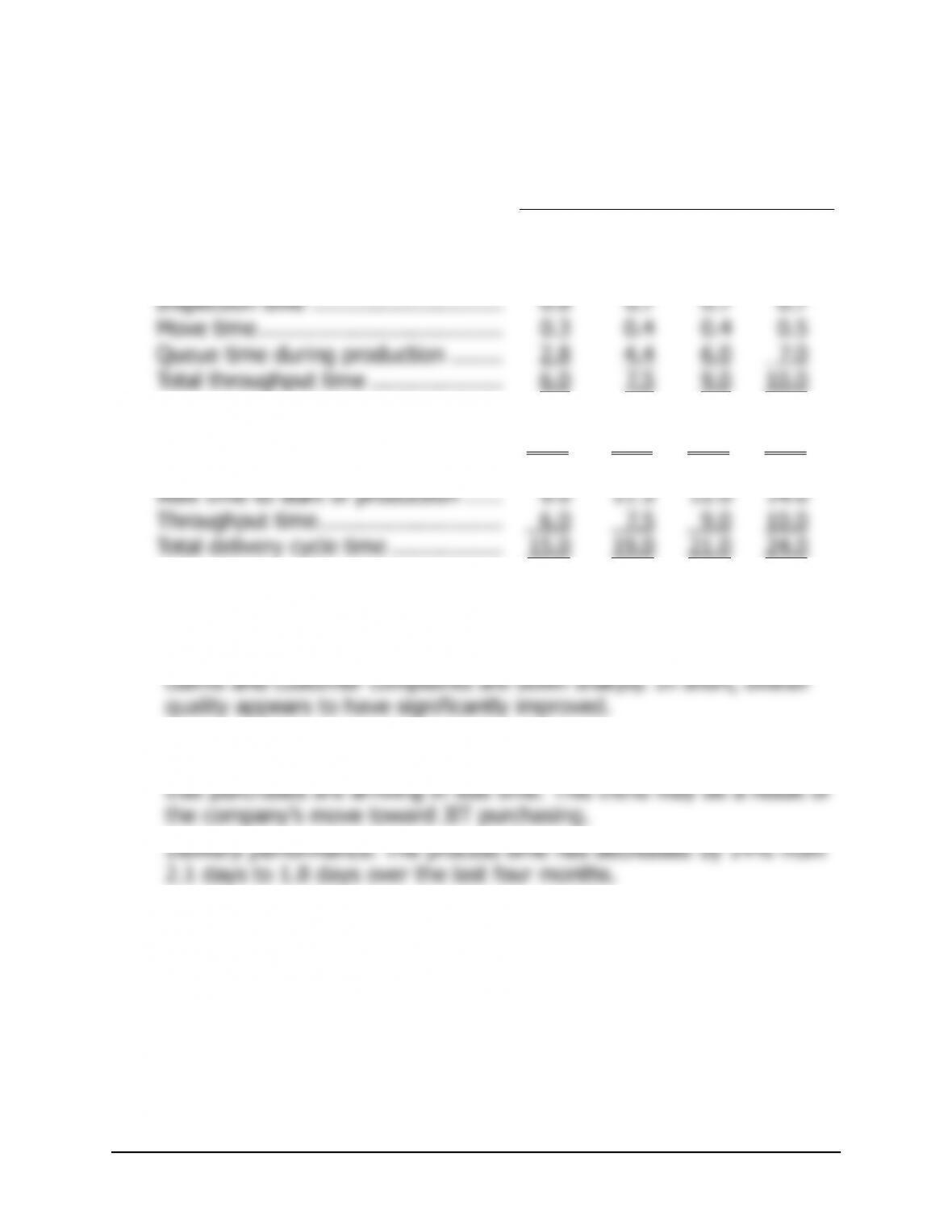
4. Dell Havasi will be inclined to reject the new product line because
5. The new product line promises an ROI of 16%, whereas the company’s
6a through 6c:
This Year New Line Next Year
Operatin
g
assets ………………… $4,000,000 $1,000,000 $5,000,000
Minimum return required……... × 12% × 12% × 12%
A
6d. Under the residual income approach, Dell Havasi would be inclined to
g
T
© The McGraw-Hill Companies, Inc., 2018. All rights reserved.
40 Managerial Accounting, 16th Edition
Problem 11-19 (30 minutes)
1. a., b., and c.
Month
1 2 3 4
T
hrou
g
hput time in days:
Process time ……………………………. 2.1 2.0 1.9 1.8
T
Manufacturin
g
cycle efficiency (MCE):
Process time ÷ Throu
g
hput time….. 35.0% 26.7% 21.1% 18.0%
Delivery cycle time in days:
T
g
T
2. a. Areas where the company is improving:
Quality control.
The number of defects has decreased by over 50%
(from 185 to 91) in the last four months. Moreover, both warranty
Material control.
The purchase order lead time is only half (now 4
days from 8 days) of what it was four months ago, which indicates