
© The McGraw-Hill Companies, Inc., 2018. All rights reserved.
Solutions Manual, Chapter 11 11
Exercise 11-2 (10 minutes)
A
vera
g
e operatin
g
assets …………………. $2,800,000

© The McGraw-Hill Companies, Inc., 2018. All rights reserved.
12 Managerial Accounting, 16th Edition
Exercise 11-3 (20 minutes)
1.
T
hrou
g
hput time = Process time + Inspection time + Move time +
Queue time
2. Only process time is value-added time; therefore the manufacturing
cycle efficiency (MCE) is:
–Value added time 2.7 days
MCE = = = 0.30
3. If the MCE is 30%, then 30% of the throughput time was spent in
4. Delivery cycle time = Wait time + Throu
g
hput time
5. If all queue time is eliminated, then the throughput time drops to only 4
days (2.7 + 0.3 + 1.0). The MCE becomes:
© The McGraw-Hill Companies, Inc., 2018. All rights reserved.
Solutions Manual, Chapter 11 13
Learning
and
Growth
Internal
Business
Processes
Financial
Customer
Exercise 11-4 (45 minutes)
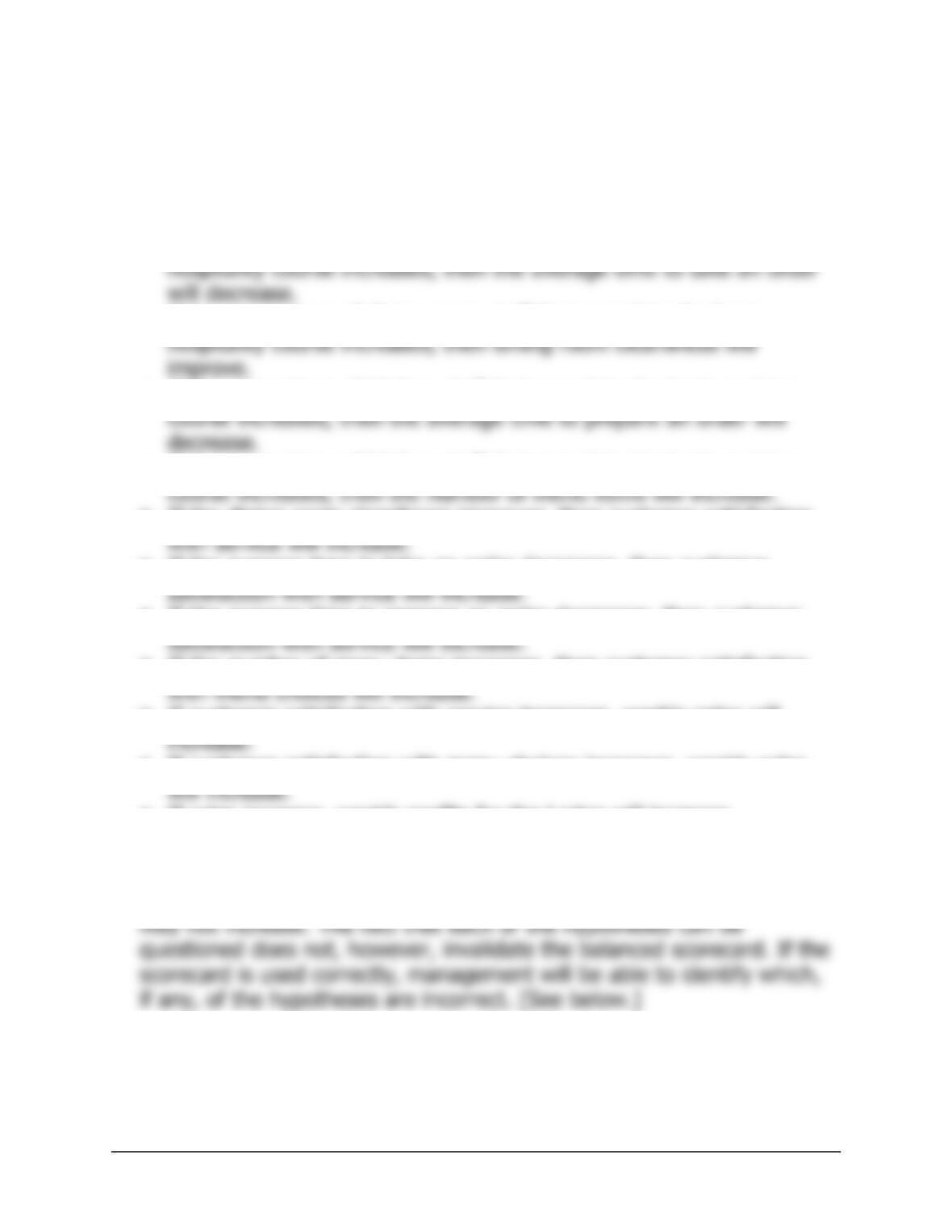
1. Students’ answers may differ in some details from this solution.
Weekly profit
Weekly sales
Dining area
cleanliness
Percenta
g
e
of kitchen
+
+
Average time
to prepare an
order
Percentage
of dining
+–
© The McGraw-Hill Companies, Inc., 2018. All rights reserved.
14 Managerial Accounting, 16th Edition
Exercise 11-4 (continued)
2. The hypotheses underlying the balanced scorecard are indicated by the
arrows in the diagram. Reading from the bottom of the balanced
scorecard, the hypotheses are:
o If the percentage of dining room staff that complete the basic
o If the percentage of dining room staff that complete the basic
o If the percentage of kitchen staff that complete the basic cooking
o If the percentage of kitchen staff that complete the basic cooking
o If the dining room cleanliness improves, then customer satisfaction
o If the average time to take an order decreases, then customer
o If the average time to prepare an order decreases, then customer
o If the number of menu items increases, then customer satisfaction
o If customer satisfaction with service increases, weekly sales will
o If customer satisfaction with menu choices increases, weekly sales
o If sales increase, weekly profits for the Lodge will increase.
Each of these hypotheses can be questioned. For example, the items
added to the menu may not appeal to customers. So even if the number
of menu items increases, customer satisfaction with the menu choices
© The McGraw-Hill Companies, Inc., 2018. All rights reserved.
Solutions Manual, Chapter 11 15
Exercise 11-4 (continued)
3. Management will be able to tell if a hypothesis is false if an
improvement in a performance measure at the bottom of an arrow does
not, in fact, lead to improvement in the performance measure at the tip
© The McGraw-Hill Companies, Inc., 2018. All rights reserved.
16 Managerial Accounting, 16th Edition
Exercise 11-5 (15 minutes)
Division
Alpha Bravo Charlie
Sales (a) ……………………….. $4,000,000 $11,500,000 * $3,000,000
Net operatin
g
income (b) ….. $160,000 $920,000 * $210,000 *
A
vera
g
e operatin
g
assets
T
Note that Divisions Alpha and Bravo apparently have different strategies to
© The McGraw-Hill Companies, Inc., 2018. All rights reserved.
Solutions Manual, Chapter 11 17
Exercise 11-6 (20 minutes)
1. ROI computations:
Net operating income Sales
ROI = ×
Sales Avera
g
e operatin
g
assets
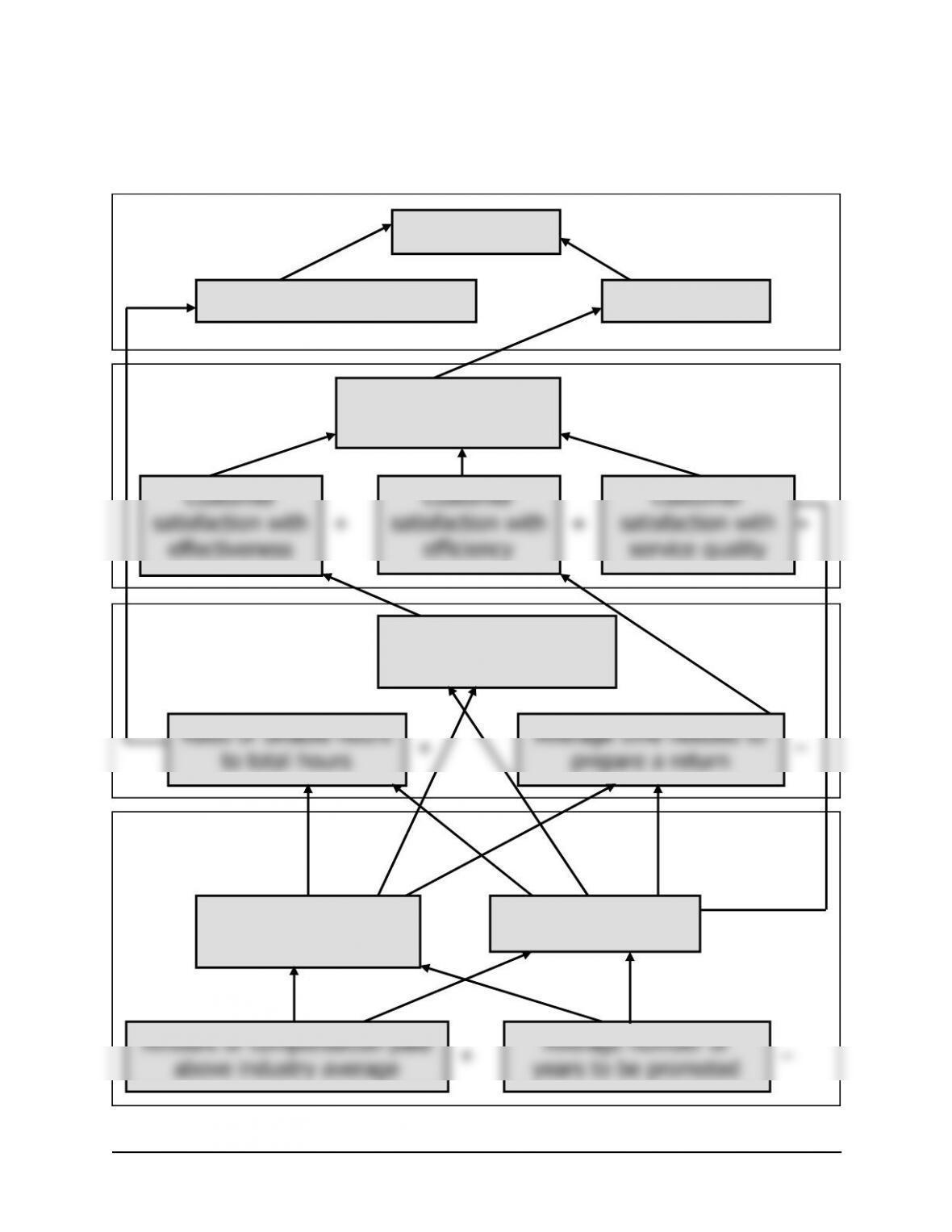
Osaka Division:
2.
Osaka Yokohama
A
vera
g
e operatin
g
assets (a) …..……………. $1,000,000 $4,000,000
3. No, the Yokohama Division is simply larger than the Osaka Division and
for this reason one would expect that it would have a greater amount of
residual income. Residual income can’t be used to compare the
© The McGraw-Hill Companies, Inc., 2018. All rights reserved.
18 Managerial Accounting, 16th Edition
Exercise 11-7 (45 minutes)
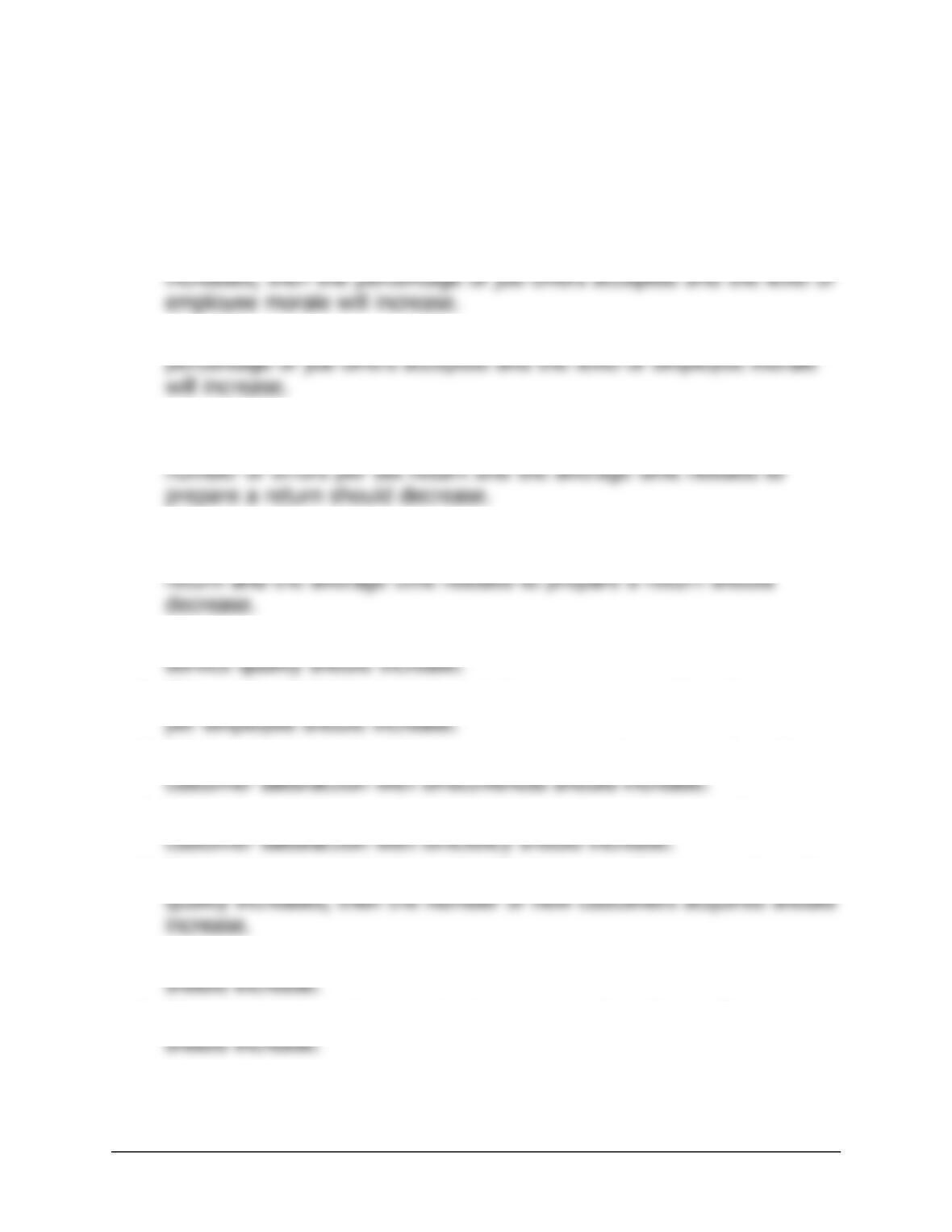
1. Students’ answers may differ in some details from this solution.
–
Revenue per employee Sales
Profit margin
Financial
Average number of
errors per tax return
Percentage of job
offers accepted
Employee morale
Customer
Internal Business
Processes
Learning
And Growth
++
–
Number of new
customers acquired
+
+ +
+
© The McGraw-Hill Companies, Inc., 2018. All rights reserved.
Solutions Manual, Chapter 11 19
Exercise 11-7 (continued)
2. The hypotheses underlying the balanced scorecard are indicated by the
arrows in the diagram. Reading from the bottom of the balanced
scorecard, the hypotheses are:
° If the amount of compensation paid above the industry average
° If the average number of years to be promoted decreases, then the
° If the percentage of job offers accepted increases, then the ratio of
billable hours to total hours should increase while the average
° If employee morale increases, then the ratio of billable hours to total
hours should increase while the average number of errors per tax
° If employee morale increases, then the customer satisfaction with
° If the ratio of billable hours to total hours increases, then the revenue
° If the average number of errors per tax return decreases, then the
° If the average time needed to prepare a return decreases, then the
° If the customer satisfaction with effectiveness, efficiency, and service
° If the number of new customers acquired increases, then sales
° If revenue per employee and sales increase, then the profit margin
© The McGraw-Hill Companies, Inc., 2018. All rights reserved.
20 Managerial Accounting, 16th Edition
Exercise 11-7 (continued)
Each of these hypotheses can be questioned. For example, Ariel’s
customers may define effectiveness as minimizing their tax liability
which is not necessarily the same as minimizing the number of errors in
a tax return. If some of Ariel’s customers became aware that Ariel
overlooked legal tax minimizing opportunities, it is likely that the
“customer satisfaction with effectiveness” measure would decline. This
3. The performance measure “total dollar amount of tax refunds
generated” would motivate Ariel’s employees to aggressively search for
tax minimization opportunities for its clients. However, employees may
be too aggressive and recommend questionable or illegal tax practices
However, if Ariel wanted to create a scorecard measure to capture this
aspect of its client service responsibilities, it may make sense to focus