
© The McGraw-Hill Companies, Inc., 2018. All rights reserved.
Solutions Manual, Appendix 10B 81
Exercise 10B-3 (continued)
4. The Work in Process will increase by $388,800 computed as follows:
5. The Finished Goods will increase by $903,960 computed as follows:
© The McGraw-Hill Companies, Inc., 2018. All rights reserved.
82 Managerial Accounting, 16th Edition
Exercise 10B-4 (30 minutes)
1a. The Raw Materials will increase by $720,000 computed as follows:
1b. The Cash will decrease by $660,000 computed as follows:
1c. The materials price variance is computed as follows:
Materials price variance = AQ(AP – SP)
2a. The Raw Materials will decrease by $720,000 computed as follows:
2b. The Work in Process will increase by $672,000 computed as follows:
Standard quantity allowed (28,000 units
2c. The materials quantity variance is computed as follows:
Materials quantity variance = SP (AQ – SQ)
3a. The Work in Process will increase by $630,000 computed as follows:
Standard hours allowed (28,000 units
© The McGraw-Hill Companies, Inc., 2018. All rights reserved.
Solutions Manual, Appendix 10B 83
Exercise 10B-4 (continued)
3b. The Cash decrease by $600,000 computed as follows:
3c. The labor rate variance is zero because the actual rate (see
requirement 3b) and the standard rate are both $15.00 per hour. The
labor efficiency variance is computed as follows:
4a. The Work in Process will increase by $1,680,000 computed as follows:
Standard hours allowed (28,000 units
4b. The fixed overhead budget and volume variances are computed as
follows:
Budget variance = Actual fixed overhead – Budgeted fixed overhead
Volume variance = Budgeted fixed overhead – Fixed overhead applied
5. The Finished Goods will increase by $2,982,000 computed as follows:
© The McGraw-Hill Companies, Inc., 2018. All rights reserved.
84 Managerial Accounting, 16th Edition
Problem 10B-5 (60 minutes)
1. The manufacturing cost variances are computed as follows:
Materials price variance = AQ(AP – SP)
*95,000 units × 2 pounds per unit = 190,000 pounds
Labor rate variance = AH(AR – SR)
Budget variance = Actual fixed overhead – Budgeted fixed overhead
Budget variance = $2,740,000 – $2,880,000 = $140,000 F
© The McGraw-Hill Companies, Inc., 2018. All rights reserved.
Solutions Manual, Appendix 10B 85
Problem 10B-5 (continued)
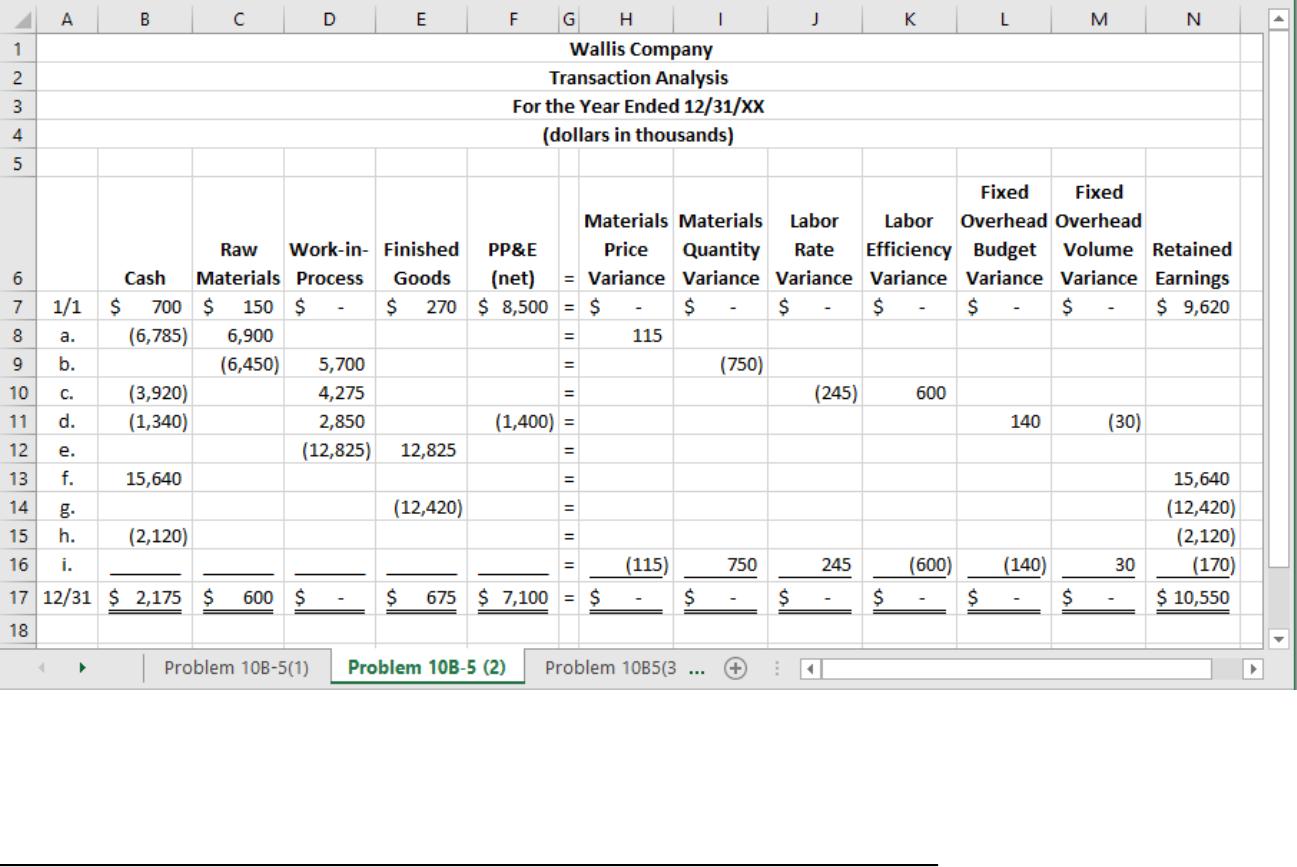
2 and 3: The transactions (including the ending balances) are recorded as follows:
© The McGraw-Hill Companies, Inc., 2018. All rights reserved.
86 Managerial Accounting, 16th Edition
Problem 10B-5 (continued)
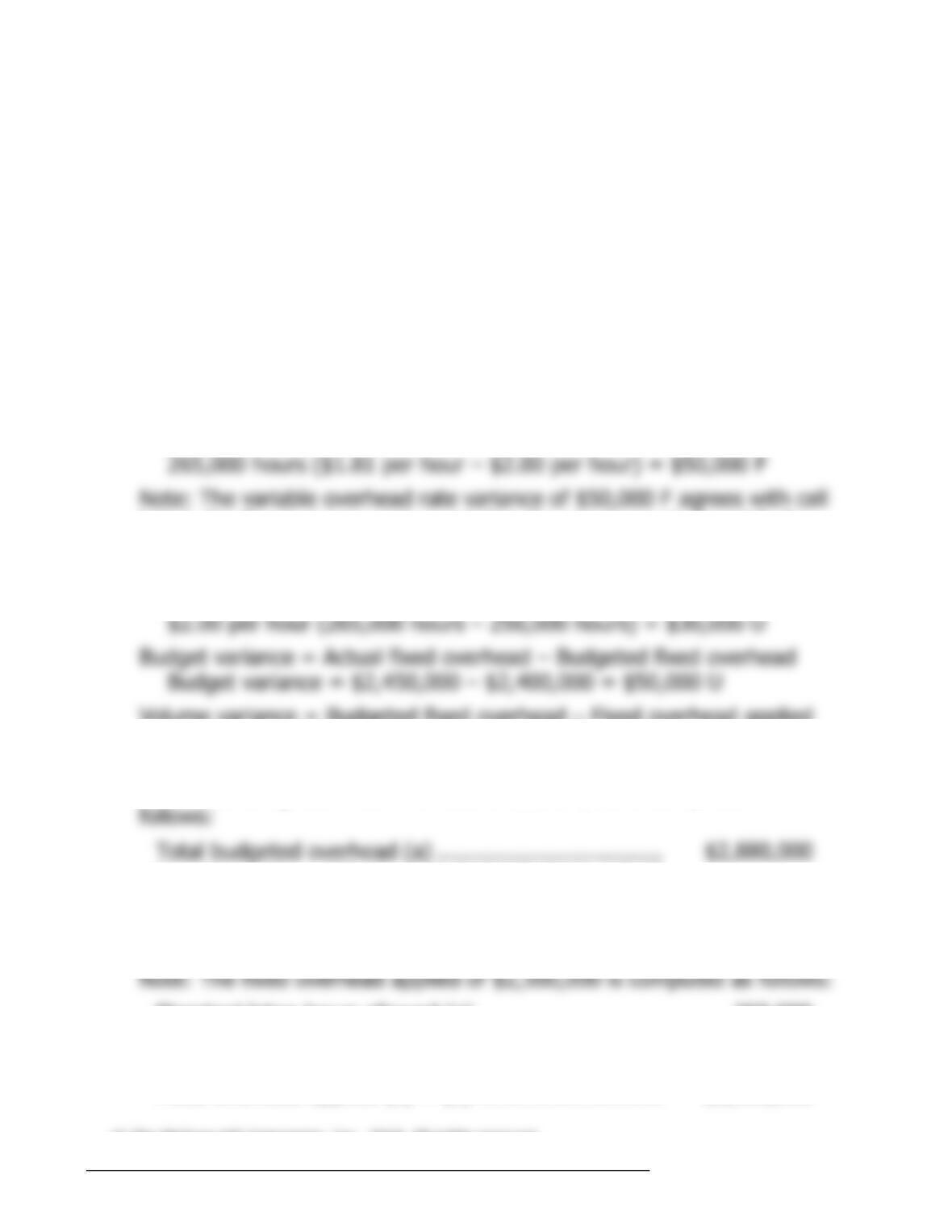
4. The income statement is computed as follows:
© The McGraw-Hill Companies, Inc., 2018. All rights reserved.
Solutions Manual, Appendix 10B 87
Problem 10B-6 (60 minutes)
1. The manufacturing cost variances are computed as follows:
Materials price variance = AQ(AP – SP)
Labor rate variance = AH(AR – SR)
265,000 hours ($15.00 per hour – $16.00 per hour) = $265,000 F
Labor efficiency variance = SR(AH – SH)
$16.00 per hour (265,000 hours – 250,000 hours) = $240,000 U
Variable overhead efficiency variance = SR(AH – SH)
$2.00 per hour (265,000 hours – 250,000 hours) = $30,000 U
Budget variance = Actual fixed overhead – Budgeted fixed overhead
Note: The budgeted fixed overhead of $2,400,000 is computed as
follows:
T
otal bud
g
eted overhead (a) ……………………………. $2,880,000
V
ariable portion of the bud
g
et (240,000 DLH ×$2.00
T
g
–
Note: The fixed overhead applied of $2,500,000 is computed as follows:
Standard labor-hours allowed (a) ………………………. 250,000
Fixed portion of the predetermined overhead rate
© The McGraw-Hill Companies, Inc., 2018. All rights reserved.
88 Managerial Accounting, 16th Edition
Problem 10B-6 (continued)
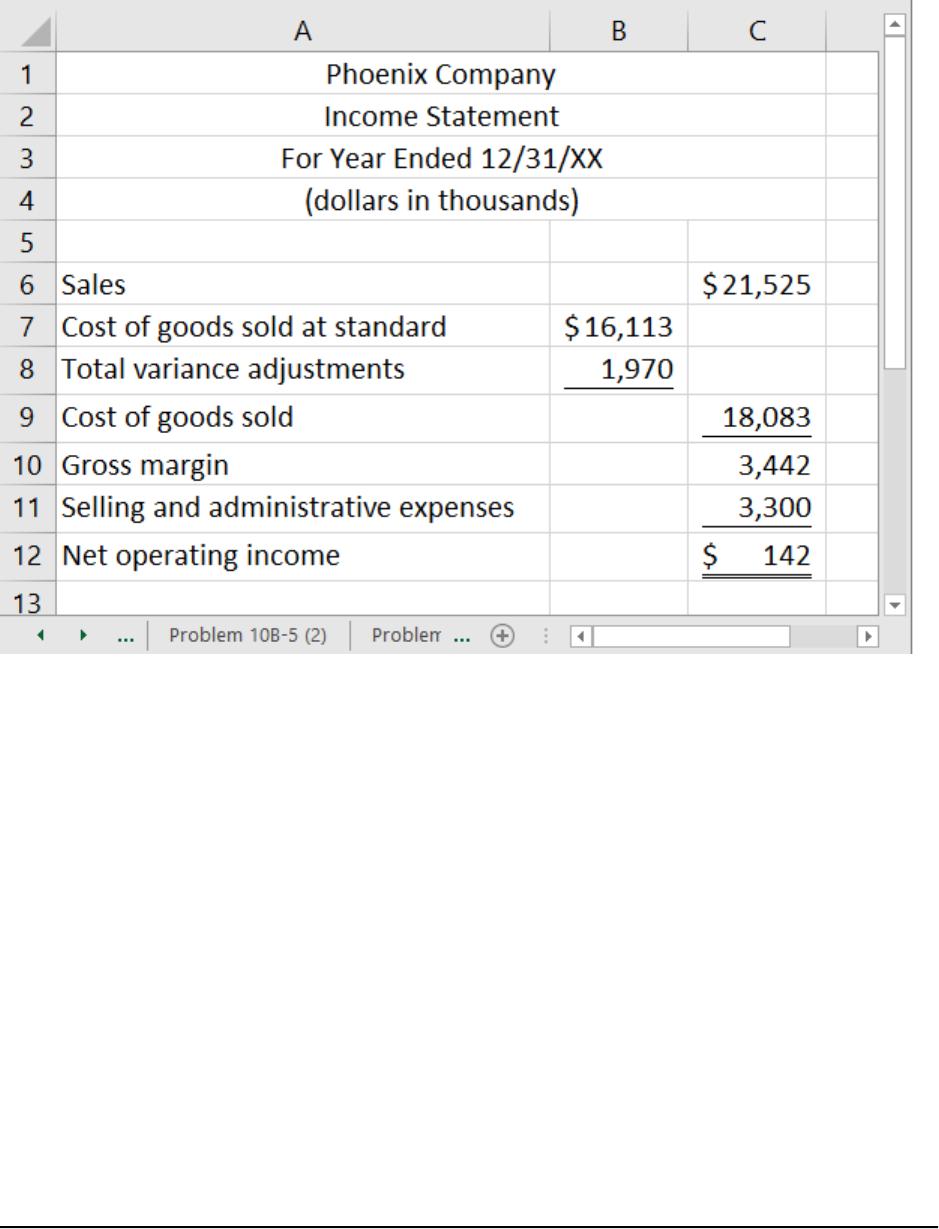
2 and 3. The transactions (including the ending balances) are recorded as follows:
© The McGraw-Hill Companies, Inc., 2018. All rights reserved.
Solutions Manual, Appendix 10B 89
Problem 10B-6 (continued)
4. The income statement is computed as follows: